Advertisement
Home Blog Page 748

MEC Resumes Hosting In-Person Events to Sold-Out Crowds After Pandemic Shutdowns: Interview

Photo: Milen Kootnikof / MEC

After a two-year break, MEC (Mountain Equipment Company) is re-establishing itself as a hub for the outdoor community – part of its mission to inspire people to explore the outdoors.

Michele Guimond

Recently, it hosted legendary climber and Edelrid ambassador Tommy Caldwell who spoke to climbing enthusiasts at the MEC flagship store in Vancouver.

The new flagship Vancouver store opened at the start of the pandemic and is home to several unique elements, like a bouldering wall and the ability to host upwards of 200 people for larger events in the community. Later this year, MEC is re-launching its clinics and workshops led by expert staff.

Michele Guimond, VP Marketing at MEC, said the recent 240-ticket event with Caldwell sold out in under 24 hours, which suggests the retailer is on the right track.

Tommy Caldwell event. photo: Milen Kootnikoff / MEC
Tommy Caldwell event, photo: Milen Kootnikoff / MEC

“It was absolutely phenomenal. That store was finished in March 2020. It’s a beautiful space to have and designed with community events in mind. Very set up for it and it felt pretty sad that we haven’t been able to do it,” said Guimond. “It sold out in like 12 hours. We had to add more tickets and they sold out in a couple of hours.

“Tommy has the ability to draw a crowd and the vibe was super, super high. It just felt so amazing. It’s so core to the brand. I think the audience was really a great mix of new consumers, young climbers. Really kind of full circle, full generation, and Tommy is just the most phenomenal speaker.”

Guimond said the event was really leaning into the company’s pillars.

On its website MEC says: “We aspire to be the most viable, vibrant outdoor retail business in Canada. We want to bring about a future where Canadians of all ages, and especially our youth, play outdoors in self-propelled ways more often and in ever-increasing numbers; have access to a comprehensive, carefully nurtured network of parks, wilderness, and outdoor recreation areas; and have a connection to nature that is stronger than ever. We want MEC and our members to set examples that inspire other organizations and individuals towards environmental, social, and economic sustainability. In short, we want to leave the world better than we found it.”

Tommy Caldwell event, photo: Milen Kootnikoff / MEC
Edelrid Climb experience, photo: Milen Kootnikoff / MEC

Guimond said there’s been a big move online by shoppers and retailers in the last few years and that’s been at a time when stores were not able to hold events such as the Caldwell one.

“I think we took them a little bit for granted prior to the pandemic but I think we see this macro level move of people wanting to come back to the stores and there’s this connection that happens through community. MEC has been grounded in our staff expertise. When you combine this in a physical space I think it really draws a deep connection to the brand, it amplifies community,” she said.

“It also allows us to amplify our platforms around sustainability and outdoor impact.”

Prior to the most recent event, MEC also held another event in early March for International Women’s Day.

The retailer, which began in 1971, currently has 22 stores in Canada. The last store opening was the Vancouver one.

Giumond said there are no plans to open any new stores this year.

“I think coming out of the pandemic what we really want to focus on is we just came through a rebrand and we really want to focus on stability in the business, we really want to focus on our staff, we really want to focus on our existing retail footprint and really elevating our experience within that,” she said.

“Really going back to our foundations before we think about expansion. We really want to stabilize the business and be really heavily focused on that.”

Climb with Tommy event, photo: Milen Kootnikoff / MEC
Empowerment Fest, photo: Milen Kootnikoff / MEC

For the first three years, MEC was run solely by volunteers. There were no paid employees until the business could support a store with regular hours and gear on the shelves. These early stores weren’t so much places to buy stuff as they were places to hang out, plan trips, get advice, and talk about gear, says the company.

In 1971 MEC was formally incorporated on August 2, with six members, and about $65 of operating capital.

In 1985, it opened a store in Toronto and in 1986 it reached 140,000 members.

By 1990, membership reached 250,000 and 330,000 in 1991 (its 20-year anniversary) with $36.5 million in annual sales.

In 1997 MEC reached one million members and at the end of the year, it launched mec.ca, a small online brochure of backcountry information. By 2004, membership had grown to two million and three million by 2009.

As it turned 40 in 2011, annual sales reached $261 million. By 2013, membership topped four million people and five million in 2017.

Prior to the pandemic, the retailer faced some serious financial challenges and in October 2021 it rebranded to return the mountain peak design to its logo while renewing a focus on its core values.

Drone Delivery for Retailers in Canadian Cities Closer than Ever with Expanded Testing Initiatives: Interview

Photo: Rand.org

Drones have moved a step closer to scaling in Canadian cities with their deployment expected to be used more and more by retailers in the coming years.

AirMatrix, an innovative software company based in Toronto, has undertaken a new project to accelerate research and development of its platform to inform communications standards for commercial drone operations.

The company, which started in 2018, is deploying its platform in Calgary and Waterloo.

“We’re ecstatic to be expanding in Waterloo and now deploying in Calgary. This is our first municipal deployment in Western Canada, having it in this city speaks to the sincere efforts taking place to increase the amount of innovative job opportunities, Alberta’s increased focus on clean energy options, and efforts to increase lifestyle benefits to residents; this is a step in the right direction,” said Bashir Khan, CEO, AirMatrix. “Long term, we see this as a revenue generating economic engine for cities.”

Khan said it’s the only platform of its kind globally as it builds millimeter-precise skyways in urban and suburban airspace, allowing cities around the world to scale commercial drone operations. By providing traffic management capabilities through the traffic manager dashboard, the operator platform grants accurate conflict-free, 3D routes in real-time to enterprise drones incorporating beyond visual line of sight operations. The sophistication of the AirMatrix software with its safe, reliable, and dynamic monitoring capabilities, is enabling new industry applications for drones to emerge and scale as the industry evolves, he said.

“We geo-reference all of that data and stitch it together in a way that’s compatible with any auto-pilot in the world,” said Khan, adding that any drone can connect to its system and get access to skyways.

“In 2022, drones are a step closer to becoming part of our day-to-day lives. Whether for having packages delivered to doorsteps and backyards, inspecting roofs, assessing infrastructure, monitoring construction sites, or for emergency services: drone use cases and commercial solutions have begun scaling worldwide. The challenges around regulations and technologies for flying in congested urban airspace, backyards, and over city streets have been developing quietly over the last few years.”

Khan said the company received funding from the National Research Council of Canada to deploy commercial drones within Waterloo and Calgary. The dashboard has been sold to those municipalities so they can start to get an understanding of how they should start planning for the future in terms of drones, infrastructure and urban planning.

“On data as a service, we’re moving towards a lot more commercialization pretty rapidly. So if you think about utilities inspections, inspecting cell towers, gas and oil pipelines, real estate, things where you want to capture aerial data above those are here today and up and running and scaling,” he said.

“But what’s actually happening now is there are new regulations coming into place which are going to allow operators to fly beyond what’s called visual line of sight. Right now, when you want to fly a drone commercially it’s not scalable because you have to watch the drone as it’s operating. We’re now moving to a place where from my office here I can launch five, six drones and be able to command them all from here and now the unit economics have gotten way better.

Photo: Shutterstock/licensed

“Now we’re in that shift towards beyond visualized sight but we couldn’t have done that without the mapping we’ve done and the data we’ve collected to allow for that flight planning to take place ahead of time.

“On the delivery of packages, more consumer facing stuff, it depends on where you are really because drone deliveries are taking off. They’ve already started scaling in different parts of the world, in Australia and the US, delivery is about a year and a half to two years away from a person being able to order something from their phone and have it delivered to your home.”

Khan said more retailers will be adopting the technology in the near future. Already, Amazon has spent a lot of money looking at this from an ecommerce initiative.

“The natural next step is logistics and fulfillment. When you think of digitizing of fulfillment and last mile delivery, drones are a huge part of that picture,” he said.

“That’s the future. Cars take up a lot of space on the road and have a lot of emissions with them.”

AirMatrix maps and provides digital infrastructure for drones to safely navigate urban airspace.

“The use of new technology within urban environments is rarely without hiccups. While some larger drones look closer to flying cars, they can be viewed as flying mobile devices, which naturally encounter unique challenges. Cities want to mitigate the risk of drones crashing into buildings due to imprecise GPS data, faulty LTE/5G connection or an unclear understanding of connectivity requirements for drones to safely operate in complex airspace from a telecommunications standpoint. Canadians can expect to see more drones in the sky in the coming years. AirMatrix has accelerated its ability to map cities, terrestrially and aerially mapping 100 cities globally over the next year to build skyways that enable advanced aerial mobility, including drones and EVTOL (Electric Vertical Take Off & Landing) aircraft,” explained Khan.

Beginning in May, as part of The City of Calgary’s Living Labs program, participating drone pilots will begin utilizing the AirMatrix software platform inside an allocated zone within city boundaries to begin logistics and public services drone operations testing.

The deployment will ramp up over the course of 18 months, with the goal of building a live drone ecosystem in Calgary.

“As a smart city that embraces fresh ideas and experimentation, The City of Calgary is excited to support innovations in the drone space and is looking forward to supporting AirMatrix’s work to enable safe and efficient drone operations in Calgary while respecting citizen privacy,” said Monique Nesset, Smart Cities Program Manager, City of Calgary.

“This region has a growing aerospace industry as well as an amazing history in communications, so it’s great to see innovative companies like AirMatrix commercializing technology built in Waterloo, scaling across Canada and Internationally,” said Rod Regier, the Commissioner of planning for the Region of Waterloo.

Foot Locker Expands Power Store Concept in Canada with 1st Suburban Location: Interview/Photos

Photo: Xandrae Ramdeem

The new Foot Locker Power Store has opened in Markham north of Toronto, and the location is emphasizing the importance of not just selling, but community engagement. The newly opened store is focusing on listening to what consumers need to improve their shopping experience and to be more involved within the Markham community.  

“Markham will be the first one where we will really be entrenched into the community versus a high tourist area, so it is really exciting for us,” says Johnathan Robillard, the VP for North GEO at Foot Locker.

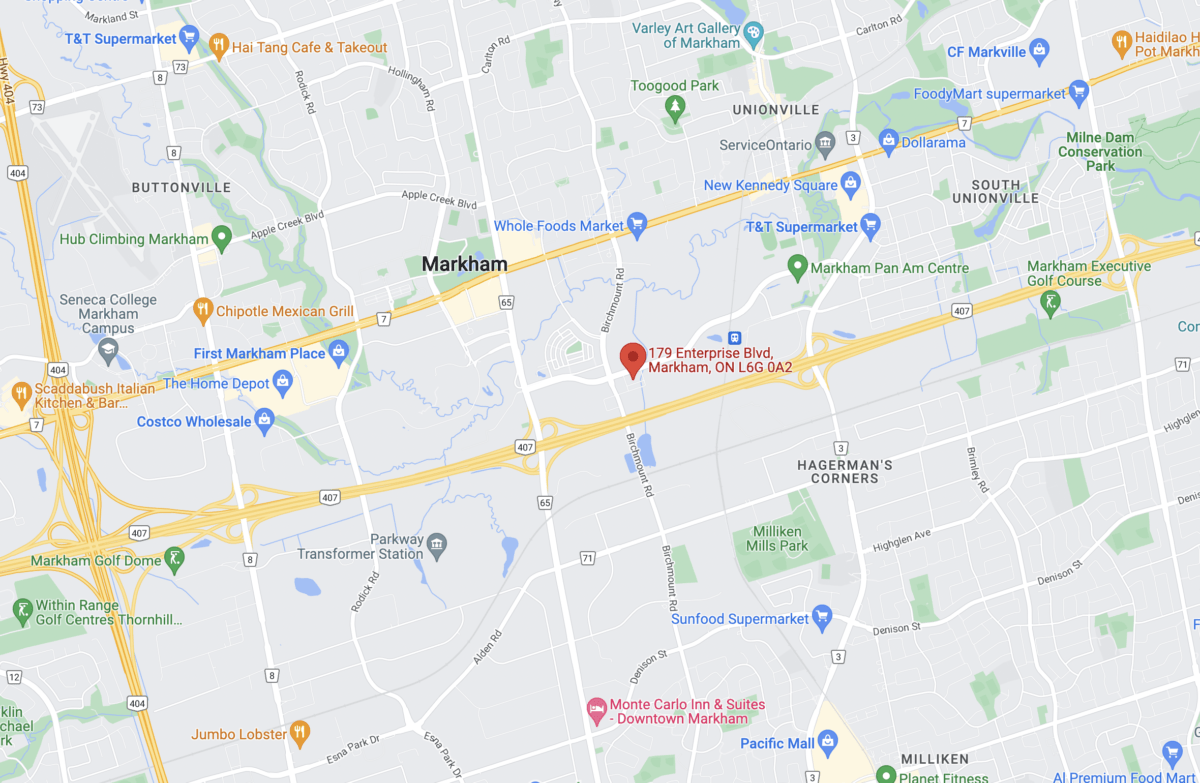
The Power Store is located at 179 Enterprise Boulevard in Markham where it will is the third store of its kind to open in Canada.  The other two Power Stores are in Toronto and Vancouver. The location of Markham was based on the growing community.

Click image for interactive Google Map
Photo: Xandrae Ramdeem

“Markham is one of the fastest growing communities just outside of Toronto and where our store is located is on the tip of three different towns coming together so when we looked at that, we really thought about where our consumer was going.  So that is definitely why we have targeted this area,” says Robillard.

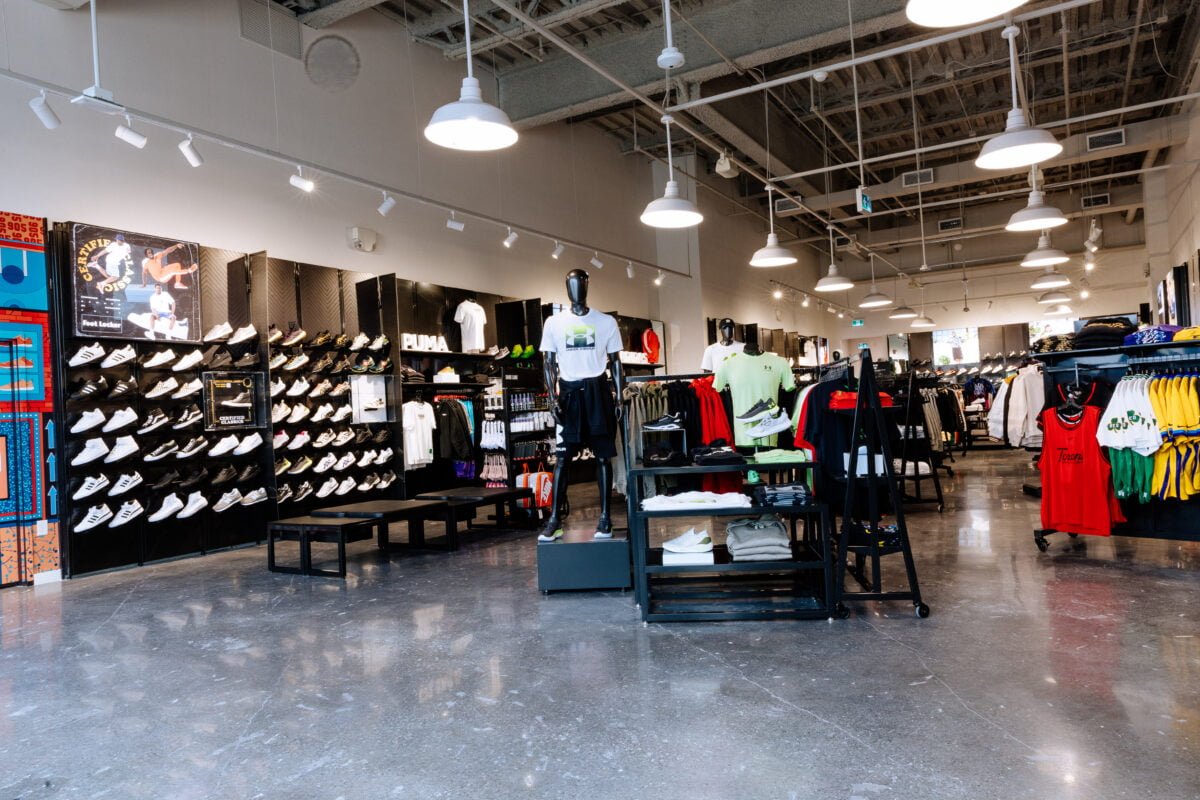
The Markham store will create a new shopping experience for customers as it has 5,560 square feet of retail space, a Call ‘N Collect window, and a digital screen for customers to view the store’s menu and to provide community updates.

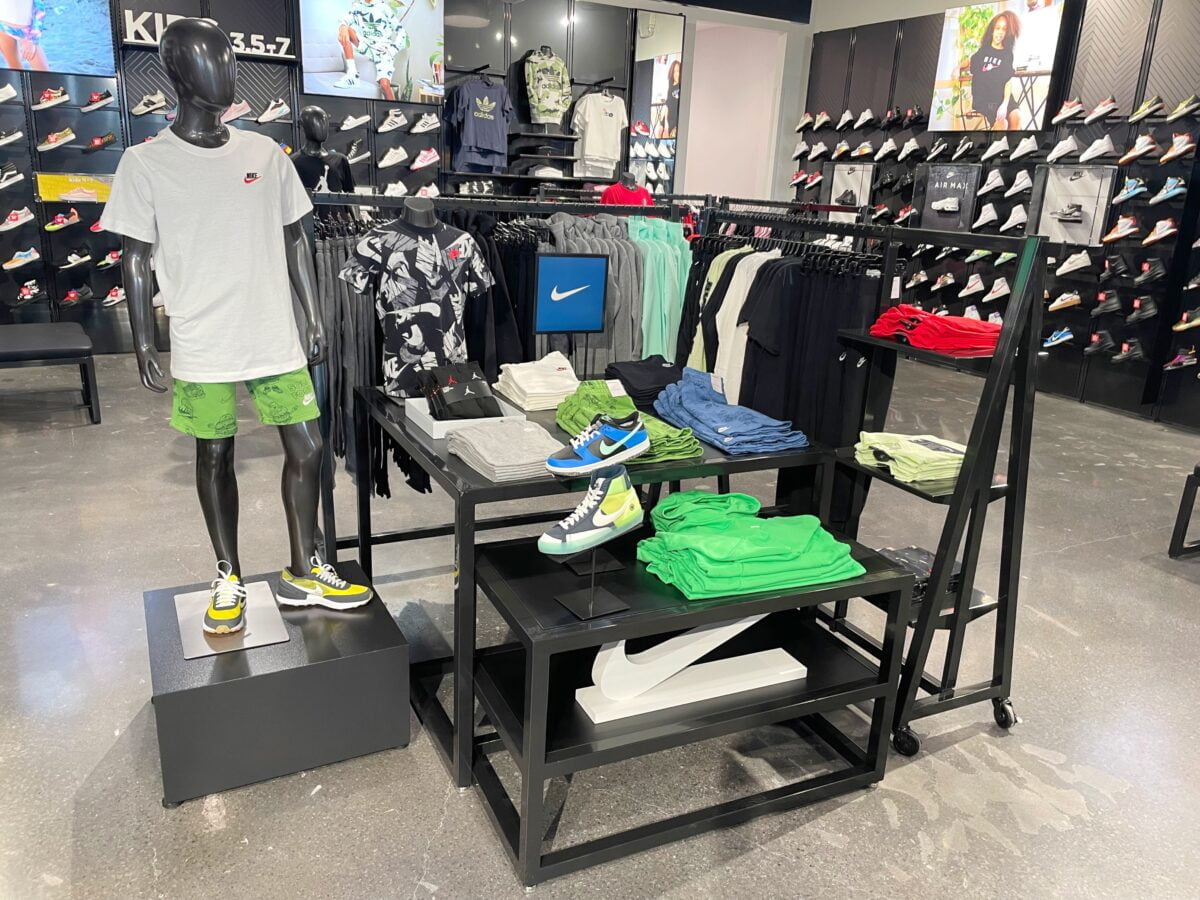
“The nice part of when we do a power store is we get to choose the best of everything we offer,” says Robillard. “So, this store will have offerings for Men, Women, and children which sometimes you don’t see in every Footlocker. Here you are going to have everything.”

Photo: Xandrae Ramdeem

NEW TECHNOLOGY

Call ‘N Collect Window

The Call ‘N Collect Window will be a way for customers to easily access items they would like to purchase without having to go in the store.

“If we were both standing at the store, you would see so many other unique foods, restaurants, drinks that are there, and we really took inspiration from the drive through window,” says Robillard. “The customer could be outside waiting for an item, or they can just come up to the window and ask for the items they are looking for and pay contactless.”

Customers can call ahead their order, pay, and talk to an associate if they have any questions regarding an item.

Digital Screen

Available by the second week in May, the digital screen will allow customers to see the menu of the store, information such as hours, social media campaigns, vendor campaigns, and the screen will also show community events.

“It is not just about the sales,” says Robillard. “We will make it specific to the community. Maybe it is an update on the baseball team or the local soccer team and how they are doing. It shows a way where we can highlight what is happening. It will definitely be a way where the consumer can purchase, but also a way for us to engage with the community.”

Other new additions will be to provide free Wi-Fi to associates and customers and a mobile pay option for customers so they can avoid the cashier lineup.

Photo: Xandrae Ramdeem

Local Brands and Artists

The new Power Store also includes local brands and artists. One of their local brands is Crane Apparel, a business based in Markham. The store is now carrying Crane Apparel’s Spring collection as well as its basketball collection.

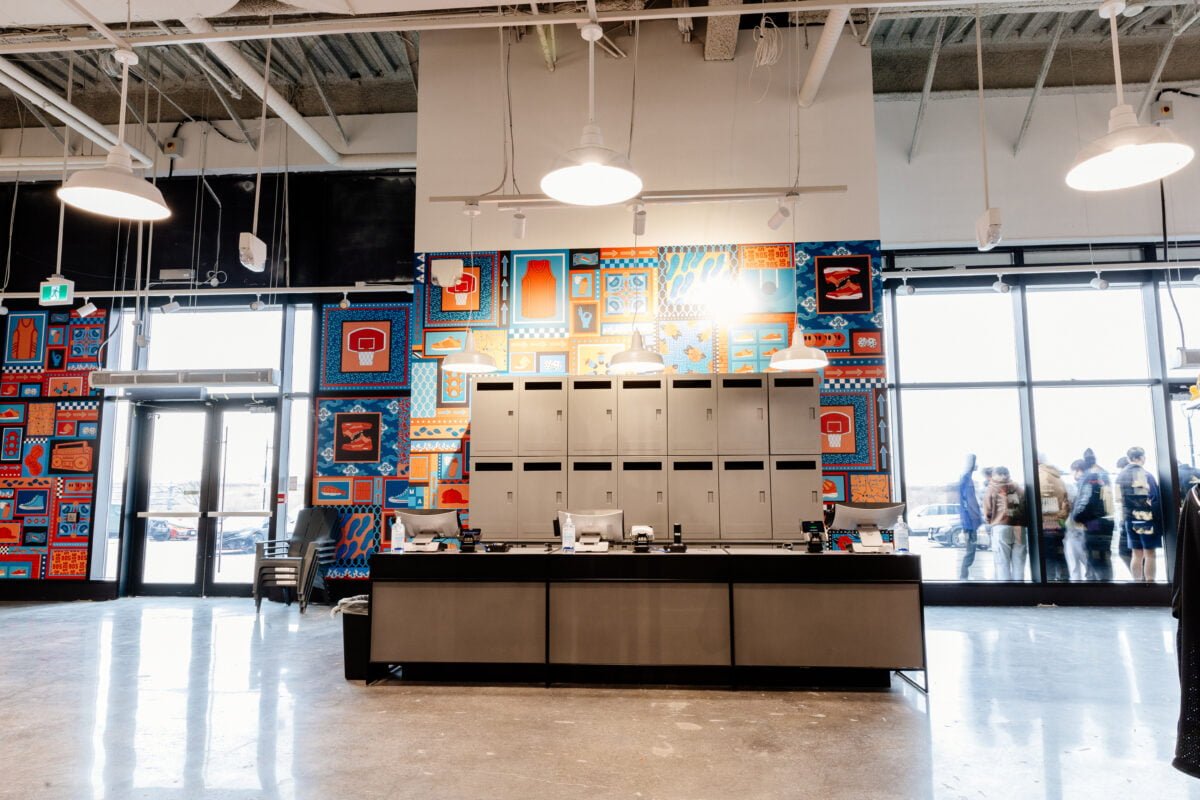
The Power Store will also be representing the Markham community with art.

“This is something we are trying to do throughout the country. Montreal is going to feel different than Toronto, and Toronto is going to feel different than Vancouver. We are trying to not only represent the artists that are there locally, but also what the consumers who are there are looking for,” says Robillard.

The art will be consisting of themes of Markham: the heritage, uniqueness, the greenery, sports, and will even have artwork that will pay tribute to Markham roads and highways.

During the opening weekend, Foot Locker had exciting events including music, face painting, food trucks, a local basketball team visit, and they will have someone explaining to customers about the Power Store and the new technologies available.

Covid-19 has made it aware what people want. “Covid highlighted that the consumer does want to interact, and we saw that here in Canada,” says Robillard. “Everyone has the option to shop online, but there is still that desire to connect and be together in a common place.” The Power Store in Markham will do exactly this, it will be a place for customers to easily shop the way they want to while keeping in touch with the Markham community.

Podcast [Interview] Nathanael Hausmann Discusses Swiss Chocolate Retailer Läderach’s Ongoing Canadian Store Expansion

Craig interviews Nathanael Hausmann, North American president of Swiss chocolate brand Läderach, which expanded into Canada shortly before the pandemic. The chocolate retailer is now expanding aggressively in North America and will be opening more locations in Canada.

The Interview Series podcast by Retail Insider Canada is available on Apple Podcasts, Stitcher, TuneIn, Google Play, or through our dedicated RSS feed for Overcast and other podcast players. Also check out our The Weekly podcast where Craig and Lee discuss popular content published on Retail Insider which is part of the The Retail Insider Podcast Network.

Interviewed this episode:

Subscribe, Rate, and Review our Retail Insider Podcast!

Follow Craig:

Follow Retail Insider:

Listen & Subscribe:

Share your thoughts!

Drop us a line at Craig@Retail-Insider.com. You can also rate us in Apple Podcasts or recommend us in Overcast to help more people discover the show!

Background Music Credit: Hard Boiled Kevin MacLeod (incompetech.com). Licensed under Creative Commons: By Attribution 3.0 License. http://creativecommons.org/licenses/by/3.0/

Canadian Mattress Brand ‘Dozy’ Opens Standalone Storefront on Toronto’s Queen Street: Interview/Photos

New store on Queen Street West in Toronto. Image supplied.

Toronto-based mattress brand Dozy has moved into a new brick and mortar location on Queen Street West, as it continues to build on its success which started five years ago.

David Owen, Owner and President of Dozy, said that having mattresses made and sold in Toronto gives the retailer room to offer a great price to consumers.

The company combines tradition with innovation with direct shipping to the consumer that skips the middle-man and passes savings along to the customer.

“We make them in North York and we ship them direct right out of the factory. The mattress business has been in the family for four generations,” said Owen, adding the business started in Peterborough, Ontario with his grandfather, who also was behind the Kingsdown mattress brand.

“I started Dozy in 2017, after having worked for my family’s mattress shop in Mississauga. While helping run the family business, I did all manner of work. Started out on the delivery truck and eventually worked my way up to the sales floor. I learned many things about the industry and noticed that the way customers were buying mattresses was changing fast. People on the hunt for a mattress were gravitating to more straightforward online shopping, and I knew that that was the route to take. A clearer, honest and upfront approach was needed.

“While the older generations of my family were getting out of the mattress business, I thought there was an opportunity to get back in and do things better. After getting in touch with a local manufacturer, I started Dozy out of a small showroom in North York.”

Click image for interactive Google Map

The new 290A Queen Street West location is in the hub of retail in downtown Toronto.

“It was also kind of really hard to access that but because of the pandemic it really loosened things up. I found the store about six months ago. But I was always operating around the core. I was operating around the corner on Spadina, which was another big staple street.”

The Queen Street store is 1,500 square feet.

Competing successfully against some other sleep retailers, comes down to service, said Owen.

“We focus really hard on making sure that every client that ever walks through our doors gets taken care of in such a way where they would want to tell people about us, leave a five-star review on whatever platform that they prefer, and just kind of getting that name out there really through hard work and keeping them happy,” he said.

“It wasn’t too long ago where I was doing pretty much every delivery, pretty much selling every customer, so they would see me in the store and they would see me deliver it. That really contributed to people talking about us on the internet, talking about me specifically. People coming down.

“Since we make everything here in Toronto, I work with customers all the time, customizing beds. Making it firmer, making it softer. When I tell this to people who have gone through 10, 15 online companies, which happens all the time, people love it. With my rating, I don’t let people down really. That helps a lot because once I’ve captured the sale I don’t really give you up. I really work with my customers to keep them very happy. Once they go through that process, it’s always good reviews and happy news to their friends.”

US-based Competitor Casper also has a storefront nearby at 342 Queen Street West which opened in 2018.

Video Interview: PJ L’Heureux, Founder of CRAFT Beer Market, Discusses Launch of New Restaurant/Bar Concept in Calgary

PJ L’Heureux, Founder of CRAFT Beer Market and Central Taps + Food, discusses the launch of a new restaurant/bar concept in Calgary.

L’Heureux talks about the growth plans for the new restaurant/bar as well as CRAFT, lessons learned during the pandemic, the challenges the hospitality industry has faced, and the current labour shortage.

The Video Interview Series by Retail Insider is available on YouTube.

Connect with Mario Toneguzzi, a veteran of the media industry for more than 40 years and named in 2021 a Top Ten Business Journalist in the world and the only Canadian – to learn how you can tell your story, share your message and amplify it to a wide audience. He is Senior National Business Journalist with Retail Insider and owner of Mario Toneguzzi Communications Inc. and can be reached at mdtoneguzzi@gmail.com.

Interviewed this episode:

Like, Share and Subscribe to Mario Toneguzzi on YouTube!

Follow Mario:

Also check out the other series offered by Retail Insider, including The Weekly podcast and The Interview Series, which are both available on Apple Podcasts, Stitcher, TuneIn, Google Podcasts, or through our dedicated RSS feed for Simplecast and other podcast players.

Follow Retail Insider:

Share your thoughts!

Ups and Downs in Canadian Retail Sales into Spring 2022: Strapagiel

Arc'teryx in Westmount, Montreal
Arc'teryx Arc’type Concept Store in Westmount, Montreal (Photo: Arc'teryx)

By Ed Strapagiel

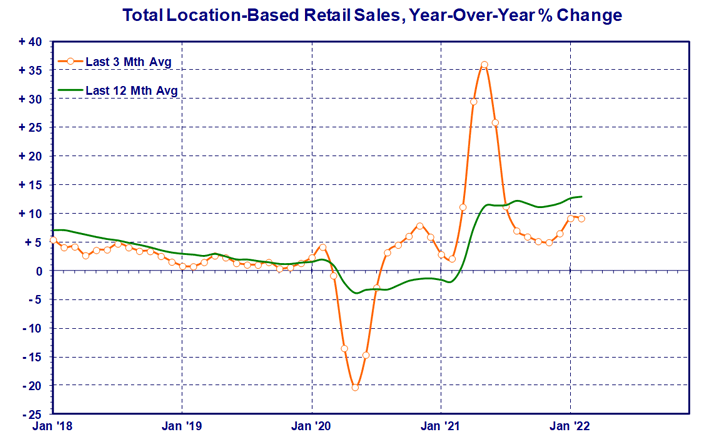
According to the latest numbers from Statistics Canada, Canadian retail sales were up 9.1% year-over-year for the 3 months ending February 2022. By historical standards, this is certainly a healthy gain. On the other hand, this is an overall average across all retail sectors, and does not well reflect what’s going on in any particular retail area. The differences are somewhat extreme, ranging from a decline of 16.3% for E-Commerce to a gain of 23.8% in Automotive & Related for the period.

Another matter is that the retail sales total is significantly influenced by the price of gas. Gasoline station sales were up 30.5% year-over-year for the 3 months ending February. Excluding gas stations, overall retail sales would be up 7.2% instead of 9.1%. This is a direct example of how inflation boosts retail sales but just makes consumers poorer.

Food & Drug

For the 3 months ending February 2022, retail sales in the Food & Drug sector declined 1.3% year-over-year, perhaps in part because year ago sales were particularly strong. The underlying 12 month growth trend (green line in the chart) however has been steadily declining over the last year. Food & Drug is normally a fairly steady business and growth declines are unusual, especially in times of high inflation.

Supermarkets & other grocery stores account for a little over half the retail sales in this sector, but their sales were off 3.1% for the 3 months ending February 2022. Convenience stores however fared even worse, with sales down 6.2% during the period.

Health & personal care stores (mostly drug stores and pharmacies) made solid gains and tended to buoy up sector sales last year. For the 3 months ending February 2022 however, their sales were up a scant 0.7%.

Store Merchandise

While Food & Drug is down in the dumps, the Store Merchandise sector appears to be up on cloud 9. Their retail sales grew by 12.7% year-over-year for the 3 months ending February 2022. The underlying 12 month trend gained 14.1%, a record high. Year ago sales growth however was depressed due to COVID, which likely contributed to making current results look good. By the same token, Q2 2022 gains may not be as robust because of strong sales in the same period in 2021.

Clothing & clothing accessories is the runaway best seller in retail, with sales up a sizzling 39.8% year-over-year for the 3 months ending February 2022. General merchandise, furniture & home furnishings stores, and the other stores group also clocked in with double digit gains for the period.

Electronics & appliance stores however remained the poor cousin of the sector, with a sales decline of 0.7%.

Automotive & Related

The Automotive & Related sector continued to have strong gains, with an increase of 16.4% year-over-year for the 3 months ending February 2022. The underling 12 month trend also improved to a gain of 23.8%.

The main driver here is gasoline station sales, which were up 30.5% year-over year over the last 3 months. This of course is almost entirely a result of pump price increases. When you pay more for gas however, you don’t get more for your money, but you do have less money for everything else.

Sales at automobile dealers were up by 11.1% during the period, somewhat due to slow performance a year ago. But sales growth took off in Q2 last year, so it’s difficult to expect a repeat performance coming up this year.

By The Numbers

Note that the data and analysis in this report are always based on not seasonally adjusted (or unadjusted) retail sales statistics.

For definitions of store types, see Statistics Canada NAICS.


Canadian E-Commerce Sales

Canadian e-commerce retail sales nearly doubled in 2020 due to COVID. Things cooled off in 2021 but there still was a decent gain. Now, at start of 2022, a correction appears to be underway, with sales declining 16.3% year-over-year for the 3 months ending February 2022. It seems like consumers are going back to the store. The circumstances however are so unprecedented that it’s impossible to know what might happen next.

Overall, e-commerce represented about 6.2% of retail sales over the past 12 months, according to Statistics Canada, including both pure plays as well as bricks & clicks stores. Note that Canadian consumers may also buy online from foreign websites which is not captured in these numbers.

Location based retail is the same as that in the preceding “By The Numbers” table. It’s what’s normally reported as Canadian retail sales. Except that it isn’t. Location based retail excludes another section called Non-Store Retailers (NAICS code 454), which includes electronic shopping and mail-order houses, which in turn is where (mostly) pure play e-commerce businesses are. For the 12 months ending February 2022, electronic shopping and mail-order houses had an estimated $27.2 billion in e-commerce sales.

But that’s not the only source of e-commerce, as (mostly) bricks & mortar location-based retailers also sell online. This group had an estimated $17.6 billion in e-commerce sales during the period. With electronic shopping and mail-order houses, there’s a grand total of $44.8 billion in e-commerce sales by Canadian operators. Note that this does not include foreign e-commerce purchases made by Canadian consumers, but it does include e-commerce purchases made by foreigners at Canadian operations.

For electronic shopping and mail-order houses, an estimated 96.0% of their sales are currently allocated to e-commerce. For (mostly) bricks & mortar retailers, it can be estimated that 2.6% of their total sales are attributable to e-commerce.

In the final section of the above table, (mostly) pure play operators (namely, under electronic shopping and mail-order houses) generated an estimated 60.7% of all e-commerce sales in Canada, while (mostly) bricks & mortar location-based retailers’ share of e-commerce was 39.3%.

For more explanation on the e-commerce numbers, see Statistics Canada: Retail E-commerce in Canada.

Monthly Update Notification

This analysis is updated monthly as new numbers are published by Statistics Canada. If you would like notification from Linkedin of when an update becomes available (and you’ve read this far), please connect with Ed Strapagiel on LinkedIn.

Should the Canadian Government Step in to Reduce Food Prices? [Op-Ed]

Photo: Getty Images

By Michael von Massow, Associate Professor, Food Economics, University of Guelph

The rhetoric around inflation and increasing food prices has become a point of emphasis for politicians, particularly for those in opposition to the incumbent government.

Even pundits and non-profit organizations are pressuring the government into taking specific actions on food prices. This begs the question: Should governments take steps to reduce food prices? And more importantly — can they?

This is not to say that food inflation doesn’t matter. It has clear impacts on food security in North America and across the world. While some argue there is little that can be done, there are some steps the government can take.

Putting a limit on food prices

The most obvious step the government could take is regulating food prices using price ceilings. This is virtually unheard of in North America, but has happened elsewhere, most recently in Malaysia where the government has announced price control measures for key staples.

While this might initially seem like a good idea, price ceilings actually end up taking money out of the system. If that money isn’t replaced (i.e. through government subsidies), products either stop being produced or make their way to other, more profitable markets. Currently, the Canadian government can’t afford these kinds of subsidies because of the debt accumulated from COVID-19 relief.

There are some products, like dairy and poultry, that have domestic production controls. Farm prices are set based on a cost-of-production model, meaning farmers earn back the amount of money it costs to produce their products. If grocery prices were capped, retailers and processors would make less money and less dairy products would make it to store shelves.

Price ceilings are impractical for food. They are unlikely to achieve much and end up hitting farmers, processors and retailers the hardest. In the long run, they end up reducing access to products and stifling innovation and research investment.

Limiting food exports

In some countries, governments have chosen to limit exports — meaning goods must be sold domestically — as a way of reducing food prices. Argentina did this recently after wheat prices increased following Russia’s invasion of Ukraine. While this is good for domestic consumers, it puts the burden on farmers who could stop production in favour of selling unregulated products.

Export taxes can also be used in place of export controls. While these stabilize domestic prices, they end up hurting domestic producers, who get lower prices, and importing countries, who face higher prices.

Canada, as a significant exporter of food products, cannot afford to let its reputation as a trusted exporter be compromised. In addition, limiting or taxing exports would only have small impacts on domestic prices, but would negatively impact Canadian producers and export customers.

For countries that import food, like India, the reduction of import duties can also help to reduce domestic prices. Import duties are often used to protect domestic producers. For the most part, Canada does not have high tariffs on food products, with the exception of supply-managed products, so this approach is not broadly applicable.

Some U.S. states are considering waiving food taxes. In Canada, most retail food items are not taxed, so this is not an option, although a similar tax is being used in Alberta to reduce the cost of transportation. One critique of this approach is that it benefits those that spend the most, rather than those that need it most.

What can governments actually do?

Another option could be to deal with the root causes of the inflation. However, many of these factors — like drought and extreme weather eventsthe war in Ukraine and supply chain disruptions — are beyond the control of the Canadian government.

There has been discussions from CEOs and political parties about implementing a grocery code of conduct for regulating how large grocery companies interact with their suppliers. While a code might benefit grocers and their suppliers, it is unclear if it would actually lower food prices for consumers.

While there is not a lot that governments can do about food prices, policy makers can still provide broader economic relief. Those with the lowest incomes are feeling the pinch of inflation more than others — they are being squeezed not only by food price increases, but by rising rent and fuel prices.

Income support for those with lowest incomes would hep reduce the burden of rising costs of living. Broader tax relief could also take the pressure off for the middle class, but tax relief is less effective for low income earners that pay little tax. Targeted programs, like the school food programs announced in the 2022 federal budget, could also increase food access for vulnerable populations.

Politicians who criticize incumbent government for rising food prices should be challenged to provide real proposals that would differentiate them. This is not an easy fix and we shouldn’t be pretending it is.

This article is republished from The Conversation under a Creative Commons license. Read the original article.

Canadian Retail News From Around The Web For May 2nd, 2022

Canadian Retail News From Around The Web

News at a Glance

Retail Insider is streamlining its Canadian retail news from around the web to include a handful of top news stories that can be viewed quickly during the day. Here are the top stories from the past three days.