There aren’t too many brands in Canadian retailing history that have captured the hearts and minds of so many consumers, becoming part of the fabric of the country, in quite the same way Roots has. Establishing itself through the years by way of the comfort, quality and versatility of its product, the adored retailer has long since achieved iconic status and a leadership role within the industry. And although the company has always operated on the same principles and beliefs on which it was founded and built nearly 50 years ago, its perpetual innovation and evolution has allowed it to remain relevant and successful, consistently adapting to and anticipating market shifts and changes. Today, as the brand approaches ever closer to its golden anniversary, it continues to evolve, expanding the brand and the community around it, driven by the guidance and leadership of CEO Meghan Roach.
“The business really has gone through an evolution through the years,” says Roach. “A lot of the heritage and essence that helped lay the foundation of the business and the brand still very much remains, but we’ve evolved it. As opposed to being a brand that’s only about camp and Algonquin Park, it’s now more about being a brand that’s at home in nature. That can be represented by going for a walk outside, going for a hike, or something as simple as taking part in a Zoom call in our clothing with natural fibres. It’s about creating a brand and a product offering that helps customers feel comfortable in their own skin and clothing that can be worn in multiple different situations. As we move forward, where we’re going as a business is about developing a really strong community around the brand we have today, really focusing on our pillars of comfort, quality and versatility, and expanding the brand to be more about the communities and nature in which we live.”
Rise to leadership
As far as backgrounds go, particularly those of CEOs managing consumer retail companies, Roach’s is an interesting one. She spent much of her career within the private equity space, starting at KPMG before joining the Ontario Teacher’s Pension Plan and later Searchlight Capital Partners where she spent time in both Toronto and the UK. Despite the unorthodox nature of her course toward a leadership position at one of Canada’s biggest brands, however, the work that she was involved in on the investor side has served to be essential. Gaining experience working with consumer businesses, collaborating extensively with brands across the retail spectrum, Roach gained intimate insights into the inner workings of retail operations and the levers that drove success for the businesses she worked with. It’s experience that she recognizes as instrumental in preparing her for her current role at Roots.
“The biggest advantage that I’ve had within my career to this point is the fact that I’ve had the opportunity to work with management teams at many different brands,” she explains. “It afforded me the chance to really dive into working on things like strategy, execution and operational turnarounds. And, as a result, I got to see what worked and what didn’t. Because of the work that I’ve been responsible for, working with a number of different companies, I bring unique leadership skills to this amazing Roots team. I’ve seen a lot of different things in repetition and am able to draw on the diverse experiences that I’ve acquired throughout my career in order to help more accurately identify opportunities for further growth and success.”
Partnership and support
The rare perspective with which Roach approaches her job is paying dividends for Roots as the company continues to improve on the tremendous accomplishments it’s already realized. Her expertise and judgement are proving critical in helping to manage the brand toward the next chapter of its impressive story. However, when it comes to identifying the factors contributing most to the company’s sustained progression and growth, she directs much of the credit to the team around her. She considers the opportunity to lead Roots as its CEO as an “honour”, describing the Roots team as “talented and dedicated”. It’s a cooperative attitude and collaborative method that supports her manner of execution, and a care and value in the collective that fuels her philosophies as a leader.
“From my perspective, it’s really important to help people carve their own paths,” she says. “There’s no one way to do something. And, as a leader, your responsibility is to work with individuals to help them find their own way toward success and achievement. It’s also very difficult to be the sole decision-maker. And so, for companies to be successful today, they really have to partner with their staff, understanding their skillsets and helping them manifest those skills in order to realize the overall corporate objectives and goals. Helping people develop their own leadership capabilities is what it means to be a leader. And, particularly during times of adversity and challenge, a leader has got to set an example for the rest of the organization, understanding that there are going to be setbacks and failures and persevering through the challenges.”
Holistic understanding
Image: Roots
Roach also emphasizes the importance of making clear and concise decisions in supporting the organization’s direction and ensuring that all staff are aligned with the strategy, equipping them with the guidance and tools to execute. It’s an outlook on leadership that seems to be underpinned by a combination of compassion and a holistic appreciation of the role that she serves, her capabilities as well as her limitations. And it’s also one that she says was shaped by a number of different influences that she’s enjoyed throughout her life and career. However, she recalls being particularly moved by the ideologies of one of her female compatriots in business, former PepsiCo CEO, Indra Nooyi.
“At the time in my career when Nooyi had risen to the highest level at PepsiCo, it was extremely rare to see a female in leadership as CEO,” she says. “That achievement in itself was really inspirational. But what I was really impressed and inspired by was the message that she always conveyed. She talked openly about the challenges of being a leader, particularly from a female’s point-of-view. She spoke about the difficulties in being a leader, a wife and a mother, and in accepting that no one can be perfect in all of these roles across the board. She stressed the importance of understanding your roles in life and the demands that come along with them while ensuring that you don’t set yourself up for failure by really appreciating what you can and can’t do. Her message has stuck with me through the years and really shown me the importance of recognizing your own limitations, strengths and weaknesses, and being transparent with your team about them.”
Adaptation and evolution
This lesson, combined with her unique experience, stands Roach well in her efforts to navigate one of the biggest challenges she’s faced thus far in her career. It’s allowed her to draw on the strongest qualities that the brand’s developed over the decades while helping it to continue adapting to consumer and market evolutions. And, given the trials and tribulations that much of the industry has faced over the course of the past 18 months or so, her razor-sharp focus and steadfast determination seem to be exactly what the company requires. It’s a time that will long be remembered by many as one of the most problematic and uncertain in recent human history. It’s also one, however, that Roach and her Roots team have leveraged in order to further adapt and maintain the momentum that the brand has amassed to this point.
“The Roots brand resonates with consumers,” she asserts. “And to be a brand as successful as Roots has been through the years, you really have to possess a deep understanding of who your customer is and what they want from you. We hear time and again that people love the comfort of our clothes and the quality and versatility. Continuing to understand how those qualities need to adapt to changing situations will enable continued success for the brand. Roots has always been extremely relevant to the society of the day. And we recognize that the Canadian consumer has changed, becoming much more diverse and differentiated. And we as a brand need to continue evolving in order to continue building strong relationships with them. In order to address this, we continue to diversify our product categories with extended sizes, more sustainable items and gender-free fit. And we’re also becoming more diverse when it comes to our marketing campaigns and thinking more intensely about the diversity of our teams. We’re doing a lot of things, and will continue to do things, that will allow us to be more reflective of society today and become even more meaningful and relevant in the lives of our customers.”
Accelerated pace
Roots at Yorkdale Shopping Centre – Photo by Dustin Fuhs (July 31st, 2021)
With respect to the adaptations and evolution of the brand that Roach refers to, much of the changes that would drive them needed to be develop and instituted at a much quicker pace than would usually be required. She took over the CEO post in January 2020, just months before eventual restrictions and lockdowns. The impacts of the pandemic accelerated everything, she says, not least of which consumer behaviour, prompting a speedy response on the part of retailers across the country. It was challenging to operate with such immediate need for execution, she says, but adds that it was essential in helping to continue moving the brand forward.
“The most significant impact of the pandemic was how quickly we needed to make decisions,” she explains. “A number of changes were required, like reducing promotions in order to make the brand a more desirable full-price brand, increasing perception among consumers. Changes were required to the overall cost-base of the business for greater efficiency. And more focus needed to be put on capital investments. Usually, when you make these types of changes to a business, they are all part of an overall strategy that often takes multiple years to implement and execute. But when you face the situation that COVID presented everyone, the need for these changes is accelerated. We needed to be focused and make quick decisions in order to remain successful through a difficult period.”
Digital investment
In addition, Roach and her team also doubled down on its understanding of the Roots customer and the product and experience that they’re looking for from the brand. To ensure the proper flow of product throughout the pandemic, the company focused on the management of its inventory, working closer than ever with its supply chain partners. And, in order to continue serving consumers during store closures, it leveraged its long-standing ecommerce presence, utilizing its brick-and-mortar locations as fulfilment hubs. It’s an area of the business that Roots began investing in and developing decades ago. And it’s one that Roach says will continue to be a priority to enhance going forward.
“Roots is a brand that has for a very long time offered very strong in-store and ecommerce capabilities,” she asserts. “And it really allowed us to continue developing the symbiotic relationship between in-store and online. We’re still making a lot of investments into honing our omnichannel expertise and creating a best-in-class experience for our customers. The shift that occurred in the consumer with respect to their increased comfort and willingness to shop and purchase online was obviously a trend that was accelerated by the pandemic. However, I don’t think that it’s a behavioural trend that will subside going forward, and we want to make sure that we continue to be at the forefront of this digital evolution for our customers.”
Building community
Image: Roots
Roach points to Roots’ ecommerce and digital maturity as a great example of the ways the company continuously adapts to the needs of its customers. However, the shift in consumer behaviour that was spurred on by the pandemic is not the only sentiment that she says has been amplified over the course of the past year-and-a-half. Attitudes and perceptions among consumers based on the values brands stand for are also heightening. As a result, Roach suggests that it’s more important than ever for retailers to listen to their customer in order to truly understand what they’re seeking from them, find synergies in the action they’re taking from an environmental, societal and governance perspective, and convey them to their customers.
“We’re extremely focused at the moment on building the right kind of community around the Roots brand,” she explains. “Today, people are not only buying with their wallets, but are increasingly making purchase decisions with their hearts as well. They want to know that the brands they’re partnering with have a purpose and values that align with their own. From a business perspective, Roots has always stood for community and integrity and continues to invest in expanding the brand out through our diversity, equality, equity and inclusion platforms. We strive to understand the Roots customer and believe that some of the things that they’re most interested in go beyond their love of our product, pushing us to consistently improve and do better as an organization.”
One Collection
Image: Roots
Though the consumer may be looking for things from brands that extend beyond their products, much of what Roots stands for as a company can be found within them. This is most evident in the recent launch of the Roots One Collection. A celebration of individuality and style, and a commitment to a better planet, the Collection features a gender-free fit, offers an extended size range and uses sustainable fibres to create what Roach says is the company’s “most comfortable and softest fleece to date”. She says that it’s a line of product that the entire team is extremely proud of, referring to it as a landmark in the progression of the Roots brand and an indication of the direction the brand is heading.
“The One Collection is really symbolic of the evolution of Roots as a company,” she says. “We had a lot of customers who were cross shopping – women buying from the men’s collection and men buying from the women’s collection – as well as those who identify as non-binary or transgender who are looking for gender-free fits. It was really important to us to reflect this in our product offering and to continue evolving it. The Collection is also made with sustainable fabric using 80 percent organic cotton and 20 percent recycled fabrics. And, it also includes extended sizes, creating greater inclusion within our offering. It provides customers the freedom to style the products in the way that best suits their needs. Because it’s not so much about the size of the product, and more about the feel and fit, it allows them to express themselves in unique and differentiated ways.”
Further growth
As interesting as Roach’s path to retail leadership has been, surely the 18 months since taking over as Roots CEO has been just as intriguing. Her focus on the team, developing forward-thinking strategy and equipping those around her to execute on the company’s vision have helped to position the brand for further positive trajectory. And her commitment to community building and values-based decisions are set to enhance the perception of the beloved Canadian brand that much more. With these things in mind, she believes that there’s still a lot of room for Roots to grow and boundless opportunities to continue building on its incredible history to date.
“For a brand to enjoy the life and longevity that Roots has clearly shows that it means more to consumers than the product we offer. People have a real love for the brand. And, as a steward of this business, my goal is to make investments and decisions that continue to affect the long-term success of the brand and continue to drive excitement and that love for Roots many years into the future. In the short-term, however, even though we’re nearly 50 years old as a business, there’s a real opportunity to become even more well-known globally. Roots is engrained in the mindset of the Canadian consumer. And although we’re proud of this fact, we’re really looking forward to expanding the brand’s digital and physical footprint, introducing our product and offering to even more people and connecting with them in meaningful ways.”
Patrician Grill on King Street (Photo: Dustin Fuhs)
A new report by Salesforce indicates that 43 per cent of Canadian small and medium businesses say financial support from the community has been vital to their survival and 90 per cent of them have moved a portion of their operations online this past year due to the COVID-19 pandemic.
Tiffani Bova, global customer growth and innovation evangelist at Salesforce, said the pandemic put a spotlight on the lack of investment SMBs have put around things like ecommerce and digital engagement with customers.
Tiffani Bova
“Because of that I think they were caught a little flat footed – and that’s a global statement. If you even look at restaurants, how many had their menus online or were set up to have delivery made or doing grocery store deliveries. Those kinds of things. Buy online, pickup in store. They didn’t have it,” said Bova.
“The need for that financial support from the community has been vital for business survival because of that lack of investment. What’s been great to see from it, the other side of the coin, is how many have actually made those investments in digital.”
The Salesforce’s Small and Medium Business Trends Report found that 72 per cent of Canadian SMBs feel operational shifts they’ve made over the past year will benefit their business long term. Also, 81 per cent of SMBs plan to offer contactless services permanently.
“If they had not had the help from the communities and from the government would they have been able to make those investments and making those investments is going to set them up for success in the future as well,” said Bova.
Was the pandemic a wakeup call for many small businesses who had coasted along for many years without investing in technology and other operational changes?
“They were caught flat-footed by not having made those investments,” explained Bova. “Sometimes they say we don’t need it, we have such a strong relationship with our customers, we’re a small retail shop, it’s a community store. Then when the doors closed, that very personal connection that many small businesses have with their customers was really challenged if you didn’t know in fact who those customers actually were.”
“What’s great is how resilient so many SMBs have been. Taking this as an opportunity to make those investments maybe they have not made in the past to make them now which puts them in a much stronger position going forward.”
“Early in the pandemic people were saying they wanted to get back to normal. They wanted to get back to the way it was. Well, I think we’ve learned that the way that it was was not as effective or as efficient or capable for especially small and mid businesses if they had not yet made those investments.”
Bova said customers today also have different expectations of small and medium businesses because of what’s happened due to the pandemic. So if those businesses don’t adapt and change, and continue to do things as they’ve done in the past, it will become harder for them to compete in the marketplace.
“It’s not about moving everything online. It’s not about completely eliminating the human interaction. This is about balancing technology and human and doing it in a way that your customers feel like they can control how and when and where they engage with you,” she said.
Bova said the trend toward offering more contactless operational features for businesses is not just geared toward customers. It’s also about recognizing the safety and concerns of employees.
She also said there is a growing trend to an ‘appointment’ economy.
“Customers are actually booking time with small businesses to come in. You have to book a time with your doctor. That’s very expected. But what about a retailer. Not just allowing people to show up but actually scheduling time for them to come in so you can control how many people are in your store both from a customer standpoint but also your employees,” said Bova.
“It will help you schedule time with your employees to know when you have a large demand for people to come in. Maybe higher on weekends and less during the week. I think looking at safety and wellbeing for your employees goes a long way and contactless is one of them.”
Bova said the resiliency in the small and medium businesses globally has been really inspiring. It’s been great to see how quickly they embraced the change and made decisions that perhaps they had stalled over time.
“That’s a great view into what the future would look like. Small and medium businesses are the heartbeat of communities around the world. So if they’re healthy and they’re thriving, their communities have places for people to work and they’re contributing to their communities as well,” she said.
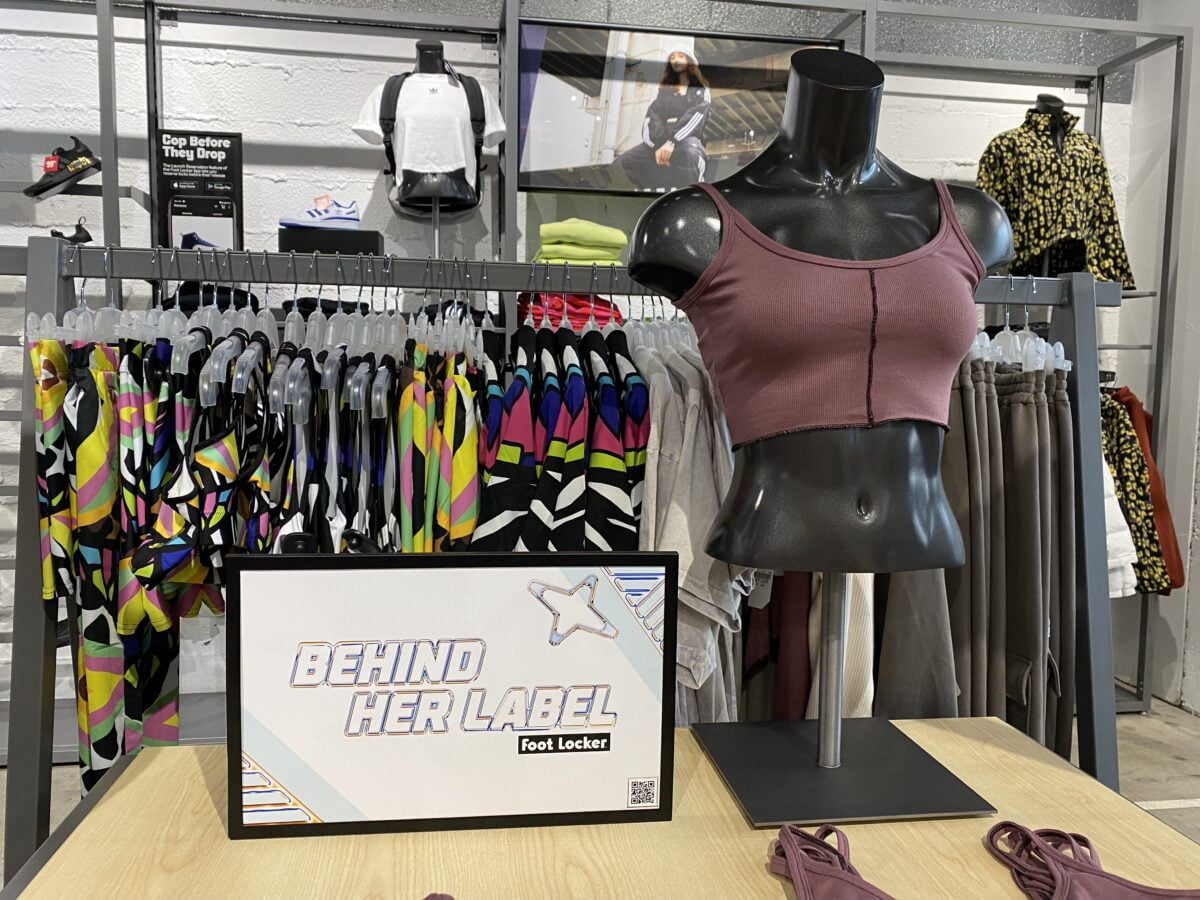
Behind Her Label at Foot Locker - Photo by Dustin Fuhs
Foot Locker has expanded its ‘Behind Her Label’ platform to Canada with three Canadian designers and their brands including: MARY YOUNG by Mary Young, Young Muse by Tamara Kucera and Remixed by Tal by Natalya Amres.
Richard McLeod
Behind Her Label is Foot Locker Women’s response to the gender gap in streetwear design. It aims to elevate and provide resources to emerging female streetwear designers who have the opportunity to launch collections in-store and on Footlocker.com. The platform first debuted in the U.S. in 2020 – its Canadian expansion will bring these female streetwear designers’ collections in-store and online.
“The original program which I was fortunate to be part of started essentially as a national program back in 2020 in the US and it’s exciting that it’s been able to expand into Canada. It’s definitely evolved into what we would call an international program,” said Rich McLeod, Foot Locker Canada Vice President, General Manager. “We’re excited about that.
“At its core we designed the program to essentially elevate and provide resources to emerging female streetwear designers. The other part of it was just how do we continue to celebrate the long time contributions that women have made to streetwear and a broader youth culture.
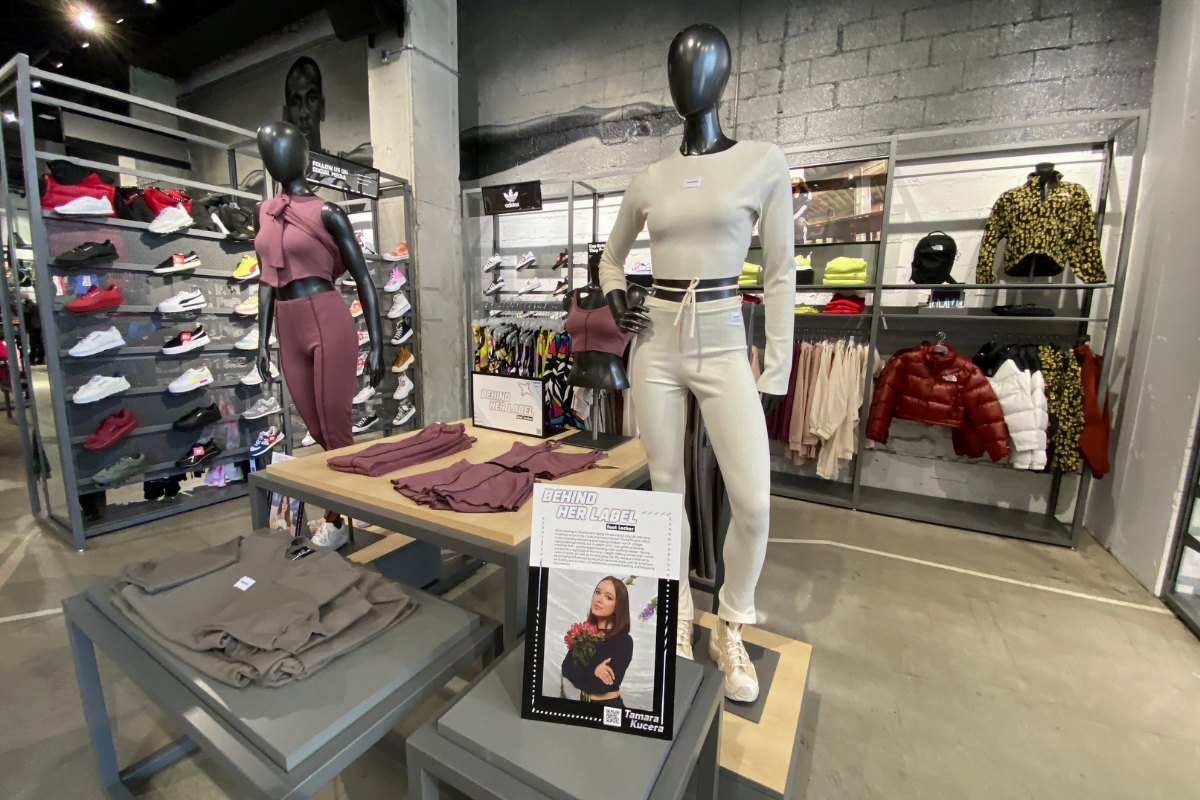
Behind Her Label at Foot Locker – Photo by Dustin Fuhs
“In terms of the selection there’s obviously a plethora of female designers.”
McLeod said much of the focus right now is in the retailer’s Community Power Store concept on Yonge Street in Toronto.
“We will be expanding out to additional stores in Canada but the initial focus will be in the Toronto Power Store,” he said.
Foot Locker has 118 locations in Canada.
Behind Her Label at Foot Locker on Yonge Street – Photo by Dustin Fuhs
This is just the start in Canada for the Behind Her Label initiative.
“We were a little bit hampered by COVID in 2020 which is kind of the reason why we were slightly delayed in terms of our launch but we were fortunate as the stars aligned with the Power Store opening in August and it gave us the opportunity to actually truly launch the program,” said McLeod.
“It’s just the start. As we continue to drive more focus around these women designers we will continue to do that in the coming years. It’s not an in and out. It’s something we’re committed to and there’s a mission to continue to close that gender gap and just provide more focus and use our leverage as a power brand within Canada to support these female designers ongoing.”
Mary Young is a Toronto-based community builder, designer and founder of MARY YOUNG, an ethical intimates brand. At her core she believes that everyone should work towards embracing their natural shape and celebrating comfort first. By mixing classic styles with her passion for street style, she has created a brand that’s versatile, sustainable, and unique to help represent the diversity we see in one another, said Foot Locker.
Image: Foot Locker
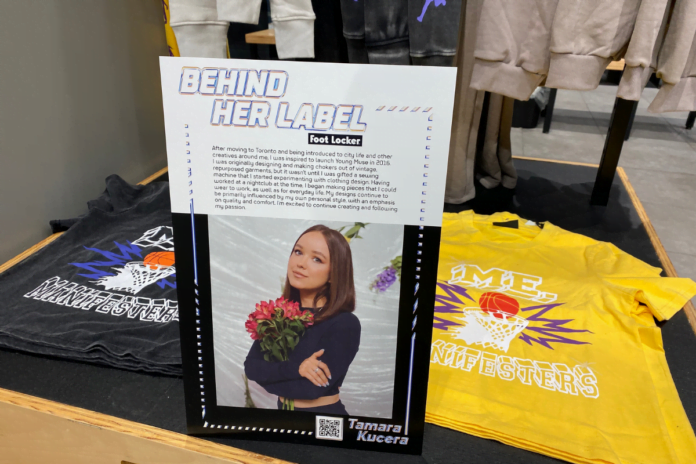
Tamara Kucera launched her label Young Muse in 2016 after moving to Toronto. After originally designing and making chokers out of vintage, repurposed garments, she shifted to clothing design, making garments she could wear to work as well as for everyday life. Designs are influenced by Tamara’s own personal style with an emphasis on quality and comfort, explained the retailer.
Recently, Foot Locker also announced the launch of a new apparel line LCKR by Foot Locker.
The retailer said “LCKR merges sneaker and sport culture with the heritage of Foot Locker to bring a new iteration of casual wear to the market. These every day, go-to lifestyle pieces compliment the Foot Locker customer’s existing wardrobe – particularly those who appreciate style and comfort.”
Bryon Milburn
“At Foot Locker we’re continuing to grow our assortment every day to make sure we’re meeting the evolving demands of all of our customers,” said Bryon Milburn, Foot Locker Senior Vice President, General Manager. “Today, we’re seeing the need for comfort and the acceptance of casual wear in more places than ever before. With LCKR, we have developed an elevated basics line that gives our customers a diverse way to complement their personal styles at a great value.”
When asked about any plans for future expansion of its retail footprint in Canada, McLeod said the marketplace is continuing to evolve and the company continues to evaluate its store presence.
“A lot of our focus is in the key markets. For us it’s more about how do we continue to look at our stores in order to drive some of the key categories.”
Foot Locker, Inc. has a portfolio of brands including Foot Locker, Kids Foot Locker, Champs Sports, Eastbay, WSS, Footaction, and Sidestep. It has about 3,000 retail stores in 27 countries across North America, Europe, Asia, Australia and New Zealand, as well as websites and mobile apps. Foot Locker, Inc. has its corporate headquarters in New York.
Huge annual shopping events over the upcoming holiday season, such as Black Friday, Cyber Monday and Boxing Day, are expected to be busier this year than last year, according to the Retail Council of Canada.
Diane J.Brisbois, President and CEO of Retail Council of Canada
And Canadian consumers expect to spend more money on average.
“Canadians are ready to put the disruption of COVID behind them and are looking forward to returning to brick-and-mortar stores,” said Diane J. Brisebois, President and CEO of the Council.
“Nevertheless, they are buying differently than they were prior to the pandemic. While it is expected that there will be more in-store buying this year, the blend between physical and online shopping will continue to evolve and consumers expect to have more choices in how and where the products they purchase are picked up and delivered. Additionally, with the removal of some of the more restrictive COVID mitigation measures, consumers will need extra assurances that physical distancing and other safety measures will be maintained so that they can enjoy the products, promotions, and unique festive experiences retailers will be offering.”
The RCC’s 4th annual Holiday Shopping Survey, of over 2,500 Canadians from coast to coast, found that average holiday spending this year is expected to be $792 compared to $693 last year. The Council said historically consumers’ actual spending is more than they plan so this year’s actual spend could be more than $800.
Brisebois said the results of the survey are certainly better than those of 2020 and are starting to mirror the results of 2019, pre-pandemic.
“That’s encouraging. And what’s also encouraging is that the majority of consumers are saying they want to make those purchases in-store which is welcome news for a lot of our retailers who even though they may have a strong online presence they’re also very focused on their brick and mortar operations,” she said.
A key factor in the strong consumer response to spending this year during the holidays is the fact that most provinces have reopened businesses. Brisebois said late fall in 2020 was when governments started to put in additional restrictions on retail and for a good part of that holiday season many of the brick and mortar retailers were considered non-essential and had to close.
Woman shops online during the holiday period.
“That meant that people could not shop in-store. The other element that changes the numbers year over year is the fact that because we have such a large number of Canadians vaccinated they are starting to socialize and so they are planning for holiday get-togethers, for family gift giving. Last year, people were just not buying their friends, or cousins, or acquaintances or colleagues, gifts for the holidays because they couldn’t see them. They were really buying for themselves and within their household whereas now people are saying yes we’re planning to get together, we’re planning holiday events, we’re seeing more people, hopefully in a socially safe manner, which means they’re buying more food, more liquor, more wine. They’re buying gifts for those they haven’t seen or been able to socialize with for a long time.”
Brisebois said this holiday shopping season will be a boost for retailers across the country who have struggled with the challenges of the COVID-19 pandemic over the past year and a half.
The RCC report said supply chain issues facing consumer packaged goods manufacturers and retailers have been widely reported around the world.
“As a result, it is anticipated that retail availability of certain items may be tighter than in years past, particularly in late November and December. Consumers that plan ahead and shop early will increase their chances of finding the products and brands they want for the holiday season. And, with expected labour shortages, shopping early will allow consumers to avoid long line-ups or shipping/delivery delays,” said RCC.
The report also found:
Canadians are planning to begin shopping earlier and more are planning to take advantage of holiday sales and product availability. 30 per cent vs 23 per cent in 2020 plan to begin shopping before November;
November will remain the busiest shopping month. 36 per cent of consumers plan to begin their 2021 holiday shopping in November. 43 per cent (vs 41 per cent in 2020) plan to shop on Black Friday, 35 per cent (vs 34 per cent in 2020) plan to shop on Cyber Monday and 34 per cent per cent (vs 32 per cent in 2020) plan to shop on Boxing Day;
In-store shopping will increase but online will continue to be strong, emphasizing once again the importance for retailers to provide seamless experiences across their selling channels. 63 per cent (vs 58 per cent in 2020) of total purchases are expected to be in-store this year and 37 per cent (vs 42 per cent in 2020) will be online. Pre-pandemic in 2019, 72 per cent of total purchases were planned to be in-store and 28 per cent online;
Supporting local retailers continues to be important to Canadians. 78 per cent feel it is important to shop locally, with 81 per cent of those respondents saying it is especially important to support local retailers that have suffered due to lockdowns; and
Product categories that Canadians will spend the most on have shifted, with clothing taking top spot this year, surpassing food, alcohol, and candy that has dropped to second spot. Top categories are: clothing (16 per cent vs 15 per cent in 2020), food, alcohol, candies or sweets for entertaining (12 per cent vs 19 per cent in 2020), toys (10 per cent vs 10 per cent in 2020) and personal electronics (eight per cent vs eight per cent in 2020).
The Canadian Federation of Independent Business is relieved that some broad-based business supports will remain in place following Thursday’s federal announcement on wage and rent subsidies for businesses affected by COVID-19, but concerned that the eligibility rules and thresholds will put them out of reach for many.
Dan Kelly
“Restaurants and tourism businesses will need to see a revenue drop of 40 per cent and all other businesses a 50 per cent drop in order to access these critical programs. This means small businesses that see revenues lower by one-third will not be able to access the previous wage and rent subsidies – potentially signing them up to lose money every single day they are open and putting them at risk of permanent closure,” said Dan Kelly, President and CEO of the CFIB, Canada’s largest association of small and medium-sized businesses with 95,000 members across every industry and region.
“CFIB will be pushing the federal government to be flexible in how it defines businesses in the tourism, restaurant and hospitality sectors for its targeted programs. Gyms, recreation facilities like bowling alleys, dance studios, dry cleaners all continue to suffer massive COVID-related losses but may be ineligible for the higher levels of support.
“New businesses that started after March 2020 must be included in any new government support programs if they meet the eligibility criteria. As it stands, they have not been able to access any of the government support programs, despite facing the same challenges and restrictions as other businesses.”
Kelly said the extension of the Canada Recovery Hiring Program to May 2022 and its return to 50 per cent is more welcome news for small businesses that are in a position to hire back staff.
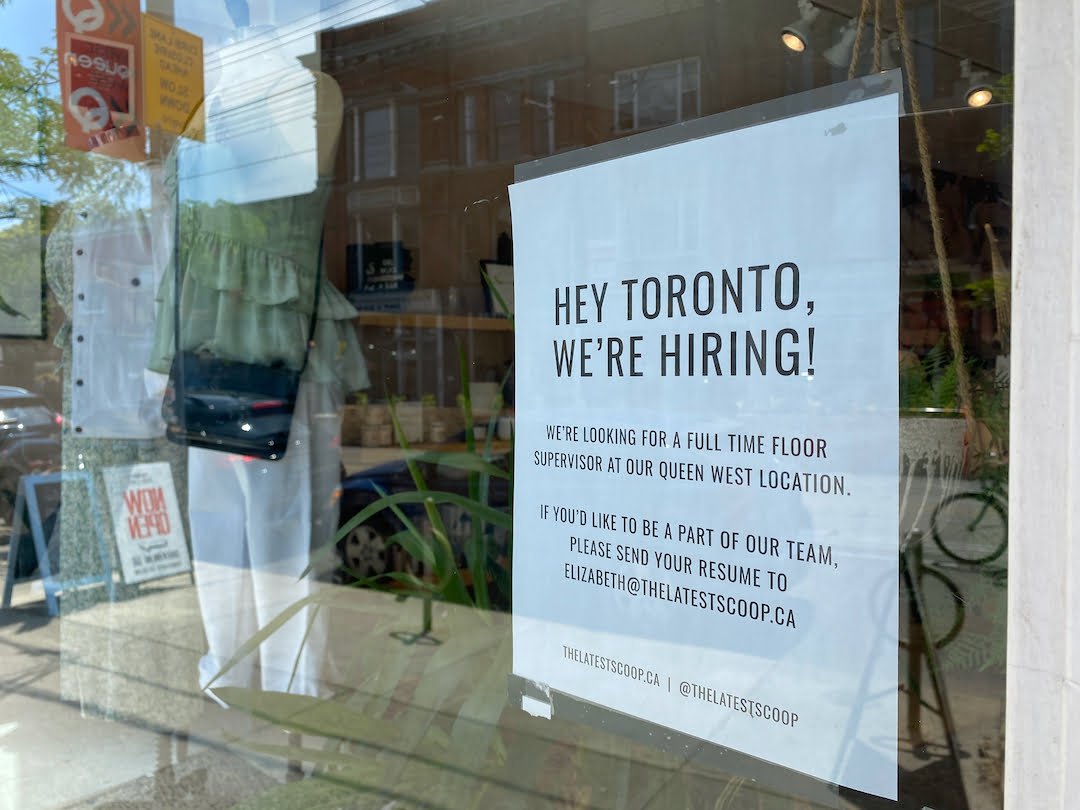
Hiring Sign on Queen Street – Photo by Dustin Fuhs
“CFIB is also pleased that the government is pivoting to supporting workers affected by lockdowns, as many businesses are facing a major labour shortage, which is throttling their recovery. The new support program for businesses facing local lockdowns will also restore some much needed certainty for businesses heading into the winter months,” he said.
“CFIB appreciates that the government has shown willingness to listen to the needs of small business owners and is counting on the Deputy Prime Minister to make important changes to ensure the programs will continue to do their job”
Mark Agnew, the Canadian Chamber of Commerce’s Senior Vice President, Policy and Government Relations, said businesses in the hardest-hit sectors continue to face capacity restrictions that prevent them from operating at full capacity.
“No business operator opens with a viable model based on half capacity, and these companies need continued support before the 2022 tourism season to ensure they do not permanently close their doors. The new retooled government support programs announced today will allow businesses who continue to be impacted by public health restrictions to survive until they can recover. This is the fair thing to do for businesses that are playing their part to protect public health,” he said.
“We look forward to seeing further details of these newly announced programs and urge Parliamentarians to expeditiously consider legislation once Parliament resumes.”
In a blog on its website, the Chamber said ongoing public health measures and travel restrictions have significantly reduced the capacities of many businesses, whose operations will once again be viable after the pandemic.
Facing these continued public health restrictions and a highly volatile and uncertain outlook, support should continue for the hardest hit sectors that still face situations far worse than those experienced for other sectors during the depths of the Global Financial Crisis in 2008-09. Ending government support programs prematurely would be self-defeating, leading to waves of job loss and unnecessary hardship that would hamper the ability of Canada’s economy to fully recover after public health measures are lifted.
“The on-the-ground reality is that we are still far from normal business operations, and the majority of businesses continue to struggle. In Statistics Canada’s 2021Q3 Canadian Survey on Business Conditions (undertaken in July and August 2021), almost one-in-five businesses (19 per cent) reported that they cannot take on any more debt, primarily due to concerns about cash flow and elevated uncertainty about future sales. Perhaps not surprisingly, corporate debt constraints for companies are highest in the hardest hit sectors including: accommodation and food services (27 per cent); and arts, entertainment and recreation (26 per cent),” said the Chamber.
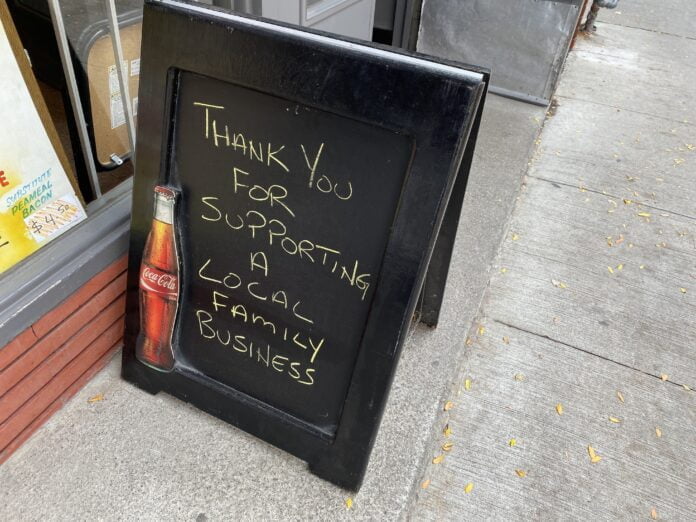
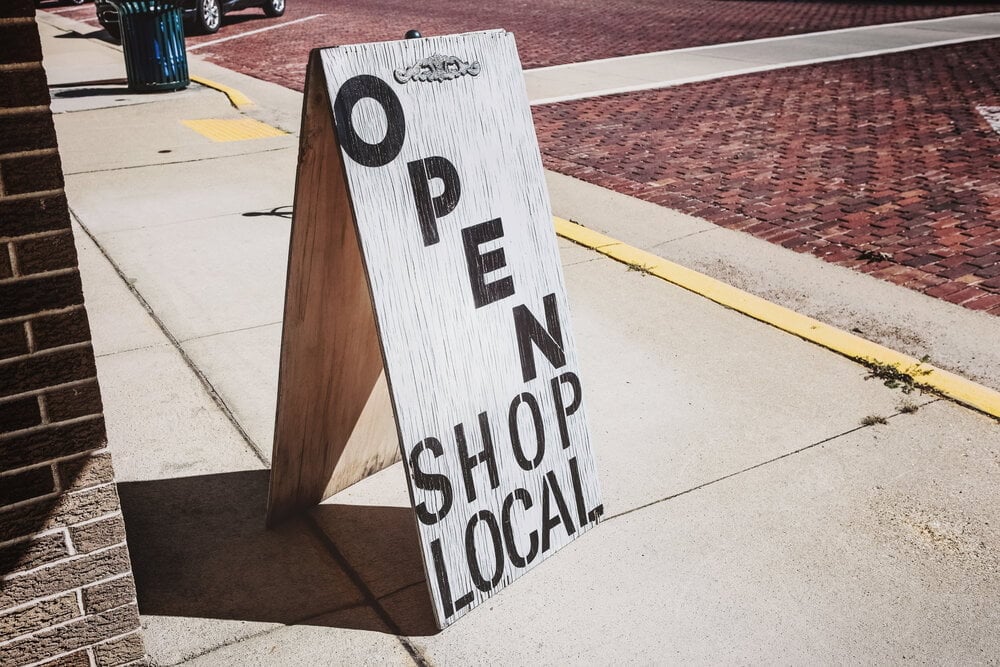
SHOP LOCAL SANDWICH BOARD OUTSIDE STORE.
“According to the Canadian Federation of Independent Business, most small businesses (60 per cent) continue to operate below pre-pandemic sales levels, while 55 per cent are not fully staffed, and one-in-four are not even fully open for business. We are seeing this pain acutely in the hardest-hit sectors, where employment and real GDP remain well below pre-pandemic levels . . . The situation remains dire indeed with employment still more than 10 per cent below pre-pandemic levels in sectors that are difficult to physically distance, such as accommodation and food service (-15 per cent, or 180,300 jobs); and “other services” (-12 per cent or 95,500 jobs). During the depths of the Global Financial Crisis in 2008-09, the worst comparable sectoral employment declines were less severe than those currently impacting these sectors.”
In a statement, Restaurants Canada said the fact that restaurants are being included in the new targeted approach to the rent and wage subsidy programs is a positive sign, reflecting how the organization has been at the table with the federal government throughout the pandemic, ensuring the needs of the uniquely hard-hit sector have been heard by key decision-makers.
“However there is still work to do so that the eligibility requirements reflect the realities of our industry. It’s critically important that businesses who desperately need this support don’t lose access to it if they have been operating at 39 per cent revenue loss for months on end and not 40 per cent,” said the organization. “Restaurant operators are innovative and resourceful, but the COVID-19 crisis has stretched their resiliency to the limits.
According to survey data from Restaurants Canada:
Eight out of 10 restaurants have been operating at a loss or barely scraping by with a profit margin of two per cent or less throughout the pandemic; nearly half of all foodservice businesses have been consistently losing money ever since the first wave of lockdowns ended last year;
Seven out of 10 restaurant operators are still receiving the federal wage and/or rent subsidy, and if they lose access to these critical sources of support nearly 80 per cent said they will struggle to keep paying existing staff/have to cut staff hours. More than half said they will struggle with hiring back staff/hiring new staff;
Eight out of 10 respondents to the latest Restaurants Canada survey said their establishments were still experiencing less traffic from July to September compared to before the pandemic;
52 per cent said their guest counts were more than 30 per cent lower in Q3 2021 compared to Q3 2019;
18 per cent said their guest counts were more than 50 per cent lower in Q3 2021 compared to Q3 2019.
“With colder weather coming, the fate of Canada’s 90,000+ restaurants is still uncertain. At least 10,000 establishments have already closed. The rest need government support to help them survive the fall and winter so they can continue feeding our recovery,” said Restaurants Canada.
The Canadian Taxpayers Federation, however, applauded the federal government’s announcement that temporary COVID subsidies are ending.
“Reining in the COVID-19 spending is a good first step towards taking the $1-trillion federal debt seriously,” said Franco Terrazzano, Federal Director with the CTF. “Taxpayers need to see more details, but Finance Minister Chrystia Freeland deserves credit for acknowledging these subsidies were always supposed to be temporary.
“This extra spending was always sold to Canadians as temporary supports and taxpayers can’t afford for these programs to become permanent red ink. Reining in the temporary COVID-19 borrowing and making sure this spending is more targeted and less expensive is a good first step.”
The CTF cited the Parliamentary Budget Officer’s estimate that COVIDspending cost $271 billion in 2020. It said the federal government is more than $1 trillion in debt – meaning that each Canadian’s average share of the debt is about $30,000.
The wage subsidy, rent subsidy and Lockdown Support programs were set to expire on October 23..
On Thursday, Chrystia Freeland, Deputy Prime Minister and Minister of Finance, announced that the government is taking targeted action to create jobs and spur economic growth by “moving from the very broad-based support that was appropriate at the height of lockdowns to more targeted measures that will provide help where it is needed, while prudently managing government spending.”
Dine on 3 at Yorkdale Shopping Centre – Photo by Dustin Fuhs
The government said it is proposing the following changes to business support programs:
Extend the Canada Recovery Hiring Program until May 7, 2022, for eligible employers with current revenue losses above 10 per cent and increase the subsidy rate to 50 per cent. The extension would help businesses continue to hire back workers and to create the additional jobs Canada needs for a full recovery;
Deliver targeted support to businesses that are still facing significant pandemic-related challenges. Support would be available through two streams:
Tourism and Hospitality Recovery Program, which would provide support through the wage and rent subsidy programs, to hotels, tour operators, travel agencies, and restaurants, with a subsidy rate of up to 75 per cent.
Hardest-Hit Business Recovery Program, which would provide support through the wage and rent subsidy programs, would support other businesses that have faced deep losses, with a subsidy rate of up to 50 per cent.
Applicants for these programs will use a new “two-key” eligibility system whereby they will need to demonstrate significant revenue losses over the course of 12 months of the pandemic, as well as revenue losses in the current month.
Businesses that face temporary new local lockdowns will be eligible for up to the maximum amount of the wage and rent subsidy programs, during the local lockdown, regardless of losses over the course of the pandemic.
These programs will be available until May 7, 2022, with the proposed subsidy rates available through to March 13, 2022. From March 13, 2022, to May 7, 2022, the subsidy rates will decrease by half.
To ensure that workers continue to have support and that no one is left behind, the government said it is proposing to:
Extend the Canada Recovery Caregiving Benefit and the Canada Recovery Sickness Benefit until May 7, 2022, and increase the maximum duration of benefits by two weeks. This would extend the caregiving benefit from 42 to 44 weeks and the sickness benefit from four to six weeks.
Establish the Canada Worker Lockdown Benefit which would provide $300 a week in income support to eligible workers should they be unable to work due to a local lockdown anytime between October 24, 2021 and May 7, 2022.
“Our economy is rebounding and we are winning the fight against COVID. It is also true, though, that the recovery is uneven and the health measures that are saving lives continue to restrict some economic activity,” said Freeland.
“That is why today we are announcing what we very much hope and believe is the final pivot in delivering the support needed to ensure a robust recovery – for everyone. Our focus is to protect and create jobs. And ensure the strongest possible recovery for everyone. And we will continue to deliver on this promise we have made to Canadians.”
The government said the Canada Emergency Wage Subsidy has helped more than 5.3 million Canadians keep their jobs, with over $95 billion in support already paid out through the program to help employers rehire workers and avoid layoffs.
The Canada Emergency Rent Subsidy and Lockdown Support have helped more than 210,600 organizations with over $6.8 billion in support for rent, mortgage, and other expenses, it said.
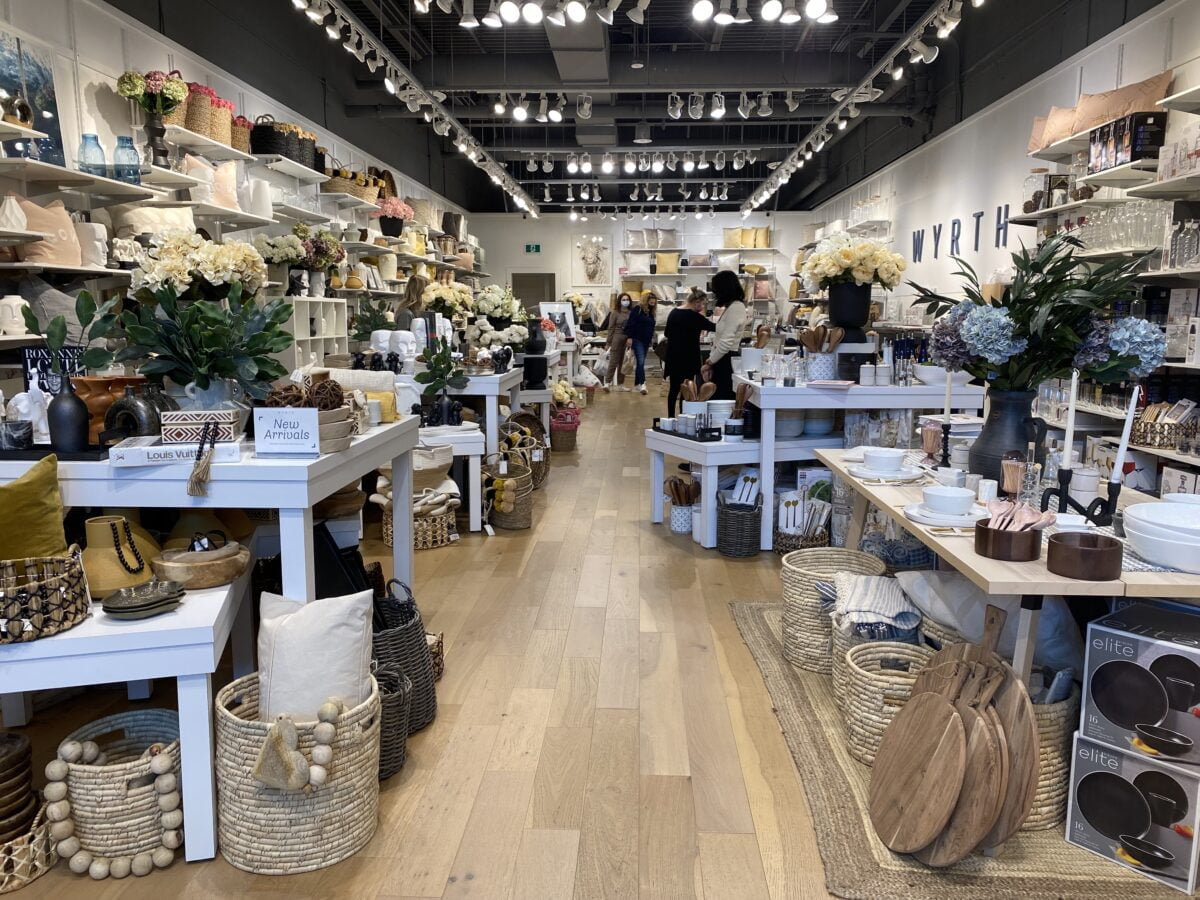
WYRTH at Yorkdale Shopping Centre - Photo by Dustin Fuhs
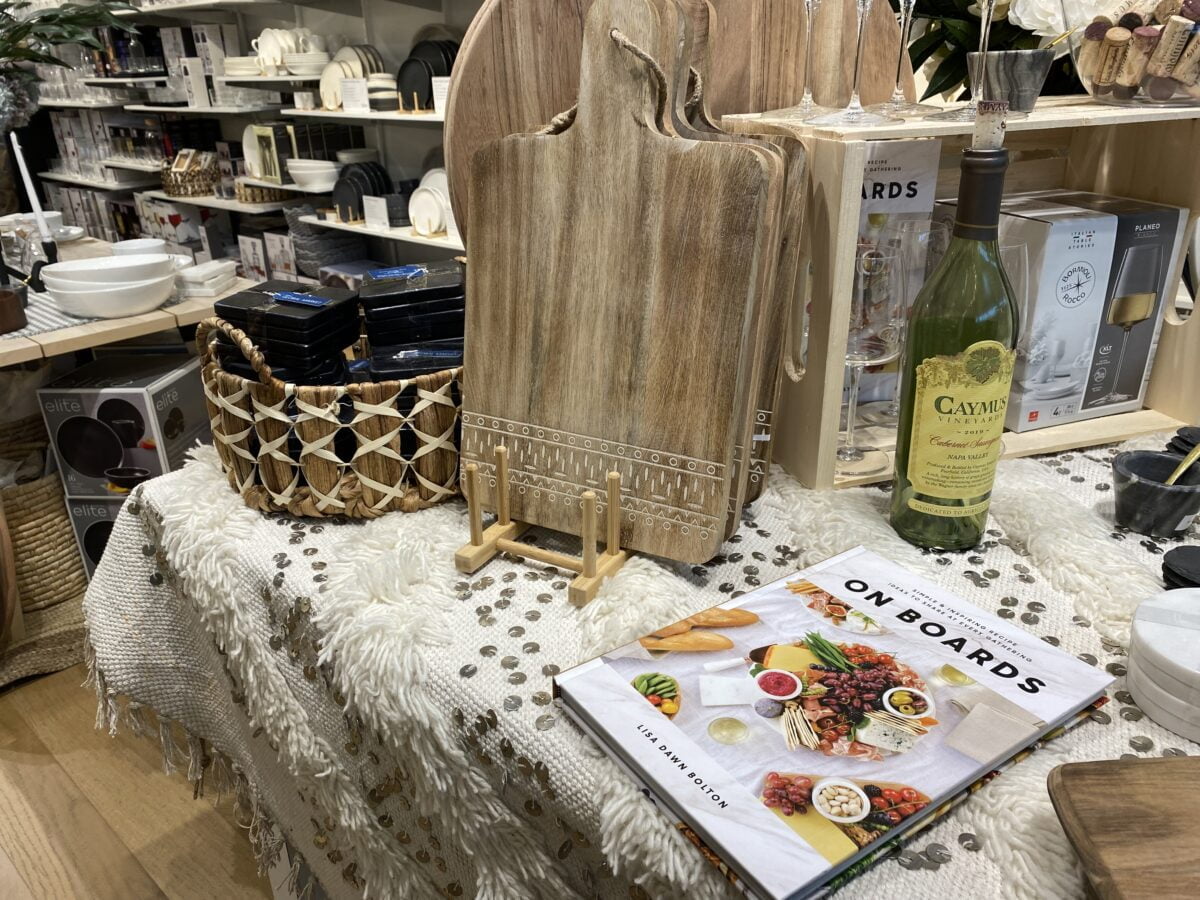
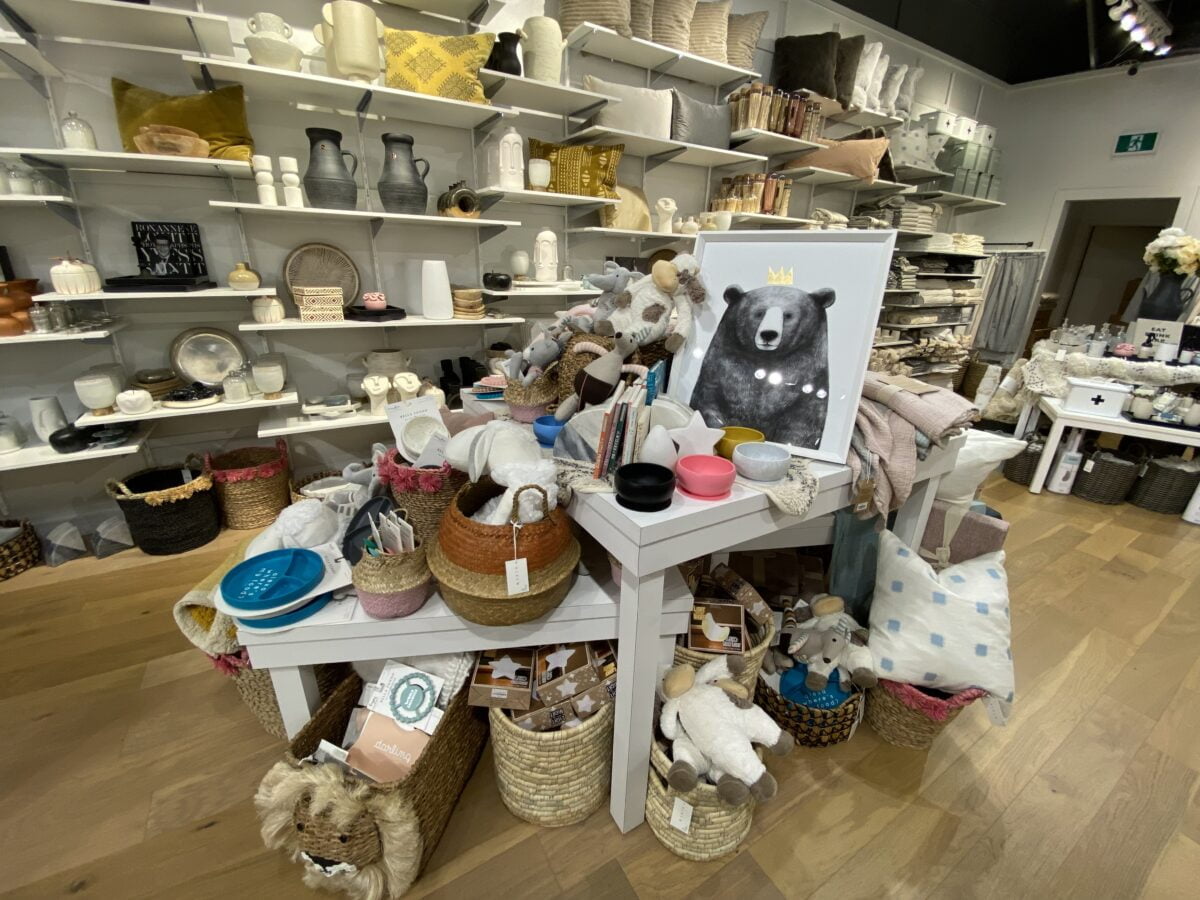
Canadian home goods store WYRTH has opened a 3,000 square foot pop-up location at Yorkdale Shopping Centre in Toronto.
The store compliments a flagship concept which opened in 2019 in a 5,000 square foot stand-alone storefront on Orfus Road in Toronto.
“We couldn’t be more excited about our new location at Yorkdale Mall,” said Founder & CEO Rachel Benitah. We believe our curated collection of aesthetically pleasing, quality home goods bodes well with the Yorkdale clientele, including our amazing loyal clients as well as new customers that we look forward to getting to know.
WYRTH at Yorkdale Shopping Centre (Photo: WYRTH)
The Yorkdale location will carry an assortment of products, including home decor and tabletop, bath and baby products.
“We believe that there is a need for more accessible, yet trendy home decor in the market, and we intend to deliver on that need. We hope that this new exposure in Yorkdale Shopping Centre opens further opportunity for our brand.”
In addition to the pop-up at Yorkdale, WYRTH was able to share additional news that it had secured a pop-up location at Sherway Gardens that will open in November.
“We want to personally thank our broker, Jay Freedman from Oberfeld Snowcap as well as Oxford Properties for believing in us and making this store a reality,” Benitah shared. “We are grateful for these amazing partners in bringing this opportunity to fruition.”
WYRTH at Yorkdale Shopping Centre (Photo: WYRTH) WYRTH at Yorkdale Shopping Centre (Photo: WYRTH) WYRTH at Yorkdale Shopping Centre – Photo by Dustin FuhsWYRTH at Yorkdale Shopping Centre – Photo by Dustin FuhsWYRTH at Yorkdale Shopping Centre – Photo by Dustin FuhsWYRTH at Yorkdale Shopping Centre – Photo by Dustin FuhsWYRTH at Yorkdale Shopping Centre – Photo by Dustin FuhsWYRTH at Yorkdale Shopping Centre – Photo by Dustin FuhsWYRTH at Yorkdale Shopping Centre (Photo: WYRTH)
An Edmonton Toyota dealership has moved into the West Edmonton Mall saying it could be the largest full-service dealership inside of a shopping centre anywhere on the planet.
Mayfield Toyota had operated since 1998 under that name and for many years prior under previous ownership.
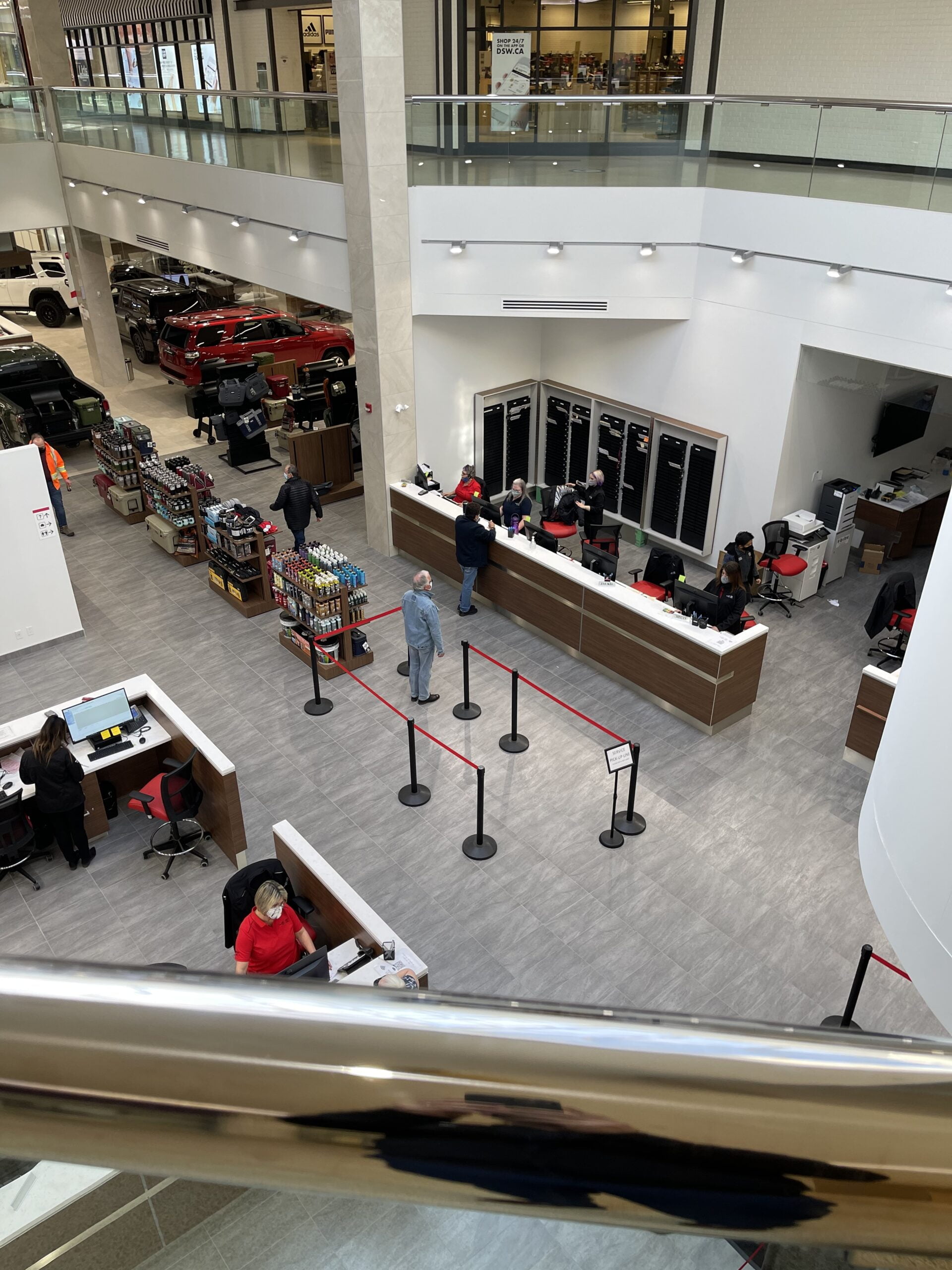
David Friesen, General Manager & Managing Partner of the dealership, said the business moved from about 56,000 square feet at its old location to about 125,000 square feet in the northeast corner, Phase One, of WEM.
Image: West Edmonton Mall Toyota
“At the end of the day we were really looking for a way to make using our facility convenient for everyone. Every ounce of marketing we’ll ever do is all about convenience for all,” said Friesen. “Our slogan is West Edmonton Mall Toyota, all makes, all models, all day, every day. It’s a gorgeous Toyota store. The showroom is unbelievable. It will blow your mind. Cars everywhere.
David Friesen
“It’s the servicing aspect of it that really is just remarkable. We built it service forward meaning that three quarters of the space is really designated to service and parts departments. Our drive-thru at Mayfield if you were coming for an appointment held six cars. Then once the six cars were full you were waiting in line outside in your car to come in the drive-thru. This particular one will fit up to 33 cars. It’s a massive drive thru.”
Friesen said the new showroom has 38 vehicles. There’s a covered carport outside that shows display units, holding up to 65 vehicles. It also has a section of the parkade that will hold up to another 600 vehicles. The previous company showroom had a capacity of about 15 vehicles.
West Edmonton Mall Toyota brings a variety of services for all makes and models, including: full detailing packages, quick and convenient express oil changes, complete mechanical services, over-the-counter parts purchases, tire sales/swaps and storage, windshields and – most importantly – all of their services will now be open seven days per week from early until late.
Image: West Edmonton Mall Toyota
In their all new state-of-the-art, indoor, fully interactive showroom, shoppers will have the ability to shop inside; no more trekking through the snow or through a heat wave.
They will offer shoppers even more convenience by constructing a massive valet centre at Entrance 50, that can be used by all WEM shoppers and employees as an easy way to drop off their vehicle for parking, full detailing packages or even express services.
West Edmonton Mall Toyota will also be offering an exclusive loyalty program through their newly created West Edmonton Mall Toyota App. The app will give their customers access to many exclusive offers and programs throughout West Edmonton Mall.
“To our knowledge we have yet to find anything like this anywhere on the planet,” said Friesen.
Image: West Edmonton Mall Toyota
“We’re 100 per cent certain we’re the largest dealership in the largest mall in the planet. There’s no question there. We think we may be the only one.”
David Ghermezian, President, West Edmonton Mall Property Inc., said “West Edmonton Mall is excited to partner with Mayfield Toyota in the development of a unique customer-focused Dealer Experience at a scale which has never been seen in a shopping centre before.”
“We’ve seen firsthand how our customers have embraced Mayfield Toyota at WEM through the last five years with many successful sale events at the Mayfield Toyota Ice Palace. This innovative partnership supports our customer’s lifestyles by providing a level of service and convenience that is unparalleled in the industry.
“We’re excited to be at the forefront of this groundbreaking automotive experience.”
Image: West Edmonton Mall Toyota
Image: West Edmonton Mall Toyota
Image: West Edmonton Mall Toyota
Cyril Dimitris
Cyril Dimitris, Vice President, Sales and Marketing at Toyota Canada Inc., said the company is excited about this unique opportunity to serve its customers in West Edmonton.
“We look forward to supporting Mayfield Toyota as they work with West Edmonton Mall to make this move a success.”
Friesen said other dealerships may look at the possibility of setting up shop in a mall especially as more big box stores close and malls need something to fill large space. Plus, a dealership would not be competing with any other retailer in a mall.
“It’s a good addition we bring in. Good customers who have some time to spend and what do they do? They can shop if they want. It’s a good marriage between the two but there’s got to be a lot of things that line up right. You’ve got to have the right space. You’ve got to have the right access. Putting a 130,000-square-foot dealership into the mall is not for every manufacturer. You have to be able to service the volume of people that come through here,” he said.
West Edmonton Mall Toyota (Image: Best Edmonton Mall)
Michael Kehoe
Michael Kehoe, an Alberta-based retail specialist, said the collaboration between West Edmonton Mall and Mayfield Toyota is part of a growing trend across North America where automotive dealerships are absorbing significant tracts of former department store spaces at major shopping centres.
“Toyota will have a major footprint at West Edmonton Mall in the former Sears store plus some space formerly occupied by retail stores,” said Kehoe, broker/owner of Fairfield Commercial Real Estate in Calgary.
“The dealership will enjoy a prominent retail location and the Mall will benefit from a significant number of dealership customers bringing their vehicles in for service where the average visit will be a minimum of three hours. It seems like a win / win to me as major malls transition large portions of their space to non and quasi-retail tenancies.”
Bruce Winder, author of RETAIL Before, During & After COVID-19 and President of Bruce Winder Retail, said Toyota’s move to the West Edmonton Mall appears to make sense. With the amount of traffic that the mall generates the dealership is bound to pick up some business.
Bruce Winder
“Tesla pioneered this approach by locating showrooms in premium malls near Apple stores. Unlike Tesla, Toyota will have a complete offering of amenities including detailing, service bays, inventory storage and showrooms. Other vehicle brands have used malls to sell including Porsche,” said Winder. “I think this represents the changing tenant mix of malls that now includes select digitally native brands, cannabis stores, health care providers, educational service providers and many other unique sellers that may have used standalone units in the past. As malls polarize into distinct lifestyle solution providers, Toyota will fit in well with their quality focused offering.
“The brand will need to ensure it is integrating e-commerce into the facility as the way consumers shop for vehicles has changed. The internet plays a much greater role in terms of information search, comparison shopping, vehicle customization, purchase, and post-purchase behaviour than previously used – and shoppers demand it. Toyota has an opportunity to leapfrog Tesla in terms of experiential retailing and take it to the next level if they wish to.
“Obviously, one would need to know what they are paying in terms of rent and how much they spent on renovations to determine the financial viability of such a move but judgmentally it feels positive.”
When it comes to ensuring the economic and social wellbeing of communities in every province and territory across the country, the health and success of small businesses is crucial. In fact, the prosperity of small businesses isn’t just a critical element lending to the vitality and verve of neighbourhoods, they are the lifeblood of the areas they serve. It goes without saying that impacts of the COVID-19 global pandemic have been devastating on their operations, limiting their ability to open their storefronts to customers and their capacity to progress and grow. As a result, it’s been recognized by many that small businesses currently require help and support in order to get through this extremely difficult period in retail history. Fortunately for some Canadian communities, there are Business Improvement Areas (BIA) that are doing everything they can to provide that much-needed help and support. However, according to Annie MacInnis, Executive Director of the Kensington Business Revitalization Zone (BRZ) in Calgary, the need for all BIAs to do so going forward is paramount.
“The role of BIAs is more critical now than ever before,” she asserts. “They were created to help communities and neighbourhoods deal with crisis. In fact, the first BIA in the world in Toronto’s Bloor West was created in order to deal with all of the issues that came with the introduction of the subway through the area. And there are so many more similar examples that can be pointed out around the world where organizations were formed in order to assist struggling businesses, protect merchants and business owners from violence and crime or to help revitalize a downtrodden community. They are the organizations that are best equipped to help businesses in communities adapt and persevere through adversity by working as a collective to address their issues and overcome their challenges. And, in light of the impact that the COVID-19 pandemic has had on small businesses in communities across the country, their efforts are going to be so important in ensuring the survival of Main Streets everywhere.”
Built for crisis
MacInnis goes on to explain that the Kensington BRZ that she manages was also formed in the wake of disruption to the area. Nestled between Sunnyside and Hillhurst in the heart of Calgary, the BRZ was organized in 1985 as a means to help support local merchants navigate the turbulence and interruptions to business that resulted from the construction of the Calgary Light-Rail Transit line through the area. By way of initiatives and advocacy on behalf of merchants, the BRZ enabled local business owners to maintain strength and continuity and continued foot traffic to the neighbourhood amid the adversity. The role that the BRZ served during its inception was pivotal in safeguarding the financial health of the area’s businesses. And it’s a purpose that it continues to fulfill today, benefitting everyone in the district.
“A healthy city is a city that evolves and grows,” says MacInnis. “And the communities and neighbourhoods within those cities are also going to go through evolution and change. It’s up to the BIAs in these communities to help them manage that growth and change, representing the collective business voice of the area. It requires strong collaboration with community associations and with the municipality to understand potential benefits of the many changes that might occur and inform business owners of them. As communities grow, so do the opportunities available to them. It can help increase the numbers of local shoppers who can be encouraged to spend their money in the community at the cool local shops, restaurants and bars. Having a lot of people who live and shop locally is the difference between a business district thriving and a business district barely surviving.”
Image: Kensington Calgary
Dedication and hard work
Today, the Kensington BRZ serves more than 270 member businesses. And, with the recent addition of new retail and office space as well as mixed-use developments, membership continues to grow. MacInnis’ work in leading the BRZ for the better part of the past 20 years has been instrumental in the success of its members. She’s also the Chair of the umbrella organization of Calgary BRZs and one of the founding members of the country’s first national organization – the Canadian chapter of the International Downtown Association. It allows her to be involved in advocacy at the municipal, provincial and federal levels. In fact, MacInnis is so active and passionate about the health and wellbeing of Canadian small businesses that when the City of Calgary developed the Business Sector Support Task Force at the onset of the pandemic, she was appointed as one of the representatives. As a result of regular meetings with the City, the Calgary Council made the decision to pay the BIA levy for more than 6,000 small businesses within 15 BIAs throughout the city. It’s an initiative that received international recognition, and one that MacInnis says is reflective of the dedication and hard work put in by everyone involved on the Task Force.
“This resulted in money in the pockets of business owners,” she exclaims. “And it was made possible because of our creativity, engagement and commitment to helping as many businesses as possible. Calgary was four years into a severe economic downturn when the COVID-19 crisis began and businesses in every district throughout the city were struggling. As a result, in order to deal with the downturn, a council had already been set up to focus on ways to help local businesses. So, when the pandemic hit, we were able to hit the ground running. But it seems that in response to its impact, everyone involved in efforts to help support merchants doubled down, going above and beyond to ensure the health and survival of their local business communities.”
Ensuring strong engagement
Beyond the advocacy efforts with government on behalf of small business owners, MacInnis stresses that one of the most important things that a BIA can do for its members during a time as difficult as the past 18 months is to maintain strong engagement with them. To do this for her own members, she made sure to speak personally with every one of Kensington’s business owners to understand their individual needs. In addition, she increased the number of newsletters that she distributes in a year from 10 to 45, advising members of provincial regulations, financial aid information and mental health resources, among other useful content. However, it was the budgetary decision that she made when the pandemic’s impacts began that has yielded perhaps the biggest reward for members.
“When we were determining our budget in Fall 2020, although a lot of BIAs were making the decision to lower fees to their members out of respect for their businesses, we were a bit of an outlier and decided not to lower our fees,” she explains. “When you lower your fees, you have to lower your budget. We figured that a crisis like COVID is what our organization was built for, and we can do so much more with that money. It allowed us to put on a campaign earlier this year with the goal of putting money back into our small businesses and to encourage people that our business district was a safe place to come back to. In order to do that, we set up live entertainment in our public plaza every Saturday for six months where visitors could come and socially distance and enjoy live entertainment. The events helped support local artists. And, as part of the event series, we also supported a different local charity organization each month, helping to raise awareness of their services. It was a great success and helped to promote Kensington as a safe, fun and vibrant place to enjoy a Saturday afternoon.”
Image: Kensington Calgary
Love conquers all
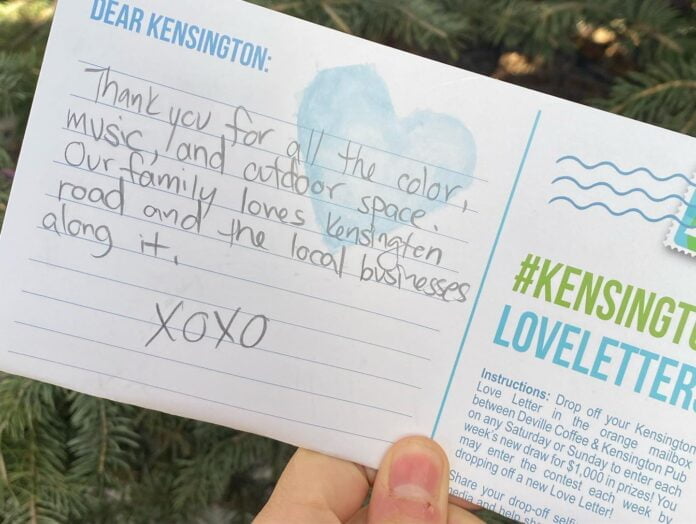
As part of the six-week entertainment series, MacInnis also initiated a contest that visitors to the area can enter every week for six months. To do so, people are encouraged to write a ‘love letter’ to Kensington, explaining their admiration for the community, and submit it in person into a mailbox located in the plaza. Each week, the mailbox is emptied and a letter is chosen as the winner, whose writer receives $1,000 in gift cards to local shops in town. To fund the project, the Kensington BRZ used $40,000 of its budget, purchasing $300 in gift cards from every business in the community. And, because many of the gift cards are $25 denominations, each winner’s prize consists of 30 to 35 gift cards to individual merchants, ensuring traffic, repeat visits, new customers and hopefully more spend above the value of the gift cards.
In addition, as part of the campaign that MacInnis calls Kensington’s ‘Love’ campaign, the BRZ and its local business members also hosted three massive community fire pits with community seating in the deep cold of February. It lit up the community with bright colourful lights. And it introduced a big heart bench in the centre of the district, reflective of the campaign and Kensington as a safe and welcoming community. Each of these initiatives on their own reaped benefits for local business owners and the Kensington community. However, as part of a collective, the success that’s been generated to date has been incredible, evidenced by the health of the Kensington business district.
“When the pandemic hit, I set a goal to save more businesses than I’d lose during this time,” she admits. “In the four years of economic downturn, prior to the pandemic, I had lost 16 businesses. At the start of COVID, when there were a number of problems between landlords and their tenants, I lost another 14 businesses. Since then, 17 businesses have opened in Kensington, 2 took the time to rebrand, 6 have expanded or moved to a larger location in the area and 6 are opening soon. In the end, the health of small businesses is critical to the health of the municipal economy, provincial economy and federal economy. I understood how important it was to protect Canada’s entrepreneurs from the devastating impacts of the pandemic and thereby protect the economic wellbeing of the country.”
Preparing for a ‘new normal’
Response to MacInnis’ initiatives has been tremendous to date. And, looking ahead, she has a number of plans to further improve Kensington, making it more welcoming than it already is, including the enhancement of the community’s plaza with better lighting, the inclusion of power sources and access to water. She’s also in the process of working with local businesses to realize new opportunities that might arise from a ‘new normal’, including the chance to reimagine their stores and the way they do things and to consider creative partnerships with other businesses that might involve a type of lease-sharing agreement. All of her efforts are aimed at helping to create more useful spaces within the district and to help support merchants in understanding the changed landscape and to embrace a new way of thinking. In doing so, she believes that there are bright days ahead.
“Things have undoubtedly changed over the course of the past 18 months. And it’s up to small business owners, with the help and support of their local BIAs, to think creatively and connect with their customers on another level. People are really starting to embrace the shop local mentality and are understanding more clearly how important small businesses are to the health of their communities. They’re seeing now more than ever that their local small business owner is also their neighbour and their friend. We’ve experienced quite a bit of support for our merchants throughout the pandemic. And, it’s support that I only anticipate strengthening as we continue moving forward.”
Goodfood Market Corp., a leading online grocery company in Canada, recently launched a fully electric refrigerated vehicle fleet which it says is a first for any private entity in Canada.
The launch is initially in Vancouver with 10 vehicles.
Jonathan Ferrari
“Innovation in technology is a core pillar for us at Goodfood. As we continue to set the bar for a sustainable future, like our fully recyclable Goodfood meal kit boxes and our plant-based ready-to-eat salad packaging, we want to go beyond our products and bring sustainability in grocery through delivery,” said Jonathan Ferrari, Goodfood’s Chief Executive Officer.
“The idea behind the initiative was over the past few years it’s become evident to us that all of our stakeholders are incredibly focused on sustainability and the whole ESG movement and so one of our key initiatives on the environmental side was we gave our team the challenge of figuring out how to create a fully electric refrigerated vehicle fleet. We thought of Vancouver as our first market because we did get some government support . . . So our fleet in Vancouver is now fully electric including the refrigeration unit in the trucks and the operation of the electric vehicles.
“What’s pretty incredible is that we’re the first private entity to participate in this program and to build a fully electric and refrigerated fleet in Vancouver. It’s still early days but the customer feedback has been excellent.”
Image: Goodfood
Goodfood is collaborating with Lightning eMotors, Volta Air and Frigid Rentals on the initiative and the company says it is the first private entity to receive a pre-approved grant from Plug-In BC for electric charging infrastructure. The vehicles themselves have an estimated range of 200 kilometres on a full charge of its 86-kWh battery pack, regenerative braking, and can comfortably hit 120km/hour – silently.
Goodfood was launched in 2014 based out of Montreal. Today, it services all the major cities across Canada with offices and fulfillment centres in Montreal, Toronto, Calgary and Vancouver.
“When we first started the business, our intent was to completely revolutionize the way that Canadians did their weekly meal planning as well as their grocery shopping,” said Ferrari. “So the first five years of the business we really focused on creating the meal kit category in Canada. Every week our customers get a box of delicious ingredients. Everything they need to prepare their weeknight meals.
“By 4 p.m. every single day 80 per cent of Canadians don’t know what they’re having for dinner. So to be able to offer them fresh ingredients, flavours and to be able to get out of that weeknight recipe rut, the meal kits are a perfect solution. So that was kind of the first five years of our business. We expanded nationally. We created fulfillment centres. We built a brand. We have over 3,000 employees across the country.
Goodfood Rendering in Toronto. (Image: LIDD Toronto Brokerage)
“And we’ve since turned our attention to being able to service more of our customers’ weekly needs. So we now offer a selection of prepared meals as well. The meals are fully cooked and ready to heat and serve as well as a growing selection of grocery products. Our intent as we look forward over the coming years is to be able to become a one-stop shop for grocery shopping needs, prepared meals and meal kits.”
Goodfood currently has about 300,000 households that are subscribers across the country and it delivers millions of meals every single month.
Ferrari said neighbourhoods across the country will be getting the electric refrigerated vehicles soon as well.
“This first fleet was intended to prove out two things. The first piece was really these trucks are fully custom. We actually customize the electric vehicle, the refrigeration. Everything. This is not like an off-the-shelf vehicle,” he said.
“The first step was to understand how would they perform in a real life setting, real life environment. And then the second piece was to be able to understand how we could set up the process to recharge the vehicles, what the performance would look like throughout the winter months for example when the battery lifes become shorter. That’s what we will be testing out over the coming months and once we get that feedback from our drivers and customers who understand the performance of the trucks and the economics of the vehicles, at that point we’ll be able to scale nationally with our electric vehicles.”
Inger Miller
Plug-In BC Program Lead, Charging Infrastructure, Inger Miller, said Goodfood is continuing its commitment to pushing boundaries of what food and grocery look like across the country.
“Going electric allows fleets to save on operational costs and reduce emissions for a sustainable future and we continue to do this through great partnerships with Canadian owned companies like Goodfood,” said Miller.
Today, about 80 per cent of the company’s deliveries are in Eastern Canada – Ontario and Quebec. If you think about the Vancouver market being 10 vehicles, the company could multiply that number by five times to meet current needs there and continue growing over time.