Advertisement
Advertisement
Home Blog Page 933

Big-Ticket Purchases in Canada Plunge Amid Coronavirus Pandemic: Survey

Planned purchases of big-ticket retail items have plunged in the past month and close to one third of consumers responding to a survey say their financial outlook over the next six months is negative.

“It’s clear that specialty retailers, car dealerships, and real estate businesses will see significant challenges in the months ahead and even if the economy starts to reopen they will need to provide significant incentives to get Canadians to open their wallets for big ticket items that are often discretionary purchases,” said Jeff Doucette, General Manager of Field Agent Canada, which produced the survey looking at the impact of the economic crisis brought on by COVID-19.

The financial outlook of Canadians for the next six months is: five percent very positive; 20 percent positive; 44 percent neutral; 25 percent negative; and six percent very negative.

JEFF DOUCETTE

“It’s pretty safe to say that every business in Canada is adapting to meet the concerns and demands of COVID-19 and the resulting social distancing measures,” said Doucette.

The survey had some interesting results when it came to purchase intentions over the next six months. The decrease from March to April was significant in almost every retail category.

The intent to purchase a house or condo dropped from 12 percent to seven percent; for a vehicle it fell from 17 percent to nine percent; large appliances dropped from 15 percent to 10 percent; small home appliances decreased from 21 percent to 13 percent; and televisions were down from 15 percent to seven percent.

What stuck out from the results for Doucette was the depth of the change and the consistency.

“We picked 25 or so different categories and they were all very negative. In the 50 percent range (of falling intentions) if you had to take the average of all those categories,” said Doucette. “It just seems like such a huge cog of our economy or a bunch of huge cogs of our economy are really stopped and to fight their way out of that is going to take a lot of effort to get consumers’ confidence back so they feel they can purchase these big ticket items. It’s kind of scary.”

Part of the challenge for big ticket items currently is that a lot of those stores are not essential service stores, so they’re closed or it’s much more difficult to order from those retailers or order those types of products.

“Amazon is backed up in deliveries of non-essential items. Part of it is just access to these products and when people are going to be able to actually go to a store and kick the tires and lift the lid on a washer or dryer. That’s the principal barrier,” said Doucette.

“And the other piece is how long does this last and how much of a hole does it burn in people’s pocketbooks. And how bad the employment situation is. All those things are tied together. But the first things to go when you need to pay for groceries are going to be the new TV that you were dreaming of. Instead of being six months down the road maybe it’s a year or two down the road now because of the new financial reality.”

Many of the consumer habits being formed now around the areas of frugality, wise spending, and discount shopping may just continue on post COVID-19.

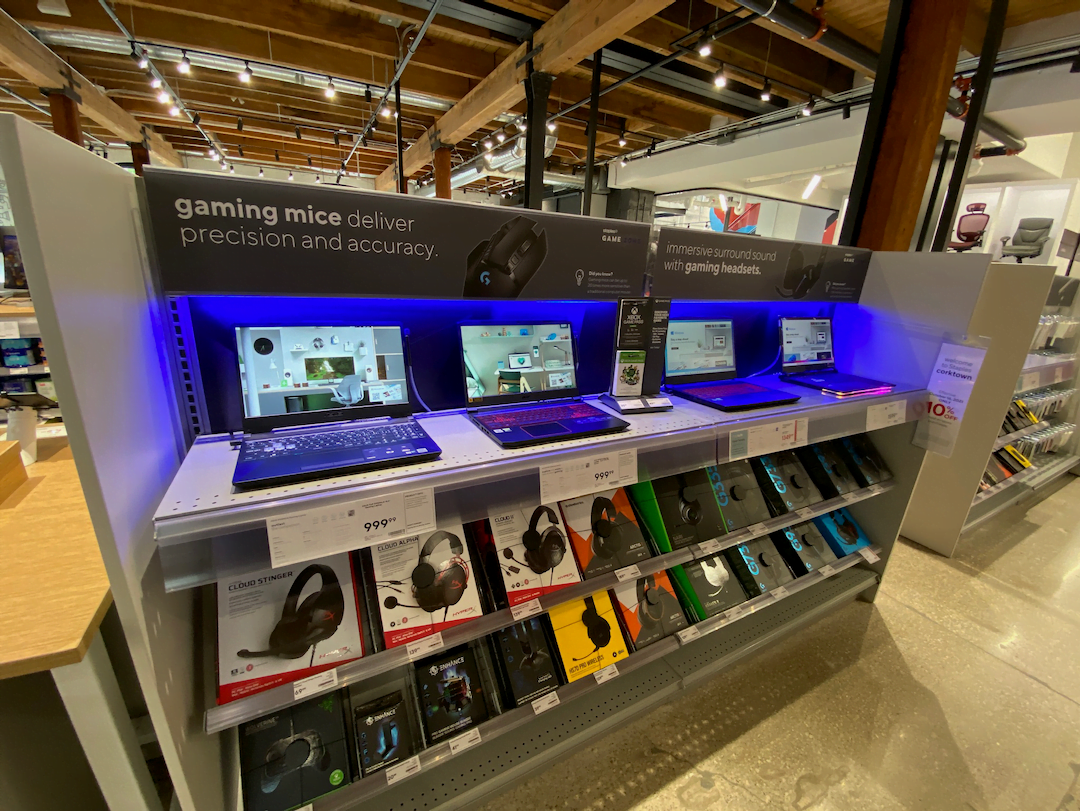
“I think there’s going to be a lot of leftovers from this time whether that’s frugality and just sort of trying to understand when we’re spending something if we really need to buy out. I think in today’s culture we want new headphones, we go to Best Buy and we go get them. And there’s no barrier. There’s no barrier to spending $200 on a pair of expensive headphones. You can go do it and it can be very much impulse driven if you have the money in your pocket,” said Doucette.

“Now it’s much more of a process to get them and there’s so many different points where you can say ‘nah, I don’t think I really need those’. I think that will happen.

“The other piece that I think that will probably happen, if we’re all buckled down for another couple of months in our houses, eventually it’s going to be ‘I’ve got to buy an Xbox just to keep the kids entertained. What else can we do? We’re running out of straws’. There will probably be the sort of enhance your home environment spending that starts to happen because people are spending so much time inside their home or on their property.”

Brief: Canadian Retailers Step Up to Support PPE Supply

This is the first of two ‘Good News Briefs’ that Retail Insider will run this week discussing good things that retailers are doing amid the COVID-19 (coronavirus) pandemic. The following brands are supporting the supply of personal protective equipment (PPE) at a critical time where health and other front-line workers are at risk of infection:

PHOTO: NOBIS

Nobis: Canadian premium outerwear brand Nobis has announced a three-week global initiative to combat COVID-19. Until April 30th, 100 percent of all online sales will be donated to protect frontline health care professionals in urgent need of supplies and Personal Protective Equipment (PPE).

IMAGE: NOBIS

In Canada, the list of recipients include the CanadaHelps COVID-19 Healthcare & Hospital Fund, which supports over 90 hospital foundations across the country, and five local Ontario hospitals. All international sales will be directed to the Red Cross COVID-19 Global Appeal.

This program is being implemented in addition to Nobis’ initial donation of $100,000 to local hospitals in Ontario.

Customers making any purchase on Nobis.com until April 30 will be able to direct the donation funds to the organization of their choice, by selecting the hospital or organization name at the time of check out. For the full list of benefitting foundations visit Nobis.com/pages/community.

Nobis operates two retail stores in Toronto, including a store on Queen Street West which opened in 2015 as well as a flagship on Hazelton Avenue in Toronto’s Yorkville area which opened in 2017.

PHOTO: KNIX

Knix: Digitally-native Canadian intimate brand Knix has started a Knix GoFundMe initiative to raise funds to support PPE needs of Canada’s frontline workers.

IMAGE: KNIX INSTAGRAM

Knix Founder & CEO, Joanna Griffiths and 26-year old brother, Dr. Chris Griffiths are collaborating on the effort, and since it launched on March 21 the campaign has secured over $250,000 in community donations, financing 200,000 units of certified masks and gloves to hospitals and clinics across Canada.

The Toronto-based global company also announced last week that a collaboration with the Robert Kerr Foundation to expand the campaign’s reach to support PPE needs for the GTA’s homeless shelters and drop-ins is in the works.

Knix opened its first two standalone stores last fall in Toronto and Vancouver.

Jewlr: Toronto-Based online jewelry company Jewlr is innovating in the face of COVID-19 by using its CNC laser — typically used to craft personalized ornaments — to manufacture face shields for Ontario’s front line workers.

After hearing about the shortage of personal protective gear among Canadian front line staff, Jewlr Founder, Tony Davis, and his team decided to put their manufacturing equipment to work creating protective shields that help preserve much-needed face masks.

To date, the company has crafted and shipped over 2,500 face shields to front line workers across Ontario, all as donations to their community. This work is ongoing and the company plans to continue as long as there is a need.

PHOTO: PUBCO

Pubco: Blainville-based company Pubco has announced that it will be contributing to the fight against the COVID-19 pandemic by producing hundreds of thousands of protective visors for essential workers.

IMAGE: PUBCO

The Quebec family manufacturer known for its high-quality packaging products have already sold more than 100,000 visors to private companies working in priority sectors, such as senior care homes and the food and pharmaceutical industries.

The new protective visors — which are made entirely in Quebec — were created by two engineers and two industrial designers at Pubco. Made from HACCP/BRC certified material, layered cardboard, and a polyester (PET) face shield, Pubco’s new single-use visors have the same level of impermeability as plastic. Easily assembled in less than 30 seconds, this protective equipment is completely adjustable with a laminated strap. The visors are affordable, retailing for $2.50-$3.00 per unit (according to the minimum quantity required). The visors are now available in large numbers.

To order visors, visit Pubco.com or contact the Pubco customer service department by phone at 1-866-984-4888,450-433-4272 or by email at services@pubco.com.

PHOTO: HARRY ROSEN

Harry Rosen: Last month luxury menswear retailer Harry Rosen began producing face masks for health workers across the country, and has now expanded to selling them to consumers for $25 each. To buy one, visit: www.harryrosen.com/en/feature/c/feature-face-masks

HARRY ROSEN FACE MASKS. PHOTO: HARRY ROSEN

Canadian Tire: Last week Canadian Tire announced that it offering up to $3 million in free PPE and other protective – such as cleaning supplies, scrubs, running and safety shoes – needed by frontline medical workers and community organizations. If your frontline medical or community organization is in need of essential products, please send us a request for support through our website here.

T&T Supermarkets: The Vancouver-based grocer announced a donation of 10million medical masks to Canadian hospitals and long-term care facilities. Recipients of the supplies include BC Provincial Health Services Authority, Alberta Health Services, Yee Hong Foundation, Mon Sheong Foundation, Sunnybrook Hospital, Grand River Hospital, St. Mary’s General Hospital, and the organization Mobilizing Masks for Health Care Providers in Ontario.

Canada Goose: Luxury Canadian outerwear brand Canada Goose is leveraging its manufacturing facilities to begin production of necessary medical gear for frontline healthcare workers and patients across Canada in the fight against COVID-19. The Company has begun making scrubs and patient gowns — which are in short supply across the country — and will be distributing them to hospitals next week.

INKSmith: INKSmith, a maker of 3D printers and laser cutters in Kitchener, Ontario is producing Health Canada–approved face shields to donate to local hospitals – and has started a spinoff company, The Canadian Shield, to do it.

Irwin Toy: Canadian toy company Irwin Toy has made a dramatic shift from selling dolls and trucks to selling medical-grade masks in the face of the COVID-19 pandemic. The company is currently making between 250,000 and 500,000 masks a day.

Montreal-Based Entrepreneur Isabelle Racicot Launches Initiative to Help Retailers Sell Online

Image: etail21

Montreal-based etail21, an online B2B marketplace that connects retailers, influencers, and brands to facilitate sales in the retail industry, has launched a new initiative to help retailers have their own fully-connected, free e-shop during the challenging times presented by the COVID-19 (coronavirus) pandemic.

Isabelle Racicot

In these trying times, brick and mortar businesses are facing great challenges. Isabelle Racicot, co-founder of etail21, said the company can create in a few minutes ready-to-go boutiques for those who are not online yet and in a dropshipping model.

The boutique simply has to select the products they want to resell from the Canadian brands connected to etail21 in dropshipping – the brands will ship the products directly to the end-customers.

“We’ve had this etail21 technology for two years now almost. When COVID-19 hit and everything started closing for retailers and brands we quickly realized that etail could really come in and help amid all that’s going on,” said Racicot. “Because we all know that right now most of the country is on pause and even though we’re talking about getting the economy back it’s going to take honestly a year or two before things get really back to normal.

“So we thought that rapidly we could help and do our share in this situation. So the brands and retailers right now who really have trouble because they either have a lot of over stock and they can’t get to the consumer, the online is really one of the best solutions and if brands or businesses were reluctant in the last year and half to go online I think that now they see that they don’t have a choice. In order to survive in the next couple of years people are going to have to really see online as a prime solution.

Image: etail21

“We really want to do our part in offering free onboarding for Canadian brands and helping businesses open up online or get them to have more products rapidly online with the solution that’s super easy and that really is automated and very simple to use.”

Here is where businesses can get an online shop to sell online with no cost: http://etail21-6326974.hs-sites.com/en-ca/free-ready-to-go-e-shops

Bianca Lessard, VP of marketing and co-founder of etail21, said the concept is a technology platform that connects selected brands with online retailers for wholesale.

It connects the brand product information and inventory levels to the retailer website. It allows instant wholesale using the dropship approach: a customer places an order on the retailer’s website and the brand ships directly to the customer.

A retailer can import their selection of products in one click to their e-shop without having to worry about lengthy product onboarding or inventory glitches and it connects the retailer e-shop with established Canadian brands like Privilege Clothing, Yoga Jeans, Celine Dion handbags, Pilgrim jewelry, etc.

Lessard said it takes five minutes to set up an account and it will earn a retailer commission on every sale.

“We call it the ‘Ready-to-Go’ boutique. It’s a fully automated solution from online shop creation, inventory management to order fulfillment. Nothing to set on their end,” said Lessard, adding that it’s easy to manage. A retailer will simply have to select products they would like to resell and promote their e-shop on their social media channels.

A Ready-to-Go shop looks like this: https://WearMyStyle.ca/BoutiqueB

“We, etail21, manage all order processes, all the tracking, everything, and the brand will ship the order direct to the end customer,” said Lessard. “We are the only company that has Canadian brands and Canadian retailers. If the retailer doesn’t have a website, if it’s a brick and mortar boutique, we can create a website in less than five minutes.”

Racicot said etail21 is focusing on Canadian brands and retailers but it really has international potential and international appeal.

“I think what etail21 wants to do right now is in the short-term period is try to help as many as possible as we can and then after that we’ll go with what’s happening in the world and in the market of course,” said Racicot. “From day one we’ve always been looking at our project as something that wanted to help retailers. We’ve always felt this. We want businesses to succeed. Let’s do a service that will enable them.

“We also wanted to as much as possible give a personalized service to anybody on etail21 and so far we’ve been able to accomplish that.”

Lessard said retailers and brands were already looking prior to COVID-19 at new innovative ways to import products and to sell online because it had been a challenging time for the industry.

“We believe that a solution like etail21 is one of the solutions of the future mainly for the inventory management. It’s very expensive for brands to support buying inventory and keep that inventory in their warehouse. It’s their cash flow that is there,” she said.

Peter Baugh Appointed Vice President of Advisory Services at The Behar Group


Screen Shot 2020-04-20 at 12.27.01 AM.pngScreen Shot 2020-04-20 at 12.27.01 AM.png

The Behar Group (TBG) team is pleased to welcome and announce that Peter Baugh has joined the brokerage as its new Vice President of Advisory Services.

Peter brings over 29 years of real estate business experience, including successful deals in office, retail and industrial asset classes. During his career he has completed over $1.2B in sale- leaseback transactions, $300M in property financings and $170M in property sales. He has worked at large and small property developers, corporate real estate users and a significant Canadian retailer.

“I am excited to join The Behar Group team and leverage my experience and relationships with their research capabilities, depth of market intelligence and deep client relationships.”

“I’m looking forward to providing clients and investors with development advisory, project management and financial advisory services in concert with the other services lines TBG currently offers.” Peter can be reached at pbaugh@thebehargroup.com or at 416.706.8210.

TBG’s advisory services is one pillar of many. They are a full-service boutique commercial real estate brokerage actively involved in commercial, industrial, office and investment real estate on all levels.

Their list of services can be found on http://thebehargroup.com/services. Its team of over 30 brokers and sales representatives offers a wide range of service and expertise.

Canadian Government Announces Rent Assistance for Small and Medium Sized Retailers

Downtown on Center Street at dusk.

The federal government moved Thursday to offer additional support to small businesses in Canada who are facing economic hardship and uncertainty during the COVID-19 (coronavirus) pandemic.

Prime Minister Justin Trudeau announced the following new measures to support Canadian businesses so they can keep their doors open and their employees on the job:

  • Expanding the Canada Emergency Business Account (CEBA) to businesses that paid between $20,000 and $1.5 million in total payroll in 2019. This new range will replace the previous one of between $50,000 and $1 million and will help address the challenges faced by small businesses to cover non-deferrable operating costs. Since the launch of the CEBA on April 9, more than 195,000 loans have been approved by financial institutions, extending more than $7.5 billion in credit to small businesses; and

  • The government intends to introduce the Canada Emergency Commercial Rent Assistance (CECRA) for small businesses. The program will seek to provide loans, including forgivable loans, to commercial property owners who in turn will lower or forgo the rent of small businesses for the months of April (retroactive), May, and June. Implementation of the program will require a partnership between the federal government and provincial and territorial governments, which are responsible for property owner-tenant relationships. It is working with the provinces and territories to increase rent support for businesses that are most impacted by the pandemic and we will have more details to share soon.

“We will always be there to support our Canadian businesses. That is why we are working closely with the business community to make sure that our emergency measures are as effective and inclusive as possible. Expanding the Canada Emergency Business Account and making sure businesses can afford their rent is the smart thing to do. Small businesses are the backbone of our communities, and will keep our economy strong in this uncertain time,” said Trudeau.

These measures are part of the Government of Canada’s COVID-19 Economic Response Plan, which has committed more than $107 billion.

“We are committed to helping Canadians through this difficult period. By making the Canada Emergency Business Account more accessible and introducing new measures to support businesses, we are positioning them to be ready for the recovery that will come. We will continue to do whatever it takes to ensure that Canadians are supported through the outbreak, and that our economy remains resilient during these challenging times,” said Bill Morneau, Minister of Finance.

Michael Kehoe, broker/owner of Fairfield Commercial Real Estate in Calgary and Lead Ambassador in Canada for the New York-based International Council of Shopping Centers, said the proposed financial assistance for small business related to rental payments announced by the Prime Minister is welcome news to everyone, especially in the commercial real estate transactional chain.

SMALL BUSINESSES IN PARIS, ONTARIO.

“It is important that the proposed program be rolled out quickly to provide a financial bridge until the situation returns to a sort of new normal that will likely occur over time. Retail and restaurant tenants in particular will also need cooperation from their landlords and their municipal governments well into this summer when people will hopefully feel comfortable venturing out again for non-essential shopping and restaurant dining,” said Kehoe.

“It could be six to eight months after that subject to the status of the virus for any kind of normalcy to set in, with consumers spending, tenant’s cash flowing in a positive manner with the full ability to pay full contracted rents and occupancy costs. Everyone in the transactional chain should be assisting to help each other at this critical time and it is nice to see the federal government talking about stepping up.”

He said the government rent relief payments will be an important lifeline as the weeks could turn into months for any kind of recovery to occur.

“This could ensure that the entire consumer real estate industry would avoid being jeopardized causing long-term damage, rampant unemployment and irreparable harm to the numerous related, commercial sectors. This will help tip the odds for small business survival and ensure there is a commercial sector left to serve consumers in communities across Canada post crisis,” added Kehoe.

SMALL BUSINESSES IN THE INGLEWOOD DISTRICT OF CALGARY.

Grace Yan, a commercial real estate agent with Coldwell Banker Mountain Central in Calgary, said deferrals, loans and more debt are not viable relief measures for businesses.

“Businesses need a more generous stimulus package and faster processing with no strings attached. The limit needs to be increased from $40,000 to at least $200,000 payable 2022. A forgivable loan program should be in place designed to ensure that businesses do not lay off employees,” said Yan.

“The longer this persists the less businesses will survive and that requires support from all levels of government. The current relief offering has too many strings attached and too many delays. In order to provide true relief to businesses the government needs to provide relief to the banks to pass on to businesses and consumers. A call to action is essential. Governments need to support businesses otherwise people will not have jobs to go back to. Fast tracking funding to businesses is imperative.”

In a statement, Dan Kelly, President, and Laura Jones, Executive Vice-President, Canadian Federation of Independent Business (CFIB), said it is clear that the government has been listening to the concerns raised by the CFIB and small business owners across the country with today’s significant change to CEBA. Reducing the wage floor from $50,000 to $20,000 and raising the ceiling to from $1 million to $1.5 million will allow thousands of additional small firms to access this important program. Still, brand new firms, the self-employed and those that pay with dividends only will remain excluded from CEBA.

Front Street and St Lawrence Market Neighbourhood in Downtown Toronto.

“After their wage bill, commercial rent is the second largest expense for most SMEs and this important fixed cost has been left out of most current federal and provincial programs. The Canada Emergency Rent Assistance Program is the first major, Canada-wide initiative to support small businesses with this giant expense as we head into a second month of a virtual shut-down of the small business economy. Provincial governments now need to offer additional financial support and ensure that commercial tenants won’t be evicted due to COVID-19. Other than Saskatchewan and Nova Scotia, provincial governments have been slow to come to the table to offer support with rent despite the fact that it is provincial governments that have ordered SMEs to close,” said the CFIB statement.

The organization said 80 per cent of small businesses are completely or partially shut-down in order to stop the spread of COVID-19. The average small business owner pays $10,000 in commercial rent and these bills have not stopped. CFIB’s research found that 90 per cent of small business owners wanted their provincial governments to offer such assistance.

Retailers in Canada Must Address Changing Consumer Habits Amid Coronavirus Isolation: Expert

Veteran retail expert George Minakakis, a global retail executive with over 25 years of experience, says the big question the industry will have to deal with once the COVID-19 (coronavirus) crisis is over is how does it break consumer habits that are being ingrained right now as people cocoon and shop less.

“That’s the big question. The old school will tell you that after 30 days of creating new habits they’re almost permanent. I think we all know we’re going for a longer run. Fear of catching this virus has settled in, and it’s changing our priorities, I’m calling it taking care of your “ship” if you will,” said Minakakis.

George Minakakis
George Minakakis

“The “s” stands for shelter taking safety in your home, the “h” stands for looking after our health, the “i” stands for being informed and the “p” stands for play, looking for ways to pass time and deal with this. This is pre-shaping everybody’s minds in their homes. There’s no wants in this. It’s needs.”

Everybody is asking him how do they rebound out of this? It depends on how entrepreneurial and optimistic you are, is your cup half full or it is half empty or is your cup “Trump full.”

“Donald Trump thought that this would have been over by Easter but the reality is that it’s ongoing. The longer this goes there will be fallout with the consumer because they are moving to ecommerce far more than ever before,” said Minakakis.

Reality will come to bear when authorities tell the public they can go on with their normal daily activities and go out. But what is on the consumer’s mind? How has this changed them? Does the risk of a second wave of the virus hitting curb their appetite for shopping freely? Will people take that chance and go to a mall? Probably not. It’s not going to happen, said Minakakis, who is CEO of the Inception Retail Group.

“Everything that is being reshaped right now is about necessity,” he said.

“At the end of the day whatever we’re seeing by way of consumer behaviour in Asia is what’s going to happen here. They’re not in a hurry to go back in the stores. You’re hearing stuff in China. I lived in China. I wouldn’t count on what you hear that the consumer is back. Maybe some but not everybody. At the end of the day you’re going to find people going back out to shop but for necessities not for any wants or apparel or for any experiences, nor going into a restaurant or a bar.

“I know that all of that is going to be pared back a great deal because the risk is still on everybody’s mind. Consumer behaviour is being reshaped by fear, you’ve been told to isolate, practice social distancing, you’ve been told to wash your hands frequently. Are consumers going to return to malls or stores where it’s shoulder to shoulder? Not likely. Not right now.”

Minakakis said if there is not a next wave of the coronavirus in the fall then things will start returning to normal and we will have dodged a bullet.

“But if we have another wave, whatever has been imprinted in our minds in terms of behaviours we will carry that on forward because now we’re scared twice not once,” he said.

This new environment will force retailers to change to adjust and accommodate the nervous consumer.


View this post on Instagram


We are a gathering space for our community and a place that brings people together. Our commitment to our community remains unwavering as we navigate these uncertain and unprecedented times.⠀ ⠀ To help keep everyone as safe as possible, and to play our part in the containment of COVID-19, in compliance with the order of the Government of Ontario on March 23, 2020 and further clarified in a press conference by Premier Ford on March 24, 2020, we are closing Yorkdale Shopping Centre effective 11:59 pm, on Tuesday, March 24 for the next 14 days. During this time, stores deemed essential will remain open and operational to ensure our community has access to essential services.⠀ ⠀ We understand this is a highly dynamic and evolving situation and we commit to providing you with regular updates. To help you prepare as much as possible, we will also be in contact as soon as we’re notified that it is appropriate to re-open.⠀ ⠀ We will continue to provide ongoing updates on our website Yorkdale.com⠀ ⠀ We continue to encourage you to closely follow the advice of our local health authorities. Our thoughts remain with our community during this dynamic and evolving situation. We look forward to the day we can reopen and welcome our community back to Yorkdale Shopping Centre.

A post shared by Yorkdale Style (@yorkdalestyle) on


View this post on Instagram


Only essential retailers and select restaurants remain open at this time. For more information, please visit the link in the bio.

A post shared by CF Chinook Centre (@cfchinookcentre) on

“They’re going to have to do something to give trust to the consumer that the retail environment that they’re walking into and the workplace that the employees are in is safe. How do you do that without significant redesigns of stores and operations?,” said Minakakis. “Those are some very complex challenges that retailers are going to be faced with coming out of this.”

“Experience says and history shows that we don’t prepare very well for change. People don’t and business doesn’t. Because of that, how are you going to prepare for this next retail environment?”

Minakakis said he believes that malls are in real trouble and they need to be rethinking shopping. Consumers will be looking for health and safety aspects in their shopping choices. I believe they will choose open air centres versus a closed shopping environment. Store choices will also be tricky if it’s too small and crowded.

“How do you define customer experience when the experience now is contactless. ‘I don’t want to have an interaction with somebody face to face’. That’s part of the whole re-shaping of the marketplace. E-commerce will take care of some of those concerns, but not all. It’s going to have a lot of retailers in a quandary,” he added.

Online Donation Platform Launches in Toronto to Support Small Businesses

As lockdown continues to keep our favourite small businesses closed, a new grassroots crowd-funding initiative has been launched to assist in covering the overhead costs of these retailers during the COVID-19 crisis.

Distantly.ca is an online donation platform that allows community members to make direct donations to small businesses in their Toronto neighbourhoods.

In collaboration with the Toronto Association of Business Improvement Areas (TABIA), Distantly’s aim is to lessen the impact of non-essential closures on main street businesses such as coffee shops, restaurants, and hair and nail salons, by enabling their customers to continue supporting those businesses until they are able to re-open.

Distantly, which launched this week, is an initiative created by Susan McArthur — a former partner at a venture capital fund — and powered by Buildable, a Toronto-based technology firm. Daniel Spataro, CEO & Co-Founder of Buildable Technologies, and Moe Katib, CTO & Co-Founder of Buildable Technologies are working alongside McArthur to ensure that Distantly is accessible and successful for Toronto neighbourhood retail.

SCREENSHOT OF DISTANTLY.CA

“As entrepreneurs, both Moe and I know first-hand how gruelling it is to own a business. A lot of sacrificed personal time with family and friends goes into it,” said Daniel Spataro, who, together with his Buildable Co-Founder, Moe Katib, and their team of product managers, engineers, and designers, developed the Distantly platform. “We’d imagine almost every business owner can say they’ve shared the same level of sacrifice. When non-essential businesses were closed, we felt compelled to use the resources, technology, and team at our disposal at Buildable to help fellow business owners. You can’t serve food or give someone a haircut over Zoom, unfortunately, and yet, without these types of businesses, our city, and our country, wouldn’t look and feel the same. In our opinion, it’s critical that main street gets through this pandemic along with the rest of us.”

The platform provides a simple, web-based application (also available on mobile) that is both secure and easy to use. Businesses can sign up through the secure portal and participating community members can then geo-locate the businesses they wish to support and enter an amount using their credit card. All donations are processed through Stripe and go directly to the business selected.

“Local businesses are important to the fabric and well-being of every community,” said Susan McArthur. “I wanted to find a scalable solution so other Canadians could easily help their local businesses by providing some needed cash flow. I knew Canadians would not want their local merchants boarded up as a result of COVID-19. Donations made through Distantly will help to cover everything from payroll to rent and hopefully ensure that our vital local businesses survive and continue to serve our communities for years to come.”


View this post on Instagram


Who’s ready for some good news?! Our Co-Founders Tim & Stacy, as well as the whole Totum team are very excited to be apart of a innovative digital platform called Distantly.ca. Distantly is designed to help all of us support each other “From a Distance”, as many small businesses face challenges during these times. This afternoon, @johntory announced his support of Distantly and explained how it will help small businesses in Toronto, and eventually all across Canada. What can you do? 1. Head over to the link in our bio – “Make a Contribution – Distantly” 2. Make a Contribution, if you wish! (any amount is greatly appreciated) 3. Spread the word! This site is open to small businesses across Canada. 4. Thank You!! 💙 #StaySafe #TheTotumApproach

A post shared by Totum Life Science (@totumlifescience) on

The team behind Distantly recently completed beta-testing of the platform, working with a few small businesses in Toronto, including Totum Life Science. “It’s been exciting to see this platform come together,” said Stacy Irvine, Co-Founder of Totum Life Science. “It’s been an incredibly challenging time for our business, and for many of our friends and neighbours who also operate small businesses in our community. We want to retain and sustain our staff. We need to continue to pay rent and keep our businesses alive. But it’s daunting when we can’t generate any income. Our clients have told us they want to help, and we are so grateful for this new platform they can use to support us.”

Due to the generous support of the benefactors involved in the project, Distantly does not charge businesses any platform fees. The only fees included are third-party transaction fees charged by Stripe. This ensures the secure distribution of capital to the business’ bank account. Stripe, a third-party payment network, charges 3.0-4.0%, depending on the credit card used for the donation.

Distantly is a collaborative effort and is closely partnered with TABIA, its 83 Toronto BIAs — which represent over 40,000 businesses and property owners — and other small business growth initiatives, including Digital Main Street.

“One of my greatest fears is that Toronto comes through this crisis and sees its main street businesses decimated and our streets devoid of the activity that make our city’s life in normal times so exciting and so fulfilling,” Toronto Mayor, John Tory said, “I encourage those who are able to contribute to the survival of your local businesses by visiting distantly.ca. All contributions go towards supporting businesses with any overwhelming expenses.”

Artitalia Group Pivots Manufacturing to Protective Safety Shields for Retailers

PHOTO: ARTITALIA

During these unprecedented times of uneasiness and uncertainty, Montreal-based manufacturer Artitalia Group is dedicated to do its part to protect its clients and the community at large.

Amidst shortages of protective gear, the company has diverted its manufacturing capabilities, and pivoted, to meet some of these needs to help the community stop the spread of COVID-19 (coronavirus).

Enzo Vardaro, a co-owner and Senior Vice President of the company, said the company understands the concerns at the retail level to protect their staff and clients.

With this in mind, Artitalia has designed and has started immediate production of custom Protective Safety Shields that can be installed at the Point of Sale to help protect staff and customers. The safety shields are being developed for some of the most essential retail outlets required at this time such as pharmacies, grocery stores, convenience stores and banking institutions. And Artitalia will be donating a portion of all sales of the Protective Safety Shields in support to the families and individuals affected by the COVID-19 pandemic in North America.

“We recognize that these are unsettling times and your safety and wellbeing is our top priority,” said Vardaro.

The company, which has been around since 1976, specializes in designing and manufacturing custom products in four different markets – retail, hospitality and restaurant, material handling, and the postal industry. Artitalia has gained some of the biggest corporate giants as clients including McDonald’s, Amazon, Walmart, Target, IHG, and Canada Post.

“We specialize in supplying major retailers across North America with custom products. Because of the pandemic, we started looking at what we could do to help our clients continue operating or what could we do to help our clients make their associates or employees feel comfortable operating on a day-to-day basis,” said Vardaro.

RENDERING: ARTITALIA

The company has developed a variety of protective safety shields made of custom commercial grade acrylic with a clear finish.

Vardaro said it is clear that germ prevention and hygiene strategies are critical in today’s reality and Artitalia is focused on designing and manufacturing low-cost and effective products to help offer a germ-free environment.

To mitigate the spread of COVID-19 the company has also developed a hands-free door opener.

On the medical side, it also has a wall system that allows anyone to erect a room or multiple rooms very quickly, efficiently and cost-effectively. Rooms can be built in an open space.

Artitalia is also producing medical carts.

“We’re currently producing material handling carts for companies like Amazon, Canada Post, Purolator, GLS. These are major transport companies. Because stores are being forced to close to help stop the curve, a lot of people are buying online and so these ecommerce companies are looking for companies like us to produce some carts to help manage the influx of packages from the distribution to the logistics company to the end consumer. So we see ourselves making a lot more material handling carts,” said Vardaro.

“But also at that point we thought what’s the difference between a material handling cart and medical carts. We’re getting involved in producing medical carts as well and other items that would be used in the medical field. So holders for IV bags or holders for hand sanitizers or holders for latex gloves or masks. We’re doing all that as well.”

Vardaro said the company is retooling its operations and machines to help fight this pandemic. But it also continues to manufacture its regular products for clients such as community mail boxes and Automated Parcel Lockers.

Vardaro said the company is also working with a major North American retailer looking at future customer shopping habits as a result of the coronavirus. “How are retailers going to sanitize their stores and their products to help keep customers and staff safe?”

Retail to See Significant Shift in Canada Post COVID-19: Doug Stephens

DOUG STEPHENS

The retail brands that will make it through this economic crisis brought on by the COVID-19 (coronavirus) pandemic will be ones that have sufficient cash in the bank to float them through this period of time, says retail expert Doug Stephens, Founder and CEO of Retail Prophet based out of Toronto.

“The second thing will be brands that had a sufficient footing in the marketplace both from a brand awareness standpoint but also from a brand equity standpoint. Brands that already had a strong place in the hearts and minds of consumers are more fit to undergo this kind of a stress test,” he said.

“And brands that find themselves either by fortune or by design in categories that consumers are interested in. So if you’re lucky enough to be in the essential category – pharmacy, food, transportation, etc. – you are likely to be alright. However, if you’re a department store I think the future is very uncertain.

“Department stores being a channel that I don’t think ever really sorted out who they were and what their value to consumers is in a post-digital age. So we’re going to see the HBCs and the J.C. Penneys and the Macys of the world struggling significantly during this period of time.”
DEPARTMENT STORES MAY STRUGGLE TO REGAIN MARKET SHARE AFTER COVID-19. PHOTO OF THE COMBINED SAKS/HUDSON’S BAY STORES AT CF TORONTO EATON CENTRE ON QUEEN STREET W., PHOTO: CRAIG PATTERSON, JANUARY 2020.
ESSENTIAL SERVICES LIKE GROCERY STORES CONTINUE TO THRIVE. PHOTO:SUPERMARKET NEWS

Retail Prophet began in March 2009 in the midst of a different crisis – the financial crisis that gripped the world at that time.

Before establishing Retail Prophet, Stephens spent a little more than 20 years in the retail industry working in both Canada and the U.S. across a number of different disciplines – human resources, marketing, store operations, franchise sales, distribution, manufacturing.

“I’ve seen the industry from virtually all sides and in 2009 founded Retail Prophet with the aim of trying to bring context to the sorts of changes we were seeing happening around us whether they were demographic, economic, technological or media shifts that were taking place and to help retailers build coherent strategies in a very, very rapidly changing retail landscape,” said Stephens, who works with brands such as IKEA, Walmart, Microsoft – large brands on a global basis.

Stephens said a significant portion of the retail industry only needs one bad quarter and “it’s lights out.”

MERCEDES BENZ DEALERSHIP
THE LUXURY VEHICLE MARKET IS SURE TO SUFFER AS PEOPLE WILL HOLD BACK ON SPENDING FOR SOME TIME POST-COVID-19. PHOTO: MERCEDES BENZ

“I think we’re going to find out just how deep that divide goes in the marketplace when this whole thing plays out,” he added.

“What’s most perplexing perhaps in this situation is we’re dealing with two things here whether we know it now or not. We’re dealing first of all with the reality and the fallout of a pandemic the likes of which we as a society, most of us anyway, have never lived through before. So we really don’t know what the other side of this looks like. But the significantly complicating factor here is once we emerge from this we could also then fall into a knock on recession which by some estimates could be deeper and more painful than the 2007-2008 recession. In fact, some are saying that it could make it look like a speed bump.”

Stephens said we are going to see a lot of dynamic behaviour from consumers as we move forward. From previous incidents in history like 9-11 and the financial market crisis, instinctively when consumers fear for their economic certainty, or they feel uneasy about the economy, there is usually a flight to frugality that accompanies that.

“So don’t be surprised if we see consumers really keeping their powder dry so to speak in terms of keeping cash in the bank, not making extravagant purchases. Count on the luxury vehicle market suffering. Count on the jewellery industry suffering. The luxury goods category in general at least in the near term is going to suffer,” he said. “Not only because the average person on the street is feeling insecure about their job but even high net worth individuals right now are watching their stock holdings decreasing by upwards of 30 to 40 percent. That’s going to put a significant dent in discretionary spending.”

NORDSTROM AT THE CF TORONTO EATON CENTRE
ON THE FLIP SIDE CONSUMERS MAY START TO CONSUME AN EXCESS OF MATERIAL GOODS DUE TO A FEELING OF SECULAR MORTALITY. NORDSTROM AT THE CF TORONTO EATON CENTRE. PHOTO: RACKED

But the past has also taught us that there are two phases of psychology that consumers go through which will be particularly prevalent in this situation. We saw after 9-11 that there’s a bit of phenomenon that psychologists refer to as mortality salience. It’s this recognition all of a sudden that you are either having or have had a brush with mortality. After 9-11 for example, we saw consumers nesting, spending more time in their home, spending more time with their family. And spending money on things that give them comfort and a sense of security. Even food choices during that time were comfort food such as meatloaf and macaroni and cheese.

“The next phase though is that once consumers return to a feeling of security, there’s also a correlating effect that’s called secular mortality and what happens there is consumers say ‘you know this has shown me that I could die tomorrow. Life isn’t forever and I’ve only got one life to live so hell maybe I should go buy that Mercedes I’ve always had my eye on’. There’s this return to not only consumer behaviour but in some cases there’s a return to significant spending as consumers sort of want to prove their existence by accumulating material goods,” said Stephens.

“We saw that after the financial crisis. There was a significant return to consumerism and people went out and spent loads of money. I think we’re going to see all of those behaviours as we move forward. We just don’t know what order they’re going to fall in because we’re dealing with these sort of multi-dimensional problems right now.”

Amid Concerns of Infection, Bank of Canada Encourages Retailers in Canada to Accept Cash

The Bank of Canada is urging retailers to continue to accept cash payment during the COVID-19 (coronavirus) pandemic to ensure Canadians continue to have access to the goods and services they need.

The Bank said refusing cash purchases outright will put an undue burden on people who depend on cash and have limited payment options.

“There are many individuals who, for a variety of reasons, do not have access to credit or debit cards and must pay with coins and bills. We know that SARS-CoV-2 (COVID-19) can stick to surfaces for a few hours to a few days, and this may include hard currency,” said Dr. Isaac Bogoch, an infectious diseases physician and scientist with the Toronto General Hospital Research Institute.

“Still, we can find ways to ensure that all Canadians have access to essential goods and services, even if they are using cash. Risk can be mitigated in retail settings using a variety of methods, including ensuring access to hand hygiene for all employees.”

Canadian currency. Dollars. Money from Canada. Old retired person paying in cash.

Karl Littler, Senior Vice President, Public Affairs at the Retail Council of Canada, said many of the Council’s members are still accepting cash obviously with some real attention to the sanitization of surfaces and hands.

“Strictly speaking cash is no different than any other surface. It’s not like it has an inherent problem relative to any other surface that you touch,” he said. “But obviously it is an incremental surface that you touch.

“And so our preference is where people can pay by tap, by contactless. If they can’t pay contactless then chip and PIN. Cash is obviously not our favourite method of payment. Tap is. But tap has some constraints. First it’s a $100 limit. Secondly if it’s credit some of them are unable for $250 but because of hard coating of payment system hardware it’s not workable in all cases.

“It is incidental in this circumstance but credit is also of course very expensive for us to accept and its use is rife right now because of ecommerce and because of contactless.”

On the cash side, the concern is if retailers don’t accept cash there is a bunch of people who are “unbanked” or their credit cards are maxed, said Littler.

Woman tapping credit card on payment terminal

“The last thing you want them to do is not be able to get food or not be able to get pharmacy or what have you. So our view is subject to the appropriate handling protocols which is the hand sanitization and the surface sanitization and so on, that cash is acceptable even though it is not the preferred method,” he said.

The one issue with cash that doesn’t apply with the use of cards is if someone pays in cash without the exact amount they receive cash back. The individual handling the cash should be going through the same protocols as they would be with respect to the PIN pad. They’re cleaning their hands. Going through a sanitization process.

“What we can’t control for is the fact we hand cash back and it can’t always be fresh from the bank or the roll of change. We’re handing over one person’s cash to another person and nobody did a wipe down of the cash itself. So then it becomes incumbent on the person receiving the cash back to make sure that they’re engaged in a sanitization of protocol of hands every time they touch the cash,” said Littler.

The retailers that are not accepting cash tend to be smaller, he said.

Alte Frau sucht Geld zum Bezahlen im Portmonee an der Kasse vom Supermarkt

The Bank of Canada said it is encouraging Canadians to use the method of payment that they are the most comfortable with.

“However, the Bank strongly advocates that retailers continue to accept cash to ensure Canadians have access to the goods and services they need. Refusing cash purchases outright will put an undue burden on those who depend on cash and have limited payment options,” said the Bank in a statement.

It said it’s important to keep in mind that the risks posed from handling cash are no greater than those posed by touching other common surfaces like doorknobs, kitchen counters, and handrails. Canadians handling cash should follow the public health guidelines on COVID-19 and wash their hands often, as they would do for other activities, it said.

If individuals want to take additional safety precautions, it is also possible to clean polymer bank notes with a bit of soap and water since they are resistant to moisture. Note that this is not the case for older paper notes, the Bank added.

The Bank said it is working with financial institutions to ensure that there is no disruption to the cash supply during this “exceptional time” so Canadians can continue to have access to cash when they need it.