Home Blog Page 956

Faith in Brands Declines to an All-Time Low in Canada: Study

The latest Gustavson Brand Trust study indicates faith in brands is on the decline.

Saul Klein, Dean of the Gustavson School of Business at the University of Victoria, said trust in key institutions has been eroding significantly over the past few years and the average brand trust scores for all brands surveyed are at an all-time low.

“The one thing we’ve really noticed across the board was that almost all brands saw a decline in trust. Even the most trusted brands in the country saw an erosion of trust this year which we thought is a bit strange but also a bit worrying. Not entirely surprising. We’re seeing the broad erosion of trust in all institutions in our society but it is nonetheless really worrying because trust in many ways is the glue that holds our society together,” said Klein.

“For businesses, trust is a really important asset and if we lose trust it’s much harder to regain it.”

In April, the brand trust research team at the Gustavson School of Business mobilized a follow-up study to their 2020 report, conducted annually in January since 2015, to gauge changes in consumer trust in the wake of COVID-19.

He said the decline can be attributed to the rise in consumer skepticism, with consumers growing more conscious of their purchasing habits while closely watching the values brands stand for.

“Brands that were unable to make products available to customers during the pandemic saw a decline in trust scores,” said Klein. “For example, despite the fact that Lysol and Clorox enjoyed increased demand, they lost trust among consumers due to the scarcity of their products on shelves.”

Klein said that while the recovery in trust is always slower than the drop, it can happen if the reason for the decline was more accidental than intentional and if the brand takes real responsibility for making things better.

The initial 2020 study was conducted between January and February of this year and measured 7,800 Canadian consumer opinions about 342 well-known corporate and product brands across 27 categories. This study showed that Mountain Equipment Co-op (MEC), Canadian Automobile Association, Costco, Home Hardware and Home Depot ranked as the top brands overall.

A second, separate study was conducted in April and measured opinions from 1,050 Canadians of 105 brands from the original list. This post-COVID study indicated the most trusted brands during the pandemic were Canada Post, Shoppers Drug Mart/Pharmaprix, and CTV News.

The Gustavson Brand Trust Index investigates consumer trust, the factors that affect it, the brands that succeed at it, and the brands that struggle with it. The team at the Gustavson School of Business established the index in 2015 to raise awareness of the role trust plays in the minds of consumers when making purchasing decisions. The index highlights how shared values, relationship management and customer experience influence consumer trust. It also measures the relationships between brand performance, social equity, trust and advocacy for brands in Canada.

The current environment around the Black Lives Matter movement is an indication of how important trust can be in authority and in well-known brands. For example, PepsiCo Inc. announced this week that it will change the name and brand image of its Aunt Jemima pancake mix and syrup because of the racial stereotype.

“What we’re seeing is that consumers’ expectations for brands to be playing a more positive role in society are increasing. And those brands that are responding positively are seeing a benefit. Those brands that are not responding positively are taking a hit. And in some cases they’re changing really rapidly,” said Klein.

“If you think about Starbucks, a couple of weeks ago when the protests and the issue around systemic racism and the Black Lives Matter protests started surfacing, Starbucks essentially told their employees not to display any open comments or open views around that issue despite the fact that the president of Starbucks issued a statement really supporting the protests, objecting to what we’d seen happening. There was an immediate backlash and accusations of hypocrisy came up.

“And very quickly within another week or two, Starbucks reversed course and they’re actually providing clothing to their employees at the retail level that are making positive statements about the protests. So there is a lot of pressure on brands to respond and to be seen to be taking a positive approach in dealing with more broader societal factors.”

Klein said one of the things that will be interesting in the near future is food and drug stores. During the pandemic, they all received a boost in trust and a big part of that was the fact they were perceived as acting fairly in relationships with their employees in providing additional compensation and putting in place safety measures in the stores.

“But the interesting thing we’re going to be watching is that going to be dissipated, is the trust that was created, going to be destroyed, as those brands are taking away the wage increases. But clearly consumers are looking, particularly in times of crisis, for brands to be seen to be playing a positive role in society,” he added.

The report found that trust in Canadian telecom companies is on the rise. Past year-over-year results had telecom companies showing signs of trouble with nearly all of the companies seeing a decline in their brand trust scores. This year, however, saw three out of the big four telecom companies show significant improvement after the pandemic struck, said the report.

“Millennials are less trusting compared to any other generation. Millennials assign their loyalties to organizations that are proactive in solving long-standing social issues and contribute to making the world a better place. For example, Lush, with its history of donating to progressive groups and advocating for many causes, was the most trusted brand in Canada among ages 18-35,” it said.


Small Business Owners in Canada Can Use RSP Savings to Keep Afloat: Expert

A financial services company, based in Calgary with a national reach, has launched an initiative to spread the word to small business owners that there’s plenty of money available for their business.

They just have to know where to look.

Olympia Trust recently launched a new website rspsmallbiz.ca geared specifically to small businesses to help them explore the little-known secret of using RSPs to fund their ventures. In fact, it could be a lifeline for many businesses who are struggling these days with the ravages of the COVID-19 pandemic and its impact on the overall economy.

Craig Skauge, President and CEO of Olympia, said access to capital has always been a key consideration for a small business and its success but perhaps maybe more so today because of the current economic challenges.

“When they talk about whatever the percentage is — 90 percent of small businesses fail in the first year or two — it’s typically due to a lack of working capital. It’s just that pot of money that’s sitting there with no particular purpose identified but it’s that money that gives a business flexibility to get through leaner times,” said Skauge, a 2019 recipient of Canada’s Top 40 Under 40, founder and the President of Exempt Edge Inc., a company providing cloud based regulatory compliance solutions for participants in the Private Capital Markets, a founder, director, and Vice Chair of the Private Capital Market Association of Canada and a member of the Alberta Securities Commission’s Exempt Market Dealer Advisory Committee.

“And oftentimes those leaner times are when a company starts up and they build a customer base. But now we’re in leaner times for different reasons and the challenge is we don’t know when things are going to return to the old way because I think as we’ve seen here it’s not just contingent on what government says. It’s also based on consumer confidence. Just because the government says that restaurants are open doesn’t mean that people are going to go out to them.”

Skauge said it’s a little known secret in the business community that the Income Tax Act generally allows for shares in Canadian controlled private companies to be held inside a registered plan (RSP/TFSA/RRIF/etc.).

One requirement for private company shares to qualify as an investment for registered plans is that the company has to be engaged in an “active business,” that’s carried out primarily in Canada. The good news is that most businesses, be they a brewery, manufacturer, restaurant, retailer, etc. will meet the active business test.

Skauge said Olympia Trust has become the leader in the country for administering registered plans where the primary investment is a private security.

He said the working capital provided through those registered plans can help float small businesses through these challenging times.

“Under the preferred share model, it could be structured in a way that it’s almost like a loan to the business,” explained Skauge. “So they’re not giving up a part of their equity, they don’t get into the complexities of what’s my company worth. It’s just hey you’re basically lending me money from your RRSP.”

From a retail perspective, he said, some businesses may need money to modify the layout of their store – to accommodate a different type of shopping experience than it previously provided.

“But where does that money come from? If times are lean to begin with, perhaps they still have to pay their landlord, where do they get the money from? If you talk about how Canadians in general are cheque to cheque, so are a lot of businesses. A lot of small businesses run that way. They just don’t have enough working capital to get to that critical mass where they’re profitable. This is just showing the entrepreneurial community this is how they could go and get some capital,” added Skauge.

Olympia has been helping small business owners find that working capital in this way for close to 25 years. The range of capital investment could be into the millions of dollars.

On an annual basis, Olympia helps about 100 or 200 small businesses raise working capital in this way.

“The reason more people haven’t used it is just because it’s not well known,” said Skauge.

Retail Pulse Check: June 17, 2020

Retail Pulse Check

This week on Retail Pulse Check, Craig Patterson and Stephen O’Keefe are joined by Jordan Karp, Executive Vice President and Head of Canadian Retail Services at Savills Canada, to discuss real estate queries amid the COVID-19 pandemic. 

Topics discussed included the longevity and practicality of curbside pickup, possible increases in commercial rent due to external COVID-related costs, what to do about uncooperative landlords, potential rent agreement modifications such as ‘percentage rent’ negotiations, and finally, why many retailers are choosing to remain shut despite government regulations allowing the reopening stages to begin. 

Other hot topics included the escalated technological progression that we’ve seen due to COVID-19 and the intrinsic role it might play in our post-COVID retail world.

Speaker Details:

Craig Patterson, Founder, Editor-In-Chief @Retail Insider

Craig Patterson is the founder and Editor-in-Chief of Canada’s most-read online retail industry news publication, Retail Insider. He is also a Director at the University of Alberta School of Retailing, as well as a research consultant at Retail Council of Canada. Craig has studied the Canadian retail landscape for over 25 years, and has also been involved with strategy pertaining to urban revitalization in several cities, as well as retail and shopping centre-related design. He is an industry consultant who also gives retail tours and and is a public speaker. He is a graduate of the University of Alberta and holds a Bachelor of Commerce degree and Bachelor of Laws degree.

Stephen O’Keefe, Founder @Bottom Line Matters

Stephen O’Keefe is a 30 year veteran of the retail industry having worked with major brands such as Sears, Hudson’s Bay, and Walmart where he was Vice President of Loss Prevention and Risk Management. He founded Bottom Line Matters as a source for retailers of all sizes to draw upon his experience and expertise and deal with what matters – maximizing their bottom line. Stephen clients have included major retailers, BIAs, vendors as well as the Industry Association itself. He was awarded the Lifetime Achievement Award for his work with the retail loss prevention community, sharing best practice to combat shrinkage and advocating for legislative changes to support retail business.

Jordan Karp, Executive Vice President, Head of Canadian Retail Services @Savills

A more than 30-year veteran of the trade, Jordan Karp is considered an industry leader and expert in retail and hospitality leasing, as well as the sale of urban street-front retail and mixed-use developments. Over the course of his extensive career, he has represented institutional landlords, developers, investors, retailers, medical and office users, both one offs and multinationals. He has completed numerous lease transactions and consulting work throughout the Greater Toronto Area and Canada, as well as other major urban and suburban markets throughout North America.

Oppsense.Digital Brings Sequoia Backed Growth Management Platform to Canadian Businesses

exc-5eea419cc69b7406e469b10d

Capture.JPG

Oppsense.Digital, a digital catalyst based in Toronto, has announced a new partnershiagreement with Sequoia backed Insider, a Singapore based company that is operating in 15 markets worldwide including Indonesia, South Korea, Japan, Malaysia, Thailand, Vietnam, United Kingdom and Australia.

This new partnership agreement between Oppsense.Digital and Insider will enable Canadian businesses to create more intelligent interactions with their customers on their preferred channels by using Insider’s Growth Management Platform (GMP). Powered by deep AI and Machine Learning capabilities, Insider’s Growth Management Platform (GMP) delivers real-time insights and personalization across the web, mobile web, mobile app and ad channels. This provides digital marketers a full suite of features across the growth funnel, from acquisition to activation, retention and revenue.

Insider’s Growth Management Platform (GMP) is being used by international clients that include Singapore Airlines, Samsung, Philips, Estee Lauder, Unilever, IKEA, MediaMarkt, UNIQLO, Avon, New Balance, CNN and Nissan.

According to Cagdas Clark Onen, Managing Director of Oppsense.Digital, ‘With international operations in 15 markets worldwide and backed by Sequoia, Insider’s Growth Management Platform enables brands to grab customer’s attention and turn browsing visitors into paying customers. We are happy to offer this premium partnership to Canadian businesses and we are confident that it will provide tremendous value.’

According to Ali Can Kamiloglu, Partner | Director of Commercial Channels & Mobile Platform,Insider ‘We always scout the market to create the best global partnership opportunities as Insider Growth Management Platform. Oppsense.Digital’s deep knowledge and industry experience is a perfect fit for exploring and evaluating the opportunities in Canada.’

You can see the company credentials on the website: http://oppsense.digital/

About Oppsense.Digital Oppsense.Digital is a Toronto-based company that offers fast and innovative solutions for catalyzing the marketing operations via the world’s fastest creative production process, customer experience journey, data-driven transformation and augmented-shopping solutions. Oppsense.Digital team has a combined experience of 10+ years in working with international technology companies and growth-stage startups. Oppsense.Digital is a Shopify Partner and Clearbanc Trusted Agency Partner.

About Insider Insider is a technology company with offices in London, Paris, Singapore, Tokyo, Hong Kong, Seoul, Sydney, Paris, Helsinki, Barcelona, Dubai, Moscow, Warsaw, Taipei, Jakarta, Istanbul, Kiev, Ho Chi Minh City, Bangkok, Brussels, Amsterdam, Manila, Wellington, Luxemburg, Ankara and Kuala Lumpur. Insider has been named a “Cool Vendor” in the report titled “Cool Vendors in Multichannel Marketing” by Gartner, Inc. and recognized as a Leader in the G2 Grid for Mobile Marketing in 2019. Also, Insider was listed as one of Europe’s 100 Hottest Startups by WIRED Magazine in 2018 and won Red Herring Top 100 Europe in 2017. CrunchBase has recently ranked Insider’s co-founder and CEO Hande Cilingir as one of the top three women CEOs outside of the US.

Insider Growth Management Platform (GMP) helps digital marketers drive growth across the funnel, from Acquisition to Activation, Retention, and Revenue. Leveraging real-time predictive segmentation powered by deep Artificial Intelligence and Machine Learning capabilities, Growth Management Platform empowers marketers to deliver personalized journeys across the web, Mobile Web, Mobile Apps, and Ad Channels. Built on a unified data layer, GMP is easy to implement and simple to use, avoiding the need for complex integrations and dependency on IT teams. Insider simplifies the life of digital marketers and helps them drive growth for their brands, with zero marketing waste.

Cadillac Fairview Proposes Adding Housing Component to CF Polo Park

RENDERING OF POLO PARK SITE. RENDERING: CADILLAC FAIRVIEW

A proposed residential development on land at CF Polo Park in Winnipeg will provide Manitoba’s top shopping centre with an additional boost in traffic over the next few years.

The proposal, however, remains in the City of Winnipeg’s approval process for the time being.

“We’ve made a presentation to the City of Winnipeg to densify the property not unlike what’s been done at (CF) Richmond (Centre). That’s the biggest and most exciting thing we have on the horizon. It is likely a few years out in terms of just getting through the approval and governmental regulations,” said Peter Havens, general manager of Polo Park.

“If that comes to fruition, densifying the Polo Park lands would be an incredible addition to Winnipeg and to certainly Cadillac Fairview.”

Havens said one of the key drivers of the initiative is densification for Cadillac Fairview on its properties. He said Polo Park in Winnipeg is so ripe for densification.

RENDERING OF POLO PARK SITE. RENDERING: CADILLAC FAIRVIEW

“We sit on a very large site. Pushing some parking underground, putting up some residential, putting up some office, some mixed-use, really densifies that location and it’s very well situated. We have a major bus loop out front and a secondary bus loop on the west side and we’re becoming more of a hub for people that want to live, work and play kind of thing all in the same area. That’s the way cities are going to develop and instead of sprawling out we want to densify that area,” added Havens.

The shopping centre is 1.2 million square feet with about 188 businesses operating in the centre.

Polo Park originally was in an outdoor strip centre which opened in 1954.

“It has had various evolutions over the last 61 years. First enclosing the mall in the 1960s, adding a second storey in 1984, plus numerous other renovations and reconfigurations over the years to arrive at what it is today. It’s quite the institution in Winnipeg,” said Havens.

“It’s actually super regional. We draw basically the whole province of Manitoba and even down into the States. The draw is quite strong for the property.”

In 2019, Havens said productivity for the mall was up about two per cent and traffic was basically flat as there has been competition entering into the Winnipeg retail market.

CLICK FOR INTERACTIVE MAP

“Our biggest opportunity that we’re still participating in is the reconfiguration of the Sears box. After Sears went dark, a fairly large Sears, we’ve been working with quite a number of tenants to reconfigure that entire space, open it up. It’s going to be chopped up into quite a number of tenants. There’s really no large majors out there taking a couple of hundred thousand square feet anymore. So we’re going to chop that up and do something really creative with it,” explained Havens.

“We have some deals in place. Unfortunately I can’t speak to them right now. They haven’t been announced publicly. We feel pretty confident in the change that we’re going to make in that building.”

The 220,000-square-feet Sears space, which includes two main levels and a full basement, has been vacant since the Sears store closure a couple of years ago. Havens said the space could be home for six or seven new tenants.

“I think it’s always better to have selection and fulfilling what the market is looking for. If there was a large tenant that made sense economically and demographically I’m sure we would look at that as well but in this market it’s better to have some variety to drive those footsteps,” he said.

The mall is also currently in the middle of a skylight refurbishment project.

“Polo Park is really noted for its very wide main corridor as a result of it being a strip centre back in the day. We have these wonderful beautiful skylights and we’re refurbishing them this year with new panes,” he said.

As Restaurants Reopen in Canada, Most Operate at a Loss

The economy may be slowly restarting but most restaurants in Canada say they are still operating at a loss.

A survey by Restaurants Canada found that six out of 10 restaurants are operating at a loss while 22 percent of single-unit operators and 15 percent of multi-unit operators said they are just breaking even.

David Lefebvre, Restaurants Canada Vice President, Federal and Quebec, said that even though establishments are able to reopen, 50 percent of the organization’s members feel there will be a money crunch problem for them.

“And one of the reasons is that a lot of them still had to pay rent during the closure and they had to be even more indebted in order to do that,” said Lefebrve.

“The challenge is basically a lack of cash flow and also it’s going to be difficult to run a business and make a profit when you run at only 50 percent capacity. This is a challenge.”

The Restaurants Canada survey also found:

  • Among restaurants that have reopened their doors for on-premise dining fewer than half (31 percent of single-unit operators and 43 percent of multi-unit operators) said doing so has had a positive impact on their operations;
  • More than a third (47 percent of single-unit operators and 39 percent of multi-unit operators) said the impact on their operations has been negative; and
  • The remainder reported no impact or said it’s still too soon to assess.

“When restaurants thrive, so do the communities they serve,” said Shanna Munro, Restaurants Canada President and CEO. “Our industry wants to contribute to rebuilding the economy and reviving neighbourhoods, but time is running out. Most restaurants have been operating at a loss and accumulating debt for three months already. If they don’t get the help they need to return to positive cash flow, many won’t be able to last much longer.”

Lefebrve said surveys have indicated about 10 percent of restaurants won’t be reopening.

“We’re working to save as many as possible,” he said. “But definitely, especially should there be a second wave (of coronavirus) or something like that, it would be absolutely catastrophic to the foodservice sector.

“I think now at least people have a chance to reopen. They can see better days and they can hope that social distancing measures will be further relaxed so they can make a better opening. I would say that most operators that I speak to, they just want a chance to reopen and see if they can make it a business again.”

Restaurants Canada said that the federal government’s 75 percent wage subsidy is helping some restaurants keep staff working during this period but it said most foodservice businesses are going to need continued assistance until they are generating enough revenue to staff their operations without support.

“We are working with government to ask for an extension and some kind of sliding scale on the wage subsidy. The wage subsidy has been the program that’s been the most helpful I would say for foodservice operators,” said Lefebrve.

Restaurants Canada recommends the following changes to the Canada Emergency Wage Subsidy (CEWS) program:

  • Continue to keep the subsidy available for as long as needed. Instead of the 75 percent wage subsidy suddenly dropping to zero, reduce support smoothly and gradually as a business gets closer to manageable levels of revenue variance; and
  • The 30 percent revenue decline threshold should be scaled to support restaurants in their recovery, instead of serving as a disincentive to improving sales at the risk of losing access to the subsidy while businesses are still operating at a loss.

    Restaurants Canada also said half of restaurant owners across the country are still dealing with landlords who are not willing to participate in the Canada Emergency Commercial Rent Assistance (CECRA) program or any other rent relief arrangement. And more than half of single-unit operators say they have not paid their rent in April, May, and June; one in five of those who have not paid rent for those months did not have permission from their landlord to defer payments for all of those months.

“We’re also asking government to extend and to make more eligible for the rent support program because moving forward it’s also a big piece,” said Lefebrve. “Rent is the number one fixed cost in the foodservice industry. So it would be important if government would be more generous with the program and also make more people eligible for it.”

Restaurants Canada recommends the following:

  • Ensure commercial tenants are protected until solutions are in place. The federal government should work with the provinces to ensure a moratorium on evictions in every jurisdiction to relieve pressure from commercial tenants currently not benefiting from the CECRA program;
  • Tenants should be able to apply for the CECRA program and an application from an eligible tenant should make a landlord’s participation compulsory;
  • Eligibility requirements should be expanded to be more inclusive of all foodservice business models; and
  • Support through the CECRA program should be available on a sliding scale beyond June, recognizing the tenuous financial circumstances that many commercial tenants still face. Relief should continue until business revenues return to a determined percentage of pre-pandemic levels.

Lightspeed Unveils New eCommerce Features as SMBs Transform their Businesses Digitally

As commerce shifts toward fast and efficient online shopping and personalized experiences for limited and distanced in-store visits, Lightspeed POS Inc. has announced the upcoming release of new Lightspeed eCommerce features that will strengthen its omnichannel experience.

In 2016, Lightspeed introduced SMBs to a powerful eCommerce solution that synced with its existing in-store platform. In the wake of COVID-19, the company saw a 400% increase in eCommerce volumes processed by its retailers in April 2020 when compared to February, illustrating that merchants who adopted Lightspeed eCommerce to power their online business were able to adapt quickly to changing consumer behaviour in the face of the pandemic.

As the global economy begins to re-open and entrepreneurs enter a new paradigm of business, Lightspeed has advanced its eCommerce onboarding process with 24/7 customer service available to new and existing merchants. By integrating the latest features into their operations, the company has been able to support an increased volume of customers. Recent new features include ‘Live Preview Themes’, which allows merchants to test the look of their online store prior to going live and ‘Multi-Location Inventory’. This gives SMB’s the ability to display to consumers their inventory availability for all store locations online so no sale is missed. Customers can also take advantage of a plethora of integrations available on the app store, working seamlessly with its multi-channel and multi-currency system, opening up a new world of selling possibilities.

Lightspeed merchants will also see the following digital tools available in the near future:

  • Lightspeed Shipping: An enhanced shipping broker service so Lightspeed merchants have immediate access to shipping rates and labels via Lightspeed eCommerce
  • Curbside Pick-Up: Enables consumers to shop curbside for convenience and flexibility
  • Personalized Shopping: Allows consumers to make appointments at their favorite merchants in a risk-free environment, building loyal relationships with store experts

“Lightspeed is a company that helps retailers and restaurants become digital, and by introducing these eCommerce features, we’re able to address the immediate business needs of SMBs,” says Dax Dasilva, Founder and CEO of Lightspeed. “Omnichannel is no longer a nice-to-have, it’s a must-have, and it is important for us to constantly innovate in the retail, eCommerce and hospitality space, so we can continue to support retailers and restaurants as they digitally transform their business.”

“We know from our customers that they find our website easy to navigate and that check out is seamless–both on a desktop and, more importantly these days, on their mobile devices,” says Lightspeed customer Simon Tooley, Founder & President of Etiket. “When we moved to Lightspeed eCommerce in 2017, we saw a jump in sales. We are seeing double-digit growth year-over-year, and part of that is because our focus is on our customers, new products, and growth opportunities, rather than having to manage the platform.”

Lightspeed is also sharing industry knowledge through an online resource guide that serves to protect SMBs during COVID-19. To further equip merchants, Lightspeed officially launched Omni Loyalty last month, which allows retailers to build out their loyalty program with integrated offers and experiences seamlessly shared through both their online shop and their brick-and-mortar store.

For more information, please visit: www.lightspeedhq.com

On social media: Linkedin, Facebook, Instagram, YouTube, and Twitter

*Partner content. To work with Retail Insider, email: craig@retail-insider.com

StyleDemocracy Pivots and Goes Digital with Online Warehouse Sales

IMAGE: STYLEDEMOCRACY

North America’s leading provider of outsourced warehouse and pop-up sale events, StyleDemocracy, is going digital in the wake of the COVID-19 pandemic. It’s a bold move that could signal the future of warehouse sales as many seek to avoid crowds for the time being.

Toronto-based StyleDemocracy is known for its work with dozens of the world’s most coveted fashion brands, helping them to utilize excess inventory by running physical warehouse and sample sales events on their behalf. Over the years, StyleDemocracy has executed close to 500 events across North America for brands such as Nike, Adidas, Nordstrom, Levis, Lacoste, Ted Baker, Hugo Boss, Dolce & Gabbana, Frank and Oak, and more.

And now, as COVID-19 has obliterated all opportunities to host physical events for the time being, StyleDemocracy has pivoted its business model to create a digital platform; a place to hold virtual warehouse sales similar to the physical ones SD has become famous for.

“We always discussed how a digital platform for online warehouse sales was something we wanted to implement at StyleDemocracy at some point. Adding this vertical to our service offering for brands, and product offering for customers, has the potential to create a tremendous amount of value to the company as it’s more scalable than physical events. It was always a back-burner type of idea as our event business has been so strong and we didn’t want to take our foot off the gas.” Like the majority of the world, though, out of nowhere our brake pedal was slammed hard by a global pandemic,” said Oliver Berg, StyleDemocracy’s Vice President.

IMAGE: STYLEDEMOCRACY

StyleDemocracy’s new platform, shop.styledemocracy.com, will be run on Shopify Plus and officially launched on June 15th with an Online Warehouse Sale for Lacoste, Canada.

OLIVER BERG

To follow this, StyleDemocracy has consecutive events lined up for the coming weeks, some of which include collaborations with John Varvatos, Valentino, Off-White, and Frank and Oak. The company is also in talks with an array of brands interested in becoming involved in the initiative and utilizing the platform.

“It’s really interesting when you think about how COVID-19 has afforded us the time to be able to completely re-tool our business, which is what we have been doing for the last two or so months. We’ve been working tirelessly behind the scenes strategizing our eCommerce approach, speaking with dozens of brands, hiring new people with some impressive eCommerce experience in the industry, and setting up marketing partnerships, in what could be a much bigger business than we had previously,” said Berg.

IMAGE: STYLEDEMOCRACY

The site provides brands with a risk-free, zero-cost platform to showcase products. Not to mention the exposure to SD’s extensive database of customers that the company has accumulated over the years from the physical business. The company has also set up marketing partnerships with companies such as American Express, PayPal, CAA, and SPC to further amplify it’s reach.

Established in 1999, StyleDemocracy — formally Paradigm Retail Group — had been having a successful run. February 2020 saw two hugely successful warehouse sales for popular brand OVO, one in Toronto and one in Vancouver. The company’s line up for the spring season was gaining momentum prior to COVID-19 with large events organized and ready to go. “The first couple of weeks of the pandemic for us was a waiting game, as everyone was cautiously optimistic we could go back to business in a month or two, but as time went on we realized this was not the case,” said Berg.

StyleDemocracy’s President and CEO, Michael Berg, grew up working in a family owned luxury retail business started by his great grandfather, Ira Berg. When he and his father, Russell, closed the business with a liquidation sale in 1996, Michael saw first-hand how customers react when faced with a good deal. Through his connections to major brands he was able to provide this service to brands and the company had instant success. Fast forward to 2020 and StyleDemocracy continues to thrive, continuing to run huge warehouse events for global brands, alongside a digital media and advertising business that was developed through the company’s massive database of shoppers. Michael’s son, Oliver Berg, is now Vice President of the company.

“We’re also really lucky that our core service hasn’t changed in helping brands with unsold product, which there is plenty of right now and which brands are looking for additional channels to move.”

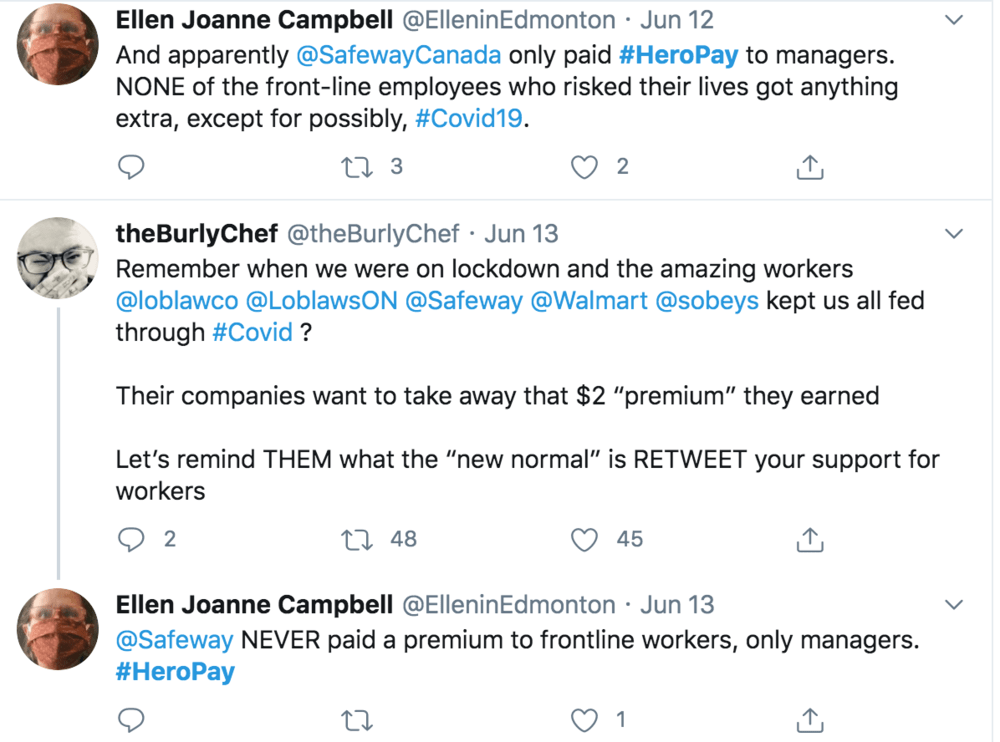
Backlash as Grocery Retailers Roll Back Hourly ‘Hero Pay’ in Canada

A few weeks ago some national grocery chains were being applauded for raising the wages of frontline workers who were considered heroes for their work during the COVID-19 pandemic.

Now, those same retailers are being sharply criticized for deciding to roll back those wages while the pandemic continues to take its toll on people’s health and on the economy.

Companies like Metro, Empire, and Loblaw have ended the $2 per hour premium pay for front-line workers.

Suzanne Sears, President of Best Retail Careers International, said there are two perceptions to the issue. First, the businesses themselves feel they gave a lot — more than was required.

“There’s the perception of the staff who feel like previously they were zeroes, then they went to heroes, now they’re back to being zeroes. There’s an emotional reaction,” said Sears, who is retained primarily by retailers for private searches to fill roles from the Executive to Sales Clerk level. “Two dollars an hour is not a huge amount of money to make. It doesn’t make a huge difference in your life but it is a sign of respect and appreciation.

“I think the way the staffing is feeling about it is that you told us this virus was so bad and so deadly we needed to shut down the entire country but we continued to go to work for you and some of us died for you and you gave us $2 an hour more. But nobody’s saying that it’s over. They’re just saying that it’s slightly better than it was. So now we’ll absorb the same amount of work, same risks.”

SCREENSHOTS FROM ANGRY TWITTER USERS

She said it’s more about the acknowledgement being withdrawn for their efforts. From a purely practical point of view, there’s not a grocery store or big box store that has lost money during the present crisis because they paid more for their staff. The amount came off of pure profit, said Sears.

“So if you can pay it why don’t you pay it,” she added.

Sylvain Charlebois, Professor, Food Distribution and Policy, Faculties of Management and Agriculture, Dalhousie University, said he can certainly understand why the businesses are rolling back premium pay.

“The economics for raising wages are weak in food retailing at best. Margins aren’t very high and of course they want to operate different stores,” he said.

“But also to me it’s a missed opportunity to look at their talent pool very differently and look at how grocery stores should be run in the future post-COVID. When I say that, I’m alluding to the use of automation to clean carts for example or cleaning anything really. Looking at how humans will interact in a store, looking at e-commerce as well. The use of analytics.

“I think grocery stores will need to deploy a very different altered strategy moving forward.”

He said grocery stores likely didn’t have much of a choice in rolling back wages. It was predictable. But it was disappointing especially in light of the fact that most people that work in the industry are those with highly vulnerable financial situations such as single-parents, students, seniors with fixed income, underprivileged demographic groups.

“These people who are probably occupying these positions may not have other options. So that’s something you may want to think about as a grocer when you think about the type of risks that your employees are exposed to. Absenteeism is also going to be something they have to look for because we’re not done with the second wave (of coronavirus). There is a second wave of course. We’re not done with this virus so risks are actually quite real still,” added Charlebois.

Unifor, Canada's largest union in the private sector, representing 315,000 workers in every major area of the economy, including 20,000 in the retail and wholesale sector, said it opposes the decision by Loblaw Companies Ltd. to end pandemic pay for workers at its retail outlets across Canada.

"The pandemic is not over. The danger has not passed. These workers are no less at risk and are no less essential today than they were yesterday. There is no justification for ending pandemic pay now, or ever," said Unifor National President, Jerry Dias.

"Retail workers have always been essential, and they have always deserved much better. The fact is, the pandemic did not make these workers essential and did not create the inequities in retail, it simply exposed them.

"Loblaw knows the risk is not over. It's just trying to boost profits on the backs of its most vulnerable workers, and that's just wrong. Unifor is putting all retail employers on notice – the return to normal for these workers is not happening, because normal was not good enough."

SCREENSHOTS FROM ANGRY TWITTER USERS

The United Food and Commercial Workers Union (UFCW Canada) said it is disappointed that employers in various sectors across Canada are choosing to stop paying COVID-19 premium pay while the pandemic continues, and some provinces are still enforcing precautionary measures.

“UFCW Canada acknowledges that premium pay was introduced as part of the COVID-19 response, but the union also expressed that premium pay should be maintained throughout the pandemic,” said the union in a statement.

It is the country’s leading private sector union, representing more than 250,000 union members across Canada working in in food retail and processing, transportation, health care, logistics, warehousing, agriculture, hospitality, manufacturing, and the security and professional sectors.

“The health and safety of UFCW Canada members is – and has always been – the union’s top priority. And, with that in mind, we must also acknowledge that many employers have acted upon UFCW Canada recommendations to better protect members, their families, and numerous communities. UFCW Canada will continue to meet with employers to maintain these achievements and further advance health and safety protocols across the country.

“UFCW Canada is pleased that society as a whole has come to better appreciate and recognize the crucial work that our members do in many important sectors of the economy. Throughout the pandemic, UFCW Canada members have gone above and beyond as frontline workers. And the issues, needs and concerns identified throughout the COVID-19 pandemic will be top priorities for the union in future collective bargaining efforts.

ICSC Survey Shows Canadians Pessimistic on Retail Recovery

A consumer survey by the International Council of Shopping Centers says 32 percent of Canadians believe economic conditions will improve 12 months from now, but 51 percent believe they will get worse, and eight percent think they will stay the same.

The sentiment is much more pessimistic than Americans as 49 percent of those south of the border said economic conditions would improve 12 months from now, 36 percent said they would get worse, and 10 percent said they would stay the same.

Improved economic conditions were most anticipated in British Columbia and Ontario at 36 percent with the Prairies the lowest at 23 percent.

“Such low levels of consumer confidence are a concern in consumer real estate circles where the recovery is expected to be a gradual improvement over time. Millennials and Gen X will lead the way in spending with physical stores, restaurants, and bars rated high on the ‘comfortable to visit’ scale,” said Michael Kehoe, Lead Ambassador in Canada for the New-York based ICSC.

“Malls and open-air shopping centres also scored high on preferred shopping venues to frequent after the COVID-19 crisis subsides. Consumer sentiment at 78 percent being more aware of the importance of small business in Canadian communities is a positive sign as small business will lead the way within any post lockdown recovery,” added Kehoe, a veteran of more than 40 years in the industry and broker/owner of Fairfield Commercial Real Estate in Calgary.

The survey of consumers also found:

  • 78 percent said the COVID-19 crisis has made them more aware of the importance of small businesses in their community and therefore will support them more in the future;

  • 73 percent said they are more likely to purchase from retailers/brands that helped communities/first responders during COVID-19 than those who did not;

  • 66 percent said whatever purchases they had planned but could not make during the outbreak, they will make after it subsides;

  • 61 percent said if small businesses in their community are forced to close due to COVID, it will be less convenient for them to get the goods and services they need; and

  • 66 percent said they would feel comfortable visiting physical stores to buy goods within two months or sooner after the crisis subsides with 56 percent citing restaurants, bars or other eating places;

Bruce Winder, a retail analyst and consultant with Bruce Winder Retail, said consumers will respond in different ways depending on their personal risk tolerance, health, and specific economic situation.

“Risk averse customers or customers who could be more susceptible to the virus (seniors or those with pre-existing conditions) may avoid non-essential retailers until a vaccine is administered in one to two years,” said Winder, who is also author of a new book on Amazon called RETAIL Before, During & After COVID-19.

“Customers who are less risk averse or feel they are less susceptible will begin to shop in somewhat similar patterns as before the pandemic, while respecting an individual retailer’s revised protocols as it relates to metering, PPE (personal protective equipment) and cleanliness.

“Overall, I think we will see brick and mortar retail return to perhaps 60-90 percent of pre-pandemic traffic and sales levels for a little while but this will vary widely by retailer, category and target customer. Retailers have worked hard to facilitate transactions outside of brick and mortar stores through e-commerce.”

Winder said some customers will reduce spending as their income has been reduced and their job prospects are at risk, specifically as the Canada Emergency Response Benefit potentially runs out for some consumers.

“The question for many retailers will be whether they can survive under these new lower traffic sales and margins (retailers often make less money on e-commerce) levels once government supports dry up but before a vaccine is widespread,” he added.

The survey also found:

  • 20 percent of consumers do not plan to cut back on spending while three percent said they will in the first month, 10 percent for one to two months; 22 percent in three to five months; 17 percent in six to eight months; 11 percent in nine to 12 months; and 17 percent to over one year;

  • New considerations among consumers include 69 percent saying they will be limiting direct contact with other people; 66 percent saying they will be practising social distancing; 41 percent saying they will be making expenditures on non-essential goods and services;

  • As for the top uses of federal stimulus money, 56 percent said to buy groceries; 45 percent to pay housing costs; 33 percent to put into savings; and 33 percent to pay off debt; and

  • 38 percent of Canadians have received or plan to receive assistance.