Home Blog Page 959

More than Half of Canadians will Avoid Restaurants for the Foreseeable Future: Study

A new survey on COVID-19 suggests 52 percent of Canadians intend to avoid restaurants for the foreseeable future.

The Angus Reid survey found that physical layout appears to be the most important issue for people as 26 percent of Canadians intend to avoid restaurants for this reason. About 10 percent of Canadians say they will avoid establishments due to their food safety reputation. And about one fifth, or 22 percent, of Canadians will avoid establishments for an undisclosed reason.

This shows that even when businesses reopen, they will need to work hard to gain back the confidence of customers. British Columbia, at 56 percent, has the highest rate of respondents who intend to avoid restaurants due to public health concerns, followed by Ontario at 55 percent. The lowest rate is in Saskatchewan, at 37 percent, according to the survey.

Sylvain Charlebois, the lead author of the report and Professor, Food Distribution and Policy, Faculties of Management and Agriculture, Dalhousie University, said consumers have a foot on the gas as well as having a foot on the brake.

“Canadians are split. They’re not sure what they’re going to do. Some are eager of course. About one Canadian in five are eager to go out as soon as possible but there is a majority of Canadians who are unsure. They’re not sure if going to the restaurant is a good idea and frankly I would say that after three months of hearing about COVID, and only about COVID, I think people are just kind of mesmerized a little bit,” said Charlebois.

“They don’t think beyond their kitchen. And frankly I think for operators the biggest challenge, the biggest competitor, that they’re now facing is our own kitchen to get us out of there and into dining halls, on patios. It’s going to be very difficult to do.”

But results of the survey also suggest many Canadians kept ordering food regularly from restaurants during the pandemic. It found that 64 percent of Canadians have ordered food at least every two weeks from a restaurant. Saskatchewan has the highest rate of respondents who ordered during the pandemic at 76 percent. The Atlantic region has the lowest at 58 percent. Younger people were more likely to order out from a restaurant. It said 81 percent of respondents between the ages of 18 to 34 years old had ordered from restaurants, the highest rate among age groups. About 29 percent of Canadians ordered from restaurants at least once a week, and nine percent have ordered food once a week since the beginning of the pandemic.

“Canadians appear to have never given up on restaurants, but when you’re at home, there are limitations to enjoying food prepared by a restaurant,” said Charlebois.

“It was a pleasant surprise. Clearly Canadians haven’t given up on restaurants. I actually didn’t expect that percentage to be as high as that to be honest. You can see that people really wanted to support their local outlets and continue to do so for 12 weeks.

“The other pleasant surprise was to see the number of Canadians wanting to support independent operators as well. That was actually quite pleasant to see. A lot of people are focusing on independent operators knowing that they don’t necessarily have the same kind of support as major chains would. That was actually quite reassuring as well.”

When asked the type of restaurant they would first visit, 64 percent said independent while 39 percent said franchise/chain.

When asked what they were missing the most from not going to a restaurant, 37 percent said enjoying time with family and friends and 22 percent said just being outside the house.

Howard Ramos, Professor of Sociology at Dalhousie University and one of the report’s collaborators, said that “people say they won’t rush back to restaurants, but almost everyone plans to go back eventually. This will be hard for SMEs who may already be on the brink of failing, and it means gift cards or other means of supporting them in the reboot is needed.”

Respondents in Ontario appear to be most concerned about a potential second COVID-19 wave as 43 percent of Ontarians plan to wait until such a second wave has occurred. Alberta ranks second in being most concerned by a second wave at 33 percent.

“I think it’s going to be a work in progress. Some people actually feel that restaurant operators will cut corners in order to make sure that they are profitable because it’s not going to be easy for them,” said Charlebois. “I don’t believe that at all. I actually do think that operators will want to make sure that Canadians are as safe as possible back and in front of the house. It doesn’t matter if it’s in the kitchen or on the patio where food and drinks are being served. I do believe that operators are fully aware that they’re dealing with a customer base that is essentially shell-shocked by what has happened over the last three months.

“COVID came quite violently in our lives. I think we need to appreciate that and restaurant operators will actually feel that they have a duty to bring some fun back into our lives.”

When Canadians were asked what they expect to see when they visit a restaurant as they reopen, 78 percent said they expect to see more personal protective equipment worn by staff, 60 per cent expect to see more plexiglass. At the same time, 36 percent of Canadians expect slower service and 29 percent expect menu changes or fewer choices. Interestingly, a total of 12 percent expect to see mannequins and dolls to fill seats to make an establishment look full.

Nordstrom Reopening Most Remaining Canadian Stores on Thursday

Nordstrom at CF Sherway Gardens. Photo: Nordstrom

On Thursday, June 11, upscale Seattle-based retailer Nordstrom will open the remainder of its full-line Nordstrom stores as well as select off-price Nordstrom Rack stores in Canada. All of Nordstrom’s stores closed temporarily in March due to the COVID-19 pandemic and some in British Columbia and Alberta had already reopened after government restrictions were lifted.

While retailers in enclosed shopping malls have not been permitted to reopen in Toronto, all of Nordstrom’s stores in the city feature exterior entrances thus allowing them to reopen as per guidelines. Nordstrom operates three full-line stores in Toronto as well as three Nordstrom Rack units in the region.

Locations due to open on June 11 include the following:

  • Ontario: Nordstrom CF Rideau Centre, Nordstrom CF Sherway Gardens, Nordstrom Yorkdale Shopping Centre, Nordstrom CF Toronto Eaton Centre, Nordstrom Rack Ottawa Train Yards, Nordstrom Rack Vaughan Mills, and Nordstrom Rack Heartland Town Centre

  • Alberta: Nordstrom Rack Deerfoot Meadows and Nordstrom Rack South Edmonton Common

These locations will join the already-opened full-line Nordstrom store in Calgary’s CF Chinook Centre which opened on May 28, as well as the Nordstrom flagship at Vancouver’s CF Pacific Centre which reopened on May 22. This announcement means that all Nordstrom Rack locations will once again be open to the public, bar the location on Bloor St. in Toronto, which is set to reopen soon.

NORDSTROM RACK, VAUGHAN MILLS. PHOTO: NORDSTROM RACK

Nordstrom wrote on its blog Nordstrom Now: “On behalf of the entire team at Nordstrom, we’d like to take a moment to say thank you again for your loyalty and support. The past several months have been unlike anything we’ve ever experienced, and we’re working hard to evolve so we can continue to show up in a meaningful way for you, our employees and communities. We want to continue to bring you the service and convenience you need, even if it may look a little different than it has in the past.”

Despite the continued online presence and availability of curbside pickup (which will continue to be offered at all Nordstrom stores at all times with the exception of Nordstrom Rideau Centre), Nordstrom had closed all stores across the country in March, at the beginning of the COVID-19 outbreak in Canada. Now, as the numbers are decreasing and the curve is slowly being flattened, Nordstrom is taking a phased, market-by-market approach to reopening its stores. The company has reiterated the importance of maintaining the health and wellbeing of its employees, customers, and surrounding communities, and so are taking necessary steps to ensure Nordstrom stores remain in alignment with the government guidelines.

NORDSTROM AT CF CHINOOK CENTRE. PHOTO: CANADIAN BUSINESS

Nordstrom have laid out the precautionary steps it will be taking moving forward. Some updates include:

  • Conducting temperature checks and health screenings for our employees before they come into work

  • Providing face coverings for employees and customers

  • Taking steps to allow for social distancing of six feet or more, including limiting the number of customers and employees in the store

  • Increasing cleaning and sanitization

  • Modifying the fitting room experience

  • Continuing to offer contactless curbside services at our full-line stores

  • Pausing or adapting high-touch services and customer events

  • Keeping tried on or returned merchandise off the sales floor for a period of time

  • Altering hours of operation

For further details on the steps being taken in response to COVID-19 can be found on www.nordstrom.ca and additional information on each store is available on Nordstrom’s Store Locator Page.

Last month, Nordstrom announced that it was closing 16 stores in the United States. Fortunately none of the Canadian stores will be closing thus far and as of Thursday, all will again be operational. A Nordstrom Rack store at Willowbrook Centre near Vancouver was set to open in April of this year, and the landlord for the centre has confirmed that Nordstrom Rack’s opening has been delayed until the fall.

City of Toronto’s ‘CafeTO’ Initiative Allowing Businesses to Expand Patios into Sidewalks

The City of Toronto recently announced its CafeTO initiative where outdoor patios can be expanded into sidewalks and parking lots to assist restaurants with physical distancing regulations as they prepare to reopen soon.

The CafeTO initiative is designed to create more outdoor space for restaurants and bars in an attempt to make up for the lost revenue over the past months of closures.

A press release stated that the program “will provide more outdoor dining areas by identifying space in the public right-of-way and expediting the current application and permitting process for sidewalk cafes and parklets.”

In Mayor John Tory’s announcement he noted the continued strain put on Toronto’s restaurants due to not being permitted to allow dine-in guests. He was also optimistic that the time to reopen is fast-approaching and assured the food and beverage industry that the city is available to assist restauranteurs in the application of the CafeTO program in the coming weeks.

“CafeTO is one more example of a quick-start program that will bring vibrancy back to our main streets and help our hospitality industry and all those who rely on it.”

To date, the city has already implemented a cross-divisional action team to oversee the program efficiently, and is conducting a review of current requirements while determining how the city can better support businesses, including waiving patio fees which would otherwise be levied on expanded space and undertaking planning for reallocating curb lanes for patios to maximize space.

CafeTO is working closely with TABIA and the city’s many BIAs to coordinate the economic rescue initiative. They will be key to ensuring restaurants in appropriate locations across the city have the means and information to sign up for expanded space as soon as possible.

Establishing the essential cafe placements guidelines is also underway and quickly being finalized to ensure participating patios can be operational as soon as they are permitted.

Regular permit and application fees may be waived in order to allow for participating restaurants and bars to incorporate these new aspects to their business model.

Deputy Mayor Thompson called the initiative “an opportunity to expand patio culture across our City and bring people back to our main streets as the city begins to reopen and recover”.

The toronto.ca website states that “a simple registration process for businesses to sign-up for CafeTO will be shared with business owners as soon as its finalized.”

This announcements comes after Ontario Premier Doug Ford announced that government officials are in the process of permitting second stage of the province’s economic reopening plan, part of which may include the reopening of patios. On Wednesday Ford allowed parts of the province to open on Friday, though areas such as Toronto will remain shut for the time being.

Restaurants in Edmonton, Calgary, and Vancouver are steps ahead of Ontario and have already been permitted to reopen the food and beverage industry for dine-in guests. Some establishments are availing of similar initiatives to what we hope to see in Toronto.

B.C. is currently in phase two of its reopening plan, which began on May 19 and permits patios to open with sufficient distancing measures. Recent reporting on the status of open restaurants and patios in B.C., however, have noted a shortage in patrons since opening a few weeks ago. Within the first few days of reopening things seemed to be picking up — at 50 percent capacity of course — but have subsequently dropped off.

In Alberta, the industry was permitted to begin business once again on May 14, during stage one of the province’s reopening plan. Again, with regulations to keep capacity at 50 percent. Foodservice businesses across the country are hoping to see a return in traffic. In international markets where foodservice businesses have reopened, however, business has been slower than prior to the COVID-19 shutdowns. A recent Angus Reid study shows that more than half of Canadians are hesitant to return to restaurants any time soon. So it seems, just like everything else COVID-related, only time will tell.

Major Optical Chain Secures Mink Mile Space at the ‘Best Retail Corner in Canada’

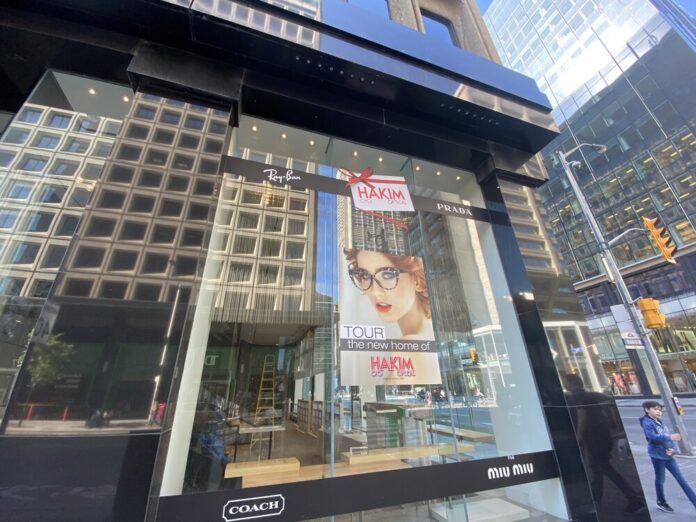
Hakim Optical PHOTO: CRAIG PATTERSON

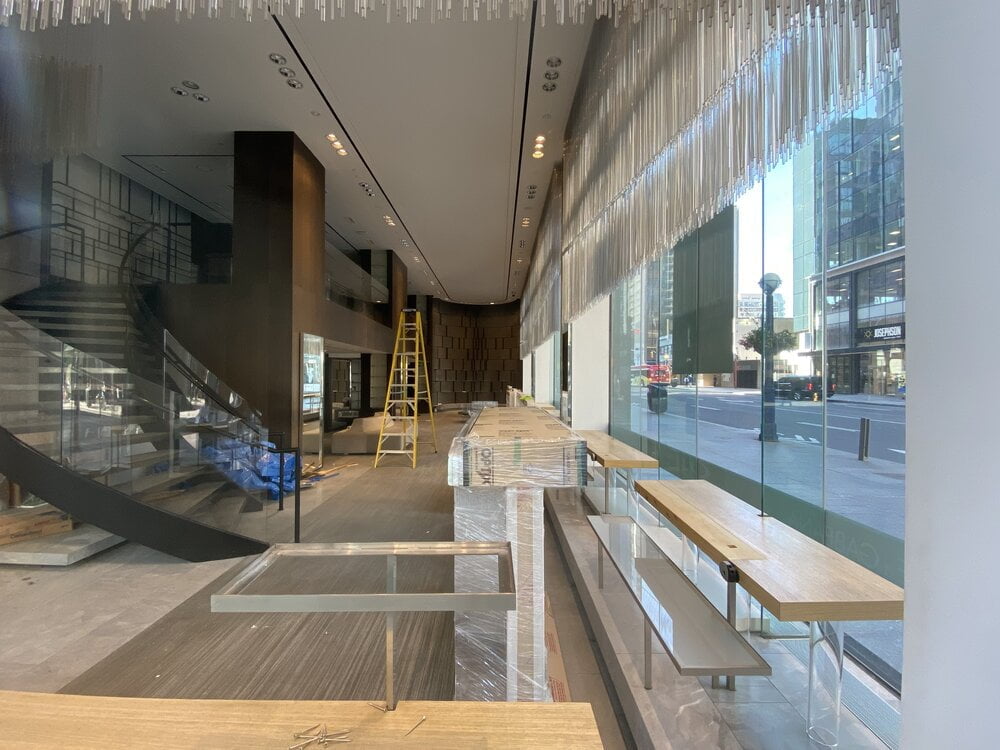
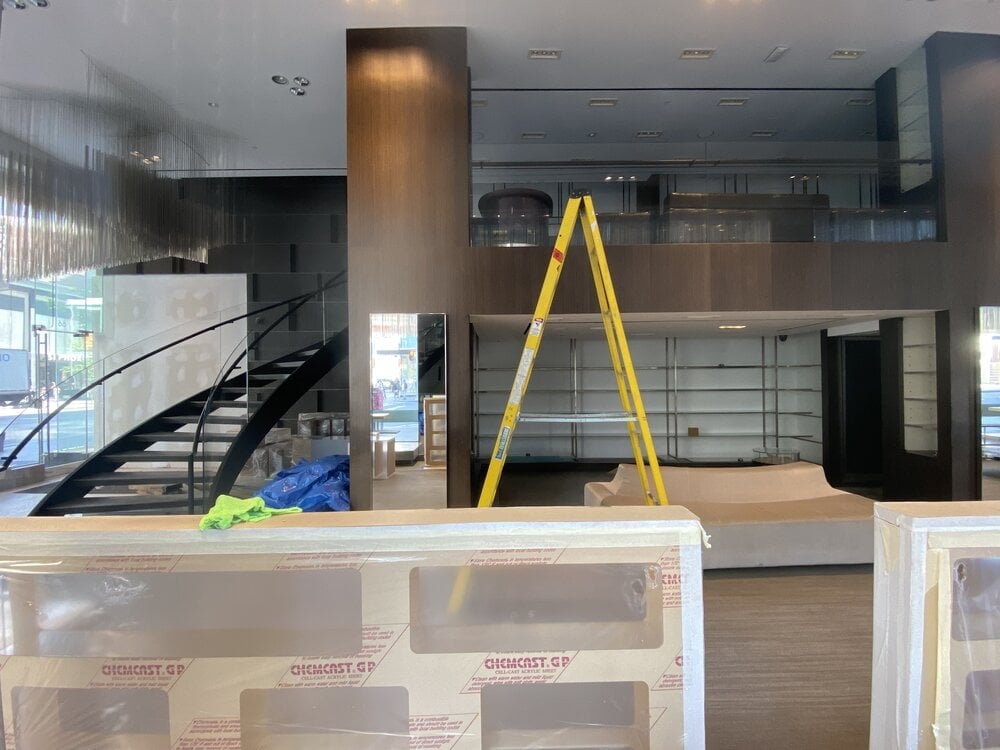
Toronto-based eyewear chain Hakim Optical has leased a prominent corner retail space at 66 Bloor Street West where it is building a luxury focused flagship. Hakim Optical will occupy part of the space formerly occupied by Davids Footwear which closed in October of 2019.

Hakim Optical’s corner retail space faces both onto Bloor Street West and Bay Street within the 1200 Bay Street building. Hakim Optical will occupy more than 3,000 square feet of the former 6,000-square-foot Davids space. Broker Jordan Karp and his team at Savills Canada negotiated the deal on behalf of the landlord. Hakim Optical was self-represented in the lease deal which a source from another brokerage described as being “too good to pass up”.

Signage on the under construction Hakim Optical store indicates that brands carried will include Giorgio Armani, Tiffany & Co., Prada, Miu Miu, Dolce & Gabbana, Coach, and others.

The corner of Bloor and Bay streets sees thousands of pedestrians pass by daily on a typical day, and is part of the stretch of Bloor Street that some refer to as the ‘Mink Mile’. To the east towards Yonge Street, major retail tenants include Holt Renfrew’s flagship, Eataly, Birks, H&M, Zara, and Nordstrom Rack. To the west of 66 Bloor is a row of upscale retailers including Harry Rosen, Holt Renfrew Men, Hermes, Dior, Gucci, Prada, Louis Vuitton, Tiffany & Co., Burberry, and others.

PHOTO: CRAIG PATTERSON
CLICK FOR INTERACTIVE MAP

In an interview last year, Birks CEO Jean-Christophe Bédos described the corner of Bloor and Bay as the “best retail corner in Canada”. The Birks flagship store located at that corner reopened last year after a substantial renovation as part of the overhaul of Manulife Centre which also saw Italian grocerant concept Eataly open upstairs.

Other optical retailers in the area could lose market share with the opening of the upscale Hakim Optical location. Across the street in the 60 Bloor Street West building is upscale eyewear retailer Josephson, which recently completed a renovation of its storefront that faces Bay Street. On nearby Old York Lane, optical retailer Karir carries frames that in some cases priced in excess of $1,000. Other eyewear retailers in the area cater to locals and visitors, which before COVID-19 included substantial tourist and office foot traffic.

Hakim optical was founded by Karim Hakimi in 1967 and is the largest privately owned optical chain in Canada. The company has over 160 stores across the country in Ontario, Nova Scotia, New Brunswick, Manitoba, Saskatchewan, Alberta, and British Columbia. The company’s slogan “Your Eyes Can Have it All at Hakim Optical” since 2003 has been named by Huffington Post Canada as one of Canada’s most memorable jingles, and is still used.

Last week it was revealed that the 12-storey 1200 Bay Street building where the new Hakim Optical location will be is expected to be demolished in years to come. A development application by Dutch developers Kroonenberg Groep and ProWinko could see a Herzog & de Meuron designed 87 storey skyscraper rise on the site rising more than 1,060 feet above the Bloor Street intersection. The proposal includes retail at the base of the building, offices from the second level to the 13th floor, and a residential tower component above containing more than 300 condominium units. The top floor would include a restaurant according to plans. Given the proposed height and density, sources say that the tower proposal is unlikely to be approved given the history of development in Toronto.

A proposal next to 1200 Bay Street, as reported on Retail Insider last year, could see a massive mixed-use tower with a residential focus rise next door. It would involve demolishing the 80 Bloor Street West office tower to construct a massive building that would cantilever over the Harry Rosen store at 82 Bloor Street West. Some are saying that the proposal is unlikely to be approved as well though it’s clear that developers are interested in building new towers in Toronto’s Bloor-Yorkville area.

The space Hakim Optical will move into was formerly occupied by Davids Footwear. The luxury footwear retailer operated at the corner for decades before being put into bankruptcy by parent company Rosejack Investments in August of 2019.

Guidelines Set for Fitness Facility Reopenings in Canada

The Fitness Industry Council of Canada has released guidelines for fitness facilities across Canada to follow as provinces begin reopening businesses.

But many of those businesses remain closed as the economy slowly recovers from the COVID-19 pandemic and some provinces still have no target date for the reopening of fitness studios and centres.

“The guidelines that the Fitness Industry Council of Canada has established are extremely helpful both to fitness establishments and to our members. As an industry, we will be following these in order to ensure our staff and members feel comfortable and confident as they return to gyms, studios, and other facilities. We appreciate all of the support we’ve received over the past few months, and look forward to seeing everyone again very soon,” said Carl Ulmer, Managing Partner / Director of Operations, L&L Signature Fitness Group.

Scott Wildeman, President of the Fitness Industry Council of Canada, said each province has different timetables for the opening of businesses in the industry. Some of the regions in British Columbia have reopened. Manitoba has reopened. Prince Edward Island reopened on June 1. Saskatchewan reopens June 15. Quebec, Ontario, and Alberta are on the way.

The Fitness Industry Council of Canada has set out protocols for containment, cleaning, staffing, and operations.

The Council has more than 5,000 facilities in Canada and the association represents about 500 locations across the country.

He said the fitness industry is taking every precaution and practical step possible to ensure the health of patrons and staff.

Wildeman said surveys out of Europe and the UK indicate about 60 percent of members will come back in the first month. Another 30 percent will come back in the second month and then seven percent will come back in the third month and three percent are undecided.

“The caveat to that is with proper protocols in place,” he said.

The Council has developed four key areas for reopening: containment, cleaning, staffing, and operations.

In the first area, containment, by scheduling workouts ahead of time, businesses will be able to limit the number of people in a facility, along with ensuring the proper social distancing. Traffic flows will be considered in common areas as well as exercise floors.

“The first thing is to limit the number of people in a facility at a given time. Most facilities will do a booking system where you can basically book your visit. So you’re not going to show up to the gym and have everybody else show up at the same time. It will be really a planned event,” said Wildeman. “There’s actually now technology where you can plan your visit inside a gym.

“So you can book your cardio equipment for half an hour and you can book to do strength for a half hour and you can even book a locker in the locker rooms. By doing that, we can ensure social distancing and then also sanitization. We’re really set up for contact tracing. So if somebody is sick we can also assist in notifying other patrons that there was somebody who contracted COVID and to go get tested. So we are perfectly set up to help with contact tracing.”

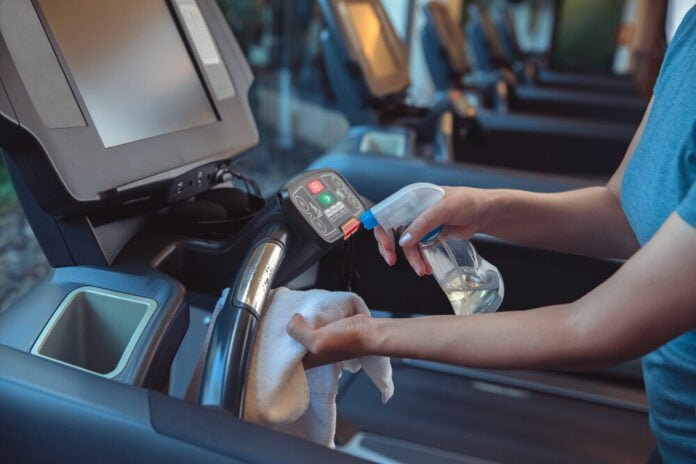
The second pillar of reopening is cleaning where members will be empowered to clean and sanitize any piece of equipment before they touch it. Staff will be committed to thorough cleaning of facilities throughout the day. Activities will be scheduled to allow for a deep clean between sessions.

“We are actually one of the only industries where you can clean and sanitize something before you touch it. If you think about it, if you go to the grocery store you don’t sanitize a cereal box before you put it in the cart,” said Wildeman. “We have hand sanitizer and disinfecting wipes that kill viruses and we’ll have those all over the place so you can be proactive as a member and clean something not only after you’re done with it but before you even touch it in the first place. We will also have staff do thorough cleans of high touch areas.

“I actually think from a cleanliness standpoint we will be one of the cleanest places you can be. And from a social distancing standpoint with the containment we’ll make sure that usable equipment is spread out and we limit the number of people in the facility at any given time.”

The third pillar of reopening is staffing where staff will be trained on proper protocols and systems to be implemented to keep them safe as well.

“Staff will be encouraged to wear gloves and masks. Staff will be encouraged to also have social distancing. Once your personal training is spotting somebody you don’t need to be within six feet of somebody. And even then personal trainers can spot somebody with verbal cues versus having to be within six feet of a person,” explained Wildeman. “We’ll make sure we adjust our operations so to speak to make sure we maintain that social distance. We’ll make sure that we choreograph our classes to be safe. So we won’t have any circuit classes where you go from station to station. Everything would be at your own personal station. The staff, the instructor, will be six feet away from everybody and not facing them so you’re not breathing onto somebody.”

The last section of reopening guidelines is operations where facilities will be required to create detailed operating procedures and will be focused on all “touch points.”

“Do you have traffic flow in your facility mapped out? Do you have pinch points notified? An entrance into a locker room for example. Do you have the ability to yield and stop and wait for somebody else to go first? We’re going to identify those pinch points. Do your policies match up? Are you going to enforce a late cancellation policy or a no-show policy? So if somebody is sick you don’t want to necessarily penalize them for not coming otherwise they might show up when they shouldn’t show up,” added Wildeman.

Retail Innovation Challenge Launched to Help Retail Sector Adapt and Emerge from COVID-19

The Bensadoun School of Retail Management at McGill University in Montreal has launched a retail innovation challenge to help the retail sector as it adapts to and emerges from the COVID-19 pandemic.

The School invited university students across Canada from different academic fields to come together and generate actionable solutions to assist the retail sector.

The challenge presents an experiential learning opportunity to mobilize the knowledge and creativity of university students and embolden them to solve real problems in collaboration with businesses during this period of economic recovery, says the School.

Charles de Brabant, executive director of the Bensadoun School, said the educational institution launched this initiative as a way to assist the retail sector in these unprecedented times that could be different from and complementary to what other organizations were doing, such as retail industry associations and consulting firms.

The mission of the Bensadoun School is to educate and empower a global network of interdisciplinary thinkers and practitioners who research, envision and develop a dynamic and successful world of retail.

“The challenge is to give students, who may not have internships this summer or have seen them canceled, real life opportunities to work with retailers . . . who are trying to figure out how they’re going to reinvent themselves or rethink their businesses or what are good ideas to survive as the economy opens up,” said de Brabant. 

“So this is where the Retail Innovation Challenge came as an idea in mid-April and we decided to launch it eventually as a series of challenges starting with the food sub-sector of retail and we broadened it to include restaurants in this category.”

Business cases have been distributed to student teams across the country which include two restaurants (Bacaro Pizzeria and Food Chain), one coffee business (Café Barista), and one grocer (Can Am). These last two companies were principally BtoB businesses prior COVID-19 and pivoted to online BtoC to survive. 

Eighty teams have been registered for the challenge and they come from 20 universities throughout Canada. The challenge, which began on June 4th, will run over three rounds. Townhalls will be offered with experts from two sponsors, Lightspeed and Canada Post, as well as mentoring sessions for the 8 finalist teams during the week of June 15. A semi final round on June 14 will allow the top five teams per company to present the respective company leaders. The finals will be held virtually on June 21 in front of an independent jury and winners announced that day.

“Like most sectors of the economy and maybe even more so, retail has been strongly impacted by COVID-19, especially retailers focused on non-essential goods and services with the closure of almost all physical stores, significant layoffs, and a dramatic drop in demand, even for those with an on-line offering. And a recent study by McKinsey & Company reveals that as the economy opens up, only 20 percent of Canadian consumers feel optimistic about Canada’s economic recovery,” says the Bensadoun School. 

De Brabant said the ambitions of the School are to be the leading academic institution in the world dedicated to the future of retail.

“So we have global ambitions but we’ve basically decided given the pandemic and the focus on local and national to focus more on local companies in this first instance at least trying to get this thing off the ground but mostly also because there seems to be this very strong nationalistic community spirit that’s developed throughout this pandemic,” he said. “So we’ve put our focus there.”

The School was launched after receiving a $25-million donation from the  Bensadoun Family Foundation, created by Aldo Bensadoun who founded and led Aldo, the global shoe empire. It began taking its first students in September of 2018.

Ontario Government Announces Moratoriums on Commercial Rent Evictions

Open Sign

Ontario joined a growing list of provinces who have placed moratoriums on commercial rent evictions to help small businesses cope with the economic pummelling they’ve received due to the COVID-19 pandemic.

Premier Doug Ford, in a news conference to announce the launch of Stage 2 of the province’s relaunch strategy, said everyone is eager to get things back to normal “and no one wants to get the economy going and get people back to work more than I do.”

“We need to get people back to work. We need to get the economy going and to do this as quickly as possible. For many small business owners today’s announcement is good news because our small businesses are struggling right now and for them making rent is top of mind. That’s why we worked to get $900 million to help businesses with commercial rent relief,” said Ford.

He said commercial landlords have to be “fair and help out everyone, but we still heard about some landlords who just didn’t get the message. Well, I’m here for the little guy. That’s why I ordered legislation to ban commercial evictions for those who qualify for the commercial rent relief program. The ban would take effect for evictions on or after June 3 and last until August 31. Our small business owners are the backbone of our communities and now more than ever we all need to support them.”

Most regions in Ontario will be allowed on Friday to proceed to Stage 2 in the province’s relaunch during COVID.

“We are pleased to see Premier Ford making good on his commitment from a couple of weeks ago that if landlords wouldn’t step up on rent, he would step in,” said Karl Littler, Senior Vice President, Public Affairs at the Retail Council of Canada.

In a joint statement, Ryan Mallough and Julie Kwiecinski, both Directors of Provincial Affairs, Ontario, for the Canadian Federation of Independent Business, said the organization applauds the Ontario government’s announcement to finally put a temporary halt to commercial tenant evictions.

“CFIB has been calling for a commercial eviction ban for tenants in good standing since the beginning of the COVID-19 pandemic. We are relieved that no more struggling small businesses will find locks on their doors because their landlords are unwilling or unable to participate in the Canada Emergency Commercial Rent Assistance (CECRA) program,” said the statement.

“We will continue to urge the provincial and federal governments to make much-needed improvements to CECRA to either make it easier for landlords to apply, or to pass the financial relief directly to small business tenants. CFIB also welcomes the details provided today on Stage 2 business reopenings. After months of decreased revenues and mounting bills, retail businesses in malls, the personal services sector, and bars and restaurants in most regions in Ontario will finally start down the long road to economic recovery.

“We also appreciate the government’s cautious, yet sensible approach to regional reopening, not holding back businesses from opening their doors to customers sooner in areas where warranted by COVID-19 statistics. We look forward to working with the Ontario government on a healthy and strong economic recovery.”

On Friday, Alberta and Saskatchewan also announced moratoriums on rent evictions.

“It’s been clear for months that an evictions ban has been a necessary step, which is why so many countries did this in late March. I feel awful for the people who have lost their businesses or experienced extreme stress due to the delays in provincial action. We expect many more landlords to consider CECRA now. But attention must now turn back to the federal Ministry of Finance and the CMHC (Canada Mortgage and Housing Corporation) to significantly reduce CECRA’s complexity. With eviction bans in place, that will be the biggest factor in limiting rent relief for small business,” said Jon Shell, co-founder of the grassroots coalition Save Small Business, supported by about 40,000 small businesses across Canada.

The CFIB said 44 percent of Canada’s small businesses are now fully open, up from 38 percent two weeks ago, but many regional and sectoral differences remain and some sectors, particularly restaurants and hospitality, continue to be largely closed. Only 15 percent of small firms report their sales have returned to normal, said the organization on Monday.

It said New Brunswick (59 percent) and Alberta (54 percent) lead the way with the largest share of open businesses, while Newfoundland and Labrador (24 percent) continues to trail the rest of the country. In Ontario, 37 percent of businesses are fully open and only 12 percent said their sales have returned to normal.

“There are definite signs that economies are awakening, with more than half of small businesses reporting they are fully open in some provinces,” said CFIB president Dan Kelly. “However, for many recovery is another question as just opening your doors does not guarantee your customers will return.

“I am deeply worried about the future of businesses in sectors like transportation, health and social services, arts and recreation and restaurants/hospitality as fewer than one in 10 of these firms have sales at or near normal. Our main street businesses will need a lot more support, both from government and from consumers, before the crisis is behind them.”

The CFIB said only 13 percent of hospitality/restaurant businesses and 21 percent of arts and recreation businesses are fully open, compared to 44 percent of retailers and firms in the personal services sector. Additionally, certain personal services businesses, like hairdressers, remain closed in most provinces.

CECRA for small businesses will lower rent by 75 percent for small businesses that have been most affected by COVID-19.

It will provide forgivable loans to qualifying commercial property owners to cover 50 percent of three monthly rent payments that are payable by eligible small business tenants who are experiencing financial hardship during April, May, and June. In this way, CECRA for small businesses will provide relief for small businesses paying less than $50,000 per month in gross rent that have either been forced to close due to the pandemic or have had their revenues severely impacted by at least 70 percent, says the CMHC which will administer the program on behalf of the Government of Canada and provincial and territorial partners.

Field Agent Canada Launches Innovative Retail Ratings Program for Online Products

Field Agent Canada, a company that leverages crowdsourcing and mobile technology to collect retail audits and conduct mystery shops for retail operations, has now launched an easy and cost-effective way to get ratings and reviews for products being sold online.

Jeff Doucette, General Manager of Field Agent Canada, said the concept mobilizes real shoppers to buy a brand’s products from specific retailers, try them at home and then leave honest ratings and reviews on product pages on either brand or retailer websites.

“It’s a new service that we’ve launched in Canada based on the success we have had in the U.S. business, which launched it earlier in the year. It meets an important need in the industry especially as online sales are seeing dramatic increases,” said Doucette.

Field Agent Ratings & Reviews helps brands ensure that their own brand website and the websites of different retailer partners have a sufficient number of ratings and reviews on each product in their lineup.”

Doucette said research discovered that many products had either no reviews or very few reviews. Other products had reviews that were really dated or did not include a lot of detail that was helpful to other shoppers.

“We’ve done surveys and explored the topic in-depth and even on grocery store and drug store type products, shoppers are using ratings and reviews to help them decide which products they’re going to put in their online baskets,” said Doucette.

“Field Agent Ratings & Reviews is about making sure that every single product has a good assortment of reviews and that they provide relevant information to help other shoppers make purchase decisions.”

The Field Agent Ratings & Reviews concept is very simple as it takes all of the work out of it for the brand. The brand provides a list of products that they would like reviewed and the website(s) where they would like those reviews posted. Field Agent takes it from there.

Shoppers are then asked to buy a specific product at the specified retailer either at a local store or online. This ensures that the posted review is a result of a verified purchase from a specific retailer and the purchase is made by a real Canadian shopper.

“If someone is placing a review on a specific retailer’s website, we are ensuring that that product was actually bought from that retailer,” said Doucette.

“Field Agent has 125,000 Canadian users that have downloaded our mobile app and we post Ratings & Reviews opportunities in the app to qualified shoppers. They’ll go and buy the product at the local store, they’ll try it at home, and they’ll provide us with verification of where they’ve bought it so we know it’s a verified purchase at the correct retailer. We then we ask them to post their product review on the retailer/brand website and also submit the details of the review through the app so our client can track the reviews on our on-line dashboard; making the process easy for the client to see all the reviews posted on their products.”

The big question that normally comes up, added Doucette, is if the reviews and ratings are being filtered. That’s a big no-no.

“It’s really about genuine reviews and real honest opinions. We do not filter out less-positive reviews but we do stress that the review must be detailed and explain why the shopper gave the rating that they gave. No three-word answers. We get the shopper to elaborate and give some context as to why you gave it a four out of five instead of a five out of five,” he said.

“Field Agent Ratings & Reviews is basically a hands-off solution where our clients only need to provide us with a list of items and the sites where they want reviews to be posted and we take care of the rest,” said Doucette.

There has been a significant increase in online shopping over the past few months so the launch of this service is very timely. Shoppers today are increasingly shopping online, whether it’s for delivery or pick up, and one of the main ways they filter products is by the star ratings on each product.

“Products that do not have a robust assortment of reviews will have a smaller chance of making it into the basket.” said Doucette. “Ensuring all products have ratings and reviews needs to be part of every brand’s e-commerce strategy.”

Field Agent Ratings & Reviews provides a quick and inexpensive solution for brands looking to boost their online sales performance in today’s omni channel marketplace.

To learn more click here.

*Partner content. To work with Retail Insider, email: craig@retail-insider.com

Cannabis Retailer ‘Choom’ Opens Flagship Retail Location in Vancouver [Photos]

NEW CHOOM FLAGSHIP. PHOTO: CHOOM

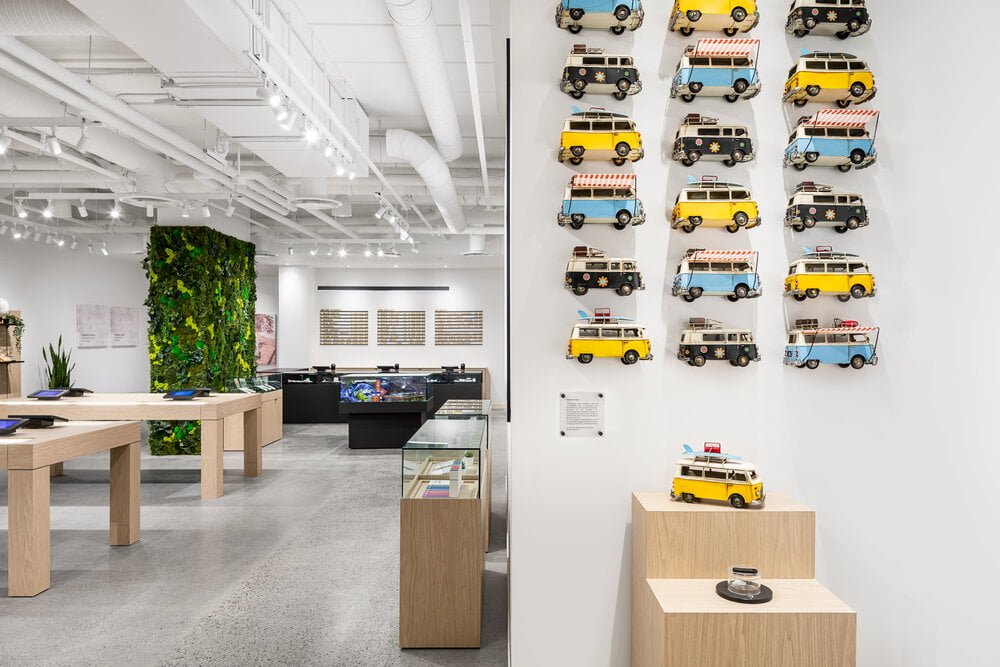
Choom, one of Canada’s leading recreational cannabis retailers, has launched a flagship retail store in the Olympic Village neighbourhood of Vancouver, B.C. (191 West 2nd Avenue).

The company — which has already seen great success in Ontario and Alberta — is expanding its reach despite the current economic climate as a result of COVID-19.

Choom is known for its elevated customer experience through its implementation of curated retail environments and in-store educators, all of whom are trained to provide a personalized client experience.

The newest Choom location will highlight cannabis favourites from local, B.C. licensed producers, as well as products by some of North America’s leading cannabis brands. Brands including Whistler Cannabis, San Raphael ’71, and Dosist, will all be amongst the Olympic Village Choom lineup.

“Today, the Choom team celebrates another exciting milestone with the opening of our flagship store in our hometown of Vancouver, B.C.,” said Corey Gillon, CEO of Choom. “Thanks to the world-class, retail expertise of our team, we are excited to share a reinvigorated version of the Choom brand – one that is founded on providing an elevated retail experience, positioning Choom as a leader in the retail cannabis space. From the novice user to the more experienced, our goal with Choom is to create a unique, welcoming environment for our customers that is rooted in our company’s ethos.”

The space was designed by Vancouver-based Cutler and millwork was manufactured by Peregrine.

INTERIOR OF NEW CHOOM FLAGSHIP. PHOTOS: CHOOM

Outfitted with premium furnishings, Choom’s new Vancouver flagship store will provide customers with the usual elevated experience previously known to customers in Alberta and Ontario.

To date, Choom operates 18 retail locations across three provinces: Alberta, Ontario, and B.C.. With an aggressive growth strategy to increase its national footprint planned for the next three to five years, Choom’s newest B.C. location follows closely behind the company’s most recent acquisition of a flagship location in Niagara Falls, Ontario.

The Canadian brand notes that its Olympic Village location is only the first new store to open in B.C. and that there are six stores planned for the province in the near future.

Inspired by Hawaii’s “Choom Gang” – a group of buddies in Honolulu during the 1970’s who loved to smoke weed – or as the locals called it, “Choom”, the brand encourages cannabis consumers to embrace an active lifestyle — one that is inspired by the social activities and pastimes of the famous “Choom Gang”.

The fast-expanding retail cannabis company has flourished in the wake of Canada’s cannabis legalization in 2018, and today Choom has one of the largest store networks in Canada, with the company’s sophisticated and inclusive culture and vast product offering no doubt having much to do with its continued success.

In the wake of the current COVID-19 pandemic, Choom’s flagship location will offer click-and-collect services to all customers, allowing purchases to be made both in-store and online.

In support of Canadian health authority recommendations, the store will be actively practicing social distancing and will adhere to elevated safety and sanitization measures to protect the health and safety of customers and in-store employees.

Cannabis retail has remained an ‘essential service’ in British Columbia amid the COVID-19 pandemic, ensuring profitability within the sector despite the surrounding shutdowns. In other parts of the country, such as Ontario, the ‘essentiality’ of cannabis retail was revoked in April after being deemed ‘essential’ at the beginning of the COVID shutterings. Retail insider recently reported on Friendly Stranger Holding Group and its plans for expansion across the GTA and potentially the entire province. Clearly, as Canada makes its transition to the ‘new normal’, cannabis retail will continue to proliferate.

MUJI Opens 2nd Largest Store in Canada at Surrey’s Guildford Town Centre [Photos]

PHOTO: LEE RIVETT

Minimalist Japanese retailer Muji has opened its second largest Canadian store at the Guildford Town Centre in Surrey near Vancouver. It is now the largest Muji store in British Columbia, bigger than the downtown Vancouver Muji store on Robson Street which became the largest outside of Asia when it opened in 2017.

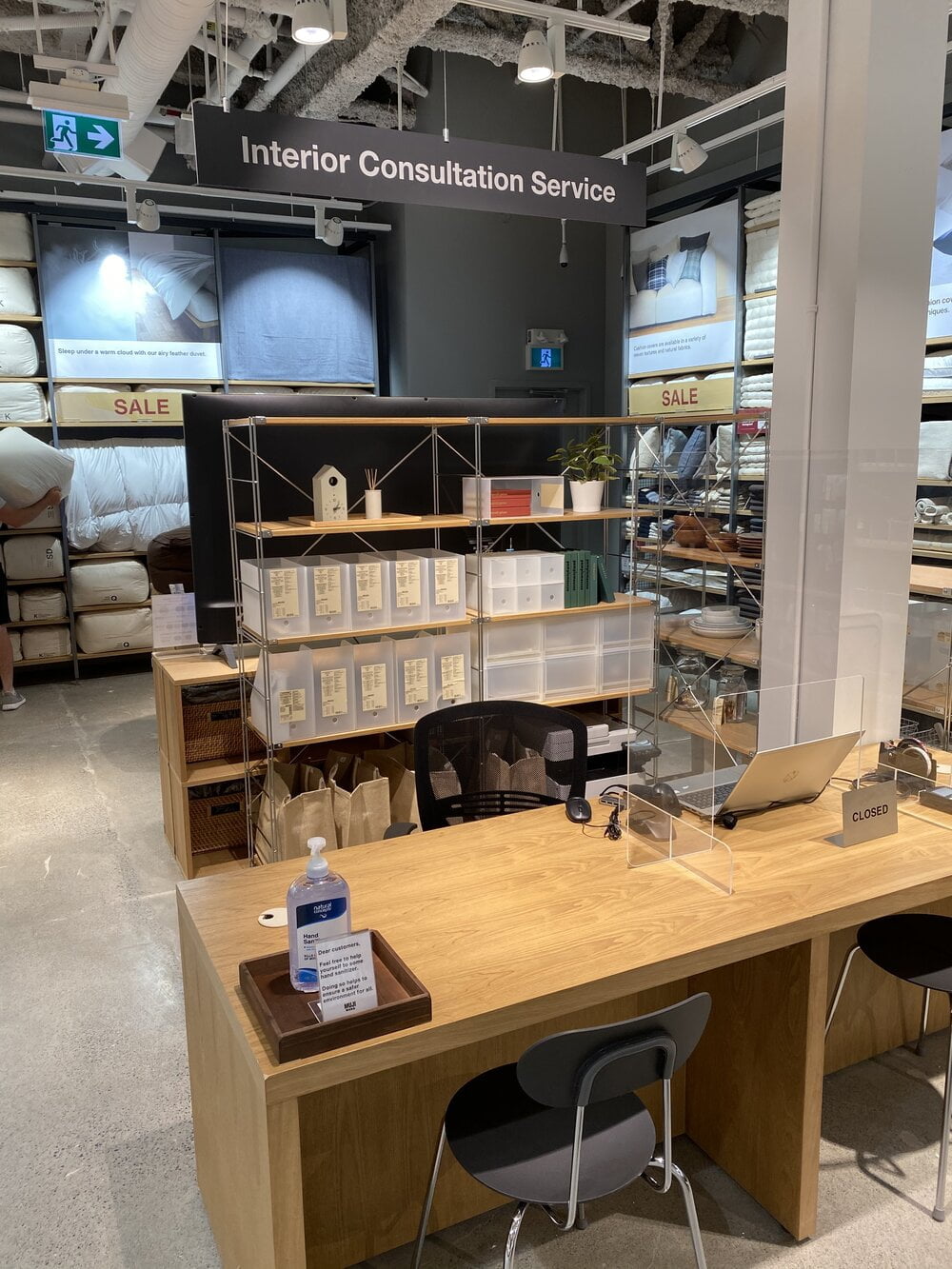
The 15,890-square-foot Guildford Town Centre Muji store is the first suburban location in Canada to span two levels. The first floor spans 8,387 square feet according to lease plans, with the second level encompassing 7,512 square feet. Escalators connect the two levels. The store’s design is similar to other Muji stores in Canada, featuring an exposed ceiling and natural wood accents throughout. Given the COVID-19 pandemic, the store’s layout is more spacious than expected.

Physical distancing is encouraged with the store’s capacity set at 50 people. Hand sanitizer is available in the store for all customers. Face masks are encouraged though not required. Returned merchandise will be quarantined for three days before returning to the sales floor. According to a sign in the store, cash will not be accepted while credit and debit cards can be used for payment.

The main floor of the Guildford Muji store includes departments for stationery, health & beauty, kitchen & tableware, laundry/cleaning, storage, and furnishings for the living room and bedroom. Upstairs is women’s wear, men’s wear, children’s wear, accessories, bags & shoes, ‘inner wear’, and travel goods. The second level also includes Muji’s embroidery service and fabric print service. The Muji ‘aroma bar’ is temporarily not available, according to the company, as a safety measure due to COVID-19.

CLICK FOR INTERACTIVE MALL MAP AT GUILDFORD TOWN CENTRE

CBRE Vancouver‘s office, including Martin Moriarty and Mario Negris, were involved in negotiating the Guildford lease deal with landlord Ivanhoé Cambridge. The duo also negotiated the lease deals for Muji’s other four stores in British Columbia. Brokerage CBRE has been involved with Muji’s negotiations across Canada, led by Arlin Markowitz, Senior Vice President of CBRE’s Downtown Toronto Urban Retail Team.

Muji’s opening is good news at a challenging time. In March, businesses deemed ‘non-essential’ were forced to close in British Columbia as well as across Canada. Stores have begun to open slowly — last month mall-based stores were permitted to reopen in British Columbia, and shoppers are starting to come back. The shutdown hit the bottom line for most businesses and some have filed for bankruptcy protection and some have closed entirely.

The largest Muji store in Canada is located in downtown Toronto at the Atrium complex on the corner of Yonge Street and Dundas Street West. It was also the first Muji location in Canada when it opened in 2014 — the 4,400-square-foot store was expanded to an impressive 20,000 square feet over two levels in November of 2018, making it the largest Muji location outside of Asia. Prior to that, the downtown Vancouver Muji store, measuring more than 14,500 square feet, held the title for the largest Muji store outside of Asia.

Muji now operates nine stores in Canada. Four of those are in the Vancouver area, including the Robson Street flagship that opened in December of 2017, a Metropolis at Metrotown location which expanded in 2018 to 12,305 square feet, a store at CF Richmond Centre which expanded to 9,212 square feet in February of 2019, and the new Guildford Town Centre store which is the largest of them all. In the Greater Toronto Area, Muji operates its massive downtown Toronto flagship store as well as a 5,225-square-foot store at Mississauga’s Square One (opened in November of 2015), a 6,375-square-foot store at Toronto’s Yorkdale Shopping Centre (opened in October of 2016), a 6,000-square-foot space at CF Markville which opened in the summer of 2017, and a store at Scarborough Town Centre, measuring about 6,800 square feet which opened in March of 2018.

In 2018, Muji was re-evaluating its Canadian operations as it looked to open larger stores. That was according to Masaaki Kanai, Chairman of parent company Ryohin Keikaku, who told us in an interview in 2018 that Muji is not only looking at opening substantially larger stores, but that it is also considering opening grocery stores, hotels, designing public realm, and even getting into residential development. A Muji hotel location was rumoured to be part of a new development on Bloor Street in Toronto, though no formal announcements have been made.

Muji was also said to be looking at the Montreal, Edmonton, and Calgary markets to open stores. No announcements have been made yet, though landlords had confirmed that they were having conversations last year.

COVID-19 has changed the retail industry at least for the time being, and expansion plans for some brands are said to have been put on hold. We’ll continue to follow Muji’s expansion in the Canadian market, which could include new units as well as possible expansions of some existing units in Ontario.