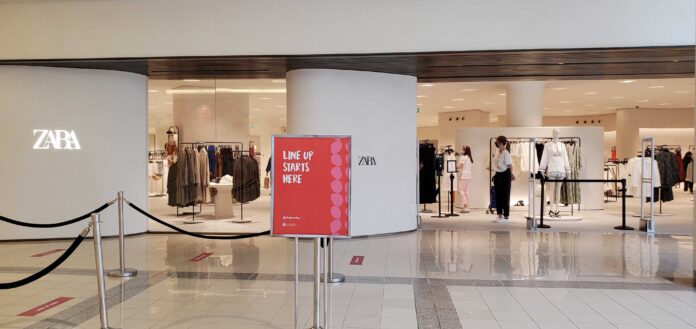
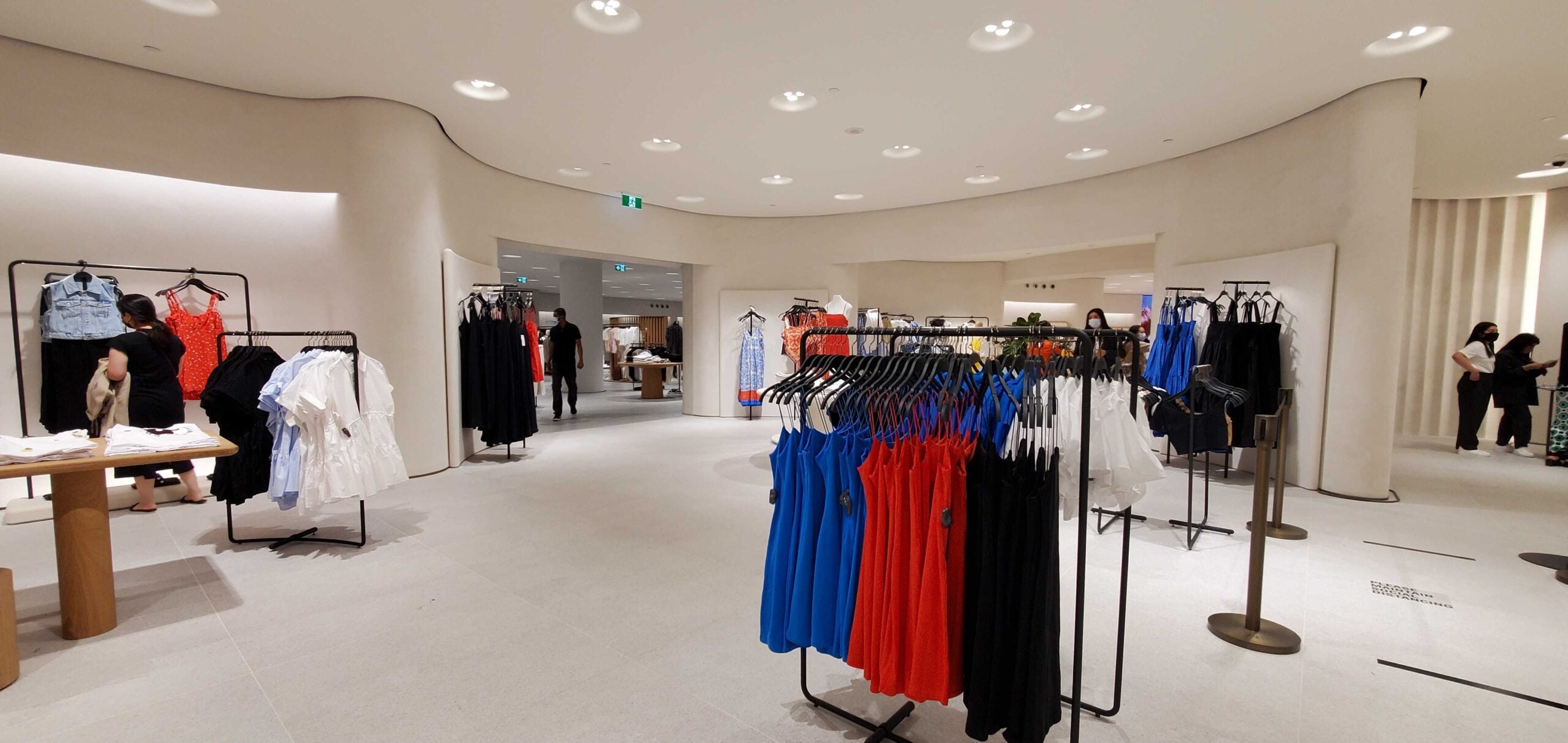
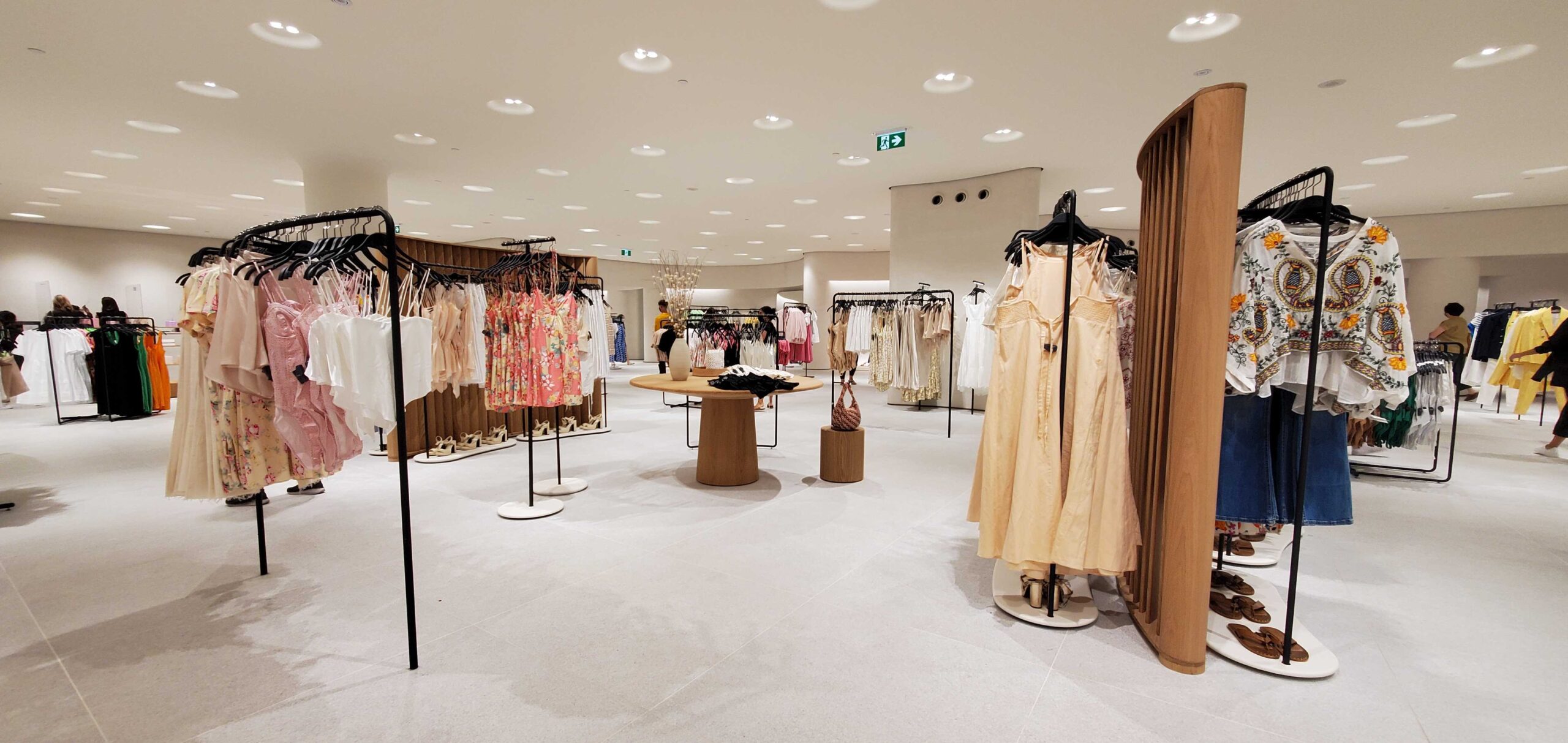
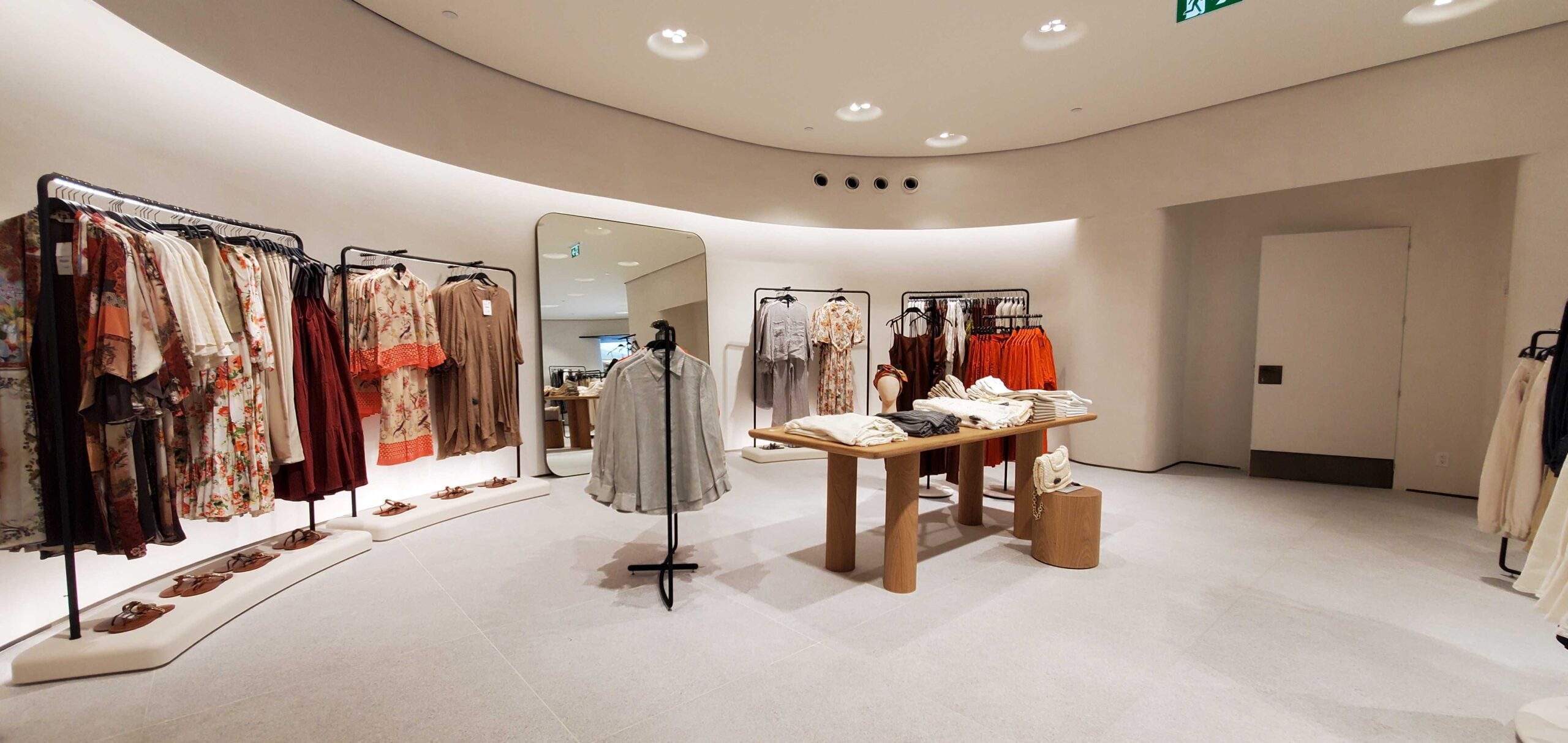
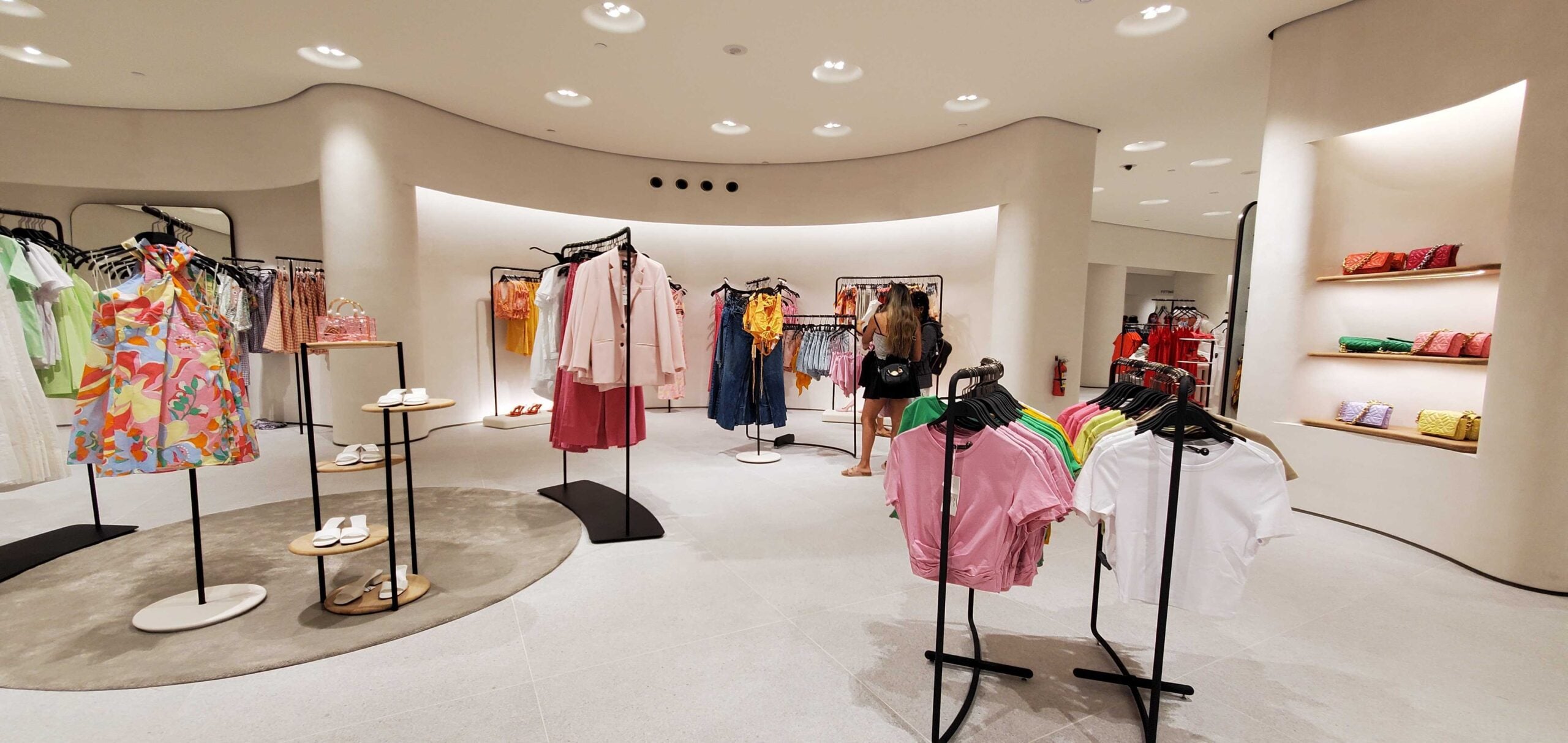
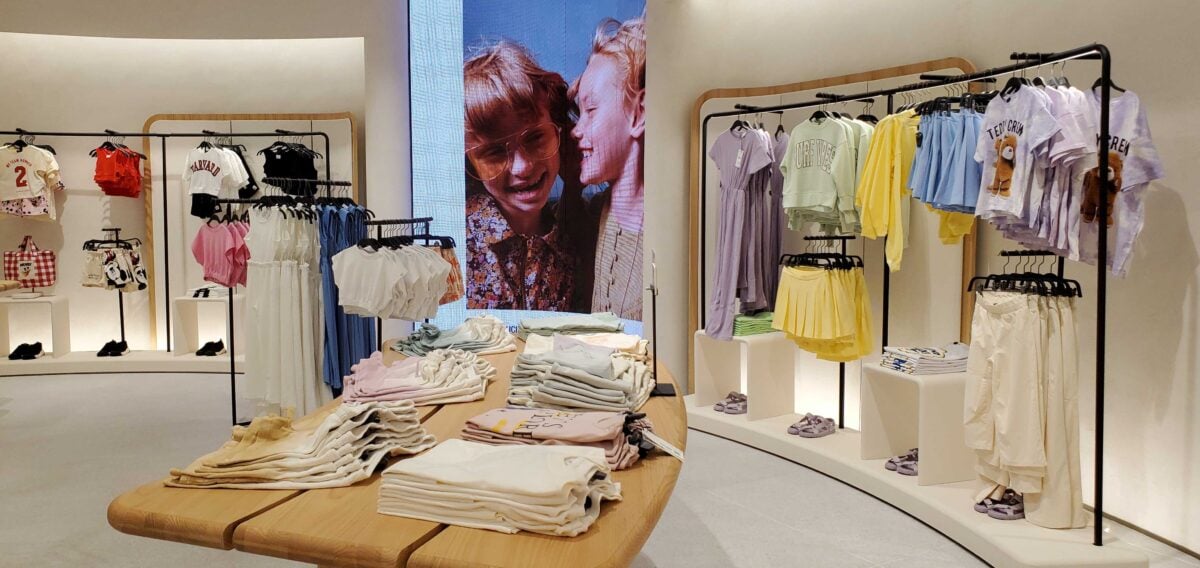
Zara re-opening on July 23, 2021 at Metropolis at Metrotown. Photo: Geetanjali Sharma.
Fast-fashion retailer Zara has opened its new flagship location at Metropolis at Metrotown in Burnaby, BC. The company is headquartered in Spain and has approximately 2,270 stores worldwide specializing clothing, accessories, shoes, swimwear, beauty, and fragrances.
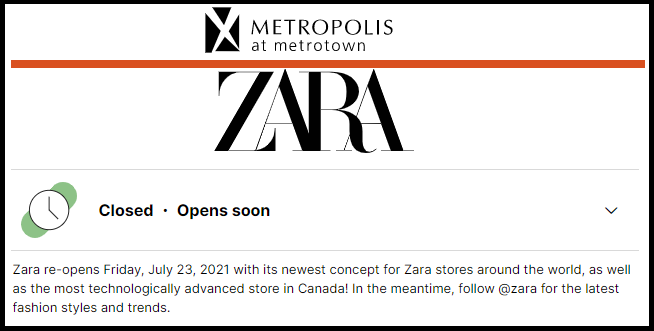
The Metrotown website proclaimed “Zara re-opens Friday, July 23, 2021 with its newest concept for Zara stores around the world, as well as the most technologically advanced store in Canada! In the meantime, follow @zara for the latest fashion styles and trends”.
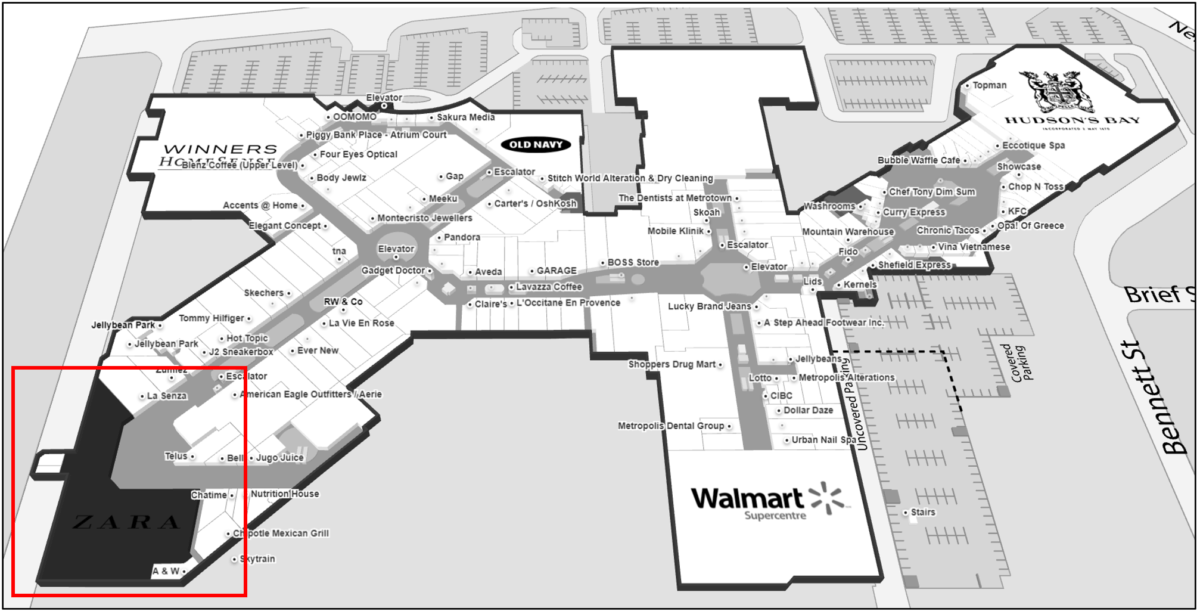
The re-opening reveals the retailer operating out of the upper level in the south-west corner of the Metropolis shopping centre in 38,499 square feet of retail space. Construction hoarding was erected in November 2020 to begin the expansion, growing from its original 18,000 square feet in another part of the mall.
Metrotown shopping centre owner, Ivanhoe Cambridge, supported the renovation by committing mall corridor space to Zara’s expansion as well as adding neighbouring retail stores to make up the extra square footage. This becomes one of the largest Zara stores in North America at 38,499 square feet.
Zara location at Metropolis at Metrotown. Map: Metrotown website.
Interior of Re-Opened Zara at Metrotown (July 23, 2021)
1 of 6
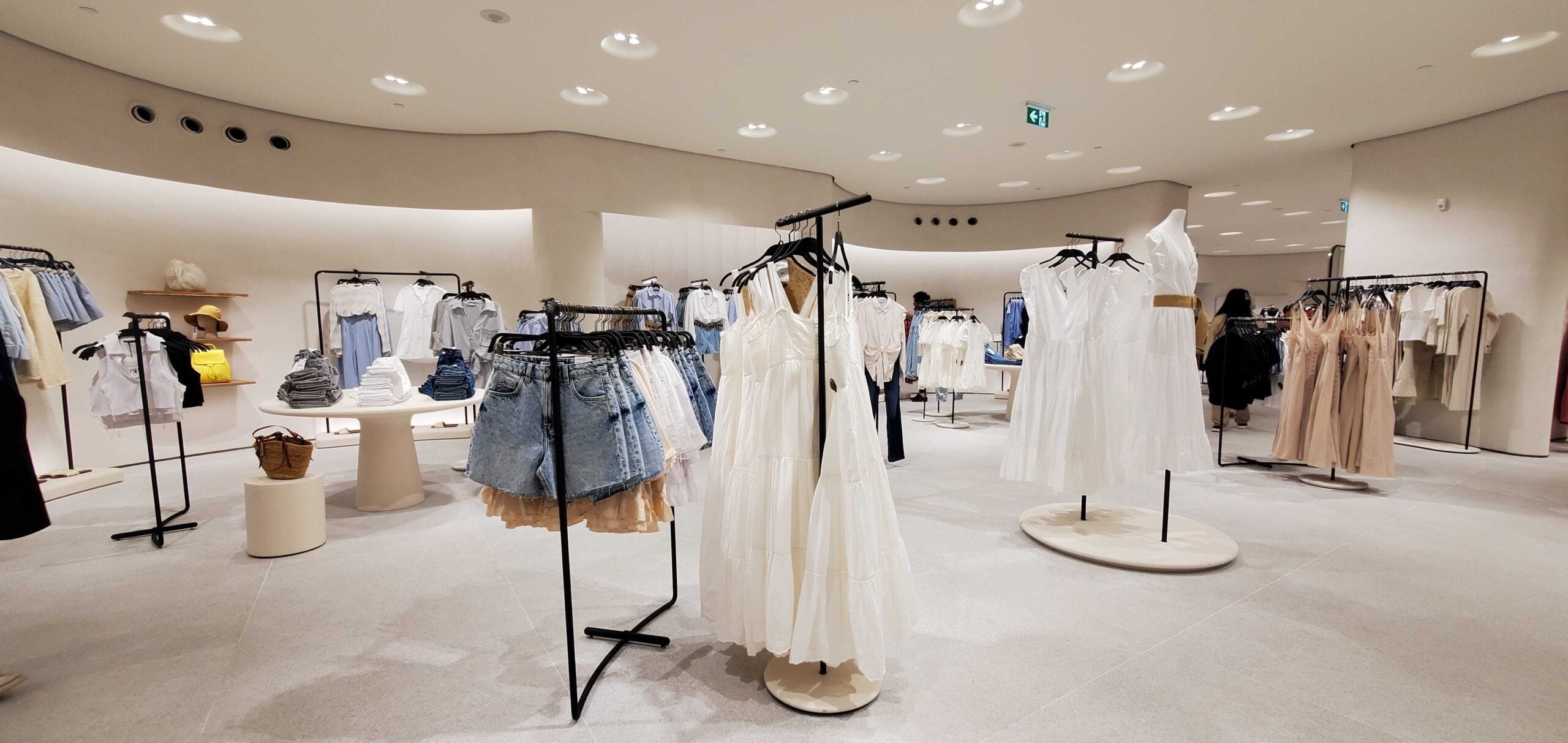
Interior of new Zara at Metropolis at Metrotown on July 23, 2021. Photo: Geetanjali Sharma.
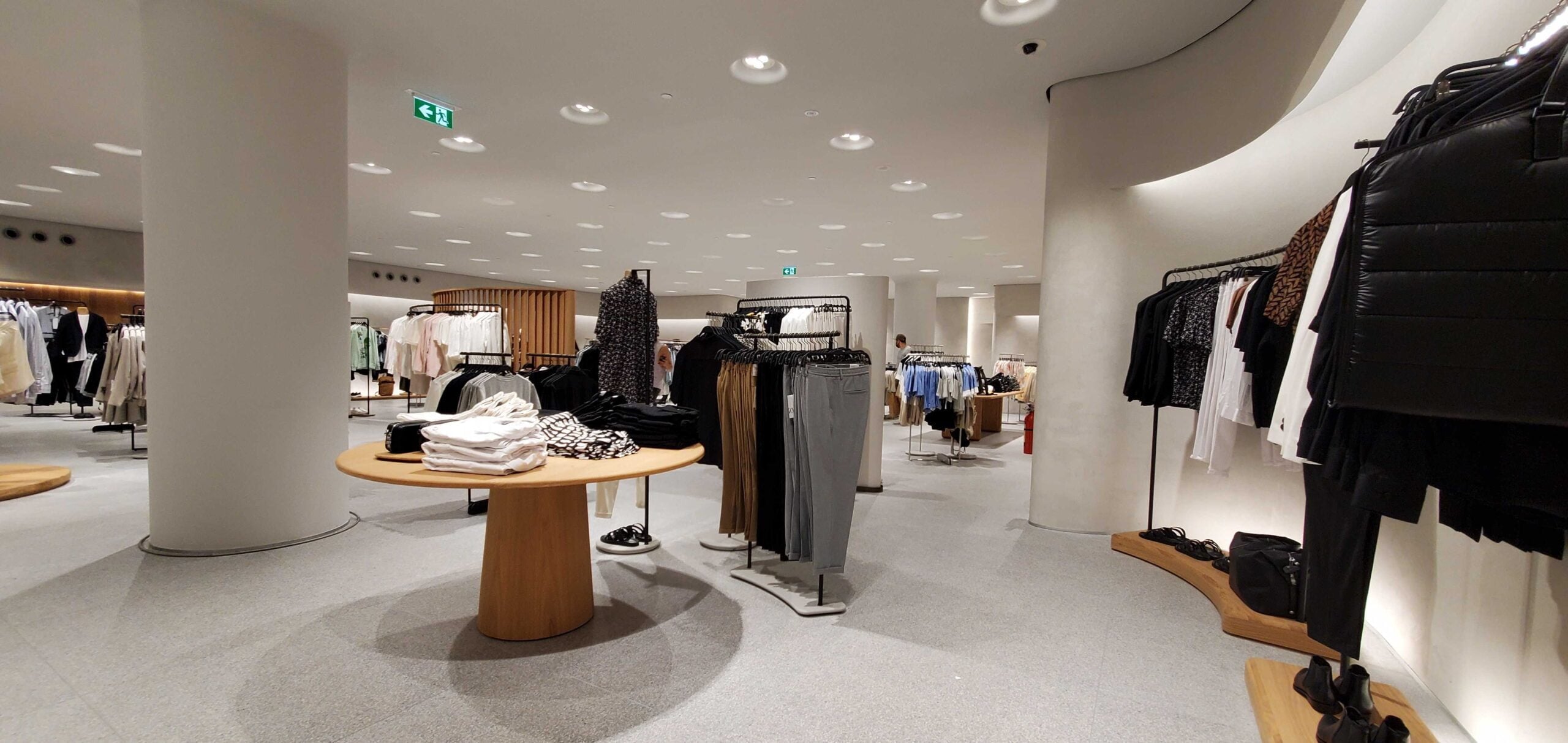
Interior of new Zara at Metropolis at Metrotown on July 23, 2021. Photo: Geetanjali Sharma.
Interior of new Zara at Metropolis at Metrotown on July 23, 2021. Photo: Geetanjali Sharma.
Interior of new Zara at Metropolis at Metrotown on July 23, 2021. Photo: Geetanjali Sharma.
Interior of new Zara at Metropolis at Metrotown on July 23, 2021. Photo: Geetanjali Sharma.
Interior of new Zara at Metropolis at Metrotown on July 23, 2021. Photo: Geetanjali Sharma.
Interior of new Zara at Metropolis at Metrotown on July 23, 2021. Photo: Geetanjali Sharma.
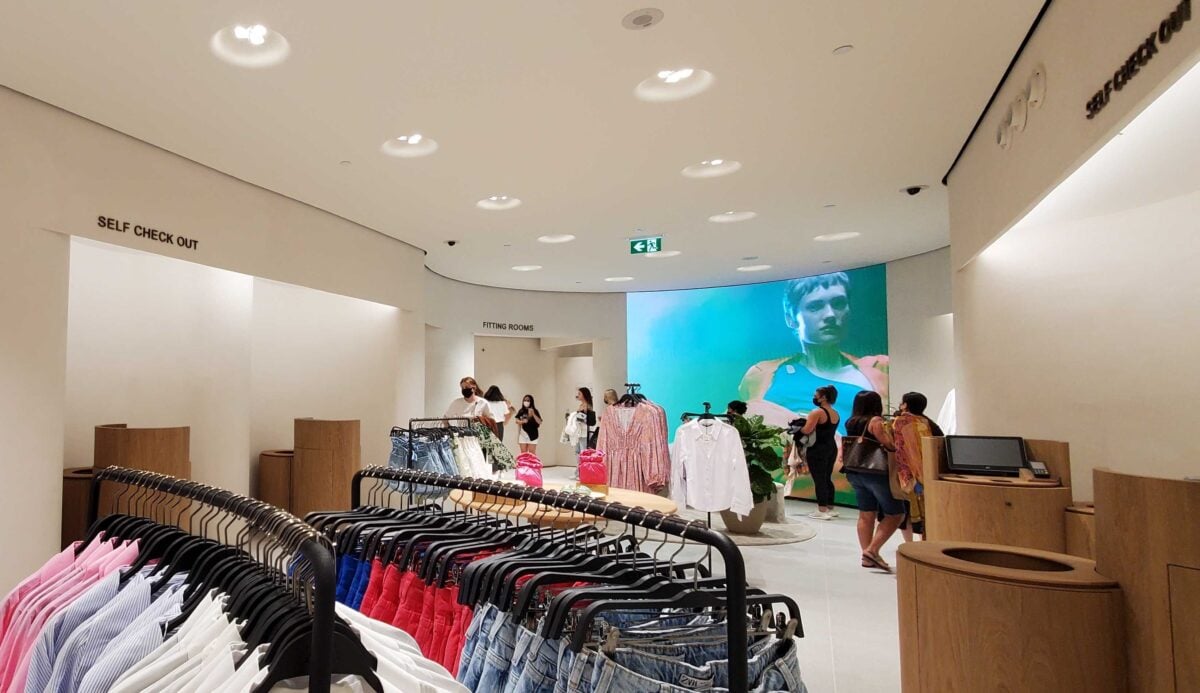
While onsite, Zara staff members said that customers will have the ability to self-checkout their own purchases or have the option for home delivery. At the time of the grand re-opening, these features and services were not yet operational.
Self checkout stations which were not yet operational at Zara reopening at Metrotown Mall (July 23, 2021). Photo: Geetanjali Sharma.
Metropolis at Metrotown website (July 23, 2021) announcing Zara reopening.
This brings back Zara to Metropolis at Metrotown which had been absent for shoppers while the renovation was underway since late 2020.
The following are social media promotions for the reopening as well as the construction progress photos taken by Retail Insider over the past months leading up to the re-opening.
Metrotown Instagram (July 23, 2021) announcing Zara reopening.
Zara Construction Signage Prior to Opening
1 of 3
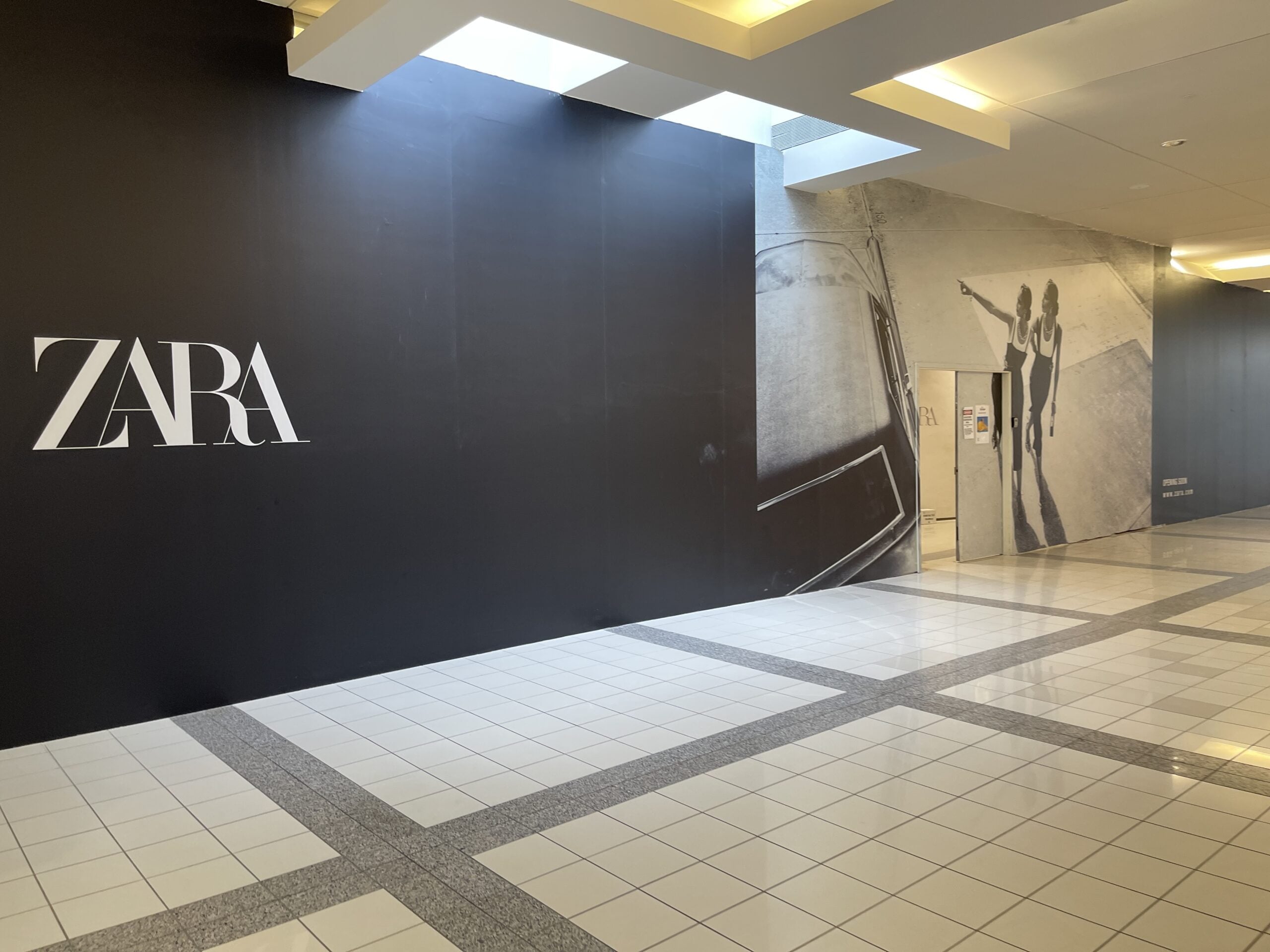
Zara Construction Signage (July 15, 2021) prior to reopening at Metropolis at Metrotown. Photo: Lee Rivett.
Zara Construction Signage (July 15, 2021) prior to reopening at Metropolis at Metrotown. Photo: Lee Rivett.
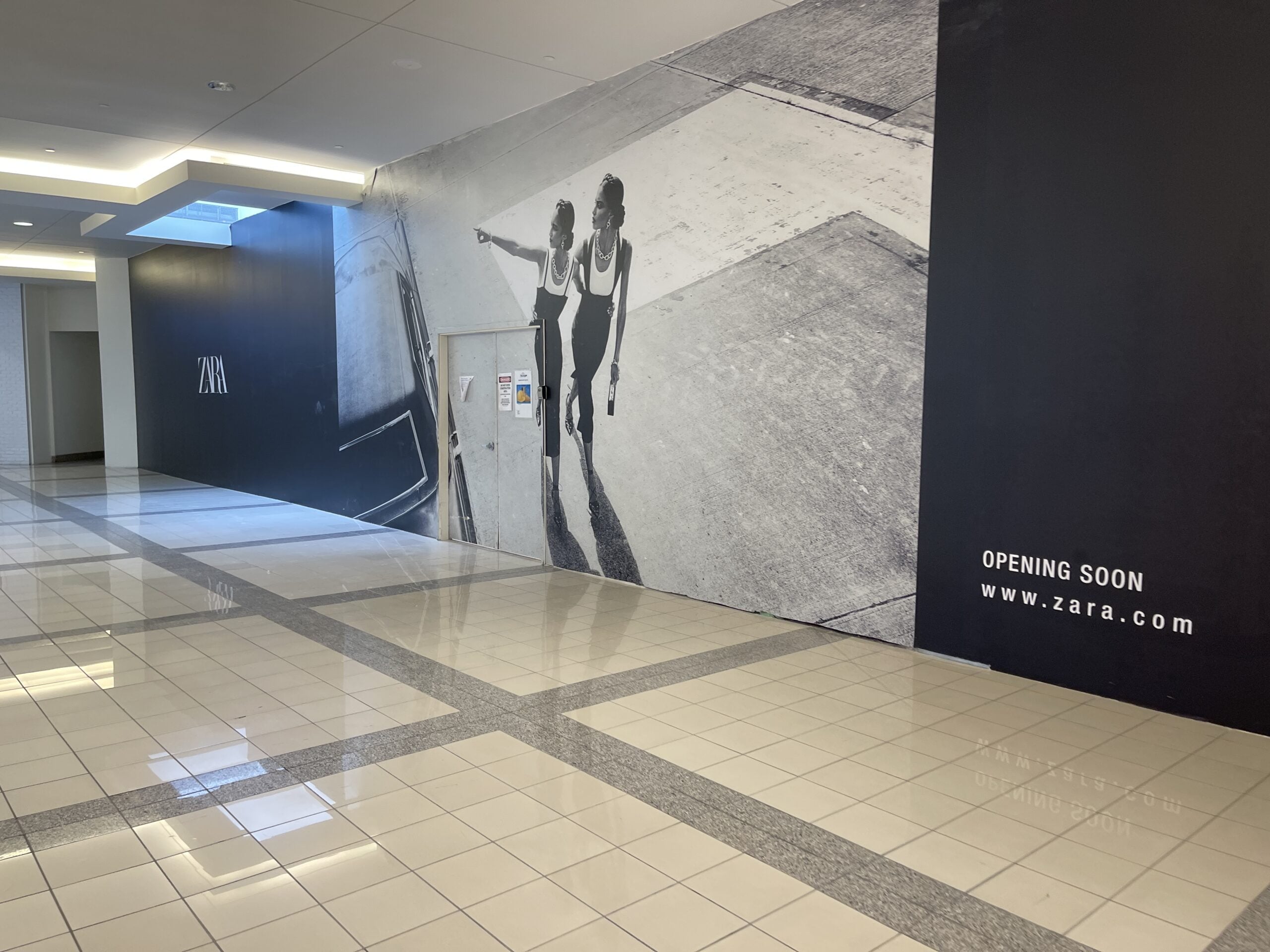
Zara 'opening soon' at Metrotown (December 2020). Photo by Geetanjali Sharma
Zara’s parent company, Inditex, is also headquartered in Spain and has other clothing brands including Massimo Dutti.
Canadian convenience store giant Couche-Tard was not successful earlier this year in acquiring international food retailer Carrefour SA but one expert believes it will eventually enter in some way into the growing food retail market.
Sylvain Charlebois
Sylvain Charlebois, Professor, Director, Agri-Food Analytics Lab and Former Dean of the Faculty of Management, Dalhousie University, said it was no coincidence that Couche-Tard was trying to buy Carrefour earlier in the year.
“In fact, Carrefour is the seventh largest grocer in the world. It’s actually larger than Loblaw. I think it took a lot of people by surprise to see Couche-Tard’s appetite to become a grocer essentially. I certainly wasn’t surprised because you have to look at the writing on the wall for Couche-Tard. They’ve been masterful in converting gas dollars into food dollars by getting people into their stores and buying some premium products,” said Charlebois.
“But if people don’t gas anymore, in a decade or two how do you actually generate more growth? And they are very good at food retailing. A lot of food products that you find at a Couche-Tard or a Couche-Tard owned and operated store some of these products are of high quality. So it’s not just necessarily a convenience store chain. I have to say that Couche-Tard is a very good food distributor as well. As much as anybody else in the game in Canada.”
Charlebois said the company in the future will likely become a grocer.
There is a trend these days for consumers looking at smaller format grocery stores for the convenience and ease of shopping. This would benefit Couche-Tard if it were to enter that market.
“With telecommuting and people working from home a lot more often, I think it’s going to be one of COVID’s major legacies to actually get people to work from home more often whether it’s on a part-time or full-time basis, it’s a reality. The real estate market has been affected by this and people have made long-term commitments to where they actually live and where they’ll be working,” said Charlebois.
“So the food network, or food retailing, will be impacted by where people live. If you actually spend a lot of time close to your kitchen, it will make you a cook more often. You’ll eat different products. You’ll probably be focused more on retailing and meal kits. And so as a convenience store operator you have to think about that too. Convenience stores are actually very accessible for people working in suburbs or in smaller communities.
“I know of a few startups that have started to look at using convenience stores as outlets for meal kits. So you can see there could be an ecosystem that would be built around convenience stores as a result of seeing more people working from home.”
And Couche-Tard has locations well situated for that because of the real estate they own.
“And they’re not very big. You can go in and out very quickly. If people are working from home and they have maybe half an hour between meetings, they can actually go in their cars, pick up whatever they need and come back home,” added Charlebois. “Very convenient. Very practical for a lot of people.”
He said Couche-Tard definitely has the capital to become a grocer.
Brian Hannasch, President and Chief Executive Officer at Alimentation Couche-Tard (Circle K). Photo: LinkedIn.
“I think the conversation is happening right now. I think a lot of people will see Couche-Tard as a potential buyer of a grocer in Canada. I don’t know which one. It’s hard to speculate but if you ask me whether or not it is more likely to see Couche-Tard become a grocer versus a new entrant in the market, I would probably vote for Couche-Tard. I think Couche-Tard has a better chance of becoming a grocer than seeing new players in the Canadian market.”
In mid January, Couche-Tard and Carrefour announced that preliminary discussions around a transaction were no longer continuing.
But Carrefour and Couche-Tard, however, also announced they decided to extend their discussions to examine opportunities for operational partnerships. Among the preliminary areas of cooperation to be explored are sharing best practices on fuel, pooling purchasing volumes, partnering on private labels, improving the customer journey through innovation, and evaluating ways of optimizing product distribution in the overlapping networks.
“The opportunity for operational partnerships with Carrefour will further our journey towards becoming a leading global retailer. The discussed areas for cooperation align with our five-year strategic plan, as well as our commitment to strengthening our core convenience and fuel business and pursuing opportunities in multiple, related growth platforms,” said Brian Hannasch, President and CEO, Couche-Tard.
“Building innovative partnerships is a key part of Carrefour’s transformation strategy. The promising partnerships anticipated with North American leader Couche-Tard is fully aligned with this strategy, which has enabled us to return to a profitable growth path,” said Alexandre Bompard, Chairman and CEO, Carrefour.
Couche-Tard is the leader in the Canadian convenience store industry, with a market cap of approximately C$46 billion as at January 12, 2021. As of October 11, 2020, Couche-Tard’s network comprised 9,261 convenience stores throughout North America, including 8,085 stores with road transportation fuel dispensing.
With a multi-format network of some 12,300 stores in more than 30 countries, the Carrefour Group is one of the world’s leading food retailers. Carrefour recorded gross sales of €80.7 billion in 2019.
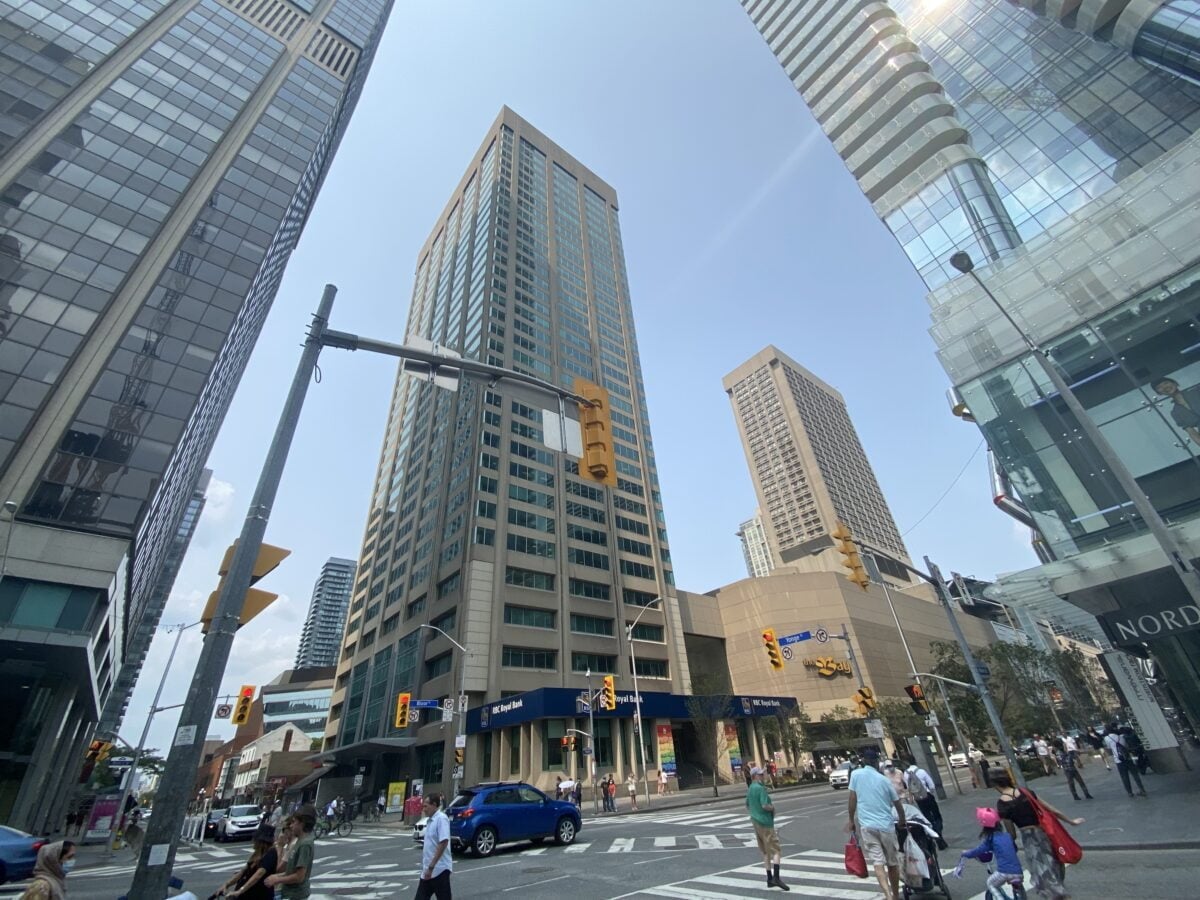
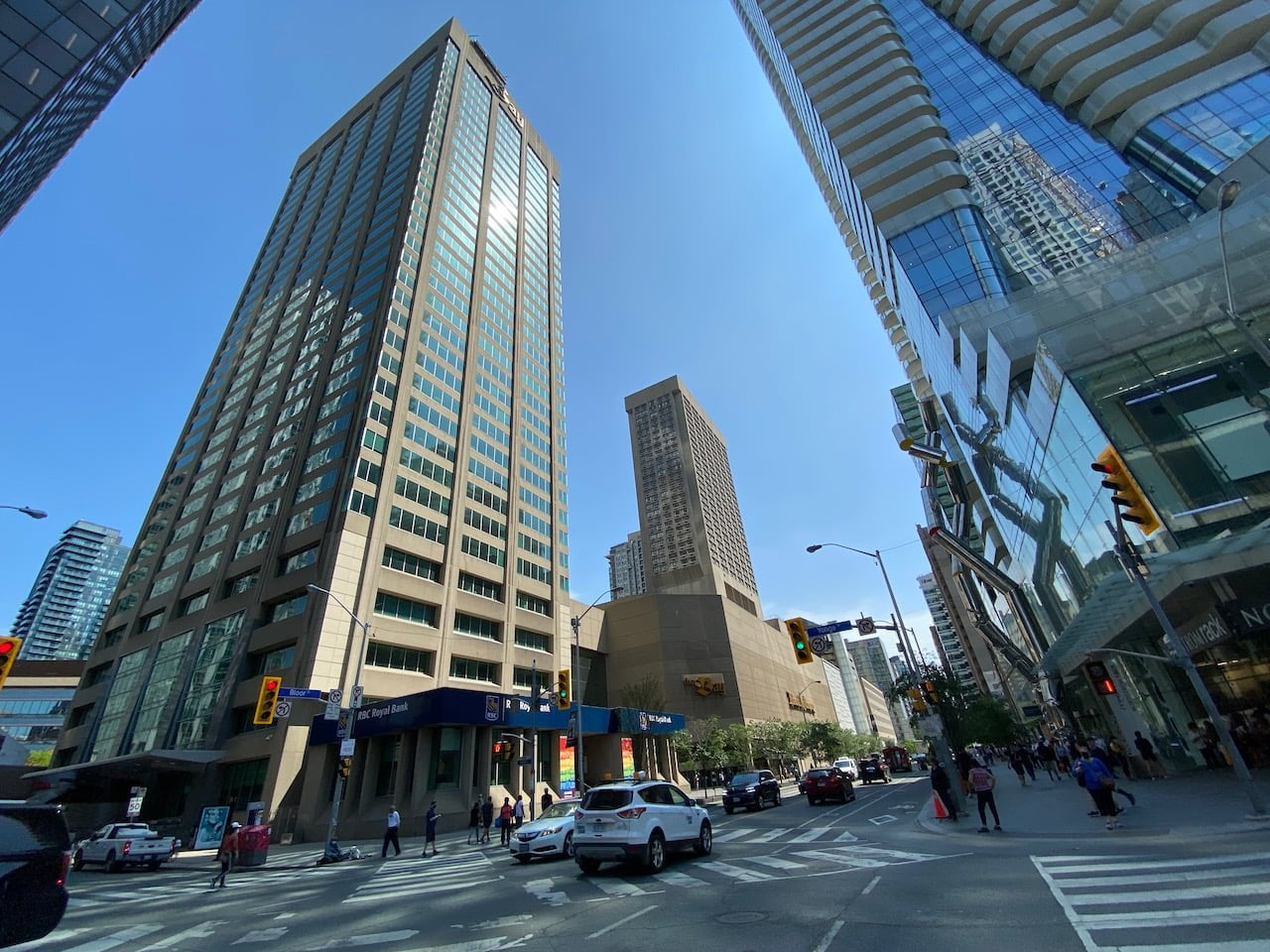
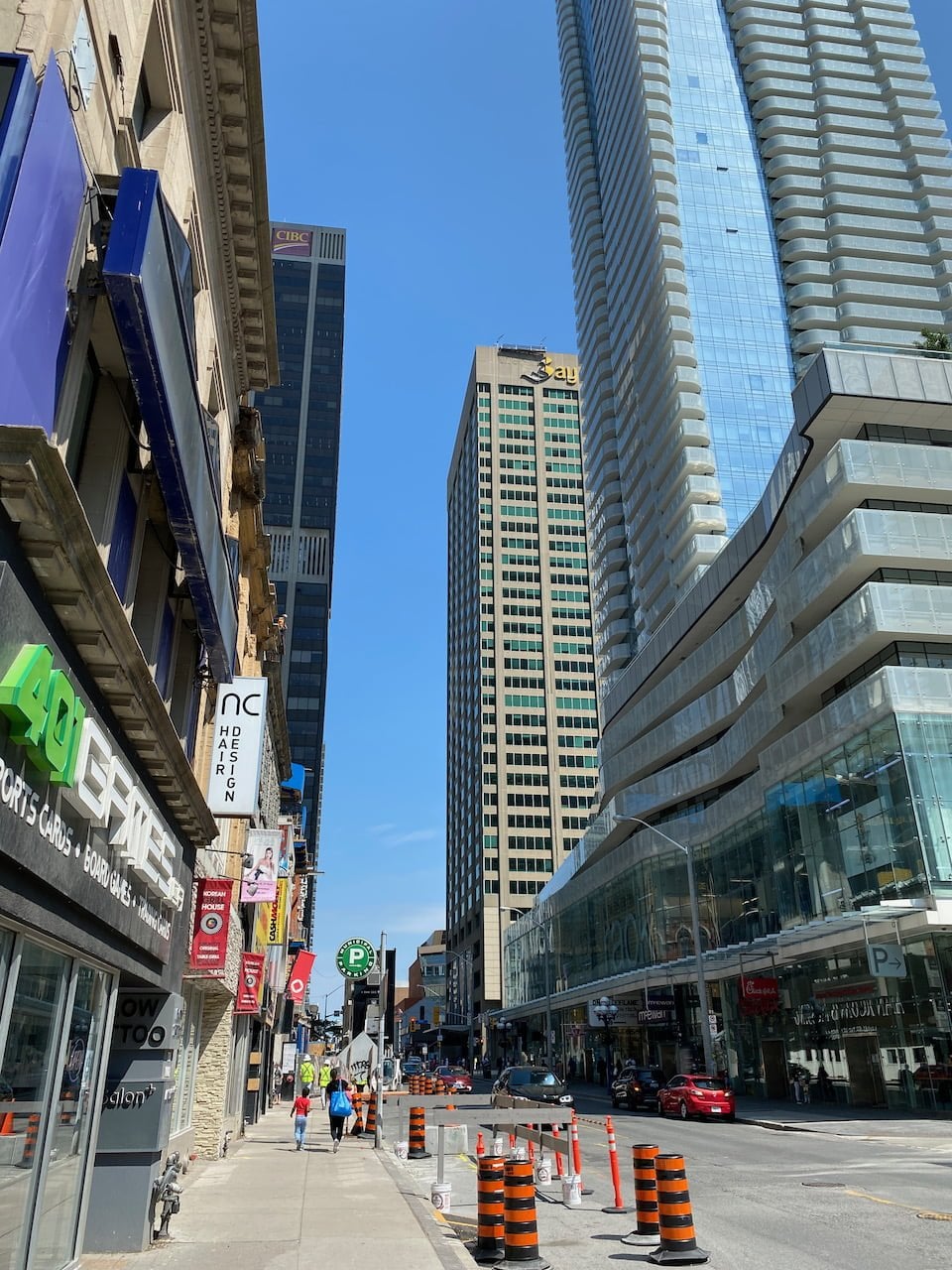
The former Bay branding on the tower connected to the Hudson’s Bay Centre in downtown Toronto has been removed after almost 50 years. The logo at one time was a beacon for the Hudson’s Bay flagship store that opened on the site in 1974.
The Hudson’s Bay Centre replaced several smaller buildings at the northeast corner of Yonge and Bloor Streets and became an anchor for the rapidly developing area. The 340,000 square foot Hudson’s Bay department store became the company’s flagship upon completion, taking the title away from the massive downtown Winnipeg flagship Bay store (which shuttered permanently several months ago).
The Yonge and Bloor Bay store lost its status as the company’s flagship in 1991 when the Hudson’s Bay Company converted the massive Simpsons department store at the southwest corner of Queen Street and Yonge to the Hudson’s Bay banner. The Hudson’s Bay Company acquired the Simpsons chain in 1978 which coincided with the decommissioning of the Simpsons-Sears store banners.
Hudson’s Bay Centre at 2 Bloor Street East in Toronto (July 2021). Photo: Craig Patterson Signage has been removed from the tower at 2 Bloor Street East (July 2021). Photo: Craig Patterson
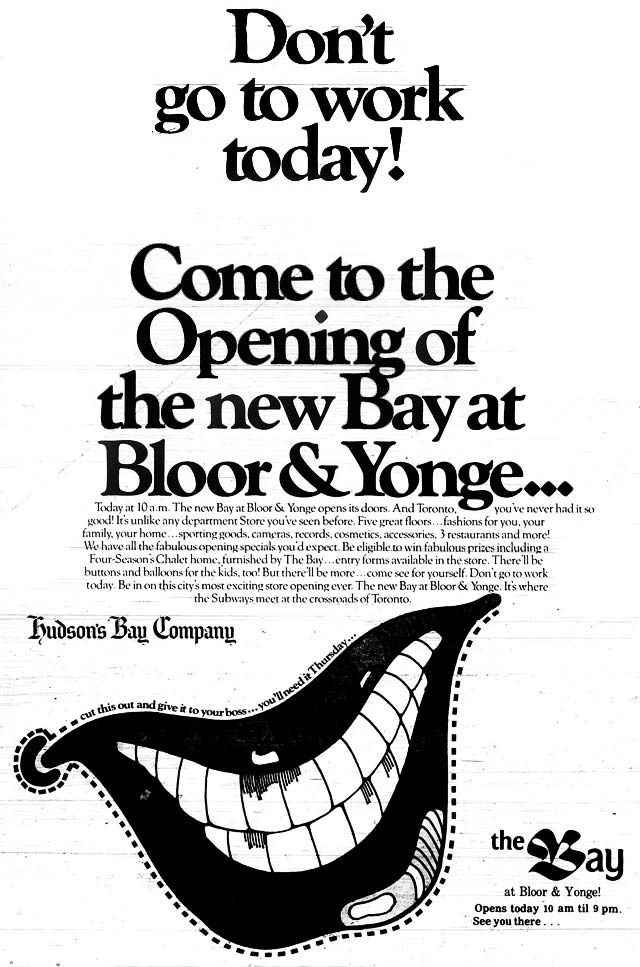
Ad from the opening of the Bay store at Yonge & Bloor in Toronto. Image from Toronto Sun, August 7, 1974.
The Hudson’s Bay Centre connects to the subway interchange below with a mall retail component spanning 213,000 square feet according to landlord Brookfield Properties. Tenants include The Bay department store as well as a Longo’s grocery store, Dollarama, LCBO, and tenants in the concourse-level mall and a food court. The 35-storey office tower above it spans 535,000 square feet and was designed by architect Craig & Boake. The centre also includes a soon-to-open W Hotel which is currently under construction — it replaces a Marriott Hotel that operated on the site for years with a rental apartment building located directly above it.
When it was built, the 2 Bloor East office tower housed offices for the Hudson’s Bay Company and with Workmen’s Compensation Board — both tenants were announced in 1971 before the tower’s completion.
The Urban Toronto forum recently included conversations that the Hudson’s Bay store at the Hudson’s Bay Centre would be closing. Retail Insider reached out to the Hudson’s Bay Company who denied that the rumours are true.
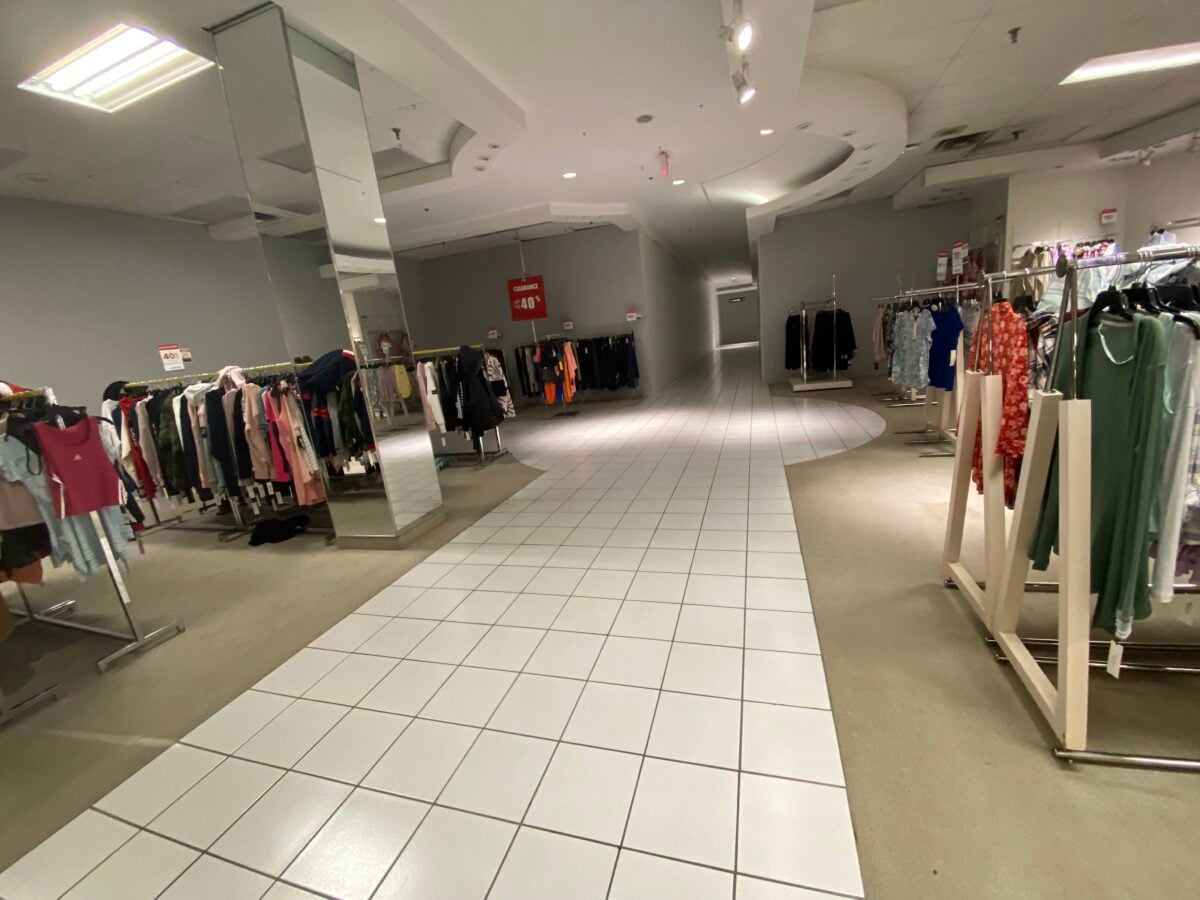
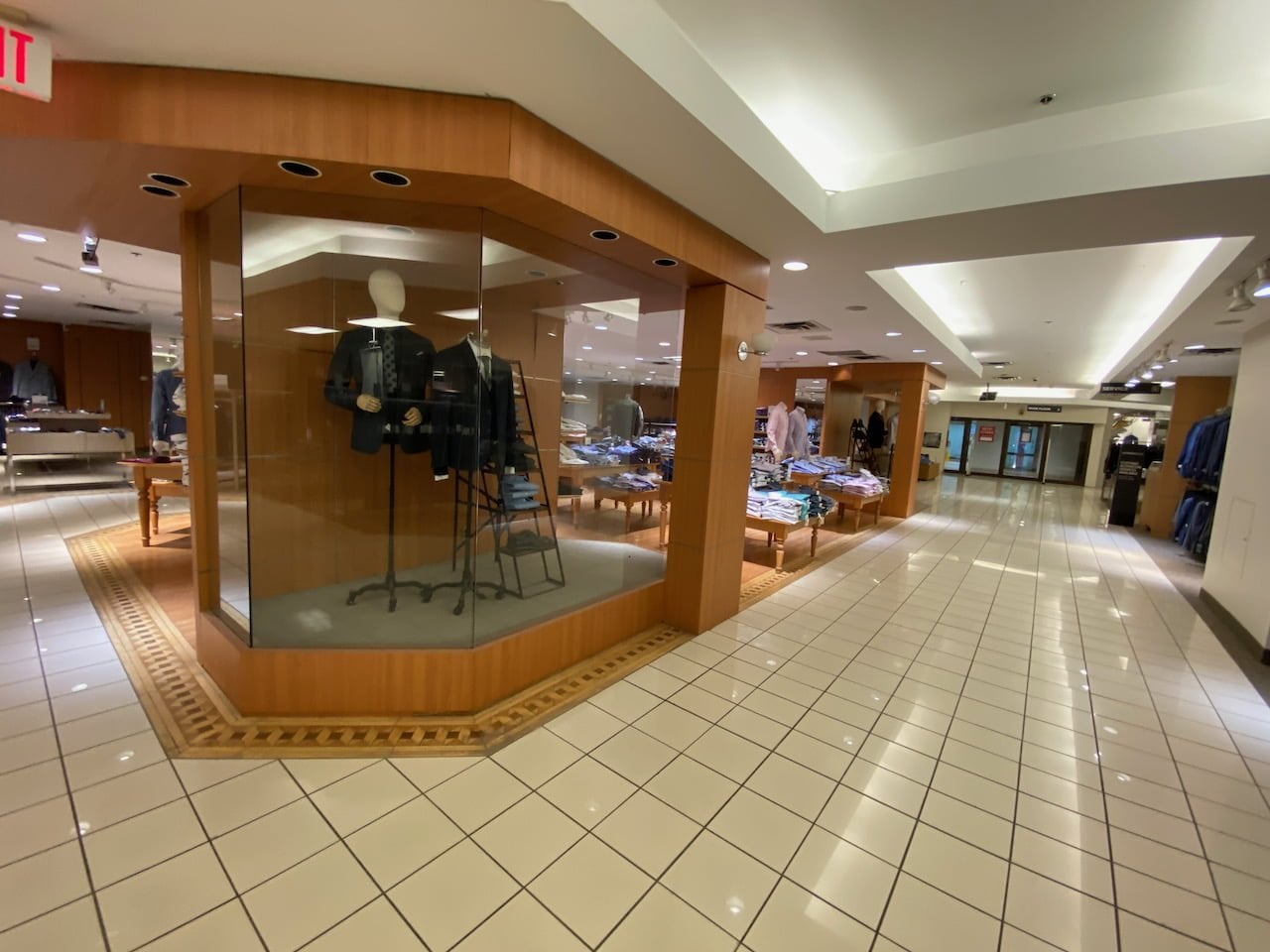
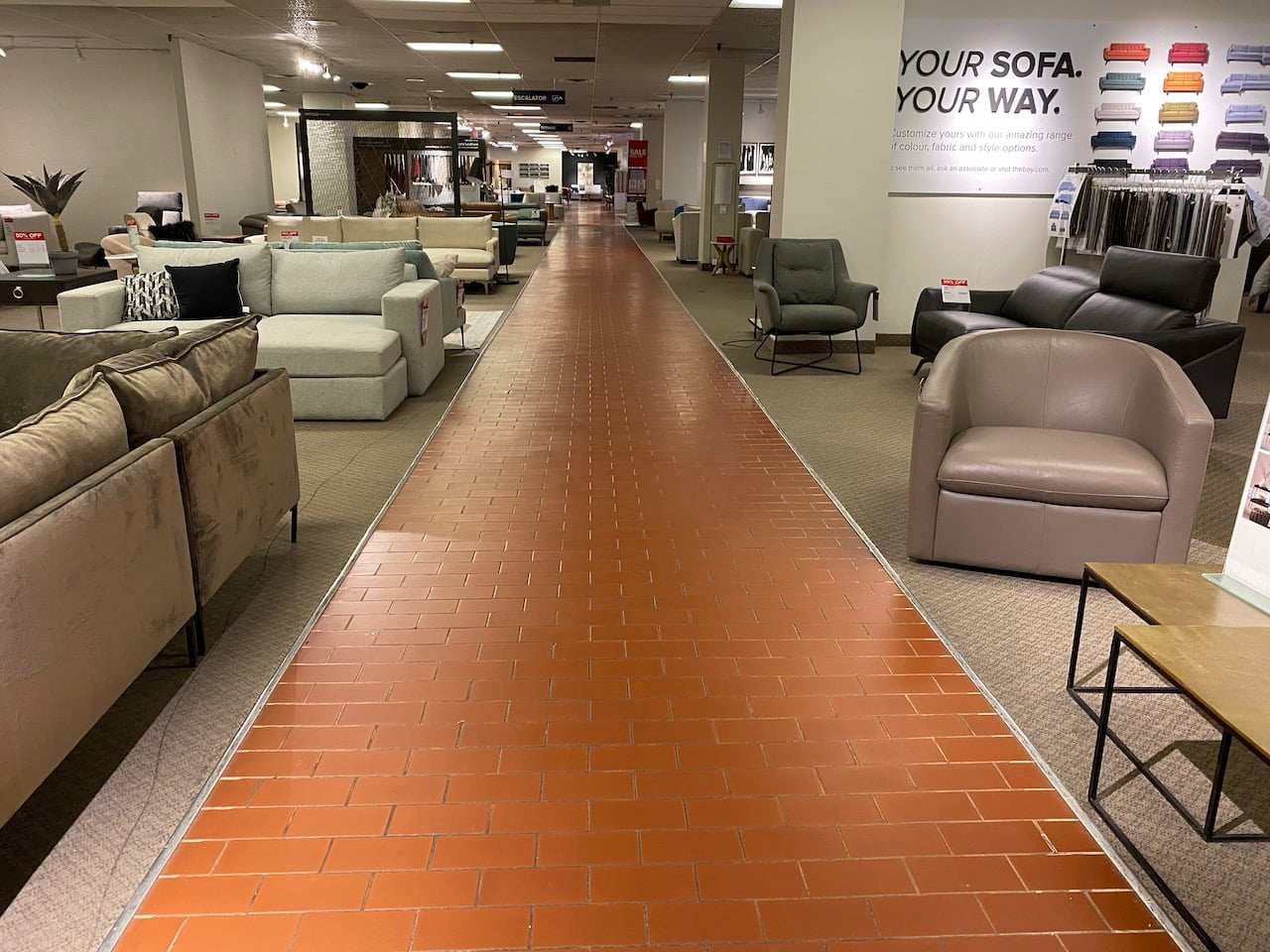
3rd floor of the Hudson’s Bay store at Yonge and Bloor showing a reduced retail footprint (July 2021). Photo: Craig Patterson
The Hudson’s Bay store has recently seen a size reduction on some floors already and departments being downsized. The photo above shows the third-level women’s floor which lost several thousand square feet with walls covering former retail space leading to a set of washrooms.
1 of 6
Hudson's Bay at Bloor - Photo by Dustin Fuhs
Hudson's Bay at Bloor - Photo by Dustin Fuhs
Hudson's Bay at Bloor - Photo by Dustin Fuhs
Hudson's Bay at Bloor
Hudson's Bay at Bloor - Photo by Dustin Fuhs
Inside Hudson's Bay at Bloor - Photo by Dustin Fuhs
Inside Hudson's Bay at Bloor - Photo by Dustin Fuhs
Craig speaks with entrepreneurs JJ Wilson and Tanner Johnston in an energetic conversation about their new Reyal Performance skincare and supplements lines.
The Interview Series podcast by Retail Insider Canada is available on Apple Podcasts, Stitcher, TuneIn, Google Play, or through our dedicated RSS feed for Overcast and other podcast players. Also check out our The Weekly podcast where Craig and Lee discuss popular content published on Retail Insider which is part of the The Retail Insider Podcast Network.
Drop us a line at Craig@Retail-Insider.com. You can also rate us in Apple Podcasts or recommend us in Overcast to help more people discover the show!
Background Music Credit: Hard Boiled Kevin MacLeod (incompetech.com). Licensed under Creative Commons: By Attribution 3.0 License. http://creativecommons.org/licenses/by/3.0/
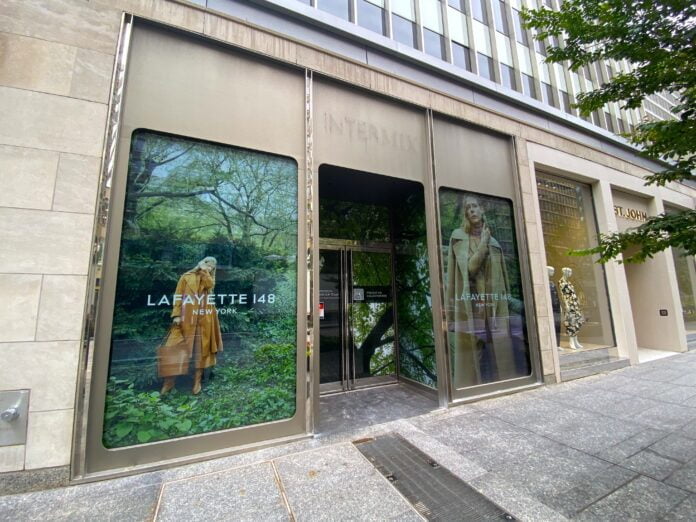
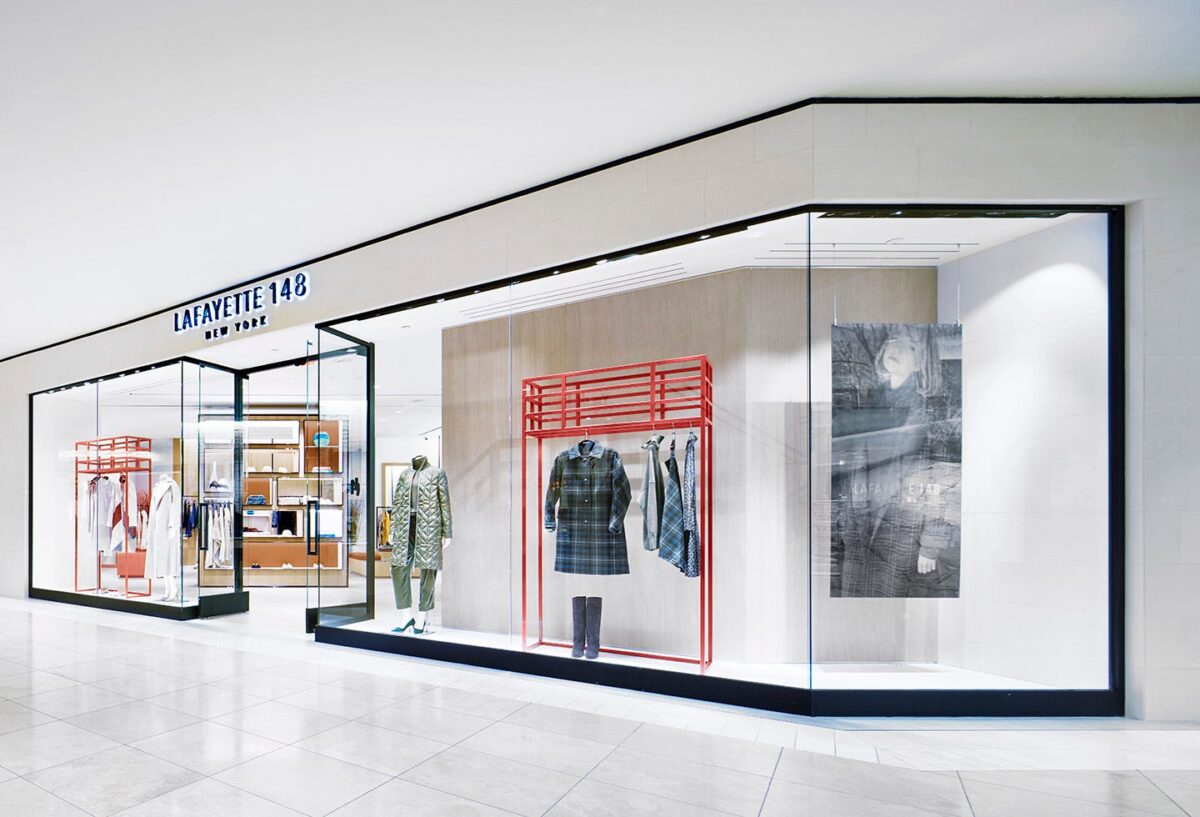
Lafayette 148 at 130 Bloor Street - Photo by Craig Patterson
Upscale New York City-based women’s fashion brand Lafayette 148 will open its first standalone store in Canada this year on Toronto’s Bloor Street luxury run. Until now the brand has had limited distribution through upscale department stores. The move signals confidence in brick-and-mortar retail on a stretch of Bloor Street where other fashion brands have recently opened.
The Lafayette 148 storefront in Toronto will be located at 130 Bloor Street West in a 2,000 square foot space between a St. John Knits store and Burberry. The Lafayette 148 store will feature the brand’s range of women’s ready-to-wear as well as footwear, bags, jewellery and accessories. Construction has started on the new space that was once occupied by upscale multi-brand retailer Intermix.
David Wedemire and Stan Vyriotes of DWSV Realty negotiated the lease deal for the Bloor Street Lafayette 148 location. Kingsett Capital owns the 130 Bloor Street West building which is also home to a Gucci flagship store facing luxury retailers across the street including Dior, Prada, Cartier and Moncler.
In Canada, Lafayette 148 is also carried at Saks Fifth Avenue and Nordstrom — Holt Renfrew recently carried the line for a time.
Click image for interactive Google MapImage: Lafayette 148
Lafayette 148 was founded in 1996 by Deirdre Quinn, Shun Yen Siu and Ida Siu, and the the company is named after its founding address in Manhattan’s SoHo neighborhood at 148 Lafayette Street. As of July 2019, the company reported $200 million in revenue with the collection available in about 400 stores in North America and China.
The company’s new headquarters are in the Brooklyn Navy Yard and its workshop and production facility in China. The company is vertically-integrated which is said to be a rarity in the fashion industry.
Lafayette 148 is known for its craftsmanship and clean-lined professional wear and sportswear with a “modern, New York sensibility” made from high-quality European fabrics. Mainstays include professional suiting, elevated essentials, leather and cashmere. The brand has been worn by Oprah Winfrey, Michelle Obama, Helen Mirren, Melissa McCarthy, Glenn Close, and other notable celebrities.
The finest fabrics are used including cashmere from Loro Piana, printed silks from Como, Italy, cotton from Reggiani, shearling from Spain and classic wool from Botto Giuseppe. Lafayette 148’s European mill partners are considered to be some of the finest textile producers in the world for the quality of their yarns as well as their commitment to sustainability.
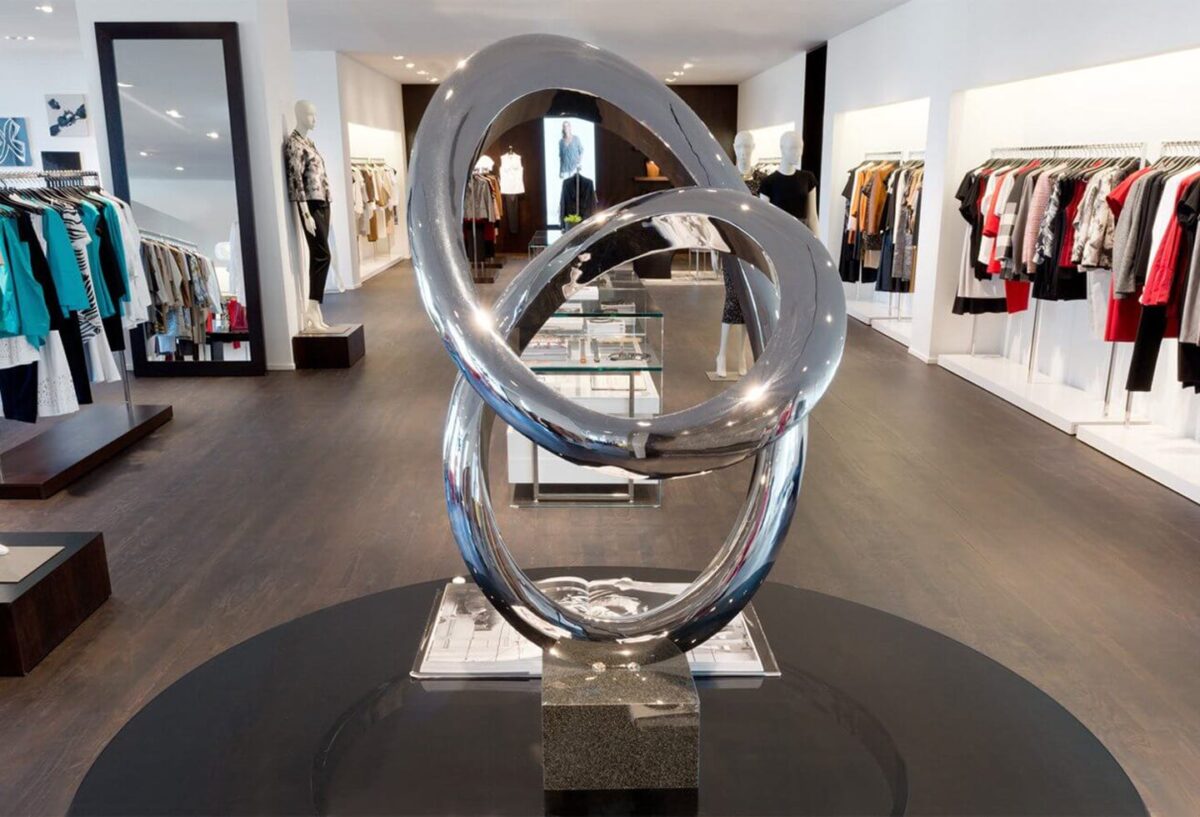
Soho concept store in NYC. Photo: Lafayette 148
Lafayette 148 has 10 standalone stores in the United States. In New York City, the brand operates its primary showroom at 148 Lafayette Street and also as storefronts at 423 Broome Street and 956 Madison Avenue in New York City. On Long Island, the brand has a store at The Americana Manhasset and in New Jersey, it has a store at the Mall at Short Hills. In the Miami area, Lafayette 148 has stores at the Brickell City Centre and at the Bal Harbour Shops. In California, Lafayette 148 operates a location at the prestigious South Coast Plaza in Costa Mesa. The brand also has standalone stores at the Phipps Plaza in Atlanta as well as Tyson’s Galleria near Washington DC. It also operates eight outlet stores in the United States and is carried wholesale at upscale multi-brand retailers including Neiman Marcus, Saks Fifth Avenue, Bloomingdale’s and Nordstrom.
South Coast Plaza store in Orange County, California. Photo: Lafayette 148
In China, Lafayette 148 operates 15 standalone stores in major markets.
The opening of Lafayette 148 spells confidence for the luxury run of Bloor Street which spans from the Harry Rosen store at 82 Bloor Street West to Avenue Road. Several luxury brands have been investing into their stores on the street. Gucci recently completed a renovation to its flagship store at 130 Bloor Street West, and St. John Knits opened next to it in December of 2019 shortly before the pandemic. Cartier, located at The Colonnade at 131 Bloor Street West is currently under renovation to showcase the brand’s latest retail design. Other high-end and luxury brands are said to be looking at leasing space in the immediate area.
It’s not yet known if Lafayette 148 will open any more stores in the Canadian market following the Toronto location on Bloor Street which is expected to open later this year.
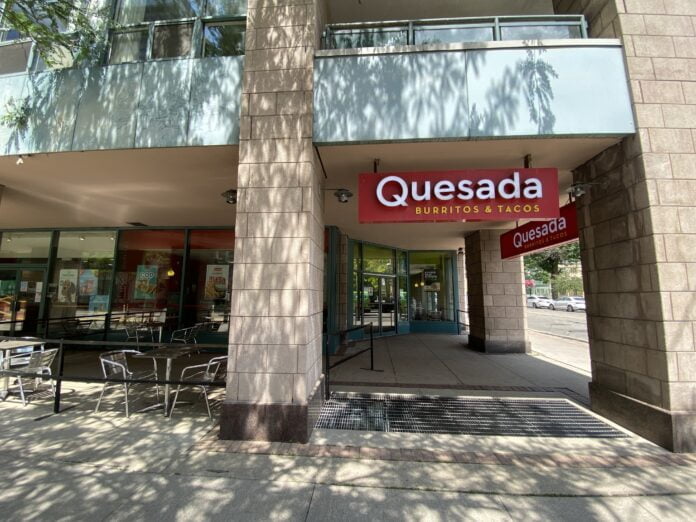
Quesada King Street Location - Photo by Dustin Fuhs
The Quesada Burritos & Tacos brand has seen spectacular growth in Canada in recent years with many more new restaurant openings planned for 2021 as the company continues on its aggressive expansion plans in the market.
It recently surpassed 150 locations in Canada and is on target to be at about 170 by the end of the year.
Steve Gill
And the brand is expected to continue to grow through a national partnership with a ghost kitchen.
Steve Gill, Founder & CEO, Quesada Burritos & Tacos, said there has been a pent up demand for opening new locations as early this year it went three months without opening a new location.
“In January to March, I think that was the first time in several years that we didn’t open a restaurant in three months. There’s some pent up demand and some backlog just in the building and the construction. So now we have a lot going on. It’s pretty wild,” he said.
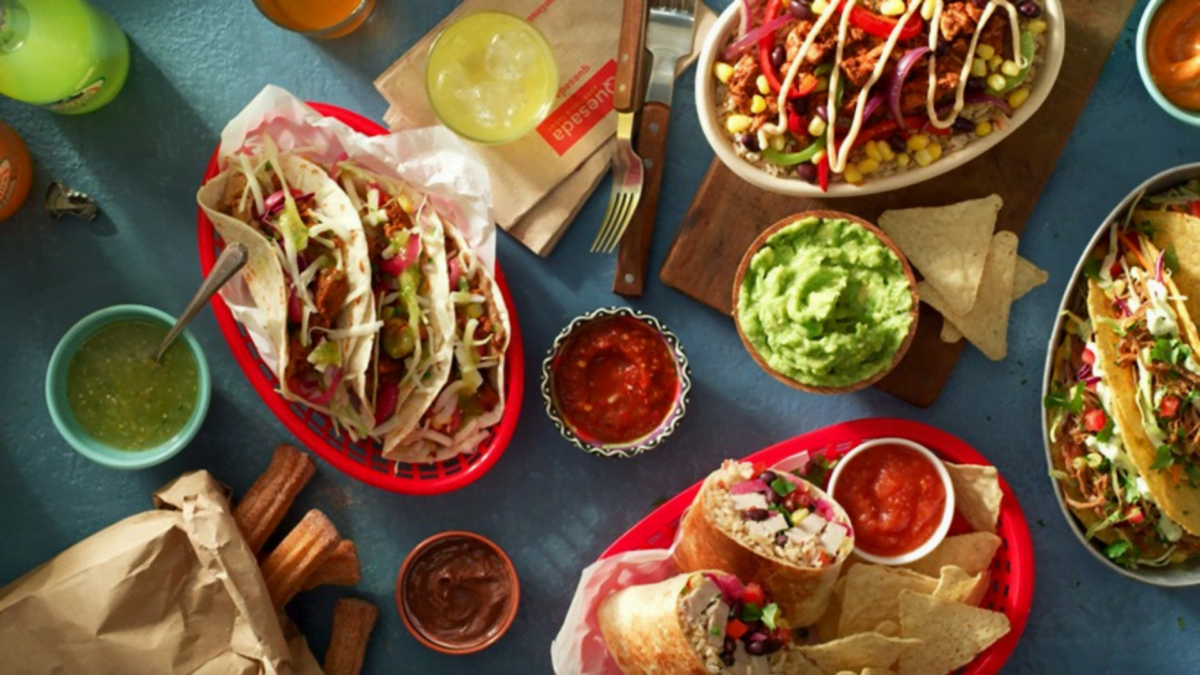
Image: Quesada
The original Quesada opened in 2004 across the street from the Skydome in Toronto. It went up to five restaurants by 2010, just opening its own locations. But the explosive growth began in 2011 when it started franchising the concept.
“I’d say we’ll be around 165 or 170 by Christmas time. That’s not unrealistic,” said Gill.
“What really helps us is the economics for our franchisees. A lot of our growth is with franchisees opening their second or third and in one case fourth or fifth locations. So a lot of the ones we have coming up are not new franchisees. It’s easier because they know what they’re doing already. They’ve already been trained and the process goes a bit smoother. It’s probably the main thing that’s driving it right now.”
The brand is in every province currently with the exception of Prince Edward Island and Nova Scotia.
Quesada King Street Location – Photo by Dustin Fuhs
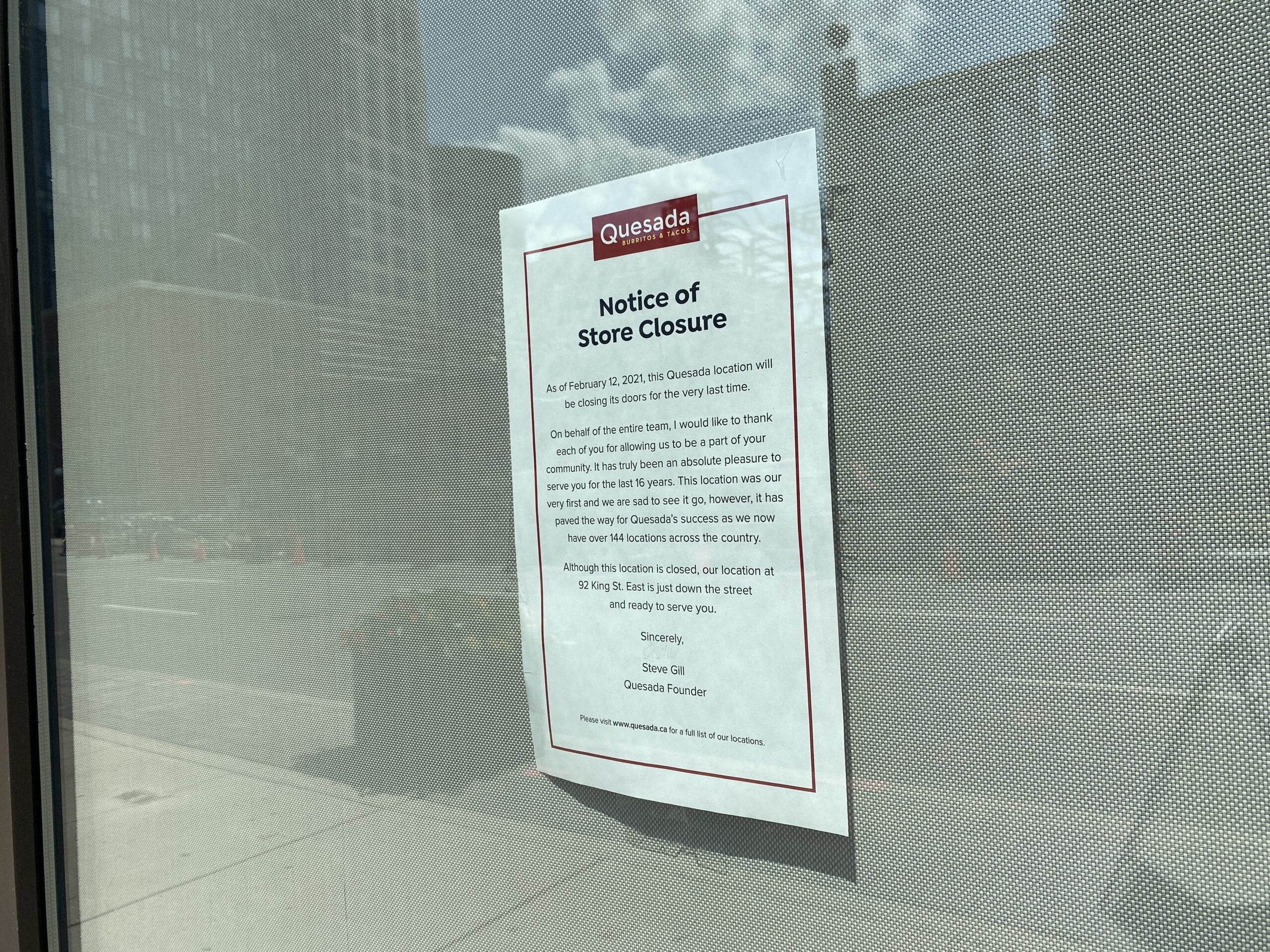
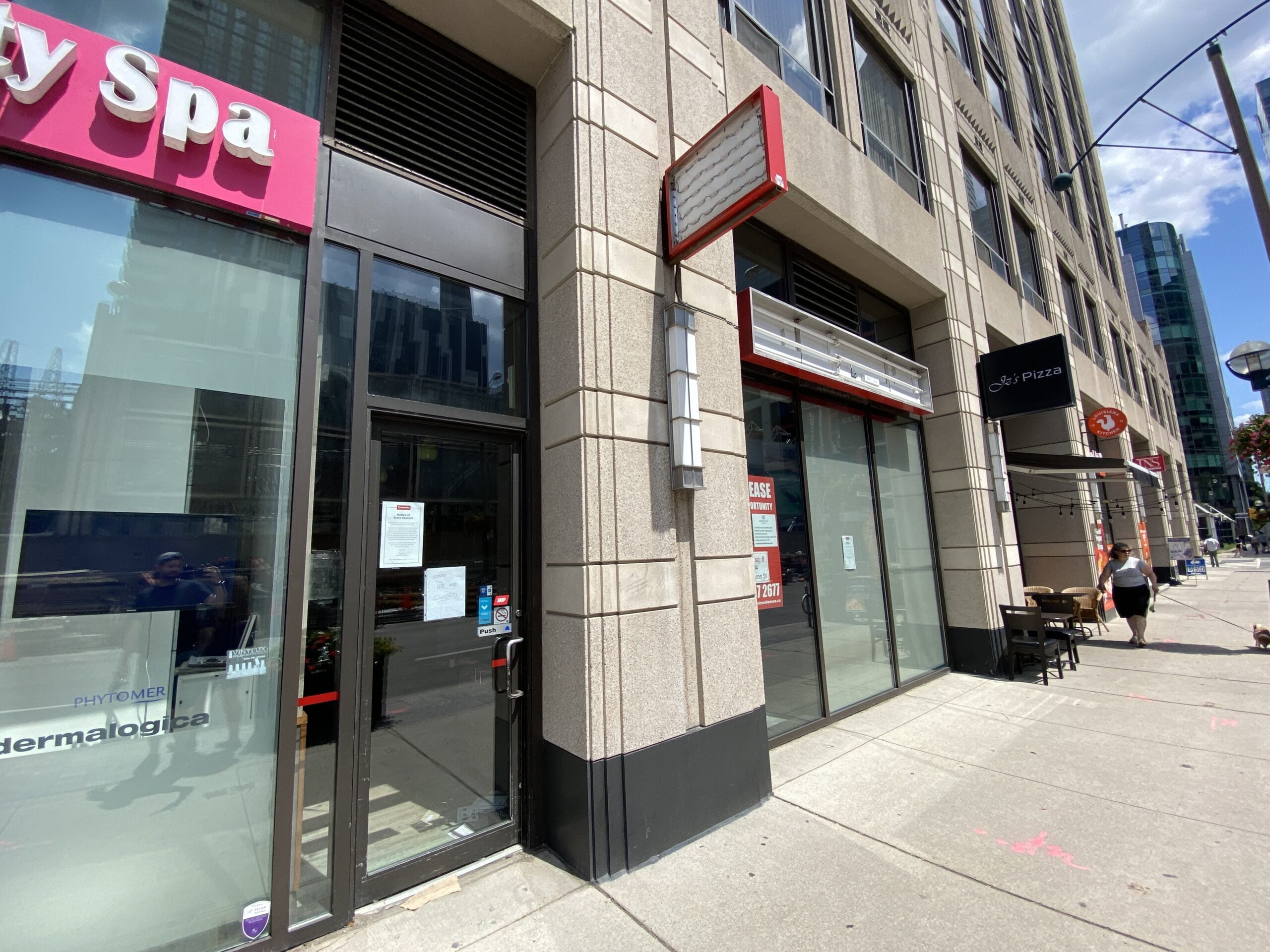
Former Quesada Wellington Location – Photo by Dustin Fuhs
Former Quesada Wellington Location – Photo by Dustin Fuhs
Gill said 300 locations within a few years is definitely within reach.
“There’s still a lot of space,” he said.
Quesada, named one of Canada’s Top 400 Companies by The Globe & Mail in 2020, has partnered with REEF Kitchens to be available through ghost kitchens in downtown Toronto starting in August with plans to expand across the country later this year. The partnership will help to build brand awareness while providing insights into optimum markets for new restaurant openings.
“This broadens our reach and allows even more people to experience Quesada. We’re excited about that because we know that once people try us, they’re hooked,“ said Gill.
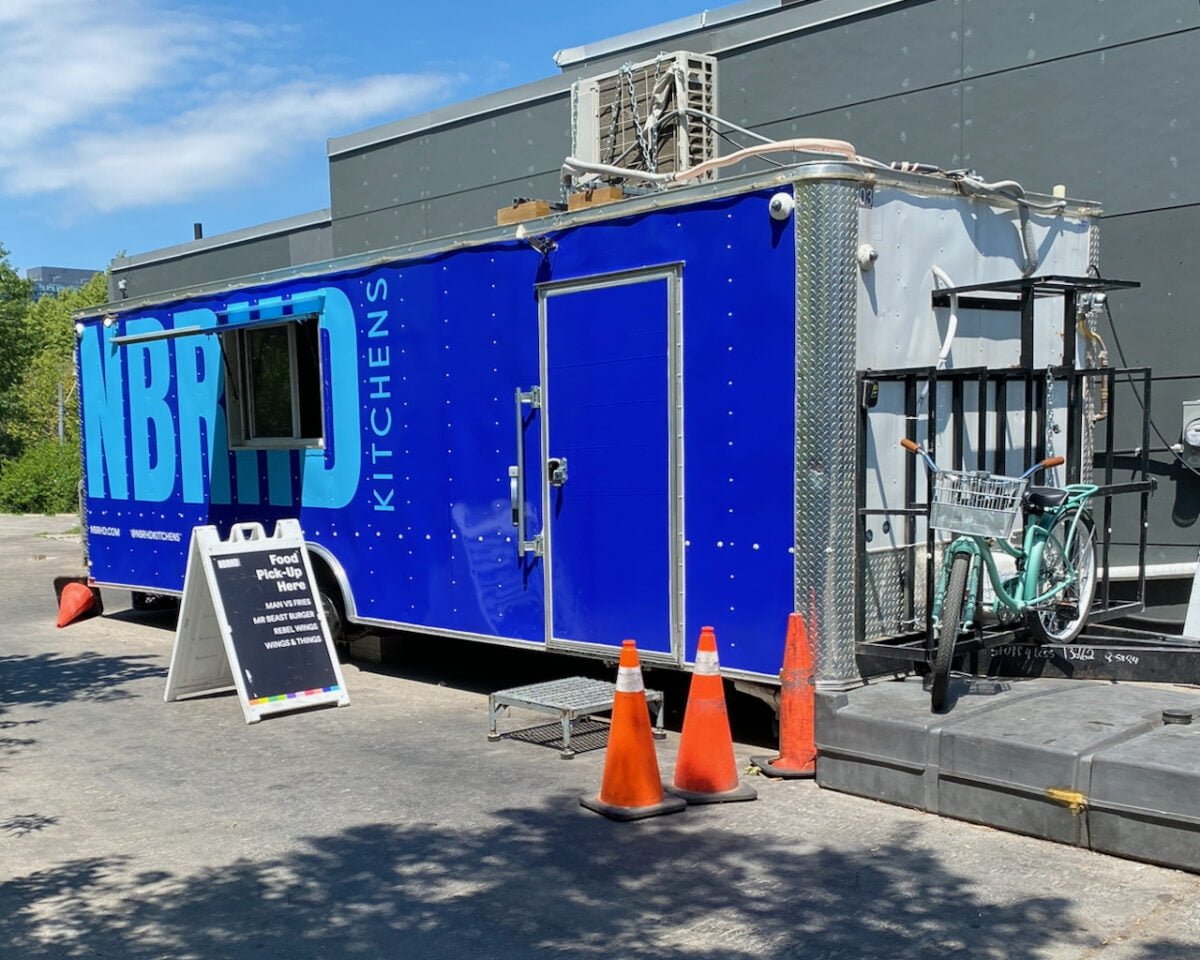
Reef Technology (NBRHD Kitchen) on King Street in Toronto – Photo by Dustin Fuhs
“I think the whole space in ghost kitchens, virtual kitchens, is just so interesting. We’ve explored a few concepts over the last couple of years. Even pre-pandemic we tested out some ghost concepts in our restaurants and I think we will continue and we’re going to land on one that works right for us. It’s a way for our franchisees to take more advantage of the real estate they already have. That’s one element of the whole ghost kitchen idea.
“But then REEF represents for me, for us, for Quesada as a brand, a different element which is just putting Quesada in places, making our offer available to Canadians almost everywhere in a very short amount of time. That’s the potential I see with REEF . . . Theoretically they could roll that out to 30 or 50 locations in a matter of months. It’s a very interesting concept and so we’re glad to be a part of it.
“Maybe too they’re our ticket to break into the US market. We’ll see. We’ve talked to them a little bit about that because they’ll have thousands of locations in the US. It’s an interesting opportunity. We’ll see where it goes. But for us the main thing is it just allows more people to get experience with our brand.”
The grocery store is in the midst of a great transformation, powered by Canadians’ changing food consumption patterns and preferences and accelerated by the impact of the COVID-19 pandemic.
The speed at which Canadians’ lifestyles and behaviours have changed—and continue to change—is forcing food retailers to accelerate change. The impact can be seen across the grocery store through: Changing formats; Updating product assortments; Embracing online shopping; and Reimagining interiors, says a new report by Deloitte called The future of food: a Canadian perspective.
Sangeetha Chandru
Sangeetha Chandru, National Operations Transformation and Retail Transformation Practice Leader, Deloitte Canada, said there were certain trends existing pre-pandemic that started to accelerate during the pandemic.
“The shift to omnichannel for example and how we use our brick and mortar stores as well as the ecommerce experience to be an extension of each other. That started to accelerate once the pandemic set. And that’s actually been the primary driver of the findings that we have in the study,” she said.
One of those includes the shift away from large format stores to smaller footprints. Chandru said there will be more focus on localization of product assortment, a huge value on fresh food and an expansion of plant-based alternatives.
“Food is truly a reflection of the cultures we serve and grocery stores are really sort of cluing into that and so we’re obviously going to be seeing more of a double down in that area.”
Chandru said as ecommerce starts to grow the necessity to have “incredibly” large stores starts to reduce “because customers are now starting to lean into what I call more convenient options.”
“Even from a shopping perspective, they want to be in and out fast. They want to get everything on their list. They want to do a hybrid shopping of online and in store depending on the types of categories they’re shopping for,” she said.
“Stores are going to become much more fresh focused. They’re going to have much larger departments that are focused on home meal replacement. So think of your ready to cook and ready to eat category, especially given the huge rise of meal delivery solutions that have happened through the pandemic. Grocery stores obviously want a piece of that action. And they want a piece of the QSR (quick service restaurant) action but they want to do it in a healthy way. And healthy and sustainable is going to become a huge need for customers.
“In order to serve that type of a customer you don’t need these humungous footprint stores. A large amount of your dry grocery stuff can be done online and you just go into the store for a fresh experience for example . . . Bigger stores mean higher costs. The retailers can re-use that footprint in another way, so think about micro fulfillment centres for example. There’s a big opportunity for retailers as omnichannel becomes more and more important, ecommerce becomes more and more important, the one big question that grocery retailers always grapple with is the last mile fulfillment economic equation. They’ve never really been able to balance that quite right. So if they start to have micro fulfillment centres where let’s say 25 to 30 per cent of the store gets dedicated to ecommerce . . . they could have inventory in the back of the store to be able to do that without depleting the front of the store inventory.”
The report found that:
66 per cent of Canadian consumers are cooking more meals at home than they did the previous year and 36 per cent are baking more often too;
88 per cent of consumers say they buy fresh produce each month and 76 per cent buy fresh meat;
25 per cent say they’ve taken more interest in learning about how food affects their health and immunity;
25 per cent ordered online for curbside pickup for the first time in the past year while 15 per cent ordered online and had their food delivered;
71 per cent feel it’s important to know where their food comes from, and 42 per cent say they’d buy more locally sourced items going forward; and
37 per cent of consumers expect food retailers to be low-carbon or carbon-neutral, and 29 per cent make an effort to shop at food retailers that help them reduce their own carbon footprint.
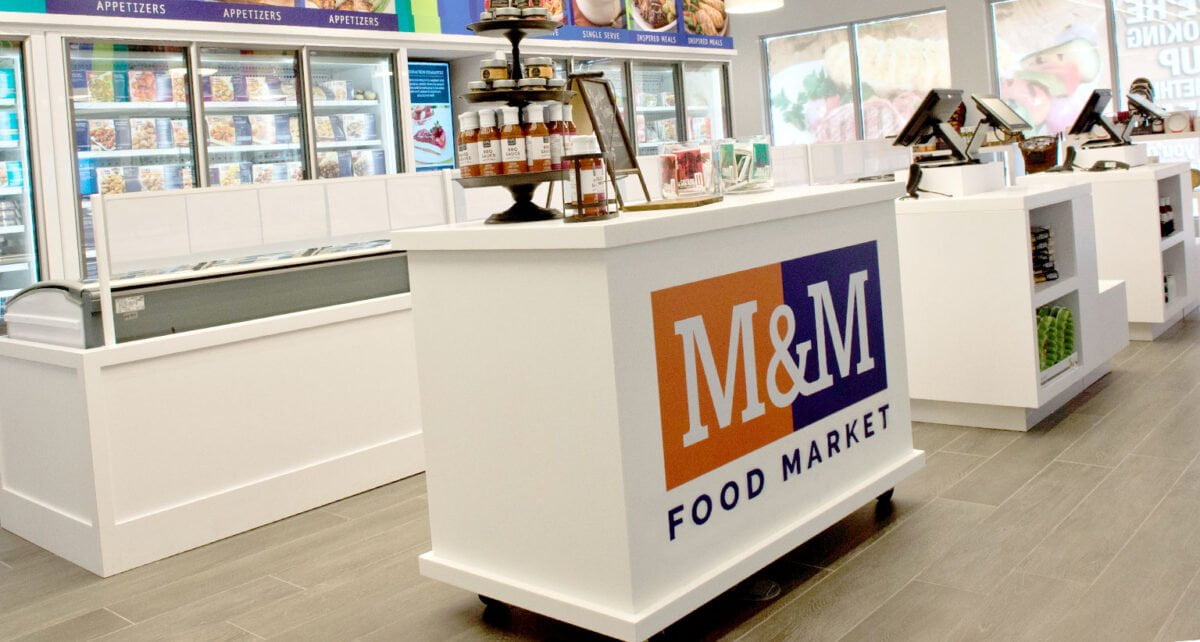
“So when you go to a smaller format like M&M you can get in and out much quicker than going into a large 100,000 square foot place where you have to walk the halls to find what you’re looking for,” said O’Brien.
“I think people also feel safer in a smaller environment where there’s not as many people and they can get in and out. I also believe, especially retail like ourselves, who offer some really added value products are attractive to a lot of consumers who are now looking for meals that they have at home that are different and unique.”
Shopping online has also helped expedite the consumer experience.
O’Brien said people’s perception of frozen food has also dramatically changed over the last 16 months. They realize it’s something they can have in the freezer as a go-to. In addition, he said the company conducted some major research recently trying to figure out consumer attitudes post-pandemic.
“What we’re expecting is that the frozen category is going to continue to grow at least seven per cent in the next two to three years. At least until the end of 2022,” he said. “We’re expecting to see some significant growth.
“Go back five years, I don’t think the frozen players really put a lot of innovation against frozen foods. Over the last 16 months, there’s been an increased interest in frozen foods and I figured there would be a lot more innovation from all retailers . . . We all realize now that frozen food is a major opportunity for our customers so we’re going to start innovating a lot more around added value products for them.”
Seattle-based e-commerce retailer Amazon confirmed with Retail Insider this week that the popular Amazon Prime Day is formally cancelled in Canada this year. It follows Amazon’s having already delayed the event due to the pandemic. Prime Day is expected to return to Canada in 2022 as more Canadians are vaccinated and things return to a degree of normalcy.
Amazon provided a statement to Retail Insider on Tuesday: “Due to the impact of COVID-19, we have decided to not move forward with Prime Day in Canada this year while we focus on the health and safety of our employees, customers and selling partners.”
Many had anticipated Prime Day to take place in the fall of 2021 after being delayed from the summer. In the United States, Amazon Prime Day took place over the course of June 21-22nd of this year.
On Amazon’s Canadian website, the Prime Day page states that it will return with no date given.
GIF image from Amazon’s Canadian website
In 2020, Amazon moved Prime Day in Canada from July to October due to concerns surrounding the pandemic, including warehouse workers falling ill with the COVID-19 virus.
This spring, three of Amazon’s distribution facilities in the Greater Toronto Area were mandated to close entirely or in part after some workers tested positive for the COVID-19 virus. Amazon has since come out with a health and safety protocol for its work spaces which include fulfillment centres as well as its offices including regional headquarters in downtown Vancouver and downtown Toronto.
Amazon had initially told employees of its downtown offices that they were to return to work five-days a week and the decision was recently changed both in the United States and in Canada. Amazon employees will be able to work from home two days per week while in-office work will be mandated for three days a week. Employees can also work remotely for a month in another location within Canada as an extra benefit.
Amazon does not break down its Canadian sales numbers which are said to be in the billions of dollars annually. The massive retailer has been growing rapidly in this country with increased sales and several recent announcements of new fulfillment centres in major markets. Amazon is also expanding its base of employees at its downtown offices and will eventually move into the 1.1 million square foot office component of the mixed-use development The Post in downtown Vancouver which is being developed by QuadReal.
The loss of Amazon Prime Day 2021 will not only impact Amazon’s bottom line, it will also affect thousands of vendors in Canada selling through the platform. We recently featured an article interviewing Canadian business owners finding success using the platform.
Amazon’s largest sale day in Canada will go ahead in 2022 on the same day as the US. The dates have been announced as July 12 and 13. Online retailers are gearing up their promotions and it is expected to be one of the largest shopping events since before the pandemic. You can see many of the best Amazon Prime Day home deals here.