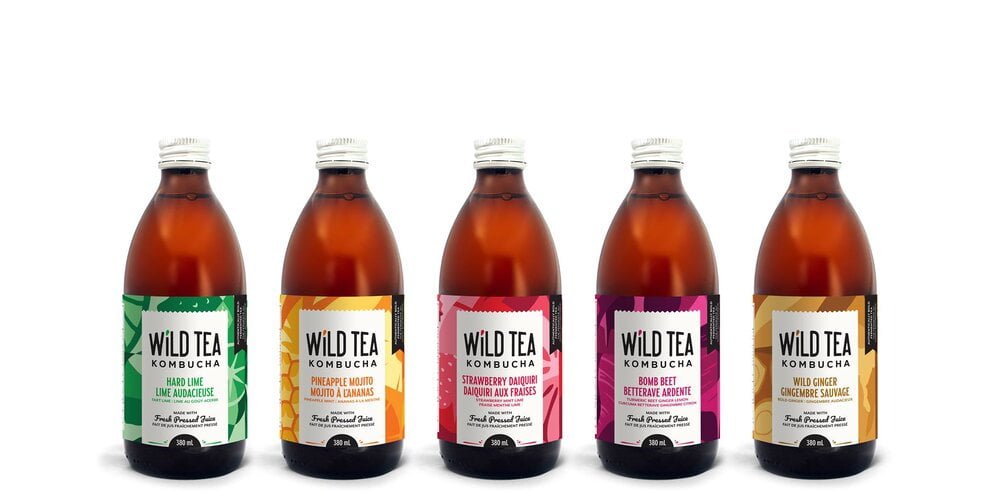
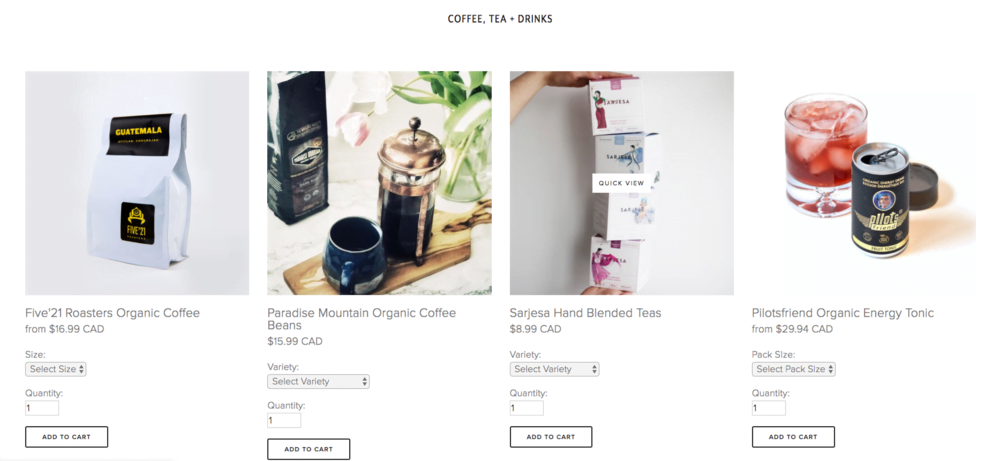
Calgary-based Wild Tea Kombucha has launched a collaborative one-stop online shop to provide shoppers with easy access to food and beverage and other products from a number of local businesses.
The new ecommerce platform, which is being powered by WTK founders Emily Baadsvik, the company CEO, and Brigette Freel, its COO, have lined up a number of businesses to join the network as consumers change their shopping habits due to social distancing and store closures brought on by the COVID-19 (coronavirus) pandemic.
“Brigette and I were just brainstorming ways once we knew the pandemic was becoming the real thing and we quickly saw the effects of all trends and businesses closing or having restricted hours,” said Baadsvik. “So we immediately wanted to do something to bring awareness to the small businesses in Calgary and try to bring extra sales because it’s the small businesses that don’t have the big multi-conventional distribution. We have to struggle to stay open.
IMAGE: WILD TEA KOMBUCHA
“So basically just on an idea we texted a bunch of our local business friends and then immediately they all replied and it’s just grown organically from there.”
WTK, which has been in business since 2015, has a goal to add more local brands to the platform to simplify the shopping process for Calgary while also helping fellow business owners to stay afloat during these challenging times.
“We’d like to grow it. We haven’t really thought about putting any kind of cap on it yet. So anyone that’s interested is welcome to reach out to us and join us in this little endeavour,” said Baadsvik.
When asked if the concept might continue on when the pandemic is over and times return to a normal state, she said: “It’s going to be just play it by ear. I think that it just depends. If people continue to want home delivery, it’s something that we’re really glad to do and I think that collaborating with our friends and having more than one option besides Kombucha is just smart business.”
EMILY (LEFT) AND BRIGETTE (RIGHT). PHOTO: WILD TEA KOMBUCHA
She said the initiative involves contactless delivery because the company is trying to limit the number of people that are coming to the facility and the contact with the outside world.
“We just want to help the small business community in Calgary,” said Baadsvik. “The thing is a lot of us don’t qualify for the benefits – the 75 per cent wage subsidy. You have to show that your business decreased by 30 percent and when you’re a small business you’re trying to grow every year. So it’s a bit of a weird situation. Even though our sales have gone down they haven’t gone down enough so we don’t qualify. So we have had to lay off some staff.
“Right now it’s just about survival and taking it day by day, week by week. So whatever we can do to lift each other up that’s all that matters.”
The businesses on the platform include:
Wild Tea Kombucha – bottled and canned kombucha and kombucha cider at wholesale, case lot pricing.
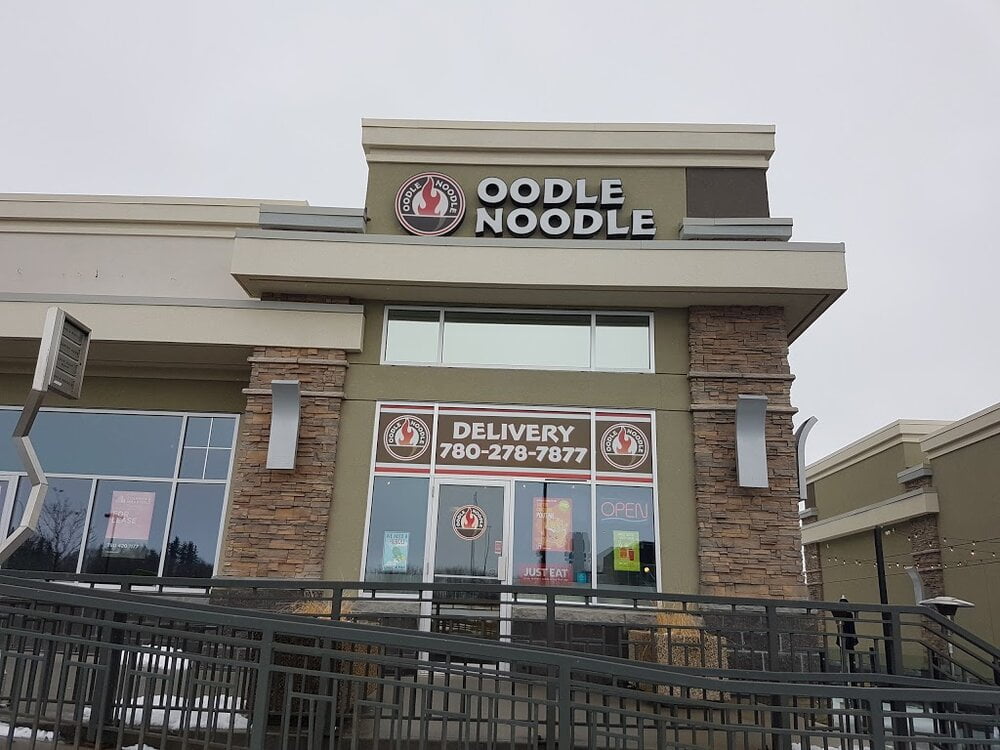
Being part of the community and giving back to it has been a part of Edmonton-based Oodle Noodle since it was first opened about 12 years ago by Sonny Pham.
And that has been even more important in recent weeks as the authentic Asian restaurant has stepped up to help different charities during the COVID-19 pandemic.
“One of the things we do better than many others is we have a very strong community presence,” said Ziad Kaddoura, general manager of the company, who is mainly in charge of business development and running the day-to-day operations.
“We do donations and charity work throughout the year but since COVID-19 started, every week we’re donating about 300 pounds of noodles and sauces to the different food banks or charities. So far we’ve donated close to 2,000 pounds. And we try to pick different charities.
“The other thing we started doing about three weeks ago is 10 percent of our walk-in sales end up being donated to community charities. And on a weekly basis we’re donating about $3,000 in hard cash money to these local charities. These are charities that are not able to get funding from other people. So they’re very small charities. It could be anything to do with kids that have pressure because of COVID-19. It could be women’s shelters. It could be whatever. That community work that we’re doing is paying back because basically our community has been very supportive of the work that we’ve done.”
The first restaurant was on Whyte Avenue. Today the company has 13 locations with the 14th opening in mid-July in Edmonton.
“They’re all in Edmonton, Spruce Grove, Sherwood Park, and Leduc for now,” said Kaddoura, who has been in the food business for more than 30 years.
SPRUCE GROVE LOCATION. PHOTO: CANADA247
The way the brand has grown in locations is the company looked at the key neighbourhoods where they could put in a store to serve that neighbourhood. None of the stores are cannibalizing other stores but at the same time the brand is serving everyone.
Kaddoura said he doesn’t think the company can grow much more in Edmonton other than maybe up to two or three more stores in the city.
“We’re looking at putting a store in St. Albert. We’re looking at putting a store in the centre north end of the city like the Castle Downs area. Because we have our supply solution and all our product comes pre-packed and pre-portioned it makes it easy for the product to be transported to other cities,” said Kaddoura. “And we have a strong also central support team, so now we’re starting to look at Calgary and we’re looking at opening maybe three stores next year.
PHOTO: UBER EATS
“I do believe that Calgary could see 10 to 12 stores easily. We will be looking at opening a store in Grande Prairie, a store in Fort McMurray. My plan is to move to about 40 stores by 2025 in Alberta. Once we hit the 40 then we can start going beyond and looking at B.C., looking at Saskatchewan, looking at other areas.”
Kaddoura said one of the keys to the business success of Oodle Noodle is how well things are streamlined in its operation.
“Our operation is a very easy operation for any franchisee to take on,” he said. “We have a very strong relationship with our franchisees. We meet quarterly with them making sure they’re happy with what we’re doing.
“The other thing that makes Oodle Noodle very unique is we have our own factory where we produce our fresh noodles and our fresh sauces. We have three different noodles and 12 sauces. So basically putting the noodles and the sauces together gives you a meal. And then we’ve got some rice dishes.”
COVID-19 has changed (and will continue to change) the way consumers shop in stores and what they elect to purchase and prioritize. When COVID-19 guidelines were enacted, essential retailers had to quickly adapt operations to comply with social distancing regulations. Retailers who had the availability of real-time location data were able to monitor shopping patterns to gain insight into how they can better meet new COVID-19 safety requirements while adapting to what consumers want during this pandemic.
Anonymized and aggregated data from five large North American retailers show a shift in the average shopper journey from mid-March, when shelter-in-place restrictions began to take effect. The data shows a combined 44% increase in paper products, household products and dry goods. At the same time, the data reported a combined almost 50% decrease in shopping for clothes and shoes. The data also showed an 11% increase in traffic to brick and mortar locations during the week of March 9 -16, 2020. From this analysis, it can be easily seen that consumers began stocking up on essential goods as soon as the call for shelter-in-place was made.
Location data helps keep up with changes in shopper habits
An Internet of Things (IoT) sensory network of intelligent lighting installed in stores enables retailers to analyze and take action on the movement and utilization patterns of carts and baskets as they move through the store. The anonymized and aggregated heat maps below show shopper traffic before and after shelter-in-place announcements were communicated.
On the left, the heat map shows relatively normal shopping behaviour for the week of February 17, with traffic dispersed throughout the store. Fast-forward a few weeks to March 11, when WHO declared COVID-19 a global pandemic and the traffic patterns shift dramatically in the same store. As the heat map on the right indicates, shoppers were dwelling almost exclusively around essential goods: grocery, health, household, and baby supplies (formula, diapers, wipes, etc.).
What can retailers do with this information?
Utilizing real-time location data allows retailers to see shopping patterns so they can adapt resources such as where and how to staff employees, what products and/or aisles need to be restocked and how to prepare for peak shopping hours. Additionally, they can use the data to capture the most stagnant times and allocate those time frames for the “at-risk” demographics to shop.
Use data to inform store design in a crisis
Stores can use shopper journey, dwell, and behaviour trend data from this pandemic to retrofit low-traffic departments (e.g., apparel in these examples), to disburse high-demand items. The insights from this data can help retailers create more space for shoppers who are buying in-demand items and can also support social distancing mandates.
Improve Buy Online Pickup in Store (BOPIS) operations
Since Canada clarified the list of essential businesses, many non-essential retailers have seen their businesses transform from receiving only a couple dozen BOPIS orders a day, to quickly having BOPIS orders becoming the only way to enable sales. Mobile wayfinding technology can help new and/or temporary employees find items faster and be more efficient to serve consumers in this new way. IoT sensory networks and location services greatly simplify the common challenges associated with order fulfillment and product search.
Shopper analytics data gives retailers the knowledge required for strategic decisions which can help address associate safety during COVID-19. Detailed understanding of stores and zones with incidence of congestion allows retailers to take immediate action, implement new protocols in near real-time and ensure compliance with local safety regulations.
As retailers prepare for the prolonged effects of COVID-19 on shopper behaviour, adoption of tools and technologies can provide real-time operational insights across a series of store locations. These insights can help a retailer improve customer experience and implementation of safety guidelines while helping to protect their store’s bottom line.
Vladi Shunturov
Vladi is a founder, product leader and innovator in the IoT, data analytics and connected buildings space. He is passionate about solving complex problems using data and building cloud-first solutions with a great user experience. Vladi serves as VP of Product for Atrius - Acuity’s Connected Lighting and Indoor Positioning technology business unit. He was also a co-founder and CTO of Lucid (acquired by Acuity Brands in 2018), maker of BuildingOS - a connected buildings cloud platform used by Facility, Energy and Sustainability management professionals across 500+ enterprise customers and 25,000 commercial buildings to centralize all building operations data (utility, meter, BMS, IoT, asset & maintenance). He is the recipient of numerous industry awards including from the U.S. EPA and the Cleantech Open. He has previously been invited to speak and share his expertise at Autodesk University, CoRE Tech, DisruptCRE, the EPA and DOE, Greenbuild, and at TEDx.
Coronavirus has ravaged the world’s economies, but there’s hope on the horizon, especially for businesses in the sleep industry. In a recent interview published in Forbes online, the CEO and a co-founder of Simba Sleep Limited, explained that sales had been increasing during the pandemic.
This was especially the case of single mattresses, with consumers self-isolating or just feeling the need for some space from their partner or others in the household. The CEO also revealed he had plans for the business’s supply chain in Canada.
Sleepless nights all around
Simba extended the trial period on their mattresses and it turned out to be a sound decision. Two other smart moves were to highlight the company’s attention to good hygiene in its factories and the importance of contactless delivery. Until the official announcement of the lockdown, sales had dipped, but then the company saw their online sales surge when the nation knew what plans its government had for them. Since then, many people will have been having sleepless nights and the lockdown has made self-care a priority.
Of course, business owners, too, will have spent nights awake, wondering how they’re going to get through this. Simba has some good news for Canada because the CEO is concentrating on building a strong supply chain in the country, as well as in the UK, France and China. The plan is to increase security and reduce lead times. The quicker the production, the faster the business can respond to demand and get its products out there.
The fact that an overseas business is talking about operating in Canada is good news at a time when businesses have been feeling fear over the future of their livelihoods. The Canadian government did rush to the rescue in March and announce a major package to support them during the crisis. They’ll have quelled a few fears and doubts and the owners will be able to sleep slightly better, but retail businesses, like many others, will still have to fight their way out of this as recession starts to hit.
What was happening before all this?
Long before the coronavirus, the sleep industry had been experiencing a wave of change in Canada. Tired citizens had been shying away from pharmaceuticals and moving towards alternative sleep products to help themselves get that much needed shuteye. White noise machines, weighted blankets, sleep apps and “smart” beds, which moderate the temperature of the mattress, had all been part of a boom in alternative sleep products. Canadians had been giving their health and wellbeing serious consideration. Getting a good night’s sleep had been part of this.
In the UK, an interview with the Digital Director of the online beds company Bedstar, Jonathan Stalker, revealed some interesting trends. Mr Stalker had commented that fabric beds, especially in grey, had become popular with the company’s customers. He explained that ottoman beds had also started to enjoy much more popularity in the last few years.
Additionally, he pointed out the general trend that people were paying a lot more attention to interior design when they bought their beds. Before it had been about buying a bed on which they could sleep comfortably and which suited their requirements; now the bed is the focal part of the room and manufacturers are bringing out upholstery in different colours.
How can retail businesses find their way out of the current situation?
Listen to a few financial podcasts and you’ll find they’re not as gloomy as you’d expect. Some guests on them have been optimistic about the economy, saying that it will bounce back quickly as businesses reopen, consumers make up for lost time and buy all the things they needed but to which they didn’t have access during the lockdown. The question is, how can retailers find themselves out of the situation that the pandemic has created?
Get ready for the built-up demand
People have had to do without lots of different things and when shops open for business again, they’re going to get spending. A lot of businesses will have made cutbacks, but they should revise these now and have steps in place so that they can cope with the high demand when the shoppers hit the streets again.
Work on long-term investments
The slowdown has been a good time to take a long, hard look at operations, processes and platforms. Where are the opportunities? What’s missing? Now is the chance to think about long-term strategic planning and work out how the business can still grow as coronavirus starts to subside.
Think about the problems customers are facing
The lockdown will have created real pain points for consumers. Retail businesses need to work out what these are and how the business can help them. This could involve re-positioning the business or certain products so that customers still see the value of them. Consumers may be worried about managing their money or access to certain goods or services. How does the business address these concerns?
Make the most of new channels
People have still wanted or needed things during this crisis. Businesses have had to embrace certain channels — namely, online — so they can carry on serving their customers. What is clear is that consumers will have adjusted some parts of their lifestyle. When life returns to “normal”, they may find they’re happier going through the channels that, originally, were a plan B. As a result, retail businesses should consider expanding their online operations or improving them and continue running them on this larger scale.
It’s been a frightening time for businesses, but light seems to be appearing at the end of the tunnel, especially for the sleep industry. Consumers are trying to take better care of themselves, which includes investing in getting a good sleep.
Retailers are analysing their operations and studying how they can keep their businesses going now and beyond the crisis. Meanwhile, there’s a sense of optimism about the prospects of the world’s economies, which can emerge from their coronavirus-induced slumber sooner than their citizens might expect.
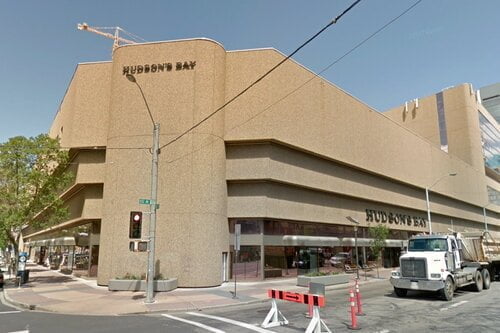
Hudson's Bay at Edmonton City Centre. Photo by Difei Xu.
The Hudson’s Bay Company has announced that it is shutting its 168,000 square foot Hudson’s Bay store in downtown Edmonton this fall, marking the closure of the last remaining department store in the city’s core. It’s a blow to Edmonton’s downtown which in January saw large-format luxury retailer Holt Renfrew shutter and years before that, the closure of Eaton’s and Woodward’s department stores nearby.
The downtown Edmonton Hudson’s Bay store will reopen temporarily on May 19 along with the company’s other Alberta stores. The downtown Edmonton store will gradually close by the fall and employees will be provided with the opportunity to transfer to Hudson’s Bay’s other five remaining Edmonton-area stores which include Southgate Centre, West Edmonton Mall, Kingsway Mall, Londonderry and St. Albert Centre.
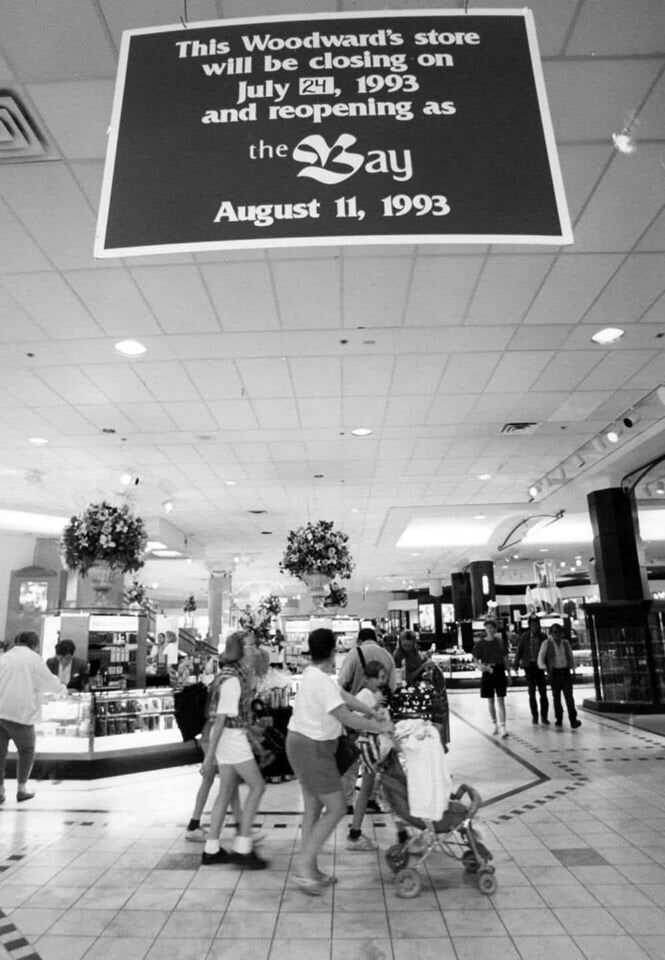
Located in the Edmonton City Centre shopping complex, the downtown Hudson’s Bay store moved into its current location in May of 2002. Before that, an Eaton’s department store occupied the space — Eaton’s went bankrupt in 1999 before being acquired by Sears Canada. Hudson’s Bay relocated to its current downtown space after exiting a large building nearby that had been formerly occupied by a Woodward’s store. Before relocating into the Woodward’s space, Hudson’s Bay occupied a massive five-level building 470,000 square foot building on Jasper Avenue that in the 1990s was branded as the ‘Hudson’s Bay Centre’. The Hudson’s Bay Centre shopping complex was a failure and the building was eventually sold and converted to the current University of Alberta Enterprise Square. Remarkably, Hudson’s Bay operated two downtown Edmonton stores for about two years in 1993-1995, including the Jasper Avenue Hudson’s Bay Centre store as well as the store in the former Woodward’s space.
CLICK FOR INTERACTIVE GOOGLE MAP
CURRENT STORE. PHOTO: GOOGLE STREETVIEW
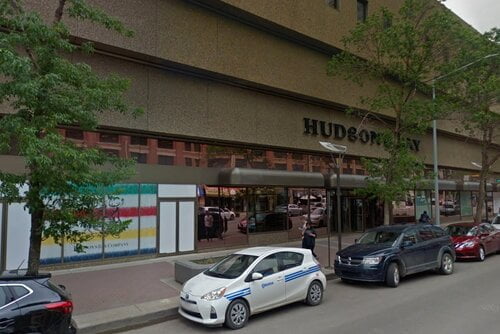
CURRENT STORE. PHOTO: GOOGLE STREETVIEW
Last year, Oxford Properties sold the two-block long Edmonton City Centre complex, which includes a shopping centre, office towers and a hotel, to a four-member group of investors. At the time we were told that the group had been considering demolishing the downtown Edmonton Bay store for a new tower to capitalize on the site’s value through densification. Hudson’s Bay had denied that the downtown Edmonton store was closing though in years past, Oxford Properties was said to have been looking to other uses that could have included a Nordstrom store in the Bay space — plans were also in place to add new Holt Renfrew and Target stores to Edmonton City Centre, though plans changed with the downturn in oil prices in 2015 which saw Alberta’s economy collapse.
Edmonton will become the first major city in Canada (with a population of nearly one million within city boundaries) to have no downtown department stores. This puts Edmonton in line with many cities in the United States which over the years have seen the shuttering of all downtown department stores. Winnipeg is likely the next large city to lose its downtown Hudson’s Bay store — the Winnipeg store once spanned 675,000 square feet and was the company’s flagship store for many years until a new Toronto store at 44 Bloor Street West opened in 1974. Downtown department stores also still operate in Vancouver, Toronto, Ottawa, Montreal and Calgary.
Calgary, which has an unofficial rivalry with Edmonton, currently has three department store retailers in the city’s core. Hudson’s Bay operates a 500,000 square foot flagship store and nearby, La Maison Simons operates a 96,000 square foot store. A block away, Holt Renfrew operates a 150,000 square store in a space once occupied by Eaton’s.
In the two largest cities in Saskatchewan, Hudson’s Bay operates downtown stores in Saskatoon and Regina. Both stores relocated to downtown shopping centres from standalone buildings after the demise of Eaton’s.
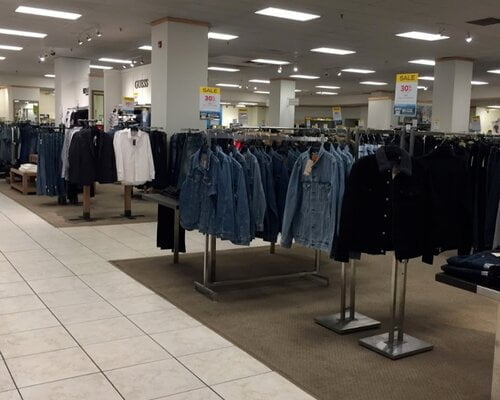
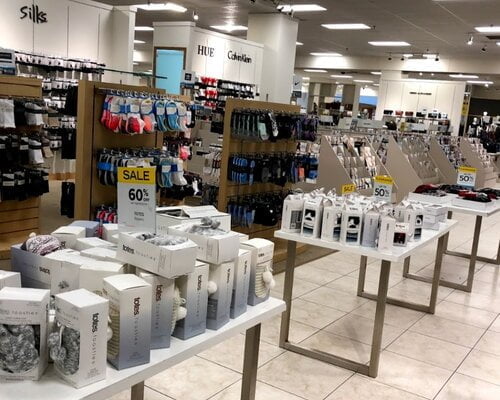
INSIDE THE EDMONTON CITY CENTRE HUDSON’S BAY STORE. PHOTO: GOOGLE MAP REVIEWSINSIDE THE EDMONTON CITY CENTRE HUDSON’S BAY STORE
In downtown Edmonton, the 32,000 square foot Holt Renfrew store closed in January of this year. Half a decade prior, plans had been drawn up to move Holts into a much larger location at Edmonton City Centre in part of the space that was once occupied by a Woodward’s department store. Woodward’s had a 400,000 square foot store which opened in that location in downtown Edmonton in 1974 until its bankruptcy in 1993 — Woodward’s first downtown Edmonton store opened on the same block in 1926. Iconic Toronto-based Eaton’s operated a large multi-level store nearby until its demolition in the mid-1980s to make way for the new Edmonton Eaton Centre, which merged with the adjacent Edmonton Centre to create the single Edmonton City Centre complex in 2002.
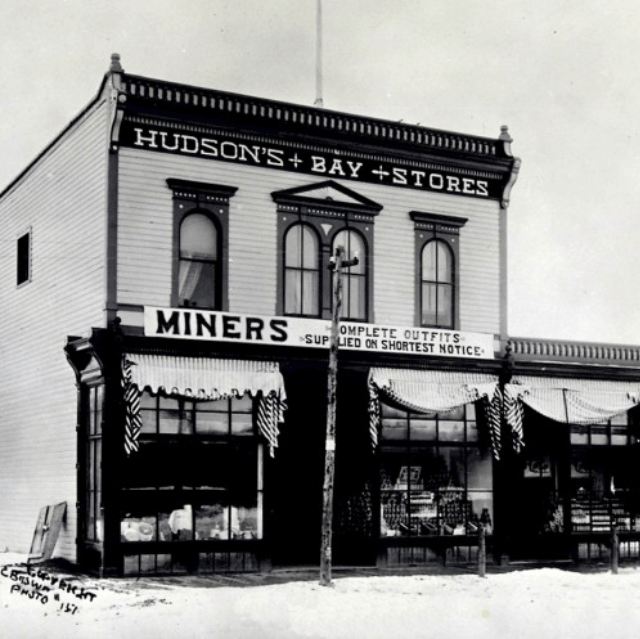
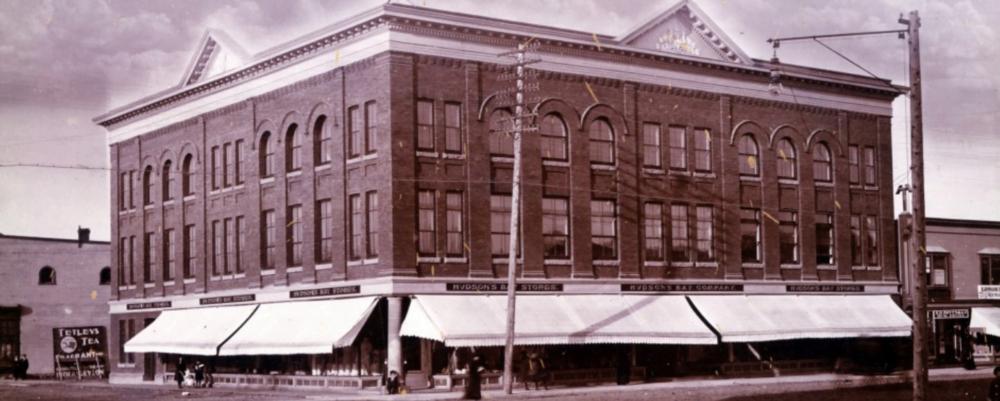
The Hudson’s Bay Company founded its Fort Edmonton trading post, focused on the fur trade, in 1795 near the current city of Fort Saskatchewan. Fort Edmonton was relocated to downtown Edmonton in 1802 in the city’s Rossdale area and in 1830, it relocated up the hill near where the Alberta Legislature is currently located. Hudson’s Bay’s first standalone downtown Edmonton store opened on Jasper Avenue in 1890 in a town of only 400 people. In 1905 when Alberta was founded and Edmonton became the capital, Hudson’s Bay expanded its store to three levels after the community grew to a population of 7,000.
Further expansions saw the block grow and by 1956, it encompassed 470,000 square feet on the north side of Jasper Avenue between 102 Street and 103 Street. In 1989, the Hudson’s Bay Company sold the massive Edmonton store to Stewart Green Properties and the Hudson’s Bay Centre was developed with the Bay occupying 118,000 square feet and the remainder tenanted by smaller retailers and food & beverage concepts, which never reached its potential.
THE FIRST STANDALONE HUDSON’S BAY COMPANY STORE IN EDMONTON, JASPER AVENUE, IN 1894. PHOTO: HBC HERITAGETHE EXPANDED STANDALONE HUDSON’S BAY COMPANY STORE IN EDMONTON, JASPER AVENUE, IN 1906. PHOTO: PHOTO: HBC HERITAGETHE EXPANDED 470,000 SQUARE FOOT JASPER AVENUE LOCATION IN THE 1950’S PRIOR TO MOVING TO EDMONTON CENTRE. PHOTO: HBC HERITAGEFORT EDMONTON, 1867 BY GEORGE LORNE HOLLAND BOUCHARD. HBC CORPORATE COLLECTION. PHOTO: HBC HERITAGE
FORT EDMONTON, 1872. HUDSON’S BAY COMPANY ARCHIVES. PHOTO: HBC HERITAGE
BETWEEN 1993 AND 2002, HUDSON’S BAY OCCUPIED THE FORMER WOODWARD’S BUILDING AT EDMONTON CENTRE FACING ONTO CHURCHILL SQUARE. PHOTO: CITY OF EDMONTON ARCHIVES
EDMONTON CENTRE TRANSITION FROM WOODWARD’S TO HUDSON’S BAY. PHOTO: WOODWARD’S FACEBOOK PAGE
The suburbanization of retail has hit the downtown cores of cities across North America hard. The rise of automobiles and the suburban shopping centre saw consumers gravitate away from downtowns, creating competition and reduced foot traffic which proved insurmountable for many downtown businesses. Department stores themselves have become irrelevant over the years in North America. The rise of brands themselves along with retail category killers, discounters and online shopping have all played a role.
The Hudson’s Bay Company was recently taken private by CEO Richard Baker, and it’s unclear what the future holds. Some are speculating that a filing could be at play to rightsize the chain which currently has 89 stores across the country, not to mention other banners including Saks Fifth Avenue.
Sources have said that a concession strategy is in the works for Hudson's Bay which will see departments run by third party vendors for the Bay stores that remain open after a post-privatization restructuring.
The COVID-19 crisis, which forced the closure of thousands of retail businesses across the country over recent weeks, has also provided retailers with an opportunity to engage their teams in professional development during this time.
April Sabral, Founder & President of retailu, an online learning platform that focuses on competency-based leadership development programs for retail managers, said leadership development is essential to store managers, district managers, and higher levels.
“Currently, we are offering our courses to everyone on a pay-what-you-can-afford donation. We have been amazed how many retail managers have taken advantage of this offer and joined, telling us that managers want leadership development,” said Sabral, an experienced retail executive who has worked for companies such as Apple, Gap, Starbucks, Holt Renfrew, and DAVIDsTEA.
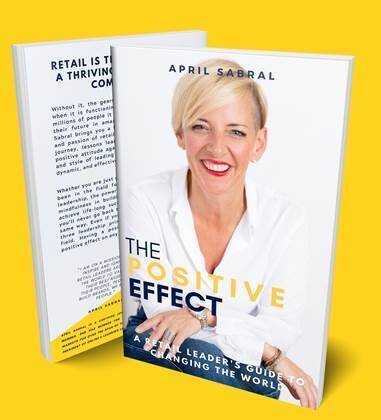
APRIL SABRAL ON THE COVER OF HER UPCOMING BOOK ‘THE POSITIVE EFFECT’
“For businesses wanting to purchase for their management teams, retailu is simple and easy to onboard. We literally can have them up and on the platform within 24 hours with no integration. Fully accessible on an employee’s mobile device. After working in operations for over two decades, I understand it needs to be simple. We are adding live lessons for retailu members to support our retailers right now develop their people during this time.”
Retailu recently engaged managers from Huddle Group, a management and consulting firm specializing in retail, to develop their leadership skills, in a time when strong leadership will be required when returning to their stores, dealing with conflict, problem-solving, developing ambiguity, and communication skills. Those skills will all be necessary, especially now.
The Huddle Group’s services range from strategy, analytics, recruiting, and team building to full-service management of Operations, Marketing, HR, Payroll, and inventory control. It provides leadership and expertise to support all areas of retail operations.
“We believe that ongoing employee development is critical to delivering results, keeping our leaders engaged, and retaining the best talent.
The majority of our retail clients are provided with brand-focused training, which connects their product, visual displays and selling behaviours for a seamless/branded customer experience. Building on this foundation, we strive to fulfil our leadership teams’ desire for professional development through ongoing mentoring, coaching and skills development training,” said Jason Sanderson, COO of Huddle Group.
CLICKTHROUGH FOR MORE DETAILS. IMAGE: RETAILU
Sanderson explains, “The sudden change in the retail landscape due to COVID-19, coupled with our clients’ desire to keep their leadership team with full employment, provided us with a rare opportunity to roll out a leadership training program that was able to leverage the ideas and input from our entire team of leaders. We’re proud to work with clients who put their people first, partnering with April at retailu allowed us to seamlessly transition to work-from-home with a full range of leadership training. The online platform of retailu paired with follow up virtual meetings allowed us to continue our commitment to the growth and development of our team, without interruption. This kept our team engaged and set up for success, ready to hit the ground running when the stores reopen.”
Sabral said many retailers took the opportunity during the ‘down time’ to pursue professional training development programs for employees.
“Many people are doing it. However, a lot of people don’t have the content we have. They’re very focused on policies, product knowledge, campaigns and all the stuff that happens on an everyday basis. Still, they don’t have the leadership skills and the competency skills, we even have an online District Manager skill-building course,” said Sabral.
PHOTO: RETAILU
“That’s where we fill that gap, I would say consider us like LinkedIn learning for retail leadership development because that’s basically what we are. The best investment you can make is in your frontline managers, and Huddle Group did the right thing, their managers will go back stronger than ever, engaged and ready to lead. We want more people to discover retailu because the feedback has been so positive from the managers who take the courses,” they always say, “I wish I knew about this sooner.” “ We have managers from Gap to Tory Burch joining retailu.”
“As retailers think about the new norm returning to business, finding solutions like retailu.ca and Huddle Group who together can support operations and training could help retailers save cost and help them with efficiencies. I have known Jason Sanderson COO of Huddle for over 15 years from our time working in operations. Having experienced retail leaders like us supporting retailers could really pay off. I feel like we are like the best-kept secrets of operational support and training and development. The new norm of retail will have to find affordable solutions without sacrificing these two areas, operational support and development of people. We all need to look at the way we run our businesses a bit differently”, Sabral says.
The platform was launched last fall.
Amber Hamilin, Store Manager of Pandora in Devonshire Mall in Windsor, Ontario, said Huddle Group provided the store with an amazing opportunity to complete the retailu courses while working from home these past few weeks.
“This proved to be an impactful growth opportunity for us as leaders. These courses are exactly what we needed and are so consistent with the support we have with Huddle Group.” Huddle Group manages brands such as Pandora, Swarovski, Tous, Soccer shots, and Oshawa Jewelry.
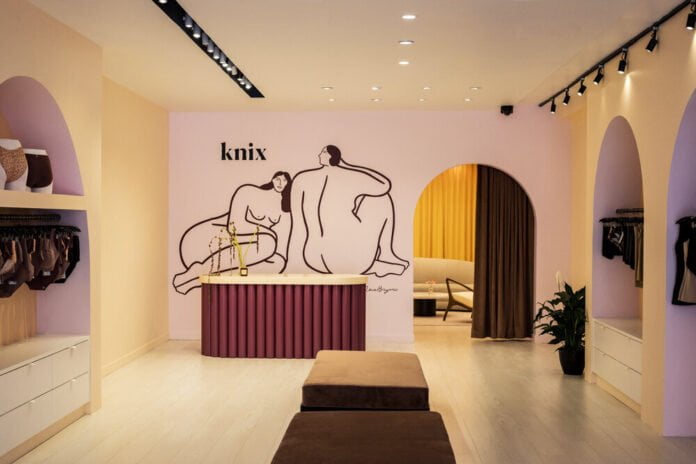
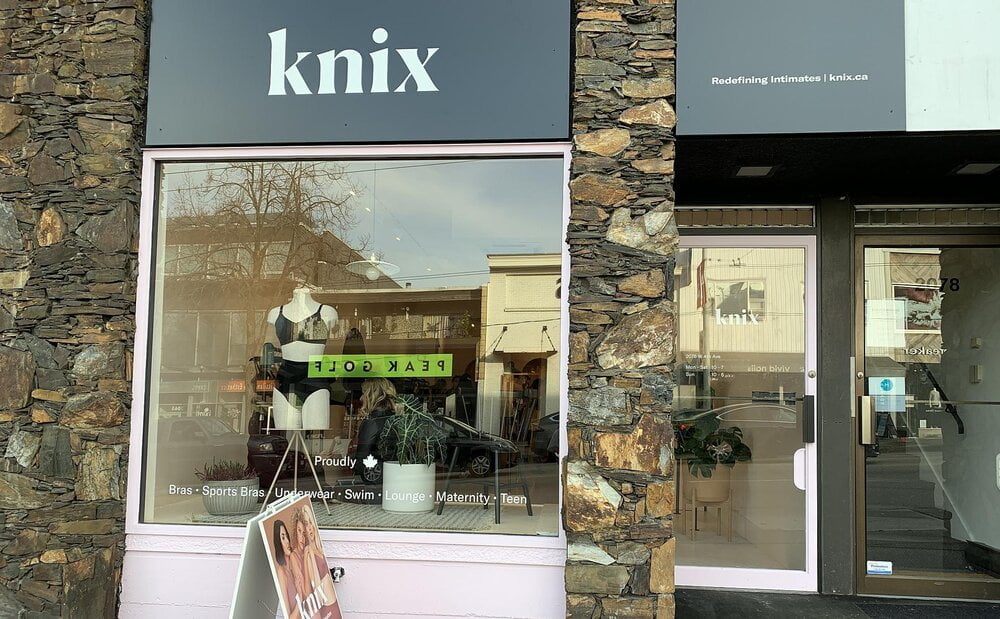
At a time when many retailers are struggling with depressed sales and revenue as a result of the unprecedented COVID-19-related physical distancing measures, some companies are thriving thanks to new and innovative steps they’ve taken to adjust their operations and adapt to the current environment. Toronto-based intimate apparel brand Knix is one example of a company that has embraced new digital strategies, which have translated into strong sales.
“We’ve really had to challenge the way we typically think about doing things and find new and creative ways to do business,” says Joanna Griffiths, founder and CEO of Knix. The company originated as an online business in 2013 and opened its first two physical locations in Toronto and Vancouver last year. Despite its digital roots, however, Griffiths says in-person interaction has always been a big part of the brand’s culture, through regular community events, photo shoots, testing products and other ways of interacting with customers.
The pandemic has forced the company to temporarily close its physical stores and find different ways of engaging customers. One of the first steps Knix took to adapt in March was to accelerate the launch of a ‘Virtual Fittings’ program that had been in the works for some time. The program allows customers to schedule a video chat, during which a Knix consultant can help customers find products suitable for them and assist with determining the right size. The sessions have been very successful so far, Griffiths says, with high demand for appointments and a strong conversion rate.
“We’re finding that typically at the start of the week, we’re already at 95-100% capacity for the appointments,” she says. Since determining the right fit is so important with products such as bras and swimwear, the Virtual Fittings program helps customers feel more comfortable buying these products online.
“We’re removing some of the traditional friction points that are associated with buying something online,” Griffiths says. Given the popularity of the Virtual Fittings sessions, she says Knix plans to continue offering the program permanently.
Another adjustment that Knix made in response to the pandemic was to switch its annual warehouse sale, held in April, from an in-person to an online event. The expanded North America-wide reach of the online format translated into a significantly higher volume of sales. In fact, merchandise sold so quickly that what was a three-day event last year only lasted four hours this year.
“We sold more in the first 10 minutes of this virtual sale than we did over the full three days last year,” says Griffiths. “We had a really overwhelming response.”
PHOTO: KNIX
PHOTO: KNIX
At the peak, more than 35,000 customers were shopping on the site at the same time during the sale, which offered discounts averaging between 40%-60% off the regular price.
“For me, it was a very eye-opening experience,” Griffiths says, adding that the virtual warehouse sale will likely become an annual event for Knix. “It really shines a light on the power of e-commerce.”
Knix sales overall have been trending higher during this pandemic. April marked the strongest month in the company’s history in terms of sales, Griffiths says, as demand for loungewear, sports bras and comfortable intimates has been on the rise with customers spending more time at home. Even in March, loungewear sales jumped by 360% over the previous month, according to Knix.
“We’re really fortunate to be in a category that people are still interested in buying,” Griffiths says. “If you look at the broader consumer trends of what it means to be working from home, they want to be comfortable.”
Griffiths also attributes some of Knix’s recent success to its efforts to support healthcare workers during the pandemic. Specifically, the company launched a fundraising campaign in March to donate personal protective equipment (PPE) to Canadian hospitals. She says that initiative has strongly resonated with Canadians, given the significant challenges associated with PPE throughout this pandemic.
“We’re doing a lot to give back and support the community,” Griffiths says, “so that’s one factor that I think that is pertinent to the success we’re seeing.”
Author: Margaret Stuart, Country Manager, Salesforce Canada
Canadian consumers may be staying at home and not able to connect in person with their favourite local retailers, but from a shopping perspective, they haven’t really gone anywhere.
According to data collected in the Salesforce Q1 Shopping Index, for example, digital commerce grew in Canada by 25 percent in the first quarter in 2020. Overall orders and traffic growth to Canadian retailers rose 37 percent, and growth via mobile devices in particular shot up 56 percent.
Given that most brick-and-mortar stores have some kind of sign announcing a temporary closure, these numbers offer a good reminder that demand for goods and services remains high, even amid a health crisis. It’s also a good indicator of how retailers should pivot their activities in order to weather the uncertainty.
In some respects, the impact of COVID-19 will only accelerate the digital shift that retailers had already been making. After all, consumer buying habits have increasingly been moving online for years, which has brought challenges to large brands and independent merchants alike.
The difference today is how the pandemic is forcing us all to think more holistically about the customer experience. Success in retail will require far more than a “buy” button on a website. It’s going to take a thoughtful approach to making consumers’ lives easier at every stage of the journey.
Create New Digital and Social Media Experiences
Essential retailers like grocery stores and pharmacies have primarily focused on setting up protective checkout shields and floor stickers to help consumers navigate safely while they shop. For the majority of retailers, however, the most significant changes they make will assist, surprise and delight customers from the comfort of their homes, on desktops, or on mobile devices.
Vancouver-based activewear brand Duer, for example, has moved quickly to reduce its costs and continue to sell its trademark denim by getting closer to customers than ever before.
Instead of creating a collection of jeans first and then driving to drive demand, for example, Duer is now crowdsourcing designs, showing prototypes as a presale item on its website. If there’s enough interest, it can move into production and delivery in a matter of weeks. This reduces waste and allows the company to produce exactly what the market wants.
Toys R’ Us Canada, meanwhile, didn’t just encourage online shopping but addressed parents’ need to keep kids entertained and adopt safe habits with ‘Stay-at-Home Play”. This included ideas for kids to have fun via YouTube videos, a ‘Wash Your Hands Challenge” that featured a dance-and-scrub-along song on TikTok, and play packs that could be ordered online.
And while most of us have gotten used to video calls to keep in touch with coworkers and family members, many retailers have turned to the technology as a means of service delivery. This includes yoga and fitness classes for humans, but don’t forget about pets!
You have to hand it to companies like Edmonton’s The Dog House Daycare, which is offering online puppy training classes that include real-time feedback.
Then there are those using social media as a way to continue serving customers, like Ottawa’s Brew Donkey Tours, which is taking consumers through breweries virtually via Instagram.
Offer Flexibility in Payment, Loyalty, and Delivery Options
Given ongoing social distancing measures, consumers need new and innovative ways to pay for purchases. The technology to do this has been in place for some time, but the business case is now clearer — and more urgent — than ever.
Firms like Castle Plumbing and Heating in Sudbury, for example, are now offering curbside pickup for all plumbing, heating, water filtration, and pump products. Payments can be made by phone or e-transfer.
Whereas Stan from PlumberSpot shares that a greater number of plumbing supplies are being bought and sold online for home delivery. He states, “Plumbers, builders, and even DIYers are turning to the computer over coming into the store. And as long as they know the correct specifications of what they need, why shouldn’t they?”
Then there’s CarGurus, which may become a case study in offering contactless buying experiences, from virtual meetings to free at home test drives to remote payments, where paperwork can be sent later on.
Companies can also help by multiplying loyalty offerings, issuing gift card expiration extensions, and rolling out longer payment cycles. For instance, Canadian car companies including Fiat Chrysler Automobiles Canada, Nissan Canada, and Mitsubishi are debuting loan relief, payment rescheduling and in some cases 90-day payment deferrals during the pandemic.
Right now, much is unknown — and things change quickly. The one thing you can be sure of is that Canadian consumers continue to want access to the products and services they love and need. Now is the moment to act on opportunities to innovate around the customer experience you provide them.
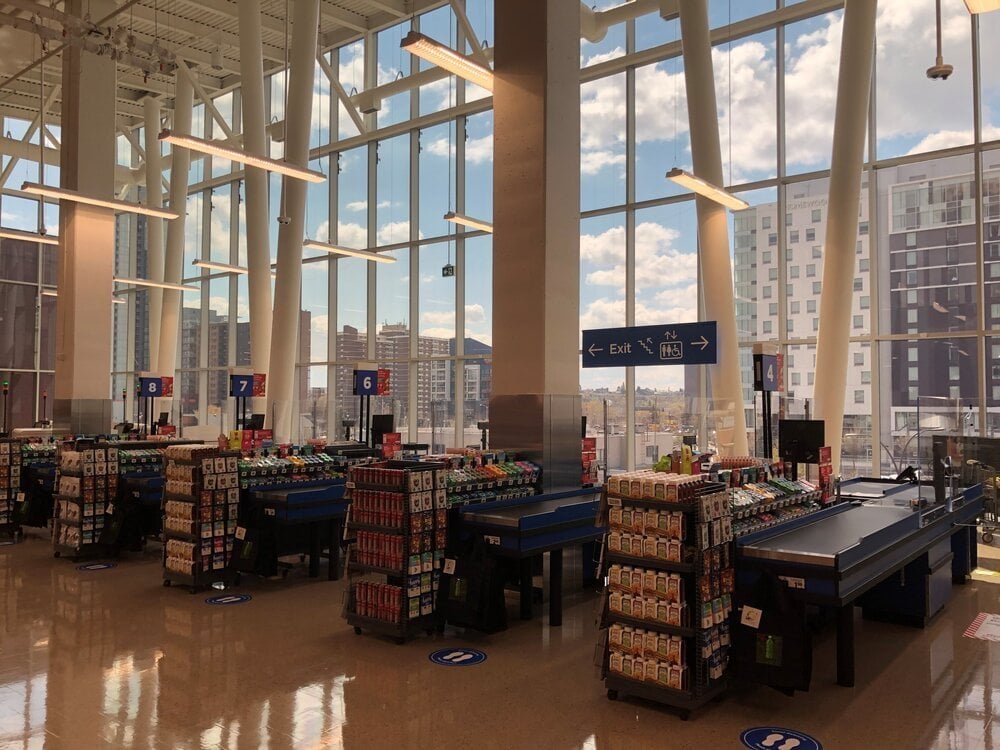
The Real Canadian Superstore is opening a first-of-its kind store in Canada on Friday in Calgary’s East Village development, directly east of City Hall and the downtown core.
The company said the store is “unlike any other Superstore location in Canada” and at about 80,000 square feet it is the first urban Real Canadian Superstore.
The store is located on the second floor of the RioCan 5th & Third East Village development.
“The opening of our store has been long awaited in the East Village community,” said store manager Tina Hawryluk. “While we had hoped to celebrate our grand opening with the local community in a different way, we are thankful to be able to open and provide our neighbours with local access to fresh and quality food at a fair price as we continue to social distance.”
PHOTOS: REAL CANADIAN SUPERSTOREPHOTOS: REAL CANADIAN SUPERSTORE
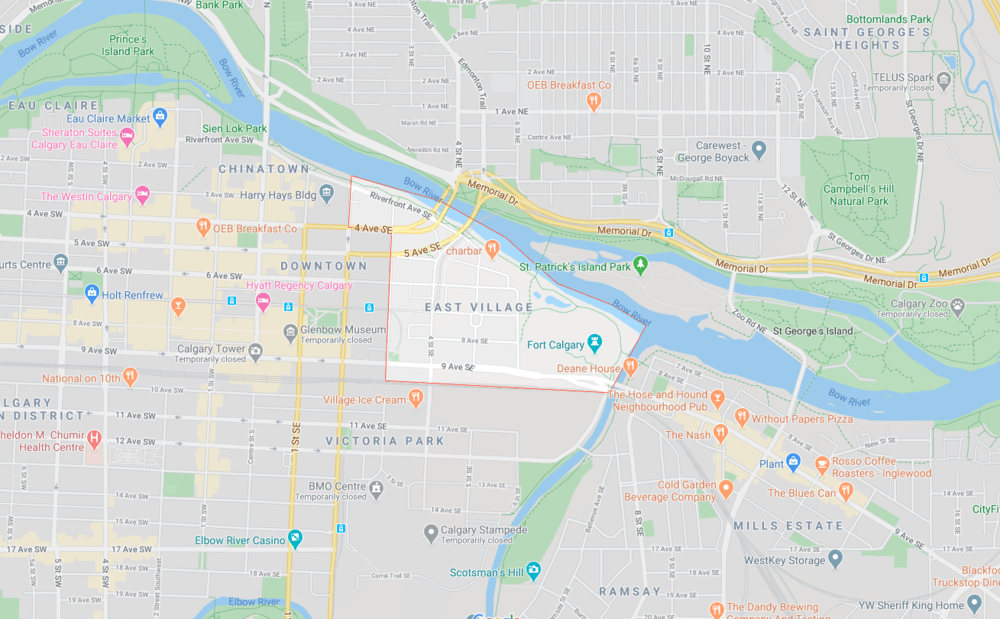
The 5th and Third East Village development, a joint venture between RioCan and Bosa Development, is located at the intersection of Fifth Avenue and Third Street S.E. RioCan’s mixed-use development features a two-storey retail podium totalling 178,000 square feet below Bosa’s two residential towers totalling approximately 500 homes. Confirmed tenants include Real Canadian Superstore, Olympia Liquor, Scotiabank, and TD Canada Trust.
“It’s a great day for retail in Calgary’s inner-city urban neighbourhood of East Village with the grand opening of Loblaw owned ‘Urban Format’ Real Canadian Superstore,” said Michael Kehoe, a retail real estate specialist with Fairfield Commercial Real Estate in Calgary. “The significance of this event is a bright spot on the local business scene that has been severely impacted by the oil price downturn and the pandemic lockdown.
“The addition of Joe Fresh and Shoppers Drug Mart also part of the Loblaw Companies will round out the retail offerings at the East Village Superstore. The project will add much-needed retail amenities to this underserved inner-city node and is sure to be a hit with shoppers in the surrounding densely-populated urban neighbourhoods. The East Village Superstore mixed-use project is a cornerstone of the master-planned East Village redevelopment process that is nearing completion.”
East Village Superstore. PHOTO: EVEXPERIENCEPHOTO: CMLC
In East Village, residential development includes 1,463 completed units with 180 units under construction. About 305,000 square feet of commercial development has been completed with another 55,000 square feet under construction. There are also two hotels with a total of 455 rooms.
According to the neighbourhood’s master plan, there are a total of 3,500 projected residential units which equates to about 11,000 residents. Currently there are about 4,000 people living there.
Total retail will be between 400,000 to 450,000 square feet on completion.
Clare LePan, Vice-President of Marketing & Communications at Calgary Municipal Land Corporation, the neighbourhood’s master developer, said the project is about half way through the 20-year master plan build out.
“The opening of 5th and Third Shopping Centre, especially with it housing such an established brand as Real Canadian Superstore, goes a long way in realizing the retail strategy for East Village and the vision for the redevelopment as a whole,” she said. “But more importantly, it betters the lives of our residents, along with our neighbours in adjacent communities on the east end of downtown Calgary, who now have convenient access to everyday essentials to care for themselves and their families.”
CLICK FOR INTERACTIVE MAP
To help customers and staff maintain social distancing at this time, Superstore said the store has implemented measures to help reduce contact and control the traffic, including limiting the number of people in the store at one time, plexiglass barriers between customers and cashiers, and decals on the floor to help customers distance while lining up to pay.
The store will be open daily from 8:00 a.m. to 10:00 p.m., with a dedicated hour for those who are most vulnerable from 7 a.m. to 8 a.m. Customers also have access to free 90-minute underground parking with a minimum purchase of $20.
Vancouver-based Bosa Development currently has the first phase of the Arris residential project under construction on the site — a 40-storey tower. The second phase has plans for another 23-storey residential tower.
Luxury multi-brand retailer Holt Renfrew has a game plan to reopen its stores across the country after all were shut in March due to the COVID-19 (coronavirus) pandemic. Three of Holt Renfrew’s stores are set to open again this month, including stores in Calgary and Vancouver, as well as the new Holt Renfrew Ogilvy store in Montreal which has been under a multi-year expansion/renovation. The company’s other stores, all located in the Greater Toronto Area, will open at a later date which will likely be in June. The openings come at a time when some consumers may pull back on luxury spending as has been seen with other recession periods.
“The health and safety of our employees and customers continue to be our top priority during these unprecedented times,” said Mario Grauso, President of Holt Renfrew. “Now, more than ever, we must maintain open communication with our customers, employees, and communities.” He went on to say, “We have put additional measures into place to help provide safe environments, striving to update our stores and experiences to reassure our customers and employees.”
The Calgary Holt Renfrew store will be first to open again on Thursday, May 14. The store spans more than 120,000 square feet on three retail levels (excluding a non-retail fourth level) in Calgary’s downtown core, which has been hit hard with low oil prices as well as an almost two-month retail shutdown. According to an internal document obtained by Retail Insider, the store’s operating hours until further notice will be 11:00am – 5:00pm Monday through Saturday, and 12:00pm – 5:00pm on Sundays.
HOLT RENFREW IN VANCOUVER. PHOTO: FRONT
HOLT RENFREW INTERIOR IN VANCOUVER. PHOTO: TOURISMVANCOUVER
Holt Renfrew’s 190,000-square-foot downtown Vancouver store will open on Tuesday, May 19 according to the retailer’s website. The four-level store, housing a vast selection of luxury brands, was the company’s top performer last year according to sources. The store was heavily reliant on Vancouver’s Asian population as well as tourists, and it remains to be seen when borders will be opened up again for travellers to come to Canada. Store hours for the Vancouver store will be 11:00am – 5:00pm seven days a week until further notice.
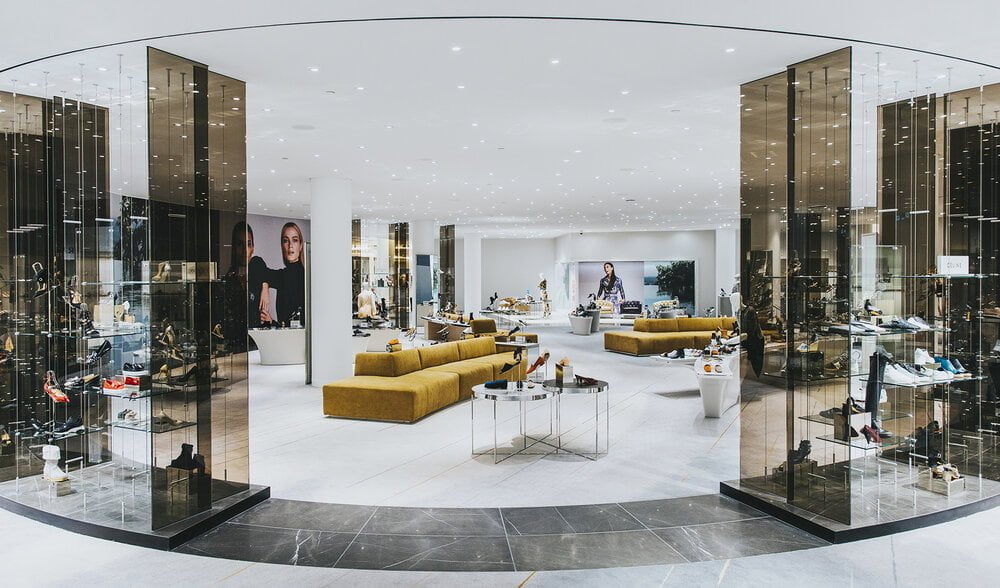
In Montreal, the new 250,000-square-foot Holt Renfrew Ogilvy store will officially open to the public on Monday, May 25 according to the staff document obtained by Retail Insider. The spectacular showpiece will become one of the finest luxury stores in the world, spanning six retail levels in the historic Ogilvy department store building which saw a significant expansion as well as the addition of an adjacent Four Seasons Hotel that has yet to reopen. About a year ago, Holt Renfrew Ogilvy unveiled a 25,000-square-foot concourse level beauty hall as well as a 40,000-square-foot menswear floor, as well as several of the luxury concessions on the store’s main level. When the store reopens this month, 11 luxury boutiques will occupy the street level luxury hall and in total, 99 brand concessions will be contained in the massive Holt Renfrew Ogilvy building on Ste-Catherine Street West. Temporary hours of operation will be 12:00pm-5:00pm Monday-Saturday, and the store will be closed Sundays (as per law).
Construction of the Holt Renfrew Ogilvy store was nearing completion before its March temporary closure. Construction resumed on Monday of this week, according to our Montreal correspondent Maxime Frechette.
The smaller Holt Renfrew store at 1300 Sherbrooke Street West, which has been there since 1937, is set to open on May 25 as well according to internal company documents. That store is expected to close permanently shortly after — plans were in place for the Sherbrooke Street Holt Renfrew store to close once the nearby Holt Renfrew Ogilvy was completed. Hours for Holts Sherbrooke Street would be the same as Holt Renfrew Ogilvy for however long the Sherbrooke Street store remains operational.
Holt Renfrew hasn’t yet announced the opening dates of its other Canadian stores, all of which are located in the Greater Toronto Area. That includes the 190,000-square-foot Holt Renfrew flagship store at 50 Bloor Street West which will soon unveil a new facade and renovated main floor, a standalone 16,500-square-foot men’s store at 100 Bloor Street West, a 130,000-square-foot store at Toronto’s Yorkdale Shopping Centre, and a 140,000-square-foot store at Square One in Mississauga. The COVID-19 infection rates in the Toronto area have been going down and are far fewer than that of the Montreal region.
Hours of operation for both Bloor Street stores will be 11:00am – 5:00pm seven days a week. The Yorkdale Holt Renfrew store will operate from 11:00am – 5:00pm seven days a week and Square One will operate from 11:00am – 4:00pm until further notice.
The company has announced plans and protocols to facilitate the store reopenings, including housekeeping, hygiene, in-store circulation, and new services which Holt Renfrew says are part of a strategy for adapting to changing customer behaviours.
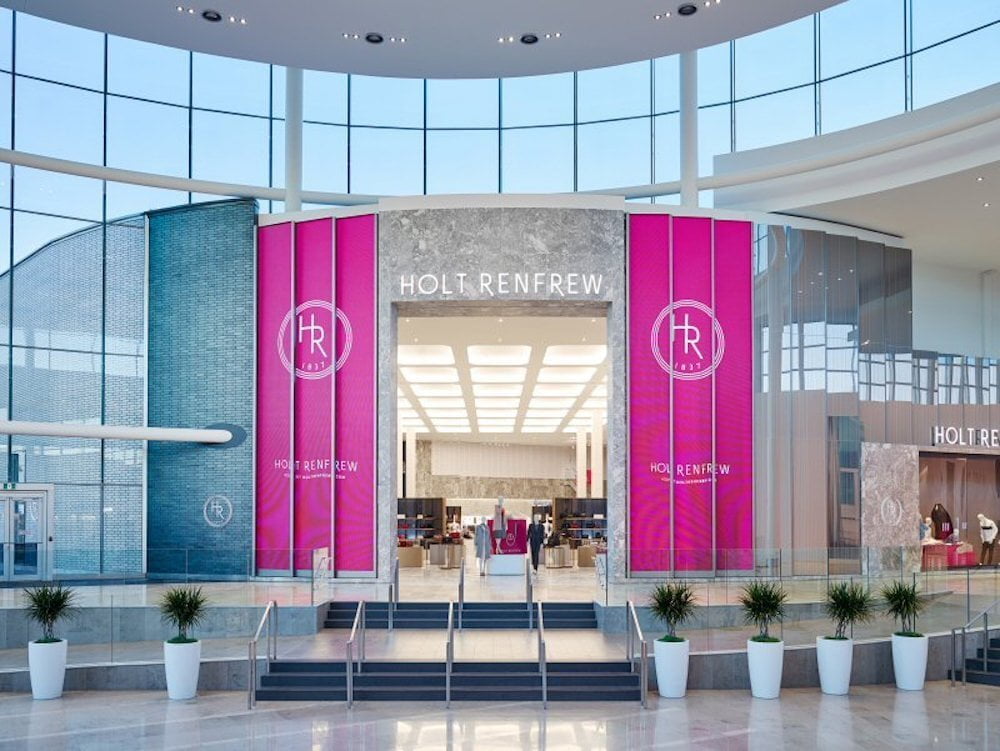
SQUARE ONE HOLT RENFREW PHOTO: HOLT RENFREW
Sanitation will be taken seriously by Holt Renfrew as it opens its stores again. “Prior to re-opening, each store will undergo a deep cleaning of all front and back of house areas. Increased daily sanitizations will occur throughout the day including sanitation of all high touch areas including pay stations, all conveyance, railings, door handles, washrooms, fitting rooms, and more, after each use,” the company said in a statement. “Additional porter staffing will be hired for all stores and the speciality retailer is committed to providing training for all employees for new health and safety efforts and policies.”
Hygiene protocol will include hand sanitization stations which will be made available throughout the stores including at all entry points. Employees and customers will be required to sanitize their hands upon entry into Holt Renfrew stores. “All store team members will wear disposable gloves and masks while in the stores, and disposable gloves and masks will be made available for all customers who wish to receive them,” said Holt Renfrew in a statement. All high touch surfaces, including point of sale, PIN pads, and phones, will be sanitized after each use, as will fitting rooms in the stores. The in-store beauty halls will become “touchless” and for the foreseeable future, Holt Renfrew’s store associates will not accept cash payments.
Physical distancing measures will be implemented in an effort to create safe in-store circulation. All of Holt Renfrew’s seven stores will operate on reduced hours once they reopen. “Pending the architecture of the respective building, entrances will be limited and there will be greeters and stanchions to welcome a controlled number of guests accordingly, to ensure safety,” said a statement. Stores will feature signage indicating a minimum of two metres physical distance for all front of house areas including fitting rooms, payment desks, escalators, elevators and other store components. In-store elevators will be restricted to only those who require them for assistance. Employees will be trained on the in-store circulation measures both on the sales floor as well as in the back of house areas.
New customer service options will be implemented across the chain. Holt Renfrew said in a statement that it is “tailoring shopping experiences so that customers can shop their preferred way, whether that’s in-store or from the comfort of their home.” That includes the option to utilize curbside pickup at valet stations for stores that have them. A newly launched Salesfloor widget will allow customers to connect with an associate for virtual assistance or to set up an in-store one-on-one appointment. The ‘Holts by Appointment’ service will be revived where customers call a store concierge to book a time to meet with an associate before coming into the store. Holts’ return policy will be extended as well.
Tailoring and alterations will only include “basic services” according to Holt Renfrew, and the in-store restaurants will open when permitted and likely at a lower capacity than in the past.
The store reopenings come at an unprecedented time when many consumers will be re-evaluating spending patterns. Many of the world’s top luxury brands are carried in Holt Renfrew stores, and the company is considered to be the national leader with concession brands such as Chanel, Hermes, Gucci, Prada, Fendi, Balenciaga, Tiffany & Co., and many others. As with other recessions, consumers may look to shop for less flashy brands that lack prominent logos after an extended period of job losses, a reduction in stock valuations and low oil prices. The lack of tourists visiting Holt Renfrew stores is also expected to contribute to a temporary sales decline until borders are reopened.
At the same time, closed borders could end up benefiting Holt Renfrew as its stores begin reopening this spring. The markets where Holt Renfrew operates, including Vancouver, Calgary, Toronto, and Montreal, are home to many wealthy consumers who might otherwise travel abroad to buy. If those consumes are inclined to again start shopping for luxury brands, they may visit their local Holt Renfrew store or otherwise shop online. Holt Renfrew Ogilvy in Montreal could see a boost given the number of millionaires and billionaires who reside in the city — luxury sales in Montreal have typically lagged in comparison to those in Toronto and Vancouver, and the Holt Renfrew Ogilvy store will need to see strong sales to justify the nine-figure cost of the store’s renovation and expansion.