By any measure, empirical and anecdotal, the number of people visiting retail stores is down. There are plenty of theories about why: it’s the mass movement of shoppers to online; it’s changing consumer preferences; it’s the weather; it’s those pesky, hard-to- figure-out millennials who would rather hunt for Pokémon than bargains at the mall.
As Jim Quinn of The Burning Platform describes in his compelling and disturbing article, The Retail Death Rattle, the decline in retail traffic may be a result of more obvious and, ultimately, troubling reasons. Too many retail stores chasing too few consumers who have less money to spend. This is a bad combination.
As someone who has studied brick-and-mortar store traffic trends for more than 20 years, I believe that Jim’s apocalyptic conclusions may be directionally correct. Headlines like Gap Tumbles as Dismal Store Traffic Drags Down July Sales recently published on Bloomberg.com supports his thesis.
As retail traffic analysts, my team and I analyze store traffic from thousands of retail stores across North America monthly, and it’s not unusual to see year-over-year store traffic declines of 5%, 10% and even 20% or more. When you put this in absolute terms, it can be startling.
We recently analyzed the store traffic data from a 600-store specialty retailer. Last year, their stores averaged about 200 traffic counts per day, which over the course of the year adds up to some 43 million store visits. For the first half of 2016, the chain experienced a 7% decline in store traffic – that’s about 1.5 million fewer people visiting their stores so far this year. If this trend holds, there will be some 3 million fewer people visiting this retailer in 2016 compared to 2015. Ouch.
Instead of hoping that traffic will return like a flock of migrating birds, retailers need to face the very real possibility that store traffic might not return – at least not in the numbers they had in the past.
I agree that declining store traffic is a real concern and that cauterizing the traffic hemorrhage may be difficult if not impossible for some retailers to do. However blaming poor sales results on store traffic is giving up the battle too easily and too early. Based on our work, we know that if retailers focused as much attention on converting the traffic they already get in their stores as they do worrying about the traffic they don’t get, their results would be significantly better. There’s a lot retailers can do to improve their results despite lower store traffic.
Before we get to the ‘what retailers can do about it’ part, we need to clear up a couple of persistent and unhelpful misconceptions about the connection between store traffic and sales and the use of sales transaction counts as a proxy for store traffic counts.
Store Traffic and Sales: Correlation vs. Causation
All retailers know that store traffic and store sales are connected. In fact, based on the mountains of traffic data I’ve studied, I can categorically say that store traffic and sales are indeed correlated. Store traffic defines the sales opportunity: less traffic, smaller sales opportunity and, often, lower sales; more traffic, bigger sales opportunity, often higher sales.
But store traffic is only one piece of the retail sales puzzle. While store traffic and sales are correlated, a decline in store traffic does not necessarily cause lower sales, just as an increase in store traffic doesn’t necessarily cause higher sales. Here’s a simple example using actual data from two stores in the same chain.
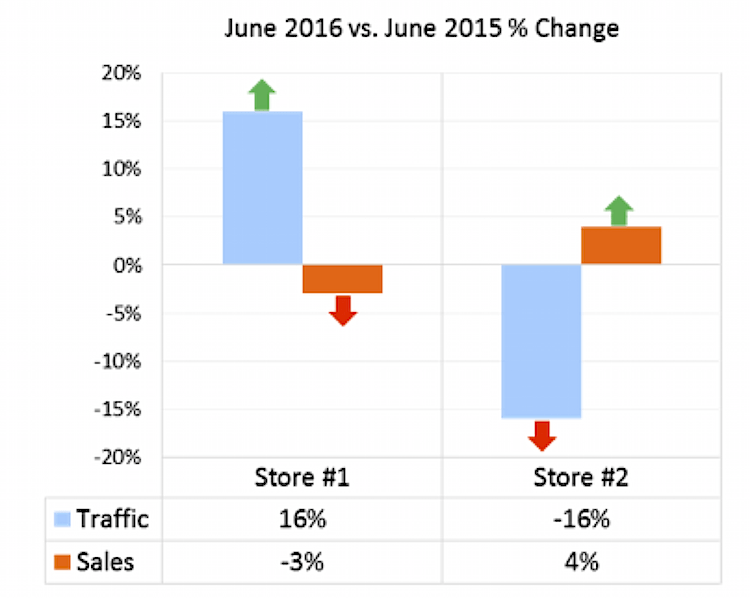
In store #1, year-over-year traffic was up 16%, yet sales were down 3%. In store #2, traffic was down 16%, yet sales were up 4%. If there were a causal relationship between store traffic and store sales, these results wouldn’t make any sense and it would be easy to write them off as anomalous. But these results are not anomalous. In fact, based on the work we do analyzing traffic data from thousands of retail stores every month, this is not uncommon at all.
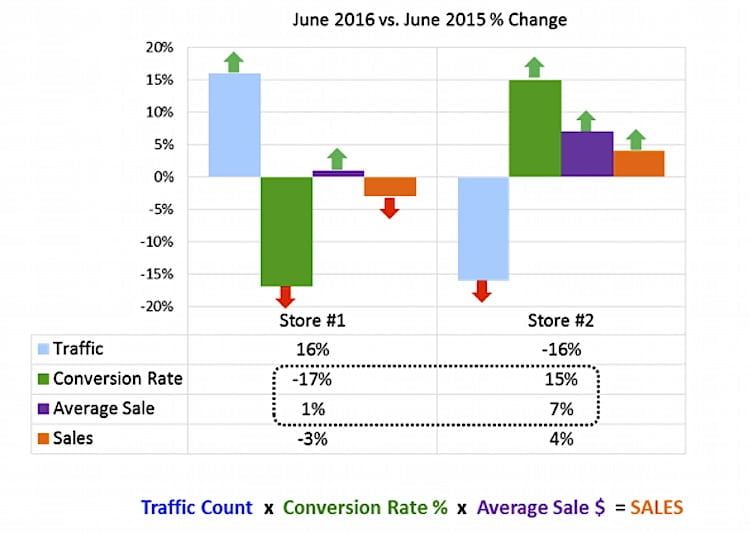
So how is this possible? The answer is perfectly clear when you break the sales results down by sales driver. Sales are a function of three components: store traffic, conversion rate (i.e. the percentage of people who actually made a purchase) and average sale value. The calculation is simple: Traffic Count x Conversion Rate % x Average Sale $ = Sales.
Store #1 had 16% more traffic, but conversion rates fell by 17%, that is, they sold to 17% fewer people who visited, and even though average sale values were up 1%, it wasn’t enough to make up for the drop in conversion rate. Add it all up, and sales were down 3%. This retailer would be incorrect to blame traffic on these poor results.
In store #2 traffic was down 16%. The sales opportunity got 16% smaller but the store still delivered a 4% increase in year-over-year sales. In this store, conversion rates were up 15% and average sale values up 7%. This store had significantly less traffic, but was still able to deliver positive sales by converting more of the traffic into a sale and selling more to each buyer. This is really terrific performance, despite the traffic decrease.
I find it ironic that some retail executives use sagging store traffic to explain away poor sales results (at least publicly) when we know that excuse would never be tolerated from their own store managers. Traffic may not even be what’s driving results. Furthermore, even when traffic is down, it doesn’t mean sales need to follow.
When it comes to sales results, it’s not just how much traffic a store gets, it’s what the store does with the traffic that matters most. In this case, ignorance is not bliss. If a retailer does not have access to these basic facts, they are, by definition, going to be oblivious to the possible corrective actions. In some cases, it is because the retailer does not actually count traffic in their stores. Or worse, they use sales transaction counts as a proxy for store traffic so they think they know what their store traffic is when they actually do not. Retailers that don’t have traffic count data are literally flying blind.
Transaction Counts vs. Traffic Counts — Hits vs. At-Bats
As I described in an article I wrote years ago, The Trouble with Traffic — What Retailers Can Learn From Baseball, there is a profound difference between transaction counts and traffic counts. It’s mind-boggling to me that, in the data-savvy world we live in today, many retailers still do not get this simple concept.
To say that transaction count represents a reliable proxy for store traffic is analogous to saying that ‘hits’ are a reliable proxy for ‘at-bats’ in baseball. Yes, the two stats are related, but they are not proxies — not even close. Store traffic is a measure of all the people who visit the store, including buyers and non-buyers where transactions obviously only account for the number of buyers. Here’s what the numbers looked like in our two-store example.
If this retailer relied on transaction counts as a proxy for store traffic, the conclusion is obvious: store traffic is down in both stores! Comparing actual store traffic counts to transaction counts completely changes the conclusion. Store traffic was not down in store #1, it was up – 16%! In store#2, the transaction counts were down 3%, when in fact, store traffic was actually down 16%, much worse than the transaction counts indicated.
Here’s the point: using transaction counts as a proxy for store traffic will lead to wrong conclusions; wrong conclusions lead to bad decisions; bad decisions lead to poor results. And, it’s just wrong and reckless.
So when someone cries “Oh no…store traffic is down!” the first question you should ask is, “Are you using transactions as a proxy for store traffic?” If the answer is ‘yes’, tell him/her to calm down until he/she has the right data.
OK, enough about traffic, let’s get on to what retailers can do to improve their results.
Productivity – making the most of the traffic you have
Retailers are always talking about how they plan to deliver better financial results by improving ‘productivity’ in their stores – great, but what does that actually mean? The obvious answer is, sell more stuff with essentially the same resources. It’s a worthy pursuit. But how should we think about this nebulous notion called productivity?
Recall, sales are a function of store traffic, conversion rate and average sale. Since store personnel don’t control the amount of traffic their store receives, the only two variables they can influence are conversion rate and average sale – sell to more of the people who visit and/or sell more to each buyer.
As my two-store example illustrates, store #2 delivered positive year-over-year sales despite having a significant decline in store traffic. If you think about productivity in terms of conversion rates and average sale values, it’s clear that store #2 was more ‘productive’ with its traffic than store #1 – despite having less of it.
Some stores may have higher conversion rates while others may have higher average sale values – frankly, it doesn’t matter how the store delivers the results, as long as they do. I think it’s helpful to amalgamate these two metrics into one metric that reflects the sales generated for every traffic count logged in the store. This can be done by either multiplying the conversion rate by average sale or by simply dividing sales by traffic counts. I call it ‘traffic productivity’. The results for the two stores are below.
Store #2 increased sales generated for each traffic count in their store by 23% and that’s why it was able to generate a 4% increase in year-over-year sales despite a 16% decrease in store traffic. It’s also clear why results at store#1 sucked – it squandered its traffic opportunity, generating a buck less for every visitor than the prior year.
I like the idea of traffic productivity – a lot. Some call it revenue per visitor, or sales per guest, but whatever you call it, it’s a terrific way to measure, trend and compare store performance, and it’s a great way to keep store personnel focused on making the most of every visit to their store, regardless of whether traffic is increasing or decreasing.
Here’s the catch: you can’t calculate conversion rates or traffic productivity unless you actually count store traffic. If you’re one of those ‘the earth is flat’ misguided retailers who still use transactions as a proxy for traffic, forget about everything you just read because you don’t have the data to create these important insights.
What drives Productivity?
So even if we all agree that driving traffic productivity is a smart thing to do (which of course it is), the obvious question is, How?
There are many things that influence productivity. For brevity sake, I’ll boil it down to three general areas: (1) inventory/merchandising, (2) promotional activity and 3) labor/scheduling.
I know what you’re thinking: “Duh! Thanks for the blinding insight…a part-time sales associate could have come up with this list.” I agree. The reasons people buy or don’t buy are well understood by most retailers. It’s a profound statement of the obvious to say a retailer needs to have the right inventory and merchandise it well or that promotions, sales events or discounting will influence purchase behavior. Of course it all does. But what about labor and scheduling?
Surely every retailer knows they need to have enough trained staff to facilitate the sale, whether that’s efficiently processing sales transactions at check-out, helping locate a particular stock item or answering questions. Furthermore, you don’t need to be a rocket scientist to know that labor should be scheduled according to when people are actually visiting the store. No brainer, right
Store Labor and Productivity
Retailers today are rightly hyper-sensitive to wage expense. However, the cost of understaffing or misaligning labor relative to traffic is not well understood. One retail executive euphemistically described their conscious understaffing as a “lean staffing model.” The concern about overstaffing is legitimate. Excessive wage costs will kill profitability, but understaffing and/or misaligning labor can be even worse.
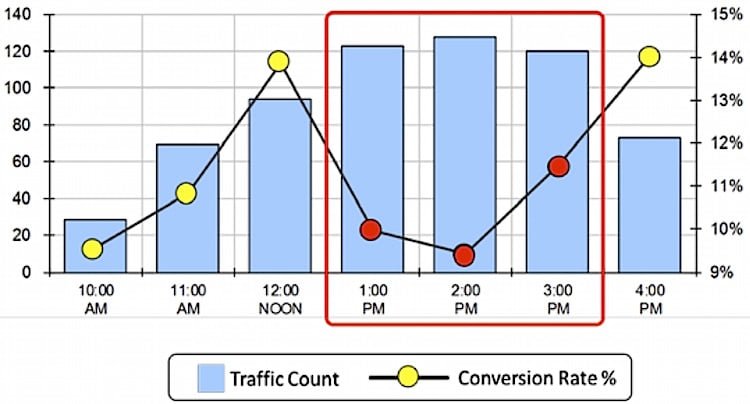
The chart below shows what happens to conversion rates when the store gets busy and there’s not enough staff to serve customers. It’s not pretty. These conversion rate ‘sags’ represent missed sales opportunities that can add up to many millions in lost sales annually.
Not having enough staff at the right times not only impacts conversion rates and therefore immediate sales, but it creates a lousy in-store experience that can turn a once happy customer into a social media terrorist bashing your brand, leaving a permanent digital scar.
Declining store traffic is a serious matter and we are sympathetic to the plight of retailers who are experiencing dramatic store traffic declines. However, it is hard to have sympathy for the retailer who squanders their store traffic, delivers poor sales results and then blames it on declines in store traffic. These are self-inflicted wounds resulting from ignorance or arrogance and retailers like these should accept whatever fate retail Darwinism provides.
The plain truth of it is that in today’s retail environment, no retailer can afford to squander their store traffic – it should be treated as a precious, non-renewable resource. Don’t count on “be-backs” and it does no good to think of your stores as responsible for traffic. They aren’t and can’t. Hold your marketing team responsible for traffic, but hold your store team responsible for conversion.
For those retailers who are doing all the right things – measuring store traffic, focusing store teams on productivity, providing enough labor to serve customers – keep going. That’s the formula to deliver the best results – even in a retail world of declining store traffic.
For everyone else, there are a number of things you need to do – the five most important are listed below.
5 Things Retailers need to do to thrive in a declining store traffic world
1) Get serious about measuring traffic in ALL of your stores – if you don’t have traffic counters installed in all your stores, install them now. Having traffic counters in only some of your stores and extrapolating results across your chain is imprecise. If you use sales transactions as a proxy for store traffic, stop it. It’s just wrong and reckless. If you have traffic counters installed in your stores, but you don’t believe the data or the data is sketchy, clean it up and keep it clean.
2) Understand your sales drivers – map performance of every store by breaking results into the underlying drivers: traffic, conversion rate and average sale. You can’t improve results unless you know what’s driving the results and without breaking them out, you’re guessing and very likely to make the wrong decisions.
3) Focus your store and district managers on driving conversion and average sale – store/district managers don’t control store traffic, but they absolutely influence conversion and average sale values. Provide your managers with easy-to-digest insights on traffic/conversion/average sale results, train them on what to do with the insights and then hold them accountable for results. It’s not good enough to dump data on these managers and hope they understand what conversion means – most of them do not have the time nor the expertise to do the analysis and develop the insights you need them to have.
4) Stop understaffing your stores – what’s the point of driving traffic to the store if you don’t have enough staff to service it? It’s pointless. Make rational allocations of labor for each store based on the traffic volume it receives. Compare performance across your entire chain to establish optimal staff to traffic ratios and then staff accordingly. Allocating labor based on store sales and/or sales transaction counts will guarantee that you under or over-staff your stores.
5) Rationalize your store base – review the long-term traffic trends and conversion/average sale productivity of every store. If you have stores that have significantly less traffic opportunities, either invest marketing dollars to try to drive up traffic or close the store. High productivity won’t matter if you have no traffic. Closing stores suck; operating stores that have pitiful and declining traffic opportunities sucks more. And, these stores become a drag on the chain’s resources and results.