The idea for ShipperBee came to Jim Estill a few years ago while he was driving on a busy highway behind a FedEx truck heading into Toronto.
“As I was sitting behind the truck and amongst a sea of cars, I realized that many vehicles are empty. Empty back seats, empty trunk space, and empty passenger seats. It occurred to me that there simply had to be a better and more productive way to tap into this unused space to transfer parcels, reduce congestion on our roads and the environmental impact the shipping industry has on the planet,” said Estill, founder and CEO of the company which began operations in January 2018.
ShipperBee, based in Guelph, Ont., is a first-of-its-kind regional parcel courier that cuts distribution centres out of the equation to help save shippers money, end unnecessary local delivery delays, and drastically reduce carbon emissions.
The company uses a collaborative delivery driver network and innovative, smart, interconnected transfer mailboxes called Hives to transfer and store parcels to their end point destination.
ShipperBee’s collaborative delivery driver network consists of people who are already on the road and in transit — commuters, stay-at-home parents, students, retirees, rideshare drivers, roadtrippers — who tap into their underutilized vehicle space to deliver parcels across the company’s Hive transfer mailboxes “like a baton in a relay”.

By tapping into this unused space to transfer parcels, ShipperBee says that it has the ability to minimize the impact of shipping on the planet. Like traditional couriers, the company’s drivers go through an extensive background check to ensure parcel safety and security. They’re also rated in a similar way as Uber and Lyft drivers. Drivers with higher ratings get offered more ShipperBee gigs to ensure the company delivers an exceptional customer experience for the shipper and parcel recipient. The adoption of a rideshare business model also means drivers can also benefit from many of the online communities available to rideshare drivers.
ShipperBee Hives are typically situated at strategic and high traffic locations like gas and convenience stores. They’re WiFi connected, fully weatherproof, camera equipped and are virtually indestructible, keeping parcels safe and secure between drivers and final delivery.
“As an environmentalist at heart, I see the true advantage of our model and Hive network being the impact shipping has on the planet. Our studies have shown that for every parcel we ship, we reduce greenhouse gas emissions by 73.1 percent, making our model far more eco-friendly. In addition, without a hub-and-spoke distribution model, we reduce the amount of traffic on the roads and don’t carry the overhead and operating costs traditional couriers do,” comments Estill.
“Fundamentally, the core of our business is aimed at being very kind to the planet. We’re building a more decentralized network with our Hives. They’re more strategically located and in closer proximity to that regional last mile,” added Lynda Murray, ShipperBee’s Chief Marketing Officer.
Many studies have shown that consumers prefer to purchase products and services from companies that stand for a purpose that reflects their own values and beliefs and will avoid companies that don’t. Consumers want companies to take a stand on the social, cultural, environmental and political issues that they care about the most.
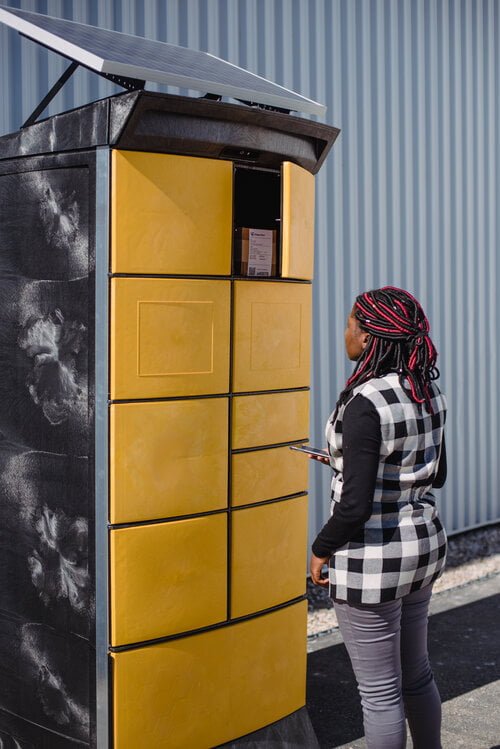
PHOTO: SHIPPERBEE 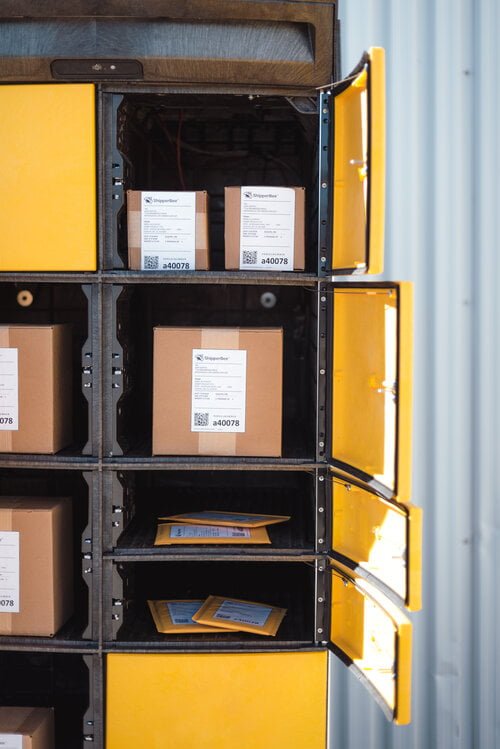
PHOTO: SHIPPERBEE
“ShipperBee really aligns with what consumers are looking for today which are brands that are more purpose and value-driven,” said Murray. “By leveraging ShipperBee for their regional shipping, brands that are environmentally focused have a significant opportunity to align with the last connection they have with their customer — the delivery of their product — to deepen that relationship and differentiate themselves from their competition.”
She said the company has definitely seen an increase in consumers looking for much more of a focus on sustainability across all areas of their business.
“When you look at the shipping industry, there’s not a lot of sustainable, eco-friendly approaches. While couriers with hub-and-spoke are implementing greener technologies, their system is still an indirect delivery route causing environmental damage like microplastics from large truck tires and wear and tear on the roads leading to more construction and traffic congestion,” said Murray. “As consumers evaluate and become more conscious about their purchase behaviours, they’re seeking brands that are aligned to their values around sustainability and doing good.”
Without hub-and-spoke overhead, ShipperBee says that it offers a simple, transparent and flat rate pricing model. There are no hidden fees, residential surcharges, or fuel surcharges, which means shippers can save up to 33 percent on their monthly shipping invoice.
“Unlike delivery giants, we don’t have the operating costs and overhead associated with distribution centres or maintaining large fleets of trucks. As a result, we’re able to pass these savings on to our customers, which in an era where consumers expect free shipping means a greater ability to keep prices lower and remain competitive,” adds Estill.
This regional shipping model couldn’t be more timely as Canada faces an old paradigm of shipping and a parcel industry that is growing at 20 percent per year — which is showing strong indicators that it’s growth rate is rapidly increasing with COVID-19 among us. As consumers turn to ordering the products they need online to remain safe and healthy, industry capacity is rapidly dwindling and consumers are facing delays in getting their orders. ShipperBee’s regional delivery solution helps increase the speed of delivery to customers during this unprecedented time.
ShipperBee also offers real-time GPS-enabled tracking for parcels where shippers and consumers can pinpoint their parcel’s exact destination at any point and time. Plus, the company’s drivers take a picture of the parcel when it’s delivered and uploads it via the driver app so shippers can see the parcel at the final delivery destination. “It’s a much better delivery when a picture is captured and an email or text is delivered when your parcel has been delivered to your front porch,” adds Estill.
ShipperBee currently operates in the Greater Toronto Area, but Estill said the plan is to expand the company across Canada and across the United States. It will take a year before it expands throughout most of Canada, however.
*Partner content. To work with Retail Insider, email: craig@retail-insider.com