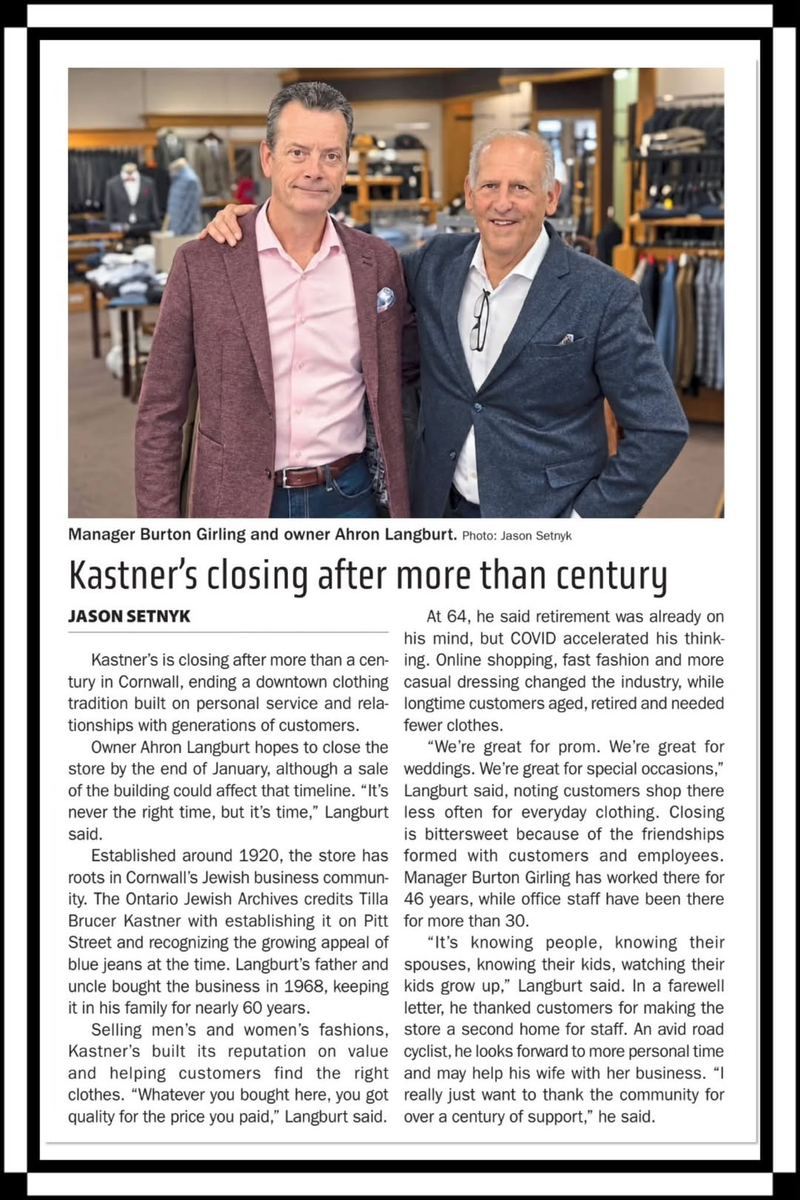
Kastners Men’s and Ladies Wear, a longstanding clothing retailer in downtown Cornwall, Ontario, is preparing to close after more than a century in business, ending an operation that has served generations of customers in the Eastern Ontario city.
The store, located at 27 First Street East, is targeting the end of January 2027 for its closure, although the timing could change depending on the sale of the building. Owner Ahron Langburt, 64, is preparing to retire after spending much of his life involved in the family business, according to Cornwall Seaway News.
The closure adds to a series of departures involving traditional clothing retailers in smaller Canadian markets, where locally operated merchants have historically provided specialized merchandise, knowledgeable staff and personal service. Changing consumer habits, growing competition and the challenges of transferring longstanding businesses to new owners have complicated the future of this segment of the apparel industry.
More Than a Century of Clothing Retail in Cornwall
Kastners traces its origins to approximately 1920, when Tilla Brucer Kastner established a clothing business on Pitt Street in Cornwall. The retailer was among a number of Jewish-owned businesses that contributed to the city’s commercial development during the 20th century, a history documented by the Ontario Jewish Archives.
The Langburt family acquired Kastners in 1968, beginning nearly six decades of family ownership. Ahron Langburt became involved as a child, spending school holidays learning the business alongside relatives.
Over the years, Kastners developed a reputation for quality men’s and women’s apparel, serving customers shopping for everyday clothing, weddings, proms and other special occasions. Its business was built around merchandise selection and personal service, with experienced employees helping customers find clothing suited to their needs.
That continuity extended to its staff. Manager Burton Girling has worked at Kastners for approximately 46 years, while other employees have remained with the business for more than three decades, according to local reporting.
The store operated through substantial changes in Canadian apparel retail, including the growth of shopping centres, national fashion chains, discount retailers and online shopping. More recently, increasingly casual clothing preferences have affected demand for some of the categories traditionally associated with full-service fashion stores.
Longstanding Clothing Retailers Disappear from Regional Markets
Kastners’ planned closure follows the departure of several established clothing retailers from smaller Ontario markets, particularly businesses specializing in menswear, occasion dressing and personalized service.
In Hawkesbury, Ontario, Maitre Charle closed in February 2023 after operating since 1977. The retailer served generations of customers shopping for suits, business clothing and special occasions in a community that once supported several independent menswear businesses, including a Kastners location.
The Hawkesbury closure also illustrates the importance of retirement and succession. According to The Review, Maitre Charle experienced one of its strongest sales years in 2022, but its longtime operators were ready to retire. The business had been offered for sale, although the demanding hours associated with running the store discouraged potential buyers.
In Barrie, Ontario, John McNabb Clothier closed in 2022 after nearly 30 years downtown. Located at 15 Dunlop Street West, the menswear retailer was among the independent clothing businesses serving the city’s downtown shopping district, according to BarrieToday.
Northern Ontario has experienced similar departures. In Timmins, the former Bucovetsky’s department store, later operating as Tweed & Hickory, closed in January 2015 after 107 years. The business operated at 227 Third Avenue and had occupied that building since 1934, according to Northern Ontario Business.
These closures occurred under different circumstances and over an extended period. They nevertheless document the disappearance of established clothing merchants from communities where traditional specialty apparel businesses once occupied a prominent place in local shopping districts.
Changing Economics of Traditional Apparel Retail
Independent clothing retailers have traditionally competed through merchandise selection, knowledgeable employees and established customer relationships. Their operating model can be demanding, particularly in smaller markets where a specialized assortment must be supported by a relatively limited customer base.
National chains can spread purchasing, technology, marketing and administrative expenses across large store networks. Smaller retailers have fewer opportunities to distribute those costs, while carrying a broad range of clothing sizes, styles and seasonal merchandise requires significant inventory investment.
Changing workplace dress codes and shopping habits have added pressure to some traditional apparel categories. More casual clothing preferences have affected demand for conventional business attire, while online retailers provide access to merchandise that once required a visit to a local specialty store.
Kastners experienced some of those changes directly. According to Cornwall Seaway News, weddings, proms and other special occasions became increasingly important to the business as everyday clothing purchases changed. Langburt also identified online competition, fast fashion and an aging customer base among the challenges facing traditional clothing retailers.
Retirement and the Challenge of Succession
For Kastners, the planned closure also reflects the personal decision of an owner who has spent decades in the business. Langburt had been considering retirement before the pandemic, and the available reporting does not establish that the store is closing because of financial losses.
Transferring a longstanding clothing business can involve more than selling inventory and assigning a lease. A new operator may need to maintain supplier relationships, retain experienced employees and understand a customer base developed over decades, while assuming the responsibilities of running a specialized retail operation.
The experience of Maitre Charle in Hawkesbury demonstrates how those considerations can influence a closure even when sales remain healthy. In smaller communities, the retirement of an established merchant can mean the loss of a longstanding business without necessarily indicating that demand for its merchandise has disappeared.
What Smaller Communities Lose
Cornwall continues to have independent clothing retailers, including The Squire Shop at 113 Pitt Street, which offers men’s and women’s apparel, including casual clothing and formalwear. Specialty fashion retail remains part of the local market, although Kastners’ departure will reduce the number of longstanding merchants serving the community.
For customers, the loss can mean fewer local options for specialized merchandise and personalized assistance. For downtown shopping districts, it removes a business with an established customer base and decades of relationships within the community.
Replacing a longstanding retailer with another tenant may fill a vacant storefront, but the new business will not necessarily serve the same customers or merchandise categories. In smaller markets, that can affect the variety of shopping options available locally.
Kastners is conducting a liquidation sale as it prepares for its anticipated January closure. Its departure will end more than a century of clothing retail history in Cornwall, leaving the city without one of its longstanding fashion merchants.