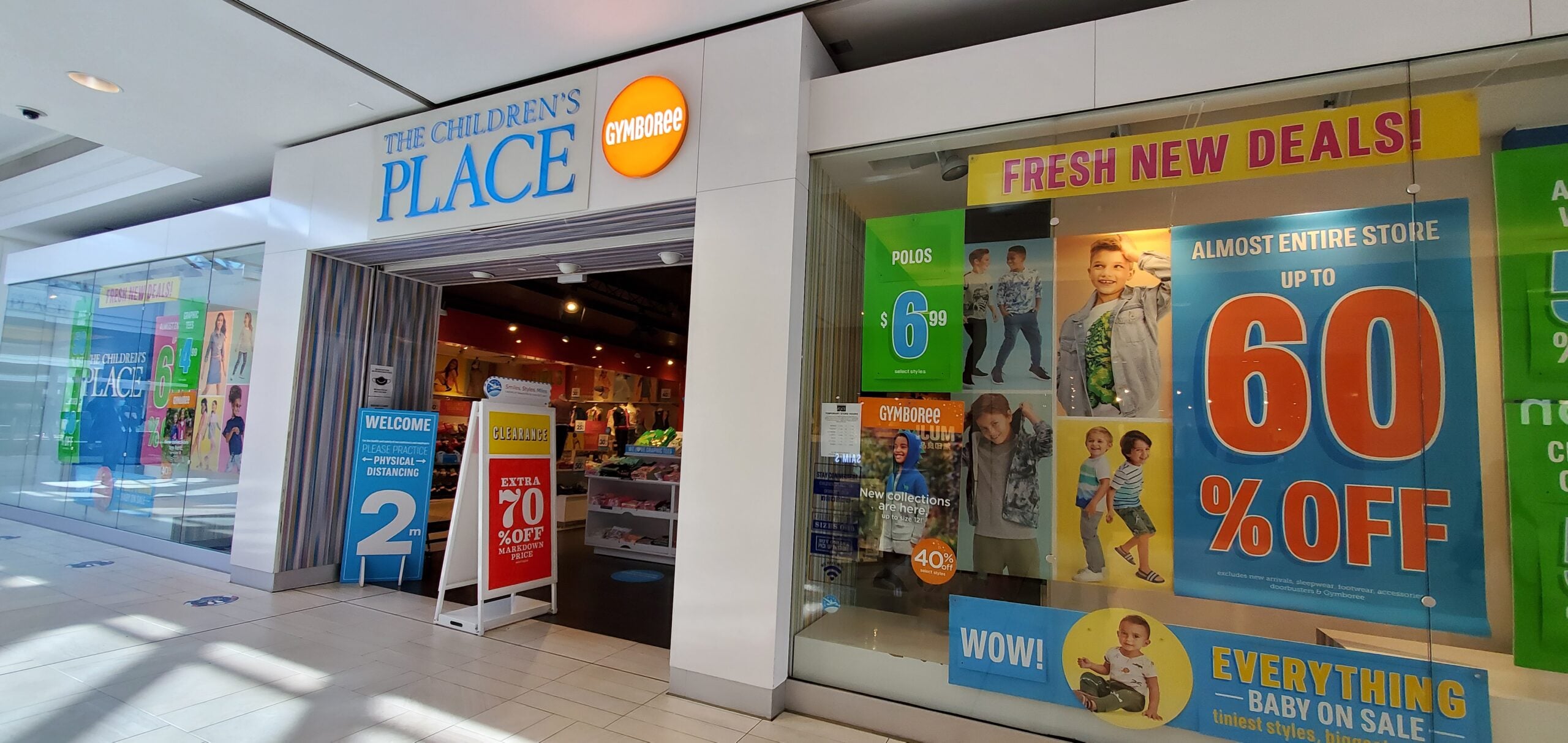
Canadian shopping centre landlords are facing another round of potential vacancies as The Children’s Place and Gymboree liquidate inventory across their 56 Canadian stores. The restructuring follows the departures of Hudson’s Bay, Toys “R” Us and several national apparel retailers, adding to the leasing requirements of property owners already managing substantial changes to their tenant portfolios.
The Children’s Place operates across nine Canadian provinces, with Ontario accounting for 26 locations, followed by Quebec and Alberta with eight each. According to an affidavit filed in the Canadian court proceedings, 21 locations accommodate both The Children’s Place and Gymboree brands. The company leases its Canadian stores from more than 25 landlords and employed 749 people in Canada at the end of October.
As previously reported by Retail Insider, the New Jersey-based retailer filed for Chapter 11 bankruptcy protection on November 8. The Ontario Superior Court of Justice recognized the American proceedings on November 13 under the Companies’ Creditors Arrangement Act. Store-closing sales began on November 6 and are expected to conclude by February 28, 2027, although individual locations could be withdrawn from liquidation if a buyer supports their continued operation.
Proposed Intellectual Property Sale Could Preserve the Brands
The Children’s Place entered into an intellectual property assignment agreement with controlling shareholder Mithaq Capital SPC on November 22. According to a filing with the U.S. Securities and Exchange Commission, the proposed transaction carries a base cash purchase price of US$31 million, subject to adjustments and the assumption of certain liabilities.
The agreement encompasses intellectual property associated with The Children’s Place, Gymboree, Sugar & Jade, PJ Place and Crazy 8, alongside digital assets and certain licensing agreements. Mithaq is also an existing lender to the company, making the proposed acquisition a related-party transaction.
The American bankruptcy court initially authorized Mithaq’s designation as the stalking horse bidder on November 23, before vacating that order later the same day. The proposed acquisition remains subject to the bankruptcy sale process and necessary court approvals in both countries.
The agreement provides for continued use of the intellectual property by the existing operating companies for specified liquidation and wind-down activities through April 30, 2027. A purchaser could subsequently operate the brands through e-commerce, licensing, wholesale distribution or a different physical retail strategy. The commercial value of a recognizable retail brand can survive the demise of its existing store network, offering little immediate relief to landlords whose tenants are winding down operations.
Canadian Landlords Face Rental Payment Disruption
The financial consequences for Canadian property owners began before the bankruptcy filing. In his November 9 affidavit, restructuring executive Rudolph Morando disclosed that rent due on November 1 had gone unpaid under substantially all of the company’s Canadian leases.
A November 12 report from AlixPartners, subsequently appointed as the Canadian information officer, stated that the restructuring budget contemplated payment of outstanding November rent in March 2027. Subsequent rent was expected to remain current until the respective leases were terminated or rejected. Concerns raised by representatives of certain Canadian landlords were acknowledged in the November 13 court endorsement.
The payment schedule creates an immediate cash flow issue for property owners while stores continue operating during liquidation. Once leases terminate, landlords may also experience reduced recovery of shopping centre operating expenses, including maintenance, security and common-area costs. With more than 46 percent of the Canadian store network concentrated in Ontario, much of the potential replacement leasing activity will occur in the country’s largest retail market.
Multiple Retailer Departures at Canadian Shopping Centres
Retailer insolvencies present different challenges according to the size and configuration of their premises. Former Hudson’s Bay department stores can require extensive subdivision and redevelopment, while former Toys “R” Us locations require tenants capable of occupying large-format retail space. The Children’s Place’s smaller specialty retail units generally accommodate a wider range of prospective tenants, although their availability adds to the workload at properties already recovering space from other retailers.
Vaughan Mills provides a tangible example of this turnover. The Children’s Place lists the property among its Canadian locations, while the shopping centre is preparing for the arrival of Greek general merchandise retailer Jumbo in premises formerly occupied by Toys “R” Us.
As Retail Insider reported in September, Fox Group Jumbo Canada acquired the former Toys “R” Us lease through a court-supervised transaction that closed on July 8. Jumbo is targeting an early 2027 opening in 47,042 square feet, illustrating how retailer insolvencies can create opportunities for international chains entering Canada.
Primaris REIT has encountered similar replacement leasing opportunities across its portfolio. Its original six Toys “R” Us locations occupied approximately 145,000 square feet and previously paid average annual rent of about $12.40 per square foot.
“We have got tenants and negotiated deals for all the boxes,” Primaris President and Chief Operating Officer Patrick Sullivan said during the company’s October 29 earnings call, as reported by Retail Insider. Replacement agreements are at various stages of completion, with incoming tenants expected to take possession during 2027 and some beginning to pay rent that year.
National apparel contractions, including Frank And Oak’s Canadian store closures, have contributed to specialty retail turnover. The cumulative financial exposure becomes particularly relevant when landlords must allocate capital between several redevelopment and replacement leasing projects at the same property.
Shopping Centre Productivity Varies Widely
The Children’s Place operates at Canadian shopping centres with substantially different sales productivity. Original 2025 property performance data from the International Council of Shopping Centers, obtained by Retail Insider, provide perspective on the markets in which landlords may be seeking replacement tenants.
Calgary’s CF Chinook Centre recorded annual sales of $1,469 per square foot, according to the 2025 ICSC data. Vaughan Mills recorded $1,043, Waterloo’s Conestoga Mall reported $958, and Galeries de la Capitale in Quebec City recorded $806. The Children’s Place lists stores at all four properties.
At Kingston’s Cataraqui Centre and Cambridge Centre in Ontario, both of which also appear in the retailer’s store directory, reported sales productivity was $587 and $482 per square foot respectively. CF Chinook Centre generated more than three times the sales per square foot of Cambridge Centre, illustrating the considerable variation in operating environments across the retailer’s Canadian network.
Higher-productivity properties generally offer greater sales potential for expanding national retailers, giving landlords opportunities to negotiate favourable rents and select tenants that complement existing merchandise categories. At lower-productivity centres, replacement leasing economics may depend more heavily on affordable occupancy costs, regional catchment areas and the availability of competing premises.
Several properties also recorded productivity improvements in 2025, including Conestoga Mall, Galeries de la Capitale and Cataraqui Centre. Retailers ultimately require profitable stores, and a dominant regional shopping centre can support attractive store-level margins at lower sales volumes if occupancy and operating costs are appropriately aligned with revenue.
Strong Leasing Demand Coexists With Vacancy Pressures
Recent financial disclosures from Canadian property owners suggest that the latest retailer insolvencies have occurred against a backdrop of relatively favourable leasing fundamentals. Third-quarter results from Primaris, RioCan and Morguard demonstrate how strong demand and vacancy-related financial pressures can coexist.
Primaris REIT’s third-quarter results included committed occupancy of 90.9 percent and in-place occupancy of 87.7 percent. The 3.2-percentage-point difference illustrates the importance of distinguishing space committed to tenants from premises that are already occupied.
Primaris completed 177 leasing transactions involving approximately 617,000 square feet during the quarter. Renewal rental spreads averaged 12.7 percent, increasing to 14.4 percent for commercial retail units. Same-property cash net operating income increased 3.1 percent, despite ongoing vacancy pressures elsewhere in the portfolio.
RioCan’s third-quarter results showed retail committed occupancy of 98.9 percent and in-place retail occupancy of 98.2 percent. New leasing spreads reached 19.1 percent, while renewal spreads reached 16.4 percent. The landlord completed approximately 1.1 million square feet of leasing, including 900,000 square feet of renewals.
RioCan’s substantial exposure to grocery-anchored and open-air properties creates different leasing conditions from those experienced by enclosed shopping centre specialists. Nevertheless, its results demonstrate continuing demand for Canadian retail premises and opportunities to generate higher rents through tenant turnover.
The financial pressures associated with vacancies were more apparent at Morguard Corporation, where quarterly retail adjusted net operating income declined from approximately $36.60 million to $32.65 million, a reduction of 10.8 percent. Higher retail vacancy, lower lease cancellation fees and reduced operating expense recoveries contributed to the decline.
Together, the September-quarter disclosures establish the financial conditions preceding The Children’s Place bankruptcy. Rental growth on successful leasing transactions can coexist with declining income where vacancies and other operating pressures offset the benefits of those agreements.
The Economics of Replacement Leasing
A higher replacement rent is only one component of a commercially successful leasing transaction. Landlords must account for the vacancy period, tenant improvement allowances, leasing commissions, construction requirements and any rent-free periods negotiated by incoming retailers. A signed lease can therefore precede any meaningful improvement in property cash flow by several quarters.
CBRE’s first-half 2026 Canadian Retail Rent Survey identified continuing rental growth across several markets and retail formats, supported by competition for available premises and constrained supply. Expanding beauty, fashion, wellness and lifestyle retailers represent potential sources of replacement demand for smaller shopping centre units.
Landlords must also consider how replacement tenants affect the broader merchandise mix. At shopping centres serving family-oriented catchment areas, replacing a children’s apparel store with an unrelated category may improve rental income while reducing the breadth of merchandise available to existing customers.
The December bankruptcy sale process will help determine whether any of The Children’s Place’s Canadian stores remain in operation. For shopping centre owners, the more consequential financial developments will occur after the liquidation, as they negotiate replacement leases alongside existing redevelopment commitments. With Canadian retail construction constrained and leasing demand holding up, opportunities exist to improve tenant quality and rental income, but the speed and cost of realizing those opportunities will vary considerably from one property to another.