While declining store traffic continues to dominate the headlines and remains the most frequent reason cited for lackluster store performance, the fact is, it’s only part of the story. If it’s true that store traffic has experienced a permanent and intractable decline, then what are brick-and-mortar retailers to do?
In the aftermath of the dot-com bubble in the early 2000’s, online marketers realized that they couldn’t merely focus on generating website traffic, rather they needed to focus on conversion – that is, get more visitors to buy. The same is true in brick-and-mortar retailing. As Jeff Gennette, CEO of Macy’s stated in a Bloomberg interview, “the key will be for us to convert – we’ll get the traffic.”
Today many brick-and-mortar retailers track store traffic and measure conversion, but the question is, what do they actually do to optimize their in-store conversion rates? The answer for many is, not much.
In the online world, Conversion Rate Optimization (CRO) has become an industry unto itself, spawning a global community of consultants and service providers, formal methodologies and over a hundred books dedicated to the topic on Amazon alone. There is only one book on brick-and-mortar conversion listed on Amazon.
Given the difficult business conditions so many brick-and-mortar retailers are facing, it’s baffling that CRO hasn’t become more of a focus if not an obsession.
There are a number of factors that may be preventing CRO from taking hold with brick-and-mortar retailers, but just like online marketers discovered after the dot-com bust, focusing on conversion can not only help them survive, but even thrive despite traffic declines.
Tracking Conversion vs. Optimizing Conversion
Most major tier-one retailers today track traffic and conversion rates in all their stores, so the basic data needed to conduct CRO already exists. For the retailers that misguidedly use sales transaction counts as a proxy for traffic – sorry, beyond being a grossly inaccurate measure for store traffic, they don’t even possess the basic data needed to calculate conversion rates, so optimization is a non-starter.
But just because a retailer has the data, doesn’t mean they’re doing much with it or as much as they could be. CRO is defined as a system for increasing the percentage of visitors that convert into customers. The key word in this definition is “system.”
In the online world, conversion rates are influenced by a website’s page layout, colors, buttons, call-to-action and checkout among other factors. All these variables contribute to conversion and CRO is the systematic process of tweaking and adjusting these factors in a way that leads to measurable and sustained improvements in conversion rate.
In physical stores there are a large number of variables that impact conversion rates including store layout, inventory levels, merchandising mix, promotional activity and most importantly the front line associates and managers who run the store and serve customers. And herein lies the challenge with CRO for brick-and-mortar retailers – variability. This variability in physical stores not only makes applying conversion improvement initiatives across stores consistently a challenge, but it also makes measuring results more challenging too.
Testing and Measurement to Prove Results
A vital tenant of CRO is testing and more specifically A/B testing. In the online world this is easily accomplished by setting up two variations of a webpage and then directing an equal amount of traffic to each site. Conversion results of website A are compared to website B and the winner is declared.
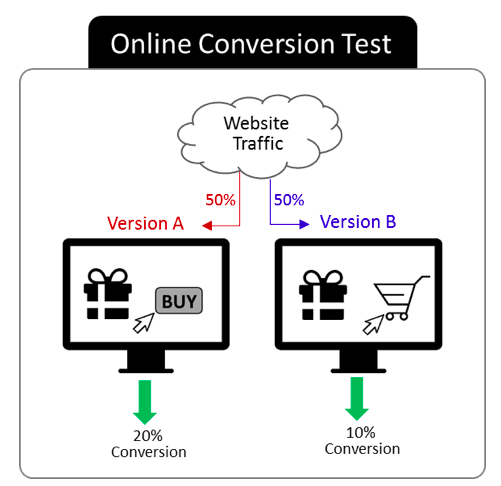
But A/B testing is much more difficult for brick-and-mortar retailers since, unlike websites, every store is unique – store layouts, inventory levels, geographic location including proximity to competitors and demographics of shoppers in the trading area, weather conditions, microeconomic factors and variations in the skill, experience and effort of the store staff all create variability which make comparisons challenging.
So unlike online conversion rate optimization where changes can easily be made and consistently applied with a few keystrokes, in brick-and-mortar stores adjusting variables like staff levels for example must be applied at the store-level.
There’s another important difference between online and brick-and-mortar conversion optimization tests: traffic. In an online experiment, traffic can be precisely controlled so each website version receives the same amount of traffic.
In brick-and-mortar stores, the amount of traffic each store receives can’t be controlled and can vary significantly by store. Since conversion rates tend to be inversely related to traffic (i.e. when traffic goes up, conversion rates tend to decline), extra care needs to be applied when interpreting brick-and-mortar conversion optimization test results.
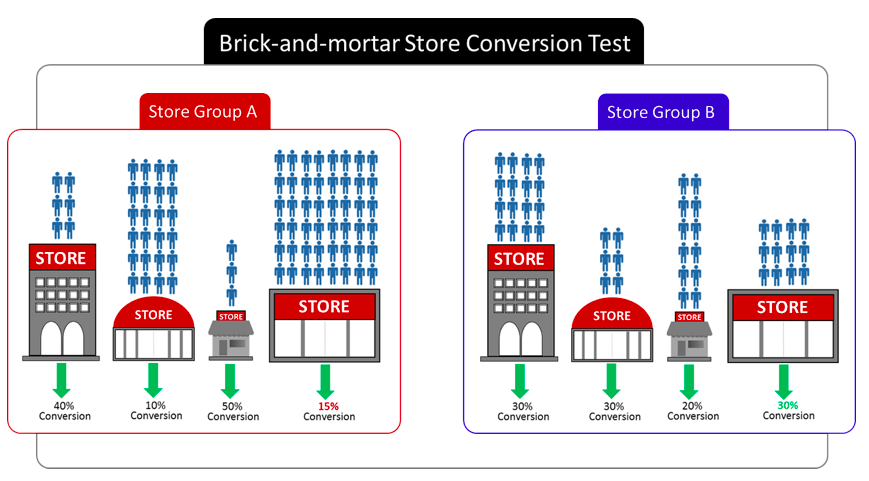
But just because the conversion variables are harder to control in physical stores doesn’t mean that conversion rates can’t be optimized or measured using A/B testing.
Here’s an example to illustrate.
The Test: Simplified Reporting and Conversion Coaching
The challenge store personnel have with improving conversion rates is twofold: first, they can’t easily see where the conversion opportunities are being missed and second, they struggle with how to adjust behaviors in-store to improve conversion. A series of A/B experiments were conducted with a group of 600 brick-and-mortar stores across four different retail segments.
In each case, a sample set of stores was identified and clustered into A and B groups. The group A store managers received a simplified daily conversion scorecard indicating where conversion rate sags were occurring along with a series of brief conversion coaching sessions conducted by phone to discuss the conversion patterns and behaviors they should consider undertaking to improve conversion rates. Group B store managers did not receive the simplified reporting or coaching.
The result: group A stores consistently outperformed group B stores. You can read more about the findings at headcount.com/ROIstudy.
Start with the Biggest Conversion Driver – People
While there are many variables that impact in-store conversion rates, staff scheduling and deployment are at the top of the list since front-line associates and managers play a critical role in converting store traffic into customers. An effective CRO system for brick-and-mortar retailers must begin with ensuring staff schedules are aligned to store traffic patterns. But aligning staff schedules to traffic is only the first step.
Second, retailers need to examine how staff are deployed – tasking versus servicing customers. Aligning staff schedules to traffic will not improve conversion rates if staff are focused on tasking instead of serving customers.
Third, retailers need to measure associate and manager productivity by analyzing conversion rates by hour attributed to each employee. This will enable retailers to identify top performers, create benchmarks and identify employees who may require additional coaching or training.
Conversion Rate Optimization can Mitigate Traffic Declines
In today’s rapidly changing and difficult environment, brick-and-mortar retailers can ill afford to squander the sales opportunities that they do have. Stemming the tide of store traffic declines may be difficult if not impossible for retailers to do, but that doesn’t prevent them from focusing on the traffic opportunities they do have and applying CRO strategies.
Conversion rate optimization is not a panacea, but it can go a long way in helping brick-and-mortar retailers deliver better business results, despite the traffic declines.
And just like the online survivors of the dot-com bust, brick-and-mortar retailers need to realize that it’s not just about the amount of traffic in their stores, but what they do with the traffic that matters most.