


Photo: Wikipedia
As a former Sears senior executive I’ve followed the once mighty brand’s journey from mediocrity to bad to just plain sad. What a long strange trip it’s been.
When I left in late 2003 we were gaining traction in our core full-line department store business and piloting several important growth initiatives. To be fair, whether we could pull off the necessary transformation was highly questionable. But one thing is now certain. The subsequent actions taken under a decade of Eddie Lampert’s leadership have assured the retailer’s demise.
For some time now, I’ve been referring to Sears as the world’s slowest liquidation sale. After yesterday’s earnings announcement, it is time to stop the charade and embrace the inevitable. Here are the 5 reasons Sears needs to throw in the towel:
- No value proposition. No reason for being. After all this time Lampert has still failed to articulate a vision of why and how Sears will fight and win in the intensively competitive mid-market sector. In fact, just about every action that has been taken over the last 10 years has weakened Sears competitive position. And the horrific results make this plain for all to see. The world does not need a place to buy a wrench and a blouse and a toaster oven.
- The competitive gap continues to widen. In every major product category Sears has lost relevance (and market share) while key competitors continue to improve. In hard goods, Sears is fundamentally disadvantaged by their real estate and as a practical matter there is not enough time nor capital to fix this core issue. In soft lines, they have been given a great gift by the recent foibles of JC Penney and Kohl’s and yet still woefully under-performed. Both competitors have key advantages relative to Sears. As they start to execute better they will win back the share they lost.
- Digging a deeper hole. For Sears to be a successful omni-channel retailer their core physical stores have to be compelling. Sears has under-invested in their brick and mortar stores for years, so not only do they have a lot of catching up to do, they have to develop and roll-out a new store design and related technology support. One need only to look at the capital that successful retailers like Nordstrom and Macy’s are investing to get a sense for the magnitude of what will be required. There is simply no way for Sears to earn an adequate return on this level of investment. More practically, Sears can’t possibly fund this.
- A leader who is either a liar or delusional. The results speak for themselves: Lampert doesn’t know what he is doing. After 28 straight quarters of declining sales–let THAT sink in for a minute–he has the chutzpah to assert, among other things, that Sears is investing in where retail will be in the future (huh?), that the “Shop My Way” member program is some huge differentiator, that having fewer, less convenient locations than the competition is a good thing and that Sears can compete effectively with Amazon. All of these hypotheses would be laughable if the implications were not so tragic. Whether he really believes any of this is, or is merely spinning the story to buy time, remains an open question. But regardless of whether he is being disingenuous or whether he is nuts, you’d be crazy to give him your money.
- Valuable assets get less valuable every day. There are pockets of meaningful value within Sears Holdings. But proprietary brands like Craftsman, Kenmore and Diehard are not sold where the majority of customers wish to buy them. Ultimately the brands are only as good as their distribution channels. Simply stated, as Sears and Kmart continue to weaken, so do the value of these brands. Side deals with hardware stores and Costco barely move the dial. Sears real estate is also cited as a major source of value, yet the real estate portfolio is a very mixed bag: some great properties in A malls, but lots of locations that are mostly liabilities. Regardless of how this all nets out, it is becoming increasingly clear that, on balance, mall-based commercial real estate has lots of supply, but relatively little demand for new tenancy. As retailers continue to prune and down-size their locations it is difficult, if not impossible, to make a case for Sears real estate value increasing over time.
The uncomfortable and sad reality is this: Sears has zero chance of transforming itself into a viable retail entity. Any further investment in this sinking ship is throwing good money after bad. Stripping out the idiosyncratic technical reasons for gyrations in the Sears stock, the underlying true company economic value declines each and every day. There is no plausible scenario where this trajectory will change.
Frankly, it’s been game over for some time now. It’s only Sears legacy equity and Lampert’s ability to pick at the carcass that has propped up the corpse.
Let’s stop the insanity.

Steven Dennis is a senior omni-channel retail executive and strategic growth advisor at SageBerry Consulting , LLC. . He is also a Former Chief Strategy Officer at Neiman Marcus. [More about Steven P. Dennis]
Published with permission. This post originally appeared at Steven P. Dennis’ Blog on May 8, 2014. Copyright 2014. Follow Steven P. Dennis’ Blog on Twitter.
NEXT ARTICLE: A 1st For Canada: May Declared ‘National Deals & Coupons Month’
PREVIOUS ARTICLE: American Girl To Open 10-15 Canadian Locations



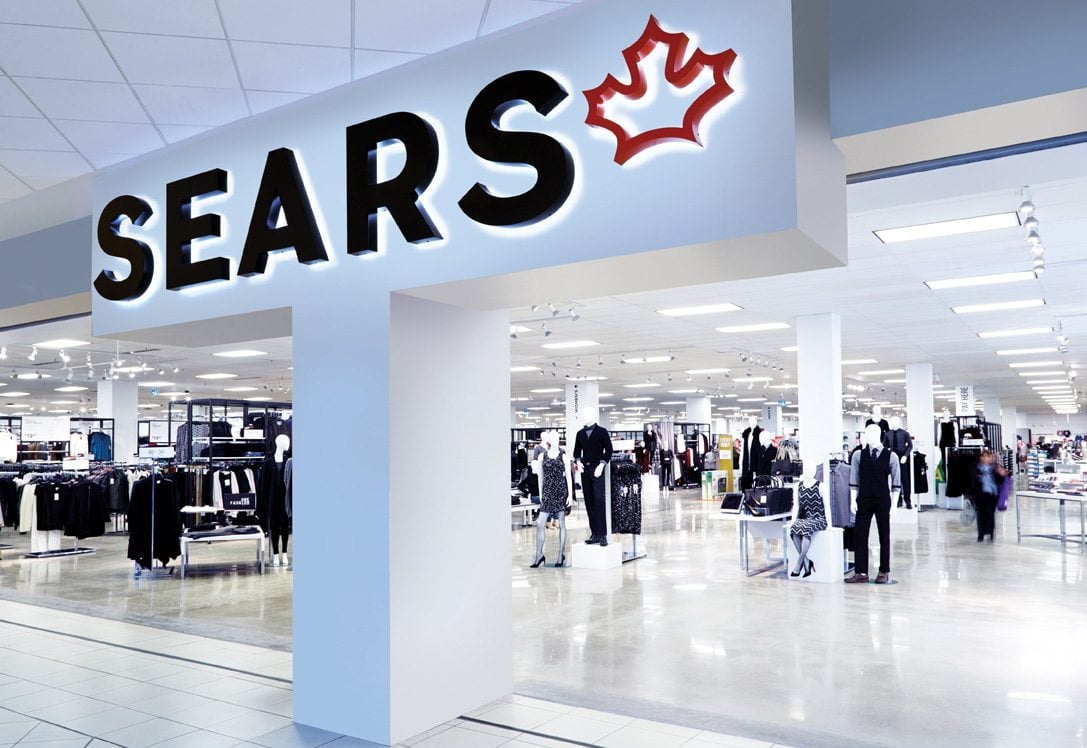



This is an opinion written about the American Sears. The photo is a Canadian Sears store. The two companies are separate entities with different merchandise & leadership. Retail Insider did not state this.
You’re correct, though Sears Canada is 51% owned by Sears Holdings (US), and Edward Lampert personally owns about 27% of Sears Canada. If the American company liquidates, Sears Canada will likely follow (and it’s half way there with its sell-off of store leases).
I have worked for Sears Canada for 8 years and although most of this is about Sears Holdings, Sears Canada is in a very similar position with an unclear future…
We’ve received interesting feedback from some Sears Canada staff and management. We feel badly for the morale issues in the company, and hope for the best for all Canadians involved.
I think the best scenario for Sears Canada would be a spinoff from its U.S. parent. An interesting observation, though, is that Sears Canada still owns the trademark rights to the Eaton’s name, which I always felt had more potential as a viable retailer. Simply changing the name above the door would allow the company to jettison the Sears baggage, and allow it to focus on different products, while at the same time avoiding costly royalties to the American chain for continuing to use the tarnished Sears name.
Excellent point – it would be interesting to see Eaton’s revived as a mid-priced Canadian retailer. We’d encourage it, though the ‘new’ Eaton’s would be missing key stores in urban centres (thanks to Sears’ selling them back to landlords).
I am disappointed that Retail Insider included this article which clearly is written from the perspective of a disgruntled former Sears Holdings former senior executive as though it applied in the same way in Canada. As much as everyone in the media seems to want Sears Canada to fail, it is nowhere near the dire straits situation that Sears Holdings is in in the US, thanks to Lampert’s "leadership". This article fails to address the fact that this writer is talking about Sears Holdings, not Sears Canada. Even though Sears Holdings owns 51% of the shares to Sears Canada, the latter is in a much better financial position than the former.
We’re sorry that you’re disappointed with the article. We published it because it provides an interesting perspective on the issue, despite being from an American writing about Sears’ American operations. We found it informative nonetheless, and that’s why we shared it.
Some of our future content will be retail industry-related, and not always necessarily Canadian. We’ll try to keep a Canadian connection in the future – you’re not the first to provide similar feedback on this article.