
Flattening Another Coronavirus Curve in Canada: The Retail Cash-Flow Gap

Date:

Share post:

By Matthäus Tekathen

These are tough times for business owners due to the COVID-19 crisis. Experiencing substantial declines in sales or even a complete suspension of operations, they face cash-flow insolvency threats.

Indeed, a recent survey of small Canadian companies by the Canadian Federation of Independent Business found that 30 per cent won’t be able to keep their businesses afloat for more than a month if current conditions remain. Why?

The Immediate Problem

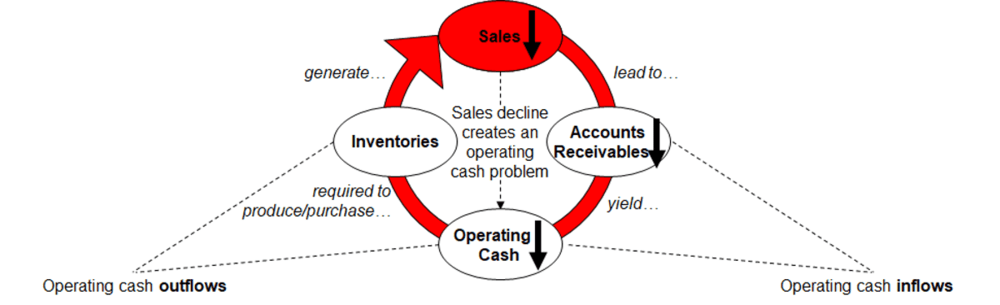
When sales drop, the cash wheel, whose function is to generate the required liquidity to operate the business, slows down or even comes to standstill. See below:
CASH FLOW WHEEL. IMAGE: MATTHÄUS TEKATHEN

The more sales drop, the more the inflow of operating cash dries up. If business owners cannot slow down, at a similar speed, what are known as cash outflows — payments for salaries, raw materials or merchandise, supplies, interest, rent and the like — eventually cash reserves and subsequently credit lines will be used up. A cash-flow insolvency ensues.

‘No Sales Without Costs’

Business owners know well: No sales without costs.

A retailer needs to purchase merchandise to sell it. That costs money. But unfortunately, the inverse — “no costs without sales” — usually does not hold. Why? For two reasons: fixed costs and a time delay.

Conceptually, there are variable and fixed costs. If sales drop, variable costs drop because lower sales volumes require, in total, fewer materials and labour and therefore fewer payments.

Yet fixed costs remain in place and are more difficult to alter in the short term. Business owners still need to pay rent, even for a closed store. Depending on the company’s cost structure, it will therefore have more or fewer possibilities to reduce cash outflows immediately.

Nonetheless, even variable costs will not disappear. Impacted business owners experience a sharp and rapid sales decline. But to offer goods for sale today, they must already have them in stock. There is a time lag: with payment terms of 30 days, say, last month’s bills must still be paid now and in the next few weeks.

Another large cost factor are labour costs. Wages need to be paid. Even with tough decisions to lay employees off quickly, two weeks of salary might still be owed. And at the end of the month or quarter, more bills come in.

As payments neither automatically nor immediately stop when sales stop, instant action is necessary to prevent cash-flow insolvencies. That’s why federalprovincial and local governments announced massive liquidity support for business owners.

What Else Can Business Owners Do?

The best scenario for business owners would be if sales returned soon, since they fuel the cash cycle. Wherever possible, business owners search for creative ways to compensate for sales declines by finding alternative sales channels, such as online sales or home delivery options.

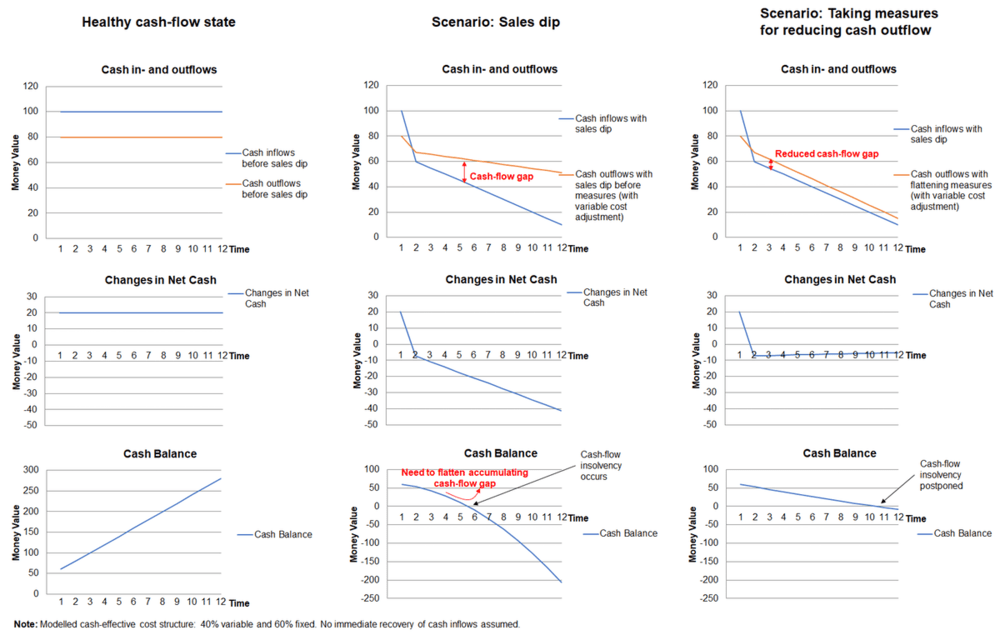
However, in many cases the services or products offered don’t allow for this quick shift. And so, besides working on getting sales back, business owners need to flatten or reduce the cash-flow gap to buy themselves some time, as visualized below:
CASH FLOW SCENARIOS. IMAGE: MATTHÄUS TEKATHEN

The left side shows a simplified, healthy cash-flow state before the crisis. Cash comes in and out.

The middle illustrates the situation when the sales crisis hits. Cash inflow drops, and if cash outflow does not follow suit, we are in the cash-flow insolvency scenario.

To prevent this, business owners need to reduce the cash-flow gap as depicted on the right through measures that increase cash inflows or reduce cash outflows.

Closing the Cash-Flow Gap

That means collecting payments from customers faster, retrieving financial resources from banks, restocking the cash balance through proprietary capital or obtaining government aid.

Postponing the payment of bills, renegotiating payment terms with suppliers, asking for deferrals, halting discretionary spending, downsizing or even closing the business temporarily are some other measures that can lower cash outflows. But before taking those measures, a quick cash diagnosis helps.

The tool that provides clarity about a situation’s severity is the cash budget, and the indicator that alarms business owners is the cash survival ratio, also know as cash buffer days. It forecasts how many days the business can survive without injecting new cash:

THE CASH SURVIVAL RATIO. IMAGE: MATTHÄUS TEKATHEN

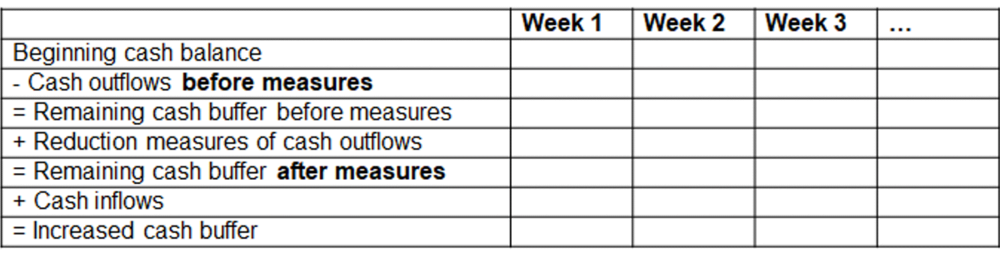
Because cash payouts aren’t evenly distributed from day to day, the cash budget is crucial to identify, proactively, cash bottlenecks before it is too late.

In the current context, modifying the cash budget’s structure, as shown below, makes improvements to increase the cash balance immediately visible. It’s a simple tool to help business owners navigate through the cash crisis by identifying, planning and forecasting their company’s immediate cash situation.
A MODIFIED CASH BUDGET. IMAGE: MATTHÄUS TEKATHEN

Overall, a company’s cost structure can accelerate cash flow troubles, and the time lag involved in adjusting outflows adds to the financial woes. Furthermore, while usually regarded as an inefficiency to be removed, having large cash buffers serves in these tough times as a valuable safety cushion.

This article was originally published by ‘The Conversation’. Click here to view the original article.

Matthäus Tekathen is Associate Professor in the Department of Accountancy at the John Molson School of Business, Concordia University. His research focuses on organisation’s risk management and management accounting and control.

Subscribe to the Newsletter

Subscribe

* indicates required

LEAVE A REPLY

Please enter your comment!
Please enter your name here

Recent articles

Dollarama Surpasses 1,700 Stores in Canada, With Hundreds More Planned

Dollarama has surpassed 1,700 stores in Canada and continues to pursue a long-term goal of approximately 2,200 locations nationwide as expansion plans move forward.

Ruby Liu Unveils TM Wander at Tsawwassen Mills and Outlines Vision for Canadian Retail

Ruby Liu discusses the launch of TM Wander at Tsawwassen Mills, future expansion plans, shopping centre acquisitions, support for entrepreneurs, and her vision for the future of Canadian retail.

Canadians driving surge in event-led travel as domestic bookings jump 15%: Flight Centre

Travellers are prioritizing meaningful experiences and exploring destinations closer to home.

Roots reports Q1 sales growth of 6.5% to $42.6 million

Net loss totaled ($10.1) million, as compared to ($7.9) million in Q1 2025.

SportChek opens Canada’s first-ever floating futsal pitch on Toronto Waterfront

SportChek Harbourfront FC brings together free public programming, interactive fan experiences, community play spaces and retail activations inspired by the growing excitement surrounding soccer in Canada.

Good Earth Coffeehouse opens at University of Alberta Hospital

Good Earth Coffeehouse is a network of authentic coffeehouses with over 50 locations across Canada.

Mondetta Expands Modern Ambition with Toronto, Calgary and Vancouver Stores

Mondetta is expanding its Modern Ambition menswear brand with new stores in Toronto, Calgary and Vancouver, while evaluating additional opportunities across Canada, the United States and Europe.

Federal government launches National Food Security Strategy

With the average transaction sitting at approximately $12 per person, restaurants provide an accessible source of nourishment for millions of Canadians.

Daily Synopsis: Jun 11, 2026

HBC Royal Charter welcomed at Winnipeg Ceremony, FreshCo opening 1st Vancouver Island store, Palliser Furniture acquired by Chinese company after 80 years, Bulgari opens in Vancouver, Dickey's Barbecue Pit opening at West Edmonton Mall, and other news.

What Happened to Canada’s Women’s Fashion Chains?

Many of Canada’s iconic women’s fashion chains have disappeared. Retail expert Antony Karabus explains how fast fashion, casualization and economic shifts changed the industry.

Chanel Opens Largest Store in Canada at Oakridge Park in Vancouver

Chanel has opened its largest store in Canada at Oakridge Park in Vancouver. The 13,000-square-foot location is the brand's first full-concept store in Canada and a key addition to the development's luxury retail lineup.

Dollarama sees more than 21% year-over-year sales growth in Q1, surpassing $1.8 billion

Net earnings increased by 10.4% to $302.3 million, resulting in a 13.3% increase in diluted net earnings per common share to $1.11, compared to $0.98.

Advertising influencing people to place a bet: CPA Canada

“You can’t hide from it; gambling ads are everywhere."

lululemon Returns to Oakridge Park with New Store Concept

lululemon has returned to Oakridge Park with one of its newest Canadian store concepts, featuring Pacific Northwest-inspired design, local programming and community engagement.

Pinterest sports trend report shows surge in women’s sports fashion and beauty trends

The La Roche Posay activation will run until July 22. 

German outerwear brand Wellensteyn targets 2nd Canadian store after strong Niagara debut

The success of the 2,350-square-foot store at Outlet Collection at Niagara demonstrates that Canada is a promising market for the international company and the goal is to open another in 2027.

Jersey Mike’s Subs to open 3rd downtown Toronto location

Redberry will open the third downtown Toronto Jersey Mike’s Subs at 160 Bloor St. E. on Wednesday June 17, with a fundraiser for Make-A-Wish Canada.

Honestly Good Chicken Fingers opens 4th location at Stock Yards Village in West Toronto 

With locations in Etobicoke, The Well and Vaughan Mills, the Stock Yards Village opening marks the fourth location in the Toronto area and sets the stage for broader growth across Canada and the United States.

CFIB urges Ottawa to protect supply chains in Canada Labour Code reforms

"Cancelled orders, delayed shipments, lost income: small businesses pay the price every time federally regulated supply chains grind to a halt."

Financial anxiety surges in Canada as costs climb

The number of those gripped by anxiety when thinking about personal finances has surged to 60%.

Daily Synopsis: Jun 10, 2026

FIFA store opens in downtown Vancouver without price tags, Calgary's European Bakery marks 20 years, Montreal Dunkin' operators bank on nostalgia, Bulgari unveils Oakridge Park store, vagrancy concerns on Spring Garden Road in Halifax, and other news.

Licensed establishments in Alberta now able to serve alcohol as early as 6 a.m.

This change gives licensees the option to open earlier to meet business needs and customer demand, including during occasions such as international sporting events and cultural celebrations.

How small businesses are leveraging social media and AI to capture consumer attention: Constant Contact

Globally, 73% of small business owners identify as "Creators" in some capacity.

A&W launching major Canadian airport expansion of Pret A Manger

The first Canadian Pret airport location is expected to open in the international terminal at YVR in early June, with additional airport openings anticipated to continue through the second half of 2026.

VIDEO: Calgary Downtown Revitalization gains momentum

Addressing safety remains a priority, with the city advancing a community-based strategy alongside increased enforcement and services.