Quebec-based clothing retailer WLKN has launched a kids’ collection in its own stores as well as with another retailer.
WLKN has diversified its strategy in an effort to grow the brand and stay ahead of its competition. The kids’ collection is now also in Boutique Clément – a top children’s retailer in Quebec with about 30 locations. It hopes to expand that reach to other retailers in Canada in the new year.
WLKN is also growing its footprint as it will open the company’s eighth store in Sherbrooke, Quebec, in September.
“It’s the first time we’ve sold our WLKN brand in another retailer,” said Maxime Bourdeau, creative director and co-owner of the retail company, adding that initial sales of the kids’ collection were tremendous.
Max Bourdeau.
“We’ve started to work on a second collection for Spring 2019 and we are now searching for other retailers in Canada that can carry our brand.”
WLKN opened in November 2010 in Quebec City and the multi-brand store offers a wide range of streetwear and sportswear clothing brands, footwear and accessories. It has 150 employees.
Pierre Mercier, the company’s CEO, said the Sherbrooke store will open in mid-September.
“The name is from walking into a big closet. We took the WLKN. It was that simple. In the first place, we wanted a name that can go through the times. So if different styles change we’ll stay no matter what the style of what we’re selling,” said Mercier. “The logo also with the W at first is a powerful letter. We’ve been around for eight years and the logo still stays strong when people recognize it and look at it,” said Bourdeau.
“We still dress people for all kinds of different activities. When people come in, they’re probably going to find something even though maybe they’re not sure because we have multi styles.”
WLKN CHILDREN CLOTHING (PHOTO: WLKN)
The kids’ collection was very popular.
“Max had a little boy approximately two years ago,” said Mercier. “We are in the clothing business. So we decided to make some styles for his kid. It was where we started in the first place. A lot of our customers were asking about kids clothing. People who were coming in and asking and through social media. Max also is an influencer and a lot of people follow him. People wanted kidswear.”
The kids’ collection was so popular it sold out in stores in two weeks.
WLKN Locations
He said kidswear has opened a new way for WLKN to grow its business and the company is searching right now for other retailers in Canada – in Ontario, Calgary, Vancouver – to perhaps carry the kids’ collection in February 2019.
“Our industry is a tough industry. It’s tough for everyone. Even us. We still will open new stores but we try to negotiate with all the landlords differently because the rent is often the biggest expense for the company,” said Mercier. “So we try to work with them and the big malls to have percentage rent. So with that we control the risk versus opening new stores.
“But we would like to have stores in every province in Canada first. Maybe around like 25 locations across Canada. We’re working a lot right now with a new website. The sales online is not what we expect yet but we’re pushing a lot online to be sure.”
Asian-themed grocery chain T&T Supermarket opened to massive crowds in Richmond, BC on the morning of Thursday, August 16.
The lineups can be attributed to some freebies that were being given out as part of the celebrations, including free tote bags, a $7.98 lobster special, and $10 gift cards to the first 400 customers.
The 70,000 square foot store, which is the largest T&T location in the country, is located at Landsdowne Centre in suburban Vancouver. According to T&T, the new Richmond store is the company’s flagship and is located in part of the mall’s former Target space which was vacated in early 2015.
CLICK FOR INTERACTIVE GOOGLE MAP
OPENING DAY CROWDS. PHOTO: RITCHIE PO
OPENING DAY CROWDS. PHOTO: RITCHIE PO
PHOTO: AIR
The giveaways were no doubt part of the reason why so many shoppers lined up for the store’s opening — T&T Supermarket already has two stores in Richmond and a total of 11 in the Lower Mainland, including two that operate under the ‘Osaka’ nameplate. T&T Supermarkets also operates seven stores in the Greater Toronto area and one in Ottawa, with two more on the way for Southern Ontario. There are also five stores in Alberta — two in Calgary and three in Edmonton, with the busy West Edmonton Mall location said to be doing sales in excess of $50-million annually.
T&T Supermarket is considered to be Canada’s largest chain of Asian grocery stores. The company was founded by Taiwanese-Canadian entrepreneur Cindy Lee in 1993 and in July of 2009, it was acquired by Loblaw Companies for $225-million in consideration (including $191-million in cash and $34-million in preferred shares). The name T&T stands for the names of Ms. Lee’s two daughters — Tina and Tiffany.
CLICK FOR INTERACTIVE MALL FLOOR PLAN
THE FUTURE OF LANSDOWNE CENTRE WILL BE LESS MALL AND MORE CITY-BUILDING. RENDERING: VANPROP INVESTMENTS / CITY OF RICHMOND
It’s unlikely that T&T Supermarket will be at Lansdowne Centre forever, however. The mall’s landlord has indicated that it plans to close the centre in the year 2025 and eventually demolish the shopping mall for a new mixed-use urban development that will include a substantial residential component as part of a new street-grid that will expand Richmond’s downtown core.
In 2014, we spoke with the head of a major big-box retailer which was expanding its operations into Canada, and he said that Lansdowne’s landlord wasn’t agreeable to long enough lease terms — as a result, the retailer opened a store nearby.
It’s not clear how long T&T’s lease is at Lansdowne Centre and weather or not it will remain for a longer period as the centre is demolished in stages, though it’s obviously a good enough deal for both parties that an agreement was reached.
Retailers are preparing to occupy the nearly-completed Asian themed King Square shopping centre in Markham, just north of Toronto. When it opens to the public in several months time, King Square will be the second-largest such shopping centre in Canada. The retail component to the project is ‘phase one’ of what will eventually become a ‘complete community’ that will include offices and residential buildings as well as a community centre, medical offices and a significant park component.
The project has been ongoing for about eight years — King Square Ltd. was formed in 2010 as part of an initiative with Fortress Real Developments, where the company began to acquire various parcels of land in suburban Markham. The company ended up securing 11.47 acres at 9390 Woodbine Avenue in Markham, which is at the northwest corner of Woodbine Avenue and 16th Avenue.
The original design would have seen King Square become the largest Asian mall in North America spanning nearly a million square feet over multiple levels. More than 1,000 retail units, mostly Asian-themed, were planned for the centre, which was positioned as being upscale.
PHOTO: FORTRESS REAL DEVELOPMENTS FACEBOOK
INTERACTIVE GOOGLE MAP
While King Square isn’t as large as was initially planned, it nevertheless reflects the developers’ initial vision of creating a mixed-use community in order to drive traffic to the area at all times of the day and year. That includes eventually adding homes and work places, as well as attractions to draw visitors from the region.
Phase 1 of King Square includes the 340,000 square foot, 500+ unit commercial complex which spans three levels. Included are about 1,500 surface parking spaces. Excavation for the project commenced in 2013. New funding from Fortress was secured in the summer of 2014 in order to make the project possible, as there had been some delays, according to the developer. Exterior cladding and window installation was nearing completion in April of this year, and retailers are expected to open either before the end of this year or early next year, depending on individual construction and occupancy.
King Square has sold hundreds of condominium retail spaces over the past several years. According to Oswin Tong, Planning Manager for King Square Ltd. and the founder of the project, the developer holds a selection of units that it plans to rent out as well, providing a hybrid ownership/rental model depending on the desires of tenants.
Retail tenants will include an Asian-themed supermarket, food court, cafeteria, and several full-sized restaurants. The individual tenant mix will be dictated where tenants have secured their units, be it condominium or rental. As such, Mr. Tong said he didn’t yet have the names of all of the confirmed tenants.
The goal, according to the developer’s website, is to create “the GTA’s most vibrant lifestyle destination featuring a luxury collection of retailers, restaurants, offices and entertainment venues. It’s a “one stop for Asian goods,” according to Mr. Tong.
As part of this, King Square will include some unique elements such as a 10,000 square foot community centre on its third level, a banquet hall, performance stage, medial centre and pharmacies, and a large park. The 50,000 square foot park, which will take the form of a Chinese garden, is dedicated to the late Dr. Norman Bethune — the Canadian doctor was a frontline surgeon in China during the Spanish Civil War (including developing a mobile blood-transfusion service) while bringing medicine to rural China.
PHOTO: FORTRESS REAL DEVELOPMENTS FACEBOOK
Future phases of King Square will include a hotel, offices and residential buildings which, according to Mr. Tong, will be built on the site’s existing ground-level parking component. King Square’s parking will be moved underground as its site is intensified for future development phases.
King Square’s ‘community’ design is part of an effort to drive traffic to the centre from multiple sources, which is something seen more in shopping centres in places like China. There, shopping centres have become ‘downtowns’ for some rapidly expanding communities, with families spending their free time at various venues, including retail stores. In North America, examples of such mega-malls include the likes of West Edmonton Mall and Mall of America in Minneapolis, which feature a dynamic mix of products and services that also include substantial entertainment components such as amusement parks and even casinos. In Asia as well, food and beverage plays a greater role in many malls and in some instances, may take over an entire floor in some multi-level shopping centres. Mr. Tong noted that food and beverage will also be an important draw for King Square in Markham.
King Square was built partly to address the substantial and growing Asian population in Markham and nearby Richmond Hill. The surrounding area is very multicultural and Markham is already home to one Asian-themed mall — Pacific Mall, which spans about 270,000 square feet and houses hundreds of tenants. Pacific Mall was recently raided by police seeking counterfeits.
The area’s Asian population is one of the reasons why the developer chose to open there, according to Mr. Tong. The 2016 Census for Markham showed that of the 330,000 people who live in the city, about 67% are Asian compared to just 20% for ‘European’.
Nearby Richmond Hill, with more than 200,000 residents, also features a substantial Asian population with 82% of respondents being Chinese, South Asian, West Asian or Korean. Both communities boast substantial average household incomes and both are also growing rapidly, as is the more expansive trade area.
PHOTO: KING SQUARE
King Square will be the second-largest Asian-themed mall in Canada. The largest to date is the Aberdeen Centre in Richmond, south of Vancouver, which spans about 380,000 square feet over several levels. Richmond’s demographics are Asian-heavy, as is the case with Markham and Richmond Hill.
Several other cities in Canada have either seen Asian-themed malls open, or have seen proposals. In Calgary, the recently completed Asian-themed New Horizon Mall spans about 320,000 square feet and is located on a suburban site north of the city. Several years ago in Dundurn, Saskatchewan, a developer proposed a 6.4-million square foot mixed-use centre with 340 outlets about 40 km south of Saskatoon (the project has since been shelved).
We’ll provide updates on King Square as it readies to open to the public in several months time.
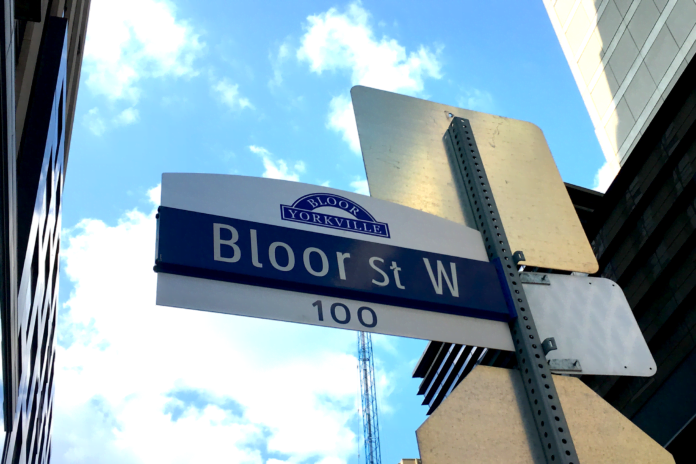
Toronto’s famed ‘Mink Mile’, representing a portion of the Bloor Street West roughly between Yonge Street to the east and Avenue Road to the west, is seeing substantial changes with significant new construction and new retailers changing the face of the area. New development is having something of a ‘snowball effect’ in the neighbourhood, including new commercial buildings as well as the addition of thousands of new residents — retailers are now said to be looking at the area with fresh eyes.
The Mink Mile is home to some of Canada’s most prestigious retailers including the flagship locations for Holt Renfrew and Harry Rosen. It’s the only area in the city to have a dedicated expanse of granite sidewalks, which elevates the street beyond that of a typical Toronto neighbourhood.
2 Bloor St. W — watch for some significant changes to this corner. Photo Craig Patterson
This article will update some of the things happening at what some consider to be Canada’s answer to New York City’s Fifth Avenue. Consensus among brokers is that Bloor Street is transitioning to become an address for large major brand retailers with a mix of luxury brands as well as some popular national and international brands. The ‘tour’ will begin at the Yonge Street and Bloor Street West crossroads, and will head westward towards the Avenue Road intersection which is anchored by the Royal Ontario Museum and the Park Hyatt Hotel, which is seeing an overhaul.
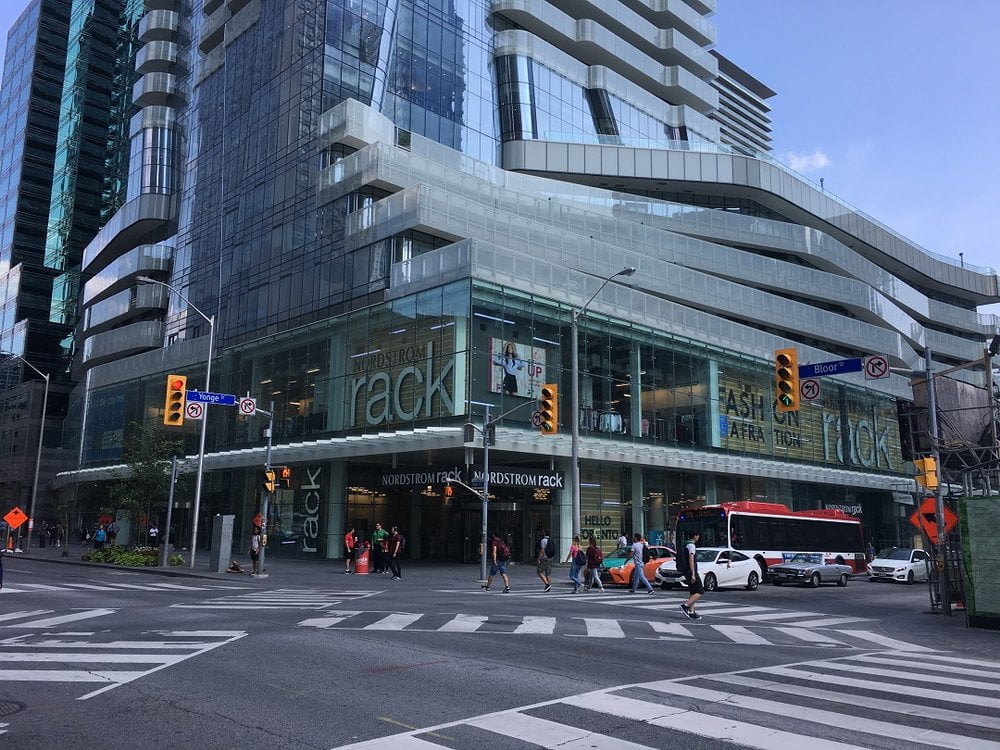
The Yonge and Bloor intersection, located above Toronto’s busiest subway stations, has seen considerable changes over the past couple of years. The 1 Bloor Street East retail podium, which was acquired by First Capital Realty in August of 2016, now houses Canada’s flagship Nordstrom Rack store right at the corner in a 38,600 square foot two level retail space. A Mark McEwan grocery store is under construction and will open in a few months — the duo behind DWSV Remax Ultimate Realty Inc., David Wedemire and Stay Vyriotes, acted on behalf of the retailer and have been key brokers for luxury retailers in the area. First Capital Reality is leasing out more retail spaces in the complex, and Eric Sherman is the contact person.
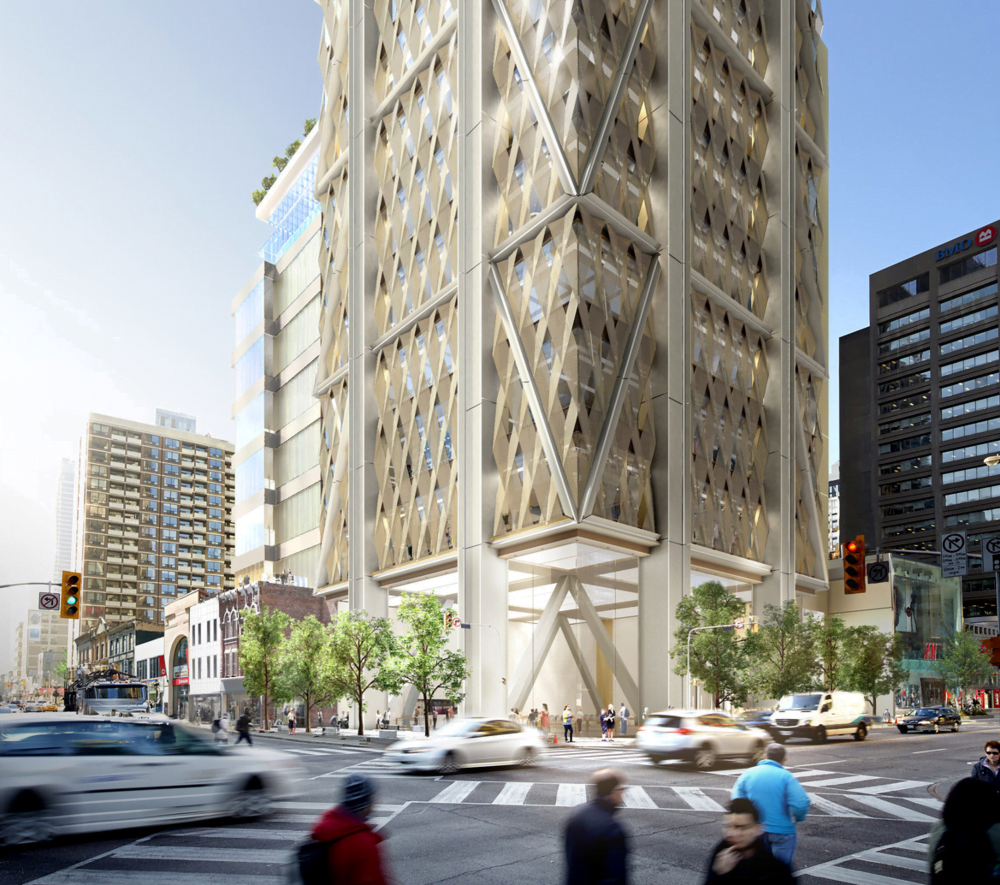
Proposed changes to the retail podium at 2 Bloor Street West.
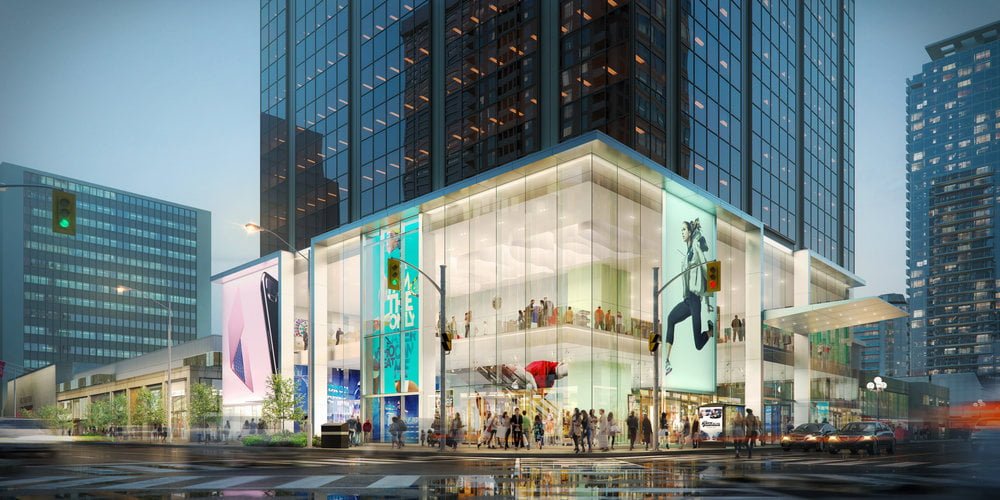
Developer Sam Mizrahi’s ‘The One’ is now under construction at 1 Bloor Street West and when it’s done, the complex will include a multi-level retail podium as well as a boutique hotel (Costar says Hyatt brand Andaz is negotiating) and a luxury residential tower that will soar to a height of more than 1,000 feet above the street. The same Costar article notes that Apple is said to have leased the corner anchor space with plans to open a multi-level flagship of about 20,000 square feet, though neither the retailer nor Mizrahi Developments will go on the record to confirm. Above the anchor space will be a retail concept which will be discussed at a later date.
[Above: Video standing at the north west corner of Yonge Street and Bloor Street West]
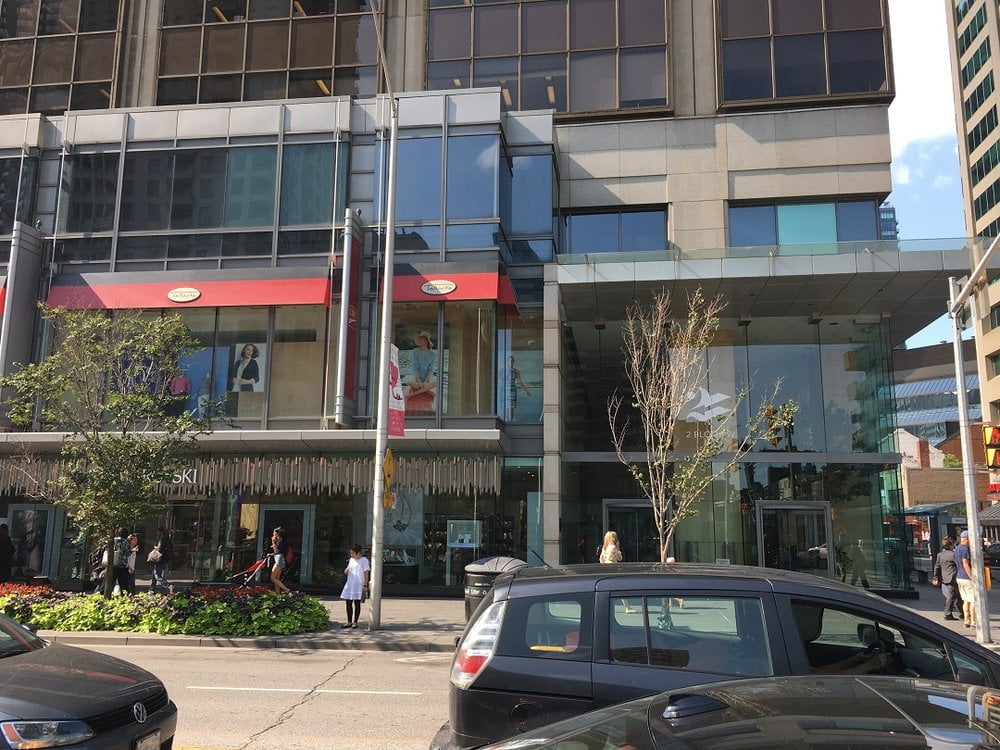
At the northwest corner of the Yonge and Bloor intersection, Kingsett Capital will be updating the retail podium of 2 Bloor Street West/Cumberland Terrace, with details to be released at a later date. Across Mayfair Mews from 2 Bloor is the construction of an expanded Aritzia flagship, which will span about 11,440 square feet when it opens next year. Dianne Lemm of Northwest Atlantic handled the deal on behalf of Aritzia with the Holt Renfrew Centre’s landlord Morguard. Ms. Lemm says she thinks within the next five years Bloor Street will be a ’world class’ retail destination that will house a mix of luxury and major-brand stores in flagship-sized retail spaces — a sentiment shared amongst several brokers we spoke to.
[Above: Proposed changes to the retail podium at 2 Bloor Street West. Listing broker: Brandon Gorman, VP, Retail Services, Cushman & Wakefield]
Morguard’s Holt Renfrew Centre and adjacent 60 Bloor Street West office tower will be seeing some significant changes over the next couple of years. The 190,000 square foot Holt Renfrew store which anchors much of the Holt Renfrew Centre at 50 Bloor Street West is seeing a significant renovation which will include updated interiors (with several new and luxury boutiques), a new facade to replace the existing white marble, and the re-introduction of menswear to the main store. Holt Renfrew opened a standalone men’s store at 100 Bloor Street West in the fall of 2014 and it recently announced that it will be moving menswear back to 50 Bloor.
Holt Renfrew at 50 Bloor St. W. – photo, Craig Patterson
[Above: video taken from the south east corner of Bloor St. W. and Balmuto Street]
The 60 Bloor Street West office tower, which includes a three-level Gap flagship store at the corner of Bloor and Bay Streets, is seeing some updates that will include a new facade. A 3,800 square foot retail space at the base of the tower, adjacent to the recently opened Saint Laurent street front boutique at Holt Renfrew, is available for lease by landlord Morguard.
On the south side of Bloor Street at the corner of Balmuto Street, a roughly 3,000 square foot retail space at 19 Bloor Street West is currently available for lease. Arlin Markowitz of CBRE explained that it is a terrific space for a variety of potential retailers — Mr. Markowitz’s team sold the building a couple of years ago for $74-million and Scotiabank intends on continuing to lease space in the building. Mr. Markowitz explained that the surrounding changes, including renovations to Holt Renfrew and the Manulife Centre, are generating considerable interest for the 19 Bloor Street property as well as the area in general.
The Manulife Centre at 55 Bloor Street West is seeing a transformation that is adding retail space in an expanded podium that will soon house Canada’s first Eataly (spanning about 50,000 square feet over three floors) as well as a new location for Over the Rainbow Jeans, and an updated Birks jewellery store which will feature street-front facades for Breitling, Van Cleef & Arpels and Cartier. These luxury boutiques, as well as the Saint Laurent boutique at street level at Holt Renfrew, add an element of luxury in an area which also houses more affordable brands such as Zara (which recently renovated) and H&M. A large corner retail space at the corner of Bloor and Balmuto Streets is available, as well as some retail spaces inside the Manulife Centre complex.
[Above: Video taken from the south west corner of Bloor St. W. and Bay Street]
Crossing Bay Street on the north side of Bloor Street is David’s Footwear, which is considered to be one of the most prestigious shoe retailers not only in Canada, but globally. The award-winning store is expanding into the adjacent former Capezio space — David’s recently shuttered its Capezio chain as part of a brand repositioning in partnership with Harry Rosen, with Larry Rosen now acting as CEO for both retailers. Watch for David’s to become a national brand with its first location outside of Toronto to open this fall at Ottawa’s CF Rideau Centre.
[Above: Video taken from the north west corner of Bloor St. W. and Bay Street]
The current office tower at 80 Bloor Street West, which houses Roots and a Banana Republic store, is proposed to be demolished to be replaced with a 66-storey tower above a 50,000 square foot retail podium. It’s unclear when or if this proposed project might get off the ground and there’s likely no hurry, given that the site houses an income-producing office tower with retail tenants.
Next door at 82 Bloor Street West, Harry Rosen’s 55,000 square foot flagship continues to see ongoing renovations, including the addition of several impressive branded luxury boutiques over the store’s four levels of retail. In the winter we profiled newly updated second floor which houses luxury boutiques such as Loro Piana, Zegna, Moncler and Brunello Cucinelli, and the store’s Tom Ford shop-in-store is also in line for a renovation. CEO Larry Rosen explained that the Bloor Street Harry Rosen Tom Ford shop competes with Bergdorf Goodman in New York City and Harrod’s in London for top shops-in-store sales globally.
[Above: Video taken from in front of the Harry Rosen flagship (82 Bloor St. W.) at the corner of Bellair Street]
On the south side of Bloor Street across from Harry Rosen, a large Hugo Boss store at 83 Bloor Street West will become available when the store closes this year, and CBRE is listing the building as it seeks a new tenant. CBRE is also selling the three-level COS building next door at 85 Bloor Street West, with owner RioCan looking to divest that particular asset.
The stretch of stores beside COS on Bloor Street’s south side has seen a few changes over the past year. European jeweller APM Monaco opened its first Canadian store last year (Jordan Karp of Savills Canada represented the retailer and says that he’s bullish on Bloor as well as the Yorkville area generally) and two doors down is Canada’s first MCM store (CBRE’s Arlin Markowitz, Alex Edmison and Jackson Turner acted on behalf of the retailer).
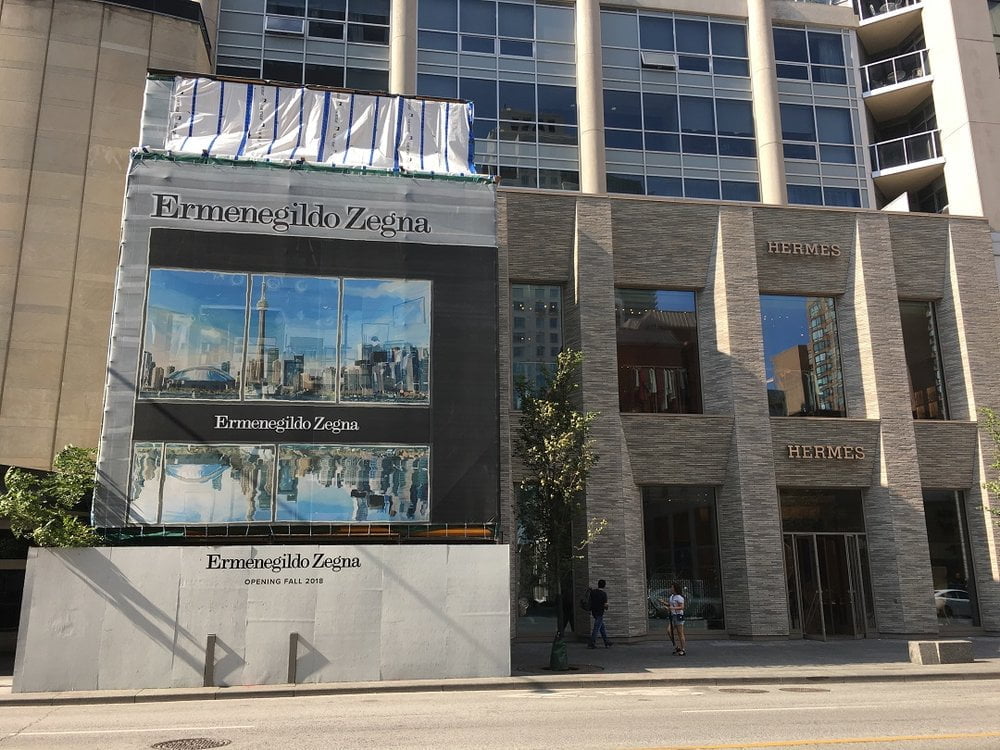
Next to Holt Renfrew men is the Hermes flagship which opened in November of 2017 and this fall, a Zegna boutique will open next to it. Photo Craig Patterson
Looking to the north side of Bloor Street across Bellair Street from Harry Rosen is the 100 Bloor retail podium. It’s considered to be one of the most important retail addresses in Canada and as such, Hermes opened its Canadian flagship there in November of 2017 and this fall, a Harry Rosen-operated Ermenegildo Zegna flagship will open next to it (Arlin Markowitz of CBRE negotiated both transactions). Holt Renfrew currently operates a 16,500 square foot men’s store at the corner of Bloor Street and Bellair Street, and the space is currently for sublease. Barry’s Bootcamp will open its second Toronto location at the rear end of the 100 Bloor podium, and the remainder of the Bfloor Street frontage west of the new Zegna store is available for lease. 100 Bloor Street West is such an important address that we’ll be dedicating a feature article about it soon.
[Above: Video taken from the south east corner of Bloor St. West and St. Thomas street looking north]
At 102 Bloor Street West, beauty retailer L’Occitane en Provence recently renovated its store. The building next to that is 110 Bloor Street West, which houses what is said to be one of the top-performing Winners/HomeSense locations in the entire company. Further down at 130 Bloor Street West, a Gucci flagship will see an expansion and renovation next year, and the former Hermes space next to Gucci, which now features 2,500 square feet of space, is available for lease by CBRE.
[Above: Standing in front of The Colonnade looking north towards Gucci and other retalers]
Across the street at 131 Bloor Street West is Morguard-owned ‘The Colonnade’, which was Canada’s first mixed-use building when it opened in 1963. Some consider it to be the most prestigious retail address in Canada, which is one of the reasons why Christian Dior leased a 13,400 square foot two-level space which will become its largest store in North America when it opens in several months time (Dianne Lemm,of Northwest Atlantic, negotiated the Dior lease deal in partnership with Hanna Struever of California-based Retail Portfolio Solutions, Morguard is the landlord). The Colonnade includes retailers Coach, Mulberry and Prada, the latter which recently completed an expansion and renovation to its store which now spans 13,630 square feet over two floors. William Ashley, which recently unveiled a beautiful new store at The Colonnade, relocated from the Manulife Centre where it had operated for years. Last fall, Moncler opened at The Colonnade and there are three retail spaces available [See Lease Plan]
[Above: Rendering of the new Dior flagship that will open at The Colonnade, as well as an interior rendering, via Dior]
[Above: Video of The Colonnade at 131 Bloor St. W.]
[Above: Video panning from Dolce & Gabbana at 111 Bloor St. W., past the new Dior at the Colonnade]
To the west of The Colonnade is the 151 Bloor Street West building, which houses Max Mara, Stuart Weitzman and a Montblanc boutique which was recently renovated to reflect the luxury brand’s newest concept. A retail space next to Montblanc is available for lease (listed by CBRE). Next to Montblanc is Club Monaco, which operates a large two-level store in a heritage building owned by the University of Toronto, and is currently under tarp for a facade refresh.
[Above: Video taken in front of Club Monaco at 157 Bloor St. West, at the south east corner of Avenue Road]
[Above: Video taken in front of The Church of the Redeemer on Bloor St. West, at the north east corner of Avenue Road]
That takes us to the corner of Bloor Street West and Avenue Road, which is anchored by the Church of the Redeemer on the corner, and an 18,000 square foot Louis Vuitton Maison is next to it. Across Avenue Road on the south side of Bloor Street is the Royal Ontario Museum and to the north, is the Park Hyatt Hotel. Oxford Properties owns the Park Hyatt property with plans to renovate the hotel facing Prince Arthur Avenue while turning the former circa 1929 hotel building facing Bloor Street into a high-end residential rental tower. The entire commercial podium of the Park Hyatt, spanning along Avenue Road, will be expanded and renovated and it will be interesting to see what kind of retailers Oxford Properties will secure for this prominent corner.
Louis Vuitton and Tiffany & Co. anchor 150 Bloor St. W., PHoto Craig Patterson
We’ll follow up this article with some smaller articles discussing properties such as 100 Bloor Street West as well as other changes in the area. As well, in September, we’ll provide an update on what’s happening in Yorkville generally, which is seeing a retail renaissance along Yorkville Avenue as well as at the Yorkville Village centre formerly called ‘Hazelton Lanes’.
INDOCHINO, a global leader in made-to-measure men’s apparel, is broadening its product range beyond formalwear to include casual clothing.
The push beginning September 5 will include made-to-measure chinos plus a refreshed selection of custom overcoats.
And Drew Green, the company’s president and CEO, said the continuing evolution of INDOCHINO will likely move to the adoption of women’s wear in the future.
Image: Indochino
He said expanding into new product categories is something the retailer’s customers have been waiting for.
“It’s a lot of the continuation of what we have been doing. We’ve set out to change the way a generation of men build their wardrobe and it really started with a set of garments that we felt historic in some way. A suit for a man is something that we all partake in points in our life or even perhaps every day and of course you need a nice dress shirt to go with that suit,” said Green.
“About two and a half, three years ago, we started focusing on blazers and suit separates. Pants. Blazers. Really what we wanted to do before we went any further was really to perfect made-to-measure suiting and shirting and I think we have. We deliver our product in under three weeks now and that used to be six weeks. Twenty four per cent of our product this year was shipped in one week or less. Eighty per cent in two weeks or less and then 99.6 per cent in three weeks or less which is our consumer promise. We really honed in and executed on suiting and shirting. I really felt like it was our opportunity to expand and really provide customers with casual wear which we’re doing this fall.
“The khaki pant has been a staple of a man’s wardrobe for decades . . . We wanted to bring that back to life in a made-to-measure, customized and personalized way. So we really zoned in on that this past year, perfecting the first iteration of our khaki pant and we also announced that outerwear is now going to be a staple within our collections.”
Green said INDOCHINO will also be announcing casual shirting within the fall – both shirts you don’t tuck in as well as other options.
“We’re growing. 2018 we’ll have averaged almost 50 per cent year-over-year growth since 2015. So four years. Compound annual growth. So the company’s growing . . . We just see an opportunity. The demand for our suits is relentless frankly,” he said.
“We’ve opened 31 showrooms now across North America. We’re opening another five before the end of the year. Another 20 next year. Just in North America. We constantly, and I constantly, speak with customers and they just love the fact that they can get a garment that fits them perfectly and that they can create their own. They’ve been asking for other products. And I think it’s always a wise idea to listen to your customer. We wanted INDOCHINO to be a bigger part of a man’s wardrobe.”
So does Green see women’s wear in the company’s future?
“It’s a great question and it’s probably the number one question I get both through the media as well as from our customers,” said Green. “And I think for us we really have stayed focused on men’s apparel. I think women’s is part of our future. Women’s custom clothing is part of our future. We don’t have official plans for this year or next year for women’s wear but definitely as we evolve the brand globally we see that as an opportunity.
INDOCHINO has opened 12 stores so far in 2018 and plans to end the year opening five more for a total of 36 showrooms. These include Newport Beach, CA, Atlanta, GA, and Madison Avenue, NY, all launching in September.
As retail in Canada continues to polarize at the low and high-end, landlord Cadillac Fairview is creating areas in several of its Canadian malls in an effort to attract a wealthier demographic. It’s a pattern being seen amongst leading shopping centres globally, and is a rather recent phenomena in Canada, which has traditionally seen luxury retail in downtown areas on street fronts.
Clustering luxury brands in one area makes sense for a landlord — high-end brands generally prefer to be within close proximity of each other in order to be conveniently accessible to their target market, which will see a high-end area of the mall as being “for them”. When luxury clustering is successful, the critical mass of spending power can propel these retailers’ sales numbers into the stratosphere.
Several of Cadillac Fairview’s Canadian malls are notable in their creating ‘luxury areas’ that haven’t been seen in the past, with the phenomena being seen particularly in Vancouver, Calgary, Toronto and Montreal.
In Vancouver, CF Pacific Centre is seeing something of a ‘luxury level’ having been created on the mall level which houses Harry Rosen and the above-ground pedway over Dunsmuir Street to Holt Renfrew. The Harry Rosen store operates a Zegna boutique across the way with a renovation to be completed in the fall, joining the likes of Max Mara, Pomellato, Mackage, Bose and Stuart Weitzman. Canada Goose and Maje will join the mix this year when they open stores on the same level, which also is home to a highly productive Apple Store. Not all stores on the ‘luxury’ mall level are pricey, however — H&M’s main mall entrance is across from Pomellato, with H&M set to expand to three levels by occupying space downstairs on the primary mall level.
In Calgary, CF Chinook Centre is seeing luxury clustering around a newer part of the mall which houses Harry Rosen, Tesla and Tiffany & Co., as well as an expanded area towards the mall’s Saks Fifth Avenue store, which opened in February of this year. Louis Vuitton has been secured as a tenant for a curved retail space across from the entrance to Saks, and Mackage is also said to have finalized a lease nearby. Tiffany & Co., Harry Rosen, Canada Goose and Burberry are all located in the curved luxury section of the mall, and more luxury brands are said to be in negotiation nearby. It will be interesting to watch what happens in downtown Calgary as Louis Vuitton exits Holt Renfrew for the suburban CF Chinook — some say other luxury brands could follow, adding further struggles to Calgary’s considerably quieter downtown core.
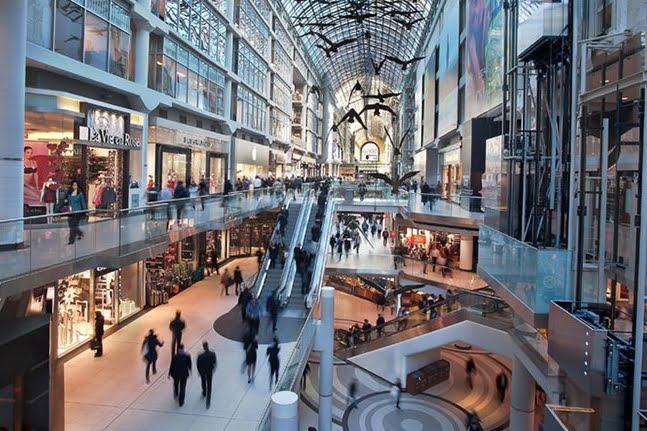
In Toronto, two Cadillac Fairview malls are seeing upscale brands opening stores. The downtown CF Toronto Eaton Centre, which is by far the busiest shopping centre in North America with more than 50-million visitors yearly, houses several upscale brands on its third level, not to mention prestige anchors. Standalone stores operating on CF Toronto Eaton Centre’s third level include the likes of Links of London, Hugo Boss, Sandro, Maje, Mackage, and Ted Baker, with the level bookended by flagships including Nordstrom to the north, and Saks Fifth Avenue/Hudson’s Bay to the south. Nordstrom carries a range of luxury brands with shop-in-store boutiques such as Loewe, Miu Miu, Gucci, Moncler and Stella McCartney, while Saks Fifth Avenue is home to an impressive roster of luxury brands which is among the best in Canada. Hudson’s Bay, as well, houses luxury women’s department ‘The Room’, known for its edgy fashions and impressive gowns, while the store’s men’s department continues to add upscale brands such as Balmain, Marni, Kenzo and, most recently, Paul Smith’s mainline collection in its own dedicated area.
CF Sherway Gardens in Toronto also features several luxury brands, though they tend to be spread out a bit more than in some of Cadillac Fairview’s other Canadian malls. It might make sense that the entire mall is positioned relatively high-end for the most part, though — CF Sherway Gardens is certainly one of the most attractive shopping centres in Canada, boasting an impressive interior, valet parking, and anchors that include a well-stocked Nordstrom as well as a luxury-heavy Saks Fifth Avenue. Other standalone luxury boutiques at CF Sherway include De Beers, Tiffany & Co., Loding, Caudalie and Links of London, while licensed locations for Chopard and Montblanc can be found not too far away.
CF Carrefour Laval near Montreal also features several upscale retailers, in an impressive shopping centre with interior architecture reminiscent of the historical buildings that might be found closer to Montreal’s downtown core. A Montblanc boutique is notable, as is Mackage, Marc Cain, Harry Rosen, and a Birks jewellery store which houses a Breitling shop-in-store. The mall lacks anchors such as Saks Fifth Avenue and Nordstrom, though it boasts a La Maison Simons store with an impressive roster of luxury brands for both women and men. CF Carrefour carries an impressive range of contemporary and international brands, though the Montreal market doesn’t generally spend as much on luxury brands as Toronto and Vancouver and possibly Calgary.
The Heartland Town Centre in Mississauga, one of Canada’s largest and busiest power centres, is about to get even busier with many retail initiatives on the horizon.
Matthew Kaplan, leasing manager with Orlando Corporation which owns the retail property, said retail giant Nordstrom Rack will be opening its third Greater Toronto Area location in the beginning of September in 36,000 square feet of space.
This comes on the heels of the widely-popular Jollibee food offering which set up shop in Seafood City at Heartland – its third Canadian location and second GTA location – in mid July.
“We’re essentially a super regional centre . . . We’re the major population centre with industrial and office to the east of us and residential to the west and we’re accessible by the 401 (highway) which is just north of the centre,” said Kaplan.
“So we’re highly accessible and we’re a massive 2.2 million-square-foot centre with everything from apparel, grocery, restaurants, just everything customers are looking for in one place.”
Kaplan described Heartland as a “hybrid” centre with a mixture of full-price and outlet stores.
Dan Hyde, senior manager of retail for the Orlando Corporation, said Seafood City is an American grocery store chain catering to the Filipino community – and that has brought a strong presence to the power centre from that community.
“That area was a redevelopment of a former Rona store. We tore down a portion of the Rona store. Rebuilt what remained, added to it and put a 50,000-square-foot Seafood City. That was their first venture out of the country. It’s been highly successful,” said Hyde. “They’re very happy with their sales and Jollibee is just going to drive their numbers up even higher. But it’s given a focal point to an ethnic group that we really hadn’t touched on specifically in the development.”
Heartland offers more than 190 stores and services with over two million square feet of retail space. The centre was built in multiple phases but the first stores started opening about 26 years ago.
Recently the New York-based chain Halal Guys, a Middle Eastern restaurant, opened at the power centre.
Other recent openings were a Costco gas bar and Congee Queen (a Chinese restaurant).
Kaplan said there are a few leasing opportunities existing at Heartland right now for retailers who might want to take advantage of the centre’s growing popularity.
One is an 11,000-square-foot space next door to the Nordstrom Rack. Also Home Outfitters recently vacated about 34,000 square feet. There are a few smaller units between 4000 and 10,000-square-feet which available which in the centre.
Hyde said the centre’s vacancy rate is running at about one per cent or a little bit less.
“One of the challenges of finding space for the tenants who do want in right now is with the right configuration and size and of course the right location with the neighbours they’re looking for,” added Hyde.
THE HALAL GUYS GRAND OPENING WAS AUGUST 3, 2018
Image: Heartland Town Centre
He said Heartland is about 250 acres of a 1,200-acre planned industrial office development that the company owns.
“It has a large neighbourhood of business community on the east side of it and of course a large residential neighbourhood on the west and north side of it,” added Hyde. “And we are surrounded by the 400 series highways . . . So we have accessibility from a long distance. People travel here from London, Kitchener, Guelph to shop here because of the scale of it but the fact we’re easy to get to.”
“We think our sales probably make us one of the higher performing large-format retailers in Canada if not North America.”
SMALL BUSINESS OWNERS PROVIDE A SERVICE BY OFFERING GOODS NOT FOUND ELSEWHERE AND EMPLOYING LOCAL COMMUNITY MEMBERS. HERE, A SARI SHOP WINDOW IN TORONTO’S ‘INDIA BAZAAR.’ IAN MUTTOO, CC BY-NC
Icy cold winters and culture shock are not the only things newcomers face when they move to Canada; they also have a hard time fitting in and finding meaningful work. We accept people with the hopes that they will be integrated into the economy, but we do not do this from the outset. The way in which we settle immigrants into the Canadian economy requires some rethinking.
None could find work in their field. Some of the exclusion was bureaucratic, but much of it was a polite form of social exclusion because they had migrated from places that white assessors do not deem as having expertise.
Canada is a land of immigrants and refugees. Except for First Nations people, we all come from somewhere else. We may celebrate the contributions of newcomers of the past and present; however, we make the integration process difficult and this is especially the case for non-white immigrants.
We dread saying this R-word (R for racism) in Canada because we would rather live in the delusion that the United States has it worse. However, evidence shows a shameful legacy of inequities against Aboriginal and racialized people. There are far too many stories of highly skilled professionals becoming taxi cab drivers, daycare workers and cleaners.
As a result, what we see are many Mom & Pop shops along the corridors of immigrant neighbourhoods in cities like Toronto: the Eglinton West, the Golden Mile, Malvern, Chinatown, Little India, Koreatown, Lawrence Heights, Jane and Finch, Rexdale.
In these instances, people are coping and deciding: why work in a depressing job for someone else when I can create my own enterprise?
For many people of colour, ours included, a family business is the way to earn a living. For many recent newcomers, when their credentials do not count they retool, they start-up businesses.
Many racialized Canadians shunned by formal sector jobs, find refuge in entrepreneurship. The psychological motive is a common reason people start a business. Immigrants and refugees want a better life; it is the reason they made the big decision to leave their homelands. The notion of being on welfare and perceived as a blight on society is demoralizing.
This is a story that resonates all over the Greater Toronto Area. People of colour are in precarious, often hostile work environments and can lose their jobs for no apparent reason.
Community-built businesses
Village of Dreams, a documentary about the Lahore Tikka House, an iconic restaurant in Toronto’s Little India, captures the essence of the late owner, Alnoor Sayani who wanted to bring comfort food to the diaspora and to give newcomers a decent-paying job. His wife Gulshan continues this tradition of training and mentoring newcomers; she has also ensured many women are leading the work in the restaurant.
We see this story play out in the life story of one of Canada’s national icons: Viola Desmond. A businesswoman and owner of a beauty salon in Halifax, N.S., Desmond trained other Black women as apprentices. Many of her trainees became financially independent in an era where jobs for Black women did not exist outside of domestic work and prostitution.
Desmond’s business was a socially conscious one because she was reaching an unmet demand by providing beauty services to Black women, as well as developing the talents of young women to work for themselves.
Alrubail feels access to venture funds and grants are elusive for her because she does not come from the traditionally well-connected network. She says many like her bond over this social exclusion occurring within the “business for good” sector.
Recent research in the social economy reveals how Black Canadian leaders are dismissed and ignored because the national Canadian narrative works better when Black and racialized people are viewed to be on the receiving end of aid and not as those leading innovative work to uplift their communities.
Redefining the social economy
How many times have we walked into a mainstream salon only to be turned away with the words, “we don’t do Black hair?”
Can a small business owner who operates a beauty salon serving a niche market to an under-served community be considered part of Canada’s social economy?
A new project, Social Innovations among racialized Canadians, based at York University, examines the operations of social innovators and immigrant-owned businesses in Ontario to learn how subsidies might help newcomers adjust better to society.
The project also looks at the hows and whys of small businesses, including social enterprises: for example, when a sales representative is fired and opens up an ethnic food store, does this business show any evidence of innovation in business economics? Or is it just survival economics?
Does his store improve his neighbourhood by hiring marginalized people and providing products not found in conventional supermarkets? Are historically oppressed people, who turn to business, able to co-opt resources and operate businesses in a socially conscientious manner?
The traditional methods of settling immigrants as workers needs review. This is not to say that every immigrant should become an entrepreneur. Many immigrants turn to business, yet they are shut out from grants for innovation or do not know about such opportunities. Currently, accessing loans and grants is a complicated process. Perhaps policymakers should be building up resources to help these budding local business people who are trying to make a difference in the communities they live in.
Nick Goberdhan, a student researcher from York University living and working in the Golden Mile, a Scarborough community, interviewed close to 30 Mom & Pop businesses. His preliminary findings show that diaspora businesses are rooted in care and self-love.
These business owners often merge the economic and the social because they hire and train people from the local community to deal with underemployment issues. In this way, diaspora businesses blur the definitions of business and community, and in doing this, they are rethinking what business actually means.
Perhaps Canada’s social economy needs to count these types of business within its definition of social enterprise. We need to recognize and honour those who have taken it upon themselves to engage in business in a different way — one that helps immigrants, families and their communities.
Caroline Shenaz Hossein is Associate Professor of Business and Society in the Department of Social Science at York University. Author of Politicized Microfinance: Money, Power and Violence in the Black Americas and editor of The Black Social Economy: Exploring Diverse Community-Based Markets. She has more than 10 years full-time professional work in finance and economic development in global nonprofits. Visit her website (Caroline-Shenaz-Hossein.com) and follow her on Twitter at @carolinehossein.
Popular Montreal-based fashion brand Pajar, known particularly for its boots and outerwear, will open its first two standalone stores this fall as it expands its operations to include a direct-to-consumer model. The retail stores will compliment Pajar’s wholesale network and will also include some product exclusives in a curated environment that will “reflect the brand’s DNA” according to the company.
One store will be located at Toronto’s Yorkdale Shopping Centre, and another will be at the Premium Outlets Montreal in Mirabel. The Yorkdale store replaces Nine West in a 1,340 square foot retail space next to luxury watch brand Breitling — Yorkdale is Canada’s most productive mall in terms of sales per square foot, and it’s also one of the largest and busiest malls in the country. Premium Outlets Montreal is Quebec’s leading outlet centre that houses brands such as Gucci, Max Mara, Ferragamo Coach and Michael Kors in an outdoor configuration.
The stores will test the concept prior to Pajar launching permanent retail spaces. Both leases are several months in duration and as such, are considered to be pop-up stores. That’s according to Michel Golbert, Vice President of Pajar and grandson of the company’s founder. Brokerage Northwest Atlantic represents Pajar under the direction of David Bishop and Ryan McCarthy.
Image: Pajar at Yorkdale Shopping Centre
Family-owned Pajar, known particularly for its high-quality footwear and outerwear, was founded in Montreal in 1963 by Paul Golbert. Paul Golbert found the inspiration for the company’s name by using the first letters of his name, his son’s name and his wife’s name, (PAul, JAcques, and Rachel), respectively. Pajar has expansive distribution in upscale retailers across the country such as Harry Rosen, Holt Renfrew, Nordstrom, Browns Shoes and David’s Footwear, and the new stores will act to further enhance Pajar’s brand awareness in order to gain market share across all channels.
Pajar’s innovations included creating the ‘Zig-Zag’ boot which is an ‘apres-ski’ item featuring a centre-zip and sheepskin lining. It became the official provider for the Canadian Alpine Ski Team in 1989. The Pajar Canada Heritage Premium collection is manufactured in the same factory that Paul Golbert opened in Montreal’s ‘Plateau’ area when he first became a producer of Canadian footwear in 1973. Boots are lined with 100% genuine sheepskin, and are guaranteed to keep feet warm in temperatures as low as -40°C, according to the company. Other Pajar collections include outerwear such as foldable rain boots, a wide variety of winter coats for men and women, socks, belts, bags, and hiking boots. Some exclusive products will only be found in Pajar’s retail stores, noted Michel Golbert.
The Pajar Sport collection includes urban performance and casual street wear that is manufactured in Pajar’s global facilities in Italy, Portugal, and Asia. The collection combines seam-sealed premium waterproof leather and textile uppers comfort rated to -30 C. The Oslo Apres Ski Collection, handcrafted in Italy, features genuine fur uppers including Fox, Rabbit, and Goat fur along with the hydro-repellent leathers, and seam-sealed construction.
The Yorkdale and Premium Outlet Montreal stores will feature Pajar’s ’DNA’ according to Michel Golbert, including various Canadian heritage/lifestyle/brand images, as well as special seating and even a toboggan in the store. The history of the company will be recognized in the stores, including images of the Golbert family in the 1920’s-40’s selling shoes in Paris where they lived prior to moving to Canada. Pajar remains an international business with distribution in more than 40 countries, notes Michel Golbert, and the company produces nearly a million pairs of boots annually.
Ten employees have been hired for the two stores, which are scheduled to open in early September. The openings are expected to be attended by some notable celebrities, according to the company, with details to be revealed closer to their opening dates.
“Pop-up retail is a terrific way for brands to test the waters before securing permanent storefronts,” said Linda Farha, founder and ‘Chief Connector’ at online pop-up retail platform pop-up go, which also features a curated pop-up match service. “Pajar is a terrific brand with an extensive heritage and given its rapid sales growth, its pop-up stores are likely to lead to permanent locations Canada-wide”
Michel Golbert reflected the same sentiment and said that once the Pajar retail concept is perfected, permanent Pajar stores may be rolled-out across the country. It’s part of an effort to amplify the brand, which already has considerable awareness both domestically as well as internationally.
Pajar is the latest brand to go direct-to-consumer over the past couple of years. Several well-known Canadian outerwear brands have expanded their operations beyond wholesale by opening stores. Montreal-based Mackage began an expansion in late 2015 that now includes stores in Montreal, Toronto, Vancouver and New York City, with a Calgary store at CF Chinook Centre in the works for this fall. Canada Goose opened its first standalone store in the world at Yorkdale in the fall of 2016, with plans to operate more than 20 stores globally by the year 2020. Last year Montreal-based Moose Knuckles also opened its first concept store at Yorkdale and most recently at Premium Outlets Montreal. All three brands are expected to further expand their network of stores while also maintaining wholesale distribution, not to mention e-commerce.
We’ll follow up with photos of the two new stores when they open next month, and we’ll provide updates as Pajar continues to expand its operations.
Edmonton-based Fire & Flower aims to be a corporate retail store specializing in elevating Canadian cannabis products through experiential strategies and education-based programming.
And Trevor Fencott, the company’s CEO, said it plans to open 37 outlets in Alberta and expand throughout the country when legalization takes place in October.
Trevor Fencott In downtown edmonton location
“We currently have 37 applications with the AGLC (Alberta Gaming and Liquor Commission) for locations all across Alberta,” he said. “At a high level, our intent was to have roughly one third Edmonton, one third Calgary and then one third rest of province. That’s the rough intent. Now as a practical matter I think we are a little heavier at the moment in Edmonton because Edmonton was fairly quick out of the gate with providing some clarity in our ability to get locations lined up.” The company received conditional approval for the 37 locations last week.
“Our goal is to be in every province where private retail is available. We’ve also been awarded a licence in Saskatchewan (Yorkton). So we are there as well and we plan to apply for British Columbia . . . Our high level objective is to get and maintain a 15 per cent market share where possible and it depends on each province.”
The cannabis retail industry is expected to be highly-competitive as it gets itself up and running beginning in October.
Fencott said the key differentiator for Fire & Flower is it started from scratch and it is designed from the ground up to be a licenced cannabis retailer.
The market, he said, includes vertically-integrated licenced producers who are producing cannabis but now will have a retail presence. Another group is retailers who are pivoting their business into the cannabis space as a new market. They have a lot of retail experience but they perhaps don’t have as much regulated cannabis experience.
“For us it’s a pretty unique position to be in from the get-go to have built a company from the ground up specifically to do this,” said Fencott.
“Our core mandate is socially responsible, education-driven retail so one of the approaches we’re taking is basically not a lot of people have a lot of experience with this product and so we want to take a very proactive education-driven approach. Some of our competitors will also do that as well but it’s really our focus. We’ve been hiring staff and training in this reality for months and months now.”
Recently, the company announced plans for its future stores which it said are intended to ensure customers across diverse demographics feel welcome, comfortable and are able to maintain a level of privacy should they so choose. The customer experience at Fire & Flower will focus both on education and knowledge of cannabis and cannabis-related products through highly-trained cannabis specialists in each location, it said.
“Our store design is modern, bright and will ensure the highest level of comfort for our customers, many of whom are purchasing cannabis for the first time, upon legalization,” said Fencott, adding that the design aims to elevate the retail experience in shopping centres and stand-alone retail stores.
The company said responsible retailing for Fire & Flower encompasses many facets including: prohibiting consumption from minors, promoting road safety and offering stringently tested, first-class strains. Leveraging the latest technology and innovations, each retail location will include a robust proprietary security protocol to ensure the highest standards of safety for surrounding communities. This protocol was developed with the assistance of Norman Inkster, a Fire & Flower board member, who served as the 18th Commissioner of the Royal Canadian Mounted Police and President of Interpol for two years.
“The initial concept came from my partner in the business, Harvey Shapiro who is our chairman, and the idea was seeing the licenced production system and the medical system that the federal government was going to push ahead . . . the assumption was that the licenced producers would be able to be in a good position to provide online adult-use retail because they had this developed infrastructure already. Highly compliant. Once it became clear the federal government was going to move ahead more quickly with legalization plans that’s kind of where the idea got started,” said Fencott.
“For us, in about November things kicked into sort of high gear because Alberta released its provincial regulations which were quite clear and Alberta was quite far ahead of the pack in terms of having a clear set of guidelines in an application process. The other provinces really hadn’t published a lot that was very clear so we decided that Alberta would be our beginning.”