Advertisement
Advertisement
Home Blog Page 1100

Last Chance to Register for eTail Canada, May 16-18 in Toronto

It’s your last chance to register online for the eTail Canada Conference, taking place at the Hyatt Regency Hotel in Toronto on May 16-18. A few tickets remain for what will be the largest digital marketing conference in Canada. 

There’s been more demand than ever for eTail Canada, including 330 retailer and solution providers with names such as Canadian Tire, Holt Renfrew, Reitmans, Canada Goose, Home Depot, Hudson’s Bay, IKEA, Walmart, and many others. 

Attendees will have plenty of networking opportunities, including at eTails receptions. There’s also an exclusive app that can be downloaded for the event. 

To see who’s attending, you may download the attendee list here. As well you may download the final agenda for a list of what’s in store. 

To secure your seat, you can register online, or call eTail Canada at 1-888-482-6012

Sponsored content. To work with Retail Insider, email: craig@retail-insider.com

Yorkville Avenue Transitioning to Become a Luxury Retail Street [Feature/Photos]

Toronto’s Yorkville Avenue is in the process of transitioning to become one of Canada’s most important luxury retail addresses. A number of exclusive retailers have recently opened, and a number of other upscale brands will be moving onto Yorkville Avenue over the next several years, according to brokers doing deals in the area. 

The stretch of Yorkville Avenue, particularly between Bellair Street and Avenue Road, has been seeing interest from a number of the world’s leading luxury brands. Some of them have already taken the leap and have signed leases, some are in discussions to potentially move in, while others are waiting for the ‘right’ space to become available. 

Until last summer, Yorkville Avenue featured a number of upscale retailers along its Bellair-Avenue Road stretch, but no freestanding luxury retailers. Signage for a Kiton boutique features prominently at the northeast corner of Yorkville Avenue and Hazelton Avenue, though it’s technically part of multi-brand luxury retailer V Hazelton. In early 2016, Spanish luxury jewellery brand Carrera y Carrera opened its first North American location on quaint Old York Lane — a  busy walkway that connects Yorkville Avenue and Cumberland Street. 

In August of 2016, luxury French footwear and accessory brand Christian Louboutin opened its first freestanding Canadian location at 99 Yorkville Avenue, in a unique two-storey space that now acts as the company’s Canadian flagship (Paracom Realty’s Jordan Karp and Ripco Real Estate‘s Jeffrey Paisner represented Louboutin, Steven Alikakos of RKF represented the landlord). Luxury streetwear brand Off-White opened its first North American store last month at 83 Yorkville Avenue, in an elongated retail space with a unique interior (CBRE’s Arlin Markowitz and Jackson Turner represented the landlord). Most recently, luxury jeweller Louis Black converted its 118 Yorkville Avenue space into Canada’s first Richard Mille boutique, featuring watches that can cost more than some of the luxury condominiums in the upscale neighbourhood. 

In the fall of 2015, Paris-based women’s luxury brand Chanel confirmed that it had leased an 8,700 square foot flagship space across the street at 100 Yorkville Avenue. Construction is now underway for the new Chanel store, which is expected to open within the next few months. Chanel was represented by DWSV Remax Ultimate Realty Inc.‘s David Wedemire and Stan Vyriotes, who are also involved with a number of other retailers that have either already secured space on Yorkville Avenue, or are currently in the process of searching for the perfect location. 

Mr. Vyriotes and Mr. Wedemire both confirm that Yorkville Avenue is being positioned as a destination for luxury retailers, with Mr. Wedemire noting that Yorkville Avenue might be compared to Madison Avenue in New York City, while Bloor Street West is more comparable to Fifth Avenue. Mr. Vyriotes explained how Yorkville Avenue has the potential for a continuity of luxury retail, because a number of its buildings are owned by one landlord — First Capital Realty. At the same time, both representatives discussed the importance of maintaining restaurants and other food and beverage offerings in the area, in order to attract visitors as well as to maintain the street’s vibrancy. On a warm summer’s day, the area is buzzing with people shopping in stores, going to bars and restaurants, and even eating ice cream/gelato at one of the local vendors. 

Mr. Vyriotes and Mr. Wedemire were instrumental in securing two more interesting retailers to the street — one an international luxury brand, the other a hip multi-brand streetwear retail concept. In late 2018, luxury footwear and accessory brand Jimmy Choo will open a two-level, 2,250 square foot store next to Chanel at 102 Yorkville Avenue, in a new retail building that will have room for three luxury retailers. As well, Mr. Vyriotes and Mr. Wedemire represented upscale/cool retailer CNTRBND in securing a new 2,147 square foot retail space at 135 Yorkville Avenue, with the store scheduled to open this summer. CNTRBND will be relocating from its current store space which is tucked away at 104 Yorkville Avenue.

CBRE’s Arlin Markowitz, who represented the landlord in the Off-White deal at 83 Yorkville Avenue, expressed a similar opinion — that Yorkville Avenue is in the process of transitioning to become a luxury retail street, and that food and beverage will also be important to maintain the vibrancy of the area. The CBRE Toronto Urban Retail team, under the direction of Arlin Markowitz, Alex Edmison and Jackson Turner, have been instrumental in representing both landlords and tenants in the area. 

RKF’s Canadian President Steven Alikakos described Yorkville Avenue as being a “beautiful street”, referring to its recently added paving stones, as well as the street’s vibrancy on a sunny day. “The village is on an upswing,” said Mr. Alikakos, explaining that a number of the world’s leading brands have been asking about space in the area. He’s been working with landlord Cumberland Private Wealth Management to lease space in the 99 Yorkville building, which includes the Christian Louboutin flagship that was discussed above. He revealed that a large restaurant with two patios will be opening behind Louboutin, and two prime Yorkville Avenue-facing retail spaces are available for lease — a 4,800 square foot unit at 87 Yorkville Avenue, as well as an adjacent space measuring about 1,300 square feet. The landlord is seeking international fashion tenants to occupy these two spaces, in order to complement neighbouring Christian Louboutin. 

Briar de Lange, Executive Director of the Bloor-Yorkville Business Improvement Area, described the excitement that is being felt both at her office, as well as in the neighbourhood at large. “The area is already very different now than it was a decade ago, and many more changes are on the way,” she said. The Bloor-Yorkville BIA is seeing a number of positive redevelopments and transformations, which will solidify the area as a truly world-class retail destination.

More is in store as the street continues to progress, and construction is completed on several commercial buildings. Towards Avenue Road, popular steak house STK opened in the fall of 2016, in a space next to the LUMAS Gallery. This summer, they’ll be joined by upscale bakery/food retailer Sorelle & Co., known for using gluten-free, soy-free, sesame-free, vegan, nut-free & preservative-free ingredients. 

Looking further into the future, the 45,000 square foot commercial building at 101 Yorkville Avenue will eventually be demolished and replaced with a 35,000 square foot multi-tenant building that will be dedicated to luxury retail. Landlord First Capital Realty partnered with Greybrook Realty Partners to acquire the site in September of 2016, as First Capital looks to continue acquiring real estate in the immediate area. 

First Capital Realty also owns the enclosed shopping centre with the name ‘Yorkville Village’ (formerly Hazelton Lanes), which is also the name given to its owned properties on adjacent Yorkville Avenue. The mall property recently unveiled a grand open entrance facing onto Yorkville Avenue, with the intention of drawing shoppers into the centre from the street. The Yorkville Village shopping centre is in the process of a significant renovation, which includes the addition of a number of exciting new retailers. This month, we’ll be profiling some of the updates happening at the Yorkville Village mall property, which will add even more luxury brands to the increasingly upscale area. 

London Drugs’ Clint Mahlman Wins Prestigious Canadian Retailer of the Year Award

Clint Mahlman

Retail Council of Canada (RCC) has awarded Clint Mahlman, Executive Vice-President & Chief Operating Officer of London Drugs Limited, as its 2017 recipient of RCC’s Distinguished Canadian Retailer of the Year. The Award will be presented to Mr. Mahlman at the Excellence in Retailing Awards Gala in Toronto on May 30, 2017, and tickets are still available to attend: retailawards.ca/content/gala-tickets

“RCC is thrilled to recognize Clint Mahlman and London Drugs Limited for their passion, their leadership, and their ability to embrace change in today’s retail landscape,” said Diane J. Brisebois, President and CEO, Retail Council of Canada.

The Distinguished Retailer of the Year Award recognizes a retail leader and company who have led their organization to outstanding business success and who have consistently demonstrated a commitment to the communities they operate within. The recipient is seen as a role model because of his/her exceptional leadership within the corporation, in the retail industry in Canada and in the community at large, through personal and/or corporate philanthropic activities.

Both Mr. Mahlman and London Drugs Ltd. are recognized by their peers in the retail industry in Canada for their outstanding and ongoing business success, their innovative and successful approach to customer care, their unwavering commitment to the communities they serve, and their outstanding leadership in promoting and supporting retail as a career.

London Drugs joins a long line of passionate merchants across Canada receiving the Excellence in Retailing Award, including Leon’s, Harry Rosen, Canadian Tire Corporation, Groupe Dynamite, Indigo, Staples Canada, Costco Wholesale Canada and Aritzia.

Clint Mahlman has held several senior positions with London Drugs since joining the company in 1984, and he became Executive Vice President and Chief Operating Officer in 2014. Under his leadership, London Drugs has continued to expand and innovate while taking a greater role in philanthropic community-based activities such as environmental stewardship, health education and the support for youth at risk.

Mr. Mahlman has also been the catalyst behind London Drugs’ environmental initiatives. He’s widely recognized for the significant impact that London Drugs’ “What’s the Green Deal?” recycling program and waste-management stewardship has and is making in the retail industry. Mr. Mahlman will humbly state that he’s happy to use his background and title to get things done, but quickly adds that there are large employee teams and many great business partners that are equally as important to making this happen.

In addition to his many contributions to London Drugs, Mr. Mahlman continues to serve and support ‘retail as a career’ programs through local and national academic programs and initiatives.

London Drugs was established in 1945 and began as a humble, community drugstore-just 1000 square feet on Main Street in Vancouver. Today, London Drugs has 80 stores in more than 35 major markets throughout British Columbia, Alberta, Saskatchewan and Manitoba, including its online store LondonDrugs.com. London Drugs offers consumers a wide range of products and services from digital cameras and cosmetics to computers and televisions. More people buy their small appliances in London Drugs than any other place in Western Canada. All told, London Drugs serves over 45 million customer visits each year, and this iconic retailer is still growing.

London Drugs proudly sponsors various community-based events and corporate initiatives that are in-line with its values and goals of building healthier and stronger communities.

The Distinguished Retailer of the Year Award will be presented to Mr. Mahlman at the Excellence in Retailing Awards Gala on May 30, 2017. For further information and to purchase tickets: retailawards.ca/content/gala-tickets

The Gala, taking place at STORE 2017, Canada’s largest and most important retail conference, will take place at the Toronto Congress Centre from 6:15 pm to 8:30 pm. 

Media are invited to attend STORE 2017, May 30 and 31, 2017. For further information: STOREConference.ca

Why Retail Should be a Priority in Urban High-Density Developments

Major Canadian cities are seeing people moving downtown like never before, creating demand for new retailers and new retail space. There’s an opportunity for developers to capitalize on retail opportunities at the base of new condominium and other mixed-use towers, if done right. However, plenty of the developers building new residential towers are neglecting the retail space beneath, according to Babak Eslahjou, principal at Toronto-based CORE Architects

Thousands of people are moving into Canada’s urban cores annually, for a variety of reasons. Some are young people seeking an exciting urban lifestyle, while also being close to work or school. Some are seniors seeking out enjoyable urban amenities, including professional sports, restaurants, theatre and other cultural activities. Even some families with children are seeking to live in high-density developments in Canada’s urban cores— though for a variety of reasons, that’s still a challenge. 

CORE Architects’ Mr. Eslahjou notes that, when done right, adding retail space to high-density urban developments can provide developers with a consistent stream of rental income after condominium units have been sold in the building above. Securing a strong tenant, such as a national grocery chain, can provide the landlord with a “very good source of revenue,” according to Mr. Eslahjou — though there are some challenges to creating such space in a multi-use high-density environment. 

Ceilings must be sufficiently high enough to attract the right tenants and in the case of grocery tenants, soaring ceiling heights are often required. This has been a challenge in some markets, particularly those with strict building height restrictions. In some parts of Vancouver, for example, it is mandated that retail be included along urban street-fronts. The city is also notorious for enforcing its mandated height limits (not to mention rather arbitrary view cones) and as a result, some residential developers have added ground-level retail space with insufficiently low ceilings for many retail concepts. One local broker, wishing not to be named, explained the frustration of dealing with less-than-ideal retail spaces, including those with low ceilings, in a number of mixed-use buildings in the city. As a result, a number of developments continue to see retail vacancies long after condominium units above become occupied. 

Column spacing must also be wide enough so that retail tenants can properly lay out and merchandise their stores. This becomes a challenge, as support pillars are required for the building above, while at the same time ample wide support columns will make some retail spaces less desirable. Creativity is required but it’s not impossible — Mr. Eslahjou described how the One Bloor Street West project in Toronto, for example, will feature column-less retail interiors. It takes skilled architects and engineers to create such spaces, though, and there are increased costs involved, but Mr. Eslahjou said that it can be worth it for the right tenant(s). 

He noted that there are also a few other challenges to adding retail in high density areas. Grocery stores typically see multiple deliveries daily, requiring loading docks to be strategically designed so as to provide minimal disruption to neighbours. Restaurants require ventilation, which needs to be integrated in an innovative way to ensure it meets zoning code. And speaking of zoning, some cities have onerous minimum parking requirements for retail that can be very expensive to adhere to (he mentioned Mississauga as an example, and there are others). 

Mr. Eslahjou went so far as to say that residential developers should consider prioritizing retail space in the designs of high-density projects, recognizing the commercial opportunities in areas with around-the-clock traffic. While it may sound outlandish to some builders, adding a strong retail offering can actually be an attraction for some buyers, helping sell-out projects. 

When Rennie Developments was marketing its L’Hermitage residential tower in Vancouver in 2005, one of its attractions was a major grocery store anchor that was to anchor its base, as well as a home furnishings retailer above. Marketing materials indicated that one’s life would be “just an elevator ride away” if buying into the project — and units sold out quickly. L’Hermitage’s marketing at the time was considered to be somewhat groundbreaking, as mixed-use buildings and urban lifestyles were still foreign to many Canadians, even those in Vancouver. 

Fast forward to today, where more developers are offering exceptional retail in their residential projects, with a number of exceptional examples now available Canada-wide. There will be even more demand for urban commercial space within high-density buildings, as Canada’s urban populations continue to explode. 

Downtown Vancouver has added thousands of residents to its downtown peninsula over the past decade, now boasting a population in excess of 100,000 in hundreds of steel and glass towers. Edmonton, Calgary, Winnipeg, Ottawa and Montreal are all seeing new residential development in their cores, and some of the developers involved are recognizing the benefits of adding high-quality retail space. Many urban dwellers are seeking a convenient lifestyle where one can walk to local retailers, be it the local grocery store, dry cleaner, hair salon, restaurant or tailor. Making such retail available will only enhance growing downtown communities, not to mention facilitate an urban lifestyle that many new urban dwellers are now seeking. 

There will be plenty more retail opportunities in downtown Toronto in the coming years as well — the city’s core, which currently has a population in excess of 250,000, is expected to grow to over 475,000 residents by the year 2041. In North America, only Manhattan will have a denser and more populous core. 

When developers add strong retail to urban projects, it also benefits communities. Animating retail spaces create animated streets, which in turn leads to a perception of safety, not to mention a level of excitement and vibrancy that can’t be replicated in the suburbs. As Canadian cities continue to add new residents, opportunities exist for developers to create great retail spaces to lease at a profit, and retailers have the opportunity to open new locations to serve rapidly expanding downtown populations. 

Sleep Country Canada Takes on Casper

(SCREEN CAPTURE FROM SLEEP COUNTRY CANADA'S WEBSITE)

Sleep Country Canada is taking a page from online mattress brand Casper, by launching its own mattress-in-a box that can be ordered online for home delivery. Similar to Casper, as well, Sleep Country has launched a line of pillows designed for enhanced restfulness. 

Sleep Country’s new mattress-in-a-box is called Bloom™ Mattress, and it’s described as featuring advanced gel memory and latex foam that conforms to one’s body and as well, it was designed with air channels and mesh sides to help regulate one’s body temperature. The mattress is finished and wrapped in a natural organic cotton fabric, that is both removable and machine washable. 

The Sleep Country mattress comes with a guarantee as well as a 10 year warranty. “If your Bloom™ doesn’t bloom your mind within 100 nights, you can exchange it at any Sleep Country location for one of our other 50 mattresses. We’ll even pick up your Bloom™ and deliver your new bed,” says its website. Prices range from $695 for a twin mattress to $1,195 for a king-sized version. 

(SCREEN CAPTURE FROM SLEEP COUNTRY CANADA’S WEBSITE)

Casper, in a similar fashion, sells memory foam mattresses that are delivered to consumers in a similar-sized box. Launched in New York City 2014 and financially backed by Leonardo DiCaprio, Tobey Maguire, Adam Levine and Ashton Kutcher, Casper is a direct-to-consumer online mattress retailer, with its product delivered in a “how did they do that?” sized box. Casper’s memory foam mattress comes in a variety of sizes, ranging in price between $725 and $1275 (Canadian), depending on size. Recently, the company has expanded its product assortment to include a “perfect pillow” pillow-in-a-pillow and soft, breathable sheets, and even dog beds.

Casper also offers free shipping, and a 100 night guarantee. Unlike Sleep Country, however, Casper will refund the purchase price instead of offering a substitute. 

Casper is growing extremely rapidly, and its phenomenal growth saw it being declared one of Fast Company’s “Most Innovative Companies in the World” and in 2015, Casper won the title of TIME Magazine’s “Best Inventions of 2015”, with sales in excess of US $100 million in its first year. 

(IMAGE: CASPER)

Sleep Country Canada has a brick-and-mortar/brand awarenss advantage over Casper — Sleep Country continues to open physical stores nationwide and as of December 31, 2016, it had 235 Canadian retail locations coast-to-coast, as well as 17 distribution centres. A new Calgary distribution centre opened last week. While Casper lacks physical retail stores in Canada, it recently partnered with West Elm in Toronto to offer consumers Casper products in a cash-and-carry model — the first time that Casper has done so, anywhere. 

Sleep Country Canada and Casper have a third significant competitor in Canada, Endy Sleep, which is based out of Toronto and was founded in 2014. Endy Sleep, which manufactures in Canada, features memory foam mattresses and pillows that can be purchased online. As with Sleep Country and Casper, Endy’s mattresses ship to consumers in boxes, feature a 100 day home trial, and have a 10 year warranty. Endy’s twin-sized mattresses retail for $675, with prices going up to $950 for king and ‘California king’ sized versions. 

(ENDY ADVERTISING ON TTC SUBWAY CAR IN TORONTO: PHOTO: ENDY VIA TWITTER)

It remains to be seen if Sleep Country Canada will advertise its new mattress on public transit, as have Casper and Endy Sleep. TTC Subway riders in Toronto, for example, have become accustomed to significant marketing by both Casper and Endy in subway stations, as well as on and in transit vehicles themselves. Both companies have been known to occupy all available ad space on some subway cars, in order to gain maximum exposure to consumers. 

MCM to Open 1st Freestanding Canadian Store this Fall 

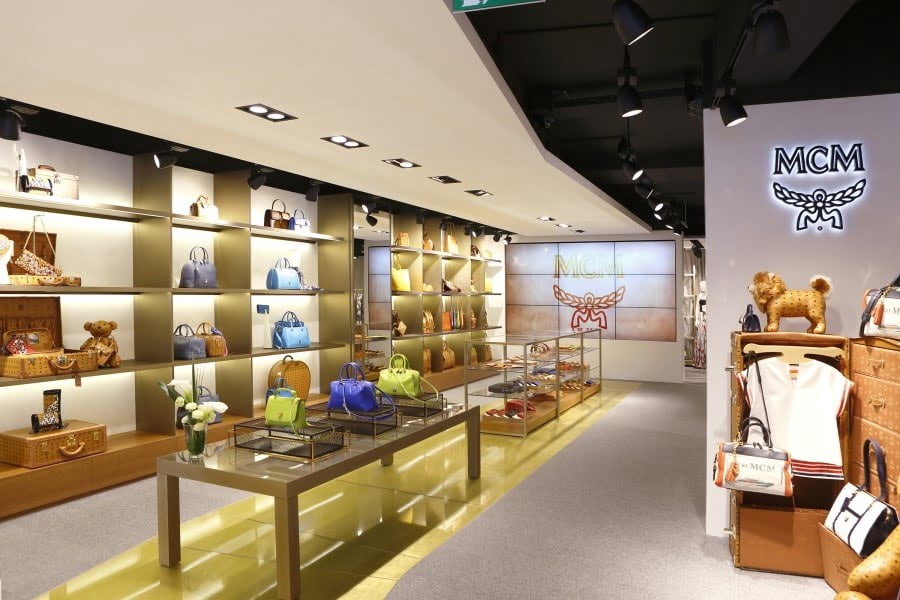
German-founded luxury brand MCM will open its first Canadian store on Toronto’s Mink Mile this fall, and it likely won’t be the country’s last. MCM is said to be doing robust wholesale business in Canada at retailers such as Holt Renfrew, Saks Fifth Avenue and Nordstrom, helping prompt a Canadian store expansion.

Founded in Munich in 1976, MCM is known for accessories and other products in its signature logo-printed material (called Cognac Visetos), similar to Louis Vuitton‘s monogram canvas. MCM (which originally stood for Michael Cromer München) was especially popular in the 1980’s for its flashy, logo-printed accessories. South Korean fashion conglomerate Sungjoo Group acquired the brand in 1995, and the brand is having a major resurgence. 

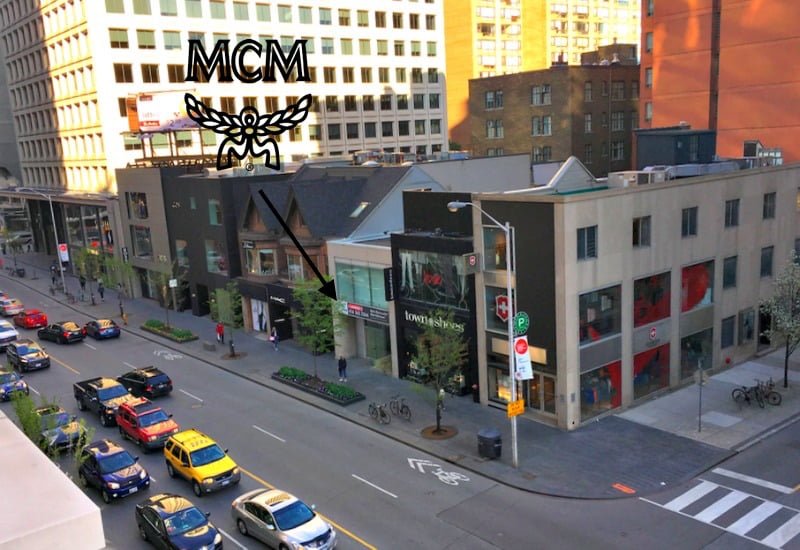
MCM’s first Canadian store will open this fall at 93 Bloor Street West in Toronto, in a retail space formerly occupied by Nine West Shoes. The 2,150 square foot store will be directly across the street from Harry Rosen’s flagship, as well as Holt Renfrew Men and a new Hermes Maison at 100 Bloor Street West. 

The CBRE Toronto Urban Retail Team negotiated on behalf of the landlord in the deal, under the direction of Arlin Markowitz, Alex Edmison and Jackson Turner

MCM’s moving into 93 Bloor Street West could be a signal for more luxury brands to open nearby — on the south side of Bloor, luxury retailers typically locate to the west of St. Thomas Street (except for Hugo Boss, currently at 83 Bloor Street West). 

(PHOTO: MCM)

Approximately 60% of MCM’s sales come from Asia, with the remaining 40% coming from Europe, the Middle East, and the Americas. Given the brand’s penetration in Asia, Vancouver is a likely target city for at least one freestanding MCM store. 

In the United States, MCM has seven stores: in New York City (x2) Garden City NY, Atlanta, Houston, San Jose CA, and Las Vegas. It also has an outlet in Orlando FL.

Last year, the company saw revenue in excess of US $700 million, with a goal of US $2 billion in sales globally by the year 2019. The brand has surpassed Versace in terms of overall sales and in the South Korean duty free market, which is the largest in the world, MCM is second only to Louis Vuitton in terms of sales. 

While the new Toronto store will be the first corporate MCM location in Canada, MCM had two free-standing licensed Canadian boutiques in the early-to-mid 1990’s, both in the resort town of Banff, Alberta. One was located at the Banff Springs Hotel and the other was downtown at Cascade Plaza, alongside Polo Ralph Lauren and Louis Vuitton. All have since shuttered as retail in the Alberta town has become less upscale. At the height of its popularity in 1993, MCM boasted 250 stores worldwide with sales in excess of $250 million. After flooding the market with product while at the same time becoming subject to counterfeiters, the brand folded in 1995, followed by a restructuring in 1997. 

Nordstrom Prepares to Open CF Sherway Gardens Store

Nordstrom is preparing to debut its third Toronto location, spanning 140,000 square feet at CF Sherway Gardens. The store will open to the public on the morning of Friday, September 15, with an opening charity gala to be held two days prior. Jobs will be posted on the company’s careers site next week (there will be about 400 positions available), and the company has also just announced the new store manager, as well as other details relating to the new store. 

Sales and support positions will be posted on Monday, May 15 and interested applicants are invited to apply for jobs online at about.nordstrom.com/careers. Sales positions at the CF Sherway Gardens store will be available in departments including footwear, accessories, beauty and women’s, men’s, and children’s apparel. Nordstrom says that retail experience is not required for sales positions. 

Hiring will also take place for various support positions in alterations, building services, housekeeping, loss prevention as well as at its new restaurant (confirmed to be Bazille) and at coffee bar ‘eBar’. 

Nordstrom offers employees a competitive benefits package including a 20% retail discount (managers receive a 33% discount), dental, medical and vision options, and an RRSP matching program.

Most of the store’s 24 sales and support managers will be promoted from the current pool of Nordstrom Canada employees. For its first two Toronto stores, Nordstrom’s new manager training was provided with experienced managers at stores in Canada and the United States. Nordstrom confirms that a similar training program will take place for management positions filled from outside of the company. As well, salespeople will also participate in a training program based in Toronto, prior to the opening of the Sherway store.

Nordstrom just announced that Jennifer Gross will be the new store manager at the CF Sherway Gardens store. Ms. Gross began her Nordstrom career in 2006 as an intern in the Hurst, Texas Nordstrom store, where she was promoted three times before moving to the Dallas Galleria store as the Personal Stylist Manager. In May of 2012, Ms. Gross took on the Store Manager role for Nordstrom Rack in Austin, Texas. She then relocated to Buford, Georgia as the Store Manager at the Mall of Georgia and most recently held the position of Store Manager at Palm Beach Gardens in Florida, until her recent move to Toronto.

As with all Nordstrom store openings, a charity gala will be held for the CF Sherway store two days prior to the store opening to the public (the evening of Wednesday, September 13). The gala’s charitable recipients have yet to be disclosed. Nordstrom’s galas have raised hundreds of thousands of dollars for various charities since the retailer entered Canada almost three years ago. 

The new CF Sherway Gardens store is Nordstrom’s sixth in Canada, as well as its third in Toronto. Nordstrom opened its first Canadian store in September of 2014, with a 140,000 square foot unit at Calgary’s CF Chinook Centre. In March of 2015, Nordstrom opened a 157,000 square foot store at Ottawa’s CF Rideau Centre. In September of 2015, a 230,000 square foot Nordstrom flagship opened at Vancouver’s CF Pacific Centre, followed by the fall 2016 opening of two Toronto stores — a CF Toronto Eaton Centre flagship in September, as well as a 200,000 square foot Yorkdale store about a month later. 

The CF Sherway Gardens store is also the company’s last confirmed location for its full-line Canadian store expansion.  

Nordstrom also plans on opening between 15 and 20 off-price Nordstrom Rack stores over the next several years, and it has already disclosed six of those locations. The first will be a 40,000 square foot downtown Toronto flagship at 1 Bloor Street East, followed by units at Vaughan Mills near Toronto, Deerfoot Meadows in Calgary, South Edmonton Common in Edmonton, Ottawa Train Yards in Ottawa, and at Heartland Town Centre in Mississauga.

Tiffany & Co. Unveils Expanded Vancouver Flagship

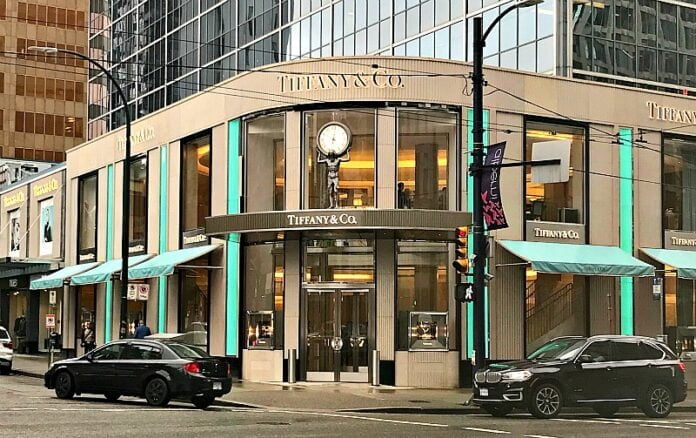
Tiffany & Co Storefront

Iconic New York City-based jewellery and accessory brand Tiffany & Co. has unveiled a second-level expansion of its freestanding downtown Vancouver location, tripling its retail space. The store is now about the same size of Tiffany’s Toronto Bloor street flagship. 

Tiffany & Co. opened at 723 Burrard Street (corner Alberni Street) in the fall of 2006. The one-level 4,700 square foot store included 3,322 square feet of retail space. Last year, Tiffany leased a second-level space formerly occupied by Japanese restaurant Kamei Royale, allowing for a significant expansion. Tiffany & Co.’s Vancouver flagship now spans an impressive 9,762 square feet of selling space, which is about the same as the 9,800 square feet of selling space at Toronto’s Tiffany flagship at 150 Bloor Street West. 

The Vancouver store’s granite facade is inspired by Tiffany’s iconic Fifth Avenue flagship in New York City (including an Atlas figure holding a clock), with a nod to American Deco skyscrapers and luxury high-rises of the 1930s and 1940s. Tiffany Blue features prominently on the store’s new branded awnings, as well as its halo-lit signage. The store’s new curved exterior is an “architectural feat” according to the company — the previous facade can be seen in the photo below. 

(CLICK FOR INTERACTIVE GOOGLE MAP) 
(FACADE PRIOR TO THE EXPANSION/RENOVATION. PHOTO: PCI-GROUP.COM)
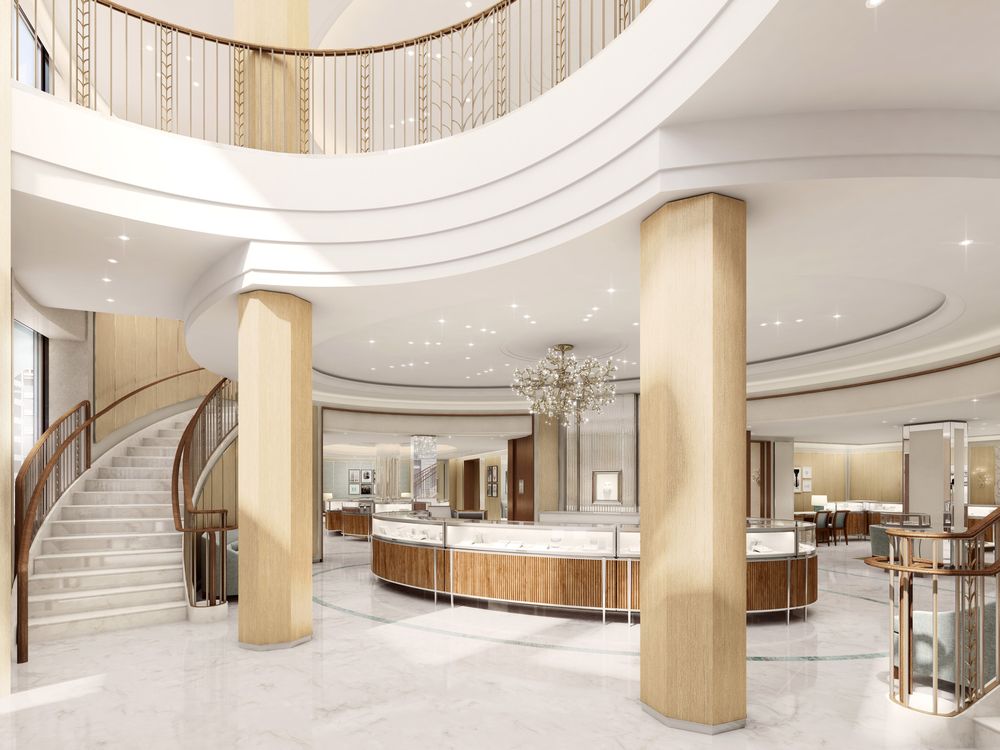
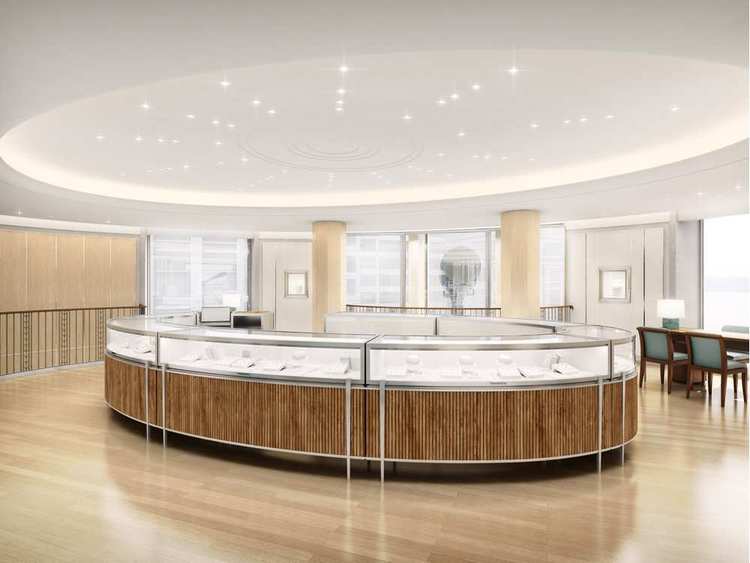
A rendering of the renovated and expanded Tiffany & Co. location in Vancouver at 723 Burrard Street. Handout: Tiffany & Co. [PNG Merlin Archive]

New soaring double-height ceilings off the store’s front entrance were created by blasting through the concrete floor above — not a simple task, and no doubt costly. A metal balustrade punctuates the new second floor mezzanine above, with hand-leafed and hand-forged Tiffany Magnolia chandeliers (by New York-based artist Michele Oka Doner) hanging overhead. Interior accents in the store also include marble, cerused walnut paneling, velvet drapery and upholstered walls. 

The expanded Vancouver store allows Tiffany & Co. to showcase a broader range of product. The store features a Fine Jewellery Salon, as well as Fashion, Bridal, Gift and Private Sales Salons. Private shopping areas were expanded in the new space, and the Burrard Street store also features the new Tiffany HardWear collection which officially launched this month. 

CBRE’s Vancouver office facilitated negotiations for the store’s second-level space acquisition, under the direction of Mario Negris and Martin Moriarty

Tiffany & Co. entered the Vancouver market as a licensed shop-in-store within Holt Renfrew in 1994. Tiffany continues to operate a shop at Vancouver’s Holt’s as a concession. Tiffany has three free-standing stores in Toronto, two in Vancouver, and one each in Edmonton, Calgary and Montreal. Three smaller Tiffany & Co. concessions also operate within Holt Renfrew locations in Calgary, Montreal (at Ogilvy) and as mentioned, in Vancouver. Tiffany’s first Canadian store opened at 85 Bloor Street West in 1991, in a building spanning 13,450 square feet over four floors. 

Inside Filson’s 1st Canadian Store [Photos]

Seattle-based heritage fashion brand Filson has opened its first Canadian store in Vancouver, and a second location will follow later this spring, in Toronto. 

The 2,800 square foot Vancouver store, located at 47 Water Street in the city’s hip and historical Gastown area, features custom furniture built from local salvaged wood, iron beams, wooden floors and imagery of Filson dating back to the late 1800’s. Street level windows will showcase apparel, bags, and accessories for both men and women.

“Finally, after 120 years, we’re opening retail stores in Canada. We’re excited to share our love for the outdoors and Pacific Northwest roots with all Canadians who share the same values,” said Steve Bock, CEO of Filson. “The tactile experience is the best way for us to show the quality, craftsmanship and durability that’s sewn into every Filson item.”

Filson’s second Canadian store will open in June of this year in Toronto, at 694 Queen Street West.

Filson partnered with broker Tony Flanz of Think Retail for its initial Canadian expansion. 

Filson operates street-front stores in American cities that include Seattle, New York City, Minneapolis, Portland OR, Dallas, San Francisco, Plano TX, Detroit, Austin and Washington DC, as well as two factory outlets. Canada is the second international market for Filson, which also operates a store in London, UK. 

Filson (originally named ‘C.C. Filson’s Pioneer Alaska Clothing and Blanket Manufacturers’) was founded in Seattle in 1897, and is known particularly for its clothing and luggage, as well as its guarantee. The company designs, manufactures and distributes its products, which feature rugged designs with prices in the mid to upper-end range. Quality is paramount to the brand, and it guarantees the lifetime of each item against failure or damage from its intended usage, according to Filson’s website. The company is owned by Bedrock Manufacturing which is led by Tom Kartsotis, who also owns Detroit-based fashion brand Shinola.

Change of Scandinavia Confirms 3 More Canadian Locations to Open this Year

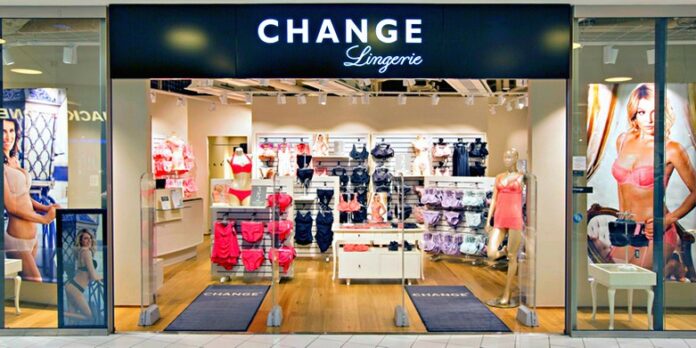
Change Lingerie (PHOTO: CLUB ONLYOU)

Danish lingerie and fashion brand Change of Scandinavia is confirmed to be opening at least three more stores in Canada in 2017, with plans for significantly more over the next several years. 

On July 1 of this year, Change will open a 570 square foot boutique at CF Carrefour Laval, north of Montreal. Two more locations will open in the fourth quarter of 2017, including a 600 square foot boutique at CF Richmond Centre near Vancouver, as well as a 680 square foot store at the recently renovated and expanded Oshawa Centre, east of Toronto. 

The company continues to seek opportunities, anticipating to open between 8 and 10 Canadian locations in 2018. By the year 2020, Change is looking to operate between 25 and 30 Canadian stores, ideally in the 600 square foot to 1,000 square foot range in busy shopping centres. Targeted regions include British Columbia (Lower Mainland), Ontario (Greater Toronto Area) and Quebec (Montreal and Quebec City CMA’s). 

Change of Scandinavia is represented by Tony Flanz of Think Retail for its Canadian real estate negotiations.

Founded in Denmark in 1995, Change of Scandinavia now operates more that 240 corporate and franchised stores globally. Stores are modern and simple, featuring a black and white palette to showcase product. Most of Change’s stores are in Europe and Scandinavia, with the exception of Canada and Singapore. The company still hasn’t entered the potentially lucrative US market. 

Change of Scandinavia is particularly unique because of its large bra sizes, which cater to a different niche than other lingerie retailers such as Victoria’s Secret and La Vie En Rose. About 75% of Change’s bras are in the DD to M cup size range, with a wide range of fits and styles. Most other lingerie retailers in Canada sell bras in the B-D range. Change stores offers free bra fitting to ensure that its products meet the needs of its diverse customers — and prices are kept reasonable to attract a broad clientele. As well, approximately 75% of Change’s revenue comes from underwear and bras, with the remainder from loungewear, swimmer, nightwear and stockings. 

Change entered the Canadian market with its first store in 2006, and it now operates 15 stores nationally, with five in British Columbia (Vancouver x 2, Burnaby, Coquitlam and West Vancouver), one in Saskatchewan (Saskatoon), five in Ontario (Toronto x 2, Thornhill, Oakville, Burlington), and four in Quebec (Montreal x 3 and in Saint-Jean-sur-Richelieu). 

Recently-opened stores include the March 2016 opening of a 1,200 square foot flagship at Montreal’s Place Montreal Trust, as well as  the summer 2016 opening of a 600 square foot store at upscale Park Royal shopping centre in West Vancouver.