Advertisement
Advertisement
Home Blog Page 1108

Organic Grocer Launches Ontario Expansion

Nature's Emporium in Burlington (Image: Nature's Emporium)

Newmarket, Ontario-based organic grocery concept Nature’s Emporium is expanding its operations throughout the Greater Toronto Area. A Burlington location opened last week, and the retailer is looking to further expand in the region, including stores in Toronto’s rapidly-growing urban core. 

The family-owned retailer now has three stores, with plans for more. Founded in 1976 as a food vendor at an Ajax flea market, the company grew in the 1990’s to open full-sized stores including a 50,000 square foot store in Newmarket, as well as a 20,000 square foot store in Vaughan. Last week, it opened its third store in Burlington, spanning 18,000 square feet in a commercial plaza at 2180 Itabashi Way, featuring organic food, as well as a cafe concept. 

A fourth Nature’s Emporium, currently in the works, will anchor a development in Whitby, Ontario, as part of a new shopping centre development at Taunton Road and Brock Road. More locations will follow, according to the company’s representative broker Don Gregor of Aurora Realty Consultants

New Nature’s Emporium stores will ideally be in the 17,500 square foot to 25,000 square foot range, targeting upscale markets where residents are more likely to purchase organic food. According to Mr. Gregor, target cities for Nature’s Emporium include Mississauga, Kitchener-Waterloo, Guelph and Barrie, as well as locations within the city of Toronto. In Toronto, targeted areas include Etobicoke, The Beach, Bloor West Village, and the King Street West/Liberty Village area, with the Yonge & Eglinton and Yonge and St. Clair areas having also been considered. Nature’s Emporium could also expand into downtown Toronto with a target size of about 15,000 square feet — a smart move, considering that the area is seeing unprecedented growth. 

(PHOTO: NATURE’S EMPORIUM)

Downtown Toronto, as well as the Yonge Street corridor spanning northward, are both growing rapidly. As a result, unique retail opportunities abound as their populations expand. The Yonge & Eglinton area is growing quickly as new condominium towers are being built, with nearly 10,000 residential units in the pipeline. The area around Yonge and St. Clair will also see upscale development, with more announcements to be made shortly. Toronto’s downtown core is by far the biggest growth area of the three, with the city’s core population forecasted to grow at a rate unseen in any Canadian downtown. The current downtown population of approximately 250,000 residents is projected to almost double by the year 2041, creating new retail opportunities in various categories. Many of the new downtown Toronto residents are younger and earn relatively high incomes — a perfect demographic for organic grocers. Retirees with money are also flocking to the downtown core, attracted by convenience, entertainment and culture. 

Nordstrom Launches ‘The Lab’ at 2 Canadian Flagships

Seattle-based Nordstrom has launched ‘The Lab’ at two of its Canadian flagship stores. The new incubator project is being launched in only five Nordstrom stores globally, and one of the designers featured has a Canadian connection. 

Conceived and curated by Nordstrom’s Vice President of Creative Projects, Olivia Kim, ‘The Lab’ showcases and supports five designers selected for the inaugural season: Eckhaus Latta, Vejas, Eric Schlösberg, A.W.A.K.E. and Dilara Findikoglu. Ms. Kim and her buying team selected a handful of looks from the five designers, including exclusive and custom-made items reflective of each designer’s aesthetic.

Self-taught Canadian designer Vejas Kruszewski won the prestigious LVMH Prize for young fashion designers last year, valued at approximately $218,000 Canadian. 

‘The Lab’ is being launched within Nordstrom’s ‘SPACE’ departments, which Ms. Kim launched in the Fall of 2015. Nordstrom’s flagships at CF Pacific Centre in Vancouver, and at CF Toronto Eaton Centre in Toronto, launched ‘The Lab’ collections in stores this week. Other Nordstrom stores to feature ‘The Lab’ include the downtown Seattle flagship, The Grove in Los Angeles, and at the Chicago Michigan Avenue flagship — as well as online at Nordstrom.com/SPACELab

SPACE features a cross-category collection of apparel, accessories, home goods and fragrance from emerging and advanced designers. Ms. Kim wanted to develop a place dedicated to recognizing fledgling talent, saying, “a brand has to be relatively established in order to support a substantial wholesale business. We wanted to find a way to show the truly new brands just starting out, and to recognize the great, raw talent out there, to say we see you, and we want to support you.”

She went on to say, “there are incredible demands on a young designer trying to grow their business, and we wanted to say ‘you may not be able to produce enough of a collection for eight stores right now and that’s okay.’ The Lab is for the designers who have just launched their collections, did their first show, maybe used their friends as models and showed in a basketball court in the Lower East Side. It’s true, authentic and they’re creating beautiful collections that we want to share with our customers.”

The Lab will be an ongoing program in SPACE at Nordstrom, refreshed with new brands each season in order to give each designer a spotlight to help grow their businesses.

Independent Optical Retailer Sees Success Through Personalization And Unique Store Design

Toronto-based optical retailer Glass Monocle, which recently opened near the former Honest Ed’s, is already seeing success through personalized products and services – and a space that helps it standout. Its co-founders are contemplating expanding into multiple locations, after launching a branded store developed by BUILD IT.

Founded by opticians Kinnard Chan and Jacky Wong late last year, Glass Monocle features a modern 1,700 square foot retail space that is equally focused on offering trendy optical frames, as well as exceptional medical services. The founders, who are passionate about the optical industry, set out to create a more ‘localized’ experience to differentiate from large chains that dominate the industry. 

The strategy appears to be paying off, with consistent five-star reviews on Google, Yelp and Facebook. Customers describe the store’s “attitude” and “vibe” in a positive way. 

Mr. Chan explained the store’s ‘balance’ is between medical and fashion, which is different than many optical retailers. Traditionally, optometrists have opened retail operations with a selection of frames to choose from, which in some instances has been an afterthought to the clinic itself. On the flip-side, some eye glass retailers have focused primarily on styles, with little or even no focus on optical health. 

Mr. Chan and Mr. Wong set out to create a retail concept that balances the medical side with the optical frame fashion side — a friendly service that also ensures that customers are being screened for optimal optical health, including testing for glaucoma and other eye diseases. On the fashion-side of the business, Glass Monocle stocks designer optical frames that are ‘on-trend’ with the demographics of the Annex community — an area with a mix of students, professionals and an increasingly affluent, urban demographic that characterizes much of downtown Toronto. 

Glass Monocle’s co-founders worked with Alburt Lefebvre and Simon Shahin of BUILD IT to build out the designer 590 Bloor Street West store. Mr. Lefebvre explained that he assisted not only with the construction and design of the space, but even with securing the initial location in Toronto’s hot Annex neighbourhood. Once designs were ready, Mr. Chan explained that it took the BUILD IT team only six weeks to build-out the store — a remarkable feat considering the complexities involved in building such a retail space. 

The store’s interiors are simple and functional, featuring a long cash desk (resembling a bar), bright lighting, and simple millwork against a white backdrop. The elegant, simple design sets off the fashion frames contained within. The front of the store is devoted to retail, with the middle area acting as a waiting area for patients to access medical services at the back of the retail space. Mr. Lefebvre brought in Toronto-based Aboveground to help coordinate the space, which his team at BUILD IT then executed for the client. 

Mr. Chan and Mr. Wong are enthusiastic about the future, having been warmly received by customers and the local community. After creating a successfully branded retail environment, they’re looking into eventually expanding their concept into multiple locations. Bigger isn’t always better, explained Mr. Chan, and Glass Monocle will be mindful to keep its sights on what makes it unique while considering its options for growth. 

Saks OFF 5TH Announces 5 Store Opening Dates for this Spring

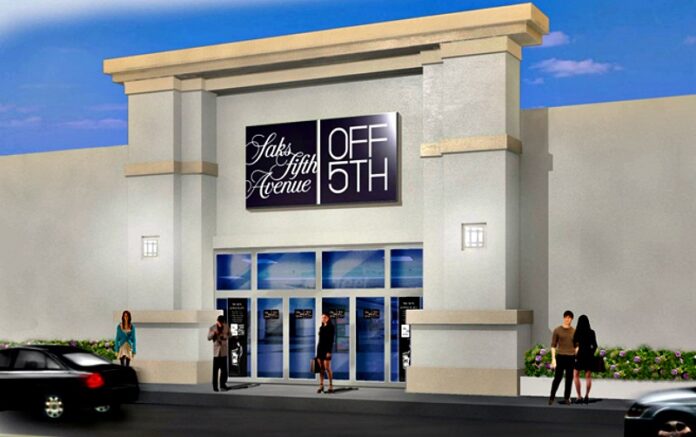
The Hudson Bay Company’s off-price division Saks OFF 5TH has announced the opening dates of its next five Canadian stores, all opening between March and May of this year. When all five are open, the company will have opened 14 Saks OFF 5TH’s in Canada — a remarkable feat, considering that its first stores opened less than a year ago. 

As discussed in an article last week, Saks OFF 5TH entered Canada in March of 2016 with four locations. The first four OFF 5TH’s opened at Vaugan Mills and Toronto Premium Outlets in the Greater Toronto Area (GTA), as well as at Outlet Collection at Niagara and at Tanger Outlets Ottawa. Locations that have since opened include an Ottawa store on the lower level of Hudson’s Bay Rideau Street, at CrossIron Mills in Calgary, at South Edmonton Common in Edmonton, at Tsawwassen Mills near Vancouver, and a freestanding Toronto location across from CF Sherway Gardens

Saks has just announced that it will open five Canadian stores this spring. Two will be in the GTA, one in Quebec City, one in Winnipeg, as well as a second Edmonton store. 

On March 9, Saks OFF 5TH will open two suburban Toronto stores — one at Pickering Town Centre in Pickering, measuring 30,000 square feet, as well as another at Bramalea City Centre in Brampton, with about 28,000 square feet of retail space. Both stores will be the first Saks OFF 5TH locations in Canada to open in traditional shopping malls, as opposed to outlet/hybrid outlet centres. 

On April 6 of this year, Saks OFF 5TH will open two more Canadian stores — a 33,000 square foot store at Place Ste-Foy in Quebec City, as well as a second Edmonton location, spanning about 30,000 square feet at the Skyview Power Centre in the city’s northwest side. The Place Ste-Foy store is located in retail space once occupied by Holt Renfrew, in the upscale Quebec City shopping mall that is anchored by the flagship location for La Maison Simons

On May 3 of this year, Saks OFF 5TH will open its first Winnipeg location at the highly anticipated Outlet Collection Winnipeg. The 32,200 square foot OFF 5TH store will join a number of popular retailers in the new centre, which will be the first pure designer outlet mall in Manitoba, and the second in Western Canada (we’re excluding CrossIron Mills and Tsawwassen Mills, both classified as ‘hybrid’ outlet centres). We’ll follow up with details on Outlet Collection Winnipeg in an article, closer to its opening date. 

Parent company Hudson’s Bay Company has said that it will open approximately 25 Saks OFF 5TH locations in Canada before the end of 2018. Other locations confirmed to be opening include one at West Vancouver’s Park Royal in the summer of 2017, as well as three in Montreal. A CF Galeries d’Anjou store is scheduled to open in the summer of 2017, and a downtown Montreal store (the largest in Canada at 44,840 square feet) will open in the fall of 2018. The company has also said that it will open a Saks OFF 5TH at Premium Outlets Montreal, though no definitive date has been provided. 

Competitor Nordstrom Rack, operating under the Seattle-based Nordstrom umbrella, will compete fiercely with OFF 5TH when the former opens its first Canadian locations in early 2018. So far, Nordstrom Rack has confirmed five Canadian stores, including locations in Toronto at 1 Bloor Street East, Vaughan Mills, at Calgary’s Deerfoot Meadows, at Edmonton’s South Edmonton Common, and at Ottawa Train Yards in Ottawa. Nordstrom has said that it plans to open at least 15 Nordstrom Rack locations in Canada, and potentially more if opportunities become available. 

Competitor TJX, operating Winners and Marshalls in Canada, also continues to rapidly open stores nationwide. 

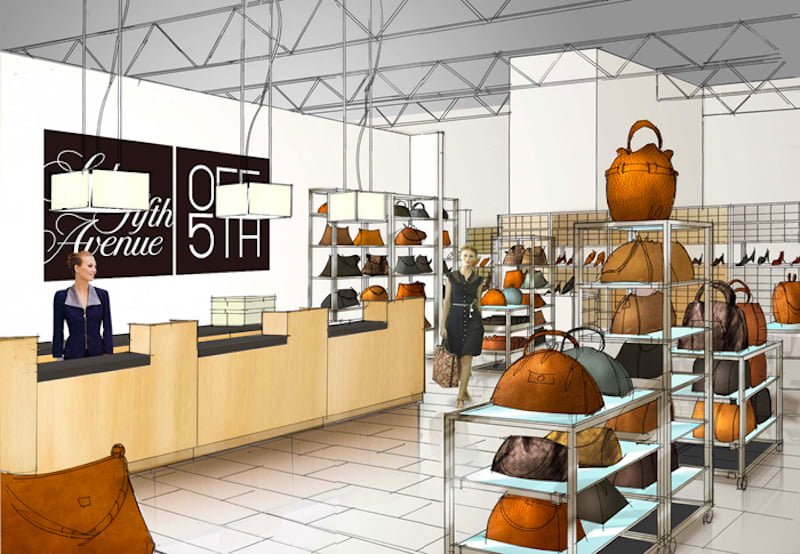
*Renderings are via Martin Roberts Design.

Upper Canada Mall to See Significant Investment

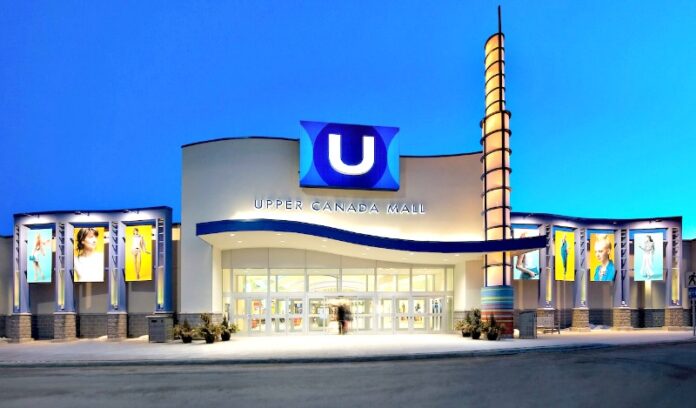
Oxford Properties has announced that Upper Canada Mall in Newmarket, Ontario, will see a $60 million investment in its former Target space. Construction has already commenced, and the redevelopment will open in phases throughout 2018. 

The enclosed 998,000+ square foot mall features over 200 stores with two major anchors: Sears and Hudson’s Bay. Co-owned by Oxford Properties Group and CPP Investment Board (CPPIB) and managed by Oxford, Upper Canada Mall is one of the region’s most productive shopping centres, with an annual productivity per square foot in excess of $750, according to a recent Retail Council of Canada shopping centre study

The announced redevelopment will include a Sport Chek replacement store, a new two-level feature court space, a 35,000 sq. ft. vertical expansion, and a unique 40,000 square foot first-to-market food market concept.

The mall’s current 26,400 square foot Sport Chek will be replaced with a one-level, 64,000 square foot location that “will focus on an enhanced overall customer experience”. Sport Chek has been opening technology-heavy flagships across the country in recent years, winning multiple awards. 

The 40,000 square foot food market concept will be particularly interesting, featuring approximately 25 best-in-class market vendors with an assortment of fresh foods and prepared take-away options, including: produce, a butcher shop, fish monger, cheese shop, bakery, a juice bar, and a gourmet gift shop. Additionally, the food market will be anchored by yet-to-be-announced full-service restaurants, located at a Yonge Street-facing entrance. Oxford Properties describes it as being “a quality driven attraction with a strong focus on the local community and will create a unique food experience. It will be a place of convenience and comfort, and a reflection of simpler times.  It will allow customers a one-stop shop, while complimenting the other amenities the mall continues to offer.”

The market also addresses a trend towards increased food and beverage in shopping centres. Oxford Properties Senior Vice President of Retail, Brad Jones, said, “Oxford is committed to enhancing the food and beverage offering across our national portfolio. The opening of the Food Market at Upper Canada Mall will create a new and elevated shopping experience for our customers, and we know it will be a welcome addition to the mall and the community.”

*top photo: Oxford Properties.

Controlling Costs in a Shifting Retail Landscape

By Antony Karabus, CEO, HRC Retail Advisory

As described in last week’s Q&A Interview in Retail-Insider, shifts in consumer behavior and expectations have permanently changed the Canadian retail landscape and as a result, physical store traffic and store sales are being meaningfully impacted as customers move online.

Retailers’ profits and losses are being pressured, with the bottom line ‘feeling the heat’. This is requiring retailers to rethink prior assumptions about the role of physical stores as well as ongoing investments in e-commerce, store level technology and more specifically omni-channel strategies.

How Did We Get Here?

Over the past five years, these changes in shopping behavior have forced retailers to establish duplicate infrastructures to enable consumers to interact with the retailers when, where, how and in whatever channel they desire.

In addition, numerous brick-and-mortar retailers are experiencing a loss of market share to Amazon.com, which is growing North American merchandise sales at almost 30% annually, versus a low- to mid single-digit increases in top-line sales for most traditional brick-and-mortar retailers with online operations.

Moreover, Amazon continues to add distribution centers and categories (while going deeper into its existing ones), while promising shorter shipping lead times, coupled with additional benefits for Amazon Prime members.

Added Infrastructure Costs

In response, retailers have tried to battle against the ‘Amazon effect’ while also meeting the needs of a consumer-centric environment. In a number of instances, retailers have made substantial investments in omni-channel while many have neglected their  physical stores — which still provide most of their sales and virtually 100% of their operating profits.

But what has played out on the Profit and Loss Statement is what’s troubling. The historic, largely fixed-cost infrastructure of retailers’ physical store channel has now been joined by a variable-cost-driven infrastructure to enable online sales.

The combination of the historic fixed-cost store-cost structure and the variable-cost e-commerce-cost structure has added significant operating and capital expenditures without, in most instances, adding aggregate top-line sales for the total retail company. This is coming about a result of a shift in sales from the physical store channel to the e-commerce channel. 

HRC Advisory Starts this Process by Asking Some Key Questions

So, the need to meet consumer demands for online shopping while protecting profits has created a conundrum for retailers. HRC recommends five key tactics to address these issues:

First, retailers should assess their business operations, organization structure, capabilities, policies and processes in an effort to create a sustainable and profitable model in this complex retail environment. 

The Key Tactics HRC Retail Advisory recommends are:

1. Decide which omni-channel capabilities will be most valued by each retailer’s particular customer, rather than investing in all capabilities. When the retailer has decided which is the most relevant capability for their business, ensure all the upstream and downstream processes and tools are equipped to deliver on the promise

2. Prioritize and decide on important decisions such as price-matching, free shipping, free returns, direct-to-customer dedicated fulfillment centers and full inventory visibility.

3. Establish the right methodology to better exploit data and related insights to drive customer-focused decisions.

4. Determine how to rethink and enhance real estate decisions in the light of the channel sales productivity issues.

5. Ensure store, supply-chain and home-office infrastructure cost is properly sized and structured to profitably serve store and omni-channel customers to enhance shareholder returns. This needs to be a bottom-up assessment, not just an attack on head-count and the “ easy targets “ of store labor and marketing costs.

Comprehensively and objectively addressing and considering these issues on a bottom-up  basis should  assist retailers to address their competitive position relative to competitors and pure-play e-retailers, and to making the right capital and operating investments to protect and even enhance earnings in the face of this new retail environment.

Understanding This New Retail Operating Economic Model

Based on HRC’s proprietary research, retailers are incurring a significant increase in the cost of enabling and fulfilling online orders and related returns, relative to the cost of physical store orders. These numbers are without allocating the cost of shared services infrastructure (such as IT, finance, human resources, payroll, executive management and other areas) to the online channel’s P&L. This additional cost burden is not sustainable in the long term if one considers the historically low earnings margin experienced by retailers.

Meanwhile, for public companies, there’s been a bit of bias on Wall Street/TSX. Shareholders and analysts have not been patient in expecting earnings from traditional retailers who are hard at work transforming their businesses to better compete and remain relevant, while they’ve been extremely patient in waiting for acceptable profits from Amazon and other pure-play retailers. And in the current climate, traditional brick-and-mortar retailers face extreme pressure from financial analysts, shareholders and activists not only to maintain, but deliver higher earnings.

The result is an increasing de-leveraging of physical store cost infrastructure as sales per square foot decline with the shift to the online channel. The exception to this de-leveraging reality is when major competitors exit the market or experience restructuring and significant store closures, allowing the remaining retailers to increase their market share in the sector, albeit in the short term. And the de-leveraging of store-cost infrastructure increases as the e-commerce penetration rate of total sales in the market increases.

Going on the Offensive

The best response to this new cost of doing business is for retailers to “take command of the game” and really go deep into leveraging their strengths and inherent advantages relative to Amazon and other pure-play e-tailers rather than trying to compete directly with these emerging competitors.

This is the Walmart effect of the 1980’s and 1990’s, but is being repeated at a much more rapid and complex pace. So while it would be a mistake to take on Amazon head-to-head at which it does best, retailers can deploy some offensive strategies. And the absolute best offensive tool that a traditional brick-and-mortar retailer has is its ability to introduce an online customer to a tactile experience in its stores, which means rethinking the role of the physical store so that it becomes an omni-channel service center and a holistic introduction to the brand, rather than just being a place to transact. 

Some of the advantages of this approach include:

• Introducing customers to physically experience the brand and the product in a store.

• Reducing the rate of return of online orders as customers can ensure the product fits, and is suitable for their needs.

• Increasing the total value of the online order by purchasing complementary items when they are in the store to pick up their online order.

• Reducing the shipping cost of the sale and potential return and provide numerous convenient locations for customers to pick up or return online orders.

With the above significant advantages, retailers should encourage online customers to visit the store in nontraditional ways such as:

• Same-day pick-up, utilizing inventory already in the store.

• Free shipping to stores for online orders.

• Samples, free gifts or discounts on additional items when customers pick up online orders in stores, to encourage additional browsing.

• Being invited to attend special invite-only events in stores, including book signings, product tastings, fashion trunk shows and so on.

And in order to effectively enable these “BOPUS” (buy online, pick up in store) and “BORIS” (buy online, return in store) omni-channel capabilities, retailers need to strengthen their inventory management practices to minimize the likelihood of disappointing online customers.

Antony Karabus is chief executive officer of HRC Retail Advisory, a leading retail consulting firm based in Toronto and Northbrook, IL. A version of this article recently appeared in WWD.com.

*Top photo: www.shopparkroyal.com.

Lightspeed Reaches eCommerce Customer Milestone

Montreal-based POS software provider Lightspeed reached a milestone this month, when it signed its 10,000th eCommerce customer. It’s a remarkable accomplishment, considering that Lightspeed only launched its eCommerce platform in North America in March of 2016. 

The 10,000th customer happens to be iconic Quebec media personality Isabelle Racicot, and her lifestyle eCommerce startup Picoum. Ms. Racicot has been a fixture in Canadian entertainment and lifestyle media for over 20 years, travelling the globe for Canada’s daily entertainment program Flash, covering the Academy Awards, the Cannes Film Festival, the Sundance Film Festival, the Grammys and the People’s Choice Awards. She has been at the helm for programs on the CBC, TVA and Virgin Radio and reports in both official languages. 

Her lifestyle eCommerce site Picoum, which includes an online magazine, was inspired by the desire to curate Canadian–made products for the modern woman.  

Ms. Racicot says that she chose Lightspeed when realizing how essential it was for her to evolve her website, which she originally launched in 2015. She transitioned to Lightspeed this month, noting that the company serves global customers while infusing its business practice with culture — the perfect fit for Ms. Racicot.

Lightspeed offers users a powerful cloud-based point of sale system. It’s designed for retailers to sell anywhere – in-store, online or both, with the help of Lightspeed’s omnichannel platform. Lightspeed powers more than 40,000 retailers and manages $15 billion in transactions across 100 countries, said founder and CEO, Dax Dasilva. 

The omnichannel platform is truly beneficial for small businesses, explained Mr. Dasilva, as they can use one system, rather than many separate systems, to manage their online and in store operations. The system allows retailers to know exactly where their inventory is and how it’s performing, while improving efficiency throughout their business. Retailers often see a 20% increase in revenue in the first year after implementing Lightspeed, he pointed out, which can be attributed to better inventory management and financial analysis.

The company’s product doesn’t require users to have any technical skills, according to Mr. Dasilva. It offers advanced security, traffic-driving marketing tools, customizable templates and is also multilingual, which was a must for Ms. Racicot’s Canada-wide fan base.   

Lightspeed continues to expand its operations into Canada, as well as internationally. The company says that it believes that “small and medium-sized businesses revive our streets by offering something unique that you can’t find in your average chain store.” Mr. Dasilva noted that the majority of Lightspeed’s clients are independent businesses, underlining that he believes that independent retailers are the future of retail in Canada.  

The company was founded in 2005 by Mr. Dasilva, beginning with four employees working out of a Montreal apartment. It now boasts over 500 staff in eight offices around the world. Lightspeed has quickly expanded its offering with a POS for restaurants, an eCommerce platform and an omnichannel selling solution, helping businesses streamline their operations and improve customer service by bringing together inventory, customer management, sales and analytics into a single platform. 

Partner content. To work with Retail Insider, contact Craig Patterson at craig@retail-insider.com

Le Labo to Open 1st Canadian Store

(LONDON STORE. PHOTO: GOOGLE STREET VIEW SCREEN CAPTURE)

Estée Lauder-owned fragrance brand Le Labo will open its first freestanding Canadian store in Toronto this spring. It is expected to be the first of multiple locations for the brand, as it expands beyond wholesale into its own retail stores. 

The pricey Le Labo brand was founded in 2006 as a collection of 10 fragrances by Fabrice Penot and Edouard Roschi. The number in the fragrance name indicates the number of notes in its composition and the name of material (Vetiver, Jasmin, Labdanum) refers to the most prominent note within. The brand now features 45 perfumes, with its most recent having been created in 2015. Prices generally range between $100 and over $500 for fragrances and related products. Le Labo was acquired by New York City-based beauty conglomerate Estée Lauder in 2014.

Le Labo currently operates 32 stores internationally, as well as shop-in-stores in leading retailers. Of the 32 boutiques, 15 are in the United States, 12 are in Europe, and five are in Asia. American stores are in cities including New York City (four stores), Los Angeles area (four stores), San Francisco, Portland, Boston, Washington DC, Chicago and Dallas. There are also five stores in London UK, four in Paris, two in Berlin, one in Antwerp, two in Hong Kong, two in Seoul and one in Tokyo. Stores are often located in ‘trendy’ shopping areas.

(JOB POSTING IN THE WINDOW OF TORONTO’S NEW LE LABO STORE)
(CLICK ABOVE FOR INTERACTIVE GOOGLE MAP)
(A BUILDING PERMIT WAS GRANTED FOR THE NEW TORONTO STORE, LATE LAST YEAR)
(EXTERIOR OF THE NEW TORONTO STORE, REVEALING THE TENANT TO BE LE LABO)

Le Labo’s first Canadian store will open at 876 Queen Street West, in the heart of the city’s hip ‘West Queen West’ area. The store joins a number of trendy brands that have recently opened nearby, including Aesop, Warby Parker and Shinola

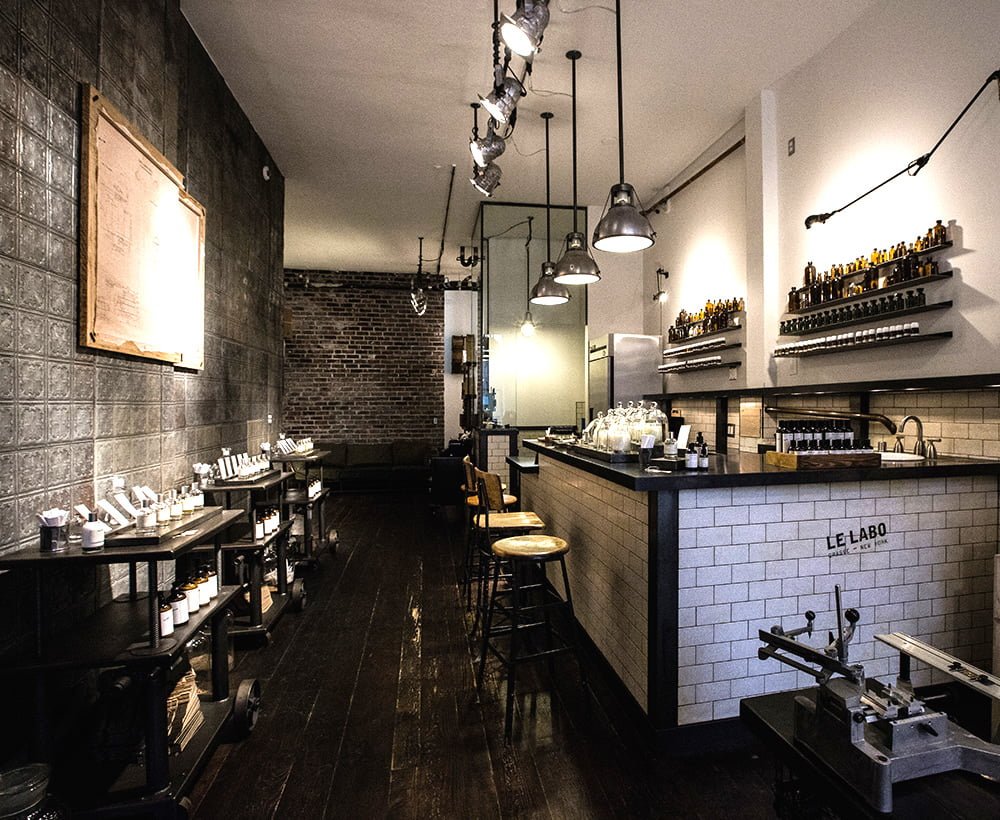
Le Labo Interior

CBRE is representing Le Labo’s Canadian real estate expansion, with Martin Moriarty and Mario Negris from the Vancouver office helping coordinate deals nationally. The Toronto Queen Street West lease was negotiated by CBRE Downtown Toronto’s Jackson TurnerArlin Markowitz, and Alex Edmison

Le Labo became available in Canada in 2010, when Toronto-based 6 by Gee Beauty (at 6 Roxborough St. W. in affluent Rosedale) began carrying the line exclusively in Canada. That exclusivity was lifted in September of 2015 when Nordstrom opened its CF Pacific Centre flagship in Vancouver, also carrying the brand. In February of 2016, Saks Fifth Avenue’s new Toronto flagship opened with a Le Labo counter contained within, and in October of 2016 a Le Labo shop opened within the new Nordstrom at Toronto’s Yorkdale Shopping Centre

Simons Reveals Calgary Opening Date, Details and Store Renderings

Quebec City-based large-format fashion retailer La Maison Simons has announced the opening date of its first Calgary location, as well as details and renderings of the new space. The unique store will span five floors in a heritage building, as well as in the adjacent downtown Calgary ‘The CORE’ retail complex. 

The store will be the second for the province — Simons’ first Alberta store opened in October of 2012 at West Edmonton Mall, and a second Edmonton store will open on August 24 of this year at Londonderry Shopping Centre. The Calgary store will be Simons’ 14th store in Canada, with plans for up to 25 locations in the country. 

Opening on Thursday, March 16, the 96,000 square foot downtown Calgary Simons store will occupy five floors of the nine-level circa 1919 Lancaster Building, as well as three levels of the adjacent The CORE shopping complex. The main floor of Simons will run an entire city block on 2 Street SW between Stephen Avenue and 7 Avenue SW, as per floor plans below. Local design firm McKinley Burkart led Simons’ architectural and design plans, with a vision to integrate the two buildings. 

The floor plans below show how the store is configured: 

“The key for Calgary was to bring Simons to the heart of the city in a way that pairs our contemporary style with the heritage of a historic building,” said Peter Simons, CEO of Simons. “The result is a five-storey, multi-building layout that creates an exciting shopping experience where customers can explore our branded environments; each with its own space and personality.” 

Art plays an important role in the design of all Simons stores, including the new Calgary location. Simons commissioned local Calgary artist Maya Gohill to install a three-storey painted mural which runs along the escalators in the Lancaster Building. Several other Calgary artists are also represented in the store, including a large graphic mural by Megan Jentsc, and a portrait (called ‘Poet #2) by internationally recognized artist Chris Cran

When entering the store from street-level, “a ribbon-like curved floor-to-ceiling windowscape,” will create “visual continuity around both buildings”, according to Simons. The store will feature Simons’ branded environments, including the following (with photos)…

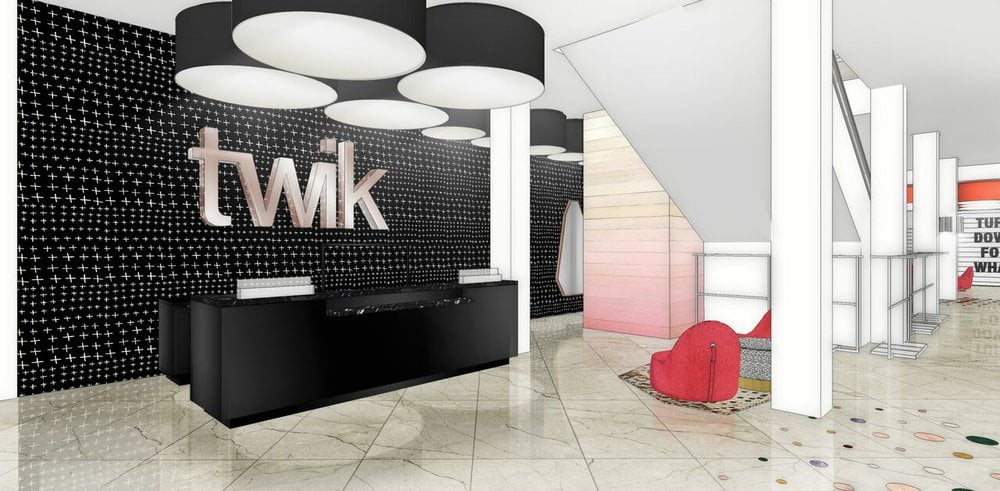
Twik for young female shoppers, decorated in pinks and peaches with decorative panels of weaving and a large vintage inspired billboard sign,

Icône for the modern woman, featuring a design of edgy black and white graphics are reflected in fitting room wallpaper and as metal screens on wall fixtures,

Contemporaine, housing classic, elegant fashions for women, featuring warm woods with an art deco feel in its curved corners and eclectic furnishings,

Miiyu, Simons’ lingerie department, designed with soft, warm woods, blush pinks and organic patterns.

Djab, featuring young men’s collections in a department featuring a “raw feel with concrete walls, industrial lighting and cityscape graphics”,

Le 31, carrying sophisticated men’s designs in an environment of cerused wood and walnut, paired with ink blue ombre patterns — also featuring a small room called ‘The Brief’, carrying men’s underwear, 

iFive, with men’s and women’s fashions in a gymnasium-inspired space with natural plywood and black exposed ceilings, 

Edito, featuring both men’s and women’s international designer collections, defined with feature entrances and using elegant darker tones for a more luxurious feel. This department features some designer fashion pieces priced into the thousands, by designers such as Balmain, Martin Margiela, Moschino and DSquared2, and 

Maison — Simons’ home collection, housed in a warm grey environment with pops of bright green tiles, featuring kitchen, bath and bedroom vignettes. 
 
The new Calgary store will also feature Ève café, with a menu of hot and cold, sweet and savoury treats. The café will act as a transition area between women’s on levels one and two; and men’s on levels three and four. Simons described the café space as having “warm light wood paneling covering every surface – floors, walls and the ceiling, enveloping the café and creating a unique nook in the store,” with “dark green banquettes with bistro tables combined with high counters and bar stools providing seating for 40.”

The upper level windows of the Lancaster Building will be lined with softly lit drapery, to create a glowing exterior façade and a dramatic skylight illuminates the asymmetrical multi-floor opening visible from all levels. Tying the Lancaster Building together will be a set of walnut stairs that connect all five floors from Customer Service on the lower level up to men’s departments on the fourth floor. The staircase will feature a frame of blackened steel chevron rails that creates a dramatic focal point in the store, according to Simons. 

Simons is a unique retail concept, housing an extensive fashion-forward collection of its own moderately-priced, exclusive private label brands for men and women, as well as a variety of national and international designers. Simons also features home fashions for the bedroom, bathroom and kitchen. It was founded in 1840 by John Simons as a dry goods store in Quebec City, and is now led by brothers Peter and Richard Simons. Other locations include: Quebec City (three stores), Montreal (three stores), Sherbrooke, Ottawa (two locations), West Vancouver, Edmonton, and Mississauga, Ontario. 

Saks Fifth Avenue Marks 1st Year in Canada with Remarkable Growth

Saks Fifth Avenue Toronto

Hudson’s Bay Company-owned Saks Fifth Avenue is marking its first year of operations in Canada. So far, the luxury retailer has opened two full-priced stores, as well as nine off-price Saks OFF 5TH locations under the separately-run HBC division. There are plans for more locations under both banners in Canada over the next several years. Sources say that some of Saks’ market share is at the expense of homegrown luxury retailer Holt Renfrew, while Seattle-based Nordstrom competes with both with an unusually high amount of luxury offerings in its larger Canadian locations.  

Saks Fifth Avenue’s Canadian flagship was originally supposed to have opened on the site of the Hudson’s Bay store at the northeast corner of Yonge Street and Bloor Street, at Brookfield’s Hudson’s Bay Centre. The massive Saks would have surpassed 300,000 square feet, making it second in size to the retailer’s Manhattan flagship. Plans were scrapped after Cadillac Fairview offered to buy the flagship Hudson’s Bay building (at Yonge Street and Queen Street) and adjacent office tower for $650 million, with part of the deal involving Saks Fifth Avenue taking four levels of the Hudson’s Bay retail building’s east side. The Hudson’s Bay buildings became part of the massive CF Toronto Eaton Centre complex as a result. 

Saks Fifth Avenue opened its new Queen and Yonge flagship on February 18 of 2016, with a sizeable gala held in the store two days prior. The roughly 170,000 square foot Saks Fifth Avenue store boasted luxury offerings comparable to that of Holt Renfrew, located two kilometres north on fashionable Bloor Street West. Saks brought a number of ‘firsts’ to its new Toronto store, including boutiques for luxury brands such as Piaget, De Grisogono, Boucheron, and others — with prices often into the thousands. 

(MEDIA TOUR ON FEB. 16, 2016, OF THE NEW SAKS CF TORONTO EATON CENTRE. PHOTO BY CRAIG PATTERSON)
(WOMEN’S DESIGNER FLOOR AT SAKS CF TORONTO EATON CENTRE. PHOTO SUPPLIED)
(‘FIFTH AVENUE CLUB’ AT SAKS CF TORONTO EATON CENTRE. PHOTO SUPPLIED)

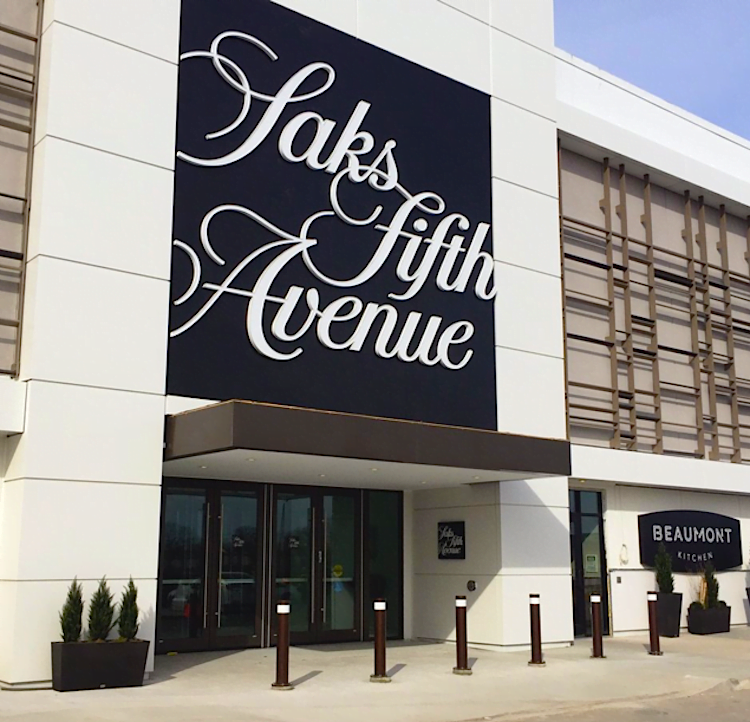
A 143,200 square foot Saks opened a week later (February 25, 2016) at Toronto’s CF Sherway Gardens. The store featured some of the most luxurious offerings in a suburban Canadian department store, including shop-in-store boutiques for Nancy Gonzalez, Dolce & Gabbana and Brunello Cucinelli. In-store restaurant Beaumont Kitchen, operated by Oliver & Bonaccini, opened in the store. Foodies were excited when on March 7 of 2016, Pusateri’s Fine Foods opened in the store’s Saks Food Hall, the first of its kind in the world. The beautiful 18,500 square foot space on Saks’ lower level (adjacent to the store’s men’s department) was actually supposed to be the second Saks Food Hall, but construction complications caused delays with the downtown Toronto flagship. 

(CF SHERWAY GARDENS SAKS, ABOVE AND BELOW. PHOTOS SUPPLIED)
SAKS CF SHERWAY. PHOTO SUPPLIED
(MEN’S DEPARTMENT AT SAKS CF SHERWAY. PHOTO SUPPLIED)

Saks’ downtown Toronto flagship wasn’t totally finished when it originally opened — three luxury brand boutique concessions, a three-level restaurant, food hall and beauty salon had yet to open. In May of 2016, both Prada and Christian Dior opened accessories concessions on Saks’ ground floor. Dior subsequently opened a women’s ready-to-wear boutique on the store’s third floor in September. Oliver & Bonacini restaurant concept Leña opened with 11,000 square feet over three levels in August of 2016, featuring heritage elements, a unique menu, and private dining rooms as part of its offerings. Pusateri’s Fine Foods opened its 24,000 square foot downtown Saks Food Hall in November of 2016, on the store’s concourse level that sees about 55,000 pedestrians pass through on a weekday. The second-floor beauty salon still hasn’t opened. A John Barrett salon was originally supposed to open in the space, but Barrett pulled the plug on a Saks expansion last year amid controversy and litigation

(VAUGHAN MILLS SAKS OFF 5TH. PHOTO: NORMAN KATZ)
(SAKS CF SHERWAY FOOD HALL, BY PUSATERI’S FINE FOODS. PHOTO: NORMAN KATZ)

Hudson’s Bay Company’s off-price division Saks OFF 5TH has been very active in Canada over the past 12 months. In March of 2016, OFF 5TH’s first four Canadian stores opened in Ontario, followed by announcements for several more stores. Saks plans to operate about 25 Saks OFF 5TH stores in Canada by the end of next year. To date, there are nine Saks OFF 5TH stores opened in this country, with another nine locations confirmed to be opening over the next several months. 

Saks Fifth Avenue will continue to expand its full-priced stores into Canada in 2018, with two confirmed locations as well as plans for others. In early 2018, Saks will open a 115,000 square foot store at Calgary’s CF Chinook Centre — one of Canada’s most productive malls, which also saw the opening of Canada’s first Nordstrom store in September of 2014. Saks also recently announced that it would open a 200,000 square foot downtown Montreal flagship at the back end of its 655,000 square foot Hudson’s Bay flagship in early 2018, featuring an 80,000 square foot ‘Quebec-themed’ food hall as well as luxury fashions for men and women. 

(RENDERING OF THE NEW MONTREAL SAKS, SUPPLIED BY HBC)

A full-priced Vancouver Saks store is almost guaranteed, according to sources in the company, though a search for real estate is proving to be a challenge. Saks would ideally like to be in downtown Vancouver, though it requires between 100,000 and 200,000 square feet of appropriate retail space. If that can’t be found in a timely manner, Saks could end up occupying part of the city’s 637,000 square foot downtown Hudson’s Bay, though that’s not a first choice, according to sources. 

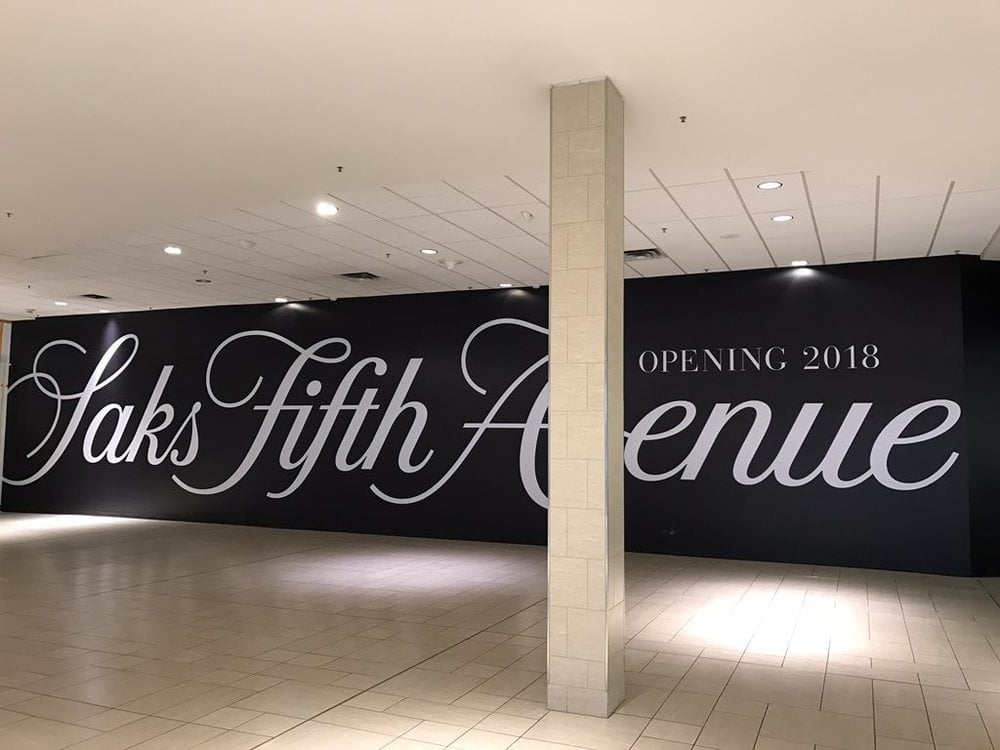
(CONSTRUCTION SIGNAGE AT THE NEW CF CHINOOK SAKS SITE IN CALGARY)

While parent company Hudson’s Bay Company won’t provide sales numbers for its Canadian Saks Fifth Avenue operations, sources confirm that its downtown Toronto flagship is seeing increasing sales numbers, both from in-store shoppers as well as private shopping and in-home visits. The store may be taking market share, as Toronto’s luxury retail sees unprecedented competition. 

In the fall of 2016, Nordstrom opened two Toronto stores — a 220,000 square foot CF Toronto Eaton Centre flagship, as well as a 200,000 square foot Yorkdale Shopping Centre store. Both locations are remarkably luxury-heavy in their offerings, particularly in designer leather goods and women’s ready-to-wear. Sources say that Saks and Nordstrom are likely responsible for reduced sales numbers at homegrown competitor Holt Renfrew, which operates three stores in the Greater Toronto Area. Saks could open a third Toronto store according to sources at Hudson’s Bay Company, and Nordstrom will open its third Toronto store in September of this year, creating intense competition in a market with a population of about 6-million. 

Saks’ disruption will continue, as mentioned above, with new stores in Calgary, Montreal and, at some point, Vancouver. All three markets feature Holt Renfrew flagships, and all three markets will see increasingly fierce competition for regional luxury dollars in the years to come.