Advertisement
Advertisement
Home Blog Page 1109

Why More Retailers Have Announced Store Closings and Bankruptcies in Canada in 2017 [Q&A]

CF Toronto Eaton Centre (PHOTO: Tourist Booklet)

Since the beginning of 2017, a number of retailers have announced that they were closing stores in Canada. While it’s not unusual for struggling retailers to announce closures at the beginning of a new year, the number and nature of closures and bankruptcies announced was more significant than usual. Antony Karabus, CEO of , advises that one of the primary causes of this situation is the polarization of retail in Canada (where “middle” retailers are being squeezed while low and high-end retailers continue to expand). 

He believes that there will be more announcements to come as a number of retailers continue to struggle, which will put additional pressure on retail landlords to replace the space to be vacated as retailers close stores, especially in ‘non-prime’ malls.

To gain additional insight into the current dynamics in the Canadian retail industry, we interviewed Mr. Karabus, who heads a leading retail consulting firm based in both Canada and the United States.

Mr. Karabus provided insight regarding these issues, first providing his opinion that a combination of six concurrent consumer-driven factors are putting pressure on the financial performance of retail chains, particularly those serving the mid-tier and also those that are being dis-intermediated by the digital age. These six factors are:

1. The rate of the shift from physical stores to online, resulting in store fleets being less profitable and contributing to the ongoing closure of stores,

2. The transfer of market share to the ‘value sector’, resulting in increased market share transferring from traditional mid-tier retailers to discounters such as Giant Tiger, TJX Canada (Winners/Marshalls/HomeSense) and Walmart, as well as fast-fashion retailers such as H&M, Forever 21, and Zara, with both groups adding significant top-line sales and store count growth,

3. The rapid growth of the ‘extreme–value sector’, with Dollarama and Dollar Tree adding numerous locations, and Dollarama adding more items at higher-price points thus increasing store productivity,

4. The massive growth of Amazon, as it continues to grow at more than 20% annually — much of which is coming from the market share of the traditional retailers,

5. Increased consumption of music and related media in digital form, further impacting retail market share in those categories,

6. The loss of market share for incumbents, due to the ongoing entry and expansion of luxury brands and retailers into Canada.

As a result of the above, some retailers are experiencing significant pressure on financial performance. Weaker retailers or those facing sharply increased competitive intensity from new entrants and e-commerce operators are either closing stores or shuttering altogether.

Retail-Insider editor-in-chief, Craig Patterson, conducted a question-and-answer interview with Mr. Karabus this week to obtain additional insights into these complex industry issues. 

Retail-Insider: How is the recent spate of store closures and bankruptcies in Canada the result of the six factors you’ve just described? 

Mr. Karabus: The massive erosion of market share by the mid-tier retailers is putting extreme pressure on the weaker retailers, many of which were slow to transform their businesses in the face of the new retail environment. Given that retail is typically a low operating margin business, this has made it hard for many to survive. 

Retail-Insider:  Why are there so many announcements of bankruptcies in January? 

Mr. Karabus: January is a fairly typical month for this type of news, as secured lenders often withdraw support at this time of year when they start seeing deteriorating financial positions following weaker peak season holiday sales, especially when they are concerned about the value of their collateral (the retailers’ inventory values) at a time of increased markdowns. 

Canadian Tire (Image: Canadian Tire)

Retail-Insider: Why are some mid-tier retailers going out of business while other mid-tier retailers are flourishing? 

Mr. Karabus: The old saying “ survival of the fittest” has never been truer in Canadian retail. What is going on in retail now is not a cyclical shift, It is a permanent secular shift in the way consumers are shopping. Retailers will survive and grow only if they have established a ‘unique value proposition’ that keeps consumers returning to their stores again and again. The best examples of this are retailers like Indigo, which has created a general merchandise offering that comprised over 43% of their Holiday 2016 sales, as reported recently. The assortment of general merchandise at Indigo and the shopping experience is unique and the transformation of that business from a traditional bookstore has been very impressive. Others such as Aritzia, Lululemon, MEC, Sport Chek and Canadian Tire have also continued to grow and win market share as they are true destination shopping experiences and have established meaningful ‘mindshare’ for Canadians. 

Retail-Insider: Why do you think pure-play retailers such as Shoes.com recently went out of business?

Mr. Karabus: While I cannot speak to the financial position of a particular company, we believe that if a young pure play retailer is playing in a very crowded market dominated by successful and well-known profitable retailers with strong e-commerce businesses (including Aldo, Browns Shoes, Hudson’s Bay, Nordstrom, DSW/Shoe Company/Town Shoes, Soft Moc, Walmart and of course Amazon), it will be challenging for the new entrant to develop a viable business economic model, especially in an era of extremely high fulfillment and digital marketing costs, together with high returns. There is only so much market share to go around. The one factor that would give the new entrant a higher likelihood of success is if they are able to quickly develop a differentiated unique customer/selling proposition that sets them apart from everyone else. And not many have been able to achieve this.

Hudson’s Bay at Yorkdale Shopping Centre (Image: Hudson’s Bay)

Retail-Insider: Do you believe we are approaching over-saturation of luxury retail in Canada with all the new entrants into the market? 

Mr. Karabus: I don’t believe so. I think that Canadian luxury consumers have been under-served with only Harry Rosen and Holt Renfrew and some independents and that the timing was right for strong new entrants into the market. I also believe that this segment of Canadian consumers has historically been cross-border shopping as they travel internationally and to the USA and they are very familiar with international luxury brands and stores. With the decline in the Canadian dollar and the increased availability of luxury retail in our own country, we expect the luxury consumer will migrate much of their shopping back to Canada. The significant store remodeling done by both Harry Rosen and Holt Renfrew will also contribute to keeping more luxury spending dollars in Canada rather than being spent in the USA. I believe luxury is one of the few retail sectors that will see much sector top-line growth in Canada. 

Over the next several weeks, Retail-Insider will explore this complex topic further with additional thought-provoking insight from HRC Retail Advisory’s CEO Antony Karabus and President Farla Efros. They are assisting numerous retail chains to compete more profitably in this extremely transformative retail climate, while also recognizing the rise in spending power of Millennials and Generation Z. 
G-Star RAW Launches Canadian Mall Expansion

G-Star Raw

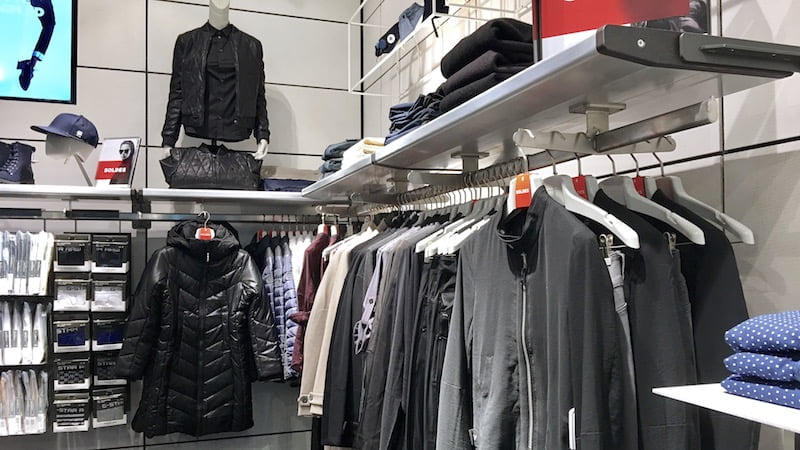
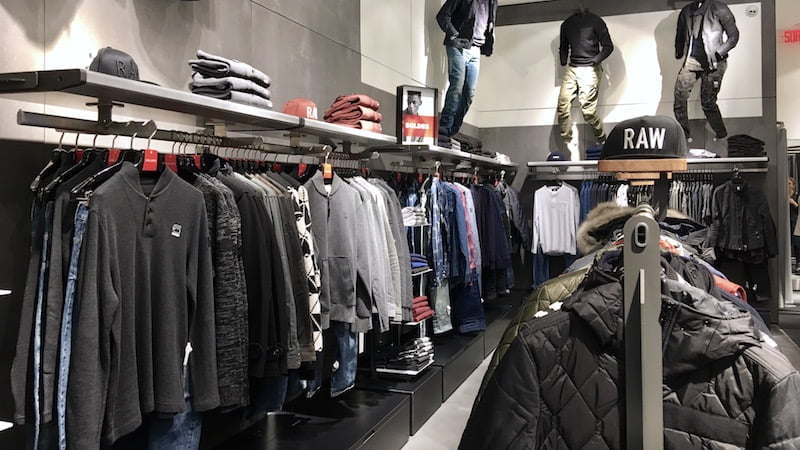
Dutch designer clothing company G-Star RAW has opened a third Canadian store, and it will continue opening locations at a controlled pace as it targets new markets. The brand is also launching an innovative collaboration this week with its celebrity co-owner Pharrell Williams, who acquired part of the company last year. 

G-Star RAW, which retails both men’s and women’s fashions, was founded in Amsterdam in 1989. In 1996, the company introduced raw (unwashed, untreated) denim jeans that come directly from the factory, creating a unique product that gained considerable brand awareness. Designs are often military influenced, including the use of special pockets and trims. 

G-Star operates stores and wholesale accounts globally, with thousands of points of sale. In Canada, it has three freestanding stores. G-Star’s first Canadian location opened at West Edmonton Mall in 2003 — the 3040 square foot store is in the mall’s ‘Europa Boulevard’, across from an entrance to La Maison Simons. A second G-Star location opened in Toronto at 328 Queen Street West in 2012, spanning about 3,800 square feet. This month, G-Star opened its third Canadian store at CF Carrefour Laval, north of Montreal. Our Montreal correspondent Maxime Frechette attended the opening of the 1,740 square foot store, and also wrote about it in French.

(CF CARREFOUR LAVAL STORE. PHOTO: MAXIME FRECHETTE)

According to G-Star Country Manager Mathieu Gagne, G-Star will carefully expand its Canadian operations by opening roughly one store per year for the next five years. Vancouver is the first potential market for expansion, with the potential for one or two stores. A second Toronto store is possible, he said, and at some point a second Montreal-area location could open as part of G-Star’s careful growth.

Mr. Gagne explained that shopping centres will be G-Star’s focus for new stores, and that G-Star is designing stores for efficiency, therefore taking less space. New mall stores will ideally be in the 1,600 square foot to 1,800 square foot range, he said, with efficient displays allowing for a full product offering in less space than in the past. Stores feature a product mix with roughly 60% for men and 40% for women, including clothing, footwear, eyewear and accessories. 

G-Star RAW co-owner Pharrell Williams, who is also the brand’s ‘Head of Imagination’ is launching a unique fashion line this week called ‘G-Star Elwood X25‘. It’s described as “a translation of unrestrained self-expression” captured in 25 prints curated by Pharrell Williams. Inspired by original checks, camouflages and traditional patterns from all over the world, these 25 prints “make space for individuality”. 

(CF CARREFOUR LAVAL STORE. PHOTO: MAXIME FRECHETTE)

The prints are photographed on Pharrell Williams and Dutch model/artist Marte Mei van Haaster in an array of industrial and pastoral scenarios. The campaign is accompanied by a behind-the-scenes short feature film and several visual snippets, all shot in analog film. The new Spring/Summer 2017 collection will be available at Canadian stores on Thursday, February 16. 

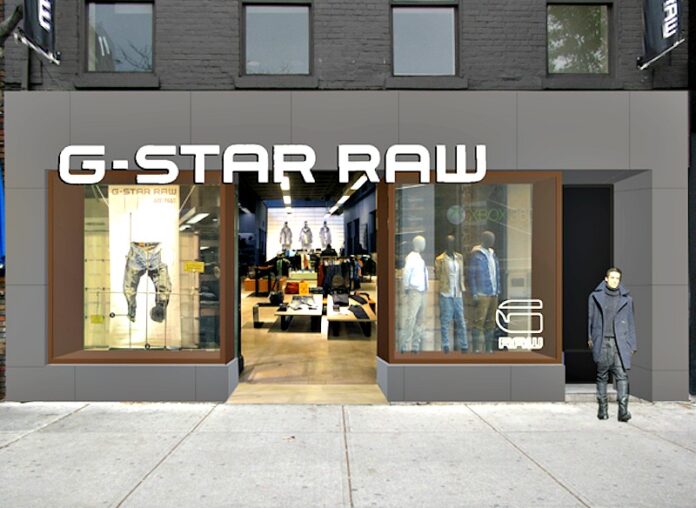
*Top photo is of the Toronto Queen Street store. 

Bizou Continues Store Expansion into 2017

Quebec-based jewellery and accessories brand Bizou plans to open stores in Canada, and is working with a brokerage on its 2017 expansion. The company is a notable success story, having also expanded its operations internationally. 

Bizou plans to open at least four stores this year, all in the province of Ontario. One location is confirmed — this summer, Bizou will open a second London store with a 558 square foot unit at CF Masonville Place. The mall recently saw a $77 million expansion/redevelopment, and a further redevelopment of the mall’s former Target space was recently announced. It’s also one of Canada’s most productive shopping centres, according to a recent study conducted by Retail Council of Canada

Bizou also plans to open three other stores in Ontario this year, with a focus on the Greater Toronto Area, according to representative brokerage Think Retail (which, remarkably, has worked with Bizou for almost 20 years). Bizou is seeking shopping mall space in the 500 square foot to 850 square foot range, with ideal co-tenants including H&M, Zara, Lolë, Sephora, Banana Republic, Fossil and Victoria’s Secret. The Greater Toronto area only has two Bizou locations, with room for considerably more in the future. 

Founded in Quebec City in 1982, Bizou specializes in women’s moderately-priced fashion jewellery and accessories. The brand’s accessory collections include purses and handbags, belts, gloves, hair accessories, scarves, socks, sunglasses, t-shirts, footwear and watches, while its fashion jewellery primarily utilizes sterling silver, gold and amber. Its target market is women aged 18 to 35, seeking style and affordability. 

The company designs its own products and retails them in over 130 stores in six Canadian provinces — Ontario (4 stores), Nova Scotia (4 stores), New Brunswick (7 stores), Newfoundland (3 stores) and Prince Edward Island, with one store. Over 90 of its Canadian stores are in Quebec. 

Bizou is also expanding globally. In 2013, it opened at La Toison Dor in Dijon, France and the following year made its debut in Saudi Arabia at Panorama Mall in Riyadh.  Bizou is currently expanding in the Kingdom, as well as markets across United Arab Emirates and Bahrain.

(Top photo: Cadillac Fairview)

Innovative Portuguese Retail Concept Expands into Canada with 1st Store

galibelle in Edmonton, Alberta (Image: galibelle)

Innovative Portuguese footwear brand galibelle (spelled with a lowercase ‘g’) has opened its first Canadian boutique, and a second location is set to open next month. The concept is particularly unique for its versatility and customization, and its Canadian master franchisee plans to expand galibelle into new markets over the next several years.  

The concept is unique and simple — consumers first pick a desired shoe sole, then choose from a variety of potential top straps that interchangeably button onto the sole. With over 30 different sole styles and over 1,000 different interchangeable straps of various colours and materials, women are able to customize their sandals, heels or boots, depending on the occasion.

galibelle in Edmonton, Alberta (Image: galibelle)

The shoes are designed and made in Brazil, and could result in cost savings for purchasers in the long run. Soles range in price between $45 and $99, and straps range between $20 and $50. Multiple coloured straps can be paired with one sole, reducing the need to buy multiple pairs of shoes. The designs are also convenient for travel — straps lay flat, so multiple sets can be packed with just one or two soles while traveling lighter. 

The galibelle concept launched in 2007 and retail operations began to take off in 2012. It now boasts stores in 15 countries globally in Europe, Africa and Australia. Galibelle also expanded into the United States last year and currently has three locations in Florida. 

galibelle in Edmonton, Alberta (Image: galibelle)

Canadian master franchisees David and Lisa Broesky brought the concept to Canada after discovering galibelle while on a holiday in Barcelona, Spain. They opened their first store last month at 10640 82 (Whyte) Avenue in Edmonton’s trendy Old Strathcona area. A second store will open next month in downtown Kelowna. 

The Edmonton store measures less than 800 square feet in size and carries a wide variety of galibelle styles, as well as the brand’s boots and accessories. The Kelowna store will be a bit larger, spanning about 1,200 square feet. As the concept expands, stores could be as small as 500 square feet in size, said Mr. Broesky. 

The couple will look to expand galibelle into other Canadian markets after evaluating its initial success. If the brand takes off, Mr. Broesky said that markets such as Toronto, Montreal, Vancouver, Calgary and other cities could be targeted for new galibelle stores. Urban street-front spaces are ideal, according to Mr. Broesky, as they lend themselves to a community-focused brand following.

Kiehl’s Innovates with Canadian Growth Plans for 2017

Photo: Kiehl's

L’Oréal owned, New York City-based natural beauty brand Kiehl’s is forecasting growth in Canada for 2017, including launching a strategy to enhance brand awareness in various markets. As well, new and existing stores will see increased personalization options, as well as design differentiation. 

Kiehl’s was founded in New York City in 1851, and now boasts retail and wholesale accounts worldwide. The company entered the Canadian market via Holt Renfrew in the early 2000’s and in 2004, opened its first freestanding Canadian store on Toronto’s Queen Street West. Kiehl’s now operates 23 freestanding Canadian stores, as well as 49 points-of-sale in host retailers such as Hudson’s Bay, Holt Renfrew, Saks Fifth Avenue and Nordstrom. Kiehl’s also operates a robust e-commerce site, with plans for growth. 

The company’s Canadian General Manager, Alexandre Ratté, explained that Kiehl’s now has stores in most of Canada’s top malls and as a result, new store expansion will be limited. The company’s goal is to not oversaturate the market — rather, Kiehl’s will look to strengthen its presence in the Canadian market by enhancing brand awareness to further gain market share both for its stores as well as existing points-of-sale. 

Photo: Kiehl’s

Kiehl’s has the strongest brand awareness penetration in Western Canada, he explained, particularly in the Vancouver area with its high Asian population that spends on skincare products. The Greater Toronto area is close behind in terms of brand awareness and, this year, the Quebec market will see an increased focus in marketing as well as potential new stores. The company will soon announce a partnership with a well-known person in the province, and philanthropy will be involved in a new campaign. As well, Kiehl’s will gain a presence in Quebec City, according to Mr. Ratté. 

‘Localization’ of the company’s stores will also be a strategy to differentiate the brand. Mr Ratté noted that some large chains operate locations that are ‘cookie-cutter’, regardless of geography. Kiehl’s is looking to add uniquely ‘local’ features to stores, including locally-based artwork, tile and other design features to create a sense of place. A shopper in a Montreal Kiehl’s, for example, will be reminded that they’re in that city by subtle elements in the store’s design. 

‘Personalization’ is another initiative for Kiehl’s — last year, the company launched a personalized facial skincare serum called Apothecary Preparations in Canada. Apothecary Preparations is currently available in only nine Kiehl’s locations (Vancouver: Robson Street, Metrotown, CF Richmond Centre. Toronto: CF Toronto Eaton Centre, Yorkdale. Montreal: Ste-Catherine St., CF Carrefour Laval. Also at CF Chinook Centre in Calgary and at West Edmonton Mall). After an initial consultation and analysis, the customer is provided with a customized serum tailored to their skin needs, with each bottle including the customer’s name. Mr. Ratté explained that the highly successful initiative will eventually be expanded into other Canadian locations, adding to the company’s goal of differentiating offerings while providing increased personalization. 

Photo: Kiehl’s

Kiehl’s will continue to expand its Canadian operations in 2017, though at a slower pace than in previous years. A new store location is about to be confirmed for a shopping centre in suburban Vancouver, and the company is in negotiations for a bigger presence in Hudson’s Bay stores. Kiehl’s is also looking to expand its digital presence in Canada. In 2017, the company’s e-commerce site will promote click-and-collect, further merging the in-store experience with online. 

Kiehl’s has partnered with Oakmont Real Estate Services as its representative brokerage in Canada. The retailer generally seeks retail space in the 700 square foot to 1,000 square foot range, with an average of roughly 850 square feet, according to Mr. Ratté. He also noted that there’s a difference between its mall-based stores and street-front locations — mall stores drive traffic and sales, while street-front units act as a community destination while also creating brand awareness.

Holt Renfrew Unveils Latest Pacific Centre Expansion, Announces Ladurée Opening [Photos]

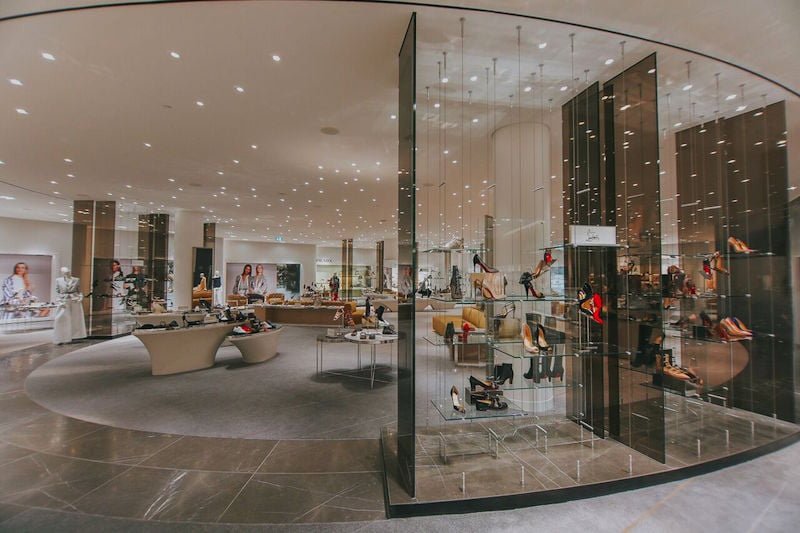
Holt Renfrew has unveiled the latest phase to open at its Vancouver CF Pacific Centre flagship, and has also revealed what’s in store for the rest of 2017. Included is newly expanded women’s ‘shoe hall’ with nine luxury designer boutiques, as well as Paris-based Ladurée, which will open its second Vancouver location inside of Holt’s this spring. 

In April of 2015, Holt Renfrew announced that it would expand its CF Pacific Centre store by annexing about 40,000 square feet of space formerly occupied by Sport Chek/Atmosphere. The first phase of the newly expanded 188,000 square foot store opened in September of 2016, which included a new men’s store as well as a 3,500 square foot 80-seat Holt’s Café. 

Holt’s has unveiled a second phase to the expansion, which includes an 8,500 square foot women’s shoe hall. Some of the world’s top luxury brands are featured in the new space, including nine luxury designer brand shop-in-stores by Aquazurra, Céline, Christian Dior, Christian Louboutin, Gucci, Manolo Blahnik, Miu Miu, Prada and Stuart Weitzman. The new shoe hall is about triple the size of the former department.  

Holt’s describes the new space as having “seemingly endless sightlines,” that are “complimented by custom glass and metal fixtures throughout. Key to the space, are custom chairs and chaise lounges.” 

The Vancouver Holt’s now boasts more footwear boutiques than any other Holt Renfrew location. The Square One store in Mississauga, which opened in July of 2016, features six women’s footwear shop-in-stores, while the Yorkdale store in Toronto has five. 

New York City-based Janson Goldstein LLP is responsible for the CF Pacific Centre Holt’s overhaul, which will be ongoing well into 2017. The firm also designed the existing Holt Renfrew space, which opened to the public in the spring of 2017. Previously, Holt’s had occupied a 68,000 square foot store a block south in the same shopping complex. 

This spring, French luxury bakery and sweets maker Ladurée will open its second Vancouver location in a space adjacent to the newly expanded Holt’s shoe hall. At 500 square feet, Holt’s Ladurée will be smaller than the 1,200 square foot Robson Street retail space that opened to massive crowds in March of 2016

In Vancouver later this year, Holt’s will reveal its new 7,000 square foot two-level personal shopping suites, featuring ‘The Apartment’ — a 1,000 square foot by-invitation-only customizable social space for its top clients. Holt’s is also in the process of expanding its jewellery, leather goods and beauty departments. The expanded 30,000 square foot leather goods department will become the largest of its kind in Canada, and the beauty department will expand by 50% to almost 25,000 square feet. 

*Photos supplied by Holt Renfrew.

Sugarfina Launches Canadian Store Expansion

Image: Sugarfina

Los Angeles-based, luxury grownup candy retailer Sugarfina has partnered with a Canadian brokerage to open stores in this country. Up to now, the brand’s products have only been available in Canada at retailers such as Nordstrom

The Sugarfina concept includes premium items made from high-quality ingredients, sourced directly from artisan candy makers around the globe. Products include gourmet chocolates, caramels, gummies, malt balls, licorice and other delicious confections. Champagne-infused gummies and maple bourbon caramels have been popular, with celebrity endorsements helping grow brand awareness. In the summer of 2016, Sugarfina introduced Rosé rose-shaped gummy bears, which were so popular they sold out within two hours while traffic caused the company’s website to crash. The wait list grew to more than 18,000 people.

Prices aren’t out of reach, despite being positioned as a luxury product. Small containers of candies are priced starting at under $10, with mix-and-match options including a ‘design your own bento box’ where several smaller candy-filled cubes (between three and eight cubes per ‘bento box’) are assembled into gift packages. 

The company was founded by married couple Rosie O’Neill and Josh Resnick, who came up with the concept after watching the original Willy Wonka and the Chocolate Factory movie together on their third date. Recognizing a niche for grownup candy retail, the couple traveled the world and met with candy makers, eventually opening an online candy shop in August of 2012. In November of 2013, Sugarfina’s first boutique opened on Santa Monica Boulevard in Beverly Hills. The 1,400 square foot store was referred to as “the Tiffany & Co.” of candy” by online culinary publication Eater, referencing both the white-and-blue colour scheme as well as the store’s high-end offerings. 

Image: Sugarfina
Image: Sugarfina

The Sugarfina concept has grown rapidly, now boasting 27 boutiques in the United States with three of those being located in Nordstrom stores. In Canada, Sugarfina shop-in-stores are located inside of all five Nordstrom stores operating in this country. The first shop-in-store opened at Nordstrom’s CF Pacific Centre flagship in Vancouver in September of 2015. 

Sugarfina is working with Tony Flanz of brokerage Think Retail on its freestanding Canadian store expansion, which could see up to 10 stand-alone locations open in this country. Initially, the retailer is looking at Toronto and Vancouver for stores, ideally in the 600 square foot to 1,000 square foot range within shopping malls. Sugarfina stores do exceptionally high sales per square foot, and its preferred co-tenants include Lululemon, Aritzia, Sephora, Apple, Godiva and other marquee brands, according to Think Retail. 

INDOCHINO Announces 8 Stores for 2017

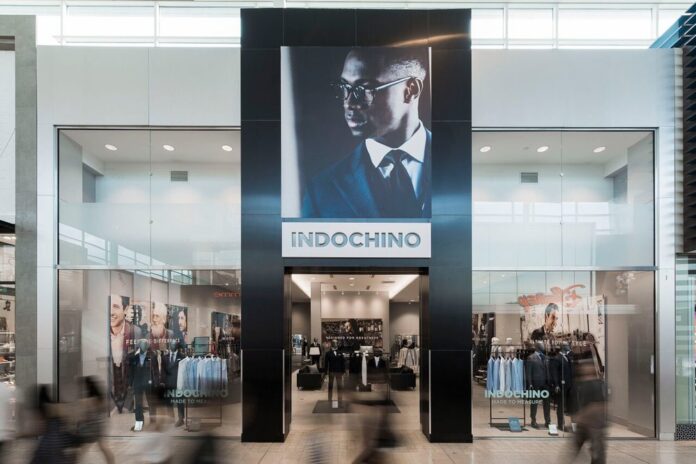
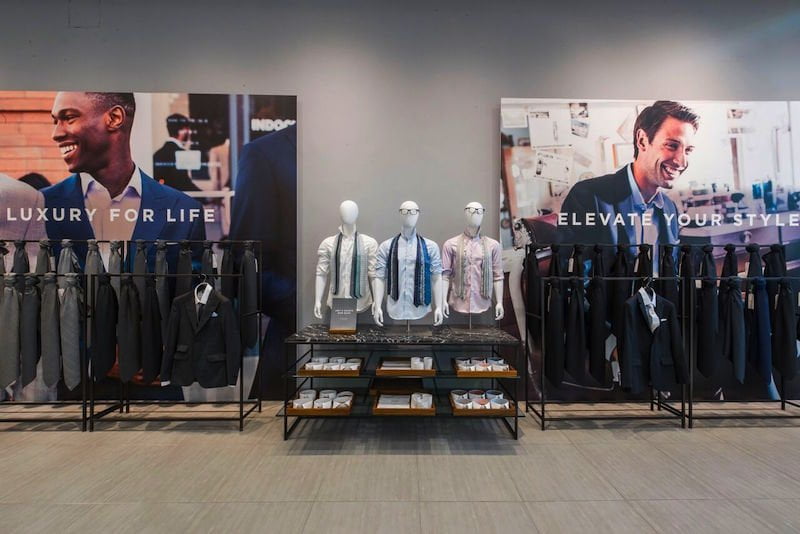
Photo: INDOCHINO at Yorkdale Shopping Centre

Vancouver-based INDOCHINO, the world’s largest made-to-measure menswear company, has announced that it will open three locations in Western Canada this spring, as well as five in the United States later this year. The company is seeing tremendous sales growth and as a result, is expanding its brick-and-mortar operations rapidly. 

INDOCHINO currently operates five Canadian locations — two of those are in Toronto (King Street east and Yorkdale Shopping Centre), and one each in Mississauga (Square One), Ottawa (CF Rideau Centre), and in Vancouver’s Yaletown. The Vancouver store was the company’s first permanent space when it opened in the fall of 2014. INDOCHINO launched its shopping mall location initiative last summer with the opening of its Mississauga store, noting that such stores see considerably more walk-by traffic than on urban street-fronts. INDOCHINO also has stores in New York City, Boston, Philadelphia, San Francisco and Beverly Hills CA. 

INDOCHINO announced a major international expansion last year, with the goal to open about 150 retail stores globally while selling a million suits annually by the year 2020. The company was founded in Vancouver in 2007 as an online custom suit retailer and in late 2015, co-founder Kyle Vucko was replaced as CEO by Shop.ca founder Drew Green.

The three newly announced Canadian stores will be in Edmonton, Calgary and suburban Vancouver. The Edmonton store, opening on March 30 of this year, will be at West Edmonton Mall. The Calgary store, opening on April 6, will be at CF Chinook Centre. A third location, at Metropolis at Metrotown in Burnaby, will open some time this spring, according to INDOCHINO. 

All three malls ranked highly in last month’s Retail Council of Canada’s Shopping Centre study, in both annual sales per square foot productivity as well as over all pedestrian footfall. CF Chinook Centre is ranked Canada’s 7th most productive mall with sales per square foot at $1,057, while Metropolis at Metrotown is in 8th place at $1,035. Both West Edmonton Mall and Metropolis at Metrotown see in excess of 28 million visitors annually. 

Five American cities will also see new INDOCHINO stores, opening later in 2017. According to a press release, the retailer “is actively investigating new markets in major cities such as Washington, D.C., and Chicago, where the company has a thriving online customer base. The brand is also looking to open secondary locations in large markets such as New York.”

“This year, we’re almost doubling our showroom network as we focus on significantly expanding our experiential retail model,” said Mr. Green. “As we continue to bring our unique showrooms to more cities and introduce custom clothing as an attractive and affordable alternative to ready-to-wear, we’re beginning to change the way a generation of men suit up, and that’s incredibly exciting to see.”

The stores, or showrooms as INDOCHINO calls them, are an extension of the company’s online made-to-measure experience. INDOCHINO customers are paired with a Style Guide in-store, who helps them design one-of-a-kind suits or shirts. Style Guides take measurements, assist with fabric selection, and walk shoppers through custom options including buttons, vents, pockets, lapels and monograms. Each garment is made to order and delivered within four weeks, when customers can return for a second fitting to ensure a perfect fit. The showroom works in tandem with INDOCHINO’s e-commerce website, so men can access their profiles and reorder at their convenience. The showrooms are designed to be modern and bright, boasting comfortable reception areas and lounges dedicated to serving groom parties and other groups.

Last year was record setting for INDOCHINO, with three new showrooms, year-over-year omnichannel sales growth of 54% and year-over-year sales in comparable showrooms ending the year at 32%. In February 2016, the company announced a US $30 million strategic investment by Dayang Group, the world’s largest suit manufacturer, which has helped accelerate the company’s expansion plans, significantly enhanced the product offering to its customers, and generated additional operating efficiencies.

In 2017 the company’s growth trajectory has continued, with January’s year-over-year omnichannel sales growth over 50%, according to INDOCHINO. 

Oberfeld Snowcap represents INDOCHINO as brokerage in Canada. According to Oberfeld’s website, INDOCHINO is seeking retail spaces both on street-fronts and in enclosed shopping centres, generally in the 1,500 to 2,000 square foot range.

*Photos are of the company’s Yorkdale store, and were supplied.

Retail Thought Leadership Conference, March 10

University of Alberta School of Retailing’s third annual Thought Leadership Conference takes place on March 10 this year in Edmonton, providing both thought leadership and networking opportunities. The half-day event is conveniently located in a hotel/conference facility attached to Edmonton International Airport, allowing for easy fly-in-fly-out. 

Tickets are still available ($225+GST) for the conference, and can be purchased here. Breakfast, lunch and parking are included. 

There’s also a hotel discount for out of town guests interested in staying at the conference venue — the funky/beautiful Renaissance Edmonton Airport Hotel.

The conference features speakers from across Canada, with a focus on the topic of leadership strategy. Speakers include: 

  • Brett Halliday, President of Michael Hill, who will open the day with a discussion about the ‘accidental career’,
  • Dr. Kyle Murray, Director of the School of Retailing,
  • Kamy Scarlett, Senior Vice President, Retail and Chief Human Resources Officer, Best Buy Canada,
  • There will also be an award given for Advancing Retail as a Career, with this year’s recipient being Toni Galli, Country Sales Manager of H&M Canada. Diane Brisebois, President & CEO of Retail Council of Canada will present Toni the award. 

On the evening of Thursday, March 9, an intimate cocktail event, sponsored by Canada Safeway and hosted by Retail Insider, will be held in ‘The Library’ at the Renaissance Edmonton Airport Hotel. 

Availability is limited, and tickets are available until March 4. 

For more information, contact Emily Salsbury-Deveaux at: retail@ualberta.ca

Arc’teryx Launching Innovative Store Concept as it Continues Retail Expansion

Arc'teryx Vancouver (Rendering via Unison Construction Management.)

North Vancouver-based outdoor clothing and sporting goods company Arc’teryx will launch a concept store in downtown Vancouver this spring, with a particular focus on the consumer experience. It’s the sixth store for the brand in Canada, as Arc’teryx expands its retail operations both domestically as well as globally. 

Arc’teryx was founded in North Vancouver in 1989, selling products associated with climbing, skiing, snowboarding, backpacking, and hiking-related activities. The company’s designs often feature technological advancements to enhance functionality, making it prominent in outdoor technical apparel. The company was purchased in 2005 by Finland-based Amer Sports, and now operates stores and wholesale accounts globally. 

In mid-May of this year, Arc’teryx will open a new store location at 813 Burrard Street in downtown Vancouver, in a retail space formerly occupied by fashion retailer Le Chateau. Arc’teryx will span about 4,020 square feet, according to the company’s Marketing Manager Stephanie Jamieson. It will be the first location for the brand to be particularly ‘community focused’, with a space where shoppers can meet, socialize and experience the product. The store will therefore be “less transactional” and more experiential, according to Ms. Jamieson. Features such as a ‘warranty and repair bar’, for example, will allow customers to further engage and deal with any potential product issues. The store is designed to complement the company’s e-commerce site, which offers the most comprehensive selection of Arc’teryx products. 

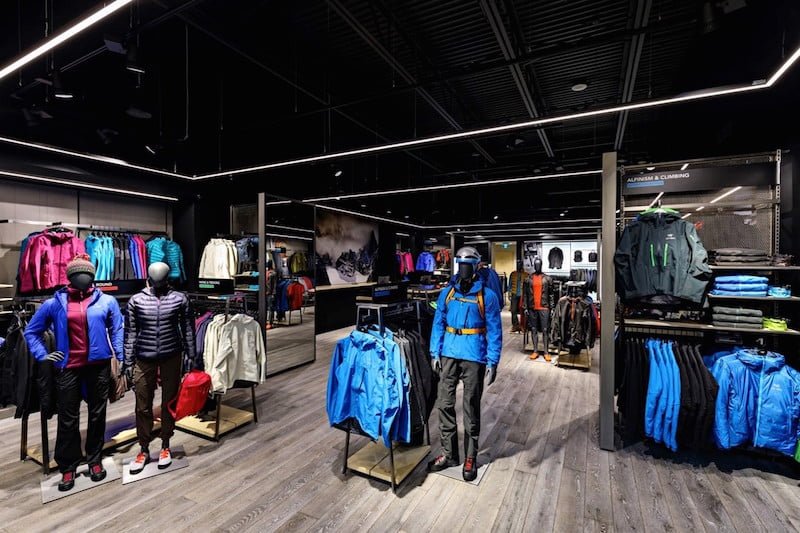
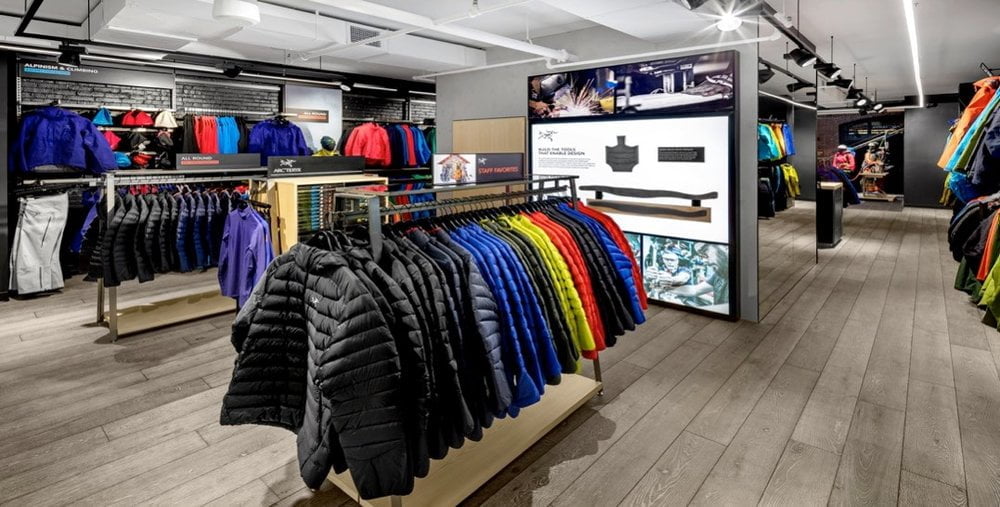
(YORKDALE STORE. PHOTO SUPPLIED) 

The Burrard Street store’s interior will include ample use of granite and other raw materials — a nod not only to the North Shore Mountain scenery at the end of Burrard Street, but also the Stawamus Chief north of the city (a mountain with a popular hiking trail). The store’s exterior will also feature grey granite in its exterior, as per the rendering at the top of this article. 

The store will also have a dedicated area for its Veilance men’s technical apparel brand — a unique feature to the Burrard Street store. The store will also carry a curated selection of the company’s outdoor-focused merchandise, similar to other Arc’teryx locations. 

Arc’teryx’s Burrard Street location is ideal, noted Ms. Jamieson, being just south of prominent retailers such as L’Occitane en Provence, Roots, and Lululemon’s Robson Street flagship. A block north is Vancouver’s burgeoning ‘Luxury Zone’, centred on the 1000 Block of Alberni Street, featuring some of the world’s top luxury brands. Despite the large size of the Burrard Street Arc’teryx, it will not technically be a flagship — Ms. Jamieson noted that the company is still looking to formally define what an Arc’teryx flagship will look like as it continues to expand its retail strategy. 

The new Burrard Street store will be Arc’teryx’s second location in Vancouver. The company’s first Vancouver store opened in the Kitsilano area October of 2013, measuring about 2,100 square feet. 

(BOSTON STORE. PHOTO SUPPLIED) 

Besides the two Vancouver stores, Arc’teryx operates four stores in Montreal, Whistler BC, and Toronto. Arc’teryx’s first Canadian store opened in 2006 at 1515 Ste-Catherine Street West in Montreal (according to Ms. Jamieson, the 4,500 square foot store will see a major renovation this year). In June of 2014, Arc’teryx opened a 2,400 square foot ‘partner store’ in Whistler, BC, followed by a 2,700 square foot unit on trendy Queen Street West in August of 2014. A second Toronto store, measuring about 2,800 square feet, opened in October of 2016 in the new Nordstrom-anchored expansion wing at Yorkdale Shopping Centre. The Yorkdale unit was the company’s first mall location for Canada. 

While Arc’teryx has no plans as of yet to open any other new stores in Canada in 2017, it will open three stores on the U.S. West Coast this year. The company has stores in various global markets, including the United States, Switzerland, France, UK, Japan, and China. 

*Rendering via Unison Construction Management