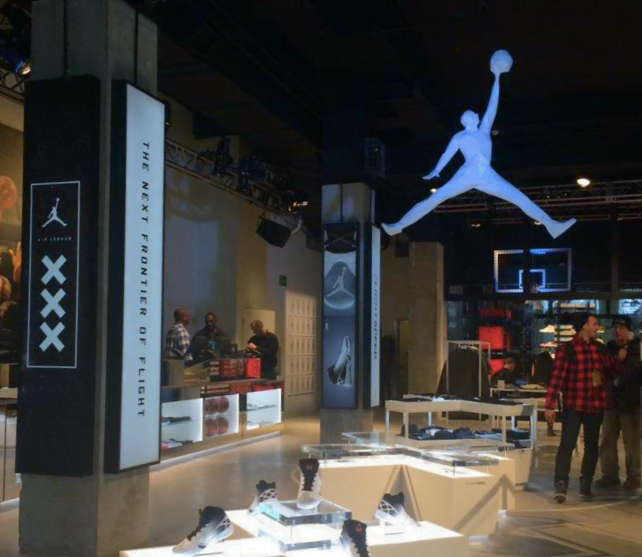
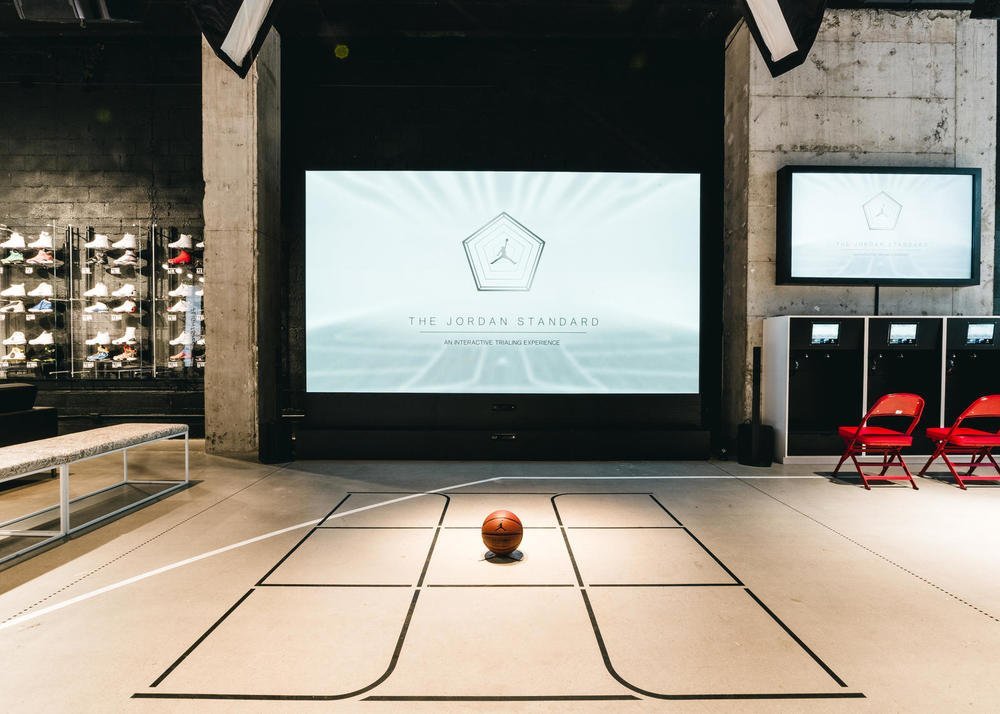
Canada’s first Michael Jordan Brand store is about to open at Toronto’s Atrium. Parent company Nike has provided photos for this article.
The store opens at exactly 6:23 am on Friday, February 12, and will remain open 24 hours a day until Monday, February 15 at 6:23 pm for the NBA All-Star Weekend.
The store occupies 15,000 square feet on the ground and concourse levels of the Atrium. The concourse level features ‘306 Underground’, a ‘VIP area’ offering services such as personal shopping, customization, early product reservations, and even a barber. The store also goes by the name of its street address, ‘306 Yonge’.
“306 YONGE, Canada’s first Jordan only retail location, opening at Atrium, provides consumers with the ultimate Jordan Brand experience in Toronto,” said Mike Parker, President of MPA, on behalf of H&R REIT. “306 YONGE will open during All- Star Weekend and will offer Jordan fans, residents and visitors the most premium assortment of Jordan sneakers in the world.” H&R REIT owns and operates Atrium, which is a mixed-use development directly north of CF Toronto Eaton Centre.
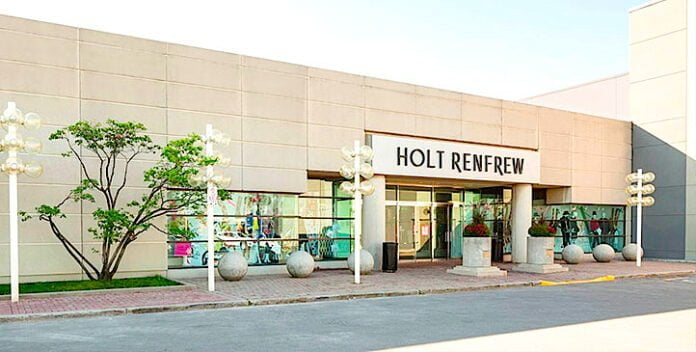
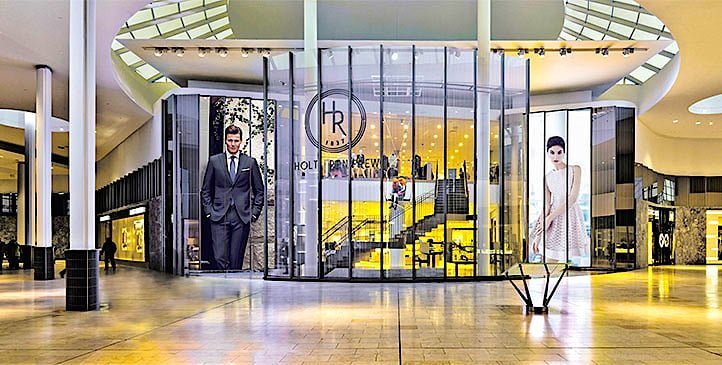
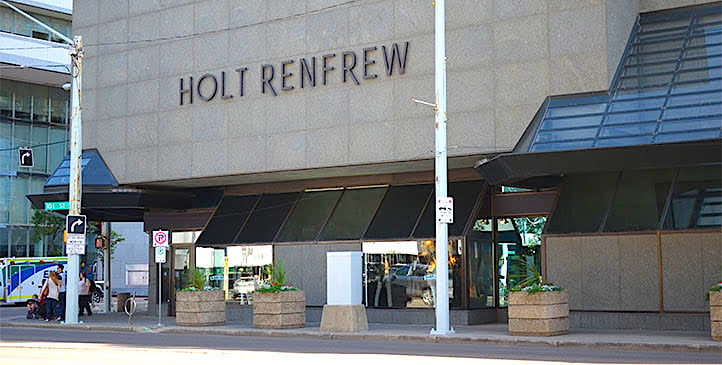
Square One’s Holt Renfrew will be larger than originally anticipated, spanning in excess of 130,000 square feet. When it opens, it will be the company’s fourth-largest store, following Holt’s 185,000 square foot Bloor Street flagship, its 147,000 square foot Calgary store, and its 146,000 square foot Vancouver flagship. Towards the end of the decade, Holt’s will open a combined Ogilvy/Holt Renfrew store in Montreal measuring 220,000 square feet, and its Bloor Street and Vancouver flagships will also see considerable expansions.
The Mississauga store’s two-story facade will feature glass curtain wall interspersed with grey graphite stone and 15 foot wide display windows. Its interior will feature soaring ceilings up to 30 feet in height, atriums, an open staircase, natural light, and unobstructed sight-lines across the store’s 90,000 square foot main floor.
The store will feature a roster of designer brands, including a number of shop-in-stores. Tiffany & Co. is now confirmed to be a concession inside of Holt’s, bringing the New York City-based jewellery brand to Mississauga for the first time. Holt’s has also revealed that its Square One store will feature designers Gucci, Prada, Miu Miu, Valentino, Derek Lam, Akris, Max Mara, Hugo Boss, Stella McCartney, Acne, Kenzo, Moncler, See by Chloe, Manolo Blahnik, Jimmy Choo, Aquazurra, and Stuart Weitzman and others, though it didn’t clarify in what product categories.
The store will also feature some impressive services, including a master tailor, shoeshine and sneaker cleaning, concierge, valet and more. Unique to the Square One store will be a ‘Leather Artisan’ — a resident expert who will “elevate the customer experiences with bespoke embossing details on any leather accessory and offer full-service repair”, according to Holt’s. The store will also feature an impressive jewellery and watch service area, under the guidance of certified watchmakers.
More than 2,500 square feet on the Square One store’s mezzanine level will be dedicated to personal shopping, including Holt Renfrew’s second ‘Apartment‘ — its private luxury shopping suite. Also located on the second level, overlooking the store, will be a 2,000 square foot Holt’s Café.
Toronto-based fashion merchandising firm J2 Merchandising is expanding its operations into all of North America, as the company continues to grow and work with top retailers. Founded by the highly-experienced team of Jodie Wolfe and Jackeline Varela, J2 Merchandising addresses an ever-increasingly important need for bricks-and-mortar retailers.
Shari Waters once said: “Visual merchandising is the art of implementing effective design ideas to increase store traffic and sales volume”. It’s now more important than ever, and J2 Merchandising co-founder Jodie Wolfe explained how strong merchandising can enhance retail sales, while poor merchandising can negatively affect store productivity. In an age of e-commerce and increased competition, retailers need to entertain and inspire consumers, with the in-store experience and enhanced window and other displays being more important now than ever, said co-founder Jackeline Varela.
Ms. Wolfe and Ms. Varela act as a team, developing and building the visual look and feel of fashion retail spaces and products. They each have over 20 years of merchandising experience, and have held executive positions with top design companies in North America. Many retailers they’ve worked with say they won’t go anywhere else — after J2 Merchandising works on stores, sales often increase substantially. The company employs some of the most talented retail and merchandising experts in Canada, led by J2 Merchandising’s experienced founders.
The company is expanding its operations into the United States this month, beginning with a foothold in New York State. J2 Merchandising will subsequently move into various other markets as it acquires new, national clients.
Ms. Varela explained the complexities of brick-and-mortar retailing, and how her company offers personalized services which includes setting/resetting shelving displays, pricing and tagging/re-ticketing products, ordering goods and placing reorders when necessary, training sales staff, conducting inventory of stock, implementing content management systems, negotiating prices with suppliers, producing sales projections, obtaining feedback data from consumers and store staff, analyzing sales information, stockroom sweeps, and even planogram resets for mid-season changes and new production releases. Many retailers struggle because they lack these and other skills.
A recent study by industry trade publication Retail Info Systems News found that only 3.7% of retailers have accurate planograms in place. That can affect the store at every level, though third-party merchandisers such as J2 Merchandising can solve these issues by training staff, creating consistent and informative marketing displays, creating reliable merchandising systems, and initiating accountable audit and problem solving services. Ms. Wolfe noted that with proper planning and implementation retailers can see tremendous financial success and growth, while also engaging with consumers and enhancing brand reputation.
Toronto’s Yonge Street will continue to see an influx of national and international retailers move into the area, according to a brokerage working extensively in the area. Saks Fifth Avenue is about to open its Canadian flagship and in September, Nordstrom will open its Toronto flagship in part of the former Sears space at CF Toronto Eaton Centre. Although much of the existing retail space reflects Yonge Street’s gritty past, the street is set to transform as new retailers and development takes place along the strip.
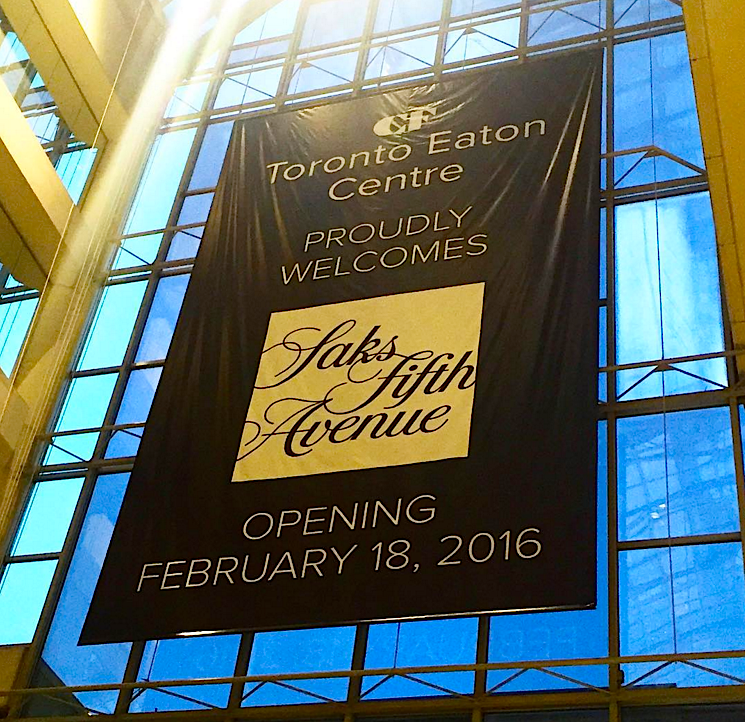
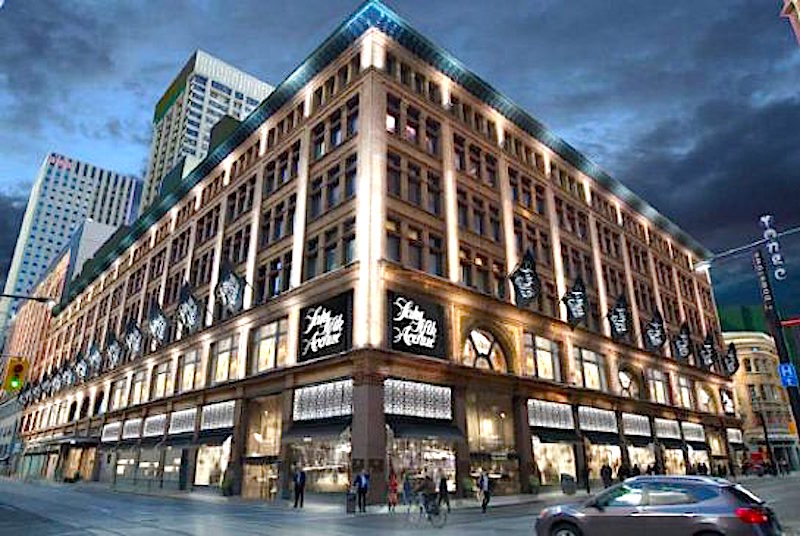
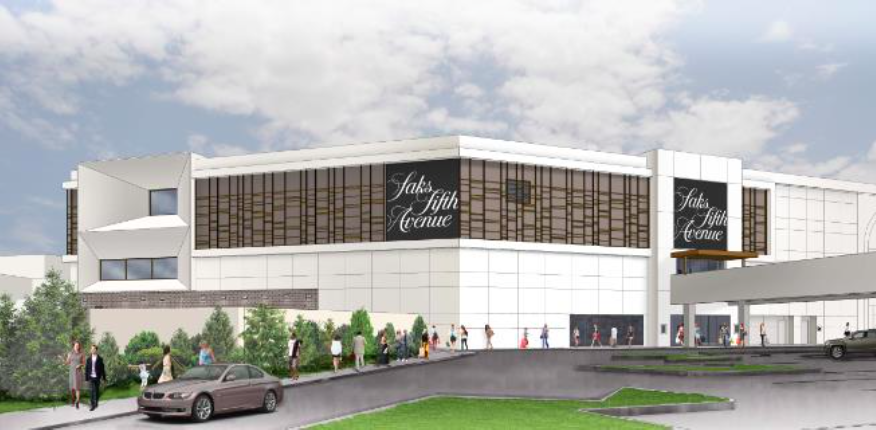
Next Thursday, February 18, Saks Fifth Avenue will open its Canadian flagship at the southeastern end of CF Toronto Eaton Centre’s Hudson’s Bay building. The 163,000 square foot Saks store will span four levels. The store’s basement level will feature a luxurious grocery store operated by Pusateri’s Fine Foods (opening mid-April), and Saks will occupy three levels above. With windows along Yonge Street, Queen Street West and Richmond Street West, Saks will boast almost 600 feet of street frontage.
Nordstrom will open its Toronto flagship on September 16, 2016 at the north end of CF Toronto Eaton Centre. The 213,000 square foot three-level store will be visible from busy Yonge-Dundas Square, and will feature almost 300 feet of frontage along Yonge Street. The store will no doubt be busy, with some predicting that it will be one of Nordstrom’s top-performers.
According to Ashlar Urban Realty Sales Representative Brandon Gorman, the addition of Nordstrom and Saks Fifth Avenue will elevate Yonge Street, particularly between Queen Street (where Saks is going) and Dundas Street (near Nordstrom). Yonge Street north of Dundas will also evolve greatly in the near future with substantial residential intensification taking place from Gerrard Street north to Bloor Street. Many of these residential development sites will create new, larger format opportunities for retailers to enter the market and service the growing urban population base at a lower cost than CF Toronto Eaton Centre”.
Ashlar Urban has a number of retail properties available in the immediate area, which is increasingly seeing interest from a variety of retailers. The magnificent three-level retail space at 229 Yonge Street, for example, features 16,571 square feet with 200 feet of frontage along Yonge Street and Shuter Streets. That property has seen interest from multiple retailers seeking flagship space in the city.
Mr. Gorman noted that retailers also paying more attention to Yonge Street north of Dundas , as the entire area continues to evolve. Ashlar Urban Realty has a 1,700 square foot retail space available at 512 Yonge Street between Grosvenor Street and Breadalbane Street, a short-term 1,764 square foot opportunity at 480 YongeStreet, and a second-floor 4,542 retail space at 401 Yonge Street (near the corner of Gerrard Street). Click each link for a full PDF package.
Other retail experts are also weighing in on Yonge Street’s latest transformation, particularly with the addition of Nordstrom and Saks. Antony Karabus, CEO of HRC Advisory, said: “I expect CF Toronto Eaton Centre will add new and some more upscale retailers over time as Saks and Nordstrom start operating in 2016 in that area. Retail rental rates have already risen so much in that shopping centre that many traditional mid-priced retailers with lower productivity and lower average unit retail prices are learning that they cannot profitably operate there. The anticipated large number of new residents in the area due to the enormous wave of new condo buildings, both those already built and many others that are in the process of being built between Bloor and Queen, will steadily demand both better restaurants and better shopping in that area over time. We don’t see it happening overnight but rather gradually over time as the area transforms”.
As Yonge Street continues to evolve, retailers will continue to move into the area. Ashlar Urban Realty is continuing to place retail and restaurant tenants along Yonge Street and throughout downtown Toronto, as tourist and residential populations continue to explode. For more information, you may contact Brandon Gorman Directly at: 416-205-9222 x 239 or by email: bgorman@ashlarurban.com.
Holt Renfrew has revealed that it will close its smallest location this year, as it prepares to open a massive replacement flagship several kilometres away. The news reflects Holt’s strategy to operate stores in excess of 120,000 square feet, bringing the future of its Edmonton store into question, according to one expert.
Holt Renfrew’s 33,670 square foot CF Sherway Gardens store became part of the mall’s expansion wing when landlord Cadillac Fairview expanded the mall in the fall of 2015. Last year, inside sources confirmed that Holt Renfrew was to close the Sherway store as part of a deal to open a 130,000+ square foot replacement location at Mississauga’s Square One Shopping Centre. Saks Fifth Avenue will open a 132,000 square foot store at CF Sherway Gardens on Thursday, February 25.
Last year, Holt Renfrew closed two of its smallest stores — a 33,000 square foot unit at Quebec City’s Place Ste-Foy, and a 36,000 square foot store at 240 Sparks Street in Ottawa. Prior to that, Holt Renfrew announced that it was in the process of spending over $300 million to update its fleet of stores, adopting a new 120,000+ square foot footprint similar to American Neiman Marcus locations. Holt’s Toronto Yorkdale Shopping Centre store was expanded to about 120,000 square feet in early 2014, with the company subsequently announcing expansions of its Vancouver, Calgary and Toronto Bloor Street flagships. Holt’s 84,000 square foot Montreal store will close late next year as a 220,000 square foot combined Ogilvy/Holt Renfrew store opens nearby.
Holt Renfrew’s recent efforts to overhaul its stores and enhance its online presence has been costly, said HRC Advisory president Farla Efros. Competitors Saks Fifth Avenue and Nordstrom are expanding into Canada and in order for Holt’s to remain competitive, it needs to “focus resources into ensuring they can keep their customers loyal and enhance their overall customer experience”. Ms. Efros went on to say that it might be best for Holt’s to shutter underperforming stores in order to concentrate on larger stores that “can deliver growth and differentiate themselves against its new lineup of competitors”. Doing so would require eliminating stores which she referred to as “distractions”, which include Holt’s Sherway and Edmonton stores.
After the closure of Sherway Gardens, Holt Renfrew will be left with seven locations, including the new 130,000 square foot Mississauga Square One store. Once the Montreal location closes, each Holt Renfrew location, except for its Edmonton store ,will measure in excess of 120,000 square feet.
Holt’s Edmonton store, which measures about 37,000 square feet over two floors, is located within the downtown Manulife Place retail podium. The store opened in 1983 and at the time, was one of Holt’s largest. Last year, Holt Renfrew president Mark Derbyshire said that the company is committed to the Edmonton market, though it’s now clear that given Holt’s strategy to operate stores in excess of 120,000 square feet, something is going to happen to the small, dated Edmonton store.
If the Edmonton store were to remain open in its current form, it would be the ‘ugly duckling’ of the chain — not only is it too small for Holt’s new retail positioning, it has only seen minor updates over the years, and features few of the luxury brands available in Holt’s larger stores. If Holt Renfrew were to remain in downtown Edmonton, it would require new retail space to expand. Some speculate that Holt’s could end up occupying much of the retail podium of Manulife Place, as sources say retailers Zenari’s and Maison Birks will be leaving, with some questioning the future of other retailers occupying both retail levels of Manulife Place.
West Edmonton Mall president David Ghermezian recently told news publication Metro that Holt Renfrew had been negotiating to open a large store in a suburban Edmonton mall. It is unclear, however, if negotiations are ongoing or if a potential deal is off the table. What is clear is that something has to happen to Holt Renfrew in Edmonton, be it a new downtown store, an expanded existing location, a new suburban unit, or the possibility that Holt Renfrew will decide to abandon the Edmonton market altogether.
If Holt’s were to exit Edmonton, it would be a blow to the city’s retail scene, particularly when compared to what’s available in Calgary. West Edmonton Mall president David Ghermezian recently confirmed that plans to put Nordstrom in his mall had stalled, as the Seattle-based retailer slows down its Canadian expansion “so that they don’t make the same mistakes as other major retailers made coming into Canada”. For those keeping score, Calgary has a 147,000 square foot downtown Holt Renfrew, a 140,000 square foot Nordstrom at CF Chinook Centre, and there’s the possibility that Saks Fifth Avenue will also move into Calgary’s Chinook Centre.
Forever 21‘s sister brand F21 RED will open its first Western Canadian store this fall. The 15,000 square foot store will be located at Highstreet, an open-air lifestyle centre in Abbotsford, east of Vancouver. It will be F21 RED’s third Canadian store.
F21 RED will open between 20 and 30 Canadian locations over the next five years, according to representative broker Jeffrey Berkowitz of Aurora Realty Consultants. F21 RED’s first Canadian location opened in the fall of 2015 at Devonshire Mall in Windsor, Ontario, and a second location opened soon after at Ottawa’s Place D’Orleans. Mr. Berkowitz worked on the Abbotsford deal with Trevor Thomas from Aurora Realty Consultants’ Vancouver office.
The F21 RED concept “offers customers a deeper inventory of the trend-led staples from Forever 21, Forever 21 Men, Forever 21 Plus and Forever 21 Girls” according to a Forever 21 spokesperson and furthermore, the brand is “able to deliver greater quantities of the styles and trends customers seek, while maintaining the value and entry-level category price points Forever 21 is known for offering”. F21 RED launched in Los Angeles in May of 2014 with a location in suburban Los Angeles.
“We’re excited that Forever 21 has chosen Highstreet for its first Western Canadian F21 RED location,” said Darren Kwiatkowski, Executive Vice President of Shape Properties. “F21 RED’s decision to locate at Highstreet is directly correlated to Highstreet’s fresh new format which provides customers with an extraordinary open-air retail, dining and entertainment experience.” Mr. Kwiatkowski explained that “the successes of innovative, international brands at Highstreet like H&M and Sephora helped to secure F21 RED and have contributed to an increase in customer traffic of over 20% in 2015. As a result, we anticipate a number of exciting new leasing announcements in the coming year.”
Parcel pick-up locker company InPost Canada is expanding into British Columbia, Alberta and Quebec as it rolls-out its 24/7 automated-parcel locker machines nationwide. The concept, which makes e-commerce shopping and returns more convenient and inexpensive, launched in Canada last year.
In his speech at the World Economic Forum, Prime Minister Justin Trudeau touted Canada as a “hub for technological innovation” and encouraged global corporations to invest their dollars in the country’s growing tech sector. InPost Canada comes with a $36.7m USD backing from the Polish Bank Gospodarstwa Krajowego (BGK) specifically for its Canadian rollout. The company is engaging landlords and retailers to partner with as it expands its service across the country.
The service provides e-commerce shoppers the option to ship online purchases directly to one of InPost’s convenient pick-up locations. Lockers are accessible 24/7 and the self-serve pick-up process takes under 7 seconds to complete, so E-commerce shoppers can have their packages delivered to a locker then pick them up at their convenience. Security cameras monitor the locker units, and e-commerce purchase returns can be coordinated quickly and easily through the same InPost lockers.
InPost’s parcel-locker network is the largest of its kind in the world and growing quickly. The company is targeting high traffic urban locations and is looking to partner with major retailers, landlords, transit companies and property managers, and is offering discounts to potential partners through decisionSMART RetailServices (416.702.9641) and Retail Insider.
If you are a major landlord, developer or multi-residential unit owner and are interested in hosting an InPost locker on your property, email Robert Luciano at robert@decisionsmart.ca with the promo-code WEW@NTINPOST in the subject line. To offer this delivery service to their customers, both brick-and-mortar and e-commerce retailers should use promo-code WE$ENDINPOST in the email subject line to Mr. Luciano’s email address.
For further product information, contact John Clarke, Chief Revenue Officer, InPost Canada Inc., 55 Browns Line, Toronto, ON M8W 3S2 at jclarke@inpost24.ca.
In recent years a variety of online retailers have been opening bricks and mortar stores to complement their online business. They have realized the benefits of being more than just an online retailer and have begun running online and offline simultaneously.
When you consider that 78% of customers prefer to shop in-store and they spend 6 times more in-store than online it is hardly surprising. 73% of customers want to try on or touch merchandise before committing to any purchase and bricks and mortar stores provide a convenient option for customers.
For example, even Apple now has 444 retail stores worldwide which allows their customers to interact with and touch their products, and they plan on opening even more in the future. Online giant Google also opened their first store in London in March 2015 in an effort to get closer to their customers.
Find out more about the reasons behind online retailers opening bricks and mortar stores in this info-graphic from Store Traffic.
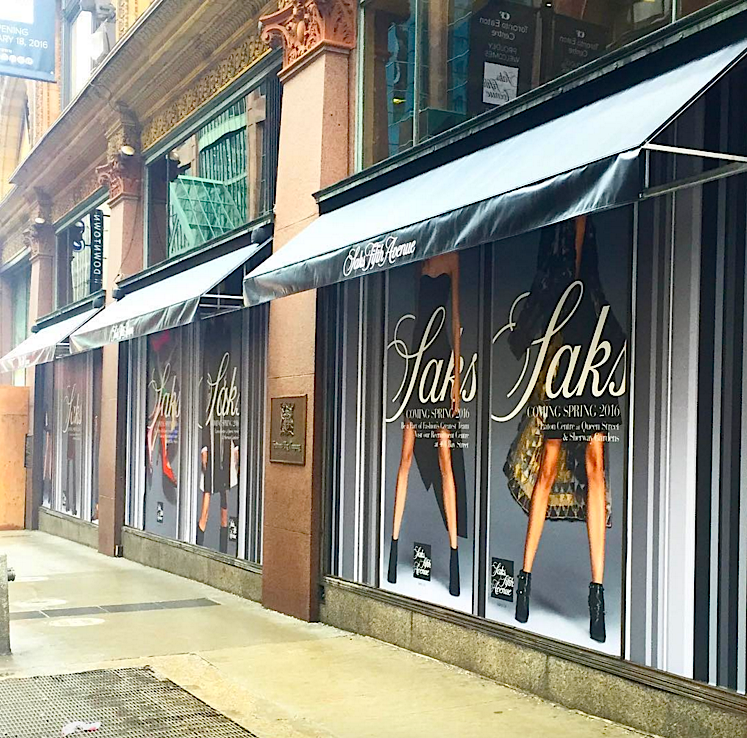
Awnings installed on the new Queen Street store. Photo: Saks via Instagram
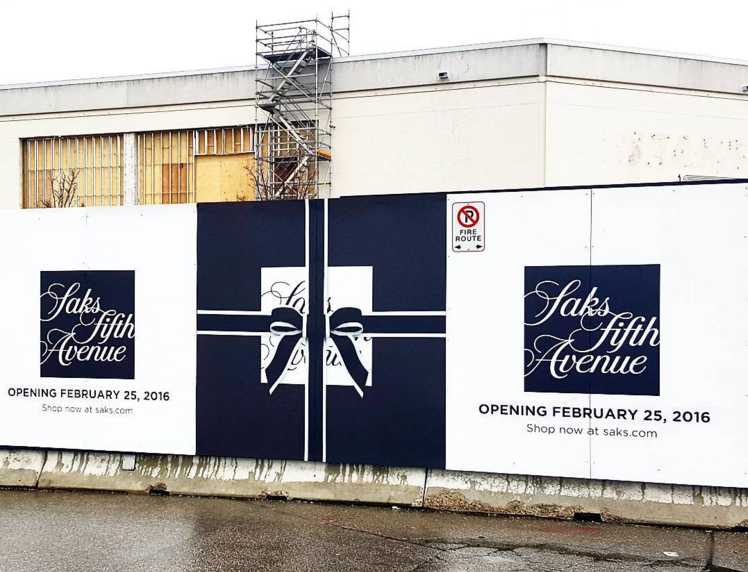
Saks Fifth Avenue is putting the final touches on its first two Canadian locations, which both open this month in Toronto. UPDATE: The first location opens with a ribbon cutting at 9:30am on Thursday, February 18.
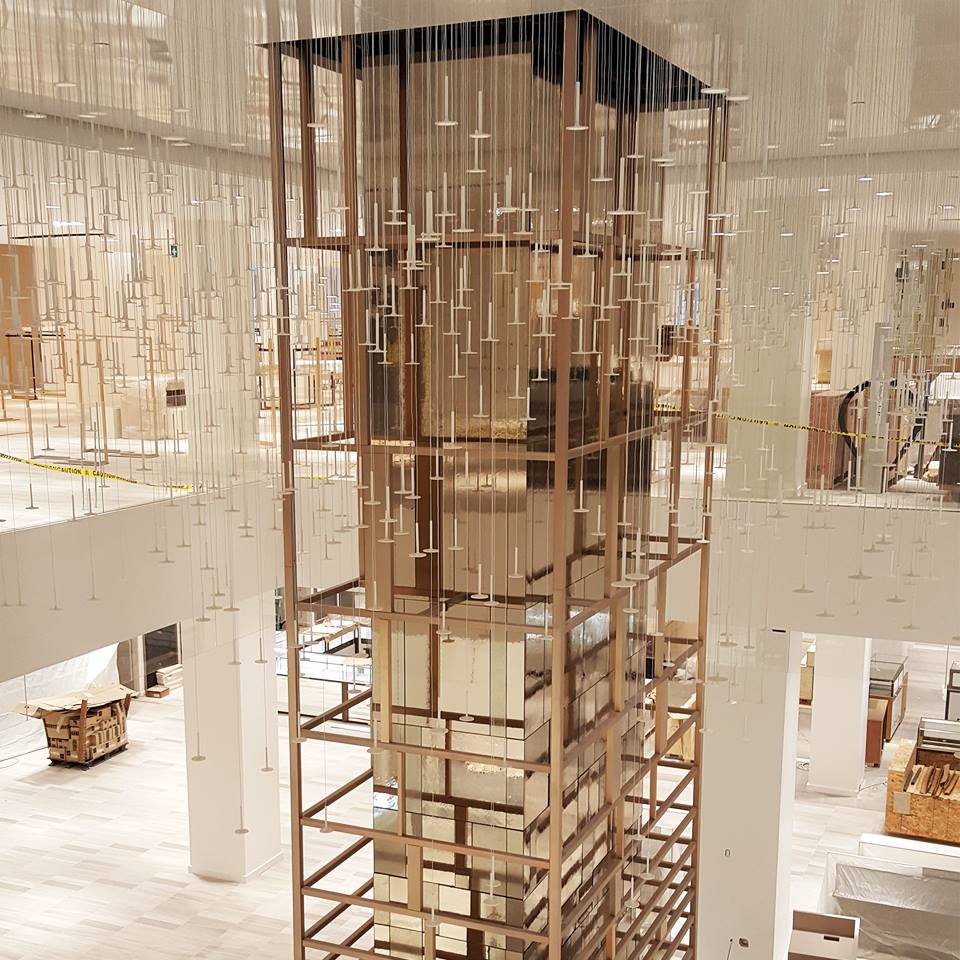
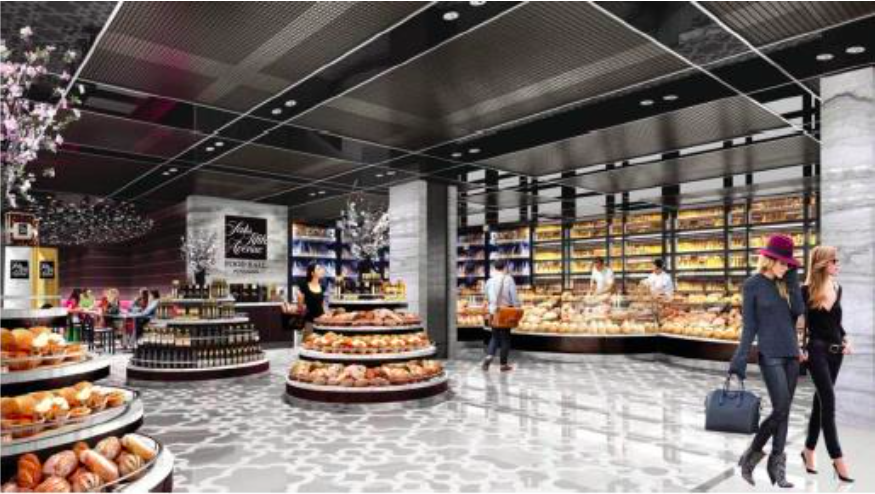
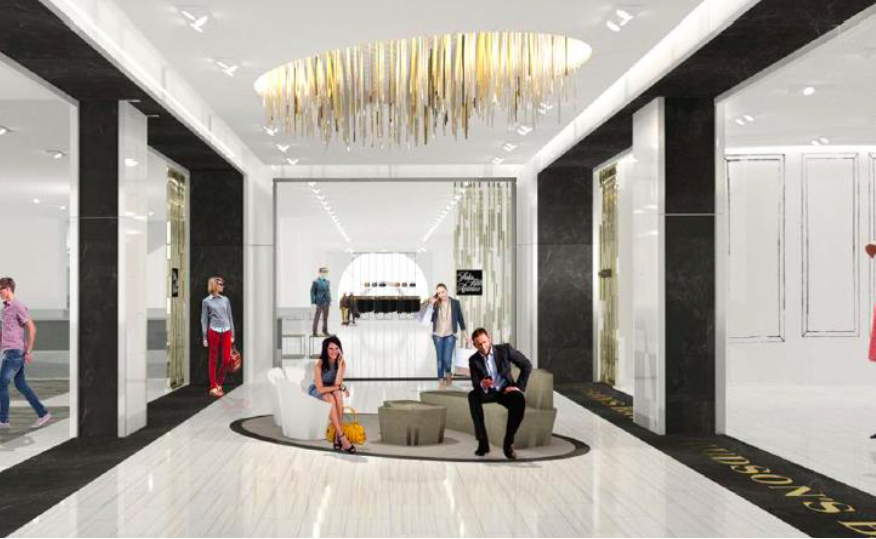
The first Saks location, at CF Toronto Eaton Centre, opens the morning of Thursday, February 18. The 163,000 square foot store will span four levels at the eastern end of the Queen Street Hudson’s Bay building, facing Yonge Street. The store will act as Saks’ Canadian flagship, and will feature a roster of luxury offerings that will rival Holt Renfrew. The store’s lower level will feature a 21,000 square foot Saks Food Hall by Pusateri’s Fine Foods (opening mid-April). The ground floor will feature a handbags hall (including boutiques for Louis Vuitton, Burberry and others), jewellery (including a Piaget boutique), cosmetics/beauty, with entrances off of Queen Street, Yonge Street, and Richmond Street. The store’s second floor will be devoted primarily to menswear, including a made-to-measure lounge. The store’s third floor will feature womenswear, a large footwear salon called 10022-SHOE, and personal shopping suites at Fifth Avenue Club, Saks’ personal shopping and styling service that will include a private suite with refreshments, not unlike Holt Renfrew’s ‘Apartment‘ concept. The Queen Street Saks will also feature a three-level, 11,000 square foot restaurant/bar operated by Oliver & Bonacini.
Photo: Saks via Instagram
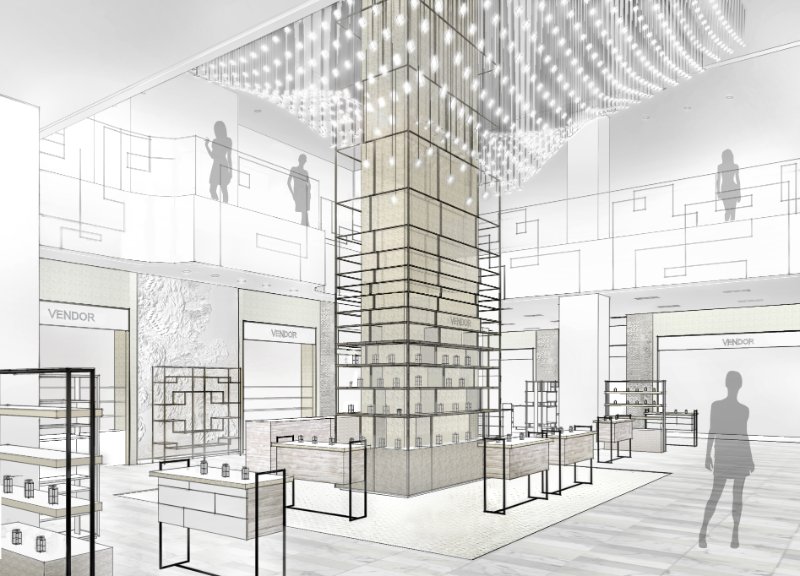
Rendering: Queen Street cosmetics hall, via Hudson’s Bay Company on LinkedIn
February 12, 2016. Photo: Saks, via Facebook
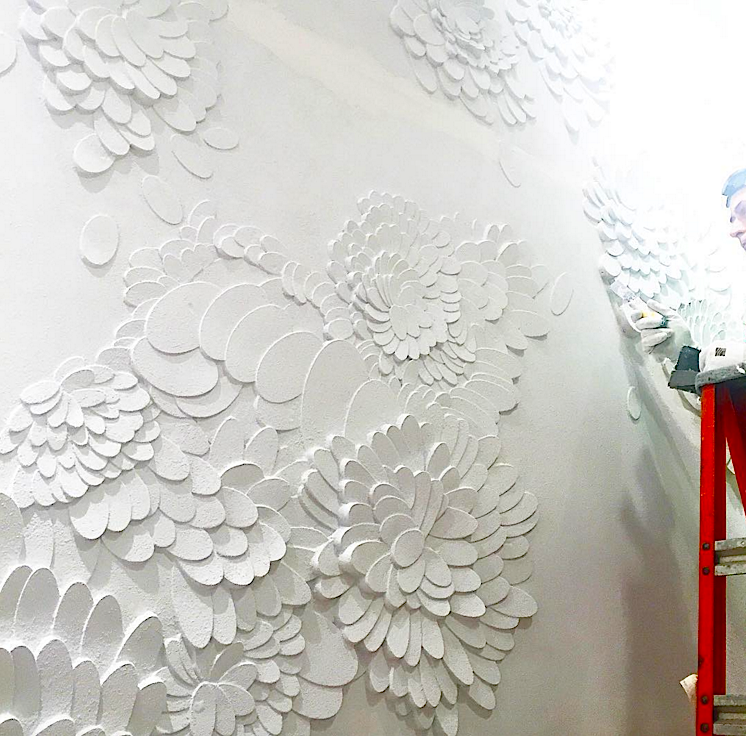
Queen Street Saks wall treatment. Photo: Saks via Instagram
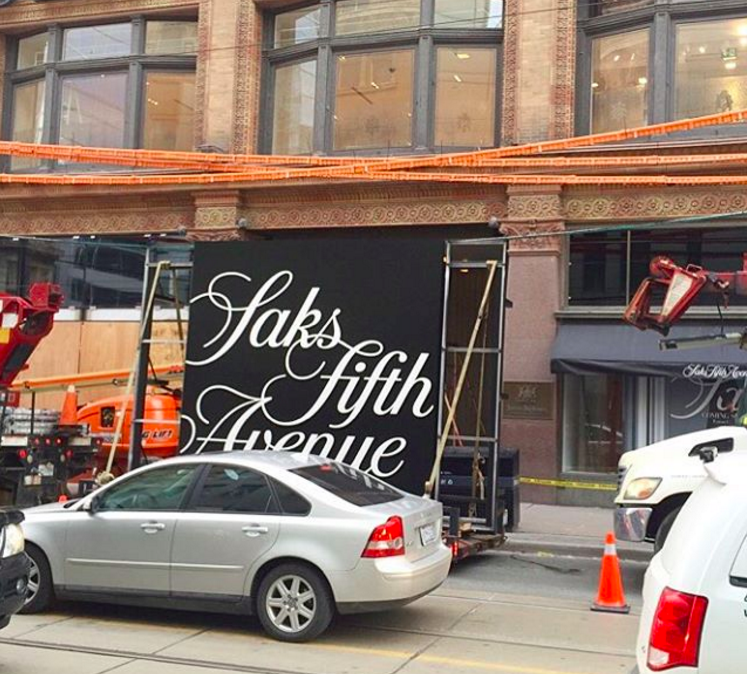
Saks signage being installed on the Queen Street store on Feb 6, 2016. Photo: Saks, via Instagram
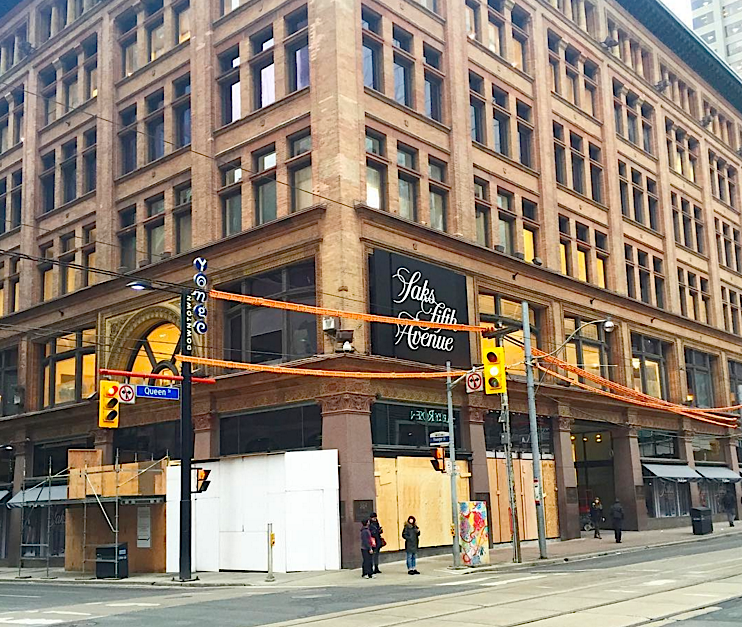
Corner of Yonge Street and Queen Street West on February 8, 2016. Photo: Saks via Instagram
Fifth Avenue Club on Feb 12, 2016. Photo: Saks via Instagram
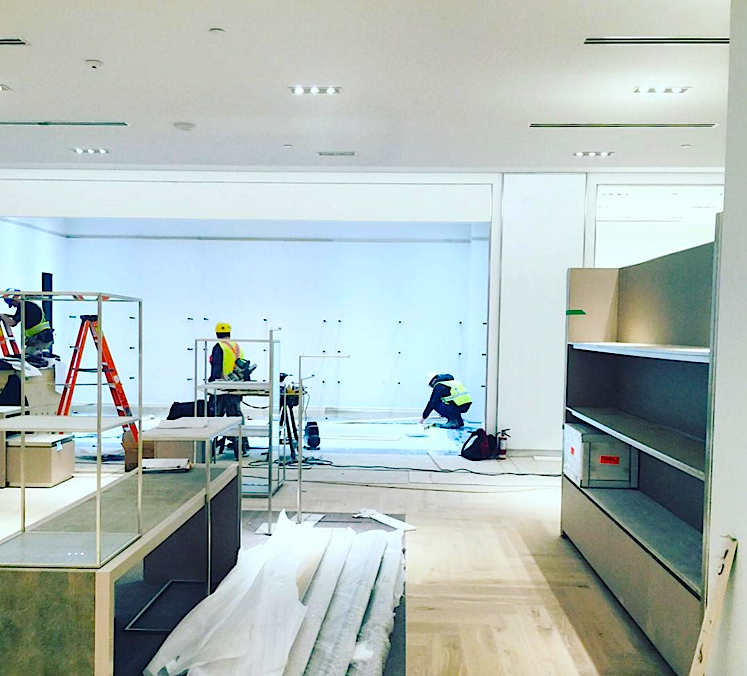
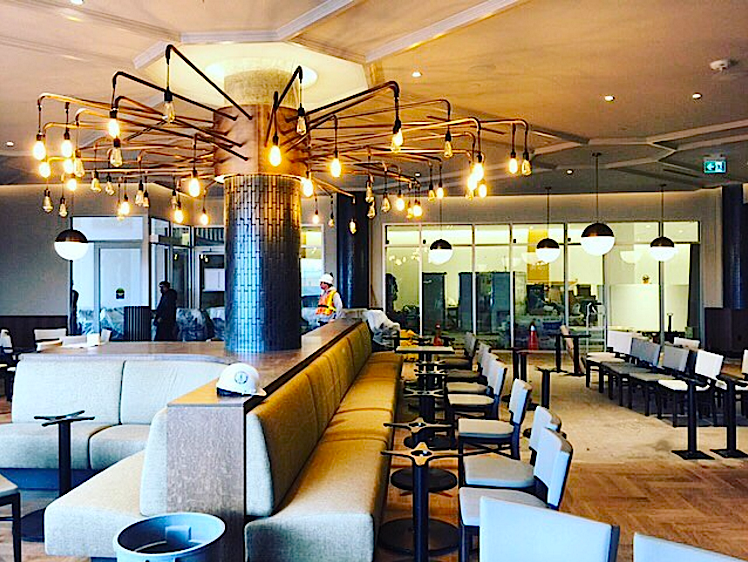
The second Saks location, at CF Sherway Gardens, opens the morning of Thursday, February 25. The 132,250 square foot store will span three levels in the mall’s former Sears space. The store’s lower level will feature an 18,500 square foot Saks Food Hall by Pusateri’s Fine Foods. The store’s two upper levels will feature many of the same departments as the Queen Street flagship, including men’s and women’s departments, The 10022-SHOE footwear salon, Fifth Avenue Club, and a 5,500 square foot Oliver & Bonacini-operated restaurant called Beaumont Kitchen. The Sherway Saks will feature “a fresh, contemporary, open-format layout”, according to Saks.
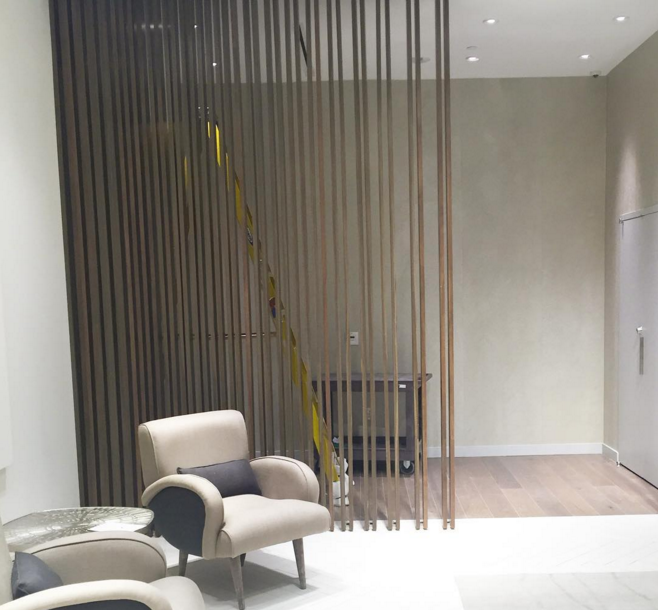
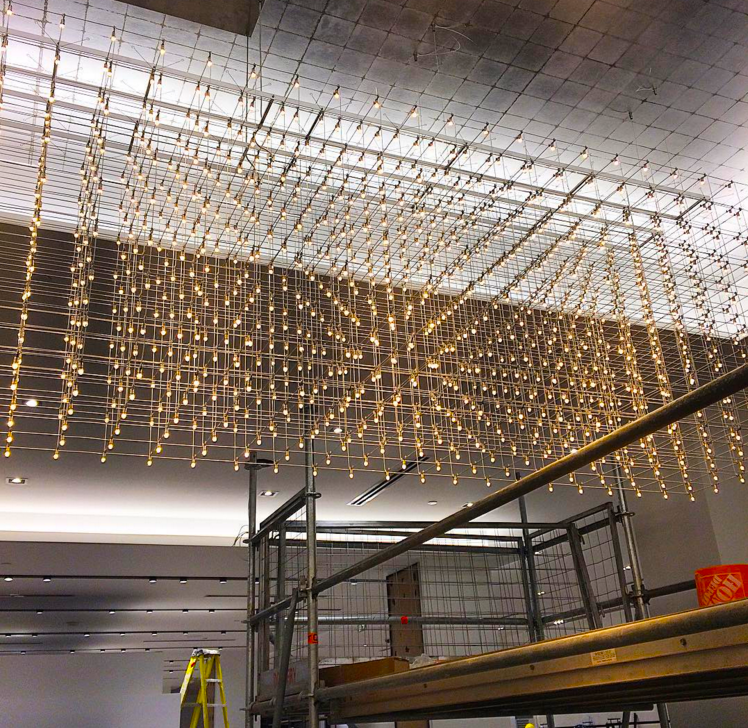
Saks Sherway lighting. Photo: Saks via Instagram
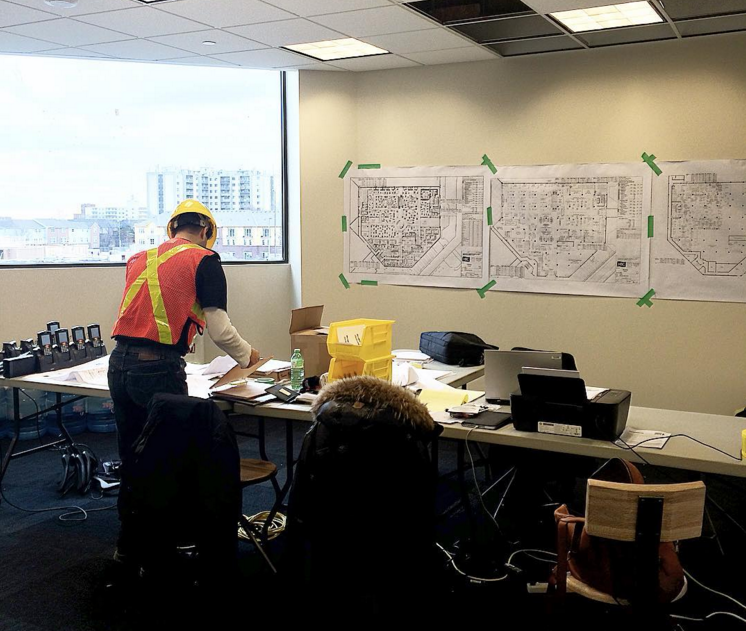
Inside the Sherway construction office. Photo: Saks, via Instagram
Photo: Saks via Instagram
Outside the Sherway store on February 9. Photo: Saks via Instagram
Beaumont Kitchen at CF Sherway Saks. Photo: Saks, via Instagram
Saks will also introduce ‘The Personal Shopping Experience’ to the Greater Toronto Area, featuring a Saks-branded Mercedes-Benz accompanied by a personal shopper that will travel to a client’s home or office. The car will be stocked with merchandise specifically selected for the client, with amenities including styling, beauty consultations and tailoring.
Saks Flagship as seen from the corner of Yonge and Richmond Streets. Rendering: Hudson’s Bay Compay
Queen Street food hall. Rendering, Hudson’s Bay Company
Entering Saks/Bay from Eaton Centre pedway. Hudson’s Bay is to the right, Saks is in front and to the left. Rendering via Hudson’s Bay Company
Sherway Rendering, via Hudson’s Bay Company
Saks could open up to eight Canadian locations, according to the company. No further locations have been confirmed, though Saks has said it will eventually open stores in Vancouver, Montreal and possibly in Calgary. Saks will also roll-out its off-price concept Saks OFF 5TH this year, and it has already announced 11 Canadian locations that will open over the next three years. Saks will eventually operate about 25 OFF 5TH locations in Canada.
We’ll be attending the February 18 opening of Saks in Toronto, as well as some pre-opening events, and will report back with our observations.
CENTRE EATON, SAINTE-CATHERINE STREET WEST. A 44,840 SQUARE FOOT SAKS OFF 5TH WILL MOVE INTO THE FORMER LES AILES AS THE MALLS MERGE. PHOTO: IVANHOÉ CAMBRIDGE
Downtown Montreal is in transition. The real estate market has become increasingly dynamic as traditional sectors evolve; the retail sector is no exception to this trend!
The core retail sector, as we define it, is based predominantly along Sainte-Catherine Street West, with the addition of some adjacent cross streets such as Crescent, de la Montagne, Stanley, and Peel. Home to major retailers such as Hudson’s Bay, Simons, and Ogilvy, Sainte-Catherine West has been the heart of downtown retail activity for over a century. To complement this corridor and to accommodate shopping during the harsher winter months, there are also five shopping centres that front on Sainte-Catherine Street, and are linked together through the under- ground network, housing a larger variety of fashion, entertainment and services. This retail sector is on the verge of one of its largest shifts ever.
Demographic change is impacting retail
This shift involves the notable population growth in the central area of downtown. We are focussing mainly on the area bounded by Avenue des Pins, Saint-Urbain Street, the river and just west of Guy Street. This area recorded an increase in population of 18.7% between 2010 and 2015 and is forecast to achieve another 15.2% increase in the next five years, compared to the Montreal CMA which is estimated to see 5.3% population growth between 2015 and 2020. This growth equals an additional 13,000 residents downtown, who will all need somewhere to buy their groceries, work-out, eat out, be entertained and relax. It is of great significance that the majority of these residents are in the 25 to 34 year age cohort, the average annual household income is $76,000 and there is an average of only 1.6 persons per household. Moreover, more than 57% of the downtown population has a university degree, far above the Montreal average of 25%. All of these factors can be summarized by stating that for the first time in decades downtown Montreal is filling up with young urban, well-educated professionals with healthy amounts of disposable income.
As a growing portion of the population is becoming university educated, and with that higher education and the time it takes to achieve, today’s graduates are more frequently delaying having children until later in their lives, rather than in their early 20s. This leaves them without the parental responsibilities that might otherwise usher them into family life, which has in recent decades meant moving off-island to the suburban markets as a young family. Without children at the top of their priority list, these young professionals are instead able to prioritize the prized “Lifestyle” that can be found by residing in the downtown core. This lifestyle choice includes proximity to work, and the ability to walk or cycle to the office. The rise of this highly-educated, high-earning, childless demographic has opened up a significant market for residential property in the downtown core, which has been quite active in Montreal in recent years with intensive condominium and apartment construction. Recent data indicates that there are more than 4,000 condominium units under construction in downtown. Just look at the cranes along Rene-Levesque Boulevard West and in Griffintown to see this growth.
Place Montréal Trust – Ivanhoé Cambridge
The Shift In Retail
As this demographic shift continues to gain momentum, the makeup of the downtown retail sector is shifting with it. Retailers in the downtown core, which historically had fewer residents, were able to focus predominantly on more consumer goods like fashion. As the number of residents downtown continues to rise, so too does the number of retailers to meet the newfound demand for services and daily needs, with entities such as grocery stores and pharmacies sprouting up. With more people living downtown, the demand for leisure after work, such as restaurants and cinemas, will also rise.
Aside from mere proximity, another major factor drawing these young professionals into the downtown core is “The Lifestyle” made available to them at their fingertips. The increased prevalence of mixed-use developments is responding to this demand, in that one needn’t trek over to the next neighbourhood for something if it is available downstairs or around the corner.
An example of lifestyle-centric development in the pipeline is the redevelopment of the Ogilvy store and surrounding properties by Carbonleo. This mixed-use development will contain a 5-star hotel, high-end condominiums, and retail and restaurant space. The centre-piece of this development, a newly renovated and expanded Ogilvy/Holt Renfrew combined store, will have over 220,000 square feet of retail space. Completion is expected in late 2017. The Tour des Canadiens sports-themed condominium complex is another example, and L’Avenue comprises residential, commercial and office space all in one building. Furthermore, the City of Montreal has seen the need to redevelop its main retail corridor, to meet the needs of this changing demographic and create a better experience for shoppers. The City’s multi-phase construction project on Sainte-Catherine is expected to launch in 2017 and last four years. Plans include wider, heated sidewalks to make navigation easier in the winter, free Wi-Fi, and fewer parking spaces (more pedestrian spaces). All of this will attract the new residents to this area.
CARBONLEO’S OGILVY/HOLT RENFREW PROJECT WILL INCLUDE AN ADJACENT LUXURY HOTEL AND CONDOS. RENDERING: CARBONLEO
Some Fail & Disappear, Some Succeed And Grow! The Darwinian Law Of Retail
In addition to increases in day-to-day shops in terms of overall market composition, the makeup of individual sectors is also changing to accommodate for the preferences of the new residents. While the closures of a number of mid-range fashion retailers has been making news headlines lately, a number of newer/trendier/younger brands have been lining up to fill the vacancies. For example Mexx, Jacob and Tommy Hilfiger all closed their doors on Sainte- Catherine in the last year. The nature of the stores that are closing versus the stores that are replacing them speaks to the rising importance of the newer generation, and how, as consumers, they are the new dominant force in the retail world. Rather than the closures indicating any kind of retail slump in Montreal, they speak to the responsiveness of the market to the constantly-changing needs of consumers, or from another angle, the constantly-changing composition of the body of consumers as a whole. Some of the newcomers to the Sainte-Catherine strip are Aritzia, COS, and G-Star RAW. On a longer horizon, one can expect to see downtown retailers like MUJI, Uniqlo, Hudson Bay’s newly-acquired Saks Fifth Avenue, F21 RED, AllSaints, Karen Millen, and more. The majority of these fashion retailers cater to a younger generation. Even with the store closures and new openings, the actual vacancy along Sainte-Catherine Street in particular has remained fairly stable, and in fact has decreased in the last year. Vacancy between Guy Street and Robert Bourassa Boulevard decreased from 6.0% in the spring of 2014 to 4.4% in the spring of 2015. Major international retailers understand the significance of this corridor. They are making careful location decisions in order to better serve customers; new entrants to the downtown core, such as Lolë and G-Star, sought out unique spaces that have character and high visibility. Frank & Oak, originally an on-line only retailer, has opened a store on Stanley Street, just north of Sainte-Catherine, where men can get a haircut and pick out suits at the same time. These types of stores cater to the young, hip demographic and understand the significance of the in-person shopping experience they offer.
PLACE VILLE MARIE FEATURES A SUBSTANTIAL RETAIL PODIUM. PHOTO: IVANHOÉ CAMBRIDGE
The Technology Era & Its Influence On Retail
Likewise, as the population in the downtown core continues to be more educated, young, and most importantly tech-savvy, they will begin to demand further technological integration in the purchasing process. With the continued rise of online purchasing, it will likely alter the very definition of a store – we have likely already surpassed the traditional brick-and-mortar vending of merchandise. Instead of acting essentially as warehouses where consumers explore the merchandise and ultimately make a purchase, stores of the future will be more successful integrating themselves with online purchasing to make a smoother and more logical overall process.
Instead of brands building redundant, two-track infrastructure and competing with themselves, they would be better served by integrating into one, smoother system. Tech-savvy consumers could select items they like online, and use stores as pickup points, important on the logistical chain. Instead of the traditional warehouse role, stores could adapt to service the parts of the consumption process that [at least today] continue to require physical presence, such as checking sizing.
As the merchandise aspect of brick- and-mortar retail continues to slide onto the sidelines, the defining role of a store could soon be entirely redefined. Since the 1700s, the word ‘store’ has referred to a place goods are stored in order to be showcased and sold. With the rise of online shopping, spurred by a rapidly growing demographic of computer-literate consumers, the storage and sale of merchandise could in large part be replaced. The main objective of stores could shift, becoming more important as delivery and distribution centres for products decided upon online. With the sale of merchandise beginning to be sidelined, stores will need to do some soul-searching to carve out their new role in this increasingly online retail landscape – with focus on the creation and/or expansion of services that require a physical presence, and cannot be replicated online with today’s technology. This will likely manifest itself in the conversion of stores into marketing vehicles where branding and lifestyle-based marketing can be promoted. The in-store experience will become more important than the inventory!
Retail is constantly in flux; consumer preference is ever-changing, demographics vary over time; technology is impacting historical means of acquiring goods. As such, the retail sector must be incredibly responsive to the preferences of consumers and retailers alike. Evolving demographics requires an evolution in the shops and services required to meet perpetually shifting demand. The significant increase in the residential population is going to alter the retail landscape as we know it in the heart of Montreal’s busiest downtown retail districts. Retail is probably the most dynamic of asset classes, its success depends on new consumer preferences, their ability to spend and their level of confidence in the economy. Montreal is no exception when it comes to retail, either to adapt and thrive or fail and disappear.