Advertisement
Advertisement
Home Blog Page 1168

Neal’s Yard Remedies Plans Canadian Expansion

British organic natural health and beauty products retailer Neal’s Yard Remedies plans to open stores across Canada over the next several years. Its first North American location opened in Canada last year, and a second store has just been announced. We spoke with Lisa Costello, CEO of Neal’s Yard Remedies Canada, to learn more. 

Founded in 1981 in Covent Garden, London, Neal’s Yard Remedies has more than 80 stores in 21 countries across five continents. It has grown to become a global leader in ethical, organic beauty and health, and its award-winning products are manufactured by hand in England using sustainably sourced, certified organic ingredients.

Neal’s Yard Remedies’ first North American location opened in June of 2014 in Calgary. The 1,000 square foot free-standing store is located in the city’s Mission district, on 4 Avenue SW. Neal’s just announced a second Calgary location, set to open in November, at Southcentre in the city’s southern suburbs. Neal’s plans to open about 10 Canadian locations over the next five years through its Calgary based Canadian ‘development agent’, headed by Ms. Costello. 

Ms. Costello explained her company’s strategy for a cross-Canada expansion, as well as how some locations may differ. Neal’s will consider retail spaces both within busy shopping centres, as well as streetfront locations similar to its first Calgary store. The chain’s streetfront stores will typically include treatment rooms, allowing for a blend of ‘inner health’ and ‘outer beauty’. The current Calgary location, for example, includes an acupuncturist providing facial treatments. Shopping mall locations, however, will lack treatment rooms, though they may be roughly the same square footage as Neal’s streetfront stores. Its Southcentre location, for example, will measure almost 1,000 square feet and will focus primarily on the brand’s products.

Although no immediate plans were revealed, Ms. Costello said that Neal’s Yard Remedies may look to open in a variety of Canadian cities, provided that the ‘right’ retail locations become available. She mentioned that a third Calgary store could be a possibility, and that markets such as Toronto and Vancouver could prove to be prime markets for future Neal’s locations.

Ms . Costello also mentioned that there could be a possibility that Neal’s Yard Remedies could partner with a larger retailer by opening shop-in-store concessions. Although no plans are in place, Ms. Costello noted that concessions within department stores are a trend internationally, including in Great Britain where Neal’s Yard Remedies was founded.

Pop-Ups Create Brand Awareness for Innovative New Denim Brand

Vancouver-based denim brand Dish Jeans is using multiple pop-up locations to build awareness for its brand, as well as its new men’s technical denim brand. We spoke with ‎Co-Founder/President of parent company Pimlico Performance Apparel Ltd.’s Gary Lenett to learn more, and we consulted with a retail expert to gain insight into the benefits of pop-ups. 

Dish Jeans recently expanded to include a new “function meets fashion” men’s denim line, called DU-ER. Recognizing the new ‘athleisure’ demographic, Mr. Lenett developed two proprietary fabrics for the line. The fabric, L2X (leisure to extreme) and N2X (nature to extreme), combine COOLMAX® fabric and TENCEL® to offer moisture management, temperature control, and anti-bacterial properties. Mr. Lenett also innovated the design to include lined pockets that protect males against cell-phone radiation and dark/reflective branding that can be spotted by night drivers, as the denim is fit for bike commuting. The lightweight jean has five times the stretch of regular denim for males, allowing it to be worn by a wide demographic of active people.

Both the women’s Dish Jeans line and the new DU-ER men’s line wholesale in a number of top retailers. To heighten brand awareness and to enhance its wholesale accounts, Mr. Lenett explained how his company is seeking temporary pop-up retail space between about 1,000 square feet and 2,000 square feet. Each location will remain open for about four weeks, hosting a variety of events for shoppers. The company’s first pop-up recently opened in Vancouver’s Railtown area, adjacent to the company’s design studio. 

The pop-up trend is “as much as an event as a store” according to Mr. Lenett. Besides its Vancouver pop-up and a number of planned U.S. locations, Mr. Lenett says that Dish Jeans may roll-out pop-ups in markets including Calgary, Toronto and Montreal. The brand will announce these closer to their opening dates. 

We spoke with retail expert Farla Efros, President of leading retail consultancy HRC Advisory, to discuss the pop-up trend. Ms. Efros explained that pop-up shops are “here to stay” and that pop-ups can bridge the gap between online and offline, as brands look to build awareness, drive loyalty, and convert shoppers into buyers. She noted that the shorter commitment and lower-cost of pop-ups make them attractive to some retailers, especially as pop-ups require little lead time. By the nature of their “limited engagement” format, pop-ups can generate brand excitement, encourage planned purchases, and create an overall buzz that may not otherwise be achieved. 

Ms. Efros further explained that pop-ups can be leveraged as brand development ‘labs’, testing new products in new markets, while reaching new customers. For pure-play retailers, the number one goal of a pop-up is to create a direct connection with the customer, she said. When done successfully, these customers will continue shopping with the brand either online, or with its local wholesalers, if applicable. 

Canada’s Top Footwear Designer, Ron White, Continues Expansion

Toronto-based footwear designer Ron White continues to grow his retail and wholesale operations. He just opened a fifth free-standing store location, and he recently launched a new bridal footwear line. We interviewed Mr. White to learn more about his booming business, which had earned him the nickname of Canada’s ‘Shoe-Ru‘. 

Ron White founded his footwear business in 1993, when he opened a comfort-focused multi-brand store in Toronto called The Foot Shoppe. It grew to several locations and in 2006, Mr. White rebranded the stores to his own name, targeting a younger, more fashion-forward shopper. Soon after, Mr. White decided to create his own namesake footwear brand, merging style with comfort to create “All Day Heels®”, utilizing cutting-edge comfort technology. His private-label women’s collection quickly became the store’s top seller, precipitating a wholesale expansion for the popular brand. 

Last month, Ron White opened his fifth free-standing store in Toronto’s Leaside area, at 1553 Bayview Avenue. Located in the heart of the ‘Bayview Strip’, the new store features about 1,200 square feet of retail space on its ground-level, as well as roughly 800 square feet of storage and operations in the basement. The shopping street features extra-wide sidewalks, pleasant patios and a plethora of loyal locals. Mr. White says that the store is doing exceptional sales after only being open for a month, and there’s a reason why — the area’s patrons are typically upper-middle class and mature, which mirrors the brand’s primary target market. Mr. White explained how the Leaside shopping strip is frequented by those living in areas such as Rosedale, Moore Park, and other adjacent affluent areas. These shoppers come to Leaside seeking a casual, relaxed shopping area away from the formalities of Yorkville and the hustle and bustle of a large shopping mall. Mr. White described how in a ‘popular mall’, roughly 25% of shoppers may be within his brand’s target market while in Leaside, it’s in excess of 95%. 

Ron White operates a total of five brick-and-mortar store locations, all in Toronto. Besides the new Leaside location, Ron White stores are located at Manulife Centre in Yorkville, Sherway Gardens, Bayview Village, as well as on Lakeshore Road East in affluent Oakville. Mr. White said that there are no immediate plans for more free-standing stores, thought that could change in the future. 

Ron White’s wholesale business is booming, and Mr. White tells us that the company continues to see double-digit growth. It wholesales through a number of Canadian retail partners, with his main line, simply called Ron White, selling at upscale retailers including Holt Renfrew, Ogilvy in Montreal and O’Connor’s in Calgary. His lower-priced line, WHITE Ron White, is carried at selected Hudson’s Bay and Town Shoes locations. His priciest line, Ron White Signature, is carried in his free-standing stores as well as online. Remarkably, Mr. White says that his brand’s sales in the United States now surpass sales in Canada, and the brand is projected to see explosive growth over the next several years as it looks to partner with retailers overseas. 

Ron White’s newest footwear line was designed specifically for brides. The five-style collection launched in March, and it is carried exclusively at Kleinfeld Bridal on the seventh floor of Hudson’s Bay at the Toronto Eaton Centre. Mr. White explained that his comfort technology allows the stylish bride to keep her footwear on for the entirety of her ‘special day’, rather than have to remove shoes due to discomfort.

The Upside of Politeness in Québec: Language Laws and Retail Signage

By Eric Blais

As expected, the Québec government indicated last week its intention to challenge Québec’s Court of Appeal’s ruling that the province cannot force companies to add a French component to their name.

Several multinationals took the province to court after they were told by the Office québécois de la langue française to change their names or risk running afoul of the rules governing the language of business in the province. A Québec Superior Court judge sided with the companies, which included Walmart, Costco, Best Buy, Gap, Old Navy and Guess.

I leave it to others to debate whether this should be forced upon retailers through legislation. It’s a sensitive issue but one marketers would be wise to consider from all angles before dismissing it as just one more obstacle to overcome when doing business in Québec.

Québec Premier Philippe Couillard was a brain surgeon before entering politics. He could also have been a marketer. This time, the governments appears to be adopting a slightly different tone. The narrative from past government on this delicate issue has often been about protecting the French language and the Québec nation’s distinct identity. It still is but Mr. Couillard gave a different explanation for his government’s position – one that sounds more like a marketer’s viewpoint than a politician’s.

The Premier gave the example of Second Cup:

“Everyone knows that they sell coffee, but it’s like this company said, ‘I know where I am, I know what environment I am in and recognize the existence of the French in Quebec.

“We don’t want to erase trademarks – it’s not that Canadian Tire will become Pneu canadien, let’s be clear on that, but it’s a question of politeness.”

A question of politeness

Most companies operating across geographies comply with local regulations while looking for efficiencies. It’s not always an easy balance to achieve and Québec, with its many unique requirements, can be particularly challenging. Those who are frustrated by Québec’s demand that a French descriptor be added to English trademarks will view this latest move as one more costly irritant.

Others will view it differently. Many already have; through a marketer’s lens instead of a lawyer’s.

The Premier called it a politesse, a courtesy. The importance of being courteous is nothing new to retailers. Let’s stay with coffee. According to the J.D. Power and Associates 2012 Specialty Coffee Retailer Satisfaction Report, staff, more than price or merchandise offerings, is key to driving higher satisfaction among specialty coffee customers. One of the key staff factor is courtesy. It’s not a stretch to suggest that adapting all brand touch points in Québec to cater to French-speaking customers can signal a higher level of courtesy, including the sign above a store’s entrance.

A competitive advantage

Quebeckers will view a retailer’s brand more favourably if it makes an effort to adjust to their needs. For retailers, adding a French descriptor to an English name is a symbolic way to signal that they are catering to them. There is directional evidence of this in the findings from our firm’s What Québec Wants™ study. When we asked 3,000 Canadians whether they agreed or disagreed with the statement “I prefer to buy products and services from companies that make an effort to cater to the specific preferences and needs of people in my locality“, 63% of French-speaking Quebeckers agreed compared to 50% of Canadians living in the rest of Canada.

There are no doubt cost and operational implications for doing so. When Crate & Barrel added the word “maison” next to its name, it did what many others have done without being forced to. To quote the Premier again, “it said, ‘I know what environment I am in” and I will brand myself accordingly.

There is no law forcing banks and other retailers to have signage in Chinese in Markham, Ontario and in other communities across Canada. They do so voluntarily. Clearly, these organizations see it as an investment instead of a cost. Even Québec’s Banque Nationale thinks it’s a business practice that will help its brand in that community.

Retailers should carefully consider their position on this issue. Rather than look at this as being forced to invest to protect the French language, they should consider assessing how it might benefit their brand to be the more polite one.

UPDATE: At a recent news conference Hélène David, the minister responsible for the French Language Charter, said the government will oblige Québec retailers to add French descriptives to their outdoor banners. However, David confirmed Québec has decided not to appeal the Québec Court of Appeal ruling. Instead, it it will change the law at the level of regulations.

Eric Blais is President of Headspace Marketing – a Toronto-based marketing-communications consultancy helping clients build their brands in Québec.

Dollar Store Wars Heat Up as Canadian Retail Polarizes

The Canadian retail market continues to polarize. Montreal-based dollar store retailer Dollarama has significantly increased its anticipated maximum number of Canadian stores, and competitor Dollar Tree is looking to increase its current store count five-fold. Family Dollar is also eyeing Canada, creating competition at the low-end which mirrors the potential bloodbath at the top end, as luxury retailers also battle to gain Canadian market share. 

In March of 2014, Dollarama CFO Michael Ross said that the then 800-store retailer would expand by about 50%, eventually operating about 1,200 Canadian locations. This was based on a growth number of about 85 stores in 2014, and a further 70 to 80 locations in 2015. According to CTV, Dollarama’s Canadian store count recently sat at 972, with its 1,000th Canadian location set to open this fall. Remarkably, Dollarama now expects that it will eventually operate about 1,400 Canadian locations within the next several years. 

Dollarama (PHOTO: DOWNTOWNCHATHAMCENTRE.CA)

American competitor Dollar Tree currently operates over 200 Canadian locations, under the ‘Dollar Tree Canada‘ nameplate. Remarkably, representatives say that its goal is to eventually operate in excess of 1,000 Dollar Tree Canada stores. Both Dollar Tree and Dollarama continue to sign leases and open stores nation-wide, with some busy locations earning well into the millions, according to some landlords we’ve spoken with. 

Also operating under the same ownership is American chain Family Dollar. A company representative recently said that Canada is on Family Dollar’s radar, with the potential to open Family Dollar-branded locations in Canada within the next several years. It would be remarkable that Canada would host three large dollar retailers, considering its size and already intense competition. 

Family Dollar (PHOTO: VIRALSURVIVAL.COM)

On BNN last month, HRC Advisory CEO Antony Karabus described how polarization in the Canadian retail market continues to unfold. He noted how high-end and lower-end retailers seem to be succeeding in Canada, while ‘middle-market’ companies struggle and in some cases, close. Canada’s ‘dollar store wars’ is certainly an indication of this, as is increasing competition at the top end of the retail spectrum from a variety of luxury retailers. 

Various luxury brands continue to enter the Canadian market, as well as expand existing operations. Prada, for example, will substantially expand its Canadian operations over the next 12 months, and brands such as Dior, Brunello Cucinelli and Jaeger-LeCoultre are preparing to open their first free-standing Canadian stores over the next few months. Large-format luxury retailers are also putting on the boxing gloves — Holt Renfrew, for example, is spending in excess of $300 million to overhaul and expand its store fleet, and Saks Fifth Avenue and Nordstrom plan to open multiple Canadian stores. Upscale menswear retailer Harry Rosen is also spending millions to update and replace some of its locations, as retailers continue to profit from an increasing number of Canadian luxury shoppers. 

Soon, Dior will open its 1st free-standing Canadian location at 900 W. Georgia St. in Vancouver. A 2nd Dior location will open on Bloor St. W. in Toronto in 2016.

One Canadian retailer appears to be addressing the polarization trend, carrying both lower-priced product as well as pricey luxury brands. Quebec City-based La Maison Simons, which we discussed yesterday, plans to open up to 25 Canadian stores, up from its current nine locations. About 80% of Simons’ product is reasonably-priced private label, with the remaining 20% being designer, with some fashions priced well into the thousands. Simons appears to be seeing success with its formula — not only does it plan to almost triple its current store count, revenues are forecasted to grow by over 30% within the next two years. 

La Maison Simons to Open 2 Toronto Locations

RENDERING: LA MAISON SIMONS

The CEO of popular large-format Quebec City-based fashion retailer La Maison Simons has revealed that it will open two Toronto stores, joining a location already under construction in Mississauga. Simons is spending in excess of $200 million to open eight locations over the next three years, eventually operating as many as 25 stores nationally. 

According to the Montreal Gazette, Simons’ CEO Peter Simons said that the retailer will open locations at Toronto’s Yorkdale Shopping Centre, as well as at Scarborough Town Centre. Store sizes and opening dates are yet to be determined. Simons will also open a 113,000 square foot location at Square One in Mississauga in the spring of 2016, and all three malls are under the ownership umbrella of landlord Oxford Properties

Mr. Simons recently told us that he was still interested in opening a downtown Toronto store, though negotiations to open at the Toronto Eaton Centre had stalled. He also said that he could open a second Calgary location at Oxford Property-owned Southcentre, joining a recently announced downtown Calgary Simons store. Sources say that Simons may have leased a second Vancouver-area store, and that the retailer is looking to eventually operate as many as four stores in the Vancouver area. 

If Simons secures space at Calgary’s Southcentre, it will be the sixth Oxford-owned mall to feature the retailer. Oxford Properties currently operates 11 shopping centres across Canada. 

PHOTO: LA MAISON SIMONS

Simons is spending in excess of $200 million on its store expansion, according to the Montreal Gazette. Its next location opens in August, measuring about 80,000 square feet at Les Promenades Gatineau, north of Ottawa. On October 15, Simons will open a 100,000 square foot location at West Vancouver’s Park Royal. In 2016 it will open the Mississauga location as well as a 100,000 square foot store at Ottawa’s Rideau Centre. In 2017, Simons will open a 92,000 square foot location at The CORE in downtown Calgary, as well as a second Edmonton location, measuring about 100,000 square feet, at Londonderry Mall. Simons’ first location outside of the province of Quebec opened at West Edmonton Mall in October of 2012. 

Several months ago, Mr. Simons told us that he envisions up to 20 locations for Canada. In last week’s Montreal Gazette article, he indicated that this number could be as high as 25. 

Founded in Quebec City in 1840, La Maison Simons is unique in how it pairs its substantial private-label fashion with a handful of higher-priced designers. Despite its large floorplates, Simons stores lack cosmetics departments and the large footwear areas typical in similar-sized department stores. Simons currently operates nine stores, including eight in the province of Quebec and one in Edmonton. The company has over 2,000 employees. The company’s 2014 revenues were in excess of $300 million, according to Mr. Simons, with projections for $400 million plus “in the next year or two”.

Prada to Substantially Expand Canadian Operations

Italian luxury brand Prada plans to substantially grow its Canadian operations over the next 12 months. It will significantly expand and renovate its ‘Mink Mile’ flagship in Toronto, as well as enlarge and replace several existing concessions. Prada will also open a second freestanding Canadian flagship in Vancouver later this year, spanning two floors. 

Sources confirm that Prada’s Toronto Bloor Street flagship will substantially expand by adding a second level. Located at 131 Bloor Street West in The Colonnade, Prada’s Canadian flagship currently measures 5,890 square feet. The store will expand by taking space currently occupied by The Japan Foundation, which occupies almost 12,800 square feet on the complex’s second floor. The Japan Foundation will vacate The Colonnade for Prada’s Bloor Street expansion, which is expected to be completed in early 2016. It is unclear how much of The Japan Foundation’s space will be occupied by Prada, as sources we spoke with indicated that neighbouring Chanel may also seek more space in the complex.  

Sources at Prada said the expansion would be ‘substantial’, with one salesperson saying that the store would exceed 15,000 square when completed. We cannot confirm that number at this time. 

Prada will open its second freestanding Canadian location in several months at the southeast corner of Alberni Street and Thrulow Street in Vancouver. Located within The Carlyle retail complex, the 8,200 square foot two-level Prada flagship will neighbour brands such as De Beers, Tory Burch, and Moncler. Across the street, Brunello Cucinelli, Versace and Strellson will open over the next several months as well, as Vancouver’s ‘Luxury Zone’ grows to rival Bloor Street’s cachet. 

Prada currently operates several concessions within luxury retailer Holt Renfrew. Sources say that Prada may open an expanded ground-floor concession with a streetfront entrance at Holt Renfrew’s Bloor Street flagship, featuring accessories, footwear and ready-to-wear. The Prada concession within Holt Renfrew’s Vancouver store is expected to expand as the store grows and renovates, and sources at Holt Renfrew say that Prada may also open substantial locations within Holt’s Mississauga Square One location when it opens in the spring of 2016, as well as at an expanded Ogilvy/Holt’s in Montreal in 2017. 

Farla Efros, President of leading retail consultancy HRC Advisory, said in an interview that despite the large size of the new Canadian Prada stores, the brand would be best to continue focusing on accessories and footwear. She noted that Prada’s bags and shoes are at a reasonable designer entry price, as are the brand’s sunglasses and other small accessories. Women are increasingly spending less on clothing and more on accessories, thus Prada’s ready-to-wear targets only a ‘certain group’ of women, according to Ms. Efros. Overall, Ms. Efros said that it’s important for Prada to continue investing in the brand’s brick-and-mortar operations to ensure that it remains relevant, in light of increased competition and a recent downward trend in Prada’s earnings. 

Saks Fifth Avenue’s first two Canadian stores are expected to open as early as December of 2015. We are unaware if Prada has agreed to operate out of either. Saks will open its 150,000 square foot Canadian flagship within the Toronto Eaton Centre Hudson’s Bay building, as well as 132,000 square foot unit at Toronto’s Sherway Gardens

Several of Nordstrom’s American locations feature Nordstrom shops-in-stores, both for accessories as well as women’s ready-to-wear. It remains to be seen if any Nordstrom locations will include Prada. Nordstrom recently confirmed that its Vancouver Pacific Centre and Toronto Eaton Centre stores will be among six downtown flagships for the company. 

Defining the Canadian Millennial

By Farla Efros, President, HRC Advisory

The Millennial generation represents approximately 26% of the Canadian population, or about 9 million people. The population is growing quickly, with spending predicted to exceed that of baby boomers. 

The group defines itself partly by technology, including the number of devices one possesses. Remarkably, Canadian Millennials average over three devices per person. Social media acts as their primary medium of communication, versus the ‘old days’ of watching the news, reading the newspaper or speaking on the phone. They define themselves by how many friends, followers or ‘likes’ they receive daily. They communicate via Instagram, Snapchat, Vine, Tumblr and/or texting—they often leave Facebook, as it ‘belongs to their parents’.

But don’t be fooled – in some cases, Millennials do like ‘the classics’. Many prefer hard cover books to digital and enjoy going out to see movies in a real theatre and on the big screen.

Millennials care about the environment and often make purchase decisions based on environmental responsibility, sustainability and/or giving back.  They opt for recycled/reusable sports bottles over packaged bottled water, and are mentoring their parents to do the same.

Having been raised by “helicopter parents,” this group is optimistic with unrealistic expectations resulting in a very demanding, savvy generation with a lot of “entrepreneurial” spirit.  This makes them potentially difficult to manage and hold on to in the everyday workforce, with many companies today struggling to hire and keep Millennial employees past the 2 year mark. 

The shopping journey for them is different than the norm, they use technology to gather options – and opinions. 68% of Millennials are looking for a form of peer acceptance prior to making the purchase.

They are highly opinionated and influential trendsetters, seekers and promoters of new brands – Triangl bathing suit, Brandy Melville, Forever 21, Top Shop, Uniqlo, Apple, to name just a few. They learn about brands via social media and then openly discuss their likes and dislikes as a way to learn about what is ‘now’. They are smart, trendy, savvy and they know how to extend their dollar. But beware, as they get bored quickly. In a recent study by Indiana University’s Kelley School of Business, when 600 fashion-savvy Millennial students were asked about brands such as A&F, Hollister, Timberland, Michaels Kors and Uggs, they indicated that they had ‘grown tired’ of these brands which had previously been their go-to items.

The Retailer’s Dilemma:  Where is the opportunity? 

The Millennial generation demands constant innovation and without it, retailers are at risk of becoming obsolete. But what does innovation really mean? How do retailers innovate fast enough? And how do they satisfy a generation of low loyalists, or loyalists that have low attention spans without alienating or putting at risk other parts of their current business and long time customers? 

Retail strategies to capture Millennial consumers:
•    Master the 4-Fs – be Fast, Fashionable, Feasible and Favoured
•    Turn browsers into buyers by speaking their language
•    Innovate through unique offerings that they can’t get anywhere else 
•    Speak their language (like H&M with the runways) 
•    Entertain them with parties and selfies  
•    Keep them in-store longer with charging stations to keep their devices working and free WiFi to help them share with friends

For today’s retailers, it is a balancing act that requires a clearly defined strategy that is nimble, forward thinking, fully integrated and leverages a deep understanding of this ever-changing consumer. Retailers recognizing the uniqueness of Millennials are more likely to see success than those who fail to recognize their nuances.

Farla Efros

Farla Efros is President of HRC Advisory, a leading retail advisory firm. She previously worked with Office Depot, where she served as the Executive Vice President and Chief Merchandising Officer. She has coached executives at numerous leading retailers and consumer packaged goods companies in the area of category management and assortment optimization, and she has broad experience in merchandising and category management, having worked with many of the world’s leading consumer packaged goods companies and retailers. Ms. Efros can be reached at: fefros@hilcoglobal.com

Pacific Centre Opens Nordstrom-Anchored Retail Wing [Article Includes Lease Plan and Photos]

The retail expansion under Pacific Centre‘s new Nordstrom opens today. Landlord Cadillac Fairview recently revealed a list of tenants, nine of which open today, and three which open later this summer. 

The 44,000 square foot retail expansion is located under the mall’s new Nordstrom, which is currently under construction. The Nordstrom flagship will open on September 18, with a charity gala set to be held two days prior. 

The following stores open today. According to an updated lease plan provided by Cadillac Fairview, stores are of the following sizes: 

AllSaints: 2,264 square feet,

B2 (by Browns Shoes): 2,167 square feet,

Hugo Boss: 6,129 square feet,

Kate Spade New York: 1,909 square feet,

Pandora: 694 square feet,

Ted Baker: 2,976 square feet,

Tumi: 1,230 square feet,

Weekend Max Mara: 1,773 square feet.

The following stores open later this summer: 

Abercrombie & Fitch: 5,073 square feet,

Disney Store: 4,497 square feet. 

Microsoft Store: 5,354 square feet,

Rockport Shoes: 1,625 square feet.

Kate Spade’s Pacific Centre unit will be the second Vancouver-area location for the brand, following the opening of its Park Royal store last fall. Tumi is a first for the Lower Mainland, and B2 replaces a location which shuttered on Robson Street last year. Pandora closed its Alberni Street store to locate in Pacific Centre, with Chinese luxury jeweller Lao Feng Ziang taking the Alberni Street space. Pacific Centre’s Ted Baker and Abercrombie & Fitch locations are both first-to-market. Remarkably, AllSaint’s Pacific Centre unit is only a third the size of its other Canadian store, measuring about 6,600 square feet at Toronto’s Yorkdale Shopping Centre

Designed by Vancouver-based architect James K.M. Cheng, the new building will also include a three-level 230,000 square foot flagship Nordstrom store, opening on Friday, September 18. The top four levels of the former Sears building have been converted to 290,000 square feet of AAA class office space and will be home to the head office of Sony Pictures Imageworks, the Vancouver offices of Microsoft, and law firm Miller Thomson.

Tiffany & Co. Opens at Rideau Centre

PHOTO: TIFFANY & CO. RIDEAU CENTRE

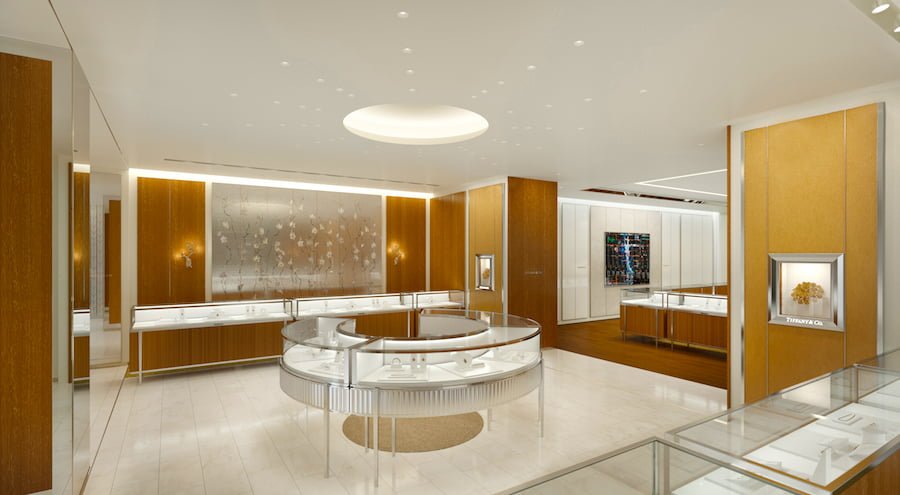
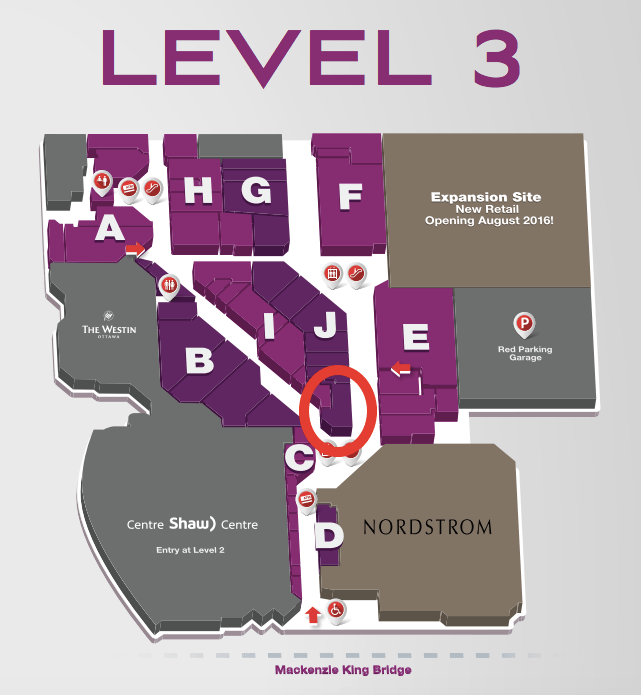
Tiffany & Co. has opened its ninth free-standing Canadian location at Ottawa’s Rideau Centre. It replaces the city’s former Tiffany concession within Holt Renfrew, which closed earlier this year. 

The new 2,400 square foot Ottawa Tiffany store carries a range of jewellery including engagement rings, ‘celebration rings’ and diamond jewellery. Lines such as the Atlas Collection and its newest collection, Tiffany T, are showcased along with jewellery collections by Tiffany designers Jean Schlumberger, Elsa Peretti, and Paloma Picasso.

The Rideau Centre Tiffany replaces a shuttered shop-in-store concession within the city’s recently closed Holt Renfrew. Holt Renfrew shuttered its Ottawa store on January 25, as the Toronto-based luxury retailer focuses on operating larger stores in a handful of primary markets

TIFFANY & CO. RIDEAU CENTRE
PHOTO: TIFFANY & CO. RIDEAU CENTRE
MAP: RIDEAU CENTRE.

Tiffany has three free-standing stores in Toronto, two in Vancouver, and one each in Edmonton, Calgary and Montreal. Three smaller Tiffany & Co. concessions also operate within Holt Renfrew locations in Vancouver, Calgary and Montreal. 

Rideau Centre is undergoing a $360 million expansion. Nordstrom’s second Canadian store opened on March 6,  measuring 157,000 square feet and occupying the top two levels of the mall’s former Sears location. New retail space will be added and in August of 2016, including a 100,000 square foot La Maison Simons which will open at the north end of the mall. As well, upscale menswear retailer Harry Rosen recently opened a 17,000 square foot replacement store featuring a footwear store with its own entrance, replacing a location about half its size.