Home Blog Page 1340

Driving profits at the retail store level

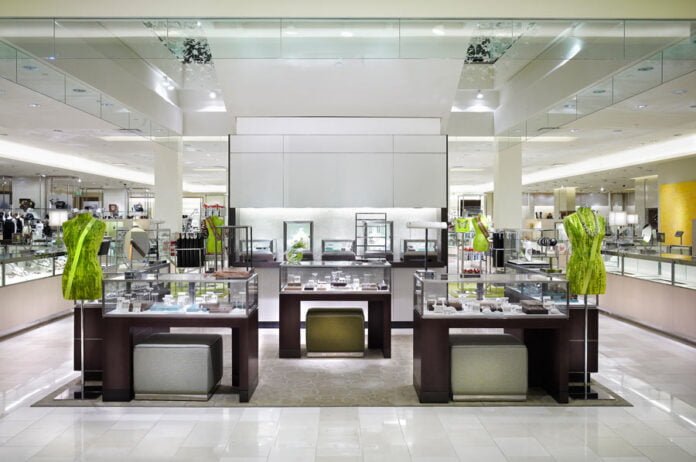
PHOTO: CALLISON ARCHITECTURE

By Nima Ghodratpour

Every day, retail managers are inundated with numbers: sales, margin, conversion, operational expenses and profitability. The confusion is not helped when the corporate raison d’etre from the higher ups keeps changing from ‘increasing revenue’ to ‘reducing costs’ or ‘increasing brand equity’. In a climate where it’s hard to understand what the actual objective is many retail managers are left scratching their heads as to how to make sound managerial decisions that will guide their stores to success.

Even with the ever-changing goals and action plans, it is encouraging to know that the main objective of most retail businesses is pretty much set in stone. What actually changes is how that objective is achieved. That main objective is creating a healthy Return on Investment, or simply, making a profit.

There are many figures that retail managers monitor on daily, monthly and yearly bases. We’ve all heard the terms, units per invoice, average invoice, and sell through. These metrics are excellent at gauging how a specific aspect of the business is performing. However, what are the main drivers that managers can directly influence that will ultimately increase the profitability of a store? There are two main managerial issues and four key performance indicators (KPIs) that can directly influence and monitor to ensure increased profitability.

The first main managerial issue is all about Asset Management. Are your assets working hard for you? The entire purpose of a business investing in assets is to generate sales. When money is invested in stock, fixtures, computers or buildings, the purpose is to help the store create revenue. The two greatest assets that a company invests in that requires constant attention is the physical store and the inventory. In accounting terms it’s all about better Space and Stock management.

SPACE MANAGEMENT – A retail manager must constantly be asking themselves what is being done to improve the store’s selling potential. The KPI to look for here is the store’s Return per square foot. Managers should always be monitoring the store’s actual sales versus square footage, against, budgeted sales versus square footage looking for opportunities to increase sales for every square foot of the store. Since so much money is tied up in retail real estate, it becomes crucial that a store is ‘earning its rent’.

STOCK MANAGEMENT – The second biggest asset and subsequently where most of the stores cash is tied up in, is the inventory. When looking at inventory, what we’re really interested in is how effectively they are being used to generate sales. The most important KPI that measures effective stock management is a store’s Stock Turn. This tells us how many times a store’s stock is turned over in a year. So when your manager says, “I want to no more than 3 months of stock cover” what he is really saying is that he wants the store to maintain a yearly stock turn of four, more simply, he wants the inventory to be turned over every three months. The higher the stock turn, the more revenue is being achieved in a year compared to the amount of cash being tied up in stock. If a store strives to achieve the same amount of sales, with less forward cover, while replenishing more often with a lower volume of stock, a store’s profitability will increase exponentially, as the same sales have been achieved with less funds being tied up in stock.

A retailer has now committed to making sure that they are using their assets, namely their Space and Stock, to their full potential to generate sales by diligently monitoring the stores, Sales per square foot and Stock turn. Better asset management to generate sales is only half what is needed to ensure an increased profit. Remembering that Profit=Sales-Costs and that we now have increased our sales through proactive asset management, we must start looking at smart ways to decrease costs. Once again in accounting jargon it’s all about Cost Management and the two management issues to think about here is better Sales and Operational Cost Management.

SALES MANAGEMENT – Though we have ensured that our assets are working hard to generate sales by rigorously checking our Return per square footage and Stock turn, we can’t pat ourselves on the back yet. The mantra being choired by retail execs seems constantly to be ‘we must maintain a healthy margin’. That translates to making sure stock is sold at full price, thereby achieving maximum margin, leading to a ‘healthy’ gross profit. The KPI here is your store’s percentage of gross profit against sales. Margin really means how much contribution your are receiving per sale of an item. So if you have a shirt which retails for $100 and costs $60 your gross profit will be $40 or 40%. This means that 40% of the sale will be contributed to the operational costs and profit of your store. In that same scenario let’s say that shirt is on 15% discount, meaning it now retails for $85 the cost remains the same at $60 but the contribution per sale towards your operational costs and profit is now $25 or 25%. Small decreases in prices often require much larger increases in sales to compensate for the lower profit/contribution per sale. Therefore, as astute managers we must constantly be pushing to achieve full margin sales, by looking at our markdowns as a percentage of sales, versus, our markdowns as a percentage of budget, ensuring minimum deviation.

OPERATIONAL COST MANAGEMENT – We have now made sure that each item is contributing the maximum amount towards operational costs and profit. The next step is effectively managing our operational costs. So what is one of the biggest operational costs a retail manager must worry about? Easy, your staff! Personnel usually account for a significant portion of your operational expenses and in my opinion also constitutes the most important element in any store. The KPI to metric here is the percentage of payroll expenses versus sales, compared to percentage of payroll expenses versus budget. The key here is to ensure that each and every single member of your team is operating at 100%. A knowledgeable, involved and motivated sales associate apart of a driven sales team translates into a store being able to achieve more sales with equal or less amount of staff. Closely performance managing your team, while persistently looking to root out loss in productivity (according to statistics Canada the average Canadian worker is absent 9.3 days a year, multiple that by your average daily individual sales and you will get a pretty alarming figure of potential sales lost per employee per year) requires a great deal of follow through but will yield tremendous dividends in both the short and long run. Ensuring maximum productivity per sales associate means less money in the budget being allocated to operational expenses therefore, increasing the profitability of the store.

Its store audit day and you’re doing a floor walk with your senior manager and he or she complements you on the presentation of the product, staff and store. He or she then turns to you, with a smirk and ominously asks you, “what are some of the ways we can improve store profitably?” Without skipping a beat you answer, that you have come up with plans to improve the store’s, Space, Stock, Sales and Cost situation by measuring progress against your four KPIs namely, Sales per square foot, Stock turn, Percentage Gross Profit on Sales and Percentage of Payroll Expenses on Sales. Aside from your boss being flabbergasted, what essentially has been achieved is a structured approach to managing a profitable store. Asking yourself how to improve the Stock, Space, Sales and Cost of the store on a regular basis will accentuate when and where management action is required.  

Nima Ghodratpour

Nima Ghodratpour is an MBA candidate at Queen’s University with over 11 years of Canadian and International Luxury retail experience, working for Clinique, Bloomingdale’s and Boutique 1. Nima can be contacted at linkedin.com/in/nimaghodratpour.
The Uptick in Canadian Retail Sales is Not a Trend

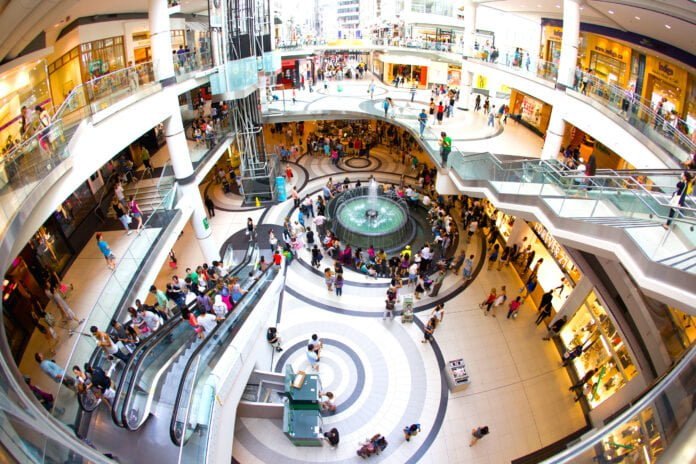
Toronto Eaton Centre

Statistics Canada latest retail sales numbers for April 2014 indicate a strong gain, up a seasonally adjusted 1.1% from the previous month. On a not seasonally adjusted basis, the gain was much higher, and up 6.1% from April a year ago. Much of the reason for this however is Easter, which was in April in 2014 but in March last year. A complication is that seasonal adjustment is an estimate based on historical trends which may be off for the current year. 

The 3 month year-over-year growth trend (orange line in the chart above) however takes the timing of Easter out of the picture. For total retail, it’s up 4.4% for the 3 months ending April, the strongest such gain in over 2 years, and ticking up to just above the underlying 12 month trend (green line). This appears to be a reversal of course, but it’s too early to claim a trend, especially after digging a little deeper. 

Overall, the April uptick appears to be a result of unusually high sales growth at convenience stores, specialty food stores, beer, wine & liquor stores, department stores, and gasoline stations. Rather than a trend, this is more like a coincidence. 

Total retail sales growth is still being driven by the Automotive & Related sector, up 7.6% versus last year for the 3 months ending April. The Food & Drug group had relatively strong sales in April, with the best single month gain in 2 years. The Store Merchandise sector however continues with only modest growth. 

Food & Drug Stores 

Health & personal care stores’ retail sales have had strong gains for the last 7 months. For the 3 months ending April 2014, sales were up 9.6% from a year ago, and this continues to shore up the overall Food & Drug sector. 

Sales at supermarkets & other grocery stores however are still struggling, up just 0.1% for the 3 months ending April. In fact, their sales are down 0.1% on a 12 month basis. 

In contrast, specialty food stores’ retail sales are maintaining a high growth rate. Their sales gained 9.3% for the 3 months ending April versus the same period last year. 

Overall, the Food & Drug sector was up 3.2% on a 3 month basis. While not outstanding, this was still ahead of the 12 month trend of 2.1%. 

Store Merchandise 

Store Merchandise retail sales were up 2.9% for the month of April versus a year ago on a not seasonally adjusted basis, indicating that Easter’s timing had minimal effect. For the 3 months ending April, sales were up just 2.0%, which is below the 12 month trend of 2.7%, as per the chart below. In other words, things are slow and getting slower. 

The only strong performer in this sector is other general merchandise stores, which are mostly large combo stores as distinct from conventional department stores. Their sales were up 7.8% for the 3 months ending April, which is more or less on a par with how their sales have been growing for the last 12 months. 

A number of store types however had sales declines for the 3 months ending April versus a year ago: building material & garden equipment/supplies retailers, down 2.5%; miscellaneous store retailers, down 2.5%; furniture stores, down 2.1%; and shoe stores, down 1.3%. 

Automotive & Related 

Sales in the Automotive & Related sector were up 7.6% for the 3 months ending April, three times higher than for all other retailers combined. Current trends (see chart below) indicate some leveling off, but at a pace well above Store Retail. 

Automobile dealers’ retail sales were up 6.3% for the 3 months ending April versus last year. This was stronger for used car sellers (9.6%) than for new (6.0%). 

With higher prices, gasoline station retail sales were up 15.0% year-over-year in April 2014 alone, the largest increase since October 2011.

Ed Strapagiel is a consultant specializing in applied marketing, business development and strategic planning. [Ed Strapagiel’s Website]

RetailWire Discussion: EBay’s CEO talks about the ‘commerce revolution’

PHOTO: AMAZON

By George Anderson, RetailWire

EBay CEO John Donahoe took to the stage at this month’s 10th annual Internet Retailer Conference & Exhibition in Chicago to discuss what he calls the “commerce revolution”.

The term applies to the many ways consumers shop for products today, including going into a store to buy a product, browsing retail sites during work hours, making a purchase from a tablet while watching television at home, etc.

For too long, Mr. Donahoe said, retailers have seen various shopping behaviors through their own eyes — in channel terms — rather than seeing it from the consumer’s vantage point. “Consumers,” he said, “just want to shop.”

To demonstrate that eBay gets it, Mr. Donahoe offered several examples:

  • In the U.K., eBay sellers can offer customers the option of having items delivered or picking their orders up at the local Argos. Argos is a general merchandise chain with stores within a 20-minute drive of 80 percent of the people living in the U.K.
  • Last year, eBay installed touchscreens on the windows of a small number of retailers in the Westfield Mall in San Francisco. A shopper could get information on a product from the screen and have it sent to his or her mobile phone to make a purchase.

Mr. Donahoe predicts the future will bring even more “interesting combinations of online and offline” to meet consumers in the time and place they want to shop. While never mentioning Amazon.com by name, it was clear throughout much of the eBay CEO’s speech that he was drawing comparisons between his company and its chief rival. He emphasized the point at least twice during his speech, reminding the audience that eBay is “a partner, not a competitor.”

Discussion Questions: Do you agree with eBay’s John Donahoe that most retailers see the business in their own terms rather than through the lenses of consumers? Is the eBay model more responsive, as he suggests, to the needs of consumers than Amazon.com?

Comments from the RetailWire BrainTrust:

Ian Percy, President, The Ian Percy Corporation: All of us see everything through our own eyes — our own values, desires, experiences, fears, aspirations, and on and on. Even our attempts to determine “the customer’s perspective” are designed through our own eyes, including how we set up surveys, focus groups and the like. They’re all skewed to how we see things. For starters, which customer’s perspective are you after? Do you think there’s one, or even a hundred?

Want to know something else? We’re pathetic at it. Ask Eric Cantor’s pollsters. 

IMHO, here are two of the best quotes related to considering the perspective of other people: 

“Do unto others as you’d have them do unto you.” (Book of Luke)

“We judge others by their behavior and ourselves by our intentions.” (This last one is widely attributed to me, but I didn’t originate it. Can’t find who did.).

Mohamed Amer, Vice President, Global Integrated Retail Unit, SAP: As much as retail is about managing the details and speed in action, those qualities have historically focused on the store. More and more retailers are expanding that view into the digital realm with a subset working on melding the two worlds. An even smaller subset are creating new possibilities in shopping with new use cases that start with the shopper in mind and leverage technology across physical and digital. So, most retailers do recognize the shift to consumers, but that hasn’t made it through their organizations (yet).

As to eBay vs. Amazon, the former innovates around new services for both sellers and buyers (call it more exploration strategy) while Amazon focuses on scaling of existing technology investment to gain more of the shoppers’ share of wallet (call it more exploitation strategy). 

Camille P. Schuster, Ph.D., President, Global Collaborations, Inc.: Most companies use an inside-out view and think about every activity as a separate area that has to be fit into the organizational chart somewhere. Then it develops as a separate activity, including e-commerce. eBay is an e-commerce company, but it is also a consumer-centric company by constantly analyzing consumer data and making decisions with consumer benefit at the center of their decisions. Other companies, such as Macy’s, are also taking a consumer-centric or outside-in approach to shopping by allowing consumers to use digital tools to shop or to shop in-store and have deliveries made from a nearby warehouse or store. Data and operations must be integrated to make that happen. Separate silos cannot achieve this process. 

Ryan Mathews, Founder, ceo, Black Monk Consulting: Absolutely! I’ve been saying this for — well — decades.

Retailers seem to want to cling to the illusion that they have something customers can only get from them and which can only be purchased on their terms. Maybe that’s true if you are a Harry Winston, but if you are selling canned soup, not so much.

As to whether or not eBay is more responsive than Amazon, I’m not entirely sure where I come down on that. In fact, that part of Donahoe’s speech sounded more like a retailer’s analysis of competition than a customer’s analysis of options. For a moment it seemed he was being at least a little guilty of the same sin he was chastising other retailers for practicing. 

Gene Detroyer, Professor, Independent: I don’t know if the retailers see their businesses in their own terms rather than the consumers. My sense is even when they understand the consumer lens, they reject it because they refuse to recognize that a sale is a sale is a sale, no matter where you get it. They believe that the more sales that go through an online channel, the fewer sales go through the store. That thinking makes no sense.

The objective is to sell the products, not operate the stores. The P&L doesn’t change based on where the product is sold. If $1,000,000 in revenue shifts from in-store to online and the costs of operating my stores remains the same, my bottom line doesn’t change at all.

It is the fear of losing brick and mortar sales that prevents retailers from accepting the changing consumer. This is no different than the inventor of digital photography (Kodak) ignoring the obvious to protect their film business. 

Marge Laney, President, Alert Technologies, Inc.: Back in the days before the Internet, retailers could get away with offering their goods and service their way! Were there customer pain points? You bet, but the customer couldn’t do much, if anything, about it.

Enter the Internet with its explosion of choices and ways to shop, and suddenly the autocratic way of running the customer isn’t working anymore. Not only that, the customer now has visibility into every other customer’s thoughts on the subject and feels empowered.

The best part for the customer is that they are now firmly in control of their shopping experience and, if the retailer balks, they are the losers.

For retailers, customer experience investment opportunities are increasing and changing at the speed of light. Keeping up with everything is not only daunting, it can be financial suicide if the wrong investment is made. 

Shep Hyken, Chief Amazement Officer, Shepard Presentations, LLC: It is not easy to put the customer in the middle of everything. You can look at companies like Zappos, Starbucks and others that are obviously customer-focused. As a result, the consumer is willing to pay more. There may be your best lesson. Find companies that are successful where the customer is willing to pay more for doing business with them than somewhere else. There’s a reason. They think like a customer and give the customer what they want — the way they want it. And they are easy to do business with.

Joan Treistman, President, The Treistman Group LLC: Retailers are human, after all, and we humans tend to see things the way we want to see them. It’s challenging to open our eyes and minds wider and process a conflicting perspective.

So John Donahoe’s comments are true, but for him the final observation must take into account what lens eBay uses. There is a proverb: “There are none so blind as those that will not see.” 

Cathy Hotka, Principal, Cathy Hotka & Associates: Every retailer knows that the landscape is changing rapidly; the question is whether retail companies can evolve fast enough to survive. They’re going to need to take a fresh look at their business model (that’s you, RadioShack, with a new emphasis on same-day PC repair).

I have dinner with multiple retail CIOs a week, and every one of them believes that there will be many fewer retail stores three years from now. The revolution is upon us! 

Kenneth Leung, Director of Enterprise Industry Marketing, Avaya: Retailers have always been focused on internal processes and optimizing supply chain, employee efficiency, and cost of goods sold in stores because it is manageable and controllable. It is harder to operate from a consumer lens because we as consumers are fickle and can’t articulate what we want in process flows that retailers can internalize. The fact that Amazon and eBay have taken market share from traditional retailers indicates that traditional retailers need to change; the fact is, however, that the consumers will want a mix of Amazon (ecommerce), eBay (marketplace and auction), and brick and mortar (instant discovery and gratification) going forward. 

Read the entire RetailWire discussion:
http://www.retailwire.com/discussion/17585


Juicy Couture to re-enter Canada, after closing Canadian stores

Image: Juicy Couture

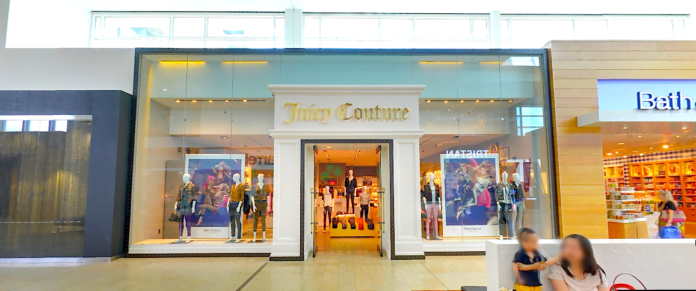
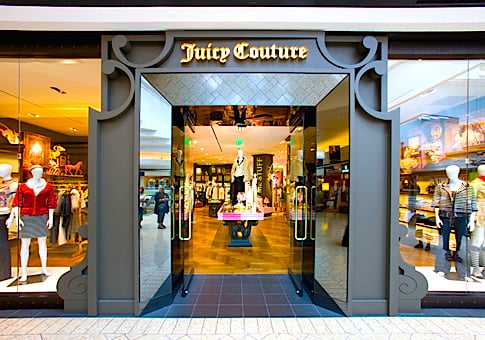
New Juicy Couture stores will open in Canada in 2015, after the recent closure of all of the brand’s stores. The new Juicy locations will be opened by its new parent company, while its previous stores operated under the brand’s former owner. Canada’s new Juicy Couture stores will be somewhat different than its previous locations, carrying a wider variety of products and some new product categories. 

Last month, we reported that Canada’s Juicy Couture stores were closing, and that several locations could re-open as Kate Spade stores. Kate Spade was the parent company of Juicy Couture, though it sold the company to brand licensing firm Authentic Brands Group last year. Authentic Brands will revive the Juicy Couture brand and according to Women’s Wear Daily, is looking to open Juicy stores in high traffic areas, with Vancouver being specifically mentioned. We expect Toronto to be a high priority for new Juicy Couture stores, as well, as it previously housed five of the company’s six Canadian locations. 

According to Women’s Wear Daily, the new Juicy Couture store concept will feature the ‘world of Juicy,’ being more representative of Authentic Brand Group’s vision for the brand’s future. The concept will feature a store layout showcasing merchandise by category, giving the stores a “department store feel”. Juicy’s Black Label Collection will be available in all the new stores, and the collection will include expanded offerings in intimates, girl’s clothing, and footwear. Last week, Authentic Brands Group revealed that it had entered into a long-term partnership with Steven Madden Ltd. for a line of Juicy Couture footwear.

Juicy Couture (PHOTO CREDIT: HTTP://MONTRE24.COM)

Authentic Brands Group is reportedly looking to open freestanding Juicy stores for girl’s clothing, as well as for intimate apparel. No word yet if Canada will see any of these new concept stores. Juicy’s new parent company will also soon relaunch its e-commerce platform, www.juicycouture.com.

Juicy’s last full-priced Canadian location, a 2,975 square foot unit at Toronto’s Sherway Gardens, closed on May 20th. Its 2,500 square foot Toronto Eaton Centre location closed on Saturday, May 17th, and its 2,250 square foot Yorkdale Shopping Centre (Toronto) and 3,500 square foot Pacific Centre (Vancouver) locations shuttered earlier this year. Its outlet location at Toronto’s Vaughan Mills, open for now, is scheduled to close on June 30th.

Juicy Couture was founded in 1995 by Gela Nash-Taylor and Pamela Skaist-Levy, and its signature tracksuit was responsible for its rapid growth and expansion. 

Retail Industry Job Seekers Have Gone Mobile

There is no denying the drastic shift that has occurred in the way individuals are now consuming information. Mobile usage is at an all-time high with users spending more time on their mobile devices than ever before.  This shift has transformed the way companies are communicating and interacting with their consumers, as well as bringing their products and services to market.

Within the recruitment space, there is an equally pronounced shift – job seekers have gone mobile.

According to a recent study conducted by LinkedIn, 74% of active candidates have viewed jobs sent to their inboxes on their mobile devices and 72% have visited a corporate careers site to learn more about an organization’s opportunities.

Companies commonly send job notification emails to potential candidate pools but fail to connect the dots after they click apply. Once a candidate receives a job notification on a mobile device, they expect the application process to be optimized and easy to complete. However, according to the same LinkedIn survey, 49% of Talent Acquisition leaders don’t view mobile recruiting as a top priority for their business.

Candidates that are seeking opportunities on their mobile or tablet devices are rarely finding an optimized experience. Creating a memorable candidate experience is just as important as creating a positive customer experience. During the application phase, candidates are looking for an easy and time sensitive process where they can input their information or upload a social profile.  

The ability to seamlessly apply for an opportunity will increase conversions and build a better experience.

As mobile penetration continues to build momentum companies need to consider whether they’re willing to disregard 74% of job seekers and the methods they’re using to find new jobs.

Lisa McCann is the Corporate Marketing Manager at Vancouver-based recruitment company, MindField Group.

Strellson to open Canadian stores

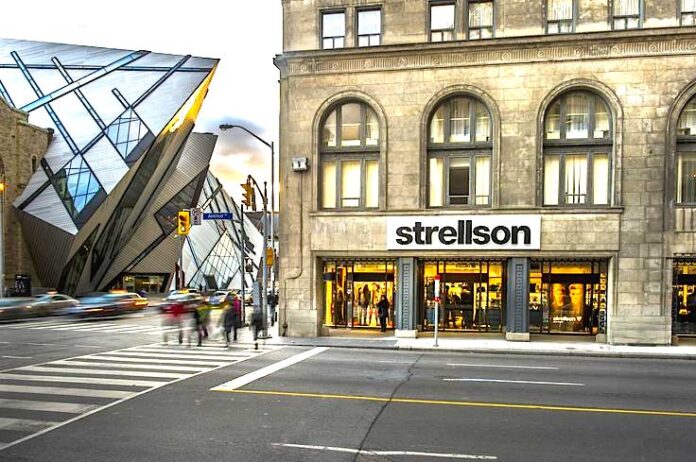
STRELLSON'S ONLY NORTH AMERICAN STORE IS AT 170 BLOOR ST. W. IN TORONTO. PHOTO: STRELLSON.

Upscale Swiss menswear brand Strellson will reportedly open more free-standing Canadian locations. The popular label, carried at several Hudson’s Bay stores, currently has one free-standing North American store in Toronto. Strellson is working with a Toronto-based broker to open more Canadian stores, beginning with a flagship location in Downtown Ottawa. A source at the company says other Canadian locations could also follow.  

Founded in 1993, Strellson is Switzerland’s largest menswear manufacturer. Owned by Holy Fashion Group, it produces mid-to-high priced menswear (both dressy and casual), accessories and related products, targeting men in the 25 to 40 age range. It retails in about 40 countries. 

According to Developers & Chains, Strellson is looking for flagship retail space in Downtown Ottawa, either within the Rideau Centre or in a high-profile street location. Strellson’s only other North American location is at 170 Bloor Street West in Toronto, at the base of the Park Hyatt Hotel at the northwest corner of Bloor Street and Avenue Road. We contacted Strellson Canada and a representative, speaking anonymously, said that the brand is considering a national store rollout, based on the brand’s success at its Toronto flagship and its success within Hudson’s Bay stores. The source would not provide confirmation, though they said that Vancouver, Edmonton, Calgary and Montreal could also eventually house free-standing Strellson stores. 

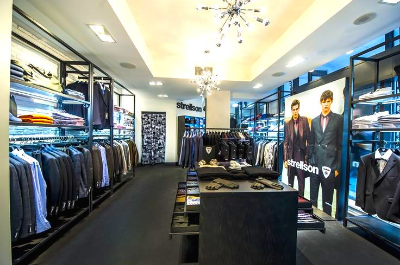
INSIDE STRELLSON’S 1,700 SQ FT TORONTO BLOOR STREET STORE. PHOTO: STRELLSON.

In 2011, a 2,400 square foot Strellson shop-in-store opened within Toronto’s flagship Hudson’s Bay on Queen Street. In November of 2012, Strellson opened its 1,700 square foot freestanding Toronto location. Sources with Strellson (and Hudson’s Bay) confirm that the label does very well in Canada, hence its plans to expand. According to Developers & Chains, Strellson is seeking Ottawa retail space in the 2,000 to 2,400 square foot range. 

For information on the broker handling Strellson’s Canadian store expansion, contact Retail Insider’s Editor-in-Chief, Craig Patterson, at: insider@retail-insider.com.


ANALYSIS: Will HBC sell its Canadian flagships?

exc-53a73652e4b053cbaa743b59

Hudson’s Bay Company (HBC) CEO Richard Baker indicates that he may sell some the company’s best stores. HBC owns several massive Canadian flagships, with a combined worth into the hundreds of millions of dollars. Similar to how the company recently sold its Toronto flagship, other Hudson’s Bay stores could be sold to adjacent mall landlords. Proceeds from these sales could renovate existing Hudson’s Bay stores, not to mention fund Saks Fifth Avenue‘s Canadian entry. We’ll provide an analysis of some top locations and what Richard Baker may have planned. 

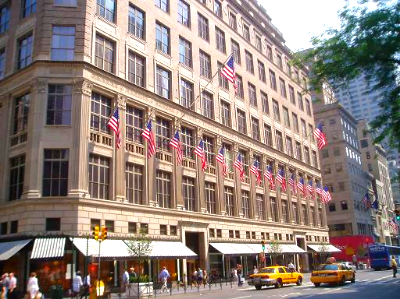
SAKS FIFTH AVENUE’S MANHATTAN FLAGSHIP IS WORTH AN ESTIMATED $1 BILLION

HBC set a precedent last January when it sold its 850,000 square foot Queen Street Toronto flagship (and adjacent office tower) to Cadillac Fairview for $650 million. Cadillac Fairview, in turn, merged Hudson’s Bay with the Toronto Eaton Centre, creating Canada’s second-largest mall. Saks Fifth Avenue will occupy 150,000 square feet within the Hudson’s Bay building as a result, and similar deals could happen in other Canadian cities. We’ll discuss several of these, below.

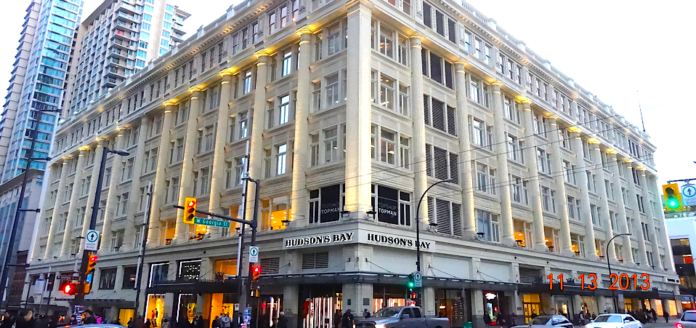
Vancouver: Sources say that Downtown Vancouver’s Hudson’s Bay is a contender for a similar sale. The massive 637,000 square foot store, spanning eight floors, is already connected to neighbouring Pacific Centre via an underground passage. Pacific Centre’s landlord, Cadillac Fairview, could be open to a deal since it’s the same landlord that spearheaded the purchase of Hudson’s Bay’s Toronto store. Saks Fifth Avenue could occupy up to 150,000 of Downtown Vancouver’s Hudson’s Bay, though details of Vancouver’s Saks store have yet to be bee finalized. Rumour has it that Saks could also open in a suburban Vancouver mall, as well, and we’ll update you when we learn more. 

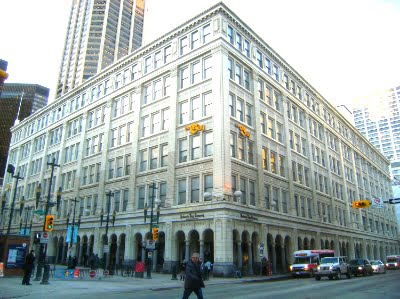
DOWNTOWN CALGARY’S HUDSON’S BAY FLAGSHIP

Calgary: Downtown Calgary’s 450,000 square foot Hudson’s Bay flagship is attached to the Scotia Centre. Selling this store could provide HBC with necessary funds for a store renovation, not to mention the addition of Saks Fifth Avenue within the same building. Downtown Calgary already has one large luxury retailer, a 147,000 square foot Holt Renfrew store, located two blocks west. Sources can’t confirm if Saks will open in Calgary though if it does, we’d expect either a Downtown location within Hudson’s Bay, or a free-standing store at Chinook Centre.  

Ottawa: Hudson’s Bay’s 335,000 square foot Ottawa store is located across the street from Cadillac Fairview-owned Rideau Centre. Similar to what it did in Toronto, Cadillac Fairview could purchase Hudson’s Bay and join it to the Rideau Centre. Although analysts suspect that Saks won’t open in the city, an Ottawa store could be a strategic move for Saks. Ottawa is affluent and growing, and we’re not aware of any expansion or relocation plans for its tiny Holt Renfrew store. A Rideau Centre Saks could see synergies with the mall’s new 157,000 square foot Nordstrom store, its new La Maison Simons store, and its new flagship Harry Rosen menswear store, all opening within the next two years. 

Montreal: Montreal’s 655,000 square foot Hudson’s Bay flagship is connected underground to Oxford Properties-managed Promenades Cathedrale. HBC indicates that Saks will open at least one store in Montreal. Selling this store could raise much needed funds for its renovation, not to mention spearheading a large Saks shop-in-store. 

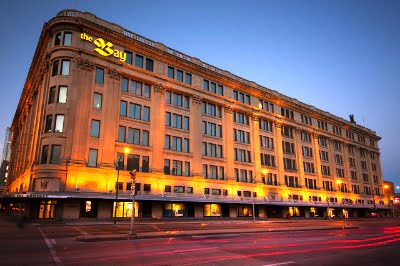
HUDSON BAY’S MASSIVE WINNIPEG STORE

Winnipeg: Hudson’s Bay’s massive Downtown Winnipeg flagship is another story entirely. The 656,000 square foot building is heritage protected, rendering it essentially a white elephant. The store underperforms, with less than 240,000 square feet currently in use. Sources say that the store is a liability and that HBC wants to offload it, with recent attempts to transfer ownership of the building to the Manitoba government in exchange for tax benefits. 

Unlocking the value in HBC’s Canadian real estate could vastly improve company cash coffers. Its most valuable real estate asset, however, isn’t one of its Canadian stores. HBC owns Saks Fifth Avenue’s 646,000 square foot Manhattan flagship, valued at about $1 billion. Richard Baker reportedly refers to it as the company’s ‘crown jewel’. We think it and other HBC properties will eventually be sold either via a REIT, or individually. 

Why Canadian luxury retailers target Chinese tourists

PHOTO: WWW.BONBRAND.COM

By Edward Quan

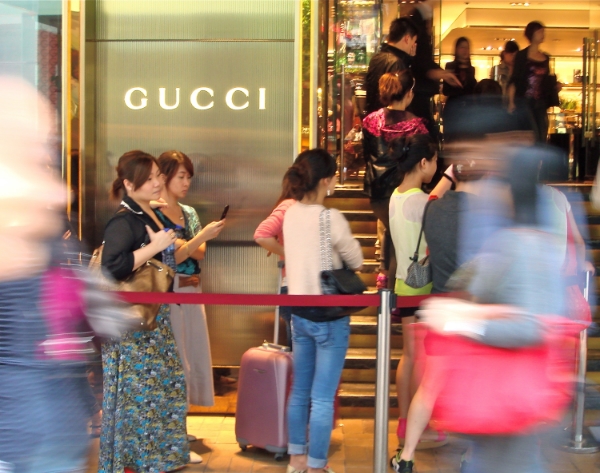
Canadian luxury retailers are targeting Chinese shoppers like never before. It should come as no surprise, given the tremendous spending power of Chinese tourists. Sources at Holt Renfrew‘s Vancouver store, for example, confirm that many of the store’s top spenders are Chinese, and that sales volumes from Chinese tourists are substantial. Other upscale retailers, especially in Toronto and Vancouver, say that they target Chinese tourists based on some of the statistics discussed below. 

Chinese travellers have broken all records for spending over the past two years, shelling out over US $129 billion in purchases in 2013, alone. Recognizing this trend, several European fashion houses such as Chanel and Hugo Boss have launched their collections in Asia, via high-profile runway presentations. Chanel recently did a show in Tokyo, while Hugo Boss dis a runway presentation last spring in Shanghai. Efforts have paid off, as international luxury brands continue to see strong spending from Chinese tourists.   

According to the United Nations World Travel Organization, China accounts for one out of every ten travellers, followed by Germans, Americans, British and Russians. In addition, the industry expects Chinese spending to almost triple by 2020, reaching US $300 billion. Surveys show that for over 80% of Chinese tourists on vacation, shopping is their top priority. In my experience as a luxury buyer in travel retail, for example, it would not be unusual for Chinese tourists to ask me what designer shops were available, and where.

Chinese tourists also lead in terms of tax-free transactions, spending an average of US $1130, compared to Russians with US $494 per transaction. This is not a surprising, given the size and the rapid growth of China’s upper and middle class. The Chinese are increasingly traveling abroad, partly due to relaxed government restrictions on foreign travel, high import duties and taxes on luxury goods at home, and rampant counterfeiting within China.

Understanding Chinese cultural nuances is paramount for retailers, and it’s not as simple having Mandarin speaking sales staff. Some retailers get it, specifically catering to the Chinese. Printemps department store in Paris, for example, now has a dedicated entrance for Chinese tour groups. Harrod’s in London has 100 China UnionPay card terminals located throughout the store, and both stores have Chinese language websites and maps. Closer to home, several Holt Renfrew stores now accept the China UnionPay card, as does Toronto’s Yorkdale Shopping Centre – the first Canadian mall to do so. 

To reach these tourists, luxury retailers must recognize how the Chinese research their destinations prior to travel. Nearly half of Chinese residents now have internet access, with two-thirds of traveling Chinese researching their destination online. The majority use Chinese language search engines and social media platforms, so Chinese-language travel writers and bloggers will play an important role.

Another challenge facing tourist destination is that the Chinese stomach is “stubborn”, according to CC Zhuang, CEO of Qunar – China’s largest travel website. Chinese tourists want their congee – Chinese porridge – in the morning. European continental breakfast would not satisfy Chinese appetites, for example, as many Chinese are not yet ready to be totally immersed in the foreign food experience.

Due to language barriers, most Chinese travellers still travel in groups. The trend is changing, however, as we’re now seeing more young, affluent independent travellers from China. With only 5% of all Chinese currently holding passports, the potential for luxury retailers is enormous. By next year, Chinese tourists will purchase more luxury goods than tourists from all other countries combined. Success will come to those retailers who take the time to understand and meet the unique needs of the Chinese tourist.

Edward Quan

Edward Quan is a luxury goods expert, based out of Vancouver. He is a fashion columnist with StyleDrama, as well as a freelance travel writer. You will also find Edward Quan at TheBahamasWeekly, as well as here periodically at Retail Insider. 


Over a third of foreign retailers enter Canada through one mall

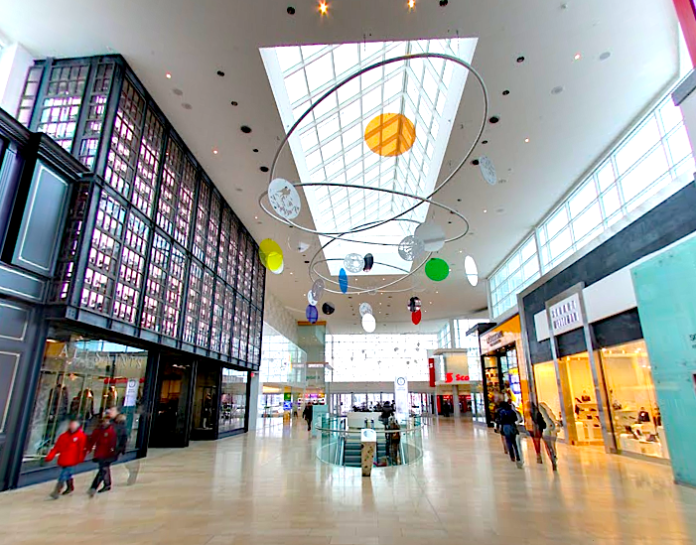
YORKDALE SHOPPING CENTRE. PHOTO: WISDEK

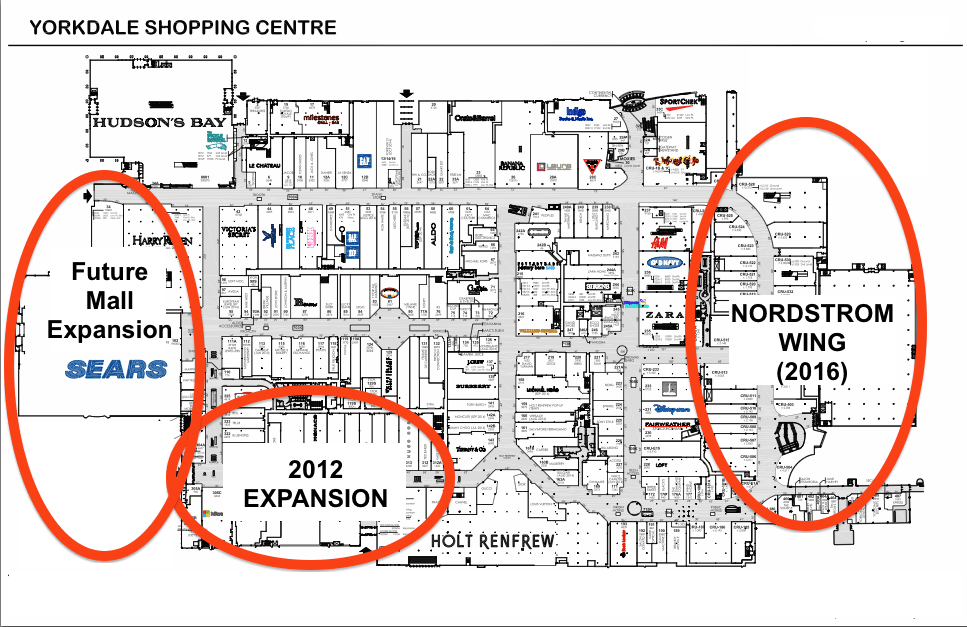
Last year, over a third of all first locations for retailers entering Canada were at Toronto’s Yorkdale Shopping Centre. 2013 wasn’t an unusual year for Yorkdale, however. From the inexpensive to luxurious, Yorkdale has been Canada’s entry point for many foreign retailers for a number of years. Its latest mall expansion, anchored by a 188,000 square foot Nordstrom store, will see even more first-to-market retailers between now and 2016. It’s no wonder that the mall is forecasted to become North America’s top-selling mall by 2018. 

In 2012, the mall saw several first-to-Canada retailers open in its south-western expansion, including Kate Spade, LOFT (by Ann Taylor), Microsoft Store, Ted Baker and Tesla Motors. In 2013, Yorkdale held the openings of Canada’s first AllSaints, David Yurman, John Varvatos, Mulberry, White House | Black Market, Tumi, and Zara Home stores.  2014 is proving to be another stellar year for the mall, with a particular focus on luxury. So far, Yorkdale has announced Canada’s first Jimmy Choo, Versace (free-standing), Moncler, Bulgari and Vince Camuto stores. We’re told that more are on the way, possibly including a Uniqlo store that was recently mentioned in the Financial Post. 

Several other first-to-Canada retailers for Yorkdale include Canada’s first Apple Store (2005), GEOX (2005), Bath & Body Works (2008) and Crate & Barrel (2008). 

The mall’s exceptional leasing team, under the management of Oxford Properties, aggressively targets foreign retailers. It also targets foreign tourists, being Canada’s first mall to accept the China UnionPay card. Last year the mall’s annual sales surpassed $1 billion, with sales forecasts of $2 billion by 2018. We expect this to become North America’s top-selling mall, considering current top-selling South Coast Plaza reaches about $1.5 billion annually, with no foreseeable expansion plans. 

Yorkdale’s new 298,000 square foot Nordstrom wing won’t be the mall’s final expansion, however. Another mall expansion is planned after Sears is demolished, housing multiple retailers and as many as two new department stores. Construction won’t likely begin until the Nordstrom wing opens in 2016, and we’ll update you with further details when permitted. 

Source: CBRE report: 


Sporting Life to open stores across Canada

exc-53a0b60ae4b033a62778838d


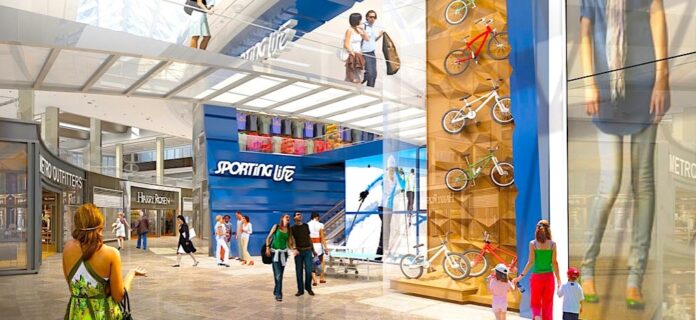
Rendering: Cadillac FairviewRendering: Cadillac Fairview

Rendering: Cadillac Fairview

Upscale sporting goods retailer Sporting Life plans to open stores across Canada. Its goal is to open two stores a year, with locations sought in Vancouver, Edmonton, Calgary, and Montreal. Its stores will be large, measuring in the 30,000-50,000 square foot range. Its expansion goals are lofty, especially considering that Sporting Life hasn’t opened a new store in 14 years.


Sporting Life's Toronto flagship. Photo: Reich+Petch (click to enlarge)Sporting Life's Toronto flagship. Photo: Reich+Petch (click to enlarge)

Sporting Life’s Toronto flagship. Photo: Reich+Petch (click to enlarge)

Founded in 1979, Sporting Life sells apparel and footwear, as well as equipment geared towards runners, cyclists, skiers, snowboarders and hikers. Some items can cost into the thousands. It has a large selection of outerwear, fleece and coats from popular brands Moncler, Canada Goose, and The North Face, among others. It also carries a mix of high-end and casual clothing brands including Barbour, Bogner, Hugo Boss, Grenoble, Mackage, John Varvatos and others.  

Given the size of its current and recently announced locations, we expect Sporting Life’s new stores to span 30,000 to 50,000 square feet. Its current and proposed store locations and sizes are as follows:

Current Stores: 

  • Toronto: flagship at 2665 Yonge Street: about 36,000 square feet,
  • Toronto: bike and snowboard shop, at 2545 Yonge Street: about 10,000 square feet,
  • Toronto: Sherway Gardens: currently 42,000 square feet, to be replaced with a 40,000 location in 2015, and
  • Collingwood, Ontario: 10,000 square feet.

Announced new store locations: 


Photo: Reich+Petch (click to enlarge)Photo: Reich+Petch (click to enlarge)

Photo: Reich+Petch (click to enlarge)

  • Markham, Ontario: Markville Shopping Centre: 32,000 square feet, opening late September, 2014, 
  • Ottawa: Landsdowne Park: 43,000 square feet, opening in October, 2014,
  • Richmond Hill, Ontario: Hillcrest Mall: 44,000 square feet, opening in 2016. 

President and CEO David Russell told the Toronto Star that Sporting Life sells about $100 million annually. Its current expansion plans were made possible after Fairfax Financial Holdings Ltd. bought 75% of Sporting Life in December of 2011.

When Sporting Life expands into Western Canada, its merchandising will be modified. Mr. Russel said: 

“When we open a store in the lower mainland of British Columbia, for example, the clothing will be perhaps a little different; more layers as opposed to big heavy down parkas. And when we go to western Canada the skis are wider and there might be more emphasis on mountain biking as opposed to road biking.”

CANADIAN RETAIL NEWS: Wednesday, June 18, 2014 (Updated Continuously)

GO BACK

Subscribe to our daily retail news updates for Canadians

* indicates required