Alibaba.com says it is expanding its CoCreate Pitch competition this year with an artificial intelligence-focused format and a total prize pool of more than $1 million as the company looks to promote AI-driven business creation and product development.
The business-to-business e-commerce platform announced that the competition, part of its CoCreate 2026 events in Los Angeles and London, will include regional finals in the United States, Europe and a new Asia-Pacific round.
The company said the updated competition reflects what it described as a shift in global trade toward “agent-to-agent” commerce, where AI systems increasingly handle functions such as sourcing, logistics and operational coordination.
Alibaba.com said entrants will use Accio Work, an AI-based enterprise tool developed by Alibaba, to help create products, business concepts and competition pitches.
“This year marks a pivotal shift from past editions of the competition: for the first time, launching a business from scratch is no longer a dream but an accessible reality, with the help of Accio Work, Alibaba’s plug-and-play enterprise AI agent,” the company said.
Vitaly Gariev photo
The competition will feature three categories: a general small and medium-sized enterprise track for established businesses, a startup track for founders using Accio Work to develop new ideas, and a student track for current students creating products.
Alibaba.com said applicants will register through Accio Work, which includes what the company calls a “CoCreate Pitch Agent” designed to help participants develop proposals and business plans.
Kuo Zhang
“In a world where execution is automated, your perspective is your greatest asset,” said Kuo Zhang, President of Alibaba.com. “Accio Work is the essential toolkit for every entrepreneur in this AI era, allowing anyone with a strong idea to reach the world. Now is the best time to start and we’re excited to see what founders will build.”
The company said submissions will be judged on innovation, feasibility, market potential and how participants use Accio Work in developing their concepts.
Finals in Los Angeles, scheduled for Sept. 9 and 10, and London, scheduled for Nov. 19 and 20, will each feature 20 finalists presenting live during the CoCreate events.
Alibaba.com said first-place winners in each final will receive $200,000, while second- and third-place finishers will receive $100,000 and $50,000, respectively. The remaining finalists will each receive $10,000.
The company said prize details for the Asia-Pacific competition will be announced later.
Alibaba.com launched in 1999 and operates a global business-to-business e-commerce marketplace serving buyers and suppliers in more than 200 countries and regions.
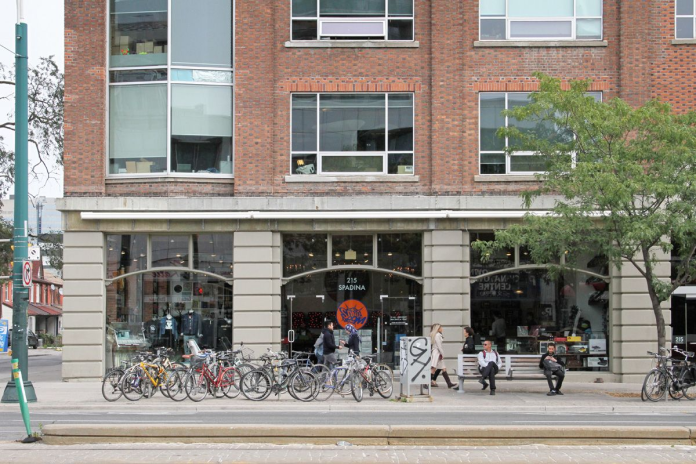
Sonic Boom store at 215 Spadina Ave in Toronto. Photo: On the Grid Toronto
When Sonic Boom opened its doors in Toronto in 2001, the music retail industry was already in decline.
File-sharing platforms such as Napster had begun to erode physical music sales, and consumers were quickly shifting away from CDs. Vinyl, once dominant, had already faded into near irrelevance. For most entrepreneurs, it would have been the worst possible time to open a record store.
For founder Jeff Barber, it was a calculated risk.
Jeff Barber
“I figured, before this industry completely dies, I might have a little bit of a run here,” Barber said in an interview. “Since the pie is quickly shrinking, I wanted to go to a big city and take a piece of a larger pie.”
Raised in Minnesota, he had previously opened a record store in Milwaukee in the late 1990s, an early venture that did not succeed but helped shape his approach. By 2001, he was looking for a larger market where his next attempt might have a better chance.
That decision brought Barber from the United States to Toronto, where he saw an opportunity to create something different. At the time, the market was divided between large chains focused on new product and smaller shops specializing in used inventory. Barber’s concept combined both at scale, a model that would ultimately define Sonic Boom’s growth.
Growth in a Shrinking Industry
In its early years, Sonic Boom expanded as competitors exited the market. As traditional music retailers closed, the company absorbed both customers and inventory, building brand recognition during a period when the broader category was contracting.
“A lot of people thought I was happy about other stores going out of business,” Barber said. “But I knew it was indicative of the whole industry. The better the entire industry does, the better we all do.”
That long period of decline unexpectedly created a foundation. By the time consumer interest in physical media began to return, Sonic Boom had already established itself as a destination.
“I never would have professed to see the resurgence of vinyl coming,” Barber said. “But when it did, we were ready. The brand was strong, and people thought of us when they wanted to buy or sell records.”
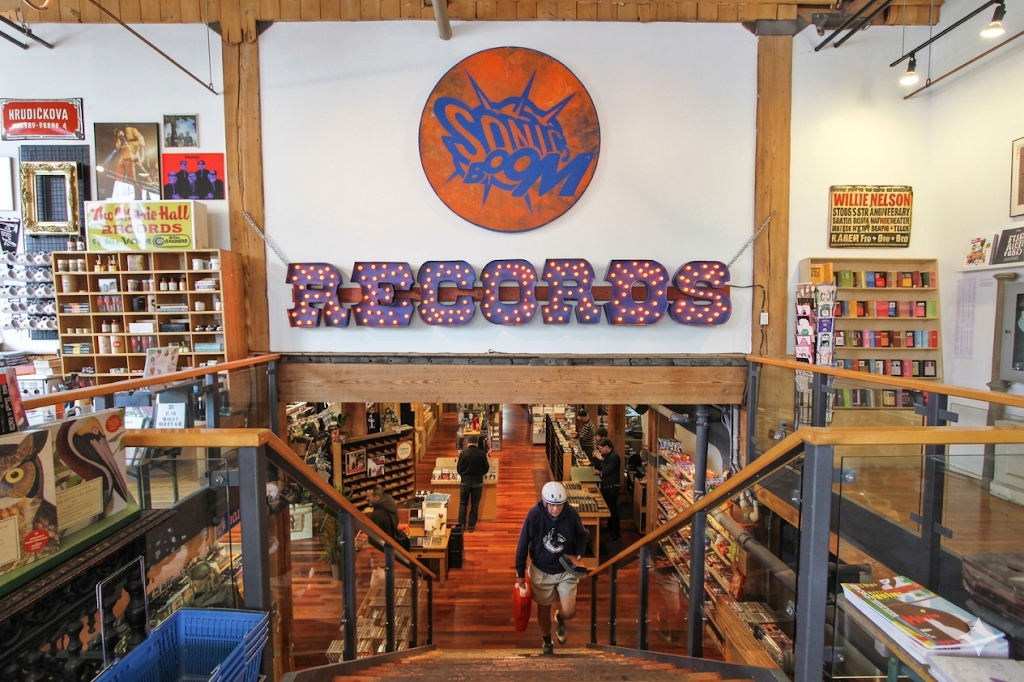
Sonic Boom store at 215 Spadina Ave in Toronto. Photo: Sonic Boom/Facebook
From Annex Shop to 13,000-Square-Foot Flagship
Sonic Boom’s physical footprint reflects both its growth and the evolution of Toronto’s retail landscape.
The original store opened at 512 Bloor Street West in the Annex, a location later lost to redevelopment when the space was leased to Dollarama. The business then moved to Honest Ed’s on Bathurst Street, followed by a secondary boutique in Kensington Market, before settling into its current flagship at 215 Spadina Avenue in 2014.
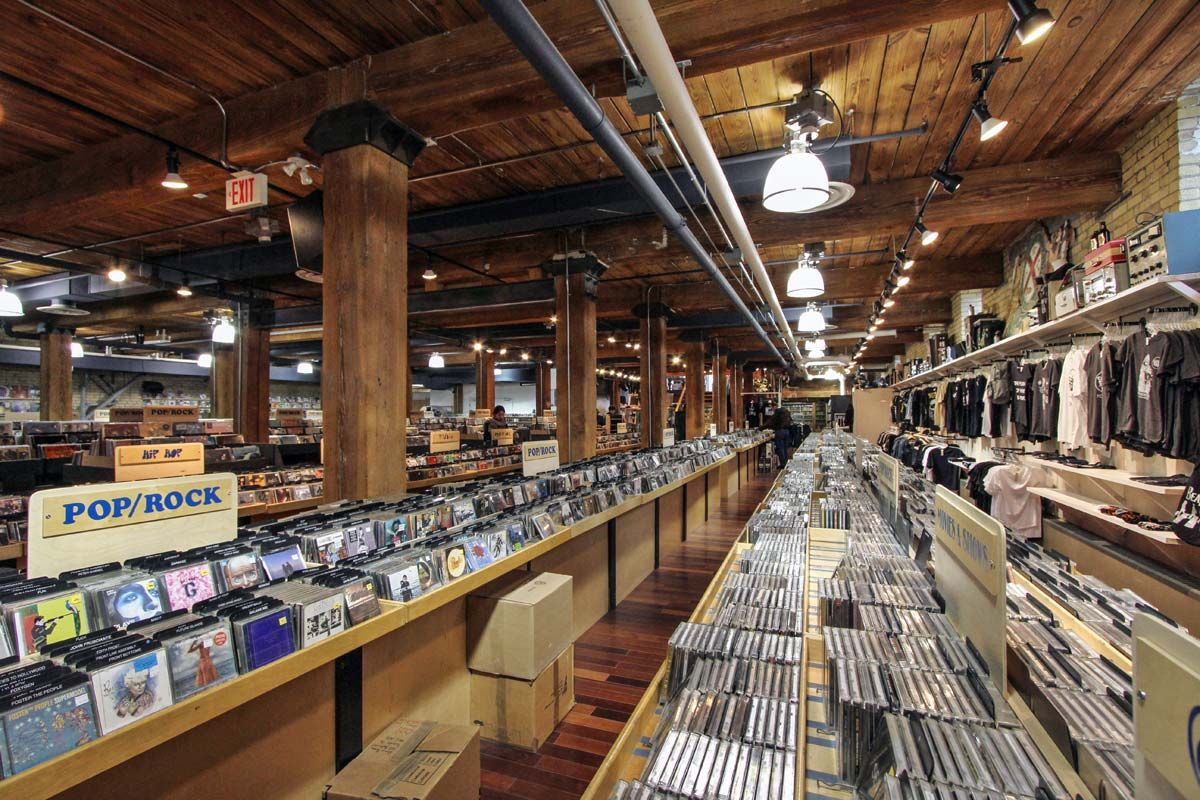
Today, the store spans approximately 13,000 square feet across two levels in a former warehouse building. The main floor features new releases, turntables, and curated merchandise, while the lower level houses an extensive used inventory often described as a maze-like browsing experience.
The scale is unusual for an independent retailer in this category, and it has helped position Sonic Boom as a destination for both locals and visitors.
A Retail Model Built on Discovery
At the core of Sonic Boom’s success is a merchandising strategy that encourages exploration.
Hundreds of new items are added to the floor daily, creating what Barber describes as a “thrill-of-the-hunt” environment. Customers return frequently, knowing that inventory is constantly changing.
That approach aligns with broader shifts in consumer behaviour. While digital platforms offer convenience, they lack the tactile and exploratory elements that physical retail can provide.
Barber believes this dynamic is central to vinyl’s resurgence.
“I don’t think it’s about sound quality,” he said. “It’s more about a technological backlash. People want something tactile, something to collect. It’s a more mindful process, like pouring a glass of wine and taking the time to enjoy it.”
That perspective reflects a growing segment of consumers seeking experiences that contrast with digital consumption. The act of browsing, selecting, and playing a record has become part of the appeal.
Sonic Boom store at 215 Spadina Ave in Toronto. Photo: On the Grid Toronto
Vinyl’s Return and New Consumer Demand
The resurgence of vinyl has been underway for more than a decade, with growth accelerating during the pandemic as consumers spent more time at home.
Sonic Boom’s online store launched in 2019, just months before COVID-19 lockdowns. The timing allowed the business to maintain sales while stores were closed, even as demand for physical media increased.
“We had a couple of months to get our feet wet online, and then when the pandemic hit, people started building record collections again,” Barber said.
At the same time, sales of turntables and audio equipment have continued to rise, signalling new entrants into the category.
“If people are buying turntables, they’re buying records,” Barber said. “That’s an indicator that there’s still a lot of runway ahead.”
Interestingly, growth has not been limited to vinyl. Sonic Boom has also seen a resurgence in CD sales, particularly among younger consumers seeking more affordable physical formats.
“It’s kids buying CDs,” Barber said. “They want to own something. They might not be able to afford vinyl, so they buy a CD and a Discman instead.”
Building a Destination Through Experience
While product remains central, Sonic Boom has increasingly positioned itself as a place to spend time, not just transact.
The store hosts regular in-store performances, artist signings, and listening events tied to new releases. It has also introduced experiential elements such as a photo booth and a custom-built “PhonoMat” machine that dispenses random records.
“It’s a cultural gathering point,” Barber said. “We want people to come in and spend time here.”
The approach has broadened the store’s audience. Prior to the pandemic, Sonic Boom’s customer base skewed older and male. In recent years, it has become younger and more diverse, reflecting a wider appeal for physical media and music culture.
Tourism has also become a meaningful driver, with visitors from across Canada and internationally drawn to the store’s scale and reputation.
Sonic Boom store at 215 Spadina Ave in Toronto. Photo: On the Grid Toronto
A Challenging Business Despite Momentum
Despite renewed interest in physical formats, the business remains complex.
Physical media still represents a relatively small share of overall music consumption, and operating costs in Toronto continue to rise.
“It’s still a difficult business,” Barber said. “Margins aren’t great, and overhead is extremely high. Rent and payroll in a city like Toronto make it challenging.”
That reality has limited expansion. While some independent record stores have opened in recent years, others have closed, underscoring the delicate balance required to operate successfully in the category.
Reflecting on 25 Years
As Sonic Boom approaches its 25th anniversary, Barber describes the milestone as a moment of reflection.
“There’s a lot of satisfaction and a lot of gratitude,” he said. “I never could have imagined where we’d be today.”
The anniversary will be marked with a live music event on May 9 at St. Anne’s Parish Hall, bringing together a lineup of Canadian artists in a celebration of the store’s role in the city’s music community.
For Barber, the future remains uncertain, as it was when he first opened the business in 2001.
“I can’t claim to know what tomorrow holds,” he said. “But I’m excited for whatever comes next.”
The restaurant group, founded by chef Victor Barry, said its frozen pizzas are now being sold across Canada through a partnership with Walmart Canada, along with distribution through Country Grocer in British Columbia and Coleman’s in Newfoundland.
The expansion builds on existing retail relationships with Ontario grocers including Loblaw’s, Sobeys, Metro, Longo’s and Summerhill Market.
The company said the national rollout represents a major milestone for the business, which began selling frozen pizzas in 2020 after establishing a following through its seven restaurant locations in Toronto, Hamilton and Oakville.
The company said its frozen pizza business has grown from a regional product into a national operation supported by a CFIA-certified and FDA-licensed production facility that produces more than 200,000 pizzas per month.
The company said the pizzas use a 72-hour naturally leavened sourdough fermentation process that originated in its restaurants.
“This pizza was born in our restaurants, out of the same obsession with doing things properly that drives everything we do. The sourdough takes 72 hours. The ingredients are the best we can find. We never cut corners – and that doesn’t change whether you’re eating with us in Toronto or heating up a pizza in your oven in Vancouver or Halifax. Canada deserves a frozen pizza that actually tastes like something,” said Barry, founder of the company.
Barry first gained recognition at Toronto restaurant Splendido before opening the first PIANO PIANO location in 2016.
According to the company, the restaurant business expanded to seven locations across the Greater Toronto Area and surrounding communities before moving into retail frozen foods.
Mikhail Nilov photo
The company said the frozen pizzas developed a customer base among restaurant patrons looking for a similar product at home.
PIANO PIANO said its crust is made using a naturally leavened sourdough fermented for 72 hours before freezing, which it says distinguishes the product within the frozen pizza category.
The pizzas are topped with locally sourced Ontario ingredients, the company said.
PIANO PIANO said its frozen pizzas are now available in more than 350 retail locations across Canada.
Veteran Canadian fashion retail executives are moving to rebuild a segment of the country’s premium menswear market left fragmented after the collapse and restructuring of several department store operators.
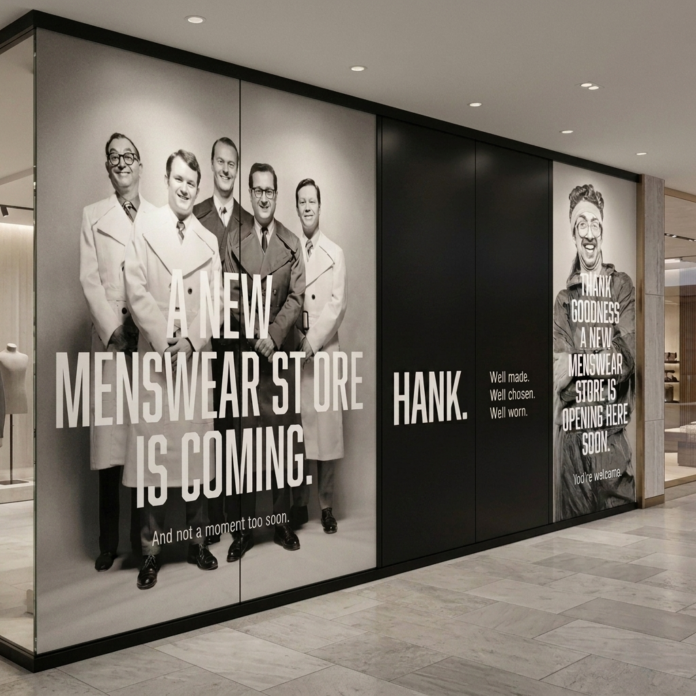
Caulfeild Apparel Group has confirmed that HANK., its new multi-brand menswear retail concept, will open its first three stores in late summer 2026 at Bayview Village Shopping Centre, Upper Canada Mall, and CF Masonville Place, alongside the launch of a national ecommerce platform.
The announcement marks the next stage of a concept first discussed publicly with Retail Insider in January 2026, when company executives outlined plans to create a new menswear retail environment following the disruption caused by the departures and downsizing of retailers including Nordstrom Canada, Saks Fifth Avenue, and Hudson’s Bay.
Caulfeild executives believe the market disruption created a significant opening within Canada’s premium menswear sector, particularly as consumers lost access to many traditional multi-brand menswear environments.
“Roughly a half-billion-dollar menswear business disappeared from the Canadian market in just a few years,” said Mike Purkis, President and CEO of Caulfeild Apparel Group, during an earlier interview with Retail Insider.
For Purkis, the concept came together almost immediately after Hudson’s Bay entered bankruptcy proceedings.
“Suppliers had a choice,” he said. “They could sit still, or they could build something new.”
A Premium Menswear Opportunity Emerges
The collapse of several department store menswear operations has reshaped how premium apparel brands reach Canadian consumers, leaving major gaps in both product distribution and physical retail presence.
Many premium brands previously relied heavily on department store shop-in-shops and large-format menswear floors for visibility and sales across Canada. At the same time, consumers lost access to broad multi-brand assortments positioned between luxury fashion and mass-market apparel.
Mike Purkis
Purkis said HANK. intends to position itself within that middle ground, targeting consumers seeking elevated apparel and service without moving fully into luxury pricing.
“We want to sit in a premium marketplace just below Rosen’s,” Purkis said, referring to Harry Rosen.
The company believes many Canadian men increasingly found themselves shopping within athletic, off-price, or highly vertical retail environments following the disappearance of traditional premium department store menswear floors.
According to Purkis, HANK. is being designed for consumers looking for wearable fashion, quality product, and service-driven retail experiences without entering ultra-luxury territory.
The assortment is expected to lean heavily toward sportswear while maintaining tailored categories including suiting and sport coats.
“Probably twenty to twenty-five percent suits and sport coats,” Purkis said. “More sportswear driven to begin with.”
The company is targeting consumers roughly between their mid-30s and mid-50s who are fashion-conscious but still seeking versatile everyday apparel.
“We’re looking at customers who are fashion forward, but not aggressive fashion,” Purkis said. “That’s wearable fashion.”
Veteran Retail Leadership Driving the Concept
One of the defining characteristics of HANK. is the depth of experience behind the concept.
The leadership team includes executives with backgrounds spanning department stores, luxury retail, merchandising, wholesale apparel, and premium fashion operations, experience that may help differentiate the retailer within a challenging apparel environment.
Purkis represents the fourth generation of leadership at Caulfeild Apparel Group, one of Canada’s oldest privately owned apparel companies. Founded in 1886, the company has operated across wholesale distribution, licensing, manufacturing, and brand management for more than a century.
The HANK. leadership group also includes Sanjay Malhotra, Vice President of Strategy and Business Development, who previously spent more than two decades at Hudson’s Bay in senior merchandising and leadership roles connected to menswear retail operations.
“We’ve brought in some talented people to help build this,” Purkis said. “Sanjay Malhotra was the last VP standing at the Bay in the men’s space.”
The broader team also includes Patrick Tier, Merchandise Director – Retail, whose background spans merchandising and menswear retail operations, as well as Lanita Layton, Senior Advisor – Retail, who is widely recognized within the Canadian fashion industry for her work advising premium retail brands and for prior leadership roles connected to HUGO BOSS Canada, Holt Renfrew, and Birks Group.
The company said the leadership structure behind HANK. was intentionally assembled to combine expertise across merchandising, customer experience, retail operations, and premium brand positioning.
Pictured from Left to Right – Mike Purkis, Sanjay Malhotra, Lanita Layton and Patrick Tier
Why the First Locations Matter
The selection of the first three HANK. locations also provides insight into how the company views the Canadian menswear opportunity.
Bayview Village Shopping Centre is positioning itself as an upscale fashion-forward shopping destination, catering to affluent consumers seeking curated retail experiences.
Meanwhile, Upper Canada Mall offers access to a growing suburban customer base north of Toronto, while CF Masonville Place provides exposure to a regional market that remains comparatively underserved in premium menswear retail.
Taken together, the first locations suggest HANK. is testing multiple consumer demographics and market types simultaneously while maintaining a strong focus on high-traffic enclosed shopping centres.
The launch also comes as Canadian shopping centre owners continue repositioning fashion assortments following the downsizing and closure of several department store anchors.
“We are looking for ideally high foot traffic mall locations with that consumer in mind,” Purkis said.
Physical Retail Still Plays a Critical Role
Although ecommerce will form a major component of the business through HANK.’s national online platform, the company believes physical stores remain central to the premium menswear experience.
“We’re seeing consumers return to physical retail environments, particularly when service and product discovery are involved,” Purkis said.
The first HANK. stores are expected to range between approximately 1,800 and 2,700 square feet depending on location.
Purkis described the interiors as clean and minimalist, incorporating dark metal finishes, bleached wood, lounge seating, and residential-inspired elements intended to create a more relaxed and service-oriented atmosphere.
“Every store will have its own lounge environment,” he said. “We want the experience to feel elevated and welcoming.”
The broader retail concept is intended to emphasize lifestyle positioning and personal confidence rather than transactional apparel shopping.
The company’s philosophy, “Well Made. Well Chosen. Well Worn.”, reflects that broader positioning strategy.
While the first three locations represent the opening phase of the business, Caulfeild’s ambitions for HANK. appear significantly broader.
“Ultimately, thirty-five to forty-five doors is probably the target,” Purkis said.
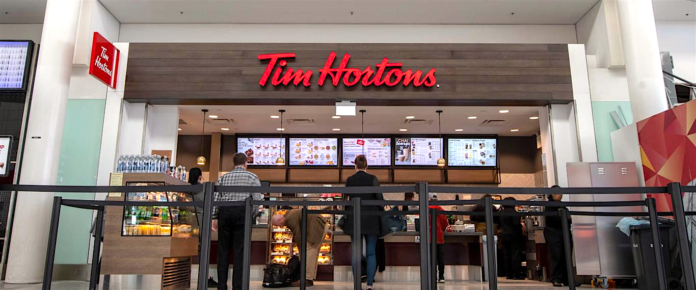
Tim Hortonssays its 30th annual Smile Cookie campaign raised a record $23.3 million this year for nearly 700 local charities and community groups across Canada and the United States.
The company said the latest fundraising total brings the campaign’s cumulative amount raised since its launch in 1996 to more than $174 million.
The campaign, which donates 100 per cent of pre-tax Smile Cookie sales to local causes selected by restaurant owners, began as a local fundraising initiative in Hamilton, Ont.
Axel Schwan
“Tims restaurant owners are proud members of the communities where they live and work, and for decades their passion for giving back has made the Smile Cookie campaign what it is today,” said Axel Schwan, president of Tim Hortons.
“When the first Smile Cookie was sold in 1996, no one could have imagined we’d one day be celebrating more than $174 million raised in the program’s history. That’s a testament to Tims restaurant owners, team members, volunteers, and guests who have committed to making a difference in their communities year after year. Thank you for your incredible generosity.”
The company said the Smile Cookie campaign was created in 1996 by Maureen Sauve and other Tim Hortons restaurant owners in Hamilton.
According to the company, the original fundraiser was inspired by efforts to support a hospital ward treating Sauve’s daughter at the time.
It said the initiative evolved from a local fundraising effort into a broader annual campaign tied to the company’s community giving efforts.
The company said all pre-tax proceeds from Smile Cookie sales are directed to local charities and community groups chosen by Tim Hortons restaurant owners.
The campaign operates across Tim Hortons locations in Canada and the United States.
Founded in Hamilton in 1964, Tim Hortons said it now operates nearly 4,000 restaurants across Canada and more than 6,000 locations globally.
From New York to Toronto, the concept of government-run grocery stores has been trending lately. The idea is not new, and the evidence shows that these initiatives do not address the root cause of high food prices, and carry a heavy risk of failure, the MEI notes in a Viewpoint published on Thursday.
The MEI is an independent public policy think tank with offices in Montreal, Ottawa, and Calgary.
Charles Lammam
“Government-run grocery stores have been tried before, and the results have been costly for taxpayers,” said Charles Lammam, Senior Fellow at the MEI and author of the publication. “Key drivers of higher food prices are the government policies already on the books, such as tariffs, interprovincial trade barriers, and layers of regulatory costs. That is where reform is needed.”
This year, a proposal for a government-run grocery pilot project was tabled and adopted in Toronto. In Ottawa, a city councillor recently proposed studying such a model, said MEI.
At the federal level, new NDP leader Avi Lewis is proposing to establish such a network across the country, promising savings of “30 to 40 percent” for families. At the provincial level, Québec solidaire recently indicated that it wants to evaluate this proposal, it noted.
“The grocery sector is well known for its razor-thin profit margins, which hover between three and five per cent,” explained the organization.
“Even if those margins were entirely eliminated, and supply chains remained just as efficient, monthly savings for consumers would be just $11 to $18 per person. By way of comparison, a Canadian family of four spends an average of $17,571 per year on groceries—roughly $370 per person per month—according to a Canadian study.”
“Running a grocery store means coordinating thousands of perishable products across complex supply chains, on margins that leave little room for error,” said Lammam. “Governments simply do not have the expertise to do that, and it is inevitably the taxpayer who ends up paying the price.”
MEI shared that the record of government-run grocery stores in North America isn’t encouraging: the failure or restructuring rate of these initiatives likely exceeds 50 per cent, according to Dalhousie University Professor Sylvain Charlebois.
In Kansas City, for example, the government spent $29 million in public funds to keep Sun Fresh Market afloat. The municipal government-run grocery store opened in 2018 and shut its doors last summer, beset by empty shelves, food safety issues, and persistent financial losses. A similar project in Erie, Kansas, operated at a loss for years before being handed over to a private operator, added MEI.
Mike Jones photo
While the sharp rise in food prices has had a real impact on household budgets, the researcher notes that many public policies are contributing factors, it said. Barriers to interprovincial trade are equivalent to an internal tariff of nine percent, according to an International Monetary Fund analysis.
Tariffs on imported food average 15 percent, with surcharges of 200 to 300 percent on dairy, eggs, and poultry. The regulatory burden, taxes throughout the supply chain, and transportation costs also inflate the price of every product found on store shelves, added MEI.
“If the goal is truly to lighten Canadians’ grocery bills, the solution is not to have governments enter the grocery business—it’s to eliminate the policies that are artificially driving up prices,” said Lammam.
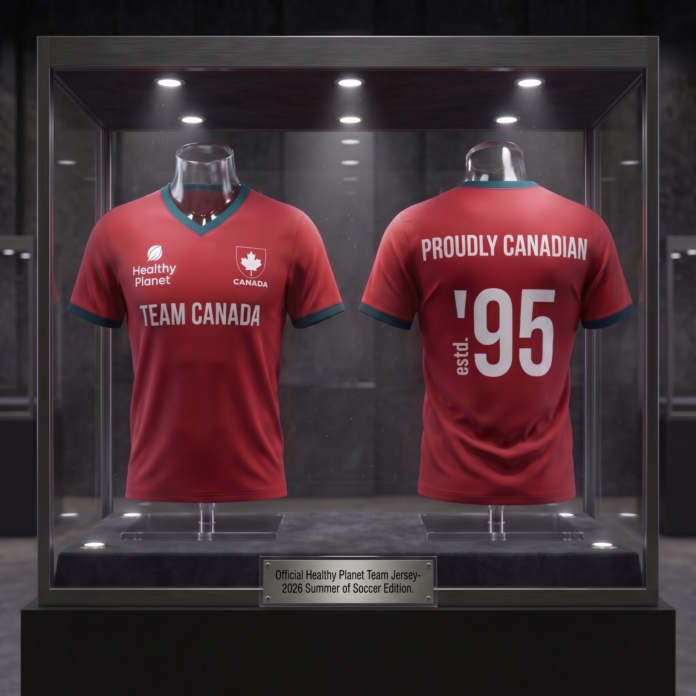
Healthy Planet says it will launch a soccer-themed promotional campaign tied to this year’s FIFA World Cup in Toronto, including a public appearance by Canadian soccer player Jonathan Osorio and a renewed national food donation initiative.
The health and wellness retailer said Toronto FC captain and Canadian men’s national team player Osorio will appear at its Etobicoke store on May 17 as part of the campaign launch in partnership with BioSteel.
The company said the campaign will extend to three downtown Toronto store locations that will be rebranded with a soccer theme during the tournament period as visitors arrive in the city. Staff at those stores will wear soccer jerseys as part of the initiative.
Jonathan Osorio Instagram
“The impact that this year’s World Cup will have on our community and for youth soccer is immeasurable,” said Osorio, captain of Toronto FC. “I’m very excited to work with BioSteel and Healthy Planet to bring the community together and ignite the World Cup spirit.”
Healthy Planet said the Etobicoke appearance marks the official start of its 2026 soccer campaign, which the company said is intended to focus on nutrition, hydration and wellness during a period when soccer activity in Canada is expected to intensify.
The company said the campaign is designed to coincide with increased international attention on Toronto during the tournament and position its stores around themes connected to sports and wellness.
Alongside the soccer campaign, Healthy Planet said it is renewing its Good Food Drive program for 2026 after reaching what it described as a one million meal milestone in 2025.
The company said it plans to donate another one million meals’ worth of healthy food across Canada this year through partnerships with Food Banks Canada and other community organizations.
Healthy Planet said the initiative is focused on providing nutritious food to families in need across the country.
“Health and community are inseparable for us,” added Khera. “Whether it is celebrating soccer with our neighbours in Etobicoke or helping ensure a family elsewhere in the country has nourishing food this week, the mission is the same. We want to help Canadians live healthier lives.”
The company said the May 17 event will take place from 8 a.m. to 10 a.m. at its Etobicoke store at 994 Islington Ave.
Healthy Planet said the event will include a mini exhibition soccer match in the parking lot followed by an in-store walkthrough with Osorio after the store opens at 9 a.m.
The retailer said local media, community members and a member of Parliament have been invited to attend.
Healthy Planet operates 43 stores in Ontario and also runs an e-commerce platform focused on health, wellness and nutrition products through Healthy Planet.
“Our first quarter results reflect a tale of two markets, underscoring both the resilience of our brand and the regional headwinds faced during the first couple of months of 2026. Nationally, our Same Store Sales Growth(i) was close to flat at -0.4%, and was the outcome of positive Same Store Sales Growth in Western Canada offset by negative Same Store Sales Growth in Eastern Canada. Our restaurants in the West achieved growth in guest counts and outperformed the market, giving us confidence that our strategic marketing and value-oriented offerings continue to resonate with Canadians. Conversely, A&W restaurants located in the Eastern provinces experienced a decline in guest counts which was primarily driven by severe weather events that forced temporary closures and hindered guest access to restaurants and delivery services. The weather events, alongside the non-recurrence of last year’s federal tax holiday, created marked differences in quarter over quarter sales growth in the Eastern provinces,” said Susan Senecal, President and CEO.
“In Ontario specifically, we are navigating changing demographics and a complex macro-environment characterized by economic and consumer uncertainty and are committed to finding ways to meet the evolving needs of our guests as we move forward” added Ms. Senecal. “Looking ahead, we are excited about the progress being made to expand the Pret A Manger brand in Canada and are pleased to share that we have secured leases for several new locations and expect to open three to four franchised Pret locations by the end of the year.”
FIRST QUARTER HIGHLIGHTS
For Q1 2026, compared to Q1 2025
System Sales of $402.8 million increased by $5.9 million (1.5%)
Revenue decreased by $1.7 million (3%) to $59.4 million
Operating costs decreased by $0.6 million (2%) to $33.3 million
General and administrative expenses increased by $0.8 million (7%) to $11.7 million
Income before income taxes increased by $1.2 million (10%) to $13.7 million
Adjusted EBITDA of $19.5 million was consistent with Q1 2025 of $19.4 million and Adjusted EBITDA Margin increased 110 bps to 32.9% from 31.8%
Cash Dividend of $0.480 per share was declared on March 5, 2026 and paid March 31, 2026
Opened 4 new A&W restaurants and 1 new corporately owned Pret location
Secured leases for additional Pret locations and expect to open three to four franchised locations by the end of Fiscal 2026, with construction starting this summer.
“We are pleased to report a solid start to 2026. Retail demand remains strong resulting in exceptional retention of maturing tenancies which has led to lease extensions with a compelling average rent growth of 11.5% (excluding Anchors). Our focus on value-oriented retail, alongside the ongoing enhancement of tenant quality is further strengthening the positioning of our centres in each market we operate; including increased consumer traffic; enhancing the long-term value of our portfolio,” said the Trust in a news release.
“On the development front, a program of new retail development is gaining momentum at SmartCentres. We are excited to bring, in the near future, new SmartCentres to Kingston, Ontario, Lindsay, Ontario and Winnipeg, Manitoba, to name a few as part of an ambitious growth program fueled by consumer demand for our core large format retailers in the categories of grocery, general merchandise, fair price apparel and others. We expect construction to begin later this year in Kingston and Winnipeg.”
2026 First Quarter Highlights
Retail Operations
In-place and committed occupancy rate of 97.6% as of March 31, 2026 or 98.0% as of today.
Strong tenant base and customer traffic continued to drive Same Properties NOI growth for the three months ended March 31, 2026, which increased by 1.4% (3.4% excluding Anchors) compared to the same period in 2025. This represents 3.0% growth over the trailing 12 months (4.8% excluding Anchors), reflecting leasing and renewal activity across the retail portfolio and improved occupancy in self-storage, partially offset by tenant turnover and higher expected credit loss provisions this quarter.
Extended approximately 80% of leases maturing in 2026, with strong rent growth of 11.5% (excluding Anchors) and 5.8% (including Anchors).
Leasing momentum remained resilient, with approximately 56,000 square feet of vacant space leased during the quarter. In addition, growing demand for new retail space continues, with approximately 52,000 square feet executed during the quarter.
Development
Construction of the 200,000 square foot retail building pre-leased to Canadian Tire on Laird Drive in Toronto continues on schedule, with possession expected in Q3 2026.
Acquired an 18.8-acre land parcel in Kingston, Ontario, for approximately $7.1 million, as part of the retail development growth program.
Construction of self-storage facilities is progressing well at Montreal (Notre Dame St. W) and Laval E, Quebec, and at Burnaby and Victoria, British Columbia. The Montreal and Laval E facilities are expected to open in Q2 2026. Both projects in British Columbia are expected to open in 2027. The Trust is also in the process of obtaining municipal approval for four additional sites across Ontario, British Columbia and Alberta.
Construction of the ArtWalk condo Tower A in the Vaughan Metropolitan Centre continues to advance as planned, with approximately 93% of the 340 units pre-sold. The underground parking structure is completed, and the formwork reached the second floor of Tower A during the quarter.
Financial
Net operating income for the three months ended March 31, 2026 was $137.7 million, representing an increase of $0.9 million, or 0.7%, as compared to the same period in 2025. The increase was primarily attributable to higher base rent driven by lease-up and renewal activities across the retail portfolio, partially offset by an increase in ECL provision.
FFO per Unit and FFO with adjustments per Unit for the three months ended March 31, 2026, were $0.54 and $0.52, respectively, compared to $0.56 and $0.54 for the same period in 2025. The decreases were primarily attributable to higher interest and general and administrative expenses, partially offset by higher NOI.
Net income and comprehensive income for the three months ended March 31, 2026 increased by $139.5 million as compared to the same period in 2025. The increase was primarily attributable to a $50.3 million fair value gain on investment properties, representing a $130.4 million increase from the prior year period, reflecting improved valuation parameters and leasing activity, as well as a $10.5 million improvement in the fair value loss on financial instruments to $4.0 million in the current period, primarily due to mark-to-market adjustments on interest rate swaps.
SmartCentres is one of Canada’s largest fully integrated REITs, with a best-in-class and growing mixed-use portfolio featuring 200 strategically located properties in communities across the country. SmartCentres has approximately $12.3 billion in assets and owns 35.5 million square feet of income producing value-oriented retail and first-class office properties with 97.6% in place and committed occupancy, on 3,500 acres of owned land across Canada.
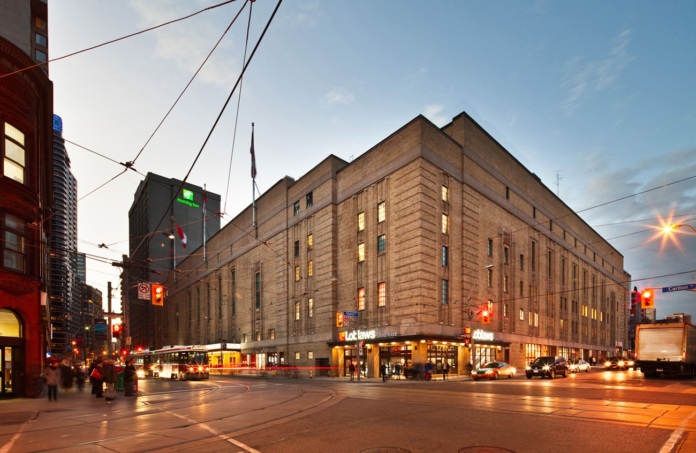
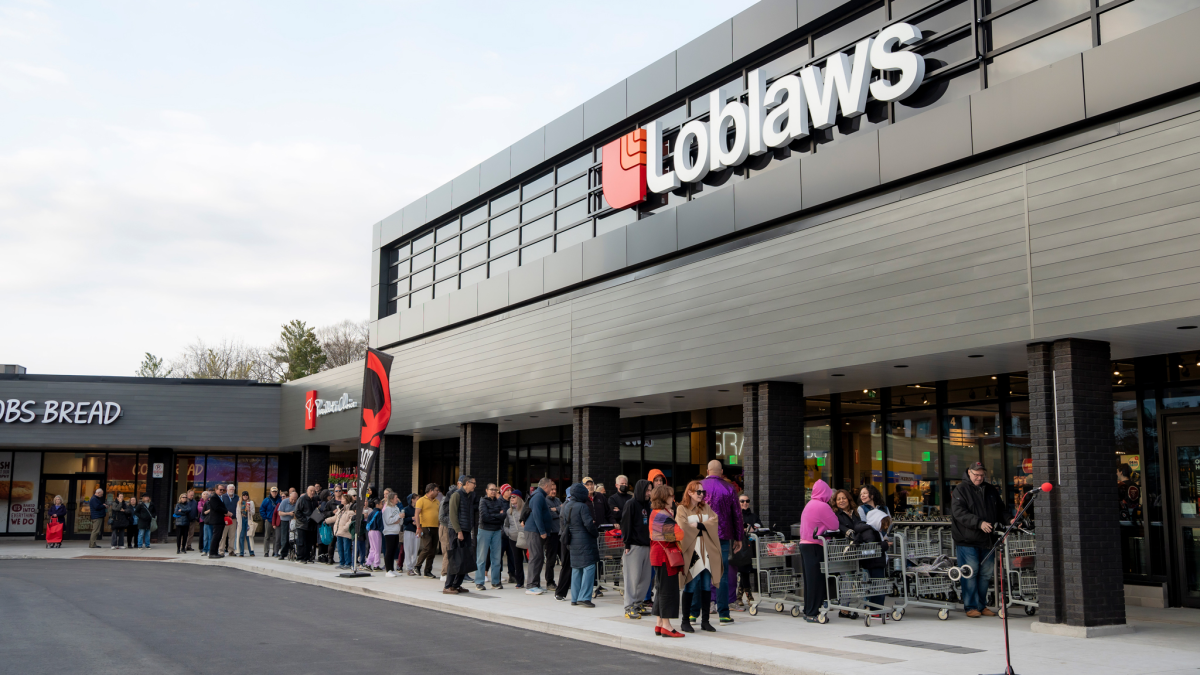
Loblaws at Maple Leaf Gardens in Toronto. Photo: Loblaws
Canadian consumers continue to prioritize value as economic pressure and elevated food costs reshape grocery shopping habits across the country, according to executives at Loblaw Companies Limited during the company’s first quarter 2026 earnings call. The retailer reported continued strength in its discount banners, growing demand for promotions and private label products, and an ongoing shift toward lower-cost food purchases as shoppers remain cautious with spending.
The company delivered first quarter revenue growth of 4.2% year-over-year to $14.48 billion, while adjusted diluted net earnings per share increased 10.6%. Loblaw also reported strong momentum in both food and pharmacy operations, supported by new store openings and continued expansion across Canada.
Executives, however, spent much of the call discussing how Canadians are continuing to adjust purchasing behaviour in response to affordability pressures.
“We are seeing right now is more of the same,” said President and CEO Per Bank during the earnings call. “Customers, they are still doing what they did in the last quarter. They are trading down.”
Loblaw executives pointed to changing purchasing patterns across core grocery categories as consumers increasingly gravitate toward lower-cost alternatives and promotional pricing.
Per Bank cited chicken sales as one example, noting that customers are buying fewer premium “free-from” products while increasingly purchasing entry-level offerings instead.
Per Bank
“It’s a double-digit decline in the free form, it’s a double up in our opening price point,” he said during the call.
Executives also noted consumers are purchasing fewer steaks while shifting toward lower-cost proteins such as minced beef, alongside increased promotional shopping activity across the grocery business.
The comments reflect broader trends unfolding across Canada’s grocery sector, where value-focused shopping habits continue to shape retail performance. Loblaw executives said the company’s internal food inflation metrics remain below Canada’s grocery CPI rate of 4.4%, which management attributed partly to promotional strategies, loyalty offers, and efforts to resist supplier price increases.
Private label products also continued to outperform national brands during the quarter, according to management, as consumers increasingly seek lower-cost alternatives without sacrificing perceived quality.
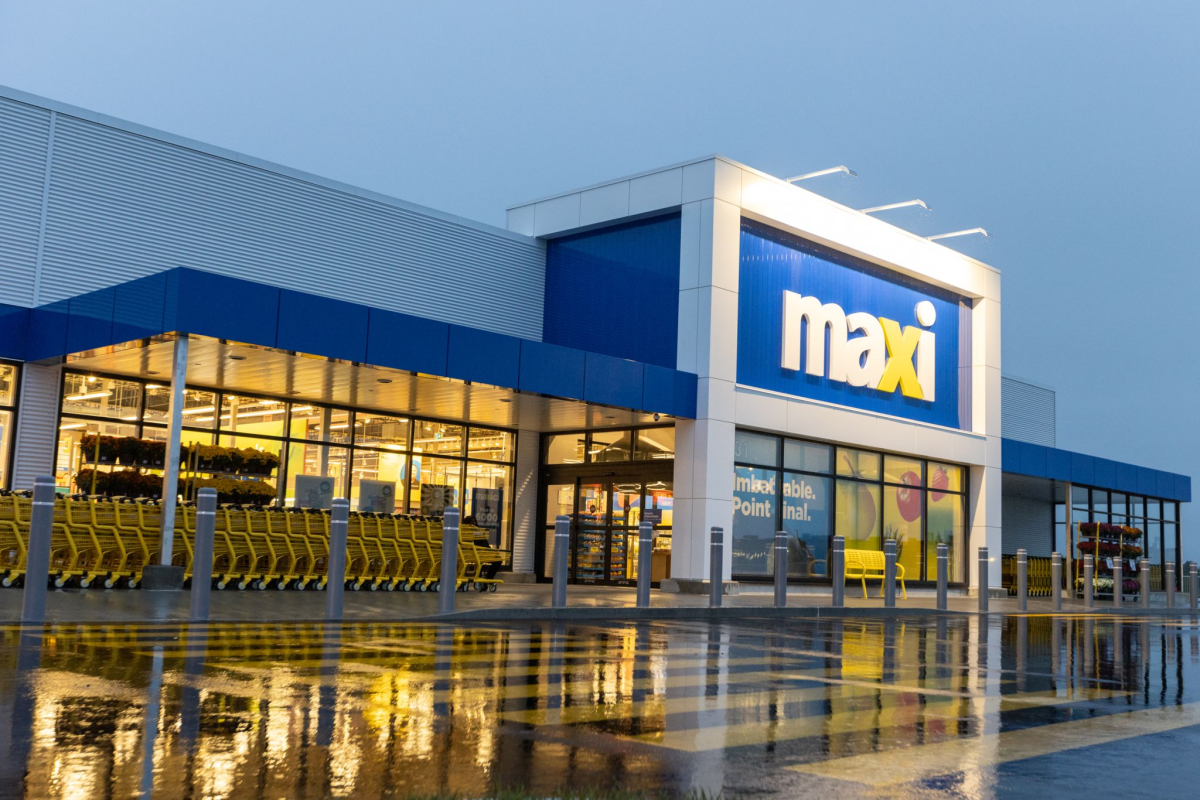
Maxi store. Photo: Loblaw Companies
Discount Banners Continue Driving Growth
Loblaw’s discount banners, particularly No Frills and Maxi, remained among the company’s strongest growth drivers during the quarter as consumers continued prioritizing affordability.
The company opened five new hard discount stores during the quarter and plans to open approximately 30 discount locations in total during 2026.
Executives said newer discount locations have been generating particularly strong results. Loblaw noted that 28 hard discount stores opened since 2023 are averaging double-digit same-store sales growth.
Management also emphasized that many new stores are being developed in underserved markets where discount grocery penetration has historically been limited.
Per Bank highlighted Vancouver Island as an example, noting that Loblaw operated only one No Frills location there when he joined the company in 2023. By the end of this year, the retailer expects to have four stores operating on Vancouver Island, with additional locations already planned.
The company also cited Sudbury, Ontario, where Loblaw previously had no No Frills stores despite a population of approximately 166,000 residents. The retailer now operates two locations in the market and said performance has exceeded expectations.
Loblaw Reducing Store Construction Costs
Executives also revealed that Loblaw has reduced grocery store construction costs by approximately 30% over the past several years through operational and design efficiencies.
According to Chief Financial Officer Richard Dufresne, the company has focused heavily on reducing refrigeration costs, accelerating store construction timelines, and testing semi-assembled building components to improve development economics.
Management said these efficiencies allow Loblaw to expand into smaller Canadian communities while maintaining acceptable returns on investment.
“For every dollar that we reduce our construction cost, it just drives up our IRR,” Dufresne said.
The comments underscore how major grocery operators are increasingly adapting real estate strategies to support discount expansion and smaller-format growth opportunities across Canada.
Loblaws at Humbertown Plaza in Toronto. Photo: Loblaw Companies
Conventional Grocery Stores Still Performing Well
While discount banners continue outperforming, Loblaw executives stressed that the company’s conventional grocery operations also remain healthy.
The retailer pointed to strong performance at banners including Fortinos and T&T Supermarket, with management highlighting continued growth in multicultural grocery offerings and preferred food categories.
Executives also said conventional stores continued gaining tonnage and market share against competitors despite cautious consumer spending.
The company’s food same-store sales grew 2.4% during the quarter, while absolute food sales increased 3.9%.
Loblaw additionally reported continued momentum in e-commerce, with online sales increasing 20.3% year-over-year, driven by growth in PC Express delivery and third-party delivery integration.
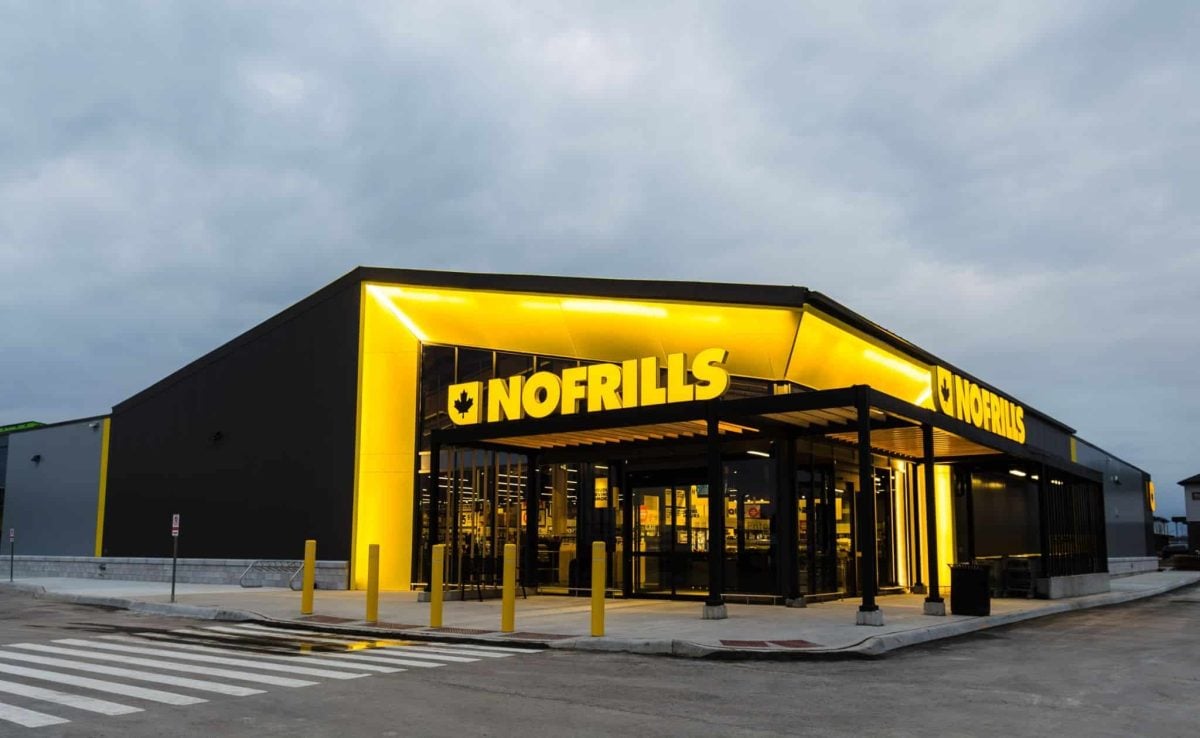
New concept No Frills store in Komoka. Image: Loblaw Companies
Discount Grocery Growth Continues Reshaping Canadian Retail
The latest results reinforce how discount grocery continues evolving from a temporary inflation-era response into a more deeply embedded consumer behaviour trend across Canada.
Although executives said shopping patterns have not materially worsened in recent months, the company acknowledged that consumers remain cautious and highly focused on value across multiple categories.
At the same time, Loblaw is continuing to invest aggressively in discount grocery expansion, supply chain modernization, e-commerce, and operational efficiencies as competition intensifies across Canada’s grocery sector.
The company plans to open approximately 70 stores in total during 2026, including both grocery and pharmacy locations.