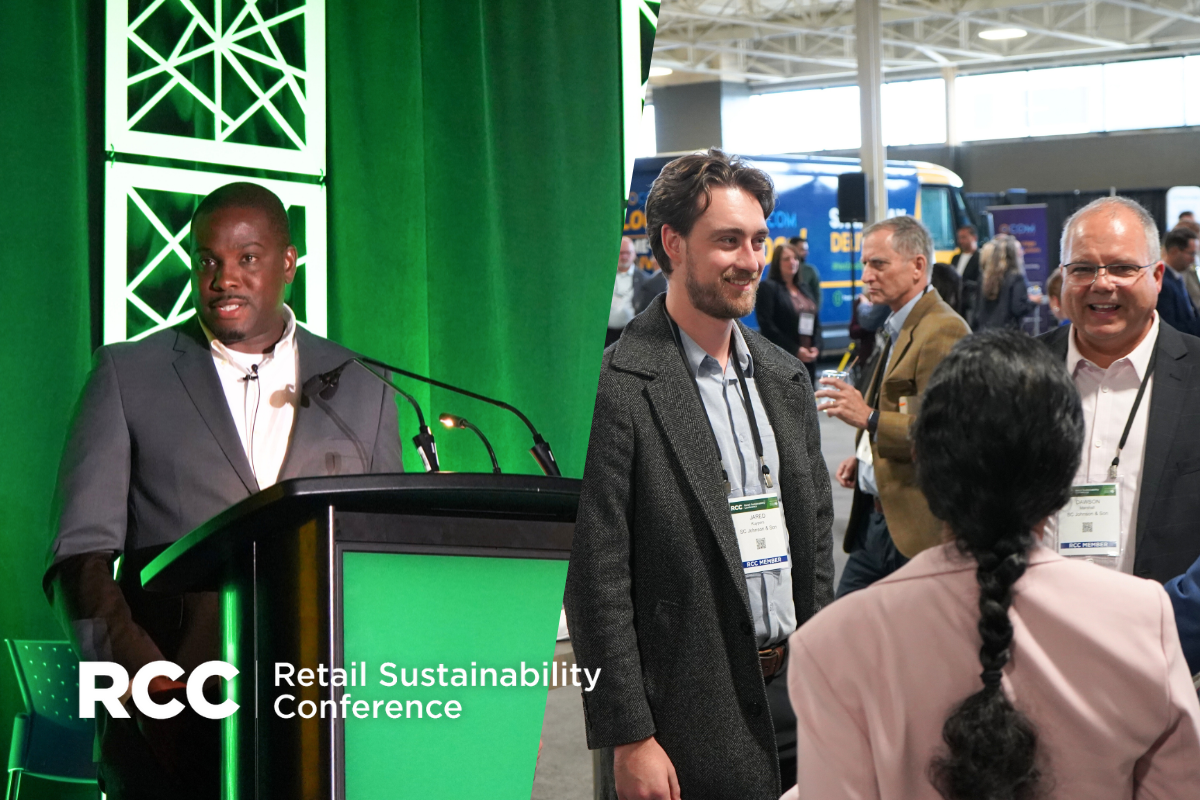
On September 25, 2025, at Vancouver’s Hyatt Regency, Retail Council of Canada’s Retail West Conference will bring Western Canada’s most influential retail leaders and innovators into one room for a concentrated day of insight, strategy, and connection.
THEMES THAT MATTER NOW
RCC Retail West’s program is laser-focused on the realities and opportunities unique to retailers in this time of hyper personalization, AI-driven shopping, and customer centric engagement.
Reimagining Leadership in Dynamic Markets – Learn how retail executives are steering through uncertainty while positioning for growth.
Building Resilience Across Operations – Tackle supply chain vulnerabilities, adopt new payment technologies, and make your data work harder.
Predicting Consumer Needs with AI – Google shares how their AI Marketing Engine helps retailers anticipate what Western Canadian shoppers will want next and how to deliver it at the perfect moment.
Creating a 360° View of Today’s Shopper – Caddle and Environics Analytics show how combining rapid-response consumer insights with segmentation and modeling tools provides a complete picture of customer behaviour.
Retail as a Career– Senior retail leaders share their employee journeys, highlighting how internal advancement programs can be a competitive advantage in an industry challenged with retention and labour shortages.
INSPIRING RETAIL PERSPECTIVES FROM PROVEN LEADERS
This year’s mainstage speakers aren’t just sharing stories. They’re opening their playbooks, revealing the strategies, missteps, and breakthroughs that drive real results in today’s retail landscape.
Mat Povse, President of Best Buy Canada, on harnessing technology while keeping customer needs at the core of everyday operations.
Brian Hill,Founder and Executive Chair of Aritzia, on building a culturally magnetic brand with purpose.
Shannon Stewart, Chief Merchandising Officer of Harry Rosen in conversation with Cameron Conn, CEO of Champlain on anticipating consumer shifts and crafting premium experiences that resonate.
Hermanjit Mahil, Assistant GM, Human Resources at London Drugs, moderates a panel of colleagues in Marketing, IT, and Legal functions about their moves from frontline operations to impactful head office roles.
MORE THAN A CONFERENCE, IT’S A LAUNCHPAD FOR IDEAS
RCC Retail West is designed for deep, candid conversations—both on stage and in the networking spaces. Over breakfast, lunch, and the evening reception, retail decision-makers can connect with peers across sectors, swap strategies, and explore innovations from a curated exhibitor showcase offering targeted solutions. It’s the perfect setting to bring your team, learn from others’ hard-won insights, and leave with ideas you can put into action the very next day.
THE COUNTDOWN IS ON
The early bird deadline is August 28, 2025. Grab your tickets today and save $100. Teams of 5 or more save an additional 20%.
In a time of rapid change, RCC Retail West 2025 offers a forward-looking space to learn, connect, and create the strategies that will define retail’s next success stories in Western Canada.
By donating to The Salvation Army Thrift Store, Canadians actively participate in extending the lifecycle of clothing and household items, reducing waste, and supporting a circular economy. (CNW Group/The Salvation Army Thrift Store – National Recycling Operations)
The Salvation Army Thrift Store recently opened its newest location at 19700 Langley Bypass, Unit 301. This marks the organization’s second store in Langley and its 14th in the Vancouver mainland, expanding its reach and positive impact on the local community.
Situated across from Willowbrook Shopping Centre, the 10,900-square-foot store is conveniently located in a high-traffic area of the city, offering a great selection of gently used clothing, household items, electronics, books, art, and more, for everyone, it said.
Ted Troughton
“We’re excited to further expand our presence in Langley,” said Ted Troughton, Managing Director of The Salvation Army Thrift Store. “Every purchase and donation help fund local Salvation Army programs and services for those in need such as foodbanks, shelters, rehabilitation for those struggling with addictions and emergency relief efforts.”
The Salvation Army Thrift Store provides an accessible shopping experience for individuals looking to stretch their budgets while also making environmentally conscious choices and supporting their local community, it said.
“Beyond the funds generated through the sales of donated items, The Salvation Army Thrift Store raises money in stores through its GoodWorks@Work campaigns, which brought in more than $1 million in 2024. These initiatives support vital causes such as Send a Kid to Camp, modern slavery and human trafficking prevention, international development, and Christmas kettles,” it added.
The Salvation Army Thrift Store (National Recycling Operations) is a non-profit organization and the only national division of The Salvation Army. Through its 95 Thrift Stores across Canada, the organization offers savings on gently used clothing, textiles, and household items while generating funds to support local programs, services, and emergency relief efforts. As one of the country’s largest textile collectors and a leader in textile diversion in the charitable sector, the store diverted over 80 million pounds of items from landfills last year.
A new Chick-fil-A restaurant is opening in Mississauga Heartland Town Centre on Thursday, August 28, creating approximately 100-120 full- and part-time jobs. Chick-fil-A, Inc. selected Mufuti Sanusi to be the local Owner-Operator of the new restaurant.
Located at 5950 Mavis Road, Mississauga, Chick-fil-A Heartland will serve customers Monday through Saturday from 10:30 a.m. to 10:30 p.m., offering dine-in, drive-thru and carry-out.
“At my core, my true passion and purpose is to be a resource and a bridgebuilder,” said Sanusi. “I want to encourage others to dare to dream and help them achieve their goals in life, just like my mother did for me.”
Mufuti Sanusi
Sanusi’s journey is a testament to her entrepreneurial spirit, taking her from learning business principles from her mother and grandmother in Lagos, Nigeria, to earning her MBA in the United Kingdom, and now leading her second Chick-fil-A restaurant in Mississauga, said Chick-Fil-A.
As the former Owner-Operator of Chick-fil-A Square One Shopping Centre, Sanusi is no stranger to the Mississauga community, as she has called the city home for the past 17 years. Sanusi is looking forward to continuing her impact on the community, and on the Team Members she’ll be working alongside, it said.
The company said Sanusi is committed to giving back to the Mississauga community by:
Participating in the Chick-fil-A Shared Table™ program, which redirects surplus food to local non-profits and has helped to create more than 35 million meals to date.
Celebrating the opening with a donation of C$40,000 from Chick-fil-A, Inc. to Second Harvest to support local hunger relief efforts in the greater Mississauga area. Since 2020, Chick-fil-A has donated approximately C$2 million (US$1.46 million) to Second Harvest to address food insecurity.
Chick-fil-A, Inc. is the third largest quick-service restaurant company in the United States, known for its freshly prepared food, signature hospitality and unique franchise model. More than 200,000 Team Members are employed by local Owner-Operators in more than 3,000 restaurants across Canada, the United States and Puerto Rico. Chick-fil-A opened its first restaurant in the UK in early 2025 with the goal of launching five locations across the UK within the next two years. The first Singapore restaurant is set to open in late 2025, marking the brand’s entry into Asia. The family-owned and privately held company was founded in 1967 by S. Truett Cathy.
Leading boba tea brand CoCo Bubble Tea recently announced a series of key expansion milestones across North America, with a new focus on smaller Canadian cities and continued momentum in the U.S. market.
These openings reflect the brand’s sustained popularity, cultural integration, and robust support for its franchise network, it said.
“As bubble tea becomes a staple refreshment in North America, we see significant potential for growth outside of major cities,” said Kody Wong, Director of Business Development at CoCo Bubble Tea. “From Alberta to Texas, CoCo’s franchise partners are bringing our brand to new communities and increasing access to authentic bubble tea for millions of North American consumers. We are immensely grateful to our partners for the passion and commitment it has taken to accomplish this.”
Already a top-three brand in Toronto with over 120 stores nationwide, CoCo is now reaching new heights of market penetration:
Recently opened: Lethbridge, Grand Prairie, Red Deer — bringing authentic CoCo bubble tea to new communities across Alberta.
Coming soon in 2025: Saskatoon, as the brand extends its footprint deeper into the Canadian Prairie provinces.
CoCo Bubble Tea in Red Deer, Alberta
CoCo opened its first overseas store in the United States in 2011, establishing itself as one of the pioneering new tea brands to expand globally. In 2025, CoCo has identified Texas as a key priority market in its U.S. growth strategy:
Dallas: Store opened in April 2025
“CoCo’s approach to franchising is rooted in trust, support, and building long-term relationships with partners. In Canada, the same franchise partners have been with CoCo for 11 years; in New York City, partners have grown alongside the brand for 14 years — both a testament to CoCo’s value-driven model and collaborative culture,” said the company.
CoCo Bubble Tea in Dallas, Texas
“To further spread pearl milk tea culture globally, the brand focuses on harnessing the popularity of the refreshment among younger consumers through social media. Also, employees and partners are referred to as ” Boba Squad”, a name embodying the resilience and vibrancy of the brand.
“In Canada, CoCo has invested heavily in synergies with local cultures. The brand has transformed fan-favorite drinks like its passionfruit series into popsicles now sold in T&T Supermarket locations across the country. In a collaboration with Barbie, CoCo brought “Strawberry Dreamer” drinks to over 100 stores across North America. This further showcases how the brand continues to innovate with purpose and reach younger audiences through pop culture.”
CoCo will exhibit at two upcoming major franchise expos in the region:
Franchise Expo West 2025 Los Angeles Convention Center | Booth #525 September 5–6, 10AM–4PM
Toronto Fall Franchise Show The International Centre | Booth #148 September 13–14, 11AM–5PM
To support franchise partners, CoCo said it provides robust support tailored to its North American network, including:
Dedicated logistics and supply chain for the region
Local operations and consulting teams offering in-person support and business strategy
Regional training programs
Product R&D and adaptation for local tastes
A single-store program that empowers individual entrepreneurs to build community-driven success stories
Operating revenue in the motion picture theatres industry reached $1.6 billion in 2024, a 12.0% increase from 2022. As restrictions related to the COVID-19 pandemic affected the industry for part of 2022, the growth in 2024 was attributable in large part to a full return to normal operations. Despite these gains, the industry’s national operating revenue was 13.1% below that of $1.9 billion recorded in 2018—the highest amount on record since the beginning of the data series in 2014—underscoring the prolonged impact of the pandemic on the industry, according to a report released Tuesday by Statistics Canada.
Operating expenditures grew at a slower pace than operating revenue, increasing 10.3% from 2022 to $1.5 billion in 2024. As a result, the operating profit margin rose to 7.9% in 2024; however, this was well below the profit margin recorded in 2018, pre-pandemic (16.2%), said the federal agency.
Image: Statistics Canada
“In response to rising cost pressures and stagnating theatre attendance, which climbed to two-thirds (66.6%) of the level seen in 2018, the average ticket price (calculated as total admission receipts divided by the number of paid admissions) rose to $12.57 in 2024. This represented a 5.5% increase from 2022 ($11.91) and a 31.9% rise from 2020 ($9.53),” said Statistics Canada.
“E-commerce sales in 2024 declined to $234.4 million, or 15.7% of total sales. This marks a significant drop from their 2022 peak of $307.2 million, or one-quarter (24.7%) of total sales. During the pandemic, e-commerce sales were buoyed by food sales made through delivery services and the widespread practice of booking seats online in advance. However, with the return to in-person experiences and a resumption of business as usual in 2024, more people began purchasing their tickets in person again.
“In 2024, the largest component of sales for the motion picture theatres industry was once again admission receipts, accounting for more than half (53.8%) of total sales. This was followed by sales of food and beverages, which increased their share to 38.0%.”
Canada’s motion picture industry continues its post-pandemic recovery, but it moves forward with measured caution. While pent-up demand and delayed theatrical releases led to revenue growth in 2024, the industry still faces significant long-term challenges, said Statistics Canada.
“The pandemic accelerated shifts in consumer habits and preferences, leading many audiences to favour the convenience of digital platforms over traditional cinema experiences. As streaming services capture an increasing share of viewer attention, box office revenues will continue to face growing competition, fundamentally reshaping how Canadians engage with film,” it said.
The Consumer Price Index (CPI) rose 1.7% on a year-over-year basis in July, down from a 1.9% increase in June. Prices for gasoline led the slowdown in the all-items CPI, falling 16.1% year over year in July, following a 13.4% decline in June. Excluding gasoline, the CPI rose 2.5% in July, matching the increases in May and June, according to a report released Tuesday by Statistics Canada.
Moderating the deceleration in July were higher prices for groceries and a smaller year-over-year decline in natural gas prices compared with June.The CPI rose 0.3% month over month in July. On a seasonally adjusted monthly basis, the CPI was up 0.1%, said the federal agency.
“Year over year, gasoline prices continued to reflect the removal of the consumer carbon levy, falling 16.1% in July, following a 13.4% decline in June. In recent months, prices for gasoline have been relatively stable, increasing 0.4% since April,” noted Statistics Canada.
“On a monthly basis, gasoline prices fell 0.7% in July. Lower crude oil prices, following the ceasefire between Iran and Israel, contributed to the decline. In addition, increased supply from the Organization of the Petroleum Exporting Countries and its partners (OPEC+) put downward pressure on the index.”
Photo: Los Muertos Crew
In July, prices for shelter rose 3.0% year over year, following a 2.9% increase in June, with upward pressure mostly coming from the natural gas and rent indexes. This was the first acceleration in shelter prices since February 2024, said Statistics Canada, adding that prices for natural gas fell to a lesser extent in July (-7.3%) compared with June (-14.1%). The smaller decline was mainly due to higher prices in Ontario, which increased 1.8% in July after a 14.0% decline in June.
“Rent prices rose at a faster pace year over year, up 5.1% in July following a 4.7% increase in June . . . Moderating the acceleration in shelter was continued slower price growth in mortgage interest cost, which rose 4.8% year over year in July, after a 5.6% gain in June. The mortgage interest cost index has decelerated on a year-over-year basis since September 2023.”
Year over year, prices for food purchased from stores rose at a faster pace in July (+3.4%) compared with June (+2.8%). Prices for confectionery (+11.8%) and coffee (+28.6%) accelerated, contributing to the increase in grocery prices. Unfavourable weather conditions in growing regions led to higher prices for the primary ingredients (cocoa and coffee beans) used to produce these food products, explained Statistics Canada. Additionally, prices for fresh fruit rose 3.9% year over year in July, following a 2.1% increase in June, largely stemming from higher prices for grapes (+29.7%). As of July 2025, Canadians were paying 27.1% more for food purchased from stores than they were in July 2020.
It’s been a hectic summer for many Canadians but as summer unfolds, retailers are already deep into the back-to-school season, a time that continues to start earlier each year, according to Jeff Doucette, General Manager of Field Agent Canada.
“We’ve already seen quite a bit of back-to-school in-store, for sure. Walmart was really quick out of the gate. I mean, Dollarama has already moved on to Halloween,” says Doucette.
Jeff Doucette
He notes a quirky new trend emerging in the U.S. retail landscape. “It’s been kind of interesting. In the States, we’ve seen this season come out of nowhere called Summerween, which is basically the candy manufacturers trying to get another wave of Halloween candy into stores earlier.”
According to a Field Agent survey, 39% of Canadians say they will spend more this year than last year and 67% say inflation is impacting them more this year.
The top five retailers for school supplies are Walmart, Dollarama, Costco, Staples and Real Canadian Superstore, said Field Agent.
The Field Agent survey also found that 71% say social media influences their shopping decisions and 95% will take packed lunches/snacks to school
As for the Canadian market, Doucette’s team has been tracking back-to-school shopping behaviour through its annual survey now in its 10th year.
“The results don’t change enormously year to year. But a few things really stood out this time: one is the bigger influence of online shopping, particularly Temu. It’s really starting to be a go-to online retailer for back-to-school.”
He attributes this growth to the rising influence of kids themselves in the shopping process.
“As kids get older, they become more influential in the process of what gets bought for back-to-school. For example, my daughter sent me her list from Amazon through a site called Share My List or something like that. She did all the shopping herself, sent me the link, I clicked a button and paid for it, that was it.”
Digital trends aren’t the only shift. Economic concerns are playing a major role this year as well.
“People are still concerned about inflation. That’s nothing new, but I think it’s driving people to shop earlier and to shop online more frequently, trying to find deals they might not get in-store.”
That concern is also causing more families to shop more conservatively, Doucette says.
Photo:
Alex P
“We’re seeing people not buying the full list anymore. They’re actually going back and seeing what they already have on hand. Maybe the backpack from last year is still good. Maybe the indoor shoes from last year become this year’s outdoor shoes.”
In his own household, Doucette approached back-to-school shopping with a creative twist.
“I said, ‘Let’s have a scavenger hunt around the house, see what we can find,’ and then we just bought the rest. That was a different take rather than just buying everything new, let’s use what we’ve already got. And surprisingly, I think we already had half the list in the house.”
The earlier start to the season is becoming more noticeable, particularly among major retailers.
“With back-to-school, there’s a bit of a hard stop when kids are still in school. I don’t think parents want to be seeing back-to-school displays before school’s even out. But we don’t see it taking long after. Walmart, for example, had displays up right after Canada Day, they went straight into back-to-school.”
But with the increase in online shopping, early physical displays are no longer the only path to sales.
“You don’t even need the displays. People are just grabbing things off the website or finding deals in-store as they go. Retailers that get an early start probably do benefit. Those early shoppers get wrapped up quickly and that’s always been Costco’s strategy, right?”
One clear distinction between Canada and the U.S. also stood out in this year’s survey.
“The primary difference is that Canadians send their kids to school with lunches way more than Americans do. About 95% of Canadians send packed lunches with their kids, compared to only around 40-something per cent in the U.S.”
That creates unique opportunities for Canadian grocery retailers during the back-to-school season.
“Back-to-school is a much bigger deal for grocery retailers in Canada than it is in the U.S. There’s a real opportunity, not just in September but throughout the school year, to help parents solve that ‘what’s for lunch tomorrow?’ problem.”
And while no retailer has fully seized on that idea yet, Doucette offers a suggestion.
“One of my best little consulting ideas is: imagine a refrigerated display where you could find everything you need for lunches, crackers, yogurt, carrot sticks, all in one spot. I think that would be really cool if someone gave it a try.”
Over the past five years, M&M Food Market has raised more than $450,000 to support BGC Canada (formerly Boys and Girls Clubs of Canada), funding essential programs for children and youth. What began as a pandemic initiative has evolved into a national partnership, with franchisees contributing locally through food and gift card donations, as well as event sponsorship.
Allan Lindsay
“We had been looking for a partner that we could get involved in with, a charitable partner, a cause we could get behind. One that fit well with who we are as a brand and what we want to support,” said Allan Lindsay, President of M&M Food Market. “We were looking at and eventually ended up landing on Boys and Girls Clubs of Canada.”
The fit made sense for the food retailer. “We are very involved in our communities, and youth and children, and food security for them, is an important play for us as well.”
M&M began the partnership by donating gift cards and other essentials to clubs during the early days of the pandemic. “We got involved in the early parts of the pandemic actually. What we were able to offer them were gift cards and other things for our stores so that they could secure food for the clubs.”
The relationship has since grown into a deeper commitment. “Now we support them in a multitude of ways. We support them still with some donations from head office, whether it be gift cards or other, we raise money in our stores, with a particular focus on their Club Day.”
Every year, the company runs a customer donation campaign from May through June. “We proactively collect donations, engage our customers at store level.”
Beyond corporate initiatives, many franchisees also build personal ties with local clubs. “They engage with local clubs and do separate events through the year. So they’ll have a partnership with a club to provide food, or our franchise partner will put on a barbecue to raise money or to support an event.”
“It’s really been a really positive relationship and one we’re proud of,” said Lindsay.
Lindsay has visited several clubs himself and is also a member of the BGC Foundation Board.
“The work they do is really amazing. It’s a place for kids to go whether it’s before or after school or during the day. Yes, it provides some food and nutrition for those kids that we can help to support. But also they help with homework, some of them have computer labs, gymnasiums. They’ll do music lessons, depending on the capabilities and skills of the people working in the club or the other club members.”
“Every time I’ve gone to one, it’s amazing to see how plugged into it the kids are, to see how much they offer. You hear stories, there are so many people, whether they’re adults now or teens, that have come up through a club, and the difference it’s made in their life, and how impressive these youth are. It’s very inspiring.”
“All of those things together just make us feel really good about being able to, in a small way, support it.”
Photo: M&M Food Market
Lindsay has been with the company for over a decade, playing a key role in its evolution as a leading frozen food retailer in Canada.
The company is based in Mississauga, Ontario, which also serves as its headquarters. The first store opened in the Kitchener area in 1980.
M&M Food Market currently operates in over 300 traditional locations across Canada. “Traditional stores like a traditional M&M, we’re about 315,” said Lindsay. “And in our Express format where we might have a couple of doors in a Rexall or something like that we’re over 2,000.”
Store expansion continues, albeit modestly. “It depends on the year, but probably five to 10 kind of thing,” Lindsay explained. “That would be slight growth because there’s always kind of a refreshing of the network. To really kind of accelerate growth, it’d probably have to be 10 plus, but we’re in kind of a five to 10 mode right now.”
M&M’s niche lies in offering convenient, high-quality meals designed for modern families.
“I think a lot of it stems from how we try and position ourself and our brand promise, which is helping make real food for real life,” said Lindsay. “A lot of times we truncate it and we just say ‘real food for real life,’ and that references more like our real food promise, which is no artificial flavours, colours, sweeteners in anything that has the M&M brand on it.”
Their service model, which includes in-store meal advisors, helps differentiate the brand. “Our place is in helping busy families put meals on the table. It stems all the way from our service model in store, our meal advisors that give personalized experience and guidance to customers, all the way to having convenient, good-for-you meals and appetizers at home that are easy to make.”
“We’re a frozen food specialty retailer, I guess, if you wanted to get technical,” added Lindsay. “But I talk about us more as a food retailer that’s helping busy families and just busy people in general.”
Franchising is a key part of M&M’s business model, with the majority of stores operated by franchisees. “We’re about, say, 70% franchised,” said Lindsay. “The number kind of moves around a little bit.”
Retailers are increasingly in the crosshairs of cybercriminals, and their growing presence on digital and social platforms is a major reason why, says John Walsh, Field Chief Technology Officer – Critical Sectors at IGEL, a Germany-founded company specializing in endpoint security.
In an interview with Retail Insider, Walsh explained that IGEL, initially known for its thin client hardware, evolved by focusing on its operating system, an architecture that supports strong security from the endpoint outward.
John Walsh
“As I understand it, the company was founded in Germany and the original founders started a business that was, for the most part, a thin client,” said Walsh. “It was an operating system, but they also manufactured, the hardware that went with it.”
That operating system turned out to be remarkably resilient. “We have customers we run into who are still operating the platform from 25 years ago,” he added.
Over time, the company saw the value in separating the OS from proprietary hardware. “It became recognized that the value in the platform was really the operating system and to become more agnostic of hardware, so that we could have multiple hardware partners that the operating system would run on,” said Walsh.
The OS itself brought unique security advantages. “It was a read-only immutable Linux operating system… being able to, because it’s read-only, eliminate 70 to 90% of the attack surface right at the endpoint,” Walsh explained. “It had some very unique, also, hardware root of trust features. So it was designed for security.”
This endpoint OS is centrally managed by IGEL’s Unified Management System, allowing enterprise control across edge devices. “It had a second component that is called the Unified Management System,” said Walsh. “This unified management system centrally manages the endpoints, which is a very unique characteristic when you look at some of the competitors.”
Walsh said the system enables customized user experiences while maintaining strict security and control. “We can enforce specifically by downloading through our app portal the things that you need to do your work, the user experience that you have,” he said. “So essentially this created a very lightweight endpoint and very secure endpoint, and one in which you could enforce the user experience.”
Notably, no data resides on the endpoint. “There’s no data on the endpoint,” he emphasized. “The data on the endpoint is coming from your data centre, your cloud, whatever the instantiation is of the architecture.”
IGEL’s open ecosystem now includes more than 120 partners, with another 60 in the pipeline. “So now we can bring any combination of permutation of applications, architectural platforms that you as the end user need to essentially meet your objectives or your requirements,” said Walsh.
When asked about the growing number of cyberattacks targeting retailers, Walsh said motivations vary. “Some of the objectives could be to eliminate availability of the architecture to cost them money,” he said. “At the end of the day, these big attacks are all about how does the person who’s launching the attack benefit, right?”
Image: IGEL
“They’re either trying to get personal information, credit card information,” he added. “They’re trying to create a ransomware event that would make the retailer have to pay. They may even go further in terms of creating false transactions to gain access, if you will, to merchandise and things like that they can resell.”
The endpoint is often where such attacks begin. “Typically the endpoint is where the attack begins. So there’s some sort of social engineering or thought processes around how to get to an endpoint so that they can move laterally and vertically within the architecture,” said Walsh.
A major driver of retail vulnerability is the shift to social selling. “Retail systems are beginning to use more and more social media,” said Walsh. “They’re rapidly expanding the attack surface.”
He warned that attackers are leveraging digital storefronts and mimicking brands to lure consumers. “When I get on Facebook and I’m sitting there and I see kind of maybe a deep fake of what looks like Best Buy and as it turns out, it’s not Best Buy. It’s a really good fake.”
He shared a personal experience: “I was provided an offer to get a 30% reduction in my AT&T billings. They knew my phone number, so they obviously had done a lot of the upfront work.” However, red flags eventually revealed the scam. “I began to realize that it was a ploy simply to get personal information.”
Asked whether retailers are prepared to combat these threats, Walsh offered a measured response. “I wouldn’t want to say something that would suggest that they’re not doing their best,” he said. “But I would say that there certainly are things they need to start thinking about more.”
He cited internal friction as a challenge. “There typically tends to be some friction between your CISO (Chief Information Security Officer) … and then you’ve got your CIO (Chief Information Officer),” said Walsh. “There seems to be a lot of friction as we start to look at what the risks are with some of these new attacks versus the risks associated with implementing new capabilities.”
Walsh said the industry is in a state of transition. “We’re beginning to adopt newer ways of doing things and we’re to some degree in a transition period.”
Image: IGEL
He concluded with a warning about how artificial intelligence is amplifying the risks. “The launch of AI allows you to take a lot of these things that are in the wild and you can rapidly modify them faster than we can respond to them with the traditional monitoring and detect approach.”
His advice: start with securing the endpoints and embrace Zero Trust principles. “Retail has to start thinking about Zero Trust in order to get to resilient solutions,” said Walsh. “At the most granular level, the access that you’re providing, the request that’s being made is a valid request. You’re only giving it the least privileges that are required.”
That mindset must stretch across the business. “That should be prevalent across the supply chain and across the business and the backhaul all through the organization to eliminate the insider threat and things like that,” he said.
Walsh closed by noting the gap that retail still needs to close. “There are a lot of things that the industry needs to be doing to catch up with the critical industries.”
Retail Insider is streamlining its Canadian retail news from around the web to include a handful of top news stories that can be viewed quickly during the day. Here are the top stories from the past 24 hours.