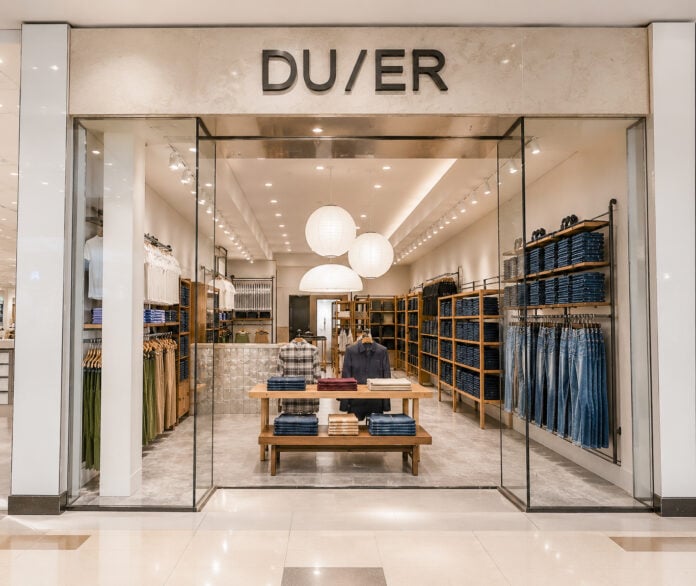
DUER, the Vancouver apparel brand behind Performance Jeanswear, has expanded to the Winnipeg market with the opening of its store in Manitoba at CF Polo Park set for Saturday August 29.
Gary Lenett, company Founder, said the brand already had the demand, years of wholesale and ecommerce telling it people there love the product.
“The only real question was where one store could reach the most of them. Polo Park settled that fast, more than 200 stores under one roof, pulling shoppers in from as far as Thunder Bay and Saskatchewan. And with winters like Manitoba’s, people would rather shop indoors than run between stores outside,” he said.
“We opened Banff in July, and Winnipeg is our third new store this year. Polo Park is about making sure we’ve got a real presence in the bigger Canadian centre, and Banff is the other side of that same push, proof we can reach a global customer without opening overseas, at least not yet.
“Winnipeg and Banff don’t look like they have much in common, but the test’s the same: has the demand already shown up before we sign a lease.”
Gary Lenett. Photo by Juno Kim
Because the brand has built out a new category, Performance Jeanswear, the store ends up doing a lot of the educating: what the category actually is and what problem it solves.
“People need to see the style and feel the performance for themselves. Once someone actually puts a pair of our pants on, we convert them at about 80% and that’s the number that keeps us investing in stores,” explained Lenett.
“Victoria and Banff taught us something else: they’re both tourist markets, and both did better than we expected going in. That’s got us looking at smaller, less permanent shops in resort towns, a way to meet that same demand without the size or lease term of a full store.”
Lenett said the Manitoba market has the same target customer, men and women 30 to 45 who lead an active, urban lifestyle.
“What shifts is the assortment. Winnipeg’s winters run longer and colder, so we lean into the winter denim collection, and the hero piece is our Tech Fleece denim. It’s the same approach we take in Ossington, Ottawa and Square One, warm, breathable fabrics that are sophisticated enough to wear anywhere,” he noted.
Lenett said the retailer has mapped 10 additional stores over the next 24 months, though Canadian retail is only one part of that vision.
“A second location in Vancouver, expansion into Montreal, maybe Saskatoon. But Seattle, a second San Francisco, and Salt Lake City is where a lot of the real growth sits,” he said.
Sobeys Inc. has reopened an IGA in west Edmonton at a grocery location with more than six decades of history, bringing a familiar banner back to the neighbourhood following the short-lived operation of L’OCA Quality Market.
The Valleyview IGA opened August 20 at 9106 142 Street NW in Edmonton’s Parkview neighbourhood. The site had been home to Andy’s Valleyview IGA for decades before longtime operator Andy Taschuk retired in 2024. L’OCA subsequently took over the space and operated there until the company closed its stores earlier this year.
The new IGA features fresh produce, a full-service bakery and deli, ready-to-eat meals and an assortment of local products. Sobeys said the offering reflects its commitment to supporting Alberta producers and serving the communities where it operates.
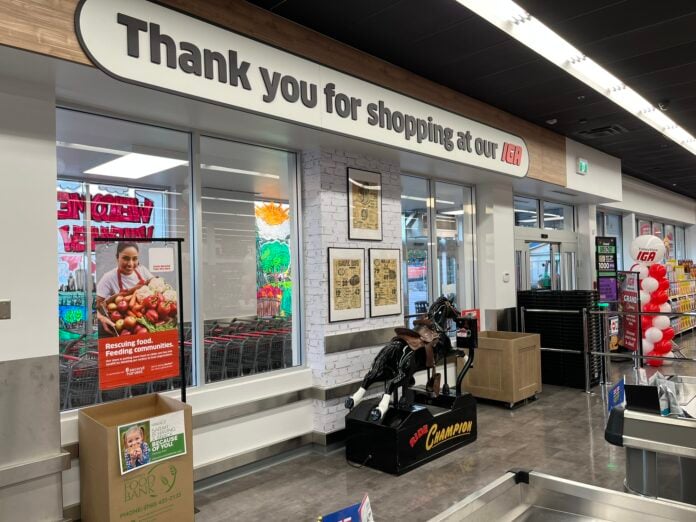
One particularly recognizable piece of the store’s history has survived the changes. The vintage horse that generations of customers have associated with the grocery store remains inside the location, and Sobeys confirmed to Retail Insider that it will stay.
A Familiar Horse Remains
The horse has remained through several changes to the store around it. When L’OCA took over the former Andy’s IGA, the company retained the fixture as part of its effort to acknowledge the location’s history.
Ben Cochrane, a partner at L’OCA Market, told Retail Insider in early 2025 that the horse had been at the store since the 1960s. He recalled riding it himself as a child while visiting his grandparents in the neighbourhood. L’OCA kept the horse when it converted the former IGA into its premium grocery concept, preserving a familiar link to the store’s past.
The location’s grocery history dates to at least the mid-1960s, with Andy’s Valleyview IGA becoming a longstanding fixture in west Edmonton. Taschuk operated the business for 59 years before retiring in 2024.
Taschuk returned to the location for the new IGA’s August 20 opening, joining customers welcoming the store back to the neighbourhood. Speaking to Global News, he described the surrounding community as highly supportive of its local grocer and expressed optimism that the reopened store would serve the area for years to come.
From Andy’s IGA to L’OCA
The recent changes began in 2024 when Taschuk announced his retirement and Andy’s Valleyview IGA closed at the end of July. The closure attracted attention beyond the immediate neighbourhood because of the store’s long history and its relationship with Edmonton’s Jewish community.
L’OCA Quality Market subsequently secured the location and opened there on January 31, 2025, less than a year after launching its first store in Sherwood Park. The Edmonton L’OCA was approximately 22,000 square feet, adapting the company’s culinary-focused grocery model to a considerably smaller footprint than its roughly 45,000-square-foot Sherwood Park flagship.
The store combined conventional grocery departments with prepared foods, a butcher, bakery, deli, café, pizza and sandwich offerings, and a range of house-made products. When Retail Insider toured the store following its opening, Cochrane said L’OCA had retained approximately 95 per cent of Andy’s former staff. The retailer also expanded the kosher assortment and preserved historical elements including the horse and old IGA materials.
At the time, the Edmonton opening formed part of a broader expansion strategy. L’OCA was planning a store in St. Albert and considering additional growth in Edmonton and potentially Calgary, although those plans would ultimately be abandoned.
L’OCA Closes After Ambitious Expansion
L’OCA announced in March 2026 that it would close its Edmonton and Sherwood Park stores, along with its restaurant operations, on March 12. The planned St. Albert location was also cancelled.
The company said it had been humbled by the difficulty of executing its locally focused, handcrafted business model and ultimately did not see a sustainable path forward. Retail Insider reported at the time, citing sources familiar with the business, that L’OCA’s operation had been losing approximately $1 million per month.
Its model involved extensive fresh-food production and prepared meals, while the larger Sherwood Park operation also incorporated full-service restaurant concepts. The Edmonton store ultimately operated for about 13 months.
The Valleyview site did not remain without a grocer for long. By June, signs of an IGA return had emerged, including approved signage for the property and Sobeys recruitment for a new management team. Five months after L’OCA closed, the site was operating under the IGA banner again.
IGA Returns Five Months After L’OCA Closure
The reopened store has hired approximately 45 to 50 employees, according to Edmonton city councillor Thu Parmar, with some former L’OCA employees joining the operation. L’OCA had similarly retained much of Andy’s staff when it entered the location in 2025, providing some workforce continuity through the changes in banners and operating models.
IGA’s return also underscores the continuing value of the Valleyview location as a neighbourhood grocery destination. The property has remained closely associated with food retail for more than 60 years despite the recent changes in operators and formats.
L’OCA brought a more elaborate model to the site, with a strong emphasis on culinary production, prepared foods and a premium shopping experience. The reopened IGA returns the property to a conventional neighbourhood supermarket format while maintaining fresh departments, prepared meals and local products.
The rapid turnaround highlights the value established grocery locations can retain within mature residential neighbourhoods. In Valleyview, Sobeys has returned a familiar banner to a site where generations of residents were already accustomed to shopping for groceries.
Longstanding Connection to Edmonton’s Jewish Community
The Valleyview store has also played a longstanding role within Edmonton’s Jewish community. For years, Andy’s Valleyview IGA was known for carrying kosher meat, groceries and Passover products.
Alberta Jewish News reported when Taschuk announced his retirement that Andy’s had been an important mainstream grocery source for kosher products in Edmonton and that Taschuk had supported Jewish community events. L’OCA recognized that history when it took over the store, retaining and expanding the kosher section as part of the conversion.
That relationship provides additional context for the August 20 reopening. Sobeys marked the opening with a ribbon-cutting ceremony and presented a cheque to the Jewish Federation of Edmonton in support of its work in the community.
For residents who have watched the property change from Andy’s IGA to L’OCA and back to IGA in little more than two years, the reopening marks another chapter for one of Edmonton’s longest-standing grocery locations. The IGA banner is familiar once again, as is the horse that has remained through decades of change.
RECENTLY OPENED VIP CINEPLEX THEATERS. PHOTO: LEE RIVETT
Cineplex is seeing Canadian moviegoers return to theatres in greater numbers while spending record amounts once they get there, with rapidly growing merchandise sales emerging as a new retail opportunity for the country’s largest cinema operator.
The Toronto-based company reported second-quarter revenue of $383.7 million, up 9.8% year-over-year and the highest Q2 revenue in its history, as theatre attendance increased 9.3% to 12.7 million guests. Adjusted EBITDA rose 20.4% to $40.8 million. The momentum has accelerated since the quarter ended, with Cineplex President and CEO Ellis Jacob telling analysts that the company had just recorded the highest-grossing week in its history, more than 20% ahead of its previous record set during the December 2015 release of Star Wars: The Force Awakens.
Cineplex is also generating more revenue from each visit. Box-office revenue per patron reached an all-time quarterly record of $13.91, while concession revenue per patron increased to a record $10.26. Theatre food-service revenue rose 11.8% to an all-time quarterly high of $130 million, with merchandise becoming an increasingly important part of that spending.
Movie Merchandise Sales Rise 45%
Merchandise sales increased 45% year-over-year during the quarter and reached a new quarterly record. Cineplex generated approximately $4 million from merchandise in Q2, with the category accounting for roughly one-third of the growth in concession revenue per patron. Products tied to major movie releases included collectibles from The Super Mario Galaxy Movie and Star Wars: The Mandalorian & Grogu, along with a red popcorn purse inspired by The Devil Wears Prada 2 that management said sold out almost immediately.
The demand is creating a retail opportunity that extends beyond the physical theatre. Jacob said Cineplex has added an online merchandise platform so consumers can continue purchasing products when inventory sells out at cinema locations. Cineplex Shop carries officially licensed movie merchandise including collectible popcorn vessels, apparel, drinkware and other products associated with current and recent releases. The shop currently carries more than 100 products, with merchandise tied to releases including The Odyssey, The Mandalorian & Grogu, Wicked and The Super Mario Galaxy Movie.
Movie merchandise represents a potentially attractive extension of the traditional cinema business because major releases continuously provide new intellectual property around which limited-edition products can be created. A successful film can generate ticket demand while simultaneously creating a temporary retail assortment supported by the same marketing campaign and cultural attention surrounding the release.
The strategy is increasingly visible across the cinema industry. U.S. exhibitors have expanded their merchandise businesses in recent years, particularly around collectible concession vessels and limited-edition products. AMC began selling 3D novelty buckets in 2019 and expanded from collectible vessels tied to nine films in 2023 to plans for more than 40 in 2026, according to the Los Angeles Times.
For Cineplex, the 45% increase indicates that Canadian moviegoers are participating in the same trend, with merchandise becoming a more meaningful contributor to spending growth rather than simply an ancillary concession item.
Cineplex Gets More From Each Theatre Visit
The merchandise growth is part of a broader increase in the value of each customer visit. Cineplex’s box-office revenue increased 11.2% to $176.2 million during the quarter, representing its second-highest quarterly box-office revenue since 2019. Box-office revenue per patron increased 1.7% to $13.91, while food-service revenue grew faster than attendance and concession spending per patron increased 2.2%.
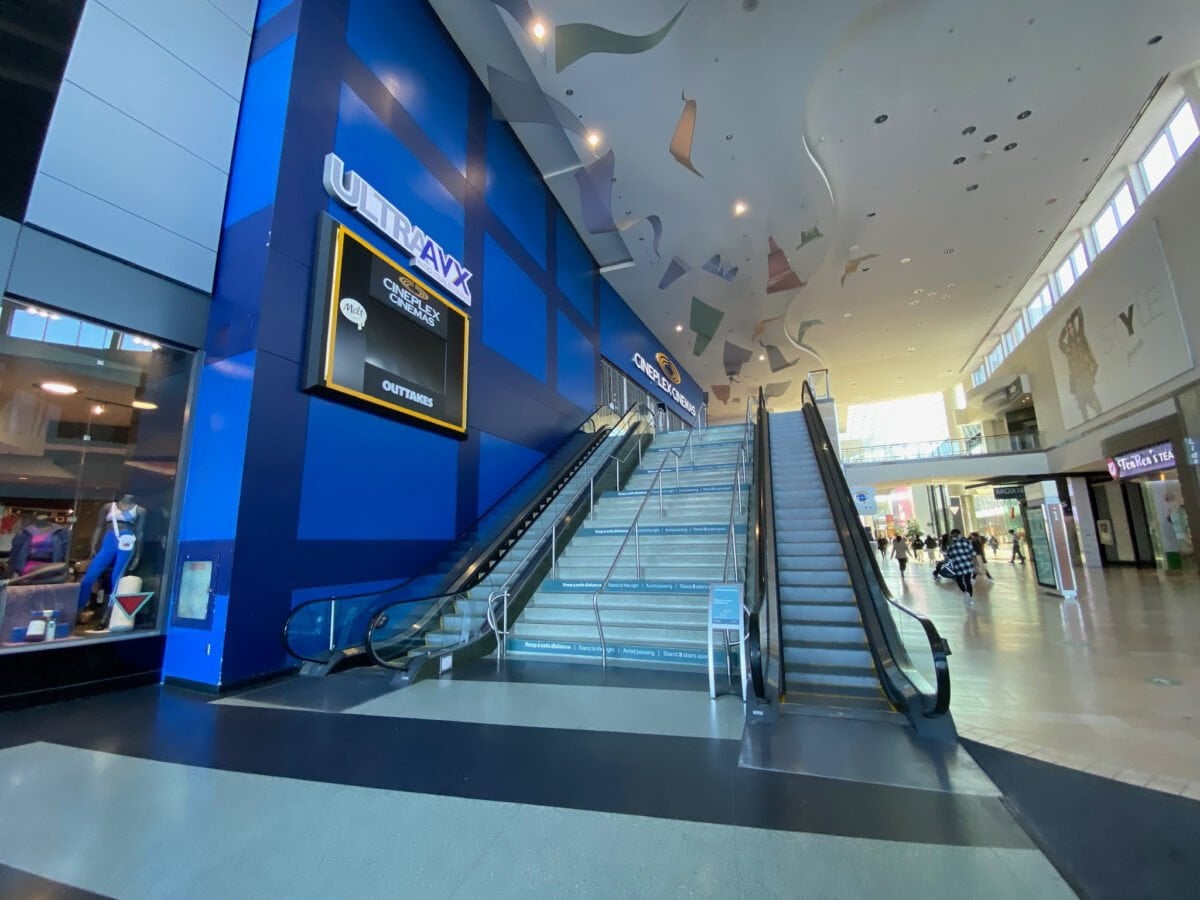
Premium cinema formats provide another opportunity to increase spending. Cineplex operates VIP Cinemas, UltraAVX, IMAX, 4DX and ScreenX locations across its network, and management reported strong demand for premium presentations around major releases. The Devil Wears Prada 2 delivered one of the strongest VIP performances in Cineplex history during the second quarter, while demand for IMAX presentations of The Odyssey has been particularly strong since the quarter ended.
Cineplex operates eight of the world’s 41 IMAX 70mm screens, giving the Canadian exhibitor a significant share of the global network capable of presenting films in the format. Management said sold-out screenings of The Odyssey highlighted consumer demand for premium theatrical experiences and the value of Cineplex’s premium-format footprint.
Box Office Momentum Accelerates in August
Cineplex’s second-quarter performance was supported by a broad mix of films rather than dependence on a single blockbuster, with family releases, horror films, franchise titles and original productions contributing to attendance. Management said the consistency of the film slate is important because it encourages repeat visits and reduces the volatility associated with relying on a small number of major releases.
That momentum strengthened substantially after the quarter ended. Jacob told analysts that during the first 10 days of August, Cineplex had already come close to generating the box-office revenue recorded during the entire month of August 2025, largely driven by The Odyssey and Spider-Man: Brand New Day. Cineplex also said the broader domestic box office surpassed $5 billion earlier in 2026 faster than in any year since 2019.
Younger consumers are contributing to the recovery. Management highlighted the return of Gen Z moviegoers during the quarter, particularly around titles including Obsession and Backrooms, and said moviegoing continues to resonate as a social experience for younger audiences. That demographic also has value to Cineplex’s advertising business, which positions its theatres as a way for brands to reach consumers who can be difficult to access through traditional media channels. Cineplex Media revenue increased 4.4% year-over-year to $20.2 million during Q2.
Cineplex at Yorkdale – Photo by Dustin Fuhs
Canadian Consumers Remain Selective
The record spending at Cineplex comes against a more challenging backdrop for Canadian household consumption, where elevated living costs and economic uncertainty have continued to influence discretionary purchasing decisions.
Cineplex’s performance does not necessarily point to a broad rebound in discretionary spending. Instead, its theatre results suggest consumers remain willing to spend when an entertainment offering generates sufficient interest, particularly around major cultural events, recognizable intellectual property and experiences that are difficult to replicate at home. The combination of rising attendance and record per-patron spending indicates that consumers choosing to visit Cineplex are also accepting more opportunities to spend around that visit.
Results elsewhere in Cineplex’s business show that discretionary entertainment spending remains uneven. The company’s location-based entertainment segment, which includes The Rec Room and Playdium, continued to face what management described as macroeconomic headwinds affecting consumer spending. Adjusted store-level EBITDA fell to $3.9 million from $5.8 million a year earlier, while adjusted store-level margin declined to 12.2% from 17.5%.
Management said food-and-beverage revenue increased within the location-based entertainment business during the quarter while amusement revenue declined. That mix weighed on profitability because amusement represents the highest-margin revenue category in the segment. Cineplex noted that the second quarter is typically its lowest-traffic period for location-based entertainment and expects some of the pressure to reverse as the year progresses.
Playdium Expands as Competition Increases
Cineplex continues to invest in experiential entertainment despite the near-term softness, opening a new Playdium at Vaughan Mills in June and bringing its location-based entertainment portfolio to 17 locations. Cineplex told analysts that the location has delivered strong results since opening.
The expansion is part of Cineplex’s longer-term strategy of positioning The Rec Room and Playdium as social entertainment destinations, frequently within or near major shopping centres. These concepts can also serve a broader role within retail properties as landlords add entertainment, dining and other experiential uses intended to generate visits beyond conventional shopping.
Competition for that spending is increasing. Cineplex acknowledged during its earnings call that competing entertainment concepts have entered some markets around successful locations in its portfolio. Management said the trend is not widespread but noted that strong-performing locations have attracted additional entrants.
Canada has seen rapid expansion from other experiential entertainment concepts, including Winnipeg-founded Activate. The company said in April that it had grown to more than 75 locations worldwide, including 64 across North America, and plans to reach 100 locations across 12 countries by 2027.
The contrast within Cineplex’s own portfolio provides a useful indication of current consumer behaviour. Movie theatres are benefiting from a strong film slate and consumers willing to spend more around major releases, while broader location-based entertainment continues to encounter greater resistance from discretionary spending pressures and increased competition.
Loyalty Supports More Frequent Visits
Cineplex is also using loyalty and subscription programs to increase the frequency of customer visits. Scene+ has more than 15 million members and expanded during the quarter with the nationwide addition of Shell Canada, allowing members to earn and redeem points across categories including groceries, entertainment, dining, travel and fuel.
CineClub, Cineplex’s movie subscription program, recently marked its fifth anniversary and has more than 270,000 members. Cineplex said members visit its theatres at approximately four times the rate of non-members, making the subscription business another way to encourage repeat moviegoing as the film supply improves. Together, Scene+ and CineClub can help increase visitation, while premium formats, food and beverage and merchandise provide additional opportunities to generate revenue from each visit.
Cineplex is also expanding the uses of its theatre network beyond conventional film exhibition. During the second quarter, the company partnered with TSN to present select FIFA World Cup matches in theatres across Canada. Management described the response as encouraging and sees sporting events, concerts, live performances and specialty programming as additional ways to attract audiences and use theatre capacity.
Cineplex Looks to Strong Second Half
Cineplex expects theatrical momentum to continue through the remainder of 2026, supported by a release calendar spanning major franchise films, family titles, horror and other genres. Management said the industry is tracking toward approximately $10 billion in domestic box-office revenue this year, while the unusually strong start to August provides additional momentum heading into the second half.
For Cineplex, the recovery is increasingly about more than filling theatre seats. The company is generating record food and beverage spending, monetizing demand for premium movie experiences and turning film merchandise into a growing physical and digital retail category. Loyalty and subscription programs provide another mechanism for increasing visit frequency while Cineplex’s theatre network is being used for a wider range of entertainment events.
The movie remains the reason consumers arrive, but Cineplex is finding more ways to participate in the spending surrounding it. Merchandise, in particular, gives the company a retail category that can change with each new theatrical release and increasingly continue online after customers have left the cinema.
JD Sports in downtown Montreal. Photo: Victor DiLallo Balsis
JD Sports has opened its new flagship store at 777 Sainte-Catherine Street West in downtown Montreal, bringing the international sports-fashion retailer to one of the city’s most prominent retail corners as it continues an aggressive expansion across Canada.
Located at Sainte-Catherine Street West and McGill College Avenue, the store occupies the main retail level and a second level that previously functioned as a mezzanine. The space was formerly home to a large Banana Republic flagship, which closed in 2021 after operating for years within the distinctive former banking premises.
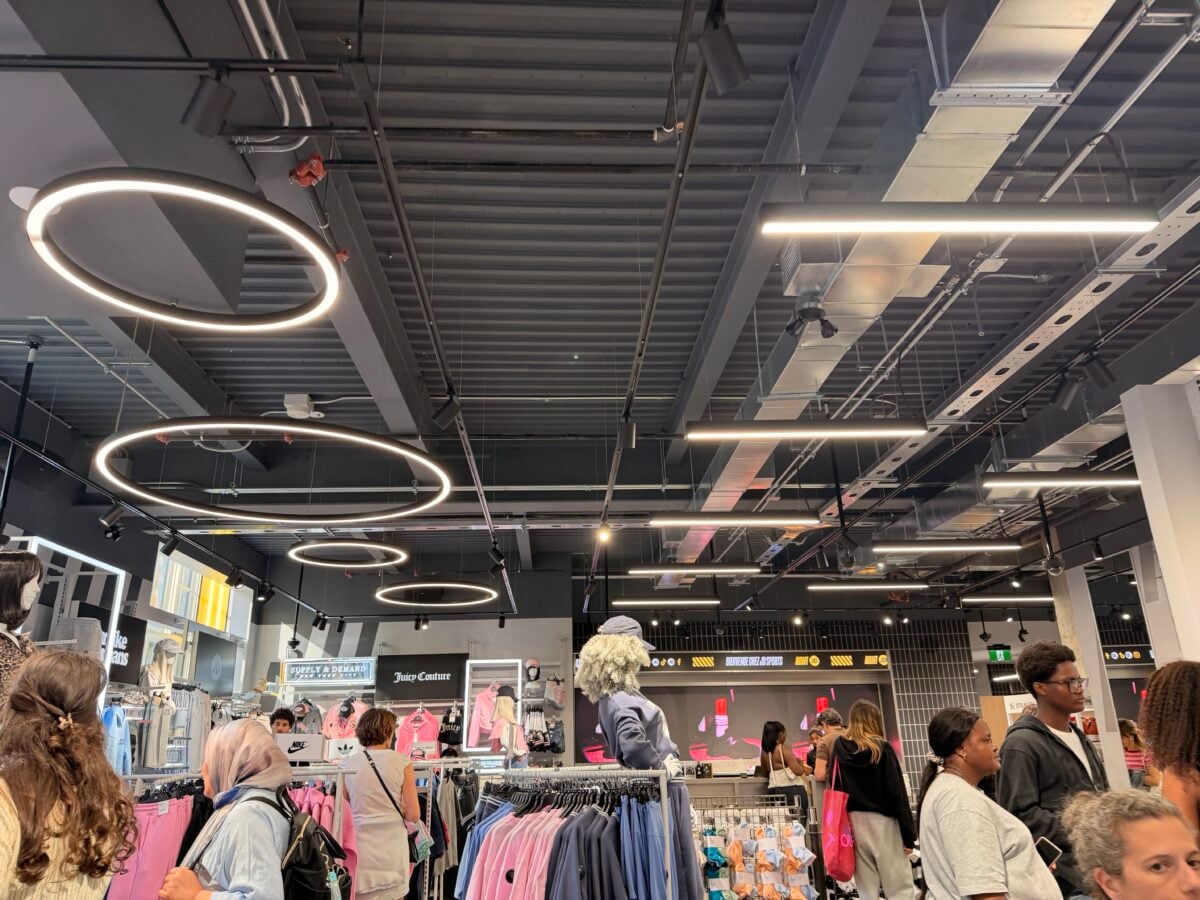
JD Sports has substantially transformed the interior for its arrival, introducing the contemporary store design found across the retailer’s growing Canadian network. The redevelopment has also attracted attention from heritage advocates over the removal of the property’s historic interior.
Major Downtown Location for JD Sports
The new flagship sits adjacent to the Montreal Eaton Centre and near McGill University, the McGill Metro station, office towers and other major retailers along Sainte-Catherine Street.
The entire premises at 777 Sainte-Catherine had previously been marketed as approximately 26,463 square feet across five levels. The ground floor accounts for approximately 5,453 square feet, while the roughly 3,946-square-foot mezzanine overlooks the main level. JD Sports occupies the main floor and former mezzanine, while the larger premises also include additional upper and lower-level space.
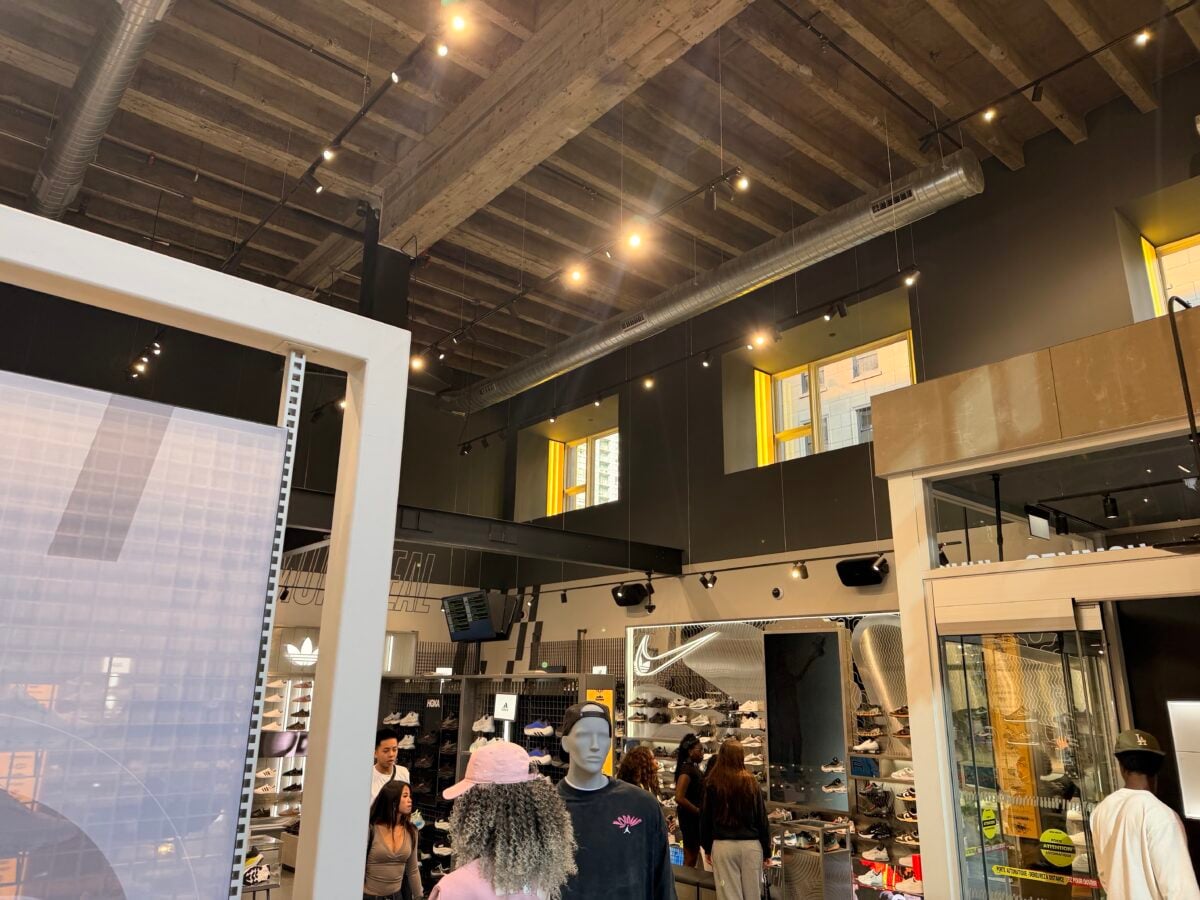
The location stands out for its substantial ceiling height and extensive exposure at one of downtown Montreal’s busiest intersections. The property has approximately 54 feet of frontage along Sainte-Catherine Street and about 120 feet along McGill College Avenue, creating considerable visibility along both streets.
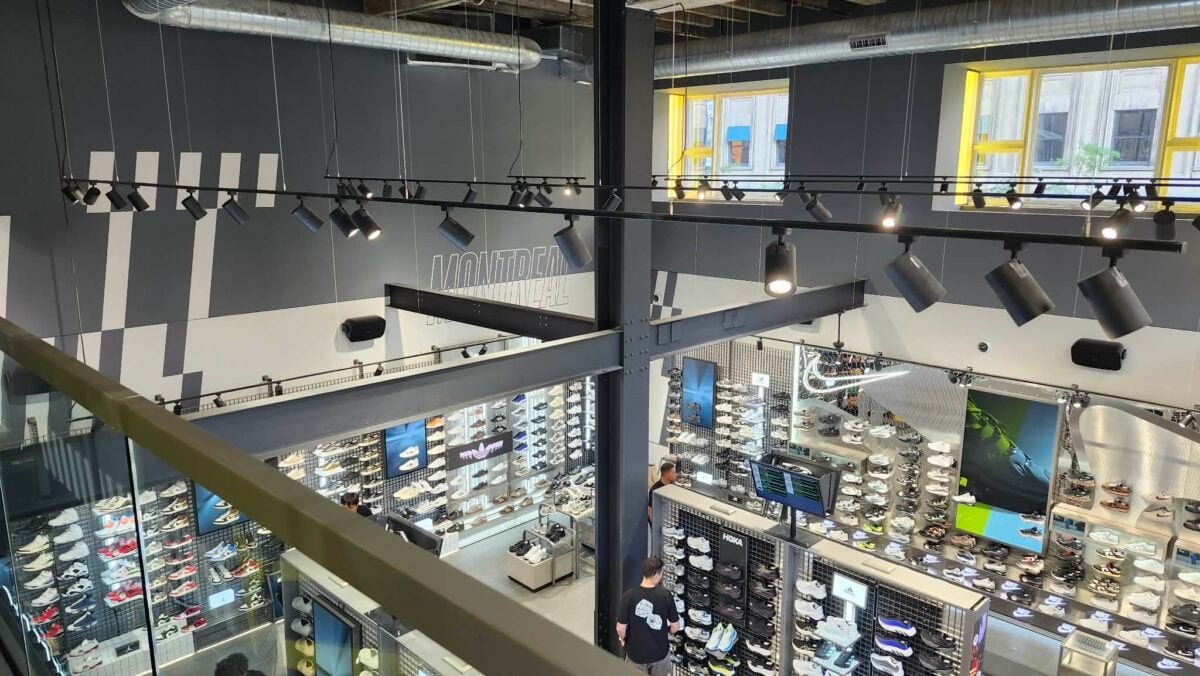
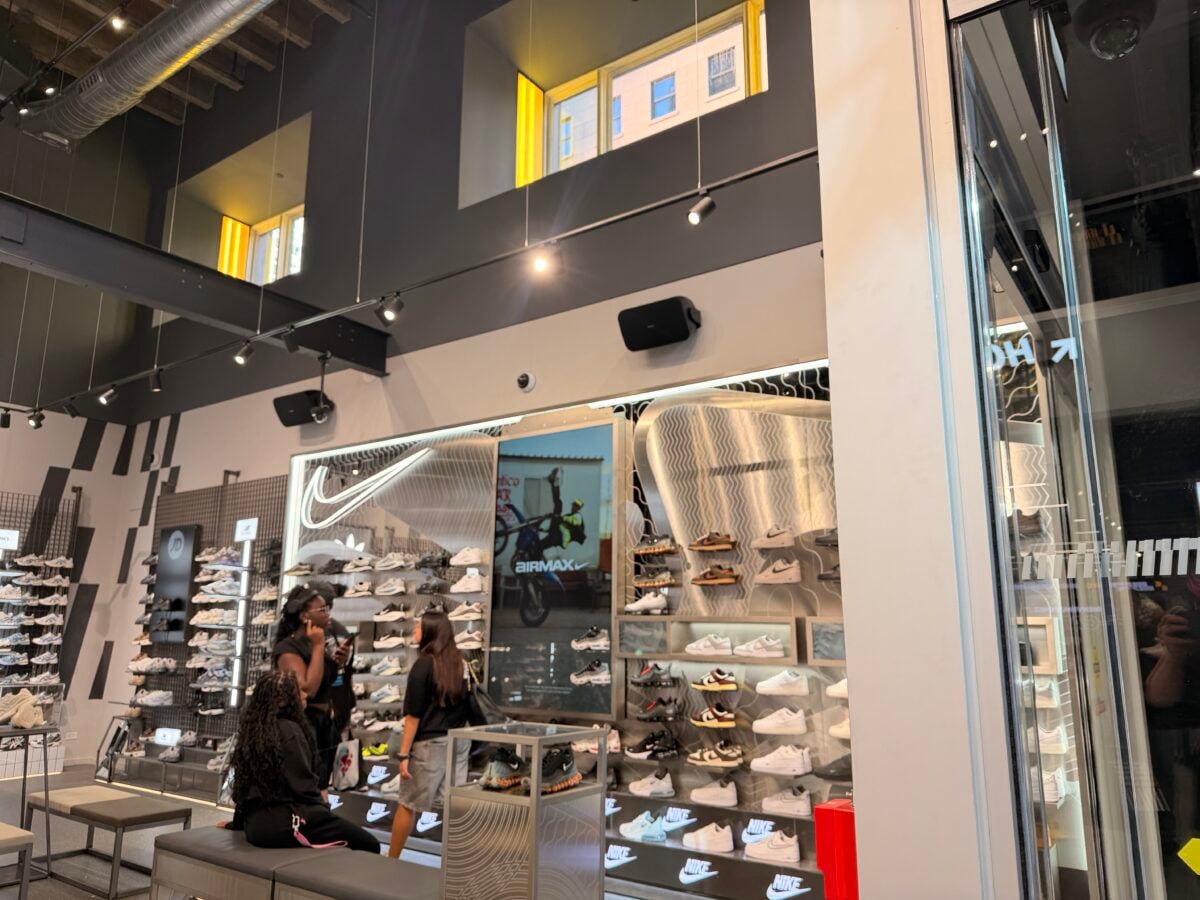
Inside, JD Sports has introduced the black-and-yellow visual identity used throughout its newer stores, with extensive footwear displays, apparel and digital elements. The retailer’s assortment centres on major sports and lifestyle brands including Nike, Jordan, adidas and New Balance, alongside a wider selection of footwear, apparel and accessories.
Jean-François Parent of JD Sports Canada previously described the Sainte-Catherine flagship as the company’s largest store to date in the region and a significant milestone for the brand in Canada.
JD Sports in downtown Montreal. Photo: Victor DiLallo BalsisJD Sports in downtown Montreal. Photo: Maxime Frechette
Historic Interior Transformed
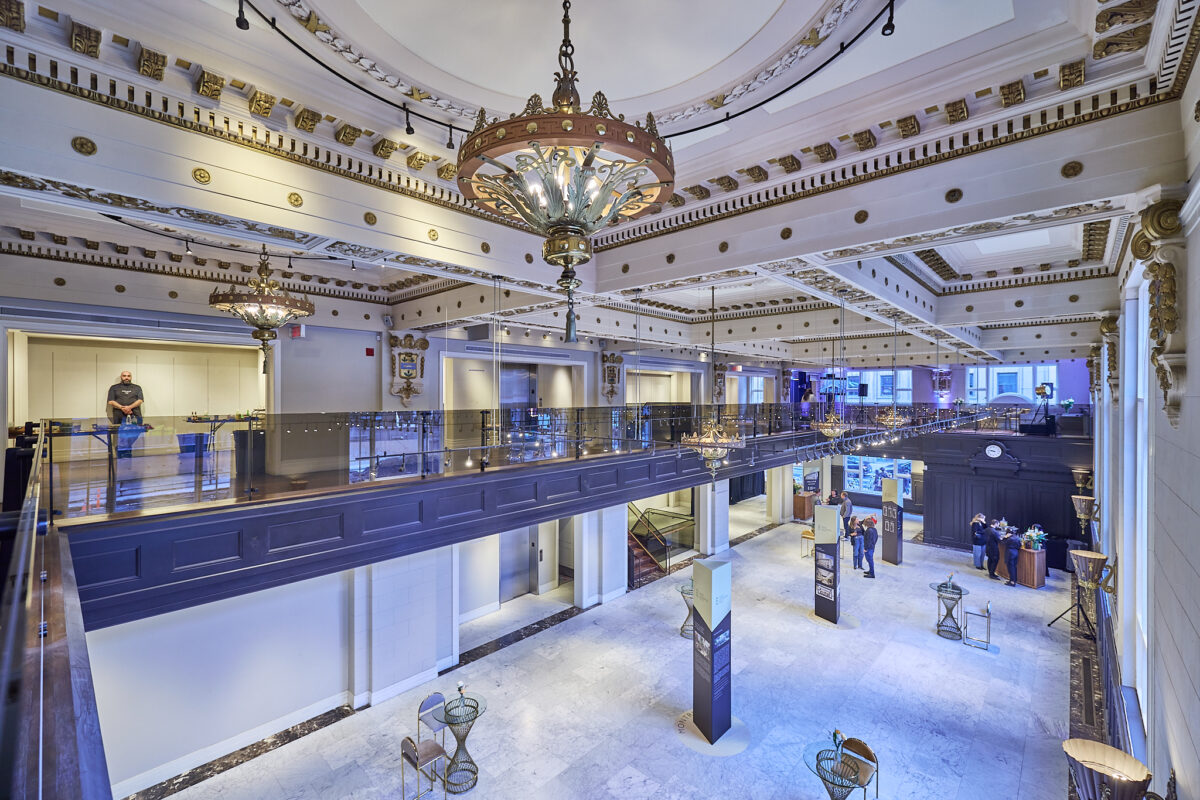
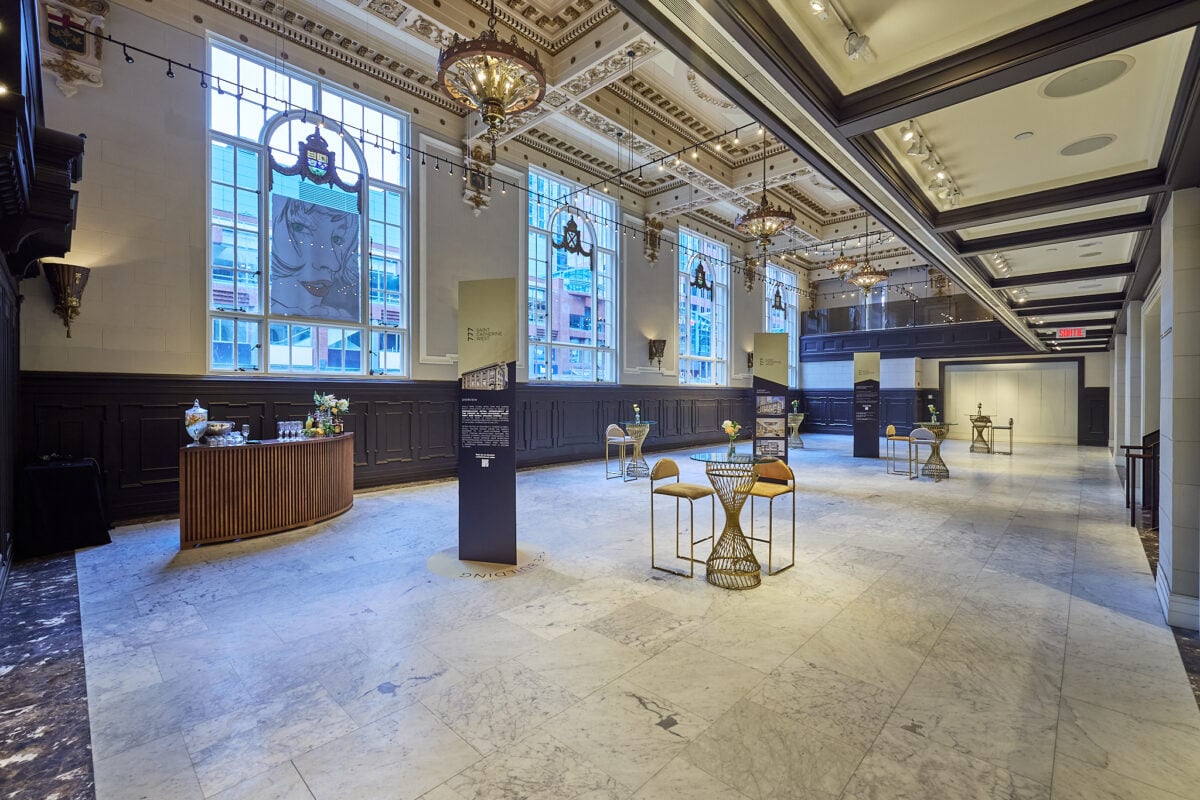
JD Sports’ arrival represents another chapter for a property with a long commercial history. The former banking premises date to the early 20th century, and significant elements of the interior survived through later adaptations of the space for retail use. Banana Republic incorporated the former banking hall and mezzanine into its store, retaining many of the architectural details that distinguished the location from a conventional retail unit.
That interior has been extensively changed for JD Sports. Before-and-after images of the property show the scale of the transformation, with much of the historic detailing removed as the space was rebuilt around the retailer’s contemporary store design.
The changes prompted concern from Héritage Montréal, which said it began investigating after receiving alerts about work at the property in early 2026. In a June update, the organization said the interior of the former Banque d’épargne de la cité et du district de Montréal, dating from the 1920s, had been completely demolished during the redevelopment.
Héritage Montréal said assurances provided by the City of Montreal in the 1990s had indicated that preservation of the interior was among the conditions associated with the development agreement that permitted construction of the office tower partly above the former bank. The organization said the interior was subsequently restored and adapted over the years for changing commercial uses.
According to Héritage Montréal, representatives of the Ville-Marie borough said the JD Sports project was authorized under regulations in effect and that municipal officials were unable to locate documentation confirming the earlier conservation commitments. The organization also met with representatives of JD Sports Canada, which it said had not been informed by the real estate brokers or architects involved with the project that there were heritage concerns surrounding the interior.
Héritage Montréal has since called on the City to have the Conseil du patrimoine de Montréal examine the case and recommend measures that could provide greater protection for significant heritage interiors. The case has also raised broader questions around how historically significant commercial interiors are documented and considered when buildings are adapted for new uses.
Before the demolition: 777 Ste-Catherine St. in May 2024, Looking from the mezzanine level to the main floor. Photo: Darwin DoleyresBefore the demolition: 777 Ste-Catherine St. in May 2024, Photo: Darwin Doleyres
High-Profile Sainte-Catherine Lease
JD Sports’ opening fills a prominent space that had represented a substantial vacancy along Sainte-Catherine Street following Banana Republic’s departure.
Jordan Karp, EVP and Head of Retail Services in Canada at Savills Canada, represented JD Sports in the lease transaction. Karp and Manon Parisien of Aurora Retail Group co-listed the property on behalf of landlord Pontegadea, the private investment group of Amancio Ortega, founder and largest shareholder of Inditex (owner of Zara).
The combination of the property’s scale, ceiling height, extensive frontage and location made 777 Sainte-Catherine an unusual flagship opportunity in the downtown leasing market. Its position also puts JD Sports within a concentration of major international sports, apparel and footwear retailers operating along the Sainte-Catherine corridor.
JD Sports in downtown Montreal. Photo: Maxime FrechetteJD Sports in downtown Montreal. Photo: Maxime Frechette
JD Sports Accelerates Canadian Expansion
The Montreal flagship arrives amid a rapid expansion of JD Sports’ Canadian store network, with the retailer adding locations across several provinces while investing in larger stores in some of Canada’s biggest urban markets.
Quebec has been particularly active. JD Sports opened at CF Fairview Pointe-Claire on March 7, 2026, followed by a new location at Place Rosemère on July 16. Those stores joined an existing Quebec network that includes locations such as CF Promenades St-Bruno and CF Carrefour Laval, while the new Sainte-Catherine flagship gives JD a prominent presence in the heart of downtown Montreal.
Expansion has continued elsewhere in the country. JD opened a flagship at CF Toronto Eaton Centre on March 16 and entered New Brunswick with a store at Champlain Place in Dieppe on April 18. Another location recently opened at Intercity Shopping Centre in Thunder Bay, while a store at Mic Mac Mall in Dartmouth is expected to open in September, marking JD Sports’ entry into Nova Scotia.
The pace follows a particularly active 2025, when JD Sports Canada said it opened 12 stores across the country. Its Canadian network has been developing through a combination of shopping-centre locations and larger urban stores, including the Robson Street flagship in Vancouver that opened in 2025.
With downtown flagships now operating in Vancouver, Toronto and Montreal, JD Sports has established high-profile locations in Canada’s three largest urban retail markets while continuing to expand its suburban shopping-centre network. In the Montreal region, locations in Laval, Saint-Bruno, Pointe-Claire and Rosemère give the retailer broader regional coverage alongside its new downtown presence.
Best Buy Canada saw sales soften in its latest quarter, reversing some of the strong growth recorded earlier in the year as the electronics retailer moves beyond the initial expansion of its Best Buy Express network.
Best Buy Co. reported Canadian revenue of US$709 million for the second quarter of fiscal 2027, ended August 1, down 4.2% from a year earlier. Comparable sales declined 1.8%, compared with growth of 7.6% in the same quarter last year. Best Buy reports its Canadian operations as its International segment.
The Canadian performance diverged from Best Buy’s U.S. business, where revenue increased 4.3% to US$9.1 billion and comparable sales rose 4.5%. Company-wide comparable sales increased 4.1%.
Despite the decline in Canadian sales, gross margins improved. Best Buy’s International gross profit rate increased to 22.3% from 21.8%, primarily due to improved product margins. Adjusted operating income in the segment was US$13 million, down from US$18 million a year earlier, while the adjusted operating margin declined to 1.8% from 2.4%.
Canadian Momentum Slows After Strong First Quarter
The second-quarter decline follows a considerably stronger start to Best Buy’s fiscal year in Canada.
During the first quarter, Canadian revenue increased 7.3% to US$687 million, while comparable sales rose 4.7%. Canada outpaced Best Buy’s U.S. operation on comparable sales growth during the period.
For the first six months of the fiscal year, Canadian revenue remains slightly higher than a year ago at US$1.396 billion, compared with US$1.380 billion. Comparable sales are up 1.3% over the six-month period.
The latest quarter also comes against an unusually strong comparison. Best Buy reported Canadian comparable sales growth of 7.6% during the second quarter a year ago, when the company was benefiting from the expansion of its store network.
A significant part of that expansion came through the rollout of Best Buy Express.
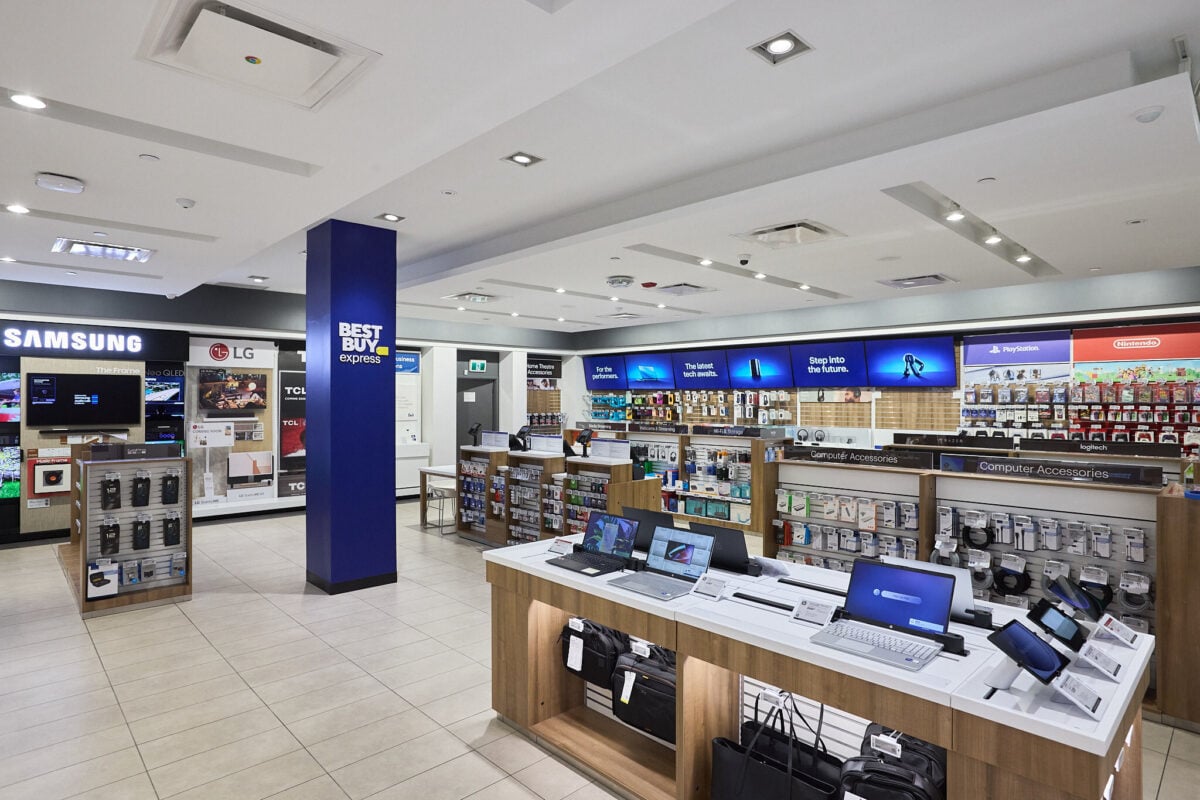
Best Buy Express store. Image: Best Buy Canada Ltd
Best Buy Express Reshaped Canadian Store Network
Best Buy Canada and Bell Canada announced a partnership in 2024 to convert former The Source locations into small-format Best Buy Express stores. The network expanded to 167 locations across Canada, including stores in communities where Best Buy previously had no physical presence.
The rollout substantially expanded Best Buy’s Canadian footprint and gave the retailer access to smaller markets that may not support one of its conventional big-box stores.
Best Buy Express combines a curated assortment of consumer electronics with access to Best Buy’s much larger digital assortment. When the rollout began, the retailer said customers would be able to access more than 100,000 products through its fulfillment network, including merchandise not physically stocked in the smaller stores.
The locations also offer Geek Squad services along with Bell, Virgin Plus and Lucky Mobile telecommunications products and services.
With the rollout now part of Best Buy’s comparable sales base, the Canadian operation is entering a different phase. Future performance will increasingly depend on the productivity of the expanded network rather than the incremental sales generated as new Express locations opened.
Small Stores Remain Part of Best Buy’s Growth Strategy
Incoming Best Buy CEO Jason Bonfig highlighted the potential of smaller-format stores during the company’s latest earnings call. His comments addressed Best Buy’s broader strategy rather than the Canadian Express network specifically.
Bonfig said smaller stores allow Best Buy to enter attractive markets that cannot support its traditional store format, extending the company’s reach to additional customers and communities. He said the strategy remains in its early stages, but customer response and performance have been encouraging.
“What is particularly exciting is the way these stores accelerate omnichannel engagement,” Bonfig said.
Customers may begin their relationship with Best Buy through a store visit before moving into its app, digital channels, membership programs and services. Bonfig described the smaller locations as both retail destinations and “customer acquisition engines.”
That strategy has particular relevance in Canada, where the 167-store Express network has significantly extended Best Buy’s physical reach. The locations can serve as access points to Best Buy’s larger assortment and fulfillment infrastructure without requiring the footprint of a conventional electronics superstore.
Best Buy continues to emphasize the importance of its larger stores. Bonfig said the company sees significant value in the format and is reallocating space toward higher-value experiences and emerging technology.
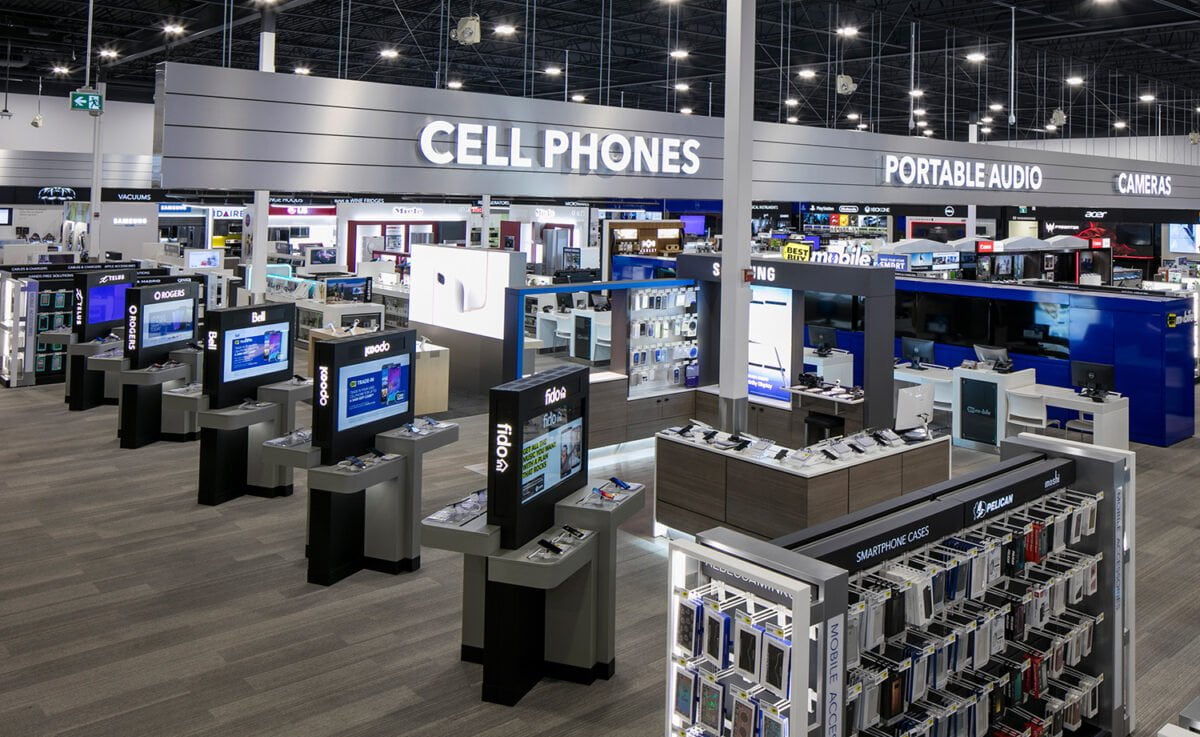
Image: Best Buy Canada
Best Buy Sees Value-Focused Consumer
At the corporate level, Best Buy said customers continue to spend but remain focused on value and particularly responsive to promotional events.
CEO Corie Barry said consumers remain thoughtful about major purchases but are willing to spend on higher-priced products when replacement becomes necessary or technological innovation provides a compelling reason to upgrade.
Computing has been one of Best Buy’s strongest categories, recording its 10th consecutive quarter of positive comparable sales growth. Home theatre was the company’s second-largest contributor to comparable sales growth during the quarter, while emerging categories including AI glasses, trading cards and health rings more than doubled their sales from a year earlier.
Those category results were discussed at the corporate and U.S. level and were not disclosed separately for Canada.
Pricing is also becoming a factor in computing. Best Buy said industry-wide increases in memory costs have been flowing through to product prices. Average selling prices in computing increased by the mid-teens during the quarter while unit volumes declined by the high-single digits.
Bonfig said Best Buy is adjusting assortments with vendors to maintain important consumer price points while using trade-ins, financing and promotions to help customers manage higher prices. The company expects the current computing pricing dynamic to continue through the remainder of the fiscal year.
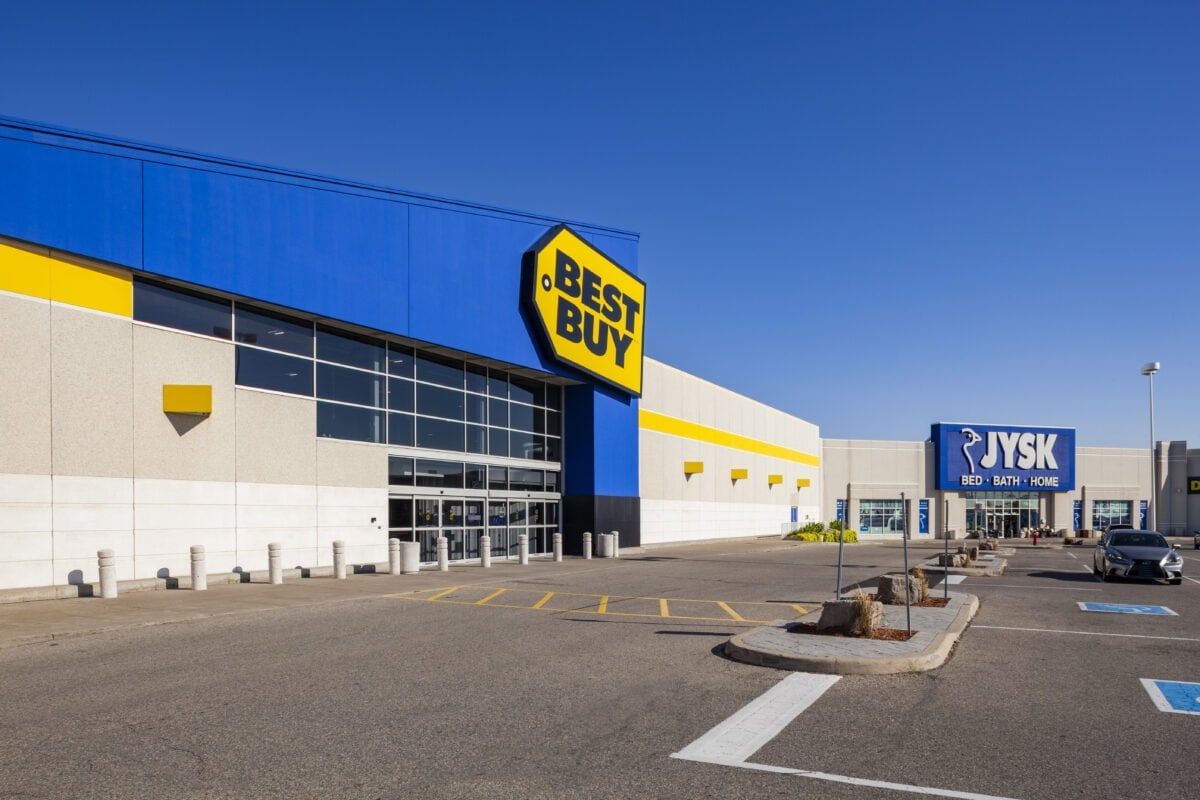
EXTERIOR OF BEST BUY AT HEARTLAND TOWN CENTRE. PHOTO: HEARTLAND TOWN CENTRE
Best Buy Broadens its Retail Model
Best Buy is simultaneously developing revenue streams beyond conventional consumer electronics sales.
Best Buy Business now generates more than US$1.1 billion annually and grew approximately 15% to 20% during the first half of the fiscal year, according to Barry. The operation serves sectors including education, hospitality, builders and multi-dwelling properties, health care and corporate enterprise.
The growth figures provided on the earnings call were for Best Buy Business overall and were not broken out for Canada.
Best Buy is also expanding its advertising and marketplace businesses as it looks to generate additional revenue and profit from the scale of its retail ecosystem.
Best Buy Raises Full-Year Outlook
The softer Canadian quarter came as Best Buy delivered stronger-than-expected results overall and raised its outlook for fiscal 2027.
Enterprise revenue increased 3.6% to US$9.8 billion, while comparable sales increased 4.1%. Adjusted diluted earnings per share rose 15% to US$1.47.
Best Buy now expects annual revenue of between US$42.3 billion and US$42.8 billion, with comparable sales growth of between 1.9% and 3%. Adjusted diluted earnings per share are forecast at between US$6.70 and US$6.90.
Management said August comparable sales were tracking at the upper end of its expected 1% to 3% range, pointing to encouraging back-to-school demand and the company’s 60th anniversary promotional event.
For Best Buy Canada, the coming quarters should provide a clearer picture of the performance of its substantially expanded physical network. The Best Buy Express rollout brought the retailer into dozens of additional Canadian communities and contributed to strong comparisons as locations opened.
With those openings now moving further into the comparable sales base, attention shifts to how effectively Best Buy can use its larger Canadian footprint to generate repeat business, connect customers with its digital assortment and services, and sustain growth across the Canadian operation.
Ken Otto, CEO of Redberry Restaurants, said the company plans to open another 25 locations in 2027 as it works toward its initial goal of 300 Jersey Mike’s restaurants in Canada over the next 10 to 12 years.
The company currently operates Jersey Mike’s locations in Ontario, Saskatchewan, Alberta, British Columbia and Manitoba locations. Otto said the chain plans to enter Quebec, Nova Scotia and New Brunswick in 2027, expanding its presence across the country.
It has 40 locations in Canada.
Ken OttoJersey Mike’s Photo
Otto said the brand’s growth is being driven by the quality of its ingredients, its made-to-order preparation and its customer service. He said Redberry believes strong restaurant concepts that deliver on service, quality and value can continue to perform well despite changing conditions in the quick-service restaurant industry.
Two years ago, Redberry bought two Jersey Mike’s that were in London and Kitchener, Ontario and the first one it built was in York Mills, which opened in the summer of 2024.
“Our first goalpost is 300 stores. But that’s just the first goalpost. We want to get to 300 stores in 10 to 12 years. Clearly, we believe, based on the success of our current Jersey Mike’s and the success of Jersey Mike’s in the U.S., that there’ll be more. And we’ll find out what more looks like a decade from now,” explained Otto.
Otto said three things make the brand appealing.
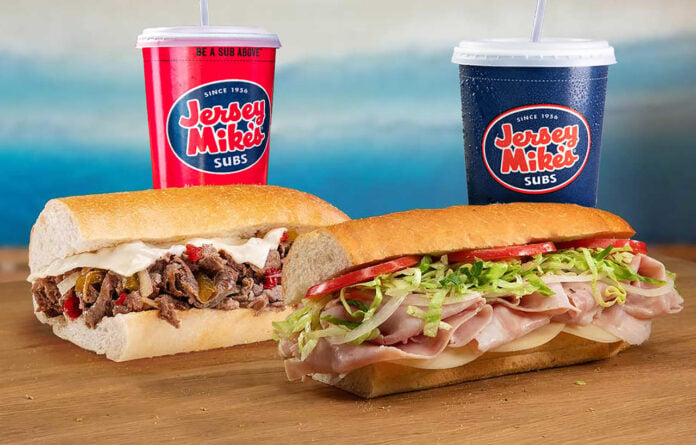
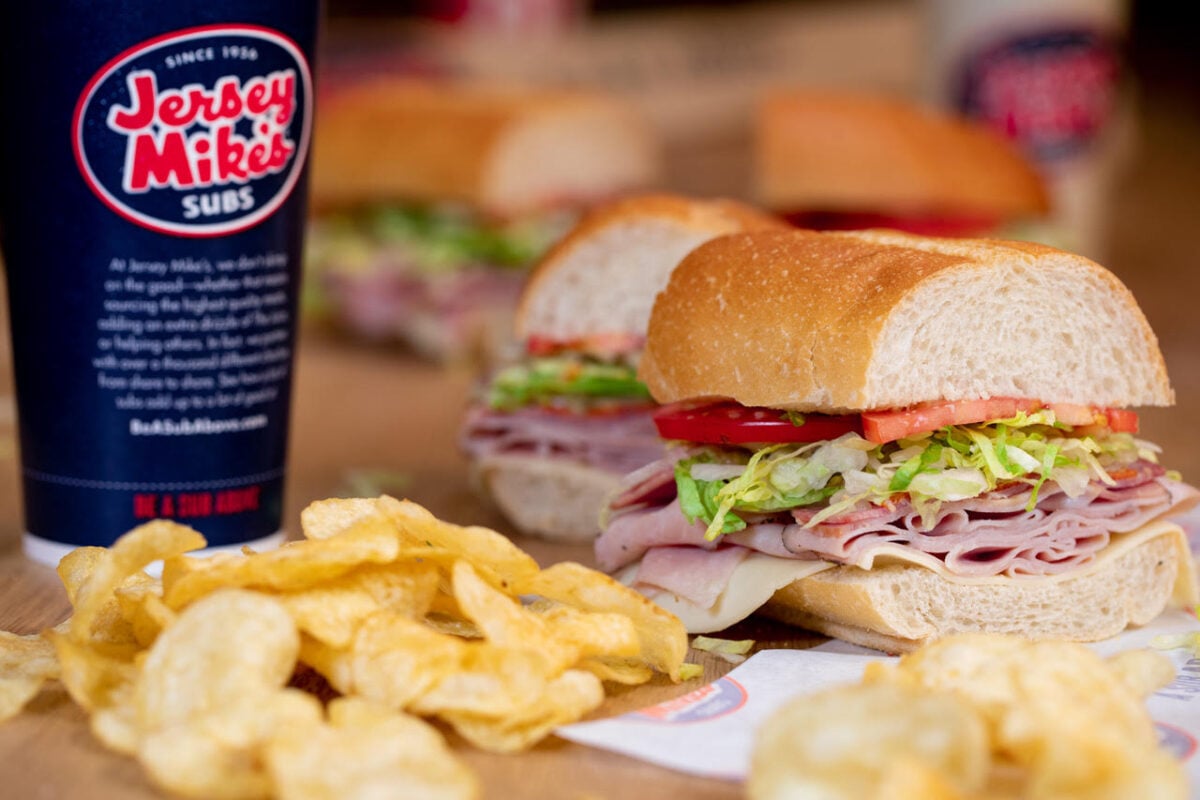
“One, we are very proud of the quality of our ingredients. Freshly baked bread, our hams and our cheeses and our ingredients really are a sub above in Canada. So I think it’s giving guests a very high-quality product.
“And a lot of it, right? Our subs, we just make them big. The second reason is the fresh slicing and made-to-order nature of what we do. No sub starts before you order it. When you order it, you see your sub, all the meats are freshly sliced, the cheese are freshly sliced right in front of you. On the hot subs, the ingredients hit the flat top after you order it.
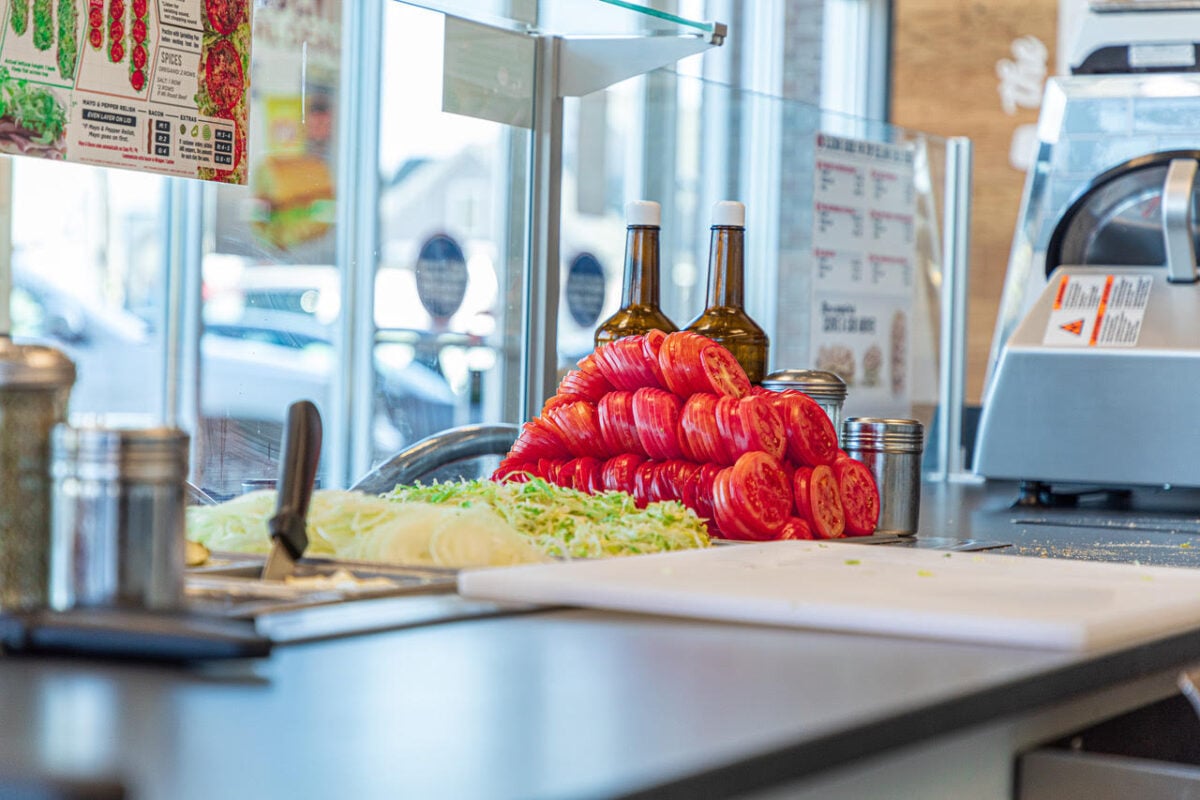
“Of course, we recommend everything being ordered Mike’s Way, where there’s lots of lettuce, lots of tomatoes, onions, and of course our favourite Jersey Mike’s juice, custom blend of red wine vinegar and olive oils. So we splash it with that.”
Jersey Mike’s Photo
He said customers really enjoy seeing their sub made in front of them.
The company’s secret sauce, if you will, and the third appeal, the icing on the cake, is its service style, added Otto.
“We are very engaging with our people. They like talking to our customers and our guests when their sub is being built, and we’ve got some great feedback on the energy and the enthusiasm of our people, and they come back for more.”
“Great concepts and great brands that deliver on the promise of service and quality and value, those concepts will always do well, they do well no matter what.”
Redberry has 168 Burger Kings and 35 Taco Bells.
“We love our mix. Burger King is a leader now in the burger QSR segment in all of North America, including Canada. Taco Bell is one of the fastest-growing iconic brands in the world. So we’re super thrilled to be their partner in Canada. At Redberry, we are a growth platform, and we’re always looking for more brands to take on.”
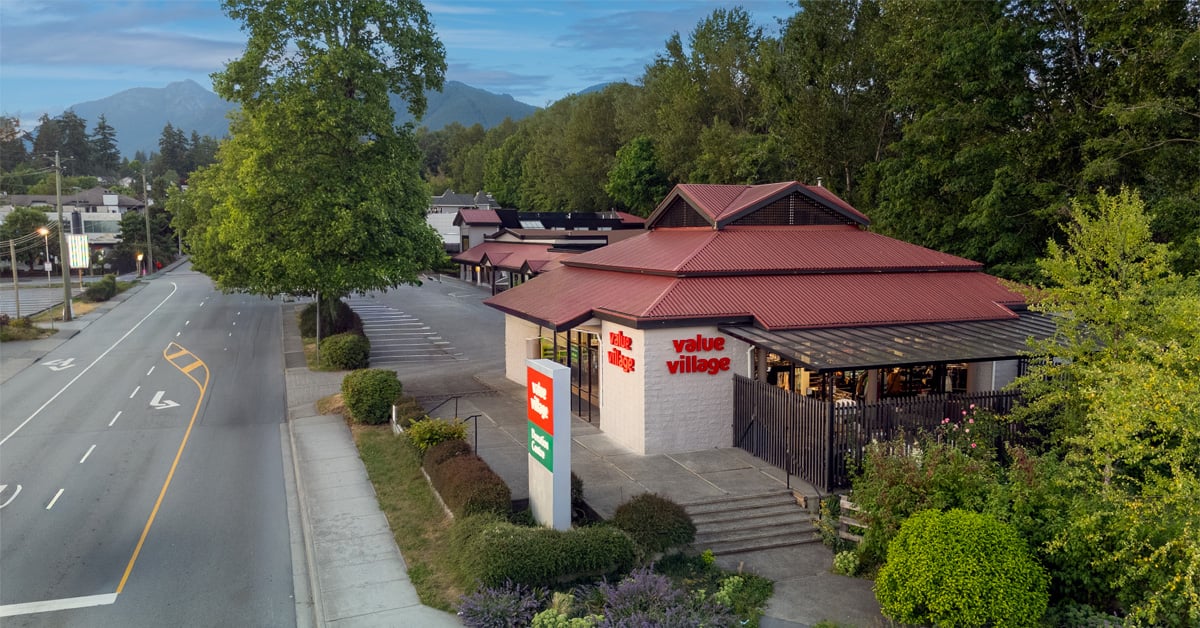
Calgary Value Village Boutique. Photo by Samantha Ungaro
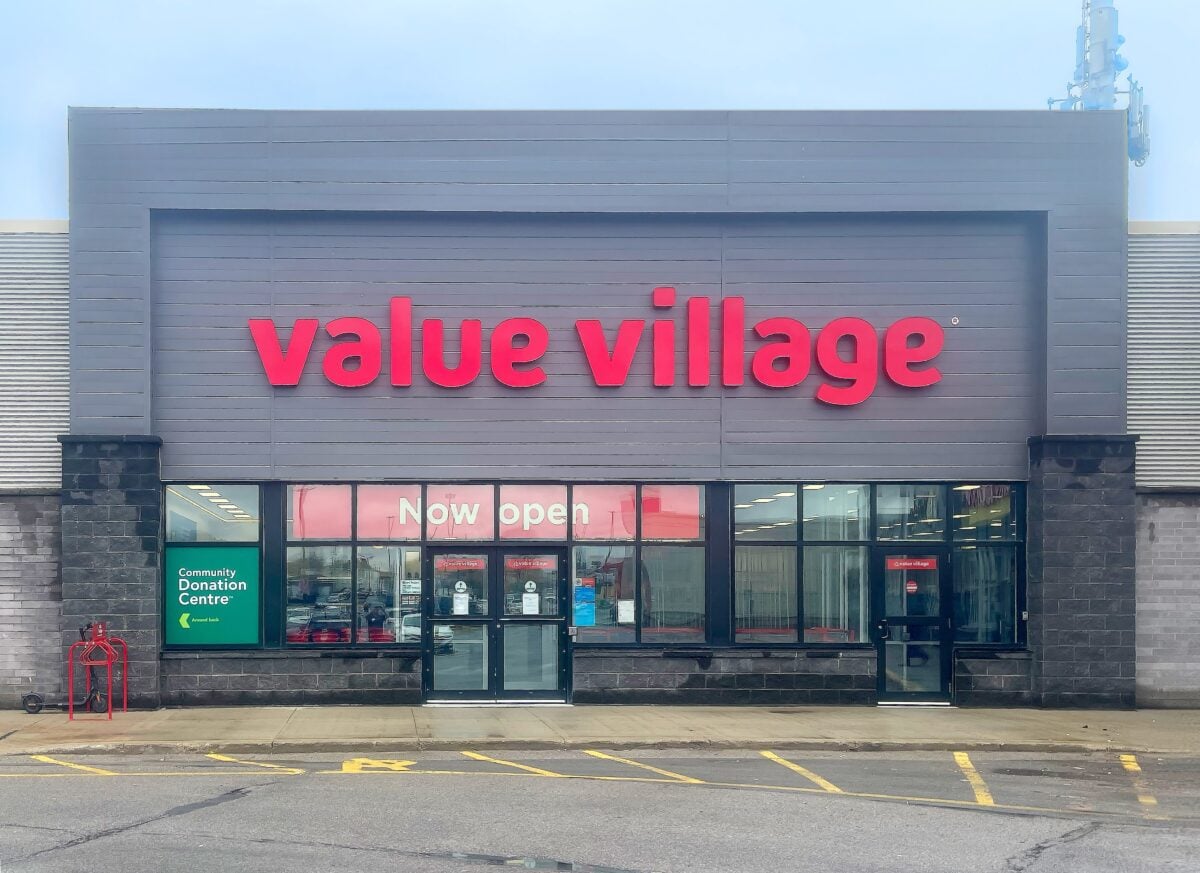
The rise of resale shopping is turning thrift stores into destinations where consumers are chasing more than a bargain, says retail expert Doug Stephens, who sees the growing popularity of Value Village as a sign that shoppers are looking for entertainment and the thrill of the unexpected.
Stephens, who has tracked the resale market for years, said he was struck by the crowd and wide range of shoppers at a recent Value Village opening, from young families and teenagers to older consumers, singles and couples. The turnout, he said, suggests resale is no longer a niche pursuit and should have mainstream retailers looking over their shoulders.
“What they’re really selling, when you get right down to it, is they’re selling dopamine,” said Stephens, Founder and President of Retail Prophet.
The appeal, he said, comes from the anticipation of finding an unexpected bargain — sometimes an item worth hundreds of dollars for a fraction of the price — and has transformed thrift shopping from a utilitarian errand into a form of sport, entertainment and social activity.
Doug Stephens
In a recent LinkedIn post, Stephens wrote about attending the Value Village grand opening in Waterdown, Ontario.
“We’ve all seen the headlines about the resale market’s explosive growth. But it’s hard to appreciate the energy around this sector until you experience it viscerally,” he said.
The store was scheduled to open at 9 a.m. and by 8 a.m. a line had already formed.
“But the numbers weren’t the most important part. It was the energy in the crowd — the genuine excitement, the anticipation. I hadn’t felt anything like it in mainstream retail in at least a decade, maybe longer. It’s the kind of energy that used to belong to store openings in New York, Los Angeles, or London. Yet here it was, brimming over in the comparatively tiny town of Waterdown,” he said.
“Just as striking was the diversity of the crowd. Families and singles. Teens and twenty-somethings. Kids and grandparents. Men and women. Everyone. The same demographic and economic breadth that once made department stores of the 1960s, 70s so powerful has migrated to the secondhand market of 2026.
“Their reasons for being there were just as varied. Eavesdropping on conversations in line, I heard it all: some had come for the savings, others purely for the thrill of the hunt. For others it was a social outing with friends and sprinkled throughout were the resellers — people sourcing inventory for their Etsy, eBay, and Poshmark stores, many of them making a tidy living doing exactly this.”
His takeaway from the experience?
“Every retailer — from the luxury houses of Regent Street and Fifth Avenue to discount chains like Walmart and Dollar General — should be rightfully terrified. Because every day resale juggernauts like Value Village, Goodwill and others are selling something conventional retailers gave up on selling a long time ago — excitement. And the market for genuine, offline, real-world excitement today is boundless.”
Value Village North Vancouver
In an interview with Retail Insider, Stephens said the trend is not a niche or a subculture for a very particular kind of consumer.
“This is, to my mind, something that suggests that consumers en masse are looking for bargains, sure, but I think more than that, they’re looking for fun and entertainment at retail, which I don’t think we’ve really had, you know, for many, many years,” he said.
The thrill of the hunt becomes addictive.
“It goes from being something that’s sort of utilitarian from a shopping standpoint. It becomes a bit of a sport, a bit of a form of entertainment for people. So I think that’s really what they’re bottling up here. And the fact that you’ll go sometimes and you won’t find anything, that’s all part of it, too.”
In June, payroll employment in the retail trade decreased by 3,900 (-0.2%), following three consecutive monthly increases totalling 24,000 (+1.2%), according to a Statistics Canada report.
“In June, the largest monthly declines in retail trade were in grocery and convenience retailers (-1,200; -0.3%) and warehouse clubs, supercentres, and other general merchandise retailers (-800, -0.5%). Meanwhile, clothing and clothing accessories retailers (+1,200; +0.7%) recorded the largest gain in the sector, partially offsetting the monthly decreases in June,” said the report.
On a year-over-year basis, payroll employment in retail trade was up by +8,100 (+0.4%) in June, added the federal agency.
Statistics Canada said payroll employment in accommodation and food services decreased by 6,100 (-0.5%) in June, following increases in May (+3,800; +0.3%) and April (+5,800; +0.5%). The decrease in the sector in June was led by full-service restaurants and limited-service eating places (-5,100; -0.5%).
Overall, the number of employees receiving pay and benefits from their employer—measured as “payroll employment” in the Survey of Employment, Payrolls and Hours—was little changed (+4,800; +0.0%) in June, following an increase of 45,000 (+0.2%) in May, said StatsCan.
On a year-on-year basis, payroll employment was up by 155,000 (+0.8%) in June. Meanwhile, job vacancies edged up by 10,500 to 509,100. Year over year, job vacancies were up by 13,800 (+2.8%).
In June, payroll employment increases were recorded in public administration (+10,600; +0.8%), construction (+2,000; +0.2%) and management of companies and enterprises (+900; +0.8%). These gains were partially offset by declines, led by manufacturing (-7,200; -0.5%), accommodation and food services (-6,100; -0.5%), retail trade (-3,900; -0.2%) and professional, scientific and technical services (-1,600; -0.1%).
Ron Lach photo
Statistics Canada said overall job vacancies edged up by 10,500 to 509,100. Year over year, job vacancies were up by 13,800 (+2.8%).
The job vacancy rate—which corresponds to the number of vacant positions as a proportion of total labour demand—was 2.8% in June 2026, unchanged from May 2026 and June 2025, it explained.
“In June 2026, total labour demand—which corresponds to the sum of filled and unfilled positions—was up 0.2% from May. Both payroll employment (+18,800; +0.1%) and job vacancies (+10,500; +2.1%) contributed to the increase. Year over year, the total labour demand was up 0.9% in June,” said the federal agency.
“There were 2.9 unemployed persons for every job vacancy in June 2026, down from 3.0 in May and from 3.1 in June 2025. This decrease was the result of a decline in the number of unemployed persons (according to the Labour Force Survey) coupled with little variation in the number of job vacancies.
“In June, job vacancies were up month over month in information and cultural industries (+2,600; +52.7%), partially offsetting the decrease in May (-3,100; -39.0%). Job vacancies were little changed in the other sectors.
“On a year-over-year basis, job vacancies were up in manufacturing (+5,800; +17.3%), retail trade (+3,900; +8.3%), professional, scientific and technical services (+3,200; +9.1%) and mining, quarrying, and oil and gas extraction (+1,500; +42.3%). Meanwhile, job vacancies were down year over year in educational services (-1,900; -10.9%) and information and cultural industries (-1,100; -13.2%).”
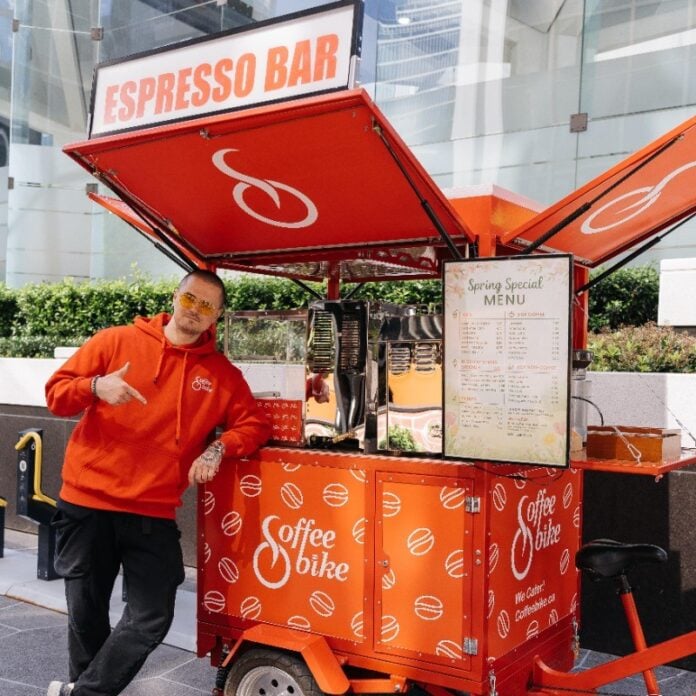
A Canadian entrepreneur recently travelled across the country to highlight a mobile coffee business model that he says offers aspiring business owners a lower-cost way to enter the specialty coffee industry while connecting with existing customers along the way.
Priadko said he built the first Coffee Bike in 2018 and has since sold 42 units to 27 owners. He said the tour was intended to demonstrate how the businesses can operate in a range of communities while strengthening relationships with current owners and introducing the concept to new audiences.
“If someone would want to launch a turnkey Coffee Bike, it would be an average of $27,000 Canadian after tax and shipping,” he explained.
“Essentially, Coffee Bike is a relatively low-investment-barrier opportunity to test your entrepreneurial skills and launch a coffee business with minimum overhead costs, or, if you have an existing business, to add an additional revenue stream to your business.
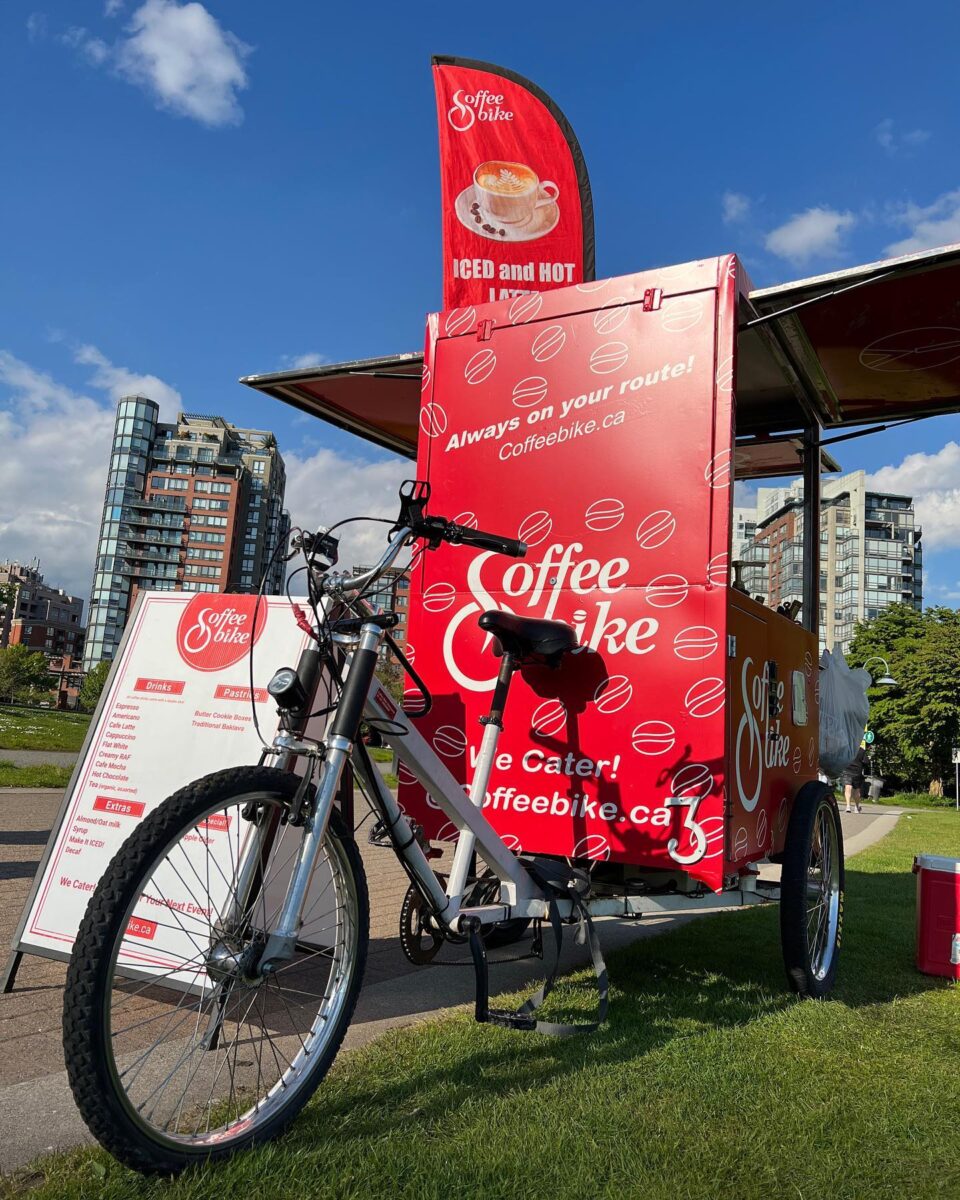
Image: Coffee Bike World
“Why people choose it over other concepts out there—there are some cars, there are some trucks, etc.—is because we have developed Coffee Bike, and I have developed Coffee Bike only after serving more than one million cups of coffee in Vancouver, Canada, with our own units. So we have really perfected the actual hardware. It’s built by baristas for baristas, as opposed to regular manufacturers who build out of mostly theoretical knowledge.”
Priadkosaid the company sells in the U.S. and it currently has eight owners south of the border in California, Portland, Michigan, New York, and Florida.
“We have a lot of inquiries from all over the States.”
The Vancouver-based company in 2024 launched a crowdfunding initiative through Indiegogo to expand its innovative mobile espresso bar concept globally.
The Toronto-based company said Thursday that revenue for the three months ended June 30 rose 7.4 per cent to $9.11 million from $8.48 million a year earlier, marking its ninth consecutive quarter of year-over-year revenue growth. Adjusted EBITDA increased 7.3 per cent to $1.03 million from $958,000, the seventh consecutive quarter of positive adjusted EBITDA.
Gross profit increased 14.8 per cent to $3.55 million from $3.09 million, while gross margin rose to 39 per cent from 36.5 per cent.
EMERGE also reported net income of $199,662 for the quarter, compared with $200,086 a year earlier. Its cash position stood at $4.8 million as of June 30, up from $3.5 million a year earlier.
“Q2 was our strongest quarter in years, across both revenue and Adjusted EBITDA, with positive cash flow generation on full display. The 2026 golf season launched with strength, while Viral Loops contributed meaningfully to our improved gross margins and positive cash flow in its first full quarter under EMERGE. Importantly, all three of our verticals drove positive Adjusted EBITDA. Q2 also provides a more representative view of the underlying business, with T2G having been acquired in early April 2025. We are especially pleased that the business achieved positive cash flow overall in both Q2 and year-to-date, as we continue to build a stronger, more durable EMERGE,” said Ghassan Halazon, founder and CEO of EMERGE.
The quarter included the company’s first full quarter of ownership of Viral Loops, which was acquired March 10, 2026. EMERGE said the referral marketing platform contributed to improved gross margins and positive cash flow.
Gross merchandise sales rose to $11.82 million in the quarter from $11.44 million a year earlier. For the first six months of 2026, revenue was $15.02 million, compared with $13.51 million in the same period of 2025, while adjusted EBITDA increased to $1.15 million from $990,315.
Ghassan HalazonEMERGE photo
The company said it expects another quarter of revenue growth and positive adjusted EBITDA in the third quarter.
Management also expects the year-over-year improvement in gross margin seen in the second quarter to continue into the third quarter. EMERGE attributed part of the improvement to higher margins from Viral Loops and the conclusion of fair-value inventory accounting at Tee 2 Green, or T2G, which the company said adversely affected gross margins for most of 2025.
EMERGE said it continues to make targeted investments across its portfolio and at its headquarters to support organic and acquisition-related growth.
The company noted that the third quarter is seasonally strong for its golf business, particularly T2G, while its truLOCAL business typically experiences a slower period during the summer holiday season. Viral Loops has less pronounced seasonality, it said.
Debt refinancing is also a priority. EMERGE said it is making progress toward refinancing its senior debt and believes its improved financial position puts it in a stronger position to obtain a lower-cost, longer-term financing facility.
The company identified four near-term priorities: driving organic growth, finding synergies and savings to improve profitability, exploring ways to increase cash flow and reduce interest expense, and pursuing accretive strategic or tuck-in acquisitions.
EMERGE operates e-commerce businesses across direct-to-consumer and business-to-business segments. Its direct-to-consumer portfolio includes grocery and golf businesses, while its business-to-business segment includes Viral Loops.