

Canada’s retail landscape has changed dramatically over the past several years. The departure of Nordstrom, the closure of Hudson’s Bay’s department store network, and ongoing pressure on smaller operators have shifted market share toward a smaller group of large retailers with national scale, diversified business models, and the resources to invest through changing market conditions.
A new report from investment firm Stifel suggests Canadian Tire Corporation may be among the retailers best positioned to benefit from that trend. The firm recently initiated coverage of the company with a Buy rating, citing Canadian Tire’s collection of retail banners, owned brands portfolio, loyalty infrastructure, financial services operations, and $2 billion True North transformation strategy.
While many Canadians continue to associate Canadian Tire primarily with automotive products, tools, and seasonal merchandise, the company has evolved into one of the country’s most diversified retail organizations. Through a combination of retail banners, loyalty programs, financial services operations, owned brands, and real estate holdings, Canadian Tire has assembled a business that reaches consumers across numerous spending categories.
More Than Stores
Today, Canadian Tire Corporation’s operations extend well beyond the stores that made the company a household name.
The company operates Canadian Tire stores, SportChek, Mark’s, PartSource, Party City Canada, Canadian Tire Gas+ locations, Canadian Tire Bank, Triangle Rewards, and CT REIT. Together, these businesses create multiple touchpoints with consumers while providing opportunities to leverage customer data, strengthen customer loyalty, and encourage engagement across banners.
According to Stifel, Triangle Rewards now has approximately 9.8 million active registered members, representing household penetration estimated at between 50 and 60 per cent. The report identifies the loyalty program as one of Canadian Tire’s most valuable strategic assets, providing customer insights that can be applied across multiple retail businesses.
In many ways, Canadian Tire today resembles a network of interconnected businesses as much as a traditional retailer. A customer can earn Triangle Rewards points while shopping at Canadian Tire, SportChek, or Mark’s, use a Canadian Tire credit card, fuel up at participating locations, and purchase products tied to some of the company’s best-known owned brands, all while interacting with the same broader organization.
Canadian Tire Bank adds another layer to that structure. The financial services division is among Canada’s larger credit card issuers and provides direct relationships with millions of customers while generating transaction data that can support merchandising, marketing, and customer engagement initiatives.
The company also benefits from CT REIT, which owns a substantial portfolio of retail and industrial properties across Canada. While real estate assets often receive less attention than stores and brands, ownership and control of strategic locations can provide long-term advantages as retail markets evolve.

Building the Business
Canadian Tire’s current scale is the result of acquisitions and strategic investments spanning more than two decades.
One of the most significant moves came in 2002 when Canadian Tire acquired Mark’s Work Wearhouse for approximately $111 million, expanding beyond its traditional automotive and home-related categories into apparel and footwear. More than two decades later, Mark’s generated approximately $1.6 billion in revenue in 2025 and has become one of Canada’s largest workwear and casual apparel retailers.
In 2011, Canadian Tire completed its acquisition of The Forzani Group for approximately $801 million, bringing SportChek, Sports Experts, Atmosphere, and other sporting goods banners into the portfolio. The transaction significantly expanded Canadian Tire’s presence in shopping centres and broadened its reach with younger consumers. Today, SportChek and related banners generate more than $2 billion annually in revenue.
The company continued expanding through acquisitions in subsequent years. Canadian Tire acquired Pro Hockey Life in 2013 and purchased the Canadian operations of Party City in 2019, further broadening its reach across retail categories.
More recently, Canadian Tire acquired a collection of Hudson’s Bay intellectual property assets. While the approximately $30 million transaction was modest in size compared with earlier acquisitions, it brought one of Canada’s most recognizable retail brands into the company’s growing portfolio of owned assets.
Viewed individually, each acquisition addressed a specific category or strategic objective. Viewed collectively, they reveal a longer-term pattern. Rather than pursuing growth through a single retail format, Canadian Tire steadily expanded into adjacent categories where it could leverage its scale, distribution network, customer relationships, and owned brands expertise.
Over time, the company assembled a collection of retail banners, brands, loyalty assets, financial services capabilities, and real estate holdings that now operate as a broader retail organization.
Why Analysts Are Paying Attention
The report suggests Canadian Tire may be reaching an important stage in its evolution.
For years, the company assembled pieces that included retail banners, owned brands, loyalty programs, financial services operations, and real estate assets. Much of that development happened gradually through acquisitions and internal growth initiatives.
Today, those assets are increasingly being viewed by analysts as components of a broader retail organization that reaches millions of Canadian consumers across multiple spending categories. As retailers seek growth in a mature and highly competitive market, that breadth may become an increasingly important competitive advantage.
The timing is notable. The report arrives roughly one year after Hudson’s Bay ceased operations, a development that reshaped portions of Canada’s retail landscape and accelerated discussions about which domestic retailers may emerge as long-term beneficiaries of industry consolidation.

True North Transformation Underway
The report places significant emphasis on Canadian Tire’s True North strategy, a four-year transformation initiative launched in 2025 that includes approximately $2 billion in investments across the business.
The initiative was introduced after management and the board undertook a review of the business and sought ways to improve long-term growth and shareholder returns, according to the report.
The strategy is designed to better integrate retail banners, improve the customer experience, modernize store concepts, leverage data and technology more effectively, and create greater operating efficiencies across the organization.
Stifel argues that Canadian Tire is now entering a critical phase of the program as investments begin moving from planning to execution. Analysts believe the initiative has the potential to stimulate sales growth, improve margins, and strengthen the company’s competitive position over time.
Recent financial results provide some early insight into the company’s progress. In the first quarter of 2026, Canadian Tire reported revenue growth of 3.3 per cent to $3.57 billion. SportChek and Mark’s posted comparable sales growth during the quarter, helping offset softer performance at Canadian Tire Retail as consumers remained selective in discretionary spending categories.
The Growing Importance of Owned Brands
One of the more notable findings in the report involves the scale of Canadian Tire’s owned brands business.
According to Stifel, owned brands generated approximately $5.7 billion in sales during 2025 and represented 37 per cent penetration across the company’s retail operations. The portfolio includes familiar names such as MotoMaster, Mastercraft, NOMA, Woods, Canvas, Paderno, Sherwood, Dakota, Denver Hayes, and numerous others.
The scale of that business is comparable to the annual revenue of many major Canadian retailers. While consumers may recognize many of the individual brands, fewer may realize they are part of a single corporate portfolio.
The report notes that owned brands generally provide higher margins than national brands while helping differentiate merchandise assortments and strengthen customer loyalty. Since 2022, three additional Canadian Tire-owned brands have surpassed $100 million in annual sales, bringing the total number of brands generating more than $100 million annually to 17.
Hudson’s Bay Assets Find a New Home
The acquisition also reflected Canadian Tire’s growing emphasis on proprietary brands and intellectual property, areas that have become increasingly important to retailers seeking differentiation and higher-margin merchandise.
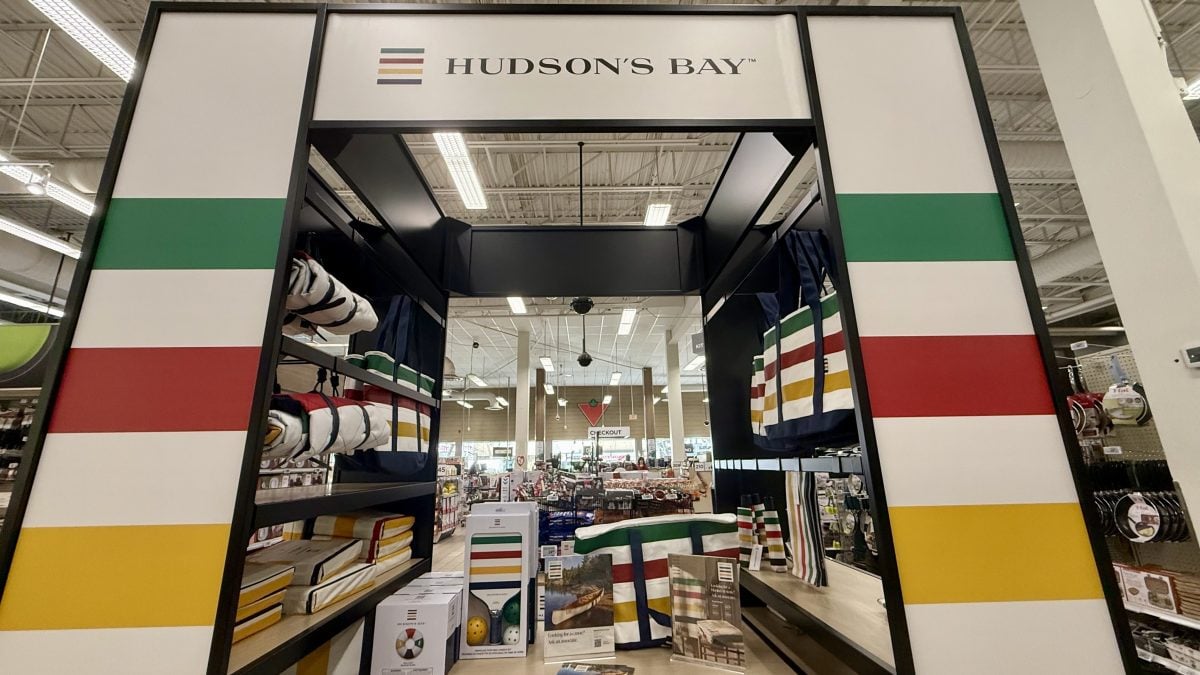
In 2025, Canadian Tire acquired the HBC Stripes, The Bay name, the Hudson’s Bay Company name, trademarks, logos, and the historic coat of arms. The transaction attracted significant attention across the retail industry because it transferred one of Canada’s oldest and most recognizable retail brands to another iconic Canadian retailer.
Since then, Canadian Tire has introduced Hudson’s Bay Stripes merchandise collections and incorporated the assets into its broader portfolio of owned brands.
Stifel views the acquisition as a logical extension of Canadian Tire’s strategy of leveraging proprietary brands that resonate with Canadian consumers.
Scale Becoming Increasingly Important
Increasingly, some of the country’s largest retailers are seeking growth through interconnected businesses that extend beyond traditional store operations. Canadian Tire’s combination of retail banners, loyalty programs, financial services operations, owned brands, and real estate assets places it among the most diversified examples of that approach in Canada.
The report argues that Canadian Tire’s scale could provide an important competitive advantage as retail consolidation continues across the country. The company participates in categories ranging from automotive and home improvement to sporting goods, apparel, petroleum, and financial services. Few retailers in Canada operate across as many categories while also maintaining loyalty, financial services, owned brands, and real estate businesses under the same corporate umbrella.
Challenges remain. Approximately 60 per cent of Canadian Tire’s merchandise assortment is considered discretionary, leaving the company exposed to shifts in consumer confidence and spending patterns. Analysts also acknowledge that investors will be watching closely to see whether the company’s significant investments translate into faster earnings growth in coming years.
Nevertheless, the report suggests Canadian Tire enters this period of change with several advantages that may become increasingly valuable if consolidation within Canadian retail continues. More than 100 years after its founding, the company appears to be entering another phase of evolution.
As Canada’s retail landscape continues to evolve, Canadian Tire’s future may be influenced as much by its loyalty programs, financial services operations, owned brands, and retail banners as by the Canadian Tire stores that remain at the centre of the business.













They should launch a super store format where all their banners are under a single roof and finally add some groceries that they talked about doing in the past they would be a true one stop competitor to Walmart with such a format!
Canadian Tire should open small Hudson’s Bay stores, similar to Sport Chek sized stores. Sell Bedding, Bath, Home Goods. Similar to what a Hudson’s Bay carried minus the clothing and beauty departments. They have such a rich brand history with Hudson’s Bay. Crazy it’s just a small little kiosk in the stores when party city get a whole department (that is never busy).
We think Strong & Free™️ made in Canada apparel, home and auto accessories would be a great brand to add to the collection!