The Palms at The Rec Room Granville, photo credit: Tom Belding (CNW Group/Cineplex)
Cineplex Inc., Canada’s leading entertainment and media company, has announced that longtime President and CEO Ellis Jacob will retire from the company on December 31, 2026.
In the interim, Jacob will continue to lead Cineplex and assist the transition to a new leadership structure, said the company in a news release.
Ellis Jacob
“The Board is delighted to recognize Ellis, who has built Cineplex Inc. over the past four decades into one of the world’s best operators of movie theatres and family entertainment centres,” said Board Chair Phyllis Yaffe.
“Ellis is, quite simply, a giant in our industry. It has been a privilege to work alongside him for many years and we look forward to working with him through this transition.”
The company said Jacob is the recent recipient of the Canadian Cinema and Television (Canadian Academy) Tribute Award at the 2025 Canadian Screen Awards. In 2022 Mr. Jacob was honoured by the National Association of Theatre Owners (NATO) with the 2022 NATO Marquee Award at CinemaCon in Las Vegas. He is the recipient of numerous other awards and recognition, including the Order of Canada and the Order of Ontario.
“After thoughtful consideration, I welcome this next chapter. For decades, I have been focused on making Cineplex a great Canadian company, and I move forward with immense pride in what we’ve built for generations of Canadian movie fans who come to us for those magical moments of escape that can only be found in a true theatre experience,” said Jacob. “I remain committed to working with the Board and the talented team at Cineplex during this transition period and have unwavering confidence in Cineplex’s bright future.”
The company is a top-tier Canadian brand that operates in the Film Entertainment and Content, Amusement and Leisure, and Media sectors. Cineplex offers a unique escape from the everyday to millions of guests through its circuit of over 172 movie theatres and location-based entertainment venues. In addition to being Canada’s largest and most innovative film exhibitor, the company operates Canada’s favourite destination for ‘Eats & Entertainment’ (The Rec Room), complexes specially designed for teens and families (Playdium), and an entertainment concept that brings movies, amusement gaming, dining, and live performances together under one roof (Cineplex Junxion). It also operates successful businesses in cinema media (Cineplex Media), digital place-based media (Cineplex Digital Media or CDM), alternative programming (Cineplex Events) and motion picture distribution (Cineplex Pictures).
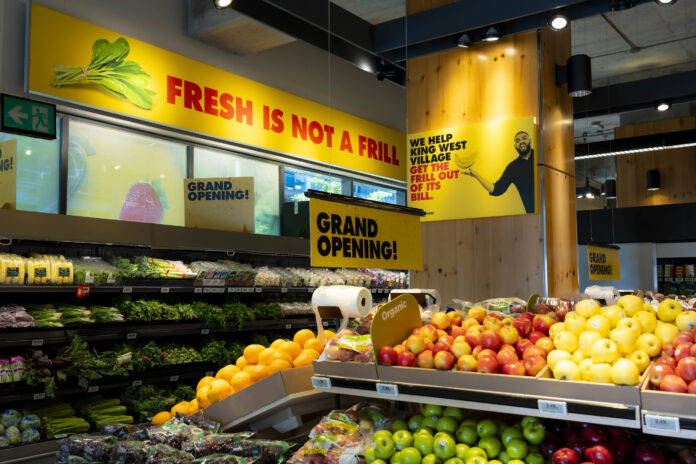
New small format No Frills opens in downtown Toronto (CNW Group/Loblaw Companies Limited - Public Relations)
While food inflation in May saw a lower rate of growth than April, it remains elevated compared to overall inflation, said Loblaw Companies Limited in its latest Food Inflation Report.
“That said,Canadians have historically seen some relief at the register on fresh products over the summer months as June kicks off the local growing season in Canada. July and August will have the widest variety of local fruit and vegetables, with savings expected on local products through until about October,” said the Loblaw report.
“The Canadian agriculture industry is a cornerstone of the national economy, supporting over 2 million jobs and ensuring a stable food supply. Grocery stores across the country purchase tens of billions of dollars worth of food from Canadian farmers each year, highlighting the critical role local producers play in feeding Canadians.”
This month, strawberries and bunched vegetables (asparagus, carrots, green onions and radishes) shift from imported to locally grown, providing Canadians with lower prices due to no foreign exchange and less transportation costs, fresher produce and longer shelf life. In many cases, the produce is harvested and ready for purchase in 1-2 days, versus U.S. or Mexican produce that can take 3-4 days in transit to reach distribution centres. Local field strawberries are generally up to 20 percent cheaper than their imported counterparts at this time of year, explained Loblaw.
“Currency often plays a role in grocery pricing in Canada. As retailers seek to diversify their international supply chains beyond the U.S., the strengthening EURO and other international currencies compared to the Canadian dollar has offset some of the benefits, especially for things like fresh produce, deli meats and cheeses, some vinegars, olive oil, and seafood. While this shift could help improve supply stability over time, it might mean slightly higher prices in these categories in the short term,” said the report.
The Loblaw report said:
Canadian Dollar: The USD has weakened since the beginning of the year over ongoing investor uncertainty regarding tariffs and U.S. fiscal health. Given many commodities trade in USD, this is beneficial to food prices.
Coffee: Rains in growing regions and improved crops have helped drop coffee prices in the most recent month. Prices remain up more than 150% since 2024, but this recent reduction is a positive sign.
Sugar: Strong supply out of Brazil and India paired with weaker demand recently has sent sugar to a four-year low.
IKEA Canada Indigenous Reconciliation Strategy comes to life through impactful room-setting and educational tipi unveiled on National Indigenous Peoples Day (CNW Group/IKEA Canada Limited Partnership)
IKEA Winnipeg recently unveiled inspiring Indigenous-influenced spaces as the renowned home furnishing retailer said it continues its commitment to building positive and respectful relationships between Indigenous and non-Indigenous people through its Indigenous Reconciliation Strategy.
The exhibit was unveiled on June 21 to coincide with National Indigenous Peoples Day, and provided customers and co-workers with a realistic view of how traditional Indigenous activities and practices come alive in a modern living room. The educational tipi, raised in unison with the Indigenous community and IKEA Winnipeg co-workers, offered customers a safe space to learn about Indigenous culture in the spirit of truth and reconciliation.
The Indigenous room-setting and tipi exhibit, which will remain in the store for the long-term, is the latest initiative in a series of actions taken by IKEA Winnipeg in collaboration with an Indigenous advisor and the local Indigenous community, said the retailer.
Andrea Dreilich, Communication and Interiors Manager, IKEA Winnipeg (CNW Group/IKEA Canada Limited Partnership)
“Manitoba has the largest urban Indigenous population in Canada with 18 per cent of the population identifying as Indigenous. With only 12 per cent of our customer base identifying as Indigenous, we knew there was work to be done to ensure that all people feel welcome and represented at IKEA,” said Andrea Dreilich, Communication and Interiors Manager, IKEA Winnipeg. “To achieve this, we are collaborating with local Indigenous families to better understand their unique life at home challenges and developing relevant solutions in our showrooms to help them create a better life at home. The living room we recently unveiled is only the first of more solutions to come.”
IKEA said the Winnipeg store is just one of many IKEA units that have been engaged in ongoing dialogue, collaboration, and relationship-building efforts with their local Indigenous communities guided by the IKEA Canada Indigenous Reconciliation Strategy. Rooted in the Truth and Reconciliation Commission of Canada (TRC) Call to Action #92 – Business and Reconciliation, the strategy, established by IKEA Canada in 2021, encompasses learning and teaching, collaboration and amplification, and reciprocity with Indigenous communities, it said.
Examples of initiatives from IKEA units across Canada include:
Indigenous showrooms at IKEA Edmonton, IKEA Halifax, and IKEA Calgary;
Support in the creation of the Ta Tsíptspi7lhḵn/the Language Nest by IKEA Richmond and the Vancouver Customer Distribution Centre (CDC);
Creation of impactful Indigenous art installations at IKEA Ottawa and IKEA Beauharnois Distribution Centre/Customer Distribution Centre (DC/CDC);
Partnership with the Canadian Library Project to use BILLY bookcases as a platform to educate and raise awareness about Missing and Murdered Indigenous Women and Girls (MMIWG);
Education for IKEA co-workers through the 4 Seasons of Reconciliation training program; and
Partnerships with Indigenous social entrepreneurs like the Setsuné Indigenous Fashion Incubator in 2017, prior to the establishment of the IKEA Reconciliation Strategy.
John Williams, Equality, Diversity and Inclusion Leader, IKEA Canada (CNW Group/IKEA Canada Limited Partnership)
“At IKEA, equality is deeply rooted in our values, and it is our ambition to be a force for positive change in society. Our vision is to create a better everyday life for the many people. With that comes a commitment to support Indigenous cultures and contribute to reconciliation with First Nation, Inuit, and Métis peoples, which goes together with our commitment to increase ethnic, racial, and national diversity in leadership,” said John Williams, Equality, Diversity and Inclusion Leader, IKEA Canada. “As we approach the 10th anniversary of the TRC’s 94 Calls to Action, we recognize there is more progress to be made, difficult conversations to be had, meaningful partnerships to be formed, voices to be amplified, and Indigenous culture to be celebrated – all of which, we will continue to strive for within the communities where we operate.”
Founded in 1943 in Sweden, the company is a leading home furnishing retaile. IKEA Canada is part of Ingka Group which operates 400 IKEA stores in 31 countries, including 16 in Canada. Last year, IKEA Canada welcomed 32.6 million visitors to its stores and 162.6 million visitors to IKEA.ca.
Contemporary Indigenous Family Room-setting at IKEA Winnipeg (CNW Group/IKEA Canada Limited Partnership) Contemporary Indigenous Family Room-setting at IKEA Winnipeg (CNW Group/IKEA Canada Limited Partnership) IKEA Canada Indigenous Reconciliation Strategy comes to life through impactful room-setting and educational tipi unveiled on National Indigenous Peoples Day (CNW Group/IKEA Canada Limited Partnership)IKEA Canada Indigenous Reconciliation Strategy comes to life through impactful room-setting and educational tipi unveiled on National Indigenous Peoples Day (CNW Group/IKEA Canada Limited Partnership)IKEA Canada marks ongoing Indigenous Reconciliation journey with Indigenous-inspired spaces at IKEA Winnipeg (CNW Group/IKEA Canada Limited Partnership)
The Vidir Merchandise Vending Machine is an automated storage unit that secures your inventory in a compact space, maximizing sales and service time. (CNW Group/Vidir Solutions)
Vidir Solutions, a leader in automated storage and retrieval systems (ASRS), officially launched itsMerchandise Vending Machine at the Winnipeg Blue Bombers’ home opener on June 12.
This groundbreaking product instantly enhanced the fan experience by offering a seamless way for supporters to purchase team merchandise on game day. It also improves team operations by automating the merchandise sales process in a compact space, greatly improving the speed of service while maximizing on-hand inventory quantities, it said in a news release.
“While the Winnipeg launch showcases the machine’s impact on the sports and entertainment industry, Vidir’s automated retail solutions are already in use across Micro Center locations throughout the United States. These installations help retailers improve inventory management, reduce stockouts, increase sales, and enhance loss prevention efforts,” explained the company.
The company said the Merchandise Vending Machine is the first of its kind to be found at a North American sporting event. The solution maximizes the storage density of game day essentials, including hats and jerseys, ensuring more products are easily accessible to fans in the concourse. It automatically stores items up to 30 feet off the ground and delivers purchased goods to the customer in as little as 30 seconds, it added.
Carissa Rempel
“We’re excited to launch the Merchandise Vending Machine at the Winnipeg Blue Bombers’ home opener,” said Carissa Rempel, Co-Owner at Vidir Solutions. “This product not only enhances the game-day experience by offering quick access to fan gear but also supports operational efficiency with its easy installation and fully assembled delivery. It’s an honor to work with the Bombers to bring this cutting-edge technology to the stadium, providing a glimpse into the future of fan engagement.”
Vidir Solutions is a global leader in automated storage and retrieval systems, specializing in high-density storage solutions that maximize space, efficiency, and safety. With a focus on innovation, Vidir Solutions provides a range of products designed to optimize operations across various industries.
Sebastian Picardo, President and Chief Executive Officer of Holt Renfrew since 2020, will be stepping down from his role effective September 30, 2025. The announcement was made by the company, which noted that Picardo has decided to return to Europe with his family and will be relocating to London to explore new professional opportunities. His departure marks the end of a pivotal five-year tenure during which he led Canada’s leading luxury department store chain through an era of intense transformation.
In a statement issued Friday, the company confirmed that a global search is actively underway to appoint a new President and CEO, with final candidates currently under review.
Picardo assumed leadership of Holt Renfrew at one of the most challenging moments in modern retail history. Joining the company in mid-2020, he entered during the height of the COVID-19 pandemic—a time when global supply chains were disrupted, consumer behaviour was shifting rapidly, and luxury retail faced mounting pressure to adapt.
Under his leadership, Holt Renfrew stabilized and evolved. The company acknowledged Picardo’s critical contributions in guiding the brand through turbulent times, stating, “His strong leadership and vision played an integral role in guiding Holts through a time never seen before in the retail landscape.”
In his own farewell message, Picardo reflected on the magnitude of the challenges and the successes that followed, noting that the company stands “stronger as a brand than ever before.”
Holt Renfrew at 50 Bloor St. W. in Toronto. Photo: Craig Patterson
A Strategic Shift in Merchandising and Customer Reach
A key part of Picardo’s impact was his work to evolve Holt Renfrew’s merchandising strategy to better reflect the changing preferences of luxury consumers in Canada. He introduced a broader assortment that included more contemporary and accessible fashion and lifestyle labels, helping the brand connect with a wider demographic.
Among the new brands brought into the assortment under Picardo’s watch were SKIMS, Canadian undergarment brand Knix, jewellery brand Mejuri, RAINS, Adidas, and On running shoes, among others. More recently, the retailer also introduced a Levi’s denim pop-up at its Calgary location, with plans to expand Levi’s into more Holt Renfrew stores across the country.
The expansion of the brand mix reflected a vision to maintain Holt Renfrew’s luxury credentials while becoming more inclusive, relevant, and accessible to a broader customer base.
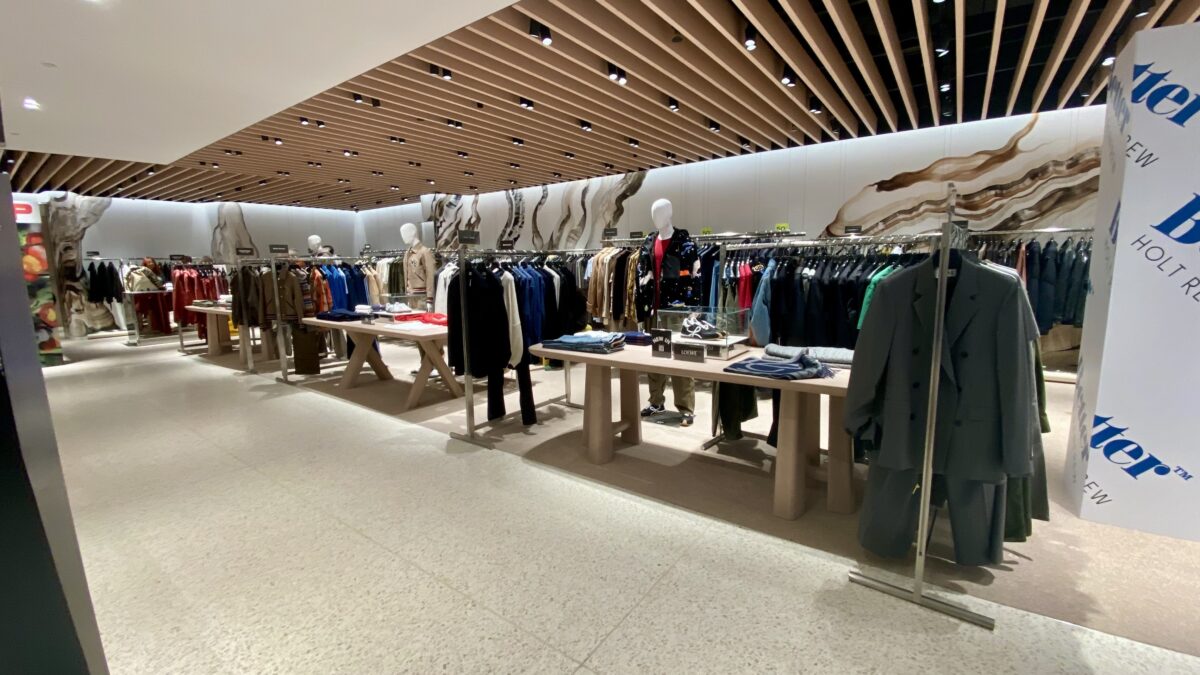
Men’s designer area ON3 in Holt Renfrew at 50 Bloor St W in Toronto. Photo: Craig Patterson
Digital Transformation and New Store Concepts
In parallel with changes to the product assortment, Picardo oversaw a significant modernization of Holt Renfrew’s digital infrastructure. The retailer launched a redesigned website featuring improved navigation, easier product discovery, and a marketplace model that expanded the breadth of offerings online.
Additionally, sales associates were provided with new digital tools to enhance customer engagement, enabling more personalized and remote shopping experiences that became particularly vital during periods of lockdown and reduced store traffic.
One of the more high-profile changes during his tenure was the closure of the standalone Holt Renfrew Men’s store at 100 Bloor Street West in Toronto. The men’s offering was relocated to the main flagship at 50 Bloor Street West and became part of the ON3 concept—a new third floor space that blends men’s and women’s contemporary fashion, SKIMS, and H Project within an integrated environment.
ON3 ribbon cutting, December 2024. Left-to-right. Xia Vanisouvong, Assistant General Manager, Holt Renfrew Bloor Street. Sebastian Picardo, President, and CEO, Holt Renfrew. And Ralph Roach, Divisional Vice President, General Manager, Holt Renfrew Bloor Street. Photo: Holt Renfrew
A Focus on People, Values, and Purpose
Picardo’s influence was also evident in company culture. In his departing remarks, he described the evolution of Holt Renfrew into a “more purpose-led company driven by our mission and values.” He cited improved employee engagement and noted that the company saw the “lowest turnover in years,” attributing that to a revitalized workplace culture.
He also highlighted growth in the company’s own-bought business, which improved in profitability during his time as CEO. Holt Renfrew also experienced an increase in customer numbers, which Picardo described as evidence that “more customers are choosing Holts.”
According to Picardo, the company had cemented a strong strategy and integrated goals, with a network of strengthened partnerships and community connections supporting continued growth.
International Experience Brought to Canadian Luxury Retail
Born in Argentina, Picardo brought a deeply international perspective to the Canadian luxury landscape. Prior to his arrival at Holt Renfrew, he held the position of Deputy President and Chief Operating Officer at Lane Crawford, the prestigious luxury department store based in Hong Kong. There, he played a pivotal role in advancing the company’s omni-channel strategy and customer experience across Greater China.
Earlier in his career, Picardo held executive positions at several globally recognized brands. At Burberry, he led key digital transformation initiatives that helped modernize the British fashion house. He also held leadership roles at Net-a-Porter, Alexander McQueen, and professional services firm Deloitte.
In addition to his corporate leadership background, Picardo is a chartered accountant and holds academic credentials in public accounting, business management, business administration, and international finance. He also recently completed the Advanced Management Program at Harvard Business School.
Yorkdale Shopping Centre marked 60 years (October 2024) with a panel discussion hosted by Mosha Lundström Halbert. Panelists included (left to right) Ian Rosen, President and COO of Harry Rosen, Bernard Leblanc, CEO of La Maison Simons, and Sebastian Picardo, CEO of Holt Renfrew. Photo: Craig Patterson
Positioning Holt Renfrew for the Future
During his time in Canada, Picardo expressed confidence in the long-term viability of the country’s luxury retail market. He cited population growth, increased immigration, and a post-pandemic shift in consumer mindset as key factors driving demand for luxury experiences and products.
He also introduced short-term retail pop-up concepts in cities where the brand no longer has permanent stores—as a way to test new markets and engage regional shoppers. These types of innovations reflected his view that luxury retail needed to combine in-person service with digital reach and cultural relevance.
In his final comments, Picardo shared optimism for the company’s future, saying, “With every leadership change comes a great new injection of knowledge, thought leadership, energy, and possibilities.” He added, “I look forward to staying connected and watching Holts thrive.”
A Legacy Brand in Transition
Founded in Quebec City in 1837 as a furrier, Holt Renfrew has grown into one of North America’s most enduring luxury retail institutions. Today, it is owned by Wittington Investments, the Weston family’s holding company, which also controls Loblaw in Canada and Associated British Foods in the United Kingdom.
Holt Renfrew operates six key retail locations in Canada, including its flagship store at 50 Bloor Street West in Toronto. Other Ontario locations include Yorkdale Shopping Centre and Square One in Mississauga. In Montreal, the brand operates the historic Holt Renfrew Ogilvy on Sainte-Catherine Street. Additional stores are located in downtown Calgary at The CORE and in Vancouver’s CF Pacific Centre.
The company continues to operate a robust national e-commerce platform at holtrenfrew.com, which has become an increasingly important part of its customer engagement strategy.
Holt Renfrew is widely viewed as Canada’s closest equivalent to U.S. luxury retailers such as Saks Fifth Avenue and Neiman Marcus, with a reputation for providing personalized service, exclusive designer labels, and a curated retail environment.
Holt Renfrew CEO Sebastian Picardo at Holt Renfrew Calgary, November 2023 (Image: Mario Toneguzzi)
What Comes Next
The departure of Sebastian Picardo represents a major leadership change for Holt Renfrew at a time when the luxury sector is continuing to adapt to shifting consumer demands, digital disruption, and global economic pressures. As the company searches for its next leader, all eyes will be on who takes the helm—and how they will carry forward the foundation built over the past five years.
For now, the company emphasized its confidence in the executive leadership team in place and expressed gratitude for Picardo’s tenure. “We are grateful for everything Sebastian brought to Holt Renfrew, our brand, our people, partners, and communities,” the company said.
As Picardo prepares for his return to Europe, he leaves behind a stronger Holt Renfrew, equipped with a clearer strategy, sharper digital tools, and a broader vision of luxury for the Canadian consumer.
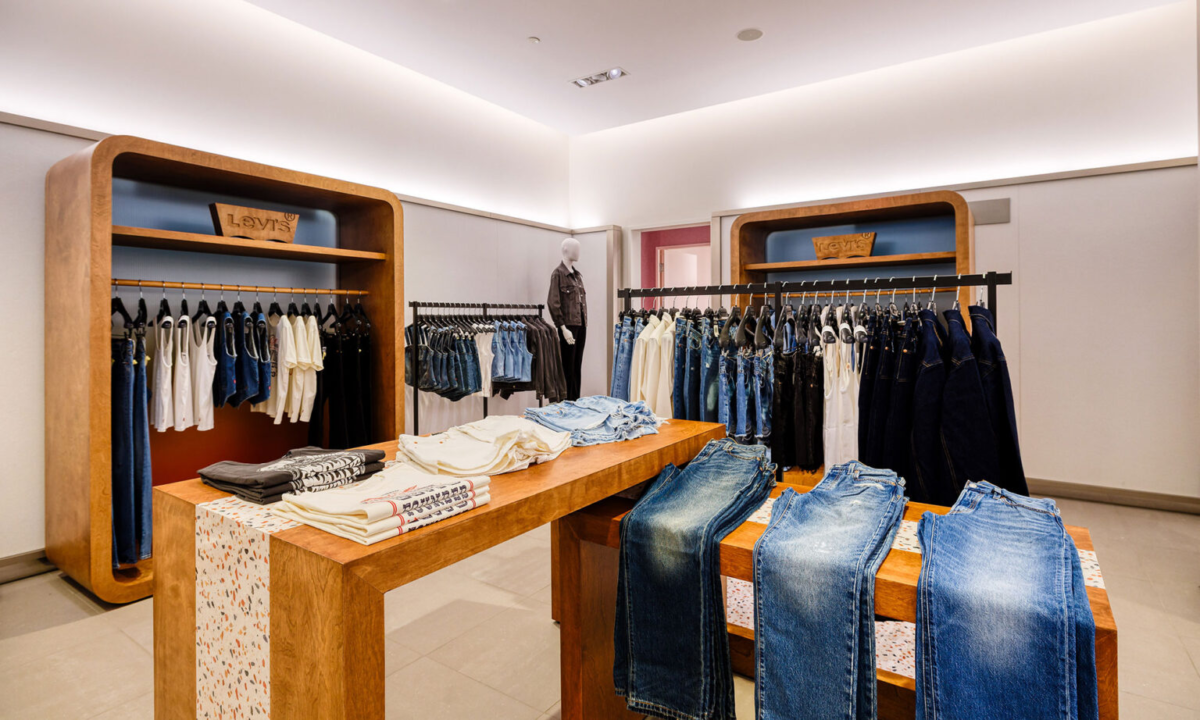
Levi's pop-up at Holt Renfrew in Calgary, June 2025. Photo: Levi's
Global denim icon Levi’s® has officially launched at Holt Renfrew, starting with pop-up shops and in-store activations at select locations across Canada. The partnership marks a major step in Levi’s® strategy to expand its premium presence in the Canadian market, following the recent closure of Hudson’s Bay stores — previously a key retail partner for the brand.
Beginning this summer, Levi’s® products are being showcased through pop-up concepts in Holt Renfrew stores, with early launches in Calgary and at Holt Renfrew Ogilvy in Montreal. These locations feature a focused selection from the Levi’s® Red Tab™ collection — including the iconic 501® jean, western shirts, Trucker jackets, and limited-edition pieces crafted by regional Levi’s® Tailor Shops.
“In Calgary and Montreal, fans can now experience the essence of Levi’s® in an elevated setting,” said Vicky Skelton, managing director for LS&Co. Canada. “This partnership with Holt Renfrew allows us to bring that spirit to life in a premium setting, offering consumers not just iconic Levi’s® pieces, but immersive experiences that celebrate self-expression and style.”
Vicky Skelton
National Rollout and Exclusive Experiences
Additional Holt Renfrew locations will debut Levi’s® offerings throughout the summer. In August, the Toronto Bloor Street flagship will launch with curated assortments from both the Red Tab™ and Blue Tab collections. Vancouver’s location will include an in-store Levi’s® Tailor Shop with a dedicated tailor on-site, allowing guests to personalize garments in real time. At the Yorkdale and Square One stores, Levi’s® collections will be integrated into the denim department.
The launch of Levi’s® pop-up shops coincides with the brand’s introduction of its most elevated product line: the Blue Tab collection. Originally launched in Japan and now available in the U.S. and Canada, Blue Tab features exclusive denim pieces made from premium fabrics that fuse Levi’s® American heritage with Japanese craftsmanship and modern silhouettes.
Levi’s® is engaging consumers through unique in-store events. In Calgary, the launch was accompanied by a Levi’s® Bandana Bar where shoppers could personalize bandanas while enjoying a live DJ and coffee from a branded barista station. The experience will be replicated at Montreal’s Ogilvy store from July 26 to July 27.
Carolyn Wright
“Denim is a rapidly growing business here at Holts, and Levi’s® has a legacy of authenticity and quality in denim,” said Carolyn Wright, senior vice president of Product at Holt Renfrew. “This partnership with Levi’s® reinforces Holt Renfrew as a destination for premium denim and features unique items, only available at Holts, underscoring our brands’ shared values of empowering self-expression.”
Filling the Void Left by Hudson’s Bay
The new partnership with Holt Renfrew follows a major shift in Canada’s department store landscape. Levi’s® was previously a major seller at Hudson’s Bay stores, where the brand generated tens of millions of dollars in annual sales. That channel closed abruptly after Hudson’s Bay Company filed for bankruptcy protection and shuttered all of its department stores across Canada in early June 2025.
Holt Renfrew’s new relationship with Levi’s® helps fill the retail gap left by Hudson’s Bay’s exit, giving Canadian consumers access to the brand in a premium setting. The timing creates a strategic opportunity for both companies — with Levi’s® securing continued brick-and-mortar visibility, and Holt Renfrew gaining sales volume from a heritage brand with longstanding customer loyalty.
Levi’s pop-up at Holt Renfrew in Calgary, June 2025. Photo: Levi’s
Ecommerce and Standalone Store Strategy in Canada
In addition to the Holt Renfrew launch, Levi’s® continues to grow its direct-to-consumer operations in Canada. The brand operates a Canadian ecommerce site at Levi.com, offering a full assortment of apparel and accessories, including the Red Tab™ and Blue Tab collections. Levi’s® has also been expanding its network of standalone stores across the country in recent years, reinforcing its commitment to serving Canadian consumers through both physical retail and digital channels.
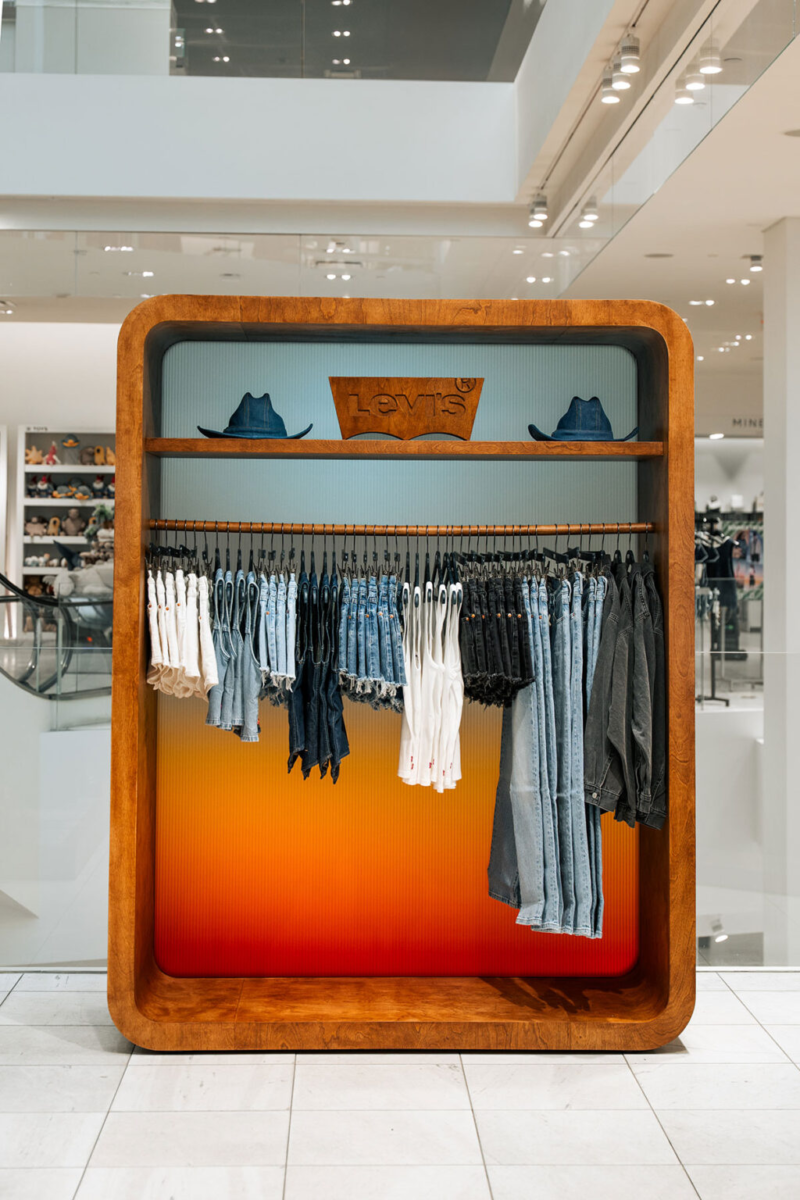
Bandana bar at the Levi’s pop-up at Holt Renfrew in Calgary, June 2025. Photo: Levi’s
These standalone locations, found in major shopping centres, offer tailored brand experiences and services such as tailoring, personalization, and limited-edition drops. The retail expansion supports Levi’s® broader omnichannel strategy to meet customers wherever they shop, whether through store partnerships, owned stores, or digital platforms.
Holt Renfrew Broadens Its Merchandise Strategy
While historically positioned as a destination for luxury labels and designer fashion, Holt Renfrew has been broadening its merchandising strategy in recent months to include a wider range of price points and product categories. This evolution reflects a broader shift in retail, as consumer expectations around value, uniqueness, and brand accessibility continue to evolve.
Rather than focusing solely on price or prestige, Holt Renfrew is increasingly curating products that are exclusive, limited-edition, or otherwise hard to find in the Canadian market. The inclusion of Levi’s® — a globally recognized heritage brand offering both iconic and premium lines — aligns with this new vision.
The move positions Holt Renfrew as a key player in Canada’s changing department store landscape. With the departure of Nordstrom and the closure of Hudson’s Bay, Holt Renfrew is filling an important void — offering both elevated shopping experiences and distinctive product assortments that span luxury to premium accessible.
This strategic pivot allows Holt Renfrew to retain its luxury positioning while embracing a broader community of shoppers who value quality, craftsmanship, and individuality over status alone.
Levi’s pop-up at Holt Renfrew in Calgary, June 2025. Photo: Levi’s
Positioning for the Future
As Holt Renfrew continues to reimagine its role in the Canadian department store landscape, its partnership with Levi’s® signals a broader opportunity: to serve as a new kind of premium destination — one that balances high fashion with heritage, exclusivity with accessibility, and product with experience.
For Levi’s®, the collaboration builds on its omnichannel strategy and brand elevation initiatives across North America. “We’re excited to continue the business momentum we’ve experienced with the premiumization of our brand,” said Skelton. “Our push to elevate the Levi’s® brand through new product assortment and our retail experience is a pivotal step, allowing us to connect with a whole new community of fans.”
With pop-ups underway and new activations on the horizon, the Levi’s® partnership reinforces Holt Renfrew’s position as a forward-looking retailer — and offers Canadian shoppers a new way to engage with one of the world’s most iconic denim brands in an upscale setting.
If you’re a matcha drinker, brace yourself—prices are likely heading up, and TikTok may be to blame.
What began as a traditional Japanese tea used in ceremonial settings has rapidly become a global wellness staple. Canada is no exception. Fueled by social media and a surge in health-conscious consumer habits, matcha has gone mainstream. The Canadian market alone was valued at about $300 million in 2024, projected to reach $375 million by 2025 and nearly double to $700 million by 2035, according to Market Research Future. That represents a compound annual growth rate of approximately 7% over the next decade.
Today, matcha is found not only in lattes but in smoothies, baked goods, energy bars, and even cosmetics. Its rise reflects a broader trend in Canadian food culture: the growing appeal of global ingredients that promise both functionality and indulgence.
But matcha comes with a key economic constraint—supply. The production process is uniquely labour-intensive and deeply artisanal. Shade-grown, hand-picked, steamed, and stone-ground, authentic matcha—particularly from Japan’s Uji region or parts of China—is difficult to industrialize. Canada, due to climate, cannot grow matcha domestically, meaning demand must be met through imports. The market’s tightness leaves it exposed to price volatility as interest surges.
Already, we’re seeing the effects. Ceremonial-grade matcha that sells for roughly $28 per 100 grams in Japan can retail for as much as $120 in Canada—a markup exceeding 300%. Even culinary-grade matcha, which typically costs $5 to $14 in Japan, often doubles in price on Canadian shelves. As demand continues to grow, especially for premium varieties, prices could climb by another 30–40% in the coming years.
There’s also concern over authenticity. As matcha’s profile rises, so too does the presence of lower-quality substitutes—powders that resemble matcha in colour but lack its nutritional properties and distinctive taste profile. Consumers may not always know the difference until they’ve overpaid.
Cafés and restaurants are already reporting supply challenges, and many are struggling to keep pace with customer expectations. This isn’t a passing inconvenience—it’s an early sign of a demand-driven imbalance that may persist.
Unlike fleeting trends like celery juice or butter boards, matcha’s growth is supported by habit formation. Its caffeine content, antioxidant profile, and calming effects appeal especially to Millennials and Gen Z consumers looking for a healthier, more stable alternative to coffee. The fact that the industry—not just consumers—is embracing matcha also signals staying power. In many ways, matcha is positioned similarly to pumpkin spice two decades ago—only this time, with the added push of social media.
For traditional coffee drinkers, there may be a silver lining. As matcha draws more market share, coffee demand may stabilize. That’s welcome news after a year in which retail coffee prices rose 25%, according to Statistics Canada.
In short, matcha is no longer niche. It’s a case study in how consumer health trends, social media, and global trade dynamics can converge to reshape what—and how—we drink. If you’re a coffee drinker, you might want to start promoting matcha yourself. Your wallet could thank you.
Real gross domestic product (GDP) edged down 0.1% in April, following a 0.2% increase in March.
The goods-producing industries were down 0.6% in April, with the manufacturing sector accounting for nearly all the decline.
The services-producing industries edged up 0.1% in April. Public administration, finance and insurance, and the arts, entertainment and recreation sectors contributed the most to the increase, while the wholesale trade sector was the largest detractor to growth. Overall, 10 of 20 industrial sectors expanded in April, said Statistics Canada.
The number of employees receiving pay and benefits from their employer—measured as “payroll employment” in the Survey of Employment, Payrolls and Hours—was little changed in April (-6,200), following two consecutive declines in February and March. On a year-over-year basis, payroll employment was up 30,400 (+0.2%) in April.
In April, monthly payroll employment declines were recorded in 9 of 20 sectors, including manufacturing (-7,300; -0.5%), accommodation and food services (-5,800; -0.4%), retail trade (-5,000; -0.3%), and administrative and support, waste management and remediation services (-4,700; -0.6%). These declines were partially offset by gains in health care and social assistance (+10,800; +0.4%), public administration (+6,200; +0.5%) and educational services (+5,200; +0.4%). The remaining eight sectors were little changed.
Meanwhile, job vacancies decreased by 16,800 (-3.2%) to 501,300 in April, following nine consecutive months of little change. On a year-over-year basis, job vacancies were down by 91,400 (-15.4%), reported Statistics Canada.
Tourism spending was virtually unchanged in the first quarter of 2025 after increasing 1.5% in the fourth quarter of 2024. Domestic tourism spending increased 0.8% in the first quarter of 2025 as Canadians pulled back from international travel to the United States. Gains in tourism spending by Canadians at home were offset by lower tourism exports (-2.6%), which refer to non-resident spending in Canada.
Tourism gross domestic product (GDP) grew 0.5% in the first quarter of 2025, compared to growth of 1.3% in the fourth quarter of 2024. By comparison, economy-wide GDP by industry was up 0.4% in the first quarter of 2025.
Growth in tourism GDP in the first quarter was driven by accommodation services (+2.0%), followed by food and beverage services (+1.0%). These gains were partially offset by declines in other tourism industries (-1.2%) and transportation (-0.3%) during the quarter.
On a nominal basis, tourism’s share of GDP was 1.74% in the first quarter, down from 1.79% recorded in the previous quarter.
The number of jobs attributable to tourism edged up 0.1% in the first quarter of 2025, following a 0.8% increase in the fourth quarter of 2024. The gains in food and beverages services (+0.6%) and accommodation services (+0.4%) were largely offset by declines in recreation and entertainment (-1.0%) and travel services (-1.6%). The total number of tourism jobs in Canada reached 707,400 in the first quarter, up slightly from 706,500 in the fourth quarter. Tourism’s share of total jobs was 3.30% in the first quarter, noted Statistics Canada.
In March, the business opening rate was 4.8% for a third straight month. The closure rate edged up 0.1 percentage points to 4.8%, following two consecutive monthly declines of 0.2 percentage points. In March, the business opening rate was 0.1 percentage point above its 2015-to-2019 historical average while the closure rate was 0.2 percentage points higher than its historical average.
The number of active businesses showed no growth over the first quarter of 2025. In March, the number of active businesses dropped by 0.1% (-722 businesses) as the number of business closures was higher than that of openings. In the same month, payroll employment dropped by 0.3%, real gross domestic product edged up 0.1% and business insolvency filings were relatively unchanged from February (448) to March (444).
Business openings held relatively steady in most sectors in March. The construction (+409 business openings compared with February) sector recorded the largest variation in business openings, followed by the accommodation and food services (-194) and other services (except public administration) (-89) sectors, shared Statistics Canada.
In March, business closures changed little in most sectors. The finance and insurance, and management of companies and enterprises (+104 business closures compared with February) and health care and social assistance (+90) sectors posted the largest increases in business closures. These increases were partially offset by the decline in closures in the retail trade (-110) sector.
The number of active businesses dropped or was relatively unchanged in all sectors in March. The decline in the overall number of active businesses was mainly driven by the transportation and warehousing (37.7% contribution to the decline in active businesses), professional, scientific and technical services (24.3% contribution) and accommodation and food services (8.0% contribution) sectors.
The number of employees receiving pay and benefits from their employer—measured as “payroll employment” in the Survey of Employment, Payrolls and Hours—was little changed in April (-6,200), following two consecutive declines in February and March. On a year-over-year basis, payroll employment was up 30,400 (+0.2%) in April.
In April, monthly payroll employment declines were recorded in 9 of 20 sectors, including manufacturing (-7,300; -0.5%), accommodation and food services (-5,800; -0.4%), retail trade (-5,000; -0.3%), and administrative and support, waste management and remediation services (-4,700; -0.6%). These declines were partially offset by gains in health care and social assistance (+10,800; +0.4%), public administration (+6,200; +0.5%) and educational services (+5,200; +0.4%). The remaining eight sectors were little changed.
Meanwhile, job vacancies decreased by 16,800 (-3.2%) to 501,300 in April, following nine consecutive months of little change. On a year-over-year basis, job vacancies were down by 91,400 (-15.4%), reported Statistics Canada.
A grocery store in Alberta. Photo: Craig Patterson
New findings from PwC Canada’s 2025 Voice of the Consumer report reveal a widening gap between Canadians’ aspirations and actions when it comes to buying food. While most consumers express strong support for locally sourced products, affordability remains the deciding factor at checkout. This growing tension underscores the challenges retailers and brands face in aligning economic realities with consumer values.
According to the report, 76% of Canadians are concerned about food costs, well above the global average of 59%. At the same time, 75% say they’re willing to pay a premium for local food, driven by a desire to support the economy and access higher-quality products. Yet, when push comes to shove, 62% still choose lower-priced imported products over Canadian alternatives.
“This disconnect reflects the tension between Canadians’ desire to shop local and the reality of their purchasing decisions at checkout,” said Elisa Swern, National Retail and Consumer Leader at PwC Canada. “Canadians value local products and want to support homegrown businesses, but price remains a powerful influence, especially in today’s economic climate.”
Elisa Swern, National Retail and Consumer Leader at PwC Canada
Swern said the issue is not necessarily that local products are more expensive—it’s that consumers perceive them as being more costly, which drives them toward lower-priced options even when they would prefer to buy local.
Value Beyond Price: A Story Yet to Be Told
Swern emphasized that brands must do more to communicate the total value of local products, not just in terms of price but also in terms of provenance, sustainability, and community impact.
“Value perception is something that needs to be worked on,” she explained. “Even if there’s a small price differential, if consumers understand that something was grown in their backyard or that it supports a local family business, it can touch them more deeply from a value perspective.”
She added that manufacturers and retailers need to collaborate to tell that story in-store and online, helping consumers understand where their food comes from and why it matters.
Domestic Sourcing Ranks High in Sustainability Priorities
Another major insight from the PwC report is that 46% of Canadian consumers now cite domestic sourcing as their top sustainability consideration, above the global average of 40%. That reflects a shift in how consumers define “sustainable”—focusing more on economic resilience and local ecosystems than just carbon emissions or packaging.
Yet this support is often undercut by perceived price premiums, even when those premiums don’t actually exist. Swern said this creates a critical opportunity for education.
“‘Made in Canada’ labels alone aren’t enough to sway Canadian consumers,” she noted. “Retailers and food manufacturers need to look at new ways of partnering—technologically, operationally, even with government—to bring sustainable products to market without passing heavy price increases on to the consumer.”
Collaboration and Efficiency: Keys to the Future
The path forward, according to the report, lies in creating more efficient and interconnected supply chains. Swern believes that if producers, retailers, and technology companies work more closely, they can reduce food waste, streamline logistics, and manage input costs—all of which help lower prices without compromising quality.
“Some companies are already experimenting with vertical growing in stores, QR code storytelling, and smarter packaging,” Swern said. “There’s huge opportunity to scale these innovations.”
She cited international examples, such as a Middle Eastern grocer working directly with farmers not only to improve wages and reduce food waste, but to also bring them into the supply chain as strategic partners rather than just suppliers.
“We need more of that kind of thinking in Canada,” she said. “Retailers should be asking: how do we give smaller producers a chance to compete, even if they can’t afford premium shelf space? What kind of story can we tell that connects consumers emotionally to these products?”
A grocery store in Alberta. Photo: Craig Patterson
Healthier Eating: A Generational Shift
The PwC report also tracked emerging health-conscious trends, particularly among younger consumers. While only 45% of Canadians plan to increase their fresh produce intake in the next six months (compared to 56% globally), Gen Z consumers are much more likely to push for healthier food choices and expect companies to lead the charge.
“They’re more attuned to what’s in their food and where it comes from,” Swern explained. “They’re also more vocal about wanting clean, recognizable ingredients.”
Swern said food companies must adapt, not just by adjusting formulations but by clearly communicating what goes into their products.
“This is where technology can help,” she noted. “New 2D barcodes can offer more information than traditional labels, linking to a brand’s website or farm origin stories. Consumers want to know their peaches came from John Smith’s orchard in Ontario—that kind of storytelling builds trust.”
Making Healthier Options Affordable
While the desire for healthier food is rising, affordability is again the barrier. The report found that nearly two-thirds of Canadians would pay more for additive-free or nutritionally enhanced foods, but many still can’t justify the higher price.
Swern said that to bridge this gap, operational efficiency must be part of the solution.
“Retailers are starting to look at how to eliminate waste throughout a product’s life cycle—from farm to shelf,” she said. “Take potatoes, for instance. How do we use the entire crop, reduce spoilage, and make the most out of every unit produced? If you reduce waste, you reduce costs.”
She also sees promise in technology-driven solutions like dynamic pricing, spoilage sensors, and smarter demand forecasting.
“Imagine if a grocer knows it’ll sell 2,300 cases of strawberries in week 23. That kind of precision, combined with dynamic pricing as a product nears end of life, could cut waste and deliver fresher food at better prices.”
Strategic Partnerships Will Shape What’s Next
Swern believes that the future of Canadian food retail depends on deeper collaboration—not only across the supply chain, but also with external partners in technology, agriculture, and government.
“There’s a lot of talk about retail media, about tech solutions, but at the end of the day it’s about partnerships,” she said. “The future belongs to companies that can align with producers, deliver on transparency, and speak to the consumer in a way that’s both emotionally compelling and economically viable.”
Even seemingly small gestures—like making QR codes easier to scan or helping smaller brands tell their stories—can build consumer loyalty.
“It’s about building trust,” Swern concluded. “Canadians want to support local. They want to eat well. It’s up to the industry to make those choices easier, more accessible, and more affordable.”
For more findings from PwC Canada’s Voice of the Consumer 2025 report, including insights on brand loyalty, health trends, and the evolving role of sustainability in food retail, visit pwc.com/ca/voice-of-the-consumer.
Two of Canada’s most beloved cultural exports—Shania Twain and Clearly Canadian—are teaming up in a major new advertising campaign that marks the beverage brand’s first national promotion since 1991.
Clearly Canadian, the once-ubiquitous flavoured sparkling water brand founded in British Columbia in 1987, has released a high-energy new commercial starring the country-pop legend in an action-packed, tongue-in-cheek “treasure hunt.” The commercial sees Twain racing through the Canadian wilderness in pursuit of her prize: a bottle of Clearly Canadian. The brand, often described as Canada’s original ‘new age soda,’ is aiming to reassert itself in the modern beverage landscape with a message steeped in national pride and nostalgia.
“I have very clear memories of Clearly Canadian growing up here,” said Twain. “When the team reached out, I was so flattered and the idea was awesome!”
A Return to Advertising, Three Decades Later
The new campaign, developed in partnership with Ryan Reynolds’ creative agency Maximum Effort, was filmed on location in Canada with a natural backdrop of waterfalls and forests. The brand is emphasizing not just celebrity endorsement, but a reconnection with its roots: Canadian water, Canadian scenery, and Canadian stars.
“Getting to shoot this in the Canadian outdoors, fighting to do my own stunts (I think I can still tumble!), and sampling all the new flavours hardly felt like work,” said Twain. “Getting to be in my own adventure movie for the day was pretty great.”
The ad also features a new jingle and unmistakable Canadian humour, a hallmark of the Maximum Effort creative style. It’s a strategic move for a brand that, while dormant for several years, remains firmly embedded in the cultural memory of Canadian and American consumers who came of age in the 1990s.
A Brand Revived by Loyal Fans
Clearly Canadian’s resurgence is a direct result of fan demand. In 2013, a crowdfunding campaign helped raise enough support to pre-sell over 40,000 cases of the product. The outpouring of enthusiasm led to Clearly Canadian’s return to store shelves in 2017, with retail expansion following in both Canada and the U.S.
Since that time, the company has reported “market-leading” growth. Distribution has steadily expanded, and the brand is now once again a regular sight in major grocery and specialty retail chains across North America.
Yet despite broader availability, consumer demand frequently outpaces supply. One of the most common comments on Clearly Canadian’s social media posts remains: “Where can I find it?!”
Clearly Canadian Expands Product Line to Meet Demand
To meet evolving consumer preferences, Clearly Canadian has introduced new product formats and flavour options while staying true to its original formulation of pure Canadian spring water and natural ingredients.
The flagship Clearly Canadian Originals line—offered in nostalgic flavours like Wild Cherry, Mountain Blackberry, Orchard Peach, Summer Strawberry, and Country Raspberry—continues to be packaged in the brand’s signature recyclable glass bottles.
The brand has also diversified its offerings with Clearly Canadian Zero Sugar, sweetened with a Stevia blend, and Clearly Canadian Essence, an unsweetened sparkling water featuring light vegan flavour profiles.
In 2024, the company introduced recyclable aluminum cans, further extending its reach into grab-and-go and convenience formats. The move balances the brand’s sustainability commitments with retail growth, as both glass and aluminum packaging are made from 100% recycled materials.
From 90s Nostalgia to Modern Pop Culture Relevance
The Clearly Canadian brand was once a staple of 1990s pop culture, appearing in everything from corner stores to TV shows. It stood out not just for its vivid fruit flavours and colourful branding, but for offering a perceived “healthier” alternative to traditional sodas.
Today, that original identity resonates even more with millennial and Gen Z consumers who prioritize natural ingredients, clean labels, and sustainability. The company is leaning into that positioning while embracing a more contemporary marketing approach.
Twain’s participation in the campaign plays an important role in that strategy. With over 100 million records sold and multiple Grammy Awards, the Timmins, Ontario-born singer continues to captivate fans globally. Her own comeback, following a long hiatus due to illness, mirrors the revival story of Clearly Canadian itself—a beloved Canadian original, returning stronger than ever.
Photo: Clearly Canadian
Maximum Effort, Maximum Impact
Partnering with Ryan Reynolds’ Maximum Effort was a deliberate choice for Clearly Canadian. The agency, known for its irreverent and distinctly Canadian storytelling, brought a level of creative flair and cultural resonance to the campaign that aligns with the brand’s ambitions.
The ad’s tone—a blend of humour, action, and nostalgia—positions Clearly Canadian as both a legacy product and a lifestyle choice. With a soundtrack designed to stick and visuals that pay homage to Canadian wilderness, the campaign brings the brand’s story full circle.
Canadian-Made, Globally Loved
Though the company’s roots are firmly planted in British Columbia, Clearly Canadian’s appeal is decidedly international. At its peak in the 1990s, the brand was exported across Europe and Japan. Its return has reignited cross-border interest, particularly in the United States where Canadians living abroad and retro beverage fans have eagerly welcomed it back.
Today, Clearly Canadian positions itself as more than a drink—it’s a cultural product, emblematic of Canadian purity, quality, and global relevance. With a product made from spring water sourced across Canada and packaged in environmentally responsible materials, the brand is speaking directly to a new generation of values-driven consumers.
Looking Ahead
Clearly Canadian’s return to the spotlight isn’t a one-off. The company has signalled that this campaign marks the beginning of a broader push, with new innovations and marketing initiatives planned in the months ahead.
“We’re proud to be back on shelves and grateful to the fans who never stopped asking for it,” the company said in a statement. “Clearly Canadian is more than just a beverage—it’s a piece of Canadian cultural heritage.”
For Shania Twain, the partnership represents a chance to champion something close to home. For Clearly Canadian, it’s a bold step forward—and proof that even after three decades, the brand is still the one.