Advertisement
Advertisement
Home Blog Page 497

Canadian Retail Insights: Modest Growth Seen for Spring 2024 with Shifting Consumer Trends [J.C. Williams Group Analysis]

CF Shops at Don Mills (Image: Dustin Fuhs)

By J.C. Williams Group

Canadian retail sales grew modestly in April, especially compared to March’s drop, with All Stores growing 2.7% YOY. However, discretionary spend not up nearly as much with All Stores Less Automotive, Food, and Pharmacies only 0.5% YOY. It is important to remember that there was an extra 1-2 shopping days in April as Good Friday and Easter Sunday landed in March.

As with the rest of the world, the price of groceries remain top of mind. Despite the ongoing boycotts targeting Loblaws, Supermarkets and Other Grocery Stores experienced decline of -1.5% YOY. This drop occurred even before the boycott commenced, indicating a significant shift in consumer behavior towards smaller, local grocers. This trend is largely attributed to consumers’ response to the high grocery inflation in Canada. While inflationary pressures pose challenges, the move towards local grocers is a silver lining, fostering community growth and providing much-needed support to local businesses.

The Canadian retail landscape also reflected the dynamic housing market and its associated rent and mortgage rates. Although the anticipated rate decrease had not yet taken effect, its expected impact on mortgage rates was already influencing consumer behavior. Condo sales in major cities like Toronto plummeted, hitting the lowest quarterly sales of new condos since the 2009 financial crisis. Consequently, potential homeowners found themselves with slightly more disposable income as they navigated the real estate market. For those staying put, the impending rate decrease fostered optimism about affording their mortgage renewals. This shift in financial confidence positively impacted several retail categories:

  • Home Furnishings Stores saw a 2.1% YOY growth,
  • Building Material and Garden Equipment sales rose by 4.9% YOY, and
  • Electronics and Appliance Stores experienced a 5.7% YOY increase, likely driven by higher appliance sales.
The Source at CF Toronto Eaton Centre (Image: Dustin Fuhs)

Finally, a surprising development in April was the retail sales performance in Alberta. Despite a significant population growth of over 202,000 by the end of March—55,000 of whom were from other provinces—retail sales have only grown by a modest 0.3% YTD compared to 2023. Given this unprecedented annual population increase, retail sales were expected to rise at a higher rate. Potential explanations could be:

  • Newcomers are shopping locally, though this alone shouldn’t have a significant impact.
  • The costs associated with moving have constrained their immediate spending capacity.
  • Alberta’s appeal lies in its lower cost of living, suggesting that many of the new residents might already be more frugal shoppers.
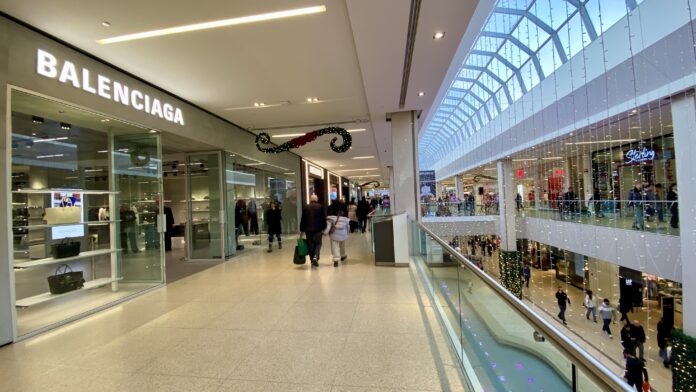
Balenciaga in Yorkville (Image: Dustin Fuhs)

As we write this, Ontario is experiencing a heat wave, prompting us to consider how summer might alter shopping patterns. Key questions on our minds include:

  • Will heat waves significantly affect traffic at shopping centres compared to Business Improvement Areas (BIAs)?
  • With the recent cut to interest rates, can we expect a resurgence in discretionary spending?
  • How will AI influence e-commerce shopping patterns, especially with on-device implementations coming to iPhones in the fall?
  • How have you prepared your retail business to navigate the uncertainties of summer?

Canadian Retail Sales by Product Category, Same Month Comparison

Sales for the Month of AprilApr-24Apr-23YOY
All Stores66,556,75564,838,3692.65%
Motor Vehicle and Parts Dealers19,692,41118,311,7557.54%
Gasoline Stations6,301,3266,182,9711.91%
All Stores Less Automotive40,563,01840,343,6430.54%
Food and Beverage Stores12,078,50412,389,336-2.51%
Supermarkets and Other Grocery Stores*8,653,6858,787,981-1.53%
Convenience Stores694,803735,682-5.56%
Specialty Food Stores800,001833,862-4.06%
Beer, Wine and Liquor Stores1,930,0152,031,810-5.01%
Health and Personal Care Stores5,575,2035,166,8027.90%
All Stores Less Automotive, Food, and Pharmacies22,909,31122,787,5050.53%
General Merchandise Stores8,861,9278,741,9231.37%
Furniture, Home Furnishings, Electronic and Appliance Stores3,363,1473,270,0262.85%
Furniture Stores1,134,4881,137,950-0.30%
Home Furnishings Stores702,863688,2732.12%
Electronics and Appliance Stores1,525,7961,443,8025.68%
Clothing and Accessories Stores3,185,5303,354,056-5.02%
Clothing Stores2,450,3422,564,162-4.44%
Shoe Stores394,868432,673-8.74%
Jewellery, Luggage and Leather Goods Stores340,320357,220-4.73%
Sporting Goods, Hobby, Book and Music Stores3,503,5683,611,297-2.98%
Building Material and Garden Equipment3,995,1393,810,2044.85%
Miscellaneous Store Retailers2,257,4002,286,383-1.27%
Cannabis Retailers428,555416,6032.87%

Canadian Ecommerce Sales

Ecommerce SalesApr-24Apr-23Percent Change
Year-to-Date13,915,73813,204,5105.39%
Year-Over-Year3,770,443  3,435,2439.76%

Canadian Retail Sales by Store Category, Year to Date Comparison

Year-to-Date, Ending AprilApr-24Apr-23YTD
All Stores242,605,245238,221,2501.84%
Motor Vehicle and Parts Dealers66,868,37665,277,1512.44%
Gasoline Stations24,262,52524,811,830-2.21%
All Stores Less Automotive151,474,344148,132,2692.26%
Food and Beverage Stores47,938,13647,012,8761.97%
Supermarkets and Other Grocery Stores*34,833,98733,853,3682.90%
Convenience Stores2,657,9442,709,431-1.90%
Specialty Food Stores3,148,0782,959,3616.38%
Beer, Wine and Liquor Stores7,298,1287,490,714-2.57%
Health and Personal Care Stores21,619,67120,223,4976.90%
All Stores Less Automotive, Food, and Pharmacies81,916,53780,895,8961.26%
General Merchandise Stores31,905,34830,084,9106.05%
Furniture, Home Furnishings, Electronic and Appliance Stores13,113,90213,178,842-0.49%
Furniture Stores4,270,6154,318,931-1.12%
Home Furnishings Stores2,530,5032,730,356-7.32%
Electronics and Appliance Stores6,312,7846,129,5532.99%
Clothing and Accessories Stores11,117,03311,365,203-2.18%
Clothing Stores8,586,7108,796,460-2.38%
Shoe Stores1,277,5551,311,192-2.57%
Jewellery, Luggage and Leather Goods Stores1,252,7671,257,550-0.38%
Sporting Goods, Hobby, Book and Music Stores13,056,14313,681,982-4.57%
Building Material and Garden Equipment12,724,11012,584,9591.11%
Miscellaneous Store Retailers8,438,2308,869,312-4.86%
Cannabis Retailers1,624,1691,598,6741.59%

Retail Trade, Canada, All Stores, by Geographic Regions

RegionYear-to-Date 2024Year-to-Date 20232024/2023
British Columbia33,221,22833,006,3220.65%
Vancouver16,889,20216,556,6282.01%
Alberta31,492,63831,413,1760.25%
Prairies*15,951,16915,654,7031.89%
Ontario90,821,72788,798,5602.28%
Toronto41,274,99740,811,3131.14%
Québec53,767,72752,880,5451.68%
Montréal26,907,95026,444,5831.75%
Atlantic Canada16,458,14315,636,1425.26%
Territories892,612831,8027.31%

Spending Increases at Canadian Grocers as Consumers Adjust to Rising Food Prices [Op-Ed]

Sobeys Nova Scotia (Image: Field Agent Canada)

On Friday, Statistics Canada reported a notable 1.7% increase in national food sales, marking the first growth observed since December 2023. This increase, though modest, is significant in the context of Canada’s growing population and persistent inflationary pressures. These factors are expected to drive food sales upward in dollar terms over time. Since mid-2021, food sales in Canada have exhibited a rollercoaster pattern, reflecting economic uncertainties and consumer hesitancies during the pandemic and post-pandemic periods. However, recent data suggests that consumers are beginning to adjust and overcome their fears of sticker shock.

Consumer behavior has shifted notably. Shoppers are now more willing to spend at grocery stores, a change from their previous tendency to save every penny for other rising expenses, such as housing and energy costs. This shift can be partially attributed to the normalization of higher interest rates, particularly for those with variable-rate debts and mortgages. However, approximately 40% of households with mortgages will face renewals within the next year, likely encountering higher payments that could reduce their disposable income for food and other necessities.

Food Basics Pape Ave (Image: Field Agent Canada)

Despite the current lack of sympathy for grocers, managing a consumer base that is increasingly frugal presents a significant challenge. Sobeys’ recent quarterly results provide some insight into this issue. The company’s sales amounted to $7.4 billion, remaining largely unchanged from the previous year. Same-store sales saw a slight decrease of 0.3%, but excluding fuel, same-store sales experienced a modest 0.2% increase. These figures suggest that while overall sales volume is stable, there is a nuanced shift in consumer purchasing behavior. Similar figures can be anticipated from Loblaw and Metro, although these companies might report slightly better performance due to their stronger portfolios of discount stores, which attract cost-conscious consumers more effectively than Sobeys.

In response to these challenges, Sobeys has strategically scaled back its e-commerce operations to optimize existing resources. They have paused plans for an e-commerce center in Vancouver and ended their partnership with the UK’s Ocado. This decision reflects a pragmatic approach to the changing market dynamics. Online total Canadian food sales, which peaked at 3.6% of all food sales in 2022 according to NIQ, have since declined. While Sobeys might not have anticipated this drop, they have navigated the challenges relatively well, considering the competition from Amazon, which continues to expand its footprint in the Canadian market. Sobeys’ decision to re-evaluate its e-commerce strategy underscores the difficulty of covering the last mile to reach consumers and highlights the logistical challenges of competing with a giant like Amazon.

Historically, profiting from online food sales has been difficult, and the current market conditions exacerbate these challenges. Today, consumers are increasingly diversifying their shopping habits to find the best deals, often visiting multiple stores rather than relying solely on online purchases. This behavior is driven by the desire to avoid delivery costs and take advantage of in-store promotions and discounts. Although online shopping might regain popularity in the future, this shift will take time as consumers balance convenience with cost savings.

Additionally, Statistics Canada has updated the Consumer Price Index (CPI) basket, increasing the food weighting to 16.72% from 16.13%. This adjustment reflects the growing importance of food expenditures in the average Canadian household budget. Notably, food consumed at restaurants accounted for almost 70% of this increase, indicating a significant shift in dining habits. On average, 35% of our food budget is now spent dining out, a substantial rise from previous years. This shift came at the expense of furnishings and equipment, which saw a significant decrease in their weight within the CPI basket.

In line with current trends, the relative weight of alcoholic beverages, tobacco products, and recreational cannabis has decreased from 4.47% to 4.17%, reflecting recent sales data. This decline suggests a change in consumer preferences and spending priorities, possibly influenced by economic pressures and health considerations.

The Canadian food market is undergoing significant changes, as evidenced by recent reports from both Statistics Canada and Sobeys. The landscape in 2024 is markedly different from 2023 and 2022, reflecting evolving consumer behaviors, economic pressures, and strategic adjustments by major retailers. As consumers continue to navigate these changes, the food industry will need to adapt to meet new demands and challenges, ensuring sustainability and competitiveness in an increasingly dynamic market.

Anatomy of a Leader: Gary Lenett, Co-Founder of DUER

Anatomy of a Leader: Gary Lenett, Co-Founder of DUER

Although Gary Lenett has a varied background in teaching and law, he is now known as a “jeaner” as designing and making jeanswear and casual apparel has been his singular focus for most of the last 30 years.

Lenett, Co-Founder of DUER, was born and raised in Vancouver. He’s fourth generation Vancouver.

He has a Bachelor of Arts from Simon Fraser University and a Bachelor of Laws from the University of Windsor and the University of British Columbia. 

“I have a teaching certificate and a law degree – none of which relates to what I currently do,” he said.

“I just missed the late 60s but I was always interested in ‘saving the world’ when I was a young man. I was really interested in the concept of teaching and what teachers can do to just make the world a better place. But I figured out quite quickly that it was difficult fighting the system to make much change. Then I thought I’ll make the change through law and I went back to law school. I thought I would be a civil rights lawyer at the time. 

“By the time I got out of law school, I realized as I started working as a lawyer that I really had this entrepreneurial gene. So it took over.”

Gary Lenett (Image: Britney Gill / DUER)

Leading up to the inception of DUER, Lenett said he was privileged to make jeans for many of the best known names in the industry including Levi Strauss, Guess Jeans, The Gap, Lee, Wrangler, Eddie Bauer, The Limited/Express, Ralph Lauren (Polo), Nordstroms, Banana Republic, Nike (Michael Jordan), Lululemon (Ococco), Harley Davidson, and more.

He has also held major North American denim licences and built a number of his own denim brands, including International Denim (ID Wear), Dish Denim, DRT Jeans, and DUER.

Lenett said DUER is reinventing the jeans category with fabric that has five times more stretch and is 30 per cent lighter and stronger than traditional denim. 

The transition from being a lawyer to entrepreneurship was a combination of different factors.

“As a practicing lawyer I was quite fortunate as I developed my own practice quite quickly because I’m sort of half creative. I’m probably naturally more of a creative than a lawyer so having that I found it  really lent itself well to working with young entrepreneurs. So built up a nice practice of people and helping them build their businesses,” said Lenett.

“Then at a certain point my brother phoned me. When I went to law school my father had a small, very cottage, clothing business. He was a manufacturer at the time of leather goods and I begged my younger brother to go into the business because I didn’t want to. I wanted to go to law school. So he did. I went to law school, I came out, I practiced. Ten years later he phoned me and said ‘hey you got me into this business, I need some help for a year’.

“So I took a one-year sabbatical to go help him. I already started to recognize that I have this entrepreneurial gene because I was working with entrepreneurs and really enjoying it . . .  One year became two and I never went back.”

Gary Lenett (Image: Britney Gill / DUER)

Lenett has created five different brands during his career. That is his love and passion.

“This business gets in your blood . . . This is really high intensity. You get immediate feedback and once it gets in your blood it’s hard to do anything else,” he said.

DUER has been his singular focus for the last 10 years. The retail brand will be opening its newest location in Ottawa at the end of June. 

“In terms of the brand values and just the stage in my career, it’s such a privilege to be doing this at the end of my career. I was 56 when I started this. I’m 66 now and to be able to do this and be able to use my experience, having fun and learning at this age is so much fun,” said Lenett.

So will this be his last brand?

“This is it,” he said.

“I’ve always been fascinated. I call them love marks. Even when I was a young man, as a teenager, I was always fascinated on why do I gravitate, why am I buying (something) . . . To me it’s a combination of literally the design aspects because I am attuned to design, I like well-designed product but also the brand values.

“I talk a fair amount to industry people about the difference in our industry between a label and a brand. You run a label and it’s usually trend driven and it comes and goes. There’s sort of a typical cycle in developing a label . . .  Enduring brands as opposed to labels are built on a foundation of values. The design can change over time but the values don’t change.”

DUER on Ossington Avenue in Toronto (Image: Dustin Fuhs)

Brands are powerful. People will pay more for the same product if a well-known and well-respected brand is attached to that product.

“I’m not a pure creative. I consider myself a merchant. I understand my customer and the psychographics of my customer. I’m not interested in putting out cheap trend driven stuff that’s going to be thrown into landfills. I want customers to really appreciate what we do. I’ve always been on the mid to high end of the market but to get people to put out $130, $140 or $150 for a pair of jeans where they can go to Costco and buy them for $12, it’s got to represent something more than just the fabric. It has to mean something more. And figuring out that puzzle is just fascinating to me.”

As a leader, Lenett aspires to be a transformational leader which means he likes to think he can make people the best versions of themselves. He’s collaborative and his motto with every single enterprise he’s ever run is personal growth drives to organizational growth. 

“I’m the entrepreneur. I have the concept . . . I believe in developing people and just trying to be a transformational leader.”

Outside of work, he’s always been someone who values experiences more than things. Health and fitness is very important to him and he’s very dedicated to getting outside every day. 

“My father got seriously ill very young in life and so it’s always been a big driver of mine to stay healthy and healthy in all the realms. Not just physical but emotional. Work, family and exercise. I have a very fulfilling life in that way,” said Lenett.

Peavey Industries Ends Relationship with ACE Hardware in Canada

ACE Hardware Canada (Image: ACE Hardware)

Retailer Peavey Industries LP announced Thursday it is ending its relationship with ACE Hardware International on December 31, marking the end of the ACE Canada banner under Peavey Industries LP.

“This decision underscores the growth trajectory that ACE Canada has experienced, evolving from Peavey Industries LP’s acquisition of the ACE Canada master license from Lowe’s in 2020,” said Peavey in a statement.

This period has been filled with shared aspirations for growth and a steadfast commitment to supporting local Canadian-owned retail. Over the past few years, the retail landscape has faced numerous challenges, including the global pandemic, supply chain disruptions, inflation-induced consumer behaviour changes, and increased operational costs, particularly in smaller, remote markets.

“These factors have prompted a strategic reevaluation by Peavey Industries LP leading to the decision to end our relationship with Ace Hardware International.”

Buck Lake Ace Hardware (Image: Google)

Peavey said it is incredibly proud of the accomplishments achieved in partnership with employees, dealers, vendors, and industry partners.

“This decision reflects a broader necessity to adapt to the evolving retail environment, ensuring continued support for future growth and stability. We express our deepest gratitude to everyone who has been part of the ACE Canada story. Your dedication, resilience, and commitment to excellence have significantly contributed to Canadian retail.

“As we move forward, Peavey Industries LP is committed to supporting our stakeholders. We pledge to maintain open communication and provide assistance and guidance to all affected parties. This moment is also an opportunity to reflect on the importance of supporting Canadian retail, particularly the small retailers and local communities that are the backbone of our economy. Peavey Industries LP remains dedicated to fostering a vibrant, diverse, and sustainable retail landscape in Canada.”

Peavey Mart is a farm and ranch retail banner in Canada offering a unique selection of agriculture, farm and ranch, pet, work wear, lawn and garden, hardware and homesteading supplies for those who enjoy a down-to-earth rural lifestyle. It is 100 per cent Canadian and employee owned.

It has  90 stores across Canada from British Columbia to Nova Scotia ranging in size from 10,000-48,000 square feet.

Peavey Mart Hyde Park (Image: Peavey Industries)

In March 2020, Peavey Industries announced the acquisition of Ace Canada to its retail family.

At the time, the Ace Canada brand consisted of 107 stores under Ace Hardware, Ace Country & Garden or Ace Building Centre banners.

“Ace Canada is a natural extension to Peavey Industries for a number of reasons: we relate strongly to their dedication to ‘local and loyal’, we appreciate their commitment to providing value to customers and we mirror their devotion to excellence in customer service. Also, it is a great opportunity for us to serve new markets with the addition of this great brand,” said Doug Anderson, President and CEO of Peavey Industries.

Currently, 95 Ace Hardware Canada locations are operated under the Peavey Industries umbrella – 92 Ace Canada dealers and three corporate Ace Canada locations owned by Peavey.

The corporate-owned locations will be converted to Peavey’s MainStreet Hardware brand, said Jest Sidloski, VP Marketing & Customer Experience, Peavey Industries LP.

No new Ace Canada locations are slated to open in 2024.

A new Peavey Mart location in Steinbach, Manitoba opened in March 2024, but Sidloski said there are no further plans to open more Peavey Mart stores this year.

Image: Peavey Mart

The Peavey Industries LP home office is located in Red Deer, Alberta and includes 180,000 square feet of distribution centre space.

The company’s roots go back to 1967 when it started as National Farmway, a chain of “super farm markets” whose first location opened in Dawson Creek, BC.

By 1975, the chain became known as Peavey Mart, a subsidiary of Peavey Company of Minneapolis.

In 1984, the company returned to Canadian ownership.

In 2017, Peavey Industries LP acquired the TSC Stores banner, based in London, Ontario with stores operating in Ontario and Manitoba.

In spring of 2021, the final conversion of all TSC Stores to Peavey Mart took place.

Image: Peavey Mart
Ace Hardware Barrhead (Image: Google)

According to its website, Ace Hardware has over 5,000 stores around the world with the majority of those stores independently owned and operated by local entrepreneurs.

“Ace stores come in all sizes and shapes based on the needs of each individual neighborhood. We have small, urban stores, large rural stores and everything in between. Ace stores offer a wide variety of paint, lawn and garden, tools, local niche services and virtually anything you’ll ever need to fix, repair and maintain your home,” it said.

“Founded in 1924 by a small group of Chicago hardware store owners, Ace changed the retail landscape by allowing individual stores to purchase merchandise in bulk to save money and buy at the lowest possible price. This partnership enabled even the smaller stores to compete effectively at retail despite larger stores in their market. And to this very day, Ace Hardware Corporation is still owned solely and exclusively by the local Ace retail entrepreneurs.”

Moxies Unveils New Design Prototype with Edmonton Flagship, Plans North American Expansion [Interview]

Moxies at South Edmonton Common (Image: Moxies)

Moxies has recently opened its fourth location in Edmonton and has plans to open between 15 to 18 stores within the next three years. Under a new design concept, the new Edmonton location will serve as a flagship restaurant, which will be copied to existing and new locations moving forward. 

Joanne Forrester

“We are thrilled to bring a stylish setting and easy sophistication to the Edmonton market, and to continue to deliver on what we are known for across the brand – exceptional hospitality and unforgettable dining experiences. Our expansion plans reflect our commitment to growth and innovation, aiming to open 15 to 18 new locations over the next three years and renovate existing ones to align with our modern design aesthetic,” says Joanne Forrester, President and COO at Moxies. 

“Bright and refreshing interior” 

Moxies at South Edmonton Common (Image: Moxies)

The new location is in South Edmonton Common and consumers can expect an elevated dining experience with its new designs. Compared to other locations, this restaurant has a brighter and refreshing interior with indoor greenery, neutral colours, and gold accents. 

The restaurant, which is 8,200 square feet, seats 290 people and includes several dining areas, a lounge, a bar, an all-season patio, and the space can host private events for up to 100 people. The new concept does not only enhance its look, but also enhances comfort and function. 

“Our new South Edmonton Common location is a flagship for Moxies, showcasing our commitment to a modern, upscale dining experience. This location is truly special because it integrates our brand’s new design aesthetic with practical functionality and is designed to provide an exceptional dining experience whether you are here for a casual meal, a special event, or just to enjoy a drink on the patio.” 

Spreading roots: Moxies growth plans 

Over the next three years, Forrester says the company is planning on opening between 15 to 18 new locations across North America. While one-third of these new locations will be in Canada, focusing on areas in Ontario and Vancouver, a majority of these locations will be in the United States. 

“We are excited to expand our footprint across North America. Our focus is on securing real estate and creating flagship locations that embody our new design aesthetic. We are targeting premium locations, with a mix of one-third in Canada, focusing on Ontario and Vancouver, and two-thirds in the United States. We are aiming to offer upscale buildings with modern designs, ensuring each new restaurant provides an exceptional dining experience and enhances the local community.” 

Moxies at South Edmonton Common (Image: Moxies)

Forrester says Moxies will be searching for locations that offer high visibility, accessibility, in busy retail spots, and locations that offer a patio: “Having a patio is a key element for us as it enhances the dining experience and aligns with our brand’s focus on creating inviting and versatile spaces.” 

Along with its prime targets, Forrester says Moxies is interested in entering new markets such as Charlottetown and Fredericton and will also be opening a flagship location in Calgary which already has four locations. 

Fresh looks: Moxies makeover 

As Moxies has a new design, it will be renovating locations across Canada to reflect the new concept. The renovation plans are taking place now and will be for the next two and a half years. 

“Our goal is to renovate all of our locations to our new look over the next two and a half years. We have already started with several key locations, including Vaughan, Ottawa, Calgary, Prince George, and Toronto and we are excited to reopen our Regina location in September after a full gut renovation.” 

Just like the new Edmonton location, consumers can expect a more modern, bright, and inviting environment with the renovations as it will feature updated interiors and new design elements such as indoor greenery and a variety of dining spaces. Forrester says the updated look and feel are expected to attract more guests and improve loyalty by providing “exceptional and contemporary dining experiences across all Moxies locations.” 

“For me, the goal is that there is not a bad seat in the house. Everywhere you sit in our restaurant has some interesting feature, whether it is through local artwork, views, or the overall ambiance. It is also about creating a more open and inviting floor plan, with flexible seating for large groups, handcrafted food made daily in-house, and an overall experience that meets and exceeds guests expectations.” 

Moxies Langley (Image: Moxies)

To keep up on trends in the kitchen, Forrester says Moxies uses its two test kitchens to innovate new food and beverage options and the company also organizes culinary tours and looks globally for inspiration to keep the menu fresh and exciting. The restaurant also will continue to evolve and innovate by actively listening to guests. 

“We are always inspired by global trends and what is happening in the marketplace. By running contests, organizing culinary tours, and utilizing our test kitchens, we ensure our menu stays fresh and exciting. Listening to our guests is key to our innovation strategy and we are committed to exceeding expectations with every visit.” 

STOR-X Expands Retail Operations with New Calgary Showroom Showcasing Custom Storage Solutions [Interview/Photos]

STOR-X Calgary (Image: Mario Toneguzzi)

STOR-X, which is a brand dedicated to helping people visualize and experience custom storage solutions tailored to their needs, has launched a new showroom in Calgary.

Wolf Nickel

Wolf Nickel, founder of STOR-X, said the Richmond, B.C.-based company began in 1989 under a different company name. It was initially a manufacturer in Vancouver, selling closet organizers primarily.

“That grew in Vancouver for about 10 years and then we sort of switched our model to an exporting model. So we shipped a lot and learned a lot about shipping and we primarily exported to the USA. We had some other accounts in Japan and the Bahamas but primarily we learned the business of shipping and packaging and all of that for our product line,” said Nickel.

“Then in 2010, right after the crash in 2008 that happened in the U.S., it forced us to look around and figure out what we wanted to do with the business so we decided to give franchising a try so that’s what we’ve been doing since then.”

STOR-X Calgary (Image: Mario Toneguzzi)

Sharon Cohen has successfully run the business in Calgary as a franchise owner for the past 10 years. The opening of a new showroom offers a hands-on opportunity for those facing storage challenges to explore and envision more organized, livable spaces in their homes.

The new Calgary STOR-X Showroom – located between Blackfoot Trail and 46th Avenue SE – caters to both residential and commercial clients, enabling them to visualize their ideal solutions and find the perfect fit for their needs.

“Essentially we’re a home organization company so anywhere that you need basically case goods to organize your home we are there. We started as a closet organizer company but we’ve branched out to all areas of the home. We’ll do pantries, home offices, garages. In the last few years we’ve started with kitchens,” said Nickel, adding that all the product is manufactured in the company’s headquarters in Richmond, B.C.

STOR-X Calgary (Image: Mario Toneguzzi)

Nickel said the company has showrooms in Calgary, Kelowna, Vancouver, Regina and opening a second one in Richmond.

The first showroom opened when the company started franchising.

“Most of our franchisees start as sort of a man in a van with a plan. They’re owner-operators. They learn the business. It takes them a little while to get their feet wet and understand the scope of it. Eventually when they develop their business and they grow, they have to invest in a facility like this (showroom) and the effort it takes to build this. This just leads to more and more business and so it’s sort of an evolution that our franchisees take over the course. Some of them are doing it over a shorter period of time. Some of them it takes a little bit longer,” explained Nickel.

Cohen said he previously had a locksmith business prior to becoming a STOR-X franchise owner. 

“For almost 10 years, I worked without a showroom,” said Cohen, adding it gives clients a place where they can visualize and touch and feel possibilities for their homes.

STOR-X has local owners in 19 territories.

Groupe Dynamite Leverages Manhattan Active® Omni to Deliver Seamless and Connected Shopping Experience [Interview]

Image: Garage

Montreal-based retailer Groupe Dynamite, with fashion brands Dynamite and Garage, has partnered with Manhattan Associates to make the North American retailer an omnichannel commerce powerhouse. 

Groupe Dynamite Inc. (GDI) is leveraging Manhattan Active® Omni’s broad functionality to significantly reduce ship times, inventory levels, and customer call times while also improving sales, profits, and customer loyalty and satisfaction for its nearly 300 female fashion stores across North America.

Dave Stevens

“By adopting Manhattan Active Omni and embracing Manhattan’s Unified Commerce vision, we are able to give our customers the modern and personalized shopping experience they require and the outstanding results speak for themselves,” said Dave Stevens, Chief Technology Officer for Groupe Dynamite Inc.”

Groupe Dynamite has leveraged Manhattan Active® Point of Sale to turn their stores into omnichannel sales hubs. The solution’s endless aisle capabilities has saved sales in out-of-stock situations, improving the retailer’s store conversion rate creating a positive impact on their second half selling.

With just one distribution center in Montreal and a growing U.S. presence, GDI employed Manhattan Active® Store Inventory & Fulfillment to transform their nearly 300 stores into reliable and scalable fulfillment points. Exposing store inventory to online demand helped GDI significantly reduce store transfers, delivery times and shipping costs all contributing to improved margin. 

Image: Groupe Dynamite

Today, the retailer fulfills the majority of its online orders from its stores. Using Manhattan’s solutions, the retailer is able to ship orders to customers in just 23 hours on average, much faster than the 3.307 day industry average.

“GDI is at the forefront of providing their customers with a seamless and frictionless omnichannel shopping experience,” said Stewart Gantt, executive vice president, services at Manhattan Associates. “The GDI/Manhattan partnership goes far beyond the typical software developer/customer relationship. These two industry leaders have pushed each other to build and deploy one of the industry’s most advanced and effective omnichannel commerce solutions.”

Groupe Dynamite Inc (GDI) is a privately held house of integrated omni-channel brands, designing and distributing accessible, trend-forward fashion for women since 1975. The organization’s mission of “Empowering YOU be YOU, one outfit at a time” is brought to life through the Garage and Dynamite banners, and represents the consumer-centric core of GDI’s long-standing success as a leading retailer in North America. Today, GDI operates nearly 300 stores across the United States and Canada, as well as shoppable brand experiences at Garageclothing.com and Dynamiteclothing.com.

Stevens said the retailer has made an aggressive push over the past few years with the opening of about 20 new stores each year in the United States. 

The Garage brand is targeted towards a Gen Z audience while the Dynamite brand offers more elevated styles focused around the Millennial female demographic. The Garage brand is the retailer’s primary brand in the U.S.

Of the total stores for the retailer, there’s 189 located in Canada. There’s 107 Garage stores in Canada and 82 Dynamite stores. In the U.S., the vast majority of stores are Garage.

Stevens said Groupe Dynamite started its partnership with Manhattan in about 2014 as a Warehouse Management System (WMS) client but over the years the retailer was looking at ways to improve operations and the next phase was moving to the Manhattan Active® Omni Order Management platform.

“One of the advantages of going with Manhattan was building into the Manhattan ecosystem and leveraging it because it’s already connected and allows us to ramp up fairly quickly,” said Stevens.

In 2019, Groupe Dynamite also added the POS system with Manhattan. All the stores across North America are now tied into the Manhattan ecosystem with WMS (Warehouse Management System), OMS (Order Management System), and POS (Point of Sale).

“We’re a customer centric organization and I know a lot of retailers probably say that, but we live and breathe it every day, from the top down. We constantly focus on how we can improve the experience for our customers whether they’re shopping online or shopping in one of our stores,” said Stevens.

“We want to make sure that the product is always available and we get the product to our customer as quickly as possible. To accomplish this, we’ve leveraged the Manhattan order management system to turn each one of our nearly 300 stores into a small distribution warehouse – a micro fulfillment center. So we can fulfill an order from every single store in our chain. 

“Owing to our partnership with Manhattan we’ve significantly improved our customer’s satisfaction (NPS – Net Promoter Score). Our customer satisfaction NPS rating since we’ve been using Manhattan Active Omni has increased by 20 points. We’ve also been able to deliver orders to the customer in under two days.”

Stevens said the partnership has allowed the retailer to significantly reduce shipping and fulfillment costs while the customer experience has improved which increases return visits and overall improves the retailer’s bottom line.

Today, 60 percent of the retailer’s ecommerce orders are being shipped from a store as opposed to from a warehouse.

“We see the cost savings whether it’s in Canada or whether it’s in the U.S. because of the proximity to the customer, and ultimately the customer is getting their purchase that much sooner,” said Stevens.

Manhattan Associates, based in Atlanta, is a global technology leader in supply chain and omnichannel commerce. It unites information across the enterprise, converging front-end sales with back-end supply chain execution. Its software, platform technology and unmatched experience help drive both top-line growth and bottom-line profitability for its customers.

Manhattan designs, builds and delivers leading edge cloud solutions so that across the store, through its network or from its fulfilment center, businesses are ready to reap the rewards of the omnichannel marketplace. For more information, visit www.manh.com.

Kevin Bass

Kevin Bass, VP of Professional Services with Manhattan Associates, said the company focuses on continuing to evolve its already leading cloud native solutions through close partnerships with companies like Groupe Dynamite by releasing new innovation each quarter while also allowing the extensibility for customer specific needs.

“We focus on our customers and our customer’s customer – adopting a B2B2C approach – whether the end user journey requires a world class warehouse management system or a world class omnichannel commerce solution inclusive of order management and point of sale seamlessly working together to improve the customer experience,” said Bass.

“We have more than 4,000 associates who wake up every day to deliver the latest expertise in supply chain commerce to our customers.”


*Partner content. To work with Retail Insider, email Craig Patterson at: craig@retail-insider.com

Denim with a Conscience: Bayeas Pioneers Sustainable and Inclusive Denim Production

Once notorious for its narrow beauty standards and environmental toll, the fashion industry is transforming. A growing cohort of conscious consumers is demanding clothing that reflects their values, prioritizing inclusivity and sustainability. A study by McKinsey & Company found that nearly two-thirds of global consumers are now willing to pay a premium for sustainable products. In this evolving landscape, Bayeas, a rising denim brand, aims to make waves for its stylish offerings and unwavering commitment to inclusivity and sustainability.

Gone are the days of a limited selection of denim fits. Bayeas recognizes and caters to this trend by offering a diverse selection of fits, rises, washes, and styles. Their motto? “One size does not fit all,” ensuring a perfect pair for everyone.

 Their collection consists of various fits, rises, washes, and styles, ensuring a perfect pair of jeans for everyone. Whether you prefer a classic straight-leg cut, a trendy mom jean, or a flattering high-waisted flare, Bayeas empowers individuals to express themselves confidently through denim.

Established in the 1990s, this family-owned denim brand has consistently set itself apart by crafting high-quality denim that caters to all body types while embracing sustainable practices. As the fashion industry faces increasing scrutiny over its environmental impact, Bayeas seeks to emerge as a leader in sustainable denim production, setting new standards for transparency, eco-consciousness, and inclusivity.

This approach aligns with the broader movement in fashion towards body positivity and inclusivity, reflecting a significant societal shift where diversity in fashion is appreciated and expected.

Consumers today are more environmentally conscious than ever before, demanding clothing brands that prioritize ethical and sustainable practices throughout their production cycles. Bayeas answers this call by integrating eco-friendly materials and responsible manufacturing processes into their operations. This commitment goes beyond using recycled materials; it encompasses minimizing waste and reducing the industry’s environmental footprint.

Transparency is becoming a non-negotiable for consumers who want to make informed purchase choices. Bayeas addresses this demand and allows customers to trace the journey of their jeans from fabric to finish. This initiative builds trust and ensures the production process aligns with the brand’s ethical and sustainable values.

The fashion industry is witnessing a paradigm shift. With increasing awareness about climate change and social justice, brands like Bayeas prioritizing sustainability and inclusivity are more relevant than ever. The demand for eco-conscious clothing is not just a trend but a reflection of a more significant movement towards responsible consumerism. The rise of social media has amplified consumer voices, holding brands accountable for their practices. Transparency, once a bonus, is now a requirement. Bayeas, the next-gen denim brand, seeks to provide traceability and detailed production information to meet these evolving expectations.

To learn more about Bayeas and explore their latest collections, visit Bayeas: Shop Denim Jeans Online.