With over 110 Donor Welcome Centres nationwide, The Salvation Army Thrift Store is calling for household item donations to support increasing demand in communities across Canada. (CNW Group/The Salvation Army Thrift Store – National Recycling Operations)
The Salvation Army Thrift Store in Canada is calling for increased donations as economic uncertainty continues to affect Canadians, driving up demand for affordable clothing and household goods.
To address this growing need, the organization said it is launching its second annual ‘No One’s Home Should Be Empty’ campaign this October.
Ted Troughton, Managing Director of The Salvation Army Thrift Store
“While clothing donations are always appreciated, household items are especially in high demand right now,” said Ted Troughton, Managing Director of The Salvation Army Thrift Store. “We’re encouraging people to look around their homes—whether it’s cupboards, basements, garages or storage lockers—and donate gently used household items like kitchenware, small appliances, and home décor that they no longer need.
“We rely on the generosity of Canadians to help us continue making a positive impact in your communities. Together, we can ensure that no one’s home is empty, and everyone has the opportunity to access what they need.”
It has also expanded its efforts by partnering with businesses and community groups to host donation drives and increase engagement with corporate donors.
“These initiatives are part of a broader strategy to ensure that thrift stores remain stocked with quality products and to continue supporting Salvation Army programs through store-generated funds,” it said.
When individuals donate or shop at a Salvation Army Thrift Store, they make a real difference by supporting life-changing programs like food banks, shelters, and emergency disaster relief services—all while promoting sustainability by giving items a second life, said the non-profit organization.
There are 94 Thrift Stores across Canada and they diverted over 94 million pounds of items from landfills last year.
Founded by former firefighters, the chain known for its hot and hearty subs unveils the exciting sponsorship just as doors are set to open at three new restaurants in downtown Toronto, said the brand in a news release.
Firehouse Subs® has become the Official Sub Partner of the Toronto Maple Leafs®. (CNW Group/Firehouse Subs)
Sam Gallant, General Manager, Firehouse Subs Canada
“We are excited to continue growing our footprint with these new restaurants, conveniently located in the heart of downtown Toronto,” said Sam Gallant, General Manager, Firehouse Subs Canada. “And we’re delighted to be entering this market as the new official sub partner of the Maple Leafs after over 30 years.”
Jordan Vader, Senior Vice President, Global Partnerships, MLSE
“We are thrilled to announce our partnership with Firehouse Subs – a growing sub chain in Canada,” said Jordan Vader, Senior Vice President, Global Partnerships, MLSE. “While hockey fans gear up for an exciting Maple Leafs home opener this weekend, we look forward to collaborating with (the brand) all season long and engaging fans in our local community.”
In 2015, the company expanded into Canada with its first locally-owned franchise restaurant in Oshawa. Since then, the brand has grown across Ontario, British Columbia, Alberta, Manitoba and Saskatchewan, with its first restaurant opening in New Brunswick later this year. The brand has more than 85 restaurants in Canada with aspirations to continue growing. The new downtown Toronto locations can be found at:
501 Yonge St, Toronto, ON M4Y 0G8
440 Bathurst St, Toronto, ON M5T 2S6
1221 King St W, Toronto, ON M6K 1G3
The heart of the brand is the Firehouse Subs Public Safety Foundation of Canada, which has awarded more than $3.7 million in lifesaving equipment to first responders and public safety organizations.
“As the brand continues to grow, so do the funds raised for the Foundation, allowing it to accomplish its mission of providing lifesaving equipment to first responders,” it said.
Circular economy can protect natural environment, stimulate economic growth, build community, and reduce waste and carbon emissions. Photo: Circular Innovation Council
In celebration of October being Circular Economy Month, Circular Innovation Council has announced a new Take Action Pledge, encouraging Canadians to get involved in the transition towards a circular economy through individual action, events, educational resources and social media.
Led by Circular Innovation Council with support from its Champion Partners CSA Group, Alberta Beverage Container Recycling Corporation, and additional partners from across Canada, the Council said Circular Economy Month is an annual invitation for Canadian governments, businesses, schools, and individuals to promote circular living and celebrate our individual and collective actions, commitments, and achievements towards a sustainable future. Each week during October features a different theme to educate and encourage understanding of various aspects of the circular economy and its benefits.
Jo-Anne St. Godard, Executive Director of Circular Innovation Council
“For Canada to reach its net-zero climate targets by 2050, we need to rethink the way we look at climate change and break away from our current take-make-waste model of consumption,” said Jo-Anne St. Godard, Executive Director of Circular Innovation Council in a news release. “Meeting Canada’s climate change commitments and economic goals requires big system changes actioned by all parts of our society. Circular Economy Month is designed to educate and engage all Canadians, whether through their work, at home or in their communities, to take action in their everyday choices.”
New Pledge Launched to Promote Individual Action
While Circular Economy Month continues its past efforts to encourage and educate businesses and governments to implement change, individual action is also required—every change matters, no matter how large or small. To preserve a livable climate, the United Nations estimates each person will need to reduce their average annual carbon emissions from 6.3 tonnes (2020) to 2.1 tonnes by 2030, said the Council in a news release.
Canadians can take the Circular Economy Month pledge, committing to one or more actions to reduce their environmental footprint, save money, and support their local community. Individuals who pledge between October 1st-31st will be entered into a draw for a chance to win prizes, including gift cards and circular products.
“Our goal is to change perspectives on the way we make and use products, materials, and food, and how small actions can lead to big impact,” said St. Godard. “This month—and throughout the year—we encourage Canadians to take action themselves to see how circular solutions protect our natural environment, stimulate economic growth, build community, and reduce waste and carbon emissions.”
Additional ways to get involved
Plan or attend a circular event like a repair café, conference, clothing swap, or recycling drive.
Governments: officially declare the month of October as Circular Economy Month.
Find informative resources about circular economy in the resource directory.
The Circular Opportunity – Facts and Stats
In Canada, the value retention processing market (VRP; i.e. reuse, repair, refurbishment) generates approximately $56 billion annually and support more than 371,000 direct jobs. Each year, VRPs prevent approximately 1.6 million tonnes of carbon dioxide equivalent (CO2e) from entering the atmosphere, and avoid the use of 470 kilotonnes (kt) of virgin materials.
Canadian small business owners have a renewed sense of optimism. Photo: Ron Lach
New data from American Express Canada reveals that Canadian small business owners are entering the last months of the year with a renewed sense of optimism.
The report said 81 per cent small business owners (SBOs) feel that they’re on track to meet their 2024 financial goals, driven largely by improved cash flow health (80 per cent), the introduction of new products and services (71 per cent), and greater access to working capital (65 per cent).
Additionally, 77 per cent of SBOs expect to see an increase in sales this Q4 compared to last year. Another 67 per centreport their business’ performance in Q4 will determine whether they meet their financial goals this year, further underscoring the criticality of this time of year.
Other survey highlights include:
84 per cent of SBOs feel that they’re prepared to handle an uptick in business in Q4;
64 per cent agree Q4 is typically the busiest time of year for their business;
54 per cent typically do most of their business spending/capital injection into their business in Q4; and
51 per cent plan to increase their social media marketing to set their business up for success in Q4.
Phanikar Yenamandra, VP of Customer Engagement at American Express
“Two of the most important factors are access to working capital and the overall stability of cash flow,” he said.
“Amex survey data shows that 80 per cent of small business owners report improved cash flow health this year, while 65 per cent have greater access to working capital. These figures indicate that Canadian small businesses are benefiting from enhanced financial flexibility in 2024. This flexibility allows them to adapt quickly to changing circumstances, manage unexpected expenses, and seize new growth opportunities—critical factors in staying on track with financial goals.
“One thing we can point to specifically is the strong support small businesses are receiving from Canadian consumers, especially during the holiday season. According to our latest Amex Trendex report, which tracks trends in social behavior, gifting, and travel, 57 per cent of consumers plan to shop at small businesses for holiday gifts this year, and nearly two-thirds prefer to receive gifts from small businesses.
“While this support is felt year-round, it becomes especially pronounced during the holidays when the sense of community and giving back is top of mind. The desire to shop local has grown significantly, particularly since the pandemic, as consumers have become more intentional about supporting small businesses.”
Key drivers for optimism
Yenamandra said key drivers of this optimism are improved cash flow and increased access to working capital.
“Reliable and consistent cash flow has long been a major concern for small businesses, and the current environment—where many owners feel more confident in their ability to manage daily operations, absorb unexpected costs, and fund growth—has naturally boosted their outlook,” he said.
“These improvements give owners the confidence to focus on growth rather than survival, which has undoubtedly contributed to their optimism for the months ahead.
“Part of our survey looked at small business owners’ plans for 2025 and beyond, and it’s clear from the data that they’re taking this optimistic outlook with them into the new year. In fact, close to half of small business owners feel confident in their ability to grow their businesses in the year ahead with plans to grow their online presence specifically. This shows that small business owners are not only feeling encouraged to end the year on a high note but are hoping to actualize even more of their business goals in 2025.
“While the current economic environment presents challenges, what continues to impress me is the resilience of small business owners. They have faced adversity before, and they’ve shown time and again that they can weather tough circumstances. The optimism we’re seeing now is rooted in their unwavering commitment to growth and their ability to adapt, no matter what external pressures they face. For many small business owners, the focus remains on delivering value to their customers, and this resilience, coupled with financial flexibility, is what enables them to navigate even the most challenging economic landscapes.”
Gen Z and Millennials defy affordability concerns. Photo: RDNE Stock project
Canadian retailers can expect a spending surge during the 2024 holiday season driven by younger shoppers, according to a recent survey by PwC Canada.
The PwC Canadian Holiday Outlook Survey found that Gen Z and Millennial shoppers are poised to outspend older Canadians. Gen Z and Millennials plan to spend an average of $2,296 and $2,233 respectively this holiday season – increases of 55 per cent and 51 per cent over last year.
Elisa Swern, National Retail and Consumer Leader at PwC Canada
“Retailers across Canada are poised to benefit from a clear spending surge from younger Canadians this holiday season, despite the affordability challenges that make headlines every day,” said Elisa Swern, National Retail and Consumer Leader at PwC Canada in a news release. “If they adapt their business strategies to align with these shoppers’ values and buying preferences, such as prioritizing quality and sustainability, and embracing digital payment platforms, retailers are poised to capitalize on the spending plans of these younger shoppers.”
The report said growing disposable income with Gen Z’s entry into the workplace and Millennials advancing in their careers is resulting in a boost in spending on gifts, travel, and entertainment.
“In sharp contrast, Gen X and Baby Boomers are cutting their spending this holiday season. The more cautious approach from older Canadians is leading to decreased spending across all categories, with expected holiday spending for these generations averaging $1,766 and $1,412 respectively – down 11 per cent and nine per cent from last year.
PwC said that on average, Canadians estimate that they will spend $1,853 on gifts, travel and entertainment this holiday season, a 13 per cent increase over last year.
“Not surprisingly, Canadians are thinking more positively about the economy as inflation and interest rates decline: 65 per cent believe the economy will stabilize or improve over the coming months, up from 48 per cent a year ago,” added the report.
“While many Canadians expect to spend more this year, they don’t necessarily have the cash to do so. 31 per cent of Canadians said they would dip into their savings.”
The survey also reveals key trends that businesses should consider this holiday season:
Loyalty Perks: Many Millennials, Gen X and baby boomers said they’d switch to brands that offer more compelling loyalty program perks to get more value for their money—a finding that underscores the importance for retailers and consumer goods companies to explore what differentiates their loyalty program from competitors. But loyalty programs don’t appeal as much to Gen Z consumers who instead look to make their money go further by buying higher-quality items, use retail financing options, and buy second-hand items;
Tangible Gifts Triumph: While older generations prioritize gift cards, Gen Z prefers giving physical items. This preference for tangible gifts reflects a desire for personal connection and thoughtfulness in gift-giving. Popular choices include apparel, cosmetics, toys, and alcohol;
Digital Payment Preference: Embracing their digital native status, Gen Z consumers are leading the charge in using digital payment methods like PayPal (44 per cent compared to 31 per cent overall), Apple Pay and Android Pay (35 per cent compared to 14 per cent), and buy now, pay later platforms (11 per cent compared to five per cent);
Early Shopping: Gen Z shoppers are more likely than their older counterparts to complete their shopping early. 21 per cent of Gen Z respondents say they plan to complete most of their shopping before Thanksgiving, compared to just 11 per cent of shoppers overall;
Value and Sustainability: Gen Z and Millennials demonstrate a strong preference for sustainable and ethically conscious brands. If businesses can clearly communicate and market their products in this way, these generations will be encouraged to buy.
Toronto Duty Free at Pearson International Airport. Photo: Torontopearson.com
Unifor, Canada’s largest private sector union, continues its expansion in the retail sector with the successful unionization of 125 workers at The Nuance Group (Canada) Inc., located within Toronto Pearson International Airport. Nuance operates several duty free retail concessions at the airport.
“These workers are employed in a bustling airport in one of Canada’s busiest travel hubs, and like all workers, their goal is decent work and fairness,” said Unifor National President Lana Payne, welcoming the new members.
The newly unionized employees work across a variety of roles, including beauty advisors, sales staff, delivery personnel, warehouse workers, and MAC make-up artists. These workers serve travellers in Pearson’s extensive retail network, which includes duty-free stores and luxury outlets selling cosmetics, perfumes, and other specialty products.
Newly unionized workers at Nuance Duty Free at Pearson International Airport in Toronto. Photo: Unifor
Key factors that motivated the workers to join Unifor included a desire for better wages, more sick days, enhanced benefits, and improved working conditions. The decision follows a growing trend of airport workers seeking stronger representation amid the pressures of working in high-traffic environments.
Pearson International Airport is not only Canada’s largest and busiest airport but also a significant retail hub. With over 1,250 flights departing daily, Pearson serves millions of travellers annually, offering a wide range of shopping options from luxury brands like Burberry, Gucci, and Chanel Beauty to everyday essentials available at stores such as 7-Eleven and MAC Cosmetics. The airport’s retail sector has grown to accommodate high-end travellers, with offerings spanning from duty-free shops to specialty stores that cater to both international and domestic passengers.
The organizing campaign for The Nuance Group workers began in September 2024, culminating in a vote on October 2 and 3. One employee, Katie Makhlouf, expressed her excitement: “With Unifor, everyone’s voice and concerns will be heard. Together, united, we will collectively change and improve our workplace for the better.”
The Promenade Shopping Centre in Thornhill, just north of Toronto, is undergoing a substantial transformation as part of a broader redevelopment plan aimed at creating a vibrant, mixed-use urban centre. The 535,000-square-foot mall, already a key retail hub in the Greater Toronto Area, is adding new residential towers, retail spaces, and entertainment attractions to meet the needs of a growing and diverse community.
Sheri McEwen. Photo: LinkedIn.
Two newly constructed residential towers, standing at 30 and 35 storeys, house over 780 units and offer direct connections to the mall, providing a seamless integration between living and retail spaces. These towers, which were sold out before completion, are expected to be fully occupied by the end of the year. This is just the first phase of a long-term redevelopment plan that will continue to increase density in the area through additional residential and office spaces.
“It’s exciting to see the first piece of the master planned urban Centre come to life with the opening of two new, beautiful towers. The direct connection to the mall is a fantastic amenity for the residents and will have a tremendous impact on the Centre,” said Sheri McEwen, Senior Vice President, Retail Leasing at Cushman & Wakefield. “With the commitments by these unique, first-to-market concepts, retailer interest continues to build in Promenade as the Centre of this vibrant and growing community.”
Exciting Retail and Entertainment Additions
The Promenade is welcoming several new tenants that will significantly enhance its offering. Leading the charge is the Olive Branch Kosher Supermarket, which opens in late October as the first of its kind in Canada. This supermarket is expected to draw visitors from across the region.
In 2025, GoodLife Fitness will open a 52,000-square-foot, state-of-the-art facility spanning two levels. The fitness centre is part of a growing trend of health-focused tenants moving into shopping centres, offering an important amenity for local residents and generating consistent foot traffic.
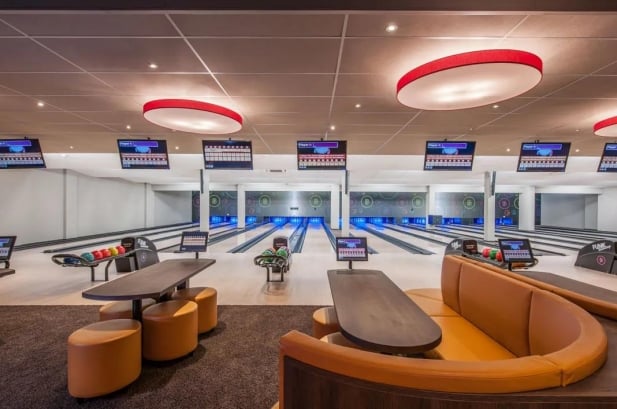
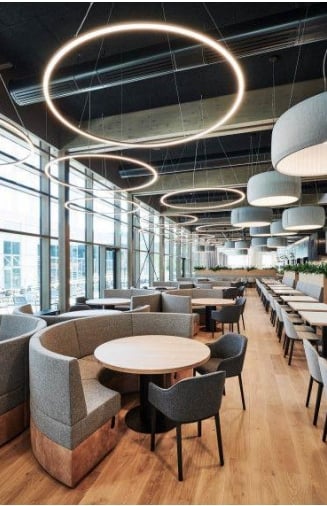
The centre will also debut Bowls and Blasters, a 20,000-square-foot entertainment concept that will feature 12 bowling alleys, indoor bumper cars, laser tag, and a food and beverage component. Set to open in March 2025, this first-of-its-kind attraction will offer family-friendly fun and further elevate Promenade’s experiential focus.
Bowls and Blasters Bowling. Photo: Cushman & Wakefield.
Bowls and Blasters Seating. Photo: Cushman & Wakefield.
Other additions include a Dental Hygiene College, opening in September 2025, which will welcome 400 students, further contributing to the centre’s daily foot traffic. Additionally, St. Louis Bar and Grill recently opened a 9,000-square-foot restaurant in September, featuring exclusive golf simulators offering over 30 sports and games—an exciting new concept for the brand and the mall.
New food concepts such as Pur & Simple, Bagel Stop, Fat Bastard Burrito, and Pizzaiolo will join the mix in 2025, adding more dining options to complement the existing tenants.
A Hub for Community Engagement
The Promenade is not just about retail; it is evolving into a community hub that actively engages with local residents. The centre has hosted a number of community-focused events, including Persian New Year Celebrations, the Royal Canadian Circus, March Break Family Fun, Dog Tales Rescue Dogs and a special Hanukkah events. Holiday activations are also a central part of Promenade’s offerings, with activities like Santa visits, ornament and cookie decorating, and winter crafts scheduled for the upcoming season.
The ongoing integration of events and activities reflects Promenade’s focus on becoming more than just a retail destination—it is positioning itself as a place where the community can come together.
Promenade Rendering. Photo: Cushman & Wakefield.
Meeting the Needs of a Growing Community
With the rise of high-density residential living in the Thornhill area, Promenade’s redevelopment is designed to cater to the evolving needs of its growing community. The direct connection between the condo towers and the shopping centre is a key feature, attracting a young, dynamic demographic of residents. As part of its long-term vision, Promenade is focused on meeting the needs of this growing population while continuing to serve its loyal customers.
The shopping centre’s tenant mix already features well-known brands like T&T Supermarket, Forever 21, Jollibee, LCBO, Swarovski, Club Monaco, Bath and Body Works, Roots, La Vie en Rose, and Rexall, along with popular specialty retailers like Urban Kids and Miniso. These additions, combined with new tenants and experiential offerings, ensure that Promenade remains a key destination for a wide range of shoppers.
Promenade Rendering. Photo: Cushman & Wakefield.
A Vision for the Future
The Promenade is in the midst of a long-term redevelopment plan that will see it become the centrepiece of a larger urban core. The addition of residential towers, office spaces, and expanded retail offerings will cement Promenade’s role as a key player in the future of Thornhill’s urban landscape. With more phases of development planned, the centre is set to grow even further, integrating itself more deeply into the daily lives of its residents and visitors.
Promenade Limited Partnership is owned in partnership by Serruya Private Equity and a limited partnership managed by Liberty Development Corporation. The property is managed by Cushman & Wakefield Asset Services.
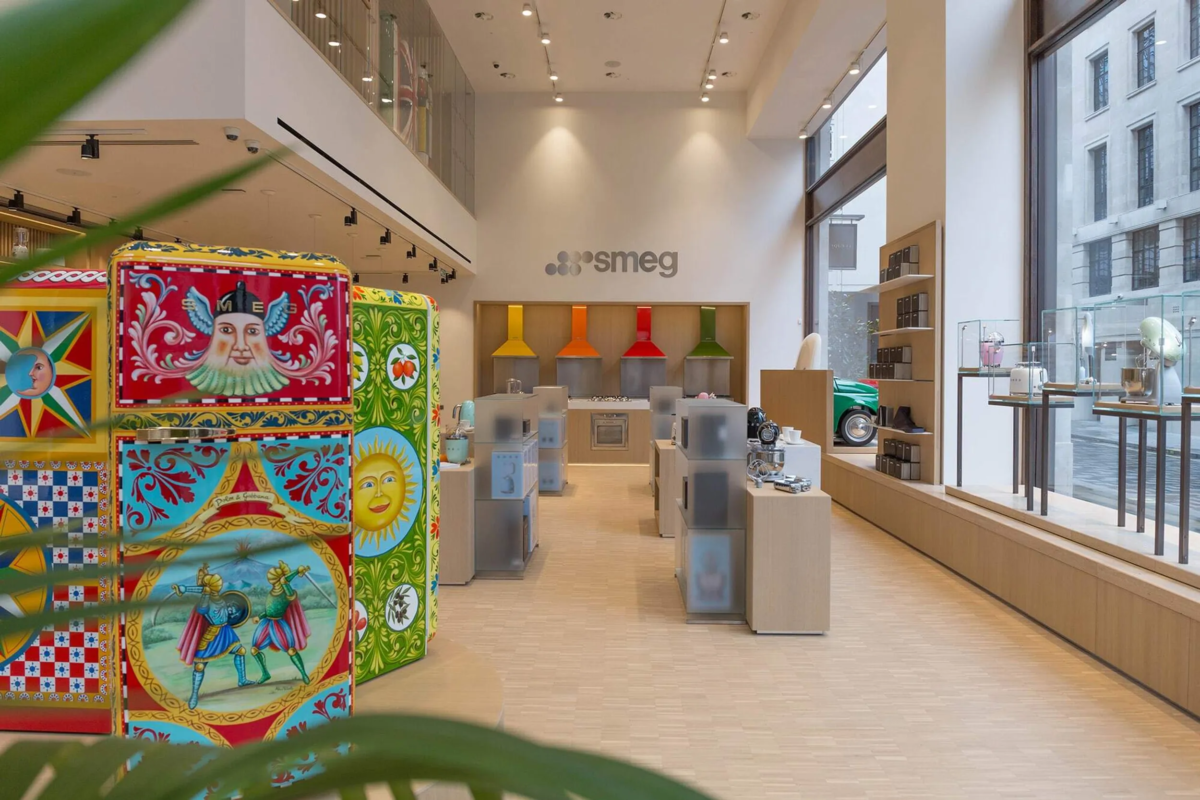
Rendering of the new Smeg store at 2 Bloor St W in Toronto. Image: Smeg
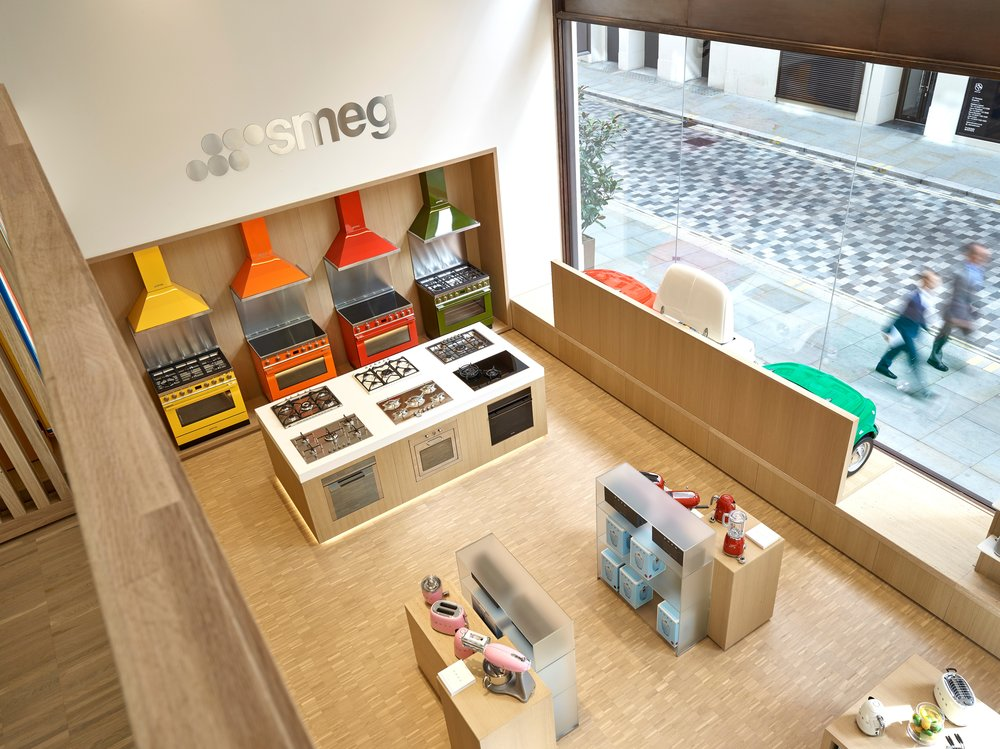
Renowned Italian appliance brand Smeg is preparing to open its first Canadian standalone retail space at 2 Bloor Street West in Toronto. The store will showcase Smeg’s iconic blend of cutting-edge technology and retro-inspired design to the heart of Toronto’s rapidly transforming Bloor-Yorkville retail district.
The two-level showroom will cover over 3,700 square feet, with a 1,137-square-foot ground floor showcasing Smeg’s kitchen appliances and a 2,590-square-foot second floor that is expected to feature full-sized appliances, including refrigerators, cooktops, ovens, and dishwashers. The second level is also expected to feature a design consultation area, providing customers with personalized advice on integrating Smeg products into their homes.
The retail space is strategically positioned next to Lululemon, which recently opened its flagship location at the corner of Yonge and Bloor, further cementing the area as a prime destination for big-brand shopping. The Bloor-Yorkville neighborhood, has seen a transformation in recent years, making it an ideal location for Smeg’s first Canadian outpost.
Bloor-Yorkville is seeing a much bigger transformation. Further to the west, the street has seen an unprecedented number of luxury brands open stores since before the pandemic, and more are on the way. The village area of Yorkville is also seeing a luxury expansion, including Yorkville Avenue as well as Hazelton Avenue and Scollard Street, and now even Cumberland Street with the opening of Harry Rosen’s new flagship store in early 2026.
Future Smeg location at 2 Bloor St W, photo: Craig Patterson
The area will also transform over the next five-to-10 years with an incredible influx of high-wealth households, who could become prime targets for businesses in the area. Several high-priced luxury residential developments in Yorkville will deliver well over 100 $10 million+ priced units in the area, increasing consumer dollars. Yorkville is also a tourist draw, while drawing an affluent demographic from within the Toronto area. The closure of luxury grocer Pusateri’s couldn’t have come at a worse time — though rumour has it that the Whole Foods store at Yorkville Village shopping centre could be getting a renovation.
The ongoing transformation of Yonge and Bloor Street, in particular, makes the intersection an ideal location for Smeg’s first Canadian showroom. By securing a space within the prominent corridor, Smeg is positioning itself to capture the attention of affluent shoppers who frequent the area, many of whom are likely to be drawn to its high-end appliances. The nearby foot traffic from the busy subway interchange, as well as overall foot traffic, will also help advertise the brand that also wholesales in various retailers in Canada.
Smeg appliances. Photo: Smeg
Smeg’s Global Presence and Design Legacy
Founded in 1948 in Guastalla, Italy, Smeg has long been a leader in high-end appliance design, combining advanced technology with unique aesthetic elements. The brand’s FAB28 refrigerator, known for its 1950s-style design and bold colours, is of its most iconic products. Smeg’s ability to seamlessly integrate retro-inspired aesthetics with modern functionality has made it a favourite among design-conscious consumers around the world.
Smeg’s Toronto showroom is expected to reflect the brand’s global strategy of creating immersive retail spaces that showcase the full range of its products, from small appliances like toasters and kettles to its larger kitchen suites. The brand’s international flagship stores, located in cities such as London, Paris, and Milan, are known for their design-forward environments and focus on customer engagement. The Toronto store is expected to follow suit, offering live cooking demonstrations, product workshops, and design consultations to help customers personalize their kitchen spaces.
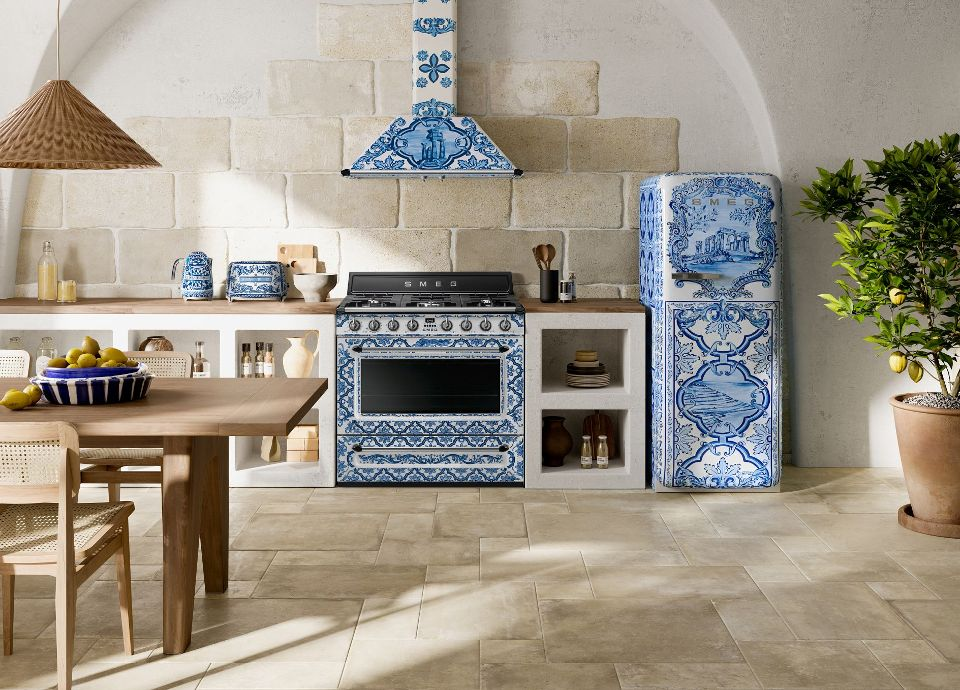
Dolce & Gabbana appliance collection. Image: Smeg
Smeg’s Competition in the Canadian Market
Smeg’s entry into the Canadian market will place it among a competitive landscape of premium appliance brands, many of which have already established strong footholds in Toronto and other key cities. Brands such as Miele, Sub-Zero/Wolf, and Gaggenau are known for their high-performance, design-driven appliances and have cultivated a loyal customer base in Canada. These competitors have focused on offering cutting-edge technology paired with sophisticated aesthetics, similar to Smeg’s design philosophy.
Miele, for example, has a long-standing presence in Canada and is known for its German-engineered kitchen and laundry appliances. Its sleek, modern designs have made it a favourite for those seeking both form and function in their home appliances – with two retail spaces in Toronto. Sub-Zero/Wolf is another major player in the premium kitchen appliance sector, offering integrated refrigeration solutions and high-performance cooking appliances. Known for its reliability and high-end design, Sub-Zero/Wolf has become synonymous with luxury kitchens in North America.
Despite this competition, Smeg’s entry into the market will likely differentiate itself through its distinctive retro design and a global reputation for bold aesthetics that other brands may lack. While Miele and Sub-Zero/Wolf have built a reputation for sleek minimalism, Smeg’s vibrant colour palettes, rounded forms, and nostalgic nod to 1950s design set it apart from its more conservatively styled counterparts. Smeg also appeals to customers seeking appliances that not only perform well but also serve as standout design pieces in their kitchens.
The upcoming showroom is also expected to showcase Smeg’s special edition collections, including its famed Dolce & Gabbana collaboration, which brought hand-painted, Sicilian-inspired motifs to its small appliance line. This artistic touch, combined with Smeg’s engineering prowess, includes eye-popping price tags for refrigerators and stoves that are each priced at about $20,000.
Inside the Smeg flagship store in London UK. Photo: Smeg
Smeg’s Entry into the Canadian Market
As the Canadian market for premium home appliances continues to grow, Smeg’s arrival is timely. There has been an increased focus on home improvement and kitchen design in recent years, particularly in urban centres like Toronto where real estate values are high. Smeg’s products, which emphasize both design and performance, are expected to resonate with Canadian consumers who prioritize aesthetics in their home environments.
The Bloor Street showroom is also expected to serve as a platform for Smeg’s exclusive collaborations, such as the “Sicily is my Love” collection created in partnership with Dolce & Gabbana. The limited-edition products, featuring intricate hand-painted designs, will likely appeal to Toronto’s luxury shoppers who are looking for unique, design-forward pieces.
While the opening date of the Smeg showroom has yet to be confirmed, the store is expected to attract interest from Toronto consumers. The Bloor-Yorkville neighbourhood’s ongoing evolution into a hub for international brands is an ideal backdrop for Smeg’s entry into the Canadian market with a standalone store.
Café William TOWT ship in Colombia in 2024. Photo: Café William
Café William, a renowned Canadian coffee company with a passion for sustainability, has announced a groundbreaking partnership with TransOceanic Wind Transport (TOWT) to decarbonize the transportation of its coffee beans. The inaugural voyage of a new sail-powered cargo ship, transporting 50 containers of green coffee beans, including those from the ANEI cooperative in Colombia, marks the beginning of a new era for both Café William and maritime transport.
This shipment, 10 times larger than Café William’s initial trial in December 2023, represents a significant step toward achieving zero-emission coffee. “We’re thrilled to partner with TOWT to fulfill our mission of acting beyond the cup and set a precedent for other players in the sector,” said Serge Picard, Owner, Chief Innovation and Commercial Officer of Café William. “It was vital for us to find an alternative method of transporting coffee, which largely depends on fossil-fuel cargo ships. Our first voyage proved that we could use sail power to bring beans to Canada, but this, much larger boat, will allow us to sustain operations and move toward zero-emission coffee.”
Revolutionizing Coffee Transport with Sail-Powered Shipping
The partnership between Café William and TOWT is driven by a shared vision to revolutionize the coffee industry’s impact on the environment. TOWT, a French company specializing in sail cargo transport, aims to provide a decarbonized alternative to traditional cargo shipping. “Maritime transport is closely linked to some of the world’s largest crises – geopolitical, energy, and environmental,” said Guillaume Le Grand, Co-founder and CEO of TOWT. “Our goal is to revolutionize the industry with an offer that is ultimately as fast as fossil fuel merchant ships, and we’re doing just that with the inaugural voyage of our first TOWT sailing cargo ship.”
Serge Picard aboard the ship with Cafe William on-board. Photo: Cafe William
This 50-container sail-powered vessel marks the largest shipment of its kind in the 21st century and sets a new benchmark for sustainable logistics. The beans transported aboard the ship come from the ANEI cooperative, a Colombian organization committed to rebuilding and strengthening Indigenous communities while promoting organic and Fairtrade practices.
Supporting Fairtrade and Organic Coffee
Café William is one of Canada’s leading importers of organic and Fairtrade-certified coffee beans. The company has long been committed to supporting fair wages and sustainable farming practices. The partnership with the ANEI cooperative, whose beans have been certified organic and Fairtrade for over 10 years, is a testament to Café William’s dedication to fostering meaningful relationships with coffee-growing communities.
“The partnership between the ANEI cooperative and Café William is a perfect example of what Fairtrade is all about – fostering thriving relationships between business and coffee-growing communities that lead to positive change for people and the planet,” said Julie Francoeur, CEO of Fairtrade Canada.
Café William TOWT ship in Colombia in 2024. Photo: Café William
By supporting Fairtrade, Café William ensures that farmers receive fair compensation and the resources they need to maintain sustainable livelihoods. The company’s focus on organic coffee further underscores its commitment to environmentally friendly practices, with beans produced in chemical-free ecosystems that protect both the planet and consumers.
A Carbon-Neutral Roasting Process
The journey toward sustainability does not end with transport. Upon arrival in Canada, the beans will be roasted at Café William’s innovative facility in Sherbrooke, Quebec. This facility is home to the world’s first 100% electric industrial coffee roaster, which runs entirely on hydroelectric power. The roaster has the capacity to process 20 million pounds of coffee annually and is expected to avoid approximately 800 tonnes of CO2 emissions each year compared to traditional roasting methods.
“Being based in Quebec, we knew we had the opportunity to leverage hydroelectricity to power our roasting process,” explained Picard. “By doing away with fossil fuels for roasting, we’ve set a new standard in the industry. Our electric roaster is a game-changer, not just for us, but for the entire coffee sector.”
Café William TOWT ship in Colombia in 2024. Photo: Café William
Sustainable Coffee Available for Canadian Consumers
Café William’s efforts to reduce its carbon footprint are not just for show—it is directly impacting the products available to Canadian consumers. This November, the company will launch its limited-edition Wind Series, featuring beans from the ANEI cooperative. These beans will be available in Costco stores across Canada, as well as through Café William’s website and select retailers. Packaged in 300g formats, the Wind Series offers consumers a chance to enjoy premium coffee that has been transported and roasted with minimal environmental impact.
“Customers are increasingly demanding transparency and sustainability from the brands they support,” Picard noted. “We’ve seen incredible demand for our sustainable coffee, especially from those who understand the positive environmental impact of sail-powered transport.”
Looking Ahead: Scaling Sustainable Operations
Café William’s commitment to sustainability extends beyond its current operations. The company’s partnership with TOWT will continue to grow, with plans to scale up sail-powered coffee transport over the coming years. The goal is to achieve 100% clean maritime shipping for their coffee beans, further reducing the environmental impact of their supply chain.
“We’re working closely with our French counterparts at TOWT to explore additional routes and expand sail-powered shipping to other regions, including Indonesia,” Picard shared. “This is a long-term vision, and we’re committed to making it a reality.”
On land, Café William is also investing in electric transportation. The company has placed orders for Tesla semi-trucks and is working with logistics partners to transition to electric trucks powered by renewable energy, further reducing emissions from its distribution network.
Café William TOWT ship in Colombia in 2024. Photo: Café William
A Holistic Approach to Environmental Impact
In addition to decarbonizing transport and roasting, Café William is taking steps to reduce its use of virgin plastic in packaging. The company’s new packaging includes 30% post-consumer recycled plastic, reflecting their commitment to minimizing waste and reliance on fossil fuels.
“Sustainability is at the heart of everything we do,” Picard emphasized. “From the way we transport and roast our coffee to the materials we use for packaging, we’re constantly looking for ways to reduce our environmental footprint.”
A Coffee Brand for the Future
Café William’s bold approach to sustainability is setting new standards for the coffee industry. With sail-powered shipping, electric roasting, and a focus on Fairtrade and organic practices, the company is proving that good coffee can be both high-quality and environmentally responsible.
“We’re not just making coffee—we’re making a difference,” Picard concluded. “Our customers care about the planet, and so do we. That’s why we’ll continue to innovate and push the boundaries of what’s possible in sustainable coffee production.”
MOVATI is in expansion mode. Photo: MOVATI website
MOVATI Athletic, a leading name in premium fitness clubs, is opening a new club in Albany in the Edmonton market by the Spring of 2025.
Closely following the recent opening of the MOVATI Manning Club, and the MOVATI Windermere Club, this expansion underscores MOVATI’s commitment to providing unparalleled fitness experiences and resources to the Edmonton community, said the brand in a news release.
Chuck Kelly, CEO:President, MOVATI
“We are excited to bring MOVATI Athletic’s signature blend of premium amenities and personalized fitness experiences to the Albany neighborhood,” said Chuck Kelly, President, and CEO of MOVATI Athletic. “As we continue to expand our presence in Edmonton, our goal remains unchanged – to foster a supportive environment where members can thrive and transform their lives through fitness.”
With a vision to inspire healthier lifestyles and empower individuals to achieve their fitness goals, MOVATI Athletic said it has established itself as a pioneer in the fitness industry.
“The new club in Albany will continue this legacy, offering state-of-the-art facilities, cutting-edge equipment, a new selection of wellness options and eight boutique fitness studios offering a wide range of group fitness classes tailored to meet the diverse needs and preferences of its members,” it said.
Rendering of the new MOVATI location. Photo: MOVATI
MOVATI showcasing new contemporary building design
MOVATI said the Albany location will showcase a new contemporary building design with a sleek façade featuring expansive glazing that seamlessly connects the interior with the surroundings.
The Albany Club will also be the first to introduce MOVATI RECHARGE, a newly conceived wellness space offering Red Light Therapy, Normatec Lymphatic Drainage stations, and a private infrared sauna and chill tub room for rejuvenation and recovery, it said.
It said an extensive selection of amenities and services will serve to enrich members’ overall fitness experience including:
Spacious workout areas featuring premier cardio and strength training equipment;
Dedicated, bespoke studios for group fitness classes, including Reformer Pilates, Hot Yoga, Barre, Cycle, HIIT, Small Group Training and more;
Luxurious locker rooms with larger dry sauna and steam rooms for relaxation;
A reimagined aquatics experience with a larger lap pool and an integrated chill and hot tub for contrast therapy;
M LOUNGE, a new member’s only lounge to facilitate connections and camaraderie;
Private self-contained, soundproof pods to allow for uninterrupted calls or meetings, ventilated and lit with access to power for charging devices; and
Expert personal and small group training services tailored to individual needs and goals.
MOVATI Athletic is a privately held company with 17 locations across Ontario and Alberta, now expanding into Albany with its 18th club. It celebrated 25 years in 2022.