Welcome to the Daily Synopsis by Retail Insider. We hope you enjoy the 12 articles we published covering key developments in Canadian retail. Here are a couple highlights with a full list of the day’s articles thereafter.
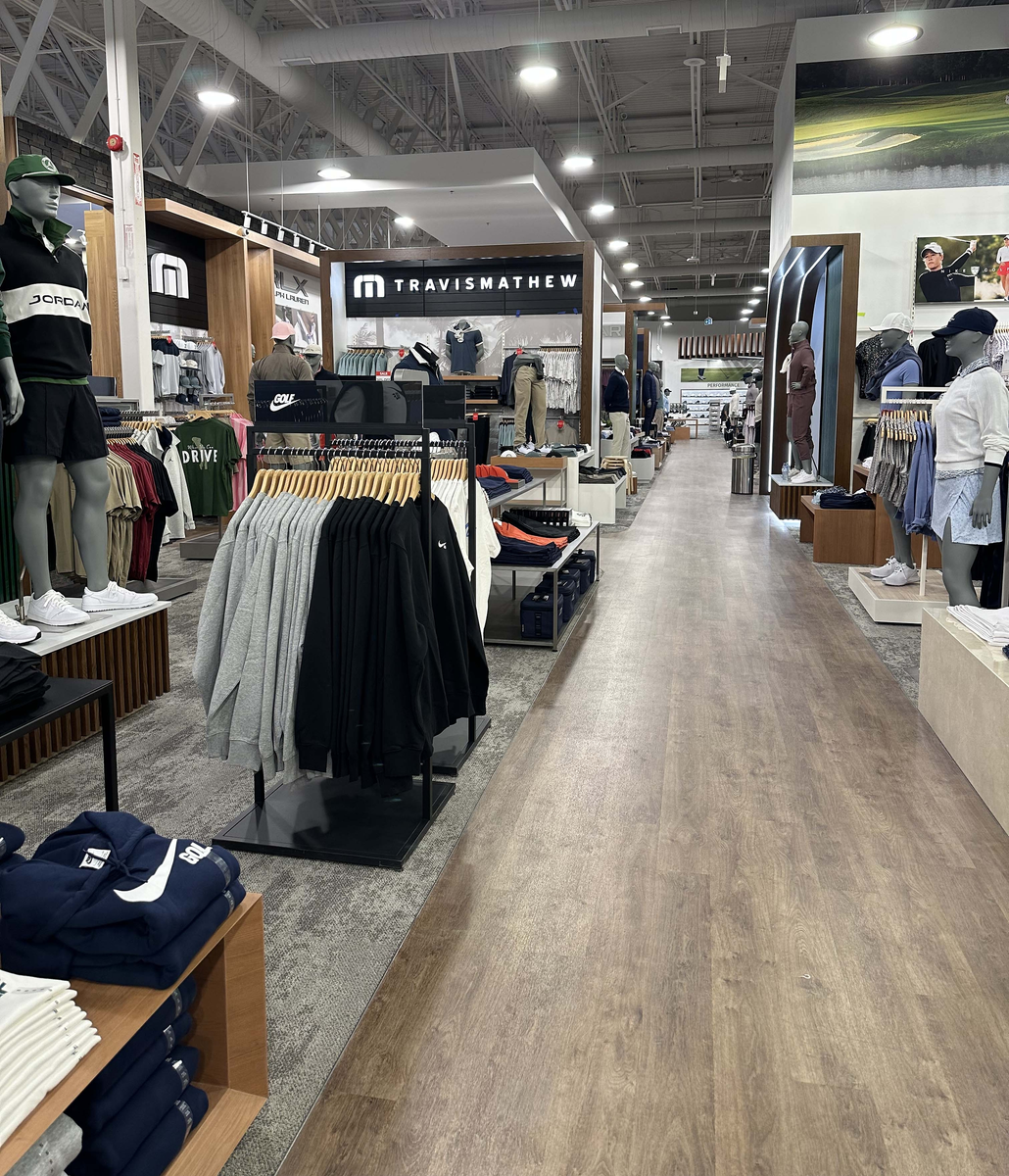
Primaris REIT is reshaping its portfolio by selling its 50% stake in Kingston’s Cataraqui Centre for $41.8 million while investing $411 million to acquire Upper Canada Mall in Newmarket. This shift targets higher-performing assets with more growth potential amid difficulties in re-leasing large vacant spaces like the former Hudson’s Bay at Cataraqui. Separately, Golf Town is planning a three-to-five-year modernization of its 50 stores inspired by its $15 million Oakville flagship, which features advanced custom fitting and interactive golf technology to boost customer engagement.
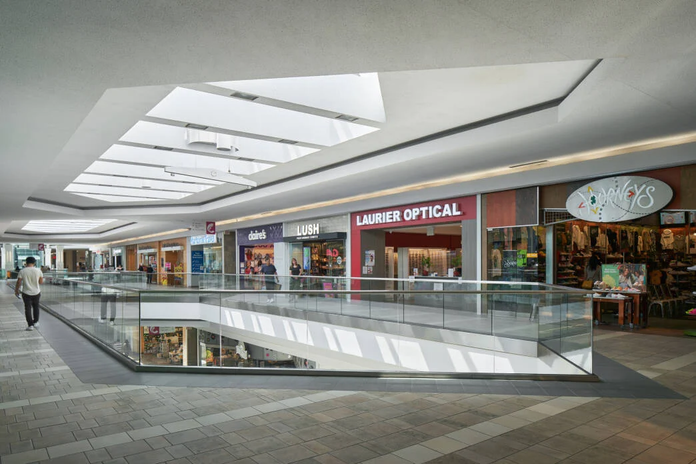
Cataraqui Centre in Kingston, ON. Image: Primaris REIT
Primaris Real Estate Investment Trust has agreed to sell its 50% managing interest in Cataraqui Centre in Kingston, Ontario, for $41.8 million, continuing its strategy of disposing of selected shopping centre properties while directing investment toward other Canadian retail assets.
The transaction, announced October 16, is expected to close by January 6, 2027, subject to customary closing conditions and any required regulatory approvals. The purchaser has not been publicly identified, and Primaris intends to use the net proceeds for debt repayment and general trust purposes.
The sale comes as Primaris completes its $411-million acquisition of Upper Canada Mall in Newmarket, Ontario. The two transactions provide an interesting comparison of how the REIT is allocating capital across its Canadian shopping centre portfolio, including properties with substantial vacant retail space.
Cataraqui Centre Faces Significant Vacancy
Located at 945 Gardiners Road, Cataraqui Centre spans approximately 572,600 square feet and serves Kingston and surrounding communities in eastern Ontario. The enclosed shopping centre opened in 1982 and underwent renovations in 2022.
Its tenant mix includes Sephora, Sport Chek and Marshalls, along with fashion, footwear, beauty and service retailers. According to Primaris, the property currently has 67% in-place occupancy, leaving considerable space available for leasing.
The largest vacancy is the former Hudson’s Bay department store, which occupied approximately 113,000 square feet. The location closed during the retailer’s nationwide liquidation in 2025, removing a major anchor tenant from the shopping centre.
Primaris regained control of the former department store premises in June 2025 following the disclaimer of Hudson’s Bay’s lease during insolvency proceedings. The space represents a substantial re-leasing opportunity, although no replacement tenant or specific redevelopment plan has been announced.
Despite its vacancy challenges, Cataraqui Centre continues to generate significant retail sales. Primaris reported current same-store sales productivity of $639 per square foot in its October 16 announcement, compared with $626 per square foot for 2025 and $616 in 2024.
Re-leasing a former department store of this size can involve subdividing premises, upgrading building systems and accommodating the requirements of incoming retailers. Such projects can require substantial capital, with costs and potential returns varying considerably between properties.
Primaris Continues Portfolio Reshaping
Primaris has been actively adjusting its Canadian shopping centre portfolio through acquisitions and dispositions, concentrating investment in properties where management sees stronger long-term growth opportunities.
The REIT has identified approximately $500 million in potential dispositions over three years, including selected non-core shopping centres, land and outparcels. The Cataraqui Centre transaction is part of that capital-recycling program.
“The sale improves overall portfolio quality, reduces exposure to assets with more limited growth opportunities, simplifies ownership structures, and provides additional financial flexibility to support strategic growth initiatives and capital allocation priorities,” said Alex Avery, Chief Executive Officer of Primaris REIT, in the company’s announcement.
The disposition will eliminate Primaris’ managing interest in a property it has classified as non-core. The REIT has not disclosed the specific financial assumptions behind its decision to sell, although its stated strategy involves directing capital toward assets expected to deliver stronger long-term value.
Alex Avery
The company has also been consolidating ownership of selected shopping centres. Earlier in 2026, Primaris acquired the remaining 50% interest in Regent Mall in Fredericton, New Brunswick, for approximately $64 million, bringing that property under full ownership.
The Regent Mall acquisition provides an important distinction. Primaris continues to invest in regional shopping centres outside Canada’s largest metropolitan markets, while making different investment decisions about individual properties.
Primaris completed its $411-million acquisition of Upper Canada Mall in Newmarket on October 15, adding approximately 990,000 square feet of retail space to its portfolio. The shopping centre serves Newmarket and the northern Greater Toronto Area, with retailers including Apple, Aritzia, Browns, Lululemon, Uniqlo, Sport Chek and Winners.
As previously reported by Retail Insider, Upper Canada Mall generated approximately $888 per square foot in annual tenant sales productivity and $271 million in annual commercial retail unit sales.
Its reported sales productivity is considerably higher than Cataraqui Centre’s $639 per square foot. The figures cover different reporting periods, but they provide a useful indication of the relative sales performance of the two properties.
Upper Canada Mall also has substantial vacant retail space. Primaris identified approximately 263,400 square feet of former anchor and large-format premises with potential for re-leasing, creating opportunities to introduce additional tenants and increase rental income.
The Newmarket property occupies approximately 76 acres, providing potential for future development. Its location in the northern Greater Toronto Area also offers access to a substantial regional customer base, although leasing and development returns will depend on market demand and capital requirements.
Both properties therefore present opportunities to generate income from vacant space, but the financial prospects of those opportunities can differ considerably. Sales productivity, demographics, tenant demand and the cost of preparing premises for new occupants all influence the economics of repositioning a shopping centre.
For Primaris, Upper Canada Mall represents a substantial investment in a property where management sees opportunities for income growth. The Cataraqui Centre disposition reflects the REIT’s decision to direct capital elsewhere within its portfolio.
The Future of Cataraqui Centre
The sale comes as Canadian shopping centre owners continue addressing vacancies left by Hudson’s Bay’s collapse. The retailer’s departure created large blocks of available space across the country, requiring landlords to assess replacement tenants, subdivision opportunities and alternative uses.
For regional mall owners, the financial challenge involves balancing the cost of re-leasing or repositioning vacant space against the rental income that can realistically be achieved. Properties with stronger tenant sales and established demand from expanding retailers may offer more attractive returns on that investment.
Cataraqui Centre remains an established retail destination in Kingston, with national tenants and considerable available space. The proposed transaction will introduce a new ownership arrangement as decisions about the former Hudson’s Bay premises and other vacancies remain outstanding.
The sale is expected to close in early January 2027. Further details about the purchaser, future property management and potential leasing plans have yet to be announced.
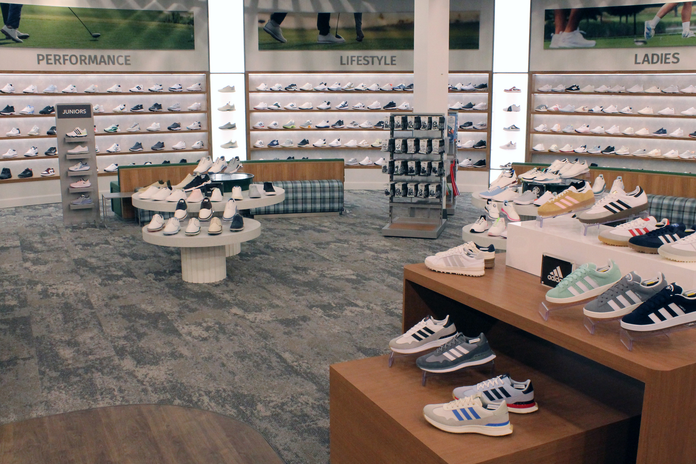
A redesigned full-service footwear section anchored by FootJoy’s FJ FitLAB at Golf Town Oakville
Golf Town is planning significant expansion and modernization across its Canadian retail network over the next three to five years, using its new $15-million flagship store in Oakville, Ontario, as a model for future investment.
The retailer, which operates 50 stores nationally, is exploring additional flagship locations in major Canadian markets while preparing to introduce selected features of the Oakville concept into existing stores. Plans include expanded custom fitting services, equipment personalization, updated merchandising and a forthcoming website replatforming.
Barry Williams, President and Chief Merchandising Officer of Sporting Life Group, which operates Golf Town, Sporting Life and Team Town Sports, outlined the strategy in written responses to Retail Insider.
“The Oakville flagship is the blueprint for Golf Town’s broader growth strategy,” Williams said. “Golf Town’s growth journey is far from over, with significant expansion and modernization plans set over the next 3–5 years.”
Oakville Flagship Provides Model for Future Investment
Golf Town’s new Oakville location spans 40,000 square feet, approximately two-and-a-half times the size of a typical store. The $15-million investment marks the retailer’s 50th Canadian location, with grand-opening celebrations scheduled for October 17 and 18.
Located at 290 North Service Road West, near Glen Abbey Golf Club, the store serves an established golf community in Oakville and is accessible to customers throughout the Greater Toronto Area and Southwestern Ontario. Williams said Golf Town had wanted to develop a flagship concept for several years, with active planning beginning in late 2025.
The location combines a large merchandise assortment with custom fitting facilities, golf simulators, putting technology and equipment personalization. It also provides space for clinics, events and activities intended to encourage customers to visit throughout the year.
Golf Town is examining how these features can be incorporated into other stores. Williams said locations do not need the size or investment level of the Oakville flagship to offer many of its services.
“A location doesn’t need a 40,000 sq. ft. footprint to deliver this level of service,” he said, identifying StudioX custom fitting, brand presentations, modern merchandising and personalization as priorities for future investment.
The company has not identified which existing stores will receive upgrades or announced locations for additional flagships. It has also not disclosed a capital budget for its broader modernization plans.
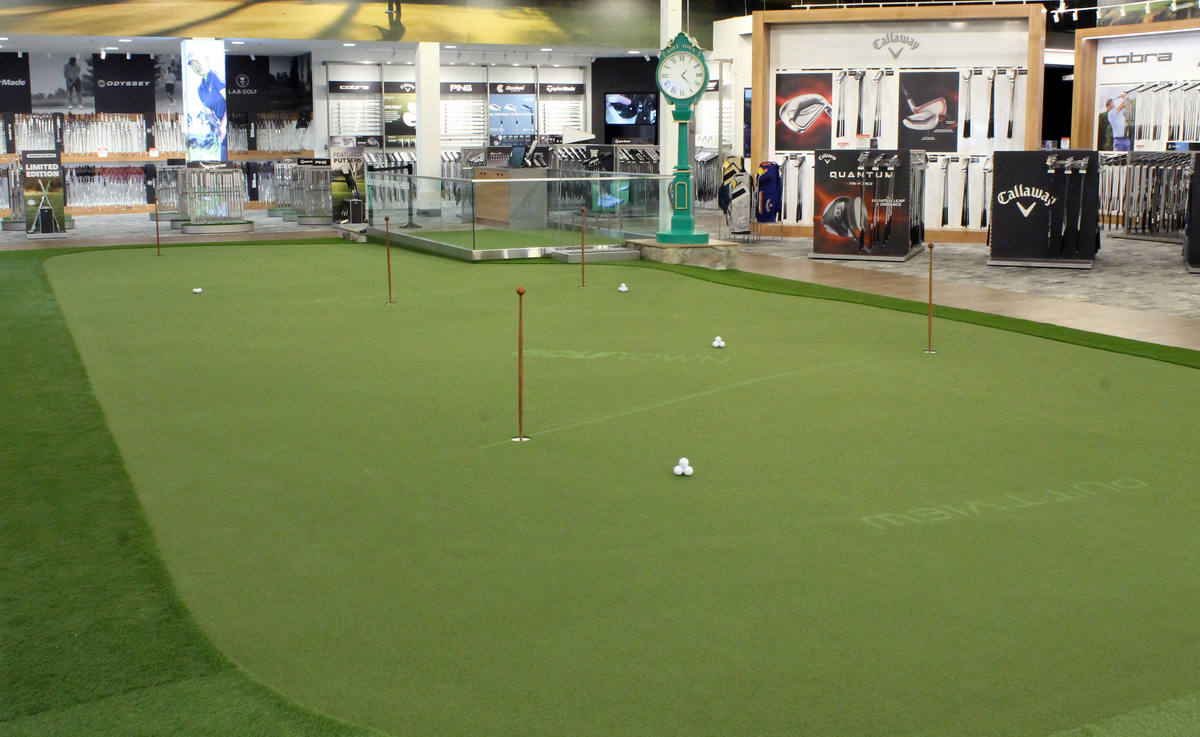
Expansive 1,300 sq. ft. putting green featured alongside Golf Town’s first-ever dual-projector PuttView installation, Oakville store. Image: Golf Town
Custom Fitting and Personalization Drive Store Strategy
Golf Town has made specialist services a major component of the Oakville flagship, investing in technology that allows customers to test equipment and work directly with trained employees.
The store includes five Foresight simulator bays, two StudioX custom fitting bays equipped with Zen Green technology, a dual-projector PuttView putting studio and a 1,300-square-foot putting green. Quintic putter analysis technology and Golf Town’s Master Club Fitters provide additional resources for customers seeking equipment suited to their individual playing characteristics.
Williams said the technology combines swing and ball-flight data with specialist advice to help golfers make informed equipment decisions. Foresight simulators are already available throughout Golf Town’s network, while Oakville brings several fitting and putting technologies together in a larger setting.
The flagship also introduces Golf Town’s first in-store personalization service, with a staffed Pro Shop offering wedge stamping, golf ball logo printing and customization of accessories such as tees and headcovers.
Williams said the service allows customers to work directly with staff on customized equipment while reducing turnaround times. Personalization is among the features the retailer expects to incorporate into future store investments.
The company has not provided conversion rates or other financial data showing how fitting appointments and personalization services affect sales. These services nevertheless provide opportunities to engage customers through equipment testing and specialist advice.
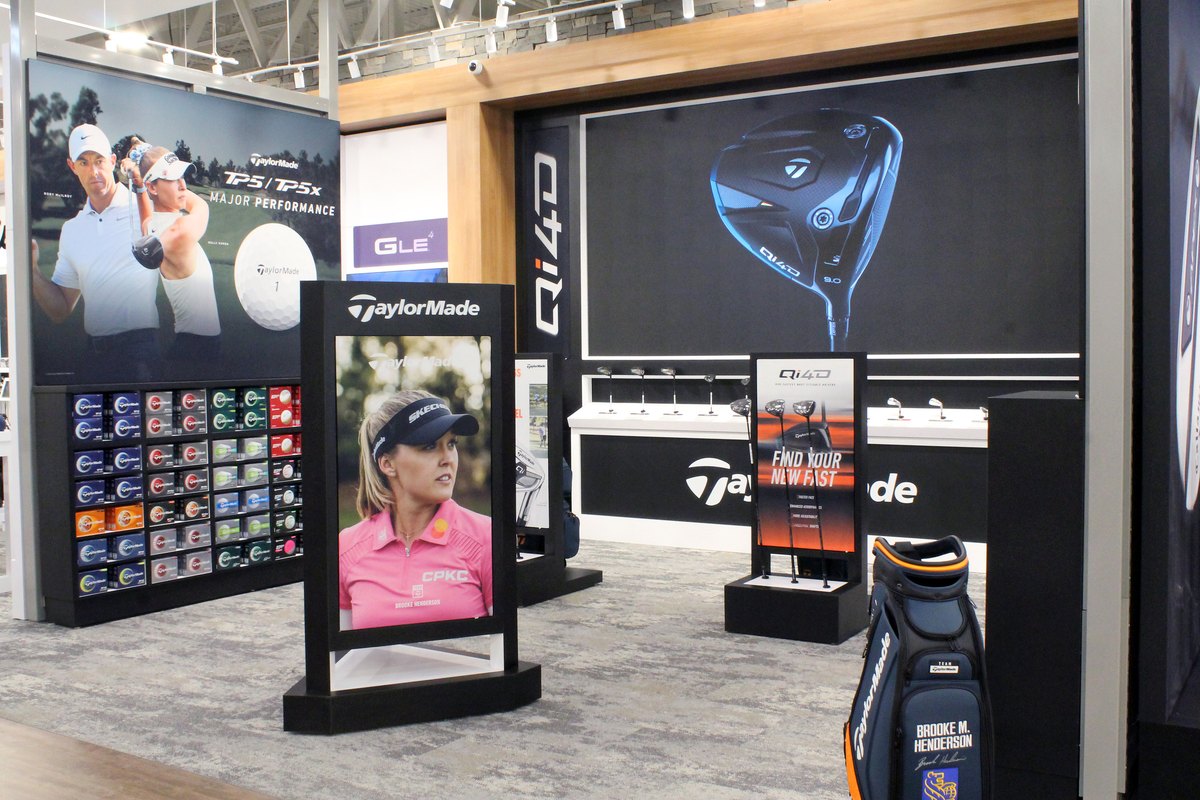
Dedicated shop-in-shops for top golf brands, including TaylorMade, Callaway, Odyssey, PING, and Titleist. Image: Golf Town Oakville
Expanding Customer Activity Beyond the Golf Season
The Oakville flagship has been designed to accommodate golfers throughout the year, including during periods when outdoor courses are closed or operating on reduced schedules.
Indoor simulators, putting facilities and fitting services allow customers to practise and test equipment during the off-season. Golf Town also plans to host clinics, product events and appearances by golf ambassadors.
The company is piloting new off-season league concepts to encourage regular customer activity. Williams described the flagship as a gathering place where retail, services and participation in the sport can support one another.
Golf Town is assessing the store through several measures beyond merchandise sales. Williams said the company tracks customer traffic, fittings, simulator sessions, expert services and event registrations alongside sales performance.
These indicators will help the retailer understand how customers use the format as it considers investments elsewhere in Canada. Golf Town has not disclosed specific financial targets for the flagship or projections for the services it offers.
Canadian Golf Participation Supports Investment
Golf Town’s plans follow several years of strong golf participation across Canada, providing a favourable backdrop for investment in stores and customer services.
Those figures measure activity at golf courses, not equipment or apparel sales, but indicate that participation remains substantially higher than before the pandemic. Williams cited the sport’s continued growth as an important factor behind Golf Town’s investment in Oakville.
The retailer is also expanding its efforts to serve golfers with different levels of experience. At Oakville, Golf Town has redesigned its women’s apparel department to offer a broader assortment and is planning women’s golf clinics.
The company says the flagship is intended to serve everyone from beginners purchasing their first set of clubs to experienced golfers seeking custom fitting and performance analysis.
Fully redesigned women’s shop at Golf Town Oakville
Further Flagships and Store Upgrades Under Consideration
Golf Town’s longer-term plans include potential flagship locations in major Canadian markets and modernization projects across its existing network. The company has not announced additional cities, opening dates or the number of locations that could receive upgrades.
StudioX custom fitting, personalization and updated merchandising are among the features expected to guide future investment. Golf Town is also preparing to replatform its website, although it has not provided a launch date or further details of the digital project.
For the existing store network, the Oakville investment provides a range of services and merchandising features that can be introduced at different scales. Golf Town’s next decisions will determine which Canadian markets receive those investments and how quickly its modernization plans take shape.
The Bank of Canada says consumer spending plans weakened and inflation expectations rose in the third quarter of 2026, even as businesses reported improving sales outlooks and consumer financial health strengthened, with both households and firms facing continued uncertainty over trade tensions, tariffs and elevated prices.
The Bank released the reports on Monday.
The Canadian Survey of Consumer Expectations was conducted through an online panel from August 5 to 27. About three‑quarters of responses were collected before trade talks between Canada and the United States broke down on August 21, and the subsequent announcement of new Canadian counter‑tariffs. Follow‑up phone interviews took place from August 24 to September 4, 2026, said the Bank
Overview
In the third quarter of 2026, consumers’ long-term inflation expectations rose to match elevated shorter-term expectations. Consumers continued to cite trade tensions and energy prices as key sources of inflation. Expectations at all horizons moved higher after trade talks between Canada and the United States broke down.
Consumers reported better financial health than in the previous quarter. Gains in the value of financial assets and greater confidence in the labour market were cited as reasons for the improved expectations of future financial health.
Workers’ perceptions of the labour market improved slightly but remain below the survey average. Compared with the previous quarter, labour market perceptions rose among workers who are more exposed to trade with the United States but deteriorated among workers in sectors where artificial intelligence poses a higher risk of task replacement.
Despite improvements in financial health and labour market perceptions, spending plans deteriorated from already weak levels. High prices and economic uncertainty continue to weigh on consumers.
Andrea Piacquadio photo
The Business Outlook Survey was conducted by in-person, video and phone interviews from August 6 to September 2. About three-quarters of the interviews took place before trade talks between Canada and the United States broke down and new Canadian counter‑tariffs were announced. The Business Leaders’ Pulse is conducted online every month; the latest results are from July, August and September. This quarter’s publication also includes results from special consultations in July and August about how firms are adapting to trade tensions and uncertainty, said the Bank
Overview
Survey evidence, gathered mostly before the breakdown in Canada‑US trade talks and the announcement of new counter‑tariffs, shows that overall business sentiment improved in the third quarter of 2026 after deteriorating in the previous quarter.
Firms reported better sales outlooks than in the second quarter. At the time of the survey, a lessening of the drag from both trade tensions and geopolitical uncertainty in the Middle East largely drove the improvement. Businesses also reported improved outlooks for export sales, supported primarily by solid US demand and high oil prices.
Firms’ investment intentions eased slightly but remain robust. Trade tensions and related uncertainty are weighing on the plans of several firms, but solid demand and elevated commodity prices support the investment plans of other firms. Despite some improvements in demand, firms’ hiring intentions remain soft, and most firms plan to keep headcounts unchanged.
The majority of firms still report spare capacity, but a slightly larger share than last quarter reported that they would have difficulty meeting an unexpected increase in demand.
Firms’ expectations for growth in their input and selling prices moderated but remain elevated. These expectations were often attributed to the impact of high global oil prices and trade tensions.
Firms facing larger‑than‑normal cost increases plan to continue passing them on to customers. For several firms, plans to further pass through costs reflect somewhat improved demand conditions and efforts to make up for past margin compression.
Compared with the previous quarter, firms’ inflation expectations eased overall but remain elevated.
Results collected since the breakdown in Canada‑US trade negotiations suggest that the new US tariffs and Canadian counter‑tariffs are weighing on firms’ outlooks. Inflation expectations have risen alongside the new tariffs and the recent rebound in energy prices. The tariffs are also dampening business sentiment, weakening outlooks for exports and investment, and putting upward pressure on costs and prices.
More generally, firms are adjusting to trade tensions through a range of measures, including modifying supply chains, increasing efficiency, exploring new markets and scaling back on capacity.
Maria Solovieva
Maria Solovieva, Economist, TD Economics, said: “Overall, both business and consumer sentiment rose in Q3, although they remained subdued. As with the previous two surveys, the timing of the data collection complicates the interpretation of the results, with responses collected after the collapse of Canada-U.S. trade negotiations pointing to a modestly more negative outlook. Nevertheless, we view overall sentiment as supportive of growth on balance.
“The divergence between consumers’ and businesses’ inflation expectations is puzzling: consumers anticipate stronger and more persistent long-term pressures, while businesses continue to view the recent inflation shock as temporary. The focus will remain on the month-to-month inflation prints, as the share of firms intending to raise prices remains elevated. On that note, today’s inflation report suggests that those intended price hikes are still slowly manifesting, giving the Bank little justification for raising rates at next week’s policy meeting.”
A Mississauga specialty food retailer focused on flavoured butter has opened its first permanent store as its founder expands into wholesale distribution through partnerships with Ontario food businesses.
Butter Bar Boutique, located at 1006 Lagoon St. in Mississauga’s Port Credit area, features the company’s gourmet flavoured butters alongside specialty foods, kitchen products, entertaining accessories and gifts, with an emphasis on locally made and Canadian products.
Founded by entrepreneur Kate Engineer in 2023, Butter Bar has grown from a market-based operation into a retail business with production support from family-owned The Alliston Creamery. The company has also supplied its packaged butters to other retailers, including SanRemo Bakery and Downey’s Farm Market, with the products at those stores during the recent Thanksgiving weekend.
The boutique’s opening and the wholesale expansion mark the next stage of a business that Engineer initially operated herself, handling production, packaging and sales before partnering with a creamery to increase output.
Kate Engineer
From farmers’ markets to retail
Engineer developed Butter Bar after growing up around her family’s restaurant and working in retail marketing and communications. She later launched a fashion public relations agency and founded hospitality training company Servers Excellence before turning her attention to specialty food.
For the first three years of Butter Bar’s operations, Engineer personally made, packaged and sold the company’s butter. She introduced the products at the Port Credit Farmers’ Market and expanded her reach through pop-up shops and the One Of A Kind Show.
“I started Butter Bar out of a love for butter and cooking, and for the first three years, I did every part of it myself — from churning and flavouring to moulding, freezing, wrapping and selling every stick,” said Engineer. “It all began at the Port Credit Farmers’ Market and grew through pop-ups and the One Of A Kind Show. The support has been incredible. Customers kept coming back, sharing our butter with friends and encouraging me to keep going. That following made it clear that it was time to grow. Opening the Boutique and partnering with Alliston Creamery are the next chapter in a business built by hand, with a lot of love and a community that believed in it.”
The partnership with The Alliston Creamery has enabled Butter Bar to increase production and pursue wholesale distribution while retaining control over its flavour recipes. The creamery produces the butter using local Ontario cream and serves as the company’s co-packing and production partner.
The products are packaged in 250-gram portions wrapped in wax paper and placed in custom sleeve boxes. The companies also worked together to introduce the wax-paper packaging as an alternative to conventional foil wrapping.
“The Butter Bar team came to Alliston Creamery with a clear vision, and it challenged us to rethink both how we make butter and how we wrap it, right down to bringing traditional wax paper back into the process. It’s what happens when two passionate Canadian food businesses aren’t afraid to do things a little differently. We’re incredibly proud of these butters and can’t wait to see them debut at the Boutique,” said Marianne of The Alliston Creamery.
Kate Engineer
Wholesale distribution adds a growth channel
Butter Bar’s products are now available to retailers, with SanRemo Bakery and Downey’s Farm Market identified as the first businesses to carry the newly packaged collection. The company is seeking additional retail partners, including specialty food stores, gourmet grocers, farm markets, butcher shops, bakeries and gift shops.
Engineer said wholesale distribution complements the opening of the company’s own store by giving customers more opportunities to purchase the products.
“Opening our own Boutique was always part of the dream, but seeing Butter Bar on the shelves of other incredible food businesses is equally exciting,” says Engineer. “SanRemo Bakery and Downey’s Farm Market are destinations people already associate with great food, tradition and gathering, which makes them such natural first retail partners for us. And having the butters arrive just in time for Thanksgiving feels especially perfect — because if there’s ever a weekend that deserves really good butter, this is it.”
The flavoured butters retail for $30 to $34 per 250-gram package, depending on the flavour.
Kate EngineerButter Bar photoButter Bar photo
Store focuses on food and entertaining
The boutique combines Butter Bar’s products with a broader selection of specialty pantry items, gourmet foods, kitchen and tabletop products, charcuterie supplies, serving accessories and gifts. Its merchandise selection is intended to appeal to home cooks, hosts and shoppers looking for food-related gifts, while featuring products from Canadian makers.
The store is open Wednesday through Sunday at 1006 Lagoon St. in Mississauga.
Engineer said the permanent location provides an opportunity to present the products alongside other Canadian-made goods and give customers a more complete retail experience.
“There’s something incredibly nostalgic about butter, but there is also so much room to have fun with it,” added Engineer. “We’ve obsessed over everything from the flavours and ingredients to the way the butter is wrapped, boxed and displayed. The Boutique gives us the opportunity to share that entire experience with our customers and introduce them to other Canadian products and makers we love. Ultimately, Butter Bar is about making everyday food feel a little more special — and spreading a little joy along the way.”
Staples Canada has launched a new business-focused brand aimed at bringing procurement, workplace products and services together for organizations ranging from small businesses to large enterprises.
The Richmond Hill, Ont.-based retailer announced Monday the launch of Staples Business, which will offer two purchasing programs with different levels of service, including options for customized procurement, personalized pricing and dedicated account support.
The move brings the company’s business offerings under a dedicated brand as it seeks to address the purchasing and operational needs of Canadian organizations facing multiple suppliers, unpredictable costs and supply uncertainty.
“Staples Business brings everything our business customers rely on together under one brand, building on our long-standing commitment to supporting Canadian businesses for more than 30 years,” said Chris Saniga, chief B2B officer at Staples Canada. “As a Canadian company, we understand the pressures organizations here are facing. Whether it’s a growing startup or a large enterprise, our goal is to take more off their plate so they can focus on what comes next.”
Chris SanigaStaples photo
Two programs target different business needs
Staples Business will be available through two programs: Staples Business Preferred, designed for smaller businesses seeking everyday value, and Staples Business Professional, aimed at organizations requiring more customized purchasing arrangements.
The Professional program will offer customized procurement, personalized pricing, consolidated invoicing and dedicated account support. The company said the broader Staples Business offering will combine products and services intended to help organizations manage purchasing and workplace operations through a single provider.
The services include centralized purchasing, next-day delivery, print and marketing services, technology and information technology solutions, and expertise in workspaces, furniture and facilities. Customers will also have access to account representatives and category specialists for personalized support.
Staples Business is intended to serve organizations across a range of sectors, including education, health care, construction, corporate offices and professional services.
The company said the new brand is built around the platform “Behind every business is Staples Business,” reflecting its role in supplying products and services that support organizations’ day-to-day operations.
Staples Canada said the offering is designed to simplify purchasing and administration for businesses that must manage multiple vendors, online portals and invoices while dealing with changing costs and supply challenges.
Staples photo
Technology emerges as fastest-growing category
Technology is the fastest-growing category among Staples Business customers, according to the company, which pointed to changing workplace requirements related to productivity, collaboration and flexible working arrangements.
The retailer’s business offering includes technology and IT solutions alongside traditional office supplies, print services, furniture and facilities expertise. It also combines dedicated business support with a broader portfolio of products and services intended to help organizations manage their operations.
Saniga said the company’s Canadian presence is central to its approach to serving business customers.
“We’re proud to have more than 11,000 associates and operations rooted entirely in Canada, and that enables us to support Canadian businesses in a meaningful way,” added Saniga. “Whether organizations are growing, expanding their teams or adapting to new ways of working, they need a trusted partner that can help them move quickly. With teams rooted in communities across Canada, we’re equipped to deliver the products, services and expertise businesses, when and where they need us.”
Staples Canada said the brand is intended to support businesses at different stages of development, from entrepreneurs and smaller companies to mid-sized organizations and large enterprises. Its services are designed to accommodate organizations seeking routine purchasing as well as those requiring more specialized procurement support.
Launch coincides with rewards campaign
To mark the launch, Staples Business is also highlighting its annual Pay Days rewards event for business customers. The campaign offers customers the opportunity to win more than $75,000 in prizes, including a $10,000 grand prize that one business can spend at Staples, subject to terms and conditions.
Staples Canada is headquartered in Richmond Hill, Ontario, and operates a network of Canadian stores and online services. Its offerings include Staples Print, Staples Business and Staples Studio co-working spaces, serving consumers, educators, entrepreneurs and businesses.
The company said Staples Business will bring its business products, services and expertise together under one brand, with purchasing programs designed to meet the needs of organizations of different sizes.
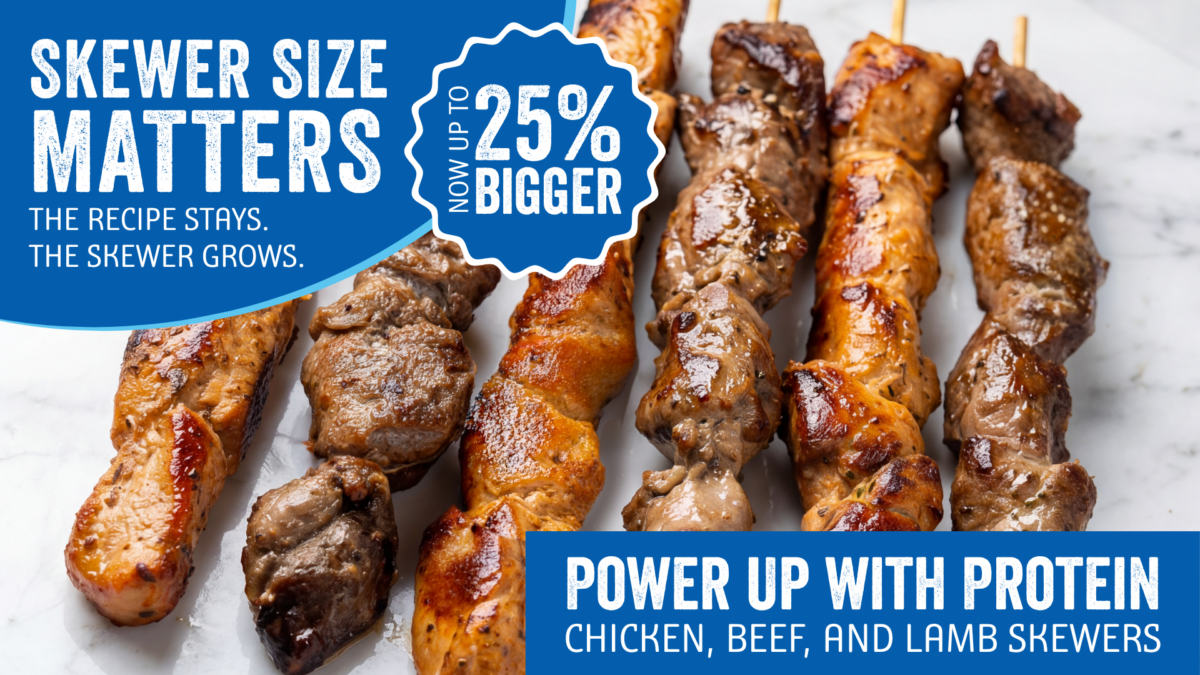
OPA! of Greece has increased the amount of protein in its souvlaki skewers by up to 25 per cent across its Canadian locations, a move the restaurant chain says is intended to offer customers greater value without raising prices.
The Calgary-founded quick-service restaurant brand said the larger portions are available now at all its locations nationwide as food affordability continues to influence consumer spending on meals.
“People are thinking more carefully about how and where they spend their money,” said Peter Shafik, director of menu innovation and supply chain at OPA! of Greece. “We know our guests are looking for meals that are filling, high quality and affordable. Rather than increasing prices, we wanted to provide even greater value by serving more protein at an affordable price.”
OPA! of Greece photo
Portion sizes and value
The company said the change is intended to provide customers with more protein while maintaining its existing approach to pricing and food quality. Its announcement points to rising grocery costs as a factor shaping how Canadians make everyday food decisions.
OPA! cited Statistics Canada data showing food prices have continued to increase over the past year, along with the 2026 Canada Food Price Report, which estimates the average Canadian family will spend nearly $1,000 more on food this year than in 2025.
The company said the increased portions reflect its focus on generous servings and value for customers across Canada.
OPA! of Greece photo
Canadian expansion
Founded in Calgary in 1998, OPA! of Greece began with a single restaurant focused on serving Greek cuisine using fresh ingredients. The company has since expanded to more than 120 locations across Canada, including British Columbia, the Prairie provinces and Ontario.
OPA! said its restaurants serve fresh, made-to-order meals and that the increased protein portions are part of its efforts to maintain its customer offering while addressing affordability concerns.
Merrithew has launched its first wood Pilates reformer, a piece of professional fitness equipment designed for boutique studios, premium fitness clubs, hotels and wellness centres.
The Toronto-based company, which created the STOTT PILATES movement system, introduced the NX3 MAX Reformer recently. The equipment features an FSC-certified maple frame, a larger carriage and adjustments intended to reduce setup time for instructors.
The launch expands Merrithew’s equipment portfolio with a wood model developed in collaboration with its engineering team and experienced Pilates instructors. The company said the design was shaped by feedback from instructors who tested prototypes through its Advisory Lab.
“Our connection to the instructor community gives us an extraordinary testing ground. We combined their real-world experience with our engineering expertise to create a wood Reformer where design and performance work together at every touchpoint. The NX3 MAX is built to elevate the experience for the client, the instructor and the studio.” said Jim Heidenreich, CEO, Merrithew.
Jim HeidenreichMerrithew photo
Instructor feedback shapes design
Merrithew developed the NX3 MAX with its engineers, STOTT PILATES Master Instructor Trainers and instructors from other Pilates methods. The company said the development process focused on how clients use the equipment and how instructors manage exercises and transitions during classes.
The reformer’s carriage measures 26 by 40 inches, making it the largest Merrithew has produced to date. The company said the additional space is intended to accommodate a wider range of body types and allow greater freedom of movement during exercises.
The equipment also features an EasyShift Gearbar that allows instructors to change resistance across four positions without removing springs. The adjustment system is intended to reduce the time required to reset equipment between exercises.
Extended rails and longer carriage travel provide additional range of motion, while an eight-wheel rolling system is designed to deliver a smooth, quiet glide. Merrithew also incorporated FastLock shoulder rests, which secure with a single twist, and a locking footbar that can be set in four positions.
A multi-position platform extender provides an expanded movement surface for additional exercises and positions, adding to the equipment’s programming options.
Wood design targets premium facilities
The NX3 MAX combines its functional features with a natural maple frame, elongated lines and curved edges. Merrithew is positioning the equipment for professional facilities that want their Pilates equipment to complement the design of their studios and other fitness spaces.
The company said the reformer is intended for boutique studios, premium fitness clubs, hotels and wellness centres seeking to distinguish their facilities and offer clients a premium exercise environment.
The frame is made from FSC-certified maple, which Merrithew says brings a natural wood finish to professional fitness settings. The company’s announcement also emphasizes the equipment’s appearance as part of its intended role in studio environments.
Merrithew photo
Company background
Merrithew describes itself as a global provider of mindful movement education and equipment. Founded in 1988, the company developed the STOTT PILATES Movement System and has expanded its portfolio to include Align-Pilates and the GYROTONIC organization.
Merrithew said it has trained more than 100,000 instructors in over 135 countries. Its business includes instructor training, fitness equipment, digital resources, business tools and a global professional network.
The company supplies equipment and education to studios, rehabilitation centres and fitness professionals, according to its corporate overview. The NX3 MAX adds a wood reformer to its equipment range, with the product developed for professional settings where equipment design and class functionality are both considerations.
The Consumer Price Index (CPI) rose 3.1% year over year in September, following a 3.0% increase in August. The acceleration was led by higher prices for gasoline in September (+27.8%) compared with August (+22.8%). Excluding gasoline, the CPI rose 2.2%, after increasing 2.4% in August, reported Statistics Canada on Monday.
Moderating the acceleration in the all-items CPI in September were smaller year-over-year price increases for travel tours and groceries compared with the previous month. The CPI increased 0.1% month over month in September. On a seasonally adjusted monthly basis, the CPI rose 0.4%, said the federal agency.
“Prices for energy accelerated in September, rising 19.0% year over year following a 15.4% gain in August. Crude oil prices increased in September, reaching their highest level since May amid ongoing uncertainty about the wars in the Middle East, resulting in higher prices for gasoline and fuel oil,” said Statistics Canada.
“Year over year, prices for gasoline rose at a faster pace in September (+27.8%) compared with August (+22.8%). Moderating the increase in gasoline prices in September was the switch to the less expensive winter blend.
“Similarly, prices for fuel oil and other fuels rose 57.8% year over year in September, following a 43.7% increase in August. The price increase in September had a greater impact on consumers in Atlantic Canada, where fuel oil is more widely used.”
Gustavo Fring photo
The report said prices for food purchased from stores rose 1.7% year over year in September, after increasing 2.8% in August. Although price levels remain high, this was the smallest yearly increase since May 2024 (+1.5%), and the second consecutive month where grocery price growth increased at a slower pace than the all-items CPI.
“Driving the year-over-year slowdown in grocery prices in September 2026 were declines in prices for fresh vegetables (-2.9%) and sugar and confectionery (-2.7%). Prices for other food preparations (+1.8%) and fresh or frozen beef (+8.7%) rose at a slower pace in September than in August (+2.8% and +11.0%, respectively), also contributing to the slowdown,” said the report.
“Despite the year-over-year slowdown in prices for groceries, prices have increased 33.0% since September 2020.”
Andrew GranthamLeslie PrestonDouglas Porter
Andrew Grantham, Senior Economist, CIBC Capital Markets, said: “Canadian inflation accelerated further in September, albeit by slightly less than expected and driven solely by higher gasoline prices. Headline CPI prices rose 0.1% (0.4% after seasonal adjustment) to take the annual rate up to 3.1%, with both of those figures a tick below consensus expectations. Higher gasoline prices drove the acceleration, and excluding that area inflation actually decelerated modestly to 2.2%, from 2.4% in August. Excluding food and energy, prices rose by a seasonally adjusted 0.1% for an annual rate of 2.1%. CPI-trim and CPI-median both printed a tick below consensus forecasts at 1.9% and 1.8% year-over-year, while the proportion of the basket rising more than 3% y/y edged down slightly. Following the hawkish tone of Governor Macklem’s (of the Bank of Canada) comments over the weekend, markets had moved to price in a greater chance of a rate hike later this month, but today’s CPI data suggests that there is little rush and policymakers can take more time to assess how US trade relations and the impact of new tariffs develop before raising rates.”
Leslie Preston, Managing Director & Senior Economist, TD Economics, said: “No jump scares in Canada’s inflation in September, in contrast to higher inflation south of the border. The hottest inflationary categories remain those most directly related to the spike in oil prices this year: energy and airfares. Looking at the Bank of Canada’s preferred inflation metrics over the past six months, inflation is only two tenths above their 2% target (2.2%). Surprisingly the 2-Year yield is only off slightly since the release.
“Today’s number supports our view that the Bank of Canada can remain on hold this year. There is little evidence higher energy costs are bleeding through to broader price pressures, which remain mild. On top of that, the Canadian economy faces downside risks due to tariffs and the volatile trade relationship with the U.S., a relatively soft job market, and now higher bond yields. We expect the combination of these forces will lead the Bank to stay on the sidelines this year.”
Douglas Porter, Managing Director, Chief Economist, BMO Capital Markets, said: “Markets came into this important inflation reading leaning heavily towards a BoC hike, driven by Governor Macklem’s hawkish comments over the weekend—which fixated on the fact that energy prices just keep going and going. However, this mild result on the cores, by themselves, will provide no satisfaction for those hiking expectations, anchoring around 2% (or lower) and exhibiting zero evidence that the energy price spike is spreading. Even so, the Bank seems laser-focused on the persistence of headline inflation above 3%, and it seems headline will stick there for a while, given the ongoing strength in oil and products. The Bank’s quarterly Business Outlook Survey is due in a few hours and if it portrays an upbeat picture for growth and rising inflation expectations, a hike at the October rate decision will very much be on the table. And while today’s CPI result was milder than expected, recall that the Bank look forward, so one tame current inflation result won’t necessarily stay their hiking hand.”
Artificial intelligence is transforming retail. While that observation is hardly new, the growing adoption of generative and now agentic AI is accelerating change at an unprecedented pace and scale.
For retailers, especially SMEs, the speed of this transformation can feel both exciting and daunting. Yet amid all the discussion about technology, a more fundamental question is emerging: what will continue to make retailers relevant when AI becomes increasingly capable of performing tasks that once required human expertise?
Retailers should absolutely embrace AI to improve business performance. However, even the most successful implementation of AI may not be enough to guarantee long-term relevance. In my view, the retailers that thrive in the years ahead will be those that continue investing in something technology struggles to replicate: the human touch. Relationships, empathy, advice and trust will become increasingly important sources of competitive advantage.
The work of McGill Professor Henry Mintzberg offers a useful framework for understanding why this human dimension may become even more important in the age of AI.
What Mintzberg’s Framework Reveals
Over the course of my career, Mintzberg’s work has been instrumental in shaping my understanding of successful organizations and business models, particularly in industries driven by creativity, experience and customer engagement. His ideas helped explain why companies such as L’Oréal developed distinctive cultures and organizational models that contributed significantly to their long-term success. They also informed many of the courses I taught at China Europe International Business School, EM Lyon and McGill on what drives success in luxury, fashion, beauty and other creative industries.
In his influential 2005 book Managers, Not MBAs: A Hard Look at the Soft Practice of Managing and Management Development, Mintzberg argues that successful management exists at the intersection of three dimensions:
Managerial science: analytical thinking, quantitative decision-making and data-driven management. This is the “dollar” dimension.
Art: creativity, vision, innovation and strategic imagination. This is the “magic” dimension.
Craft: experience, intuition, engagement and human understanding. This is the “human-heart” dimension.
For many years, advances in technology have steadily expanded their influence over the managerial science dimension. Machine learning, predictive analytics and large language models excel when vast quantities of data are available. This helps explain, in part, the success of highly data-driven retail organizations such as Amazon and Alibaba.
Charles De Brabant
Today, generative AI is moving increasingly into the artistic dimension as well. It is becoming a powerful tool for ideation, content creation, product design, marketing and even store design. The pace of progress has been remarkable.
The third dimension, however, remains fundamentally different.
While AI will continue making inroads into customer-facing functions and repetitive tasks, it faces far greater challenges when it comes to replicating human judgment, empathy, trust and lived experience.
Trust May Become Retail’s Most Valuable Asset
Recent events have highlighted why the human dimension remains so important, and why AI’s growing influence within Mintzberg’s “art” dimension presents both opportunities and risks.
Generative AI is becoming increasingly capable of producing compelling stories, persuasive marketing content and emotionally resonant brand narratives. While these capabilities can help legitimate businesses connect with consumers, they can also be misused.
A notable example involved Juliette & Lea Montreal, a supposedly local mother-daughter business that promoted an emotional story about a closing-down sale that would allow the daughter to pursue her dream of studying fashion in Europe.
The story resonated with consumers. It was also entirely fabricated.
Customers who placed orders later discovered they were purchasing products shipped directly from overseas suppliers, often with disappointing results. The incident illustrates how AI-powered storytelling and digital marketing can be used to manufacture credibility and emotional connection where neither actually exists.
Retail strategist and McGill University lecturer Carl Boutet recently warned that increasingly sophisticated scams may make it harder for consumers to distinguish legitimate businesses from fabricated ones.
“It’s getting scary out there. And it makes it tougher for legitimate businesses. I feel for the legitimate brands that are starting out, which you wouldn’t know either because they are literally getting off the ground and you might be more doubtful.”
As AI-generated content becomes increasingly convincing, consumers may become more skeptical of what they see online. That reality creates new challenges for legitimate businesses attempting to establish credibility and trust.
In such an environment, authentic human relationships, real expertise and genuine customer engagement may become even more valuable competitive advantages.
Carl Boutet
Why Physical Stores Still Matter
This growing trust gap reinforces the continued importance of physical retail.
Many occupations that appear least vulnerable to AI disruption share common characteristics. Nurses, electricians, hairstylists, fitness trainers and countless other professionals create value through expertise, judgment, empathy and personal relationships.
Technology can support these professions, but it cannot fully replace the human connection at their core.
Retail operates under similar principles.
Despite years of e-commerce growth, approximately 80 per cent of global retail sales continue to be completed in physical stores, with the percentage remaining even higher in North America. Store teams therefore continue to play a critical role in helping customers make informed decisions, building confidence in purchases and creating lasting relationships.
While AI and automation will continue transforming retail operations, they are unlikely to diminish the importance of physical stores where trust, expertise and personal relationships remain central to the customer experience.
Retailers That Invest in People Win
Some of the world’s most successful retailers demonstrate that lasting differentiation often comes from people rather than technology.
Apple has intentionally designed its stores as places where customers can learn, ask questions and solve problems. Employees act as trusted advisors who help demystify technology and build confidence. The store experience is built around expertise, reassurance and human interaction.
Costco takes a different approach but achieves a similar outcome. The company invests heavily in employee training and compensation, creating a culture that reinforces trust and loyalty among members. Customers return not only because of value, but because they know what to expect from the experience.
Nespresso has elevated everyday purchasing into a premium retail experience. Boutique advisors guide customers through products, preferences and rituals, transforming routine transactions into meaningful interactions.
In each case, the store serves as a human expression of expertise, empathy and trust.
The value of those interactions remains particularly evident in specialty retail. Carlos Oyanguren, President of Nespresso Canada, believes physical stores continue to play a unique role even as digital channels become increasingly sophisticated.
“An omnichannel strategy is essential. Our online platform and app must be outstanding. However, the human interaction in a boutique remains irreplaceable. E-commerce can deliver convenience, while great advisors in our boutiques deliver trust, reassurance and a sense of recognition that no screen can fully replicate.”
Canadian research supports the same conclusion.
Léger’s WOW In-Store studies consistently show that retailers with highly engaged and knowledgeable store teams continue to outperform many competitors in customer experience rankings. Retailers such as Costco, Lee Valley Tools, Long & McQuade, Lindt, Nespresso, Familiprix, Imaginaire, SAQ, Avril and Yves Rocher consistently perform well because customers feel welcomed, advised and recognized by knowledgeable staff.
According to Stéphane Drouin, Executive Vice President of Shopper Insights at Léger, retailers that excel are often those that continue investing in the quality of human interactions.
“As AI and omnichannel continue to reshape retail, the role of the store, and especially in-store teams, is not diminishing; it is evolving and gaining value. Our WOW studies clearly show that top-performing retailers are not just those investing in technology, but those prioritizing the quality of human interactions.”
In a retail environment increasingly shaped by automation and digital tools, these findings serve as an important reminder. Technology can enhance efficiency and convenience, but customer trust, service quality and emotional connection remain powerful drivers of long-term success.
A Message for the Next Generation
The implications extend beyond retailers themselves and may also shape the future of retail careers.
Many white-collar occupations are already experiencing significant disruption from automation and artificial intelligence. By contrast, retail roles grounded in judgment, communication, empathy and relationship-building remain among the most resilient.
Store operations provide a unique opportunity to understand customers, brands, products and business fundamentals firsthand. They also help develop skills that technology cannot easily replicate.
For young professionals entering the workforce, this reality deserves greater attention. Retail careers are sometimes overlooked in favour of more traditional corporate pathways. Yet in many respects, retail offers an exceptional environment for developing leadership skills, commercial awareness and customer understanding.
Far from being a fallback option, retail can offer some of the most meaningful and future-relevant career opportunities available today.
Working in stores provides a front-row seat to how businesses create value, how customers make decisions and how brands build loyalty. These lessons remain highly relevant regardless of where a career ultimately leads.
The Human Advantage
Artificial intelligence will continue transforming retail. Retailers should embrace the opportunities it creates and use technology to improve efficiency, decision-making and customer experiences.
Those who fail to adapt risk falling behind competitors that are moving faster and operating more efficiently.
However, as AI becomes increasingly powerful and accessible, technology alone may no longer be enough to create lasting differentiation.
The retailers that continue investing in trust, expertise, empathy and meaningful human relationships will be best positioned to thrive in the years ahead.
As the Financial Times editorial board argued in a 2025 commentary on artificial intelligence and the future of work, the defining advantage in an AI-saturated economy may lie less in our ability to code and more in our capacity to care.
For retailers navigating rapid technological change, investing in AI will be essential. Investing in people may prove even more important.
As technology becomes increasingly accessible, trust, expertise, empathy and meaningful human relationships may emerge as some of retail’s most valuable competitive advantages.
In the age of AI, the human touch may become retail’s most valuable asset.