Ontario-based Darwynn, which is building an end-to-end fulfillment ecosystem, is taking possession of its new facility in BC on November 1, further expanding the company’s offering into Western Canada.
The 112,000-square-foot facility will utilize Darwynn’s fulfillment platform including automated guided vehicles (AGVs), automated storage & retrieval systems (ASRS), and a software solution that provides visibility and insights to retailers.
The company has also appointed an Advisory Board, comprised of eight industry leaders, to help its future growth.
“Global supply chain issues and the pandemic fuelled the need for an innovative fulfillment solution,” said Reza Bafandeh, CEO of Darwynn. “We’ve seen a lot of growth over the past year, and this is an extremely exciting time for the company. With the Advisory Board and upcoming facility opening, Darwynn is strategically positioned to provide nationwide access to its fulfillment platform that will enable companies of all sizes to effectively compete in e-commerce.
“We’re seeing a heightened level of appetite for space and fulfillment in BC, specifically around the GVA (Greater Vancouver Area) . . . It has a fairly sized population and customer expectations are starting to also remain high even post-pandemic. From our perspective, we thought it would be right. A while back we made the decision to come to Vancouver and we’re very excited to take possession of a building in Surrey.
Reza Bafandeh
“We plan on growing into the facility. We’re going to have clients from all around the world. Canada. The goal of the solution is to provide service to retailers of all sizes so they can store their products, have their product fulfilled and have their product distributed to their clients either nationally, provincially or even locally.”
He said Darwynn is at the core of the company’s name and change, or reaction to market demand, is what it strives itself on.
“We believe we have a solution that’s exceptionally agile and quick to turn around. So if we see the demand we will always react to it,” added Bafandeh.
“I think this is going to put us at a very strategic position to provide a very unique offering. Space and facilities of being able to do fulfillment at the scale that we’re going to be able to do are not so common to come by, especially in British Columbia, given the state of the market. So I think not only from our presence but also the combination of what we offer from hardware to software to execution, we’ll be positioned to have a very compelling offer within the market and also help raise the bar.”
Image: Darwynn
The company said its end-to-end fulfillment ecosystem is equipped with cutting-edge technology and automation that enables companies to compete more effectively in eCommerce. The Advisory Board will provide guidance to the company’s executive team through its continued growth and development as a leader in the Canadian fulfillment industry.
New members of the advisory board named were:
Dr. Tina Dacin – Stephen J.R. Smith Chaired Professor of Strategy and Organisational Behaviour, Queen’s University, Smith School of Business
Jim Defer – Chief Financial Officer of Tribe Property Technologies, former CFO at DDS Wireless and SunSelect Produce, and former Head of Investment Banking at P.I. Financial Corp.
Elsie Li – Chief Financial Officer for Central City Brewers & Distillers, and Founding Partner at ALNA Packaging Ltd.
Jon Rosenberg – Founder & Chief Executive Officer of the Strongpoint Group, former Senior Vice President of Operations at Indigo and previous COO of GoBolt Logistics
Amir Sahba – Founder & Chief Executive Officer of Thinkingbox, Technology Entrepreneur and Venture Capitalist
Jim Slomka – Executive Vice President at Grocery Business Magazine, former member of the Senior Leadership Team at Clorox Canada
Dr. Ma Song – Senior Vice President at JD.com, and Founder of Qiyi Technology
Jerome Vallet – Worldwide Director at Kering and former global executive at Carrefour Group
Deloitte Canada’s Holiday Retail Outlook reveals consumer spending nationwide will substantially drop this holiday season to levels below 2020.
According to the report, Inflationary pressures along with economic uncertainty are disproportionately impacting Canadians across different income levels and spending cuts will impact restaurants, travel, groceries, and will span across several sectors as consumer sentiment continues to wane.
The report shows Canadians are tightening the purse strings and are pessimistic about the year ahead, with about half expecting the economy to get worse over the coming years. We have seen consumer sentiment oscillate through the past four years with things starting to look more optimistic in 2021. However, consumer holiday spending outlook is down again, said the Deloitte report.
Bath & Body Works at CF Toronto Eaton Centre (Image: Dustin Fuhs)
Marty Weintraub, Partner, National Retail Leader at Deloitte Canada, described the report as coming at “an interesting point in time” to be looking at what consumers are going to be spending for the holiday season.
Marty Weintraub
“What we see this year, and by the way it’s not a huge surprise because of what’s going on around us both economically, geo-politically, we’re just in a little bit of an extreme situation. We thought 2020 was sort of quite extreme being our first holiday season heading in but . . . we have some additional extremities coming up,” said Weintraub.
“Spend going down may not surprise folks but the magnitude of the spend coming down is quite high . . . People are extremely anxious about what could happen. We’ve (the general public) been using the R word (recession) off and on and with all of that uncertainty we’re just seeing that buttoning down, earlier than ever shopping – 26 per cent of Canadians will finish by Black Friday.”
The report found:
Almost half (48 per cent) of Canadians expect the economy to be worse in 2023, and four in 10 (41 per cent) have seen their household finances worsen this year;
Overall holiday spending will fall 17 per cent this year, to $1,520, with the biggest cuts in non-gift electronics (-55 per cent), travel (-30 per cent), and non-gift clothing (-27 per cent);
Canadians will shop early and hunt for deals to stretch their holiday budget: One in three (37 per cent) will shop earlier this year, with 46 per cent believing it will help them get better deals. They’ll shift to other brands if their preferred one is too expensive (72 per cent), buy from retailers that sell at the lowest possible prices (70 per cent), and seek out sale items (69 per cent);
Rising prices and supply issues may impact consumer trust and brand loyalty: (76 per cent) of survey respondents expect prices to rise this holiday season and, worryingly, 68 per cent question if retailers may be raising prices more than needed, a concern that has been creating tensions across industries. Additionally, supply chain challenges have trained consumers to find substitutes, with 61 per cent indicating they’ll try new brands if what they want is out of stock;
Consumers want to buy goods that express their values—but some are skeptical: Four in 10 (44 per cent) consumers are willing to pay up to 10 per cent more for sustainable/ethical products or services. Others won’t pay more because of affordability issues (47 per cent), challenges in identifying genuinely sustainable/ethical products (41 per cent), or the belief that their purchase choices won’t have a meaningful impact (28 per cent);
51 per cent of customers say they will favour shopping in-store this holiday season (up slightly from 49 per cent last year), and those who will are planning to visit more stores: 5.9 on average, up from 5.3 last year but shy of pre-pandemic levels (6.4 in 2019). And more are planning to host formal meals this year than last (41 per cent versus 35 per cent).
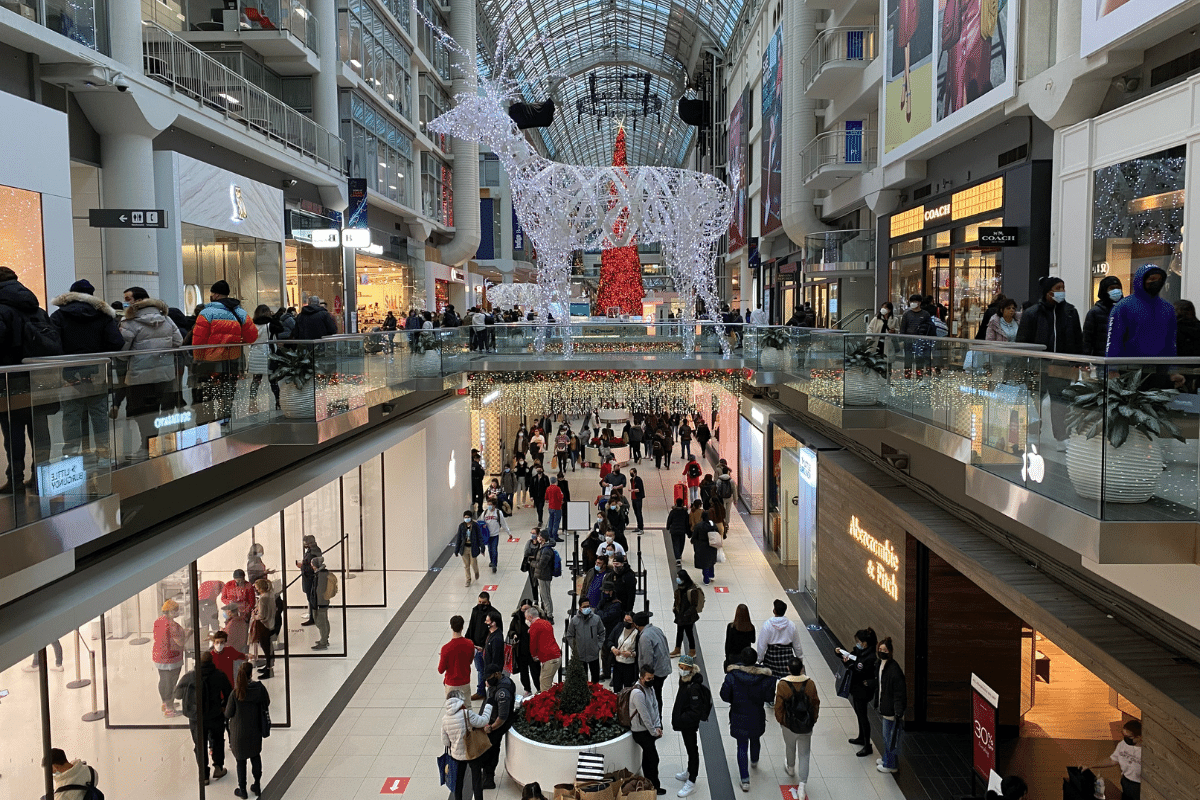
Hudson’s Bay Queen Street Holiday 2022 (Image: Dustin Fuhs)CF Toronto Eaton Centre on Black Friday 2021 (Image: Dustin Fuhs)
Weintraub said 71 per cent of Canadians are likely to shop at Amazon this year versus 62 per cent last year. He said 43 per cent will start their holiday shopping in November versus 35 per cent last year. Everyone is starting earlier and will be done earlier this holiday shopping season.
“Recent holiday seasons have seen Canadian consumers cycle between cautious optimism and concern. This year, they’ve been exposed to a seemingly endless cycle of negative news, including economic uncertainty, high inflation, rising interest rates, geopolitical upheaval, general “pandemic hangover,” new or resurgent diseases, and more. It will be hard for Canadians to find reasons for optimism when there is so much Ambiguity,” said the report.
“Across income brackets, consumers have seen their buying power shrink. They’ll be looking for ways to stretch their dollar this holiday season. For some, that may mean choosing new products; for others, it might mean spending more time looking for the best deals. While some will strive to make purchases that reflect their sustainability and/or ethical values, others question whether they can afford to do so or whether they feel equipped to identify products that are genuinely sustainable and/or ethical.”
Best Buy Black Friday 2021 (Image: Dustin Fuhs)
The report said a growing number of Canadian consumers are signing up for Amazon Prime: 47 per cent say they’re now Amazon Prime members, up from 40 per cent in 2021 and 37 per cent in 2020. However: 59 per cent of shoppers expect their Amazon holiday spend to remain the same this year.
“After a couple of years of having to keep their distance from other people, Canadian consumers want to connect—with friends, families, and even fellow shoppers. Half of survey respondents (51 per cent) say they prefer to shop in-store this season, up slightly (49 per cent) from last year, to interact with products, take advantage of better prices and promotions, and avoid shipping costs. They’re planning to visit more stores, too: 5.9 on average, up from 5.3 in 2021, but still shy of pre-pandemic levels (6.4 in 2019). They also plan to spend more than half (56 per cent) of their holiday budget in a physical store, compared to 41 per cent online,” added the report.
“Canadians from coast to coast to coast have been through a lot these past few years and although they’re resilient, they’re understandably fatigued. Even as fears about COVID-19 fade, consumers are living in a highly charged state of anxiety, with recessionary concerns, inflationary pressures, and rising interest rates top of mind. These economic and financial concerns are likely leading Canadians to focus on their personal finances and short-term needs, which is reflected in the planned reduction in holiday spending.
“Retailers will need to do more than sharpen prices to win the hearts of consumers this holiday season. If communicated in a genuine and authentic manner, they can offer moments of respite by demonstrating empathy and an understanding of what their customers are feeling. The holiday period can be stressful in the best of times, and consumers will be making tough spending decisions as they work to take care of their families’ needs.”
Retail Insider is streamlining its Canadian retail news from around the web to include a handful of top news stories that can be viewed quickly during the day. Here are the top stories from the past 24 hours.
Video Interview: Inflation To Impact, But Not Reduce, Holiday Spending [Survey]
Jennifer LaForge, GM, Rakuten Canada, discusses the impact rising costs and inflation will have on holiday spending this year.
LaForge talks about the importance of sales and promotions such as Black Friday and Cyber Monday, the circular economy, loyalty and cash back programs, and the popularity of gift cards.
The Video Interview Series by Retail Insider is available on YouTube.
Connect with Mario Toneguzzi, a veteran of the media industry for more than 40 years and named in 2021 a Top Ten Business Journalist in the world and the only Canadian – to learn how you can tell your story, share your message and amplify it to a wide audience. He is Senior News Editor with Retail Insider and owner of Mario Toneguzzi Communications Inc. and can be reached at mdtoneguzzi@gmail.com.
Also check out the other series offered by Retail Insider, including The Weekly podcast and The Interview Series, which are both available on Apple Podcasts, Stitcher, TuneIn, Google Podcasts, or through our dedicated RSS feed for Simplecast and other podcast players.
Jill Yoga, a Canadian brand under the parent company of Ranka, has recently opened its new concept store at Hillcrest Mall in Richmond Hill.
The Ranka Group of Companies, formed 45 years ago to cater to a market asking for reasonably priced apparel and home product, added Jill Yoga under its umbrella to focus on active wear for women and girls. Jill Yoga opened its doors on October 1st and unlike other retailers, the new concept store will have a retail space that will include a yoga studio where customers can enjoy free yoga classes.
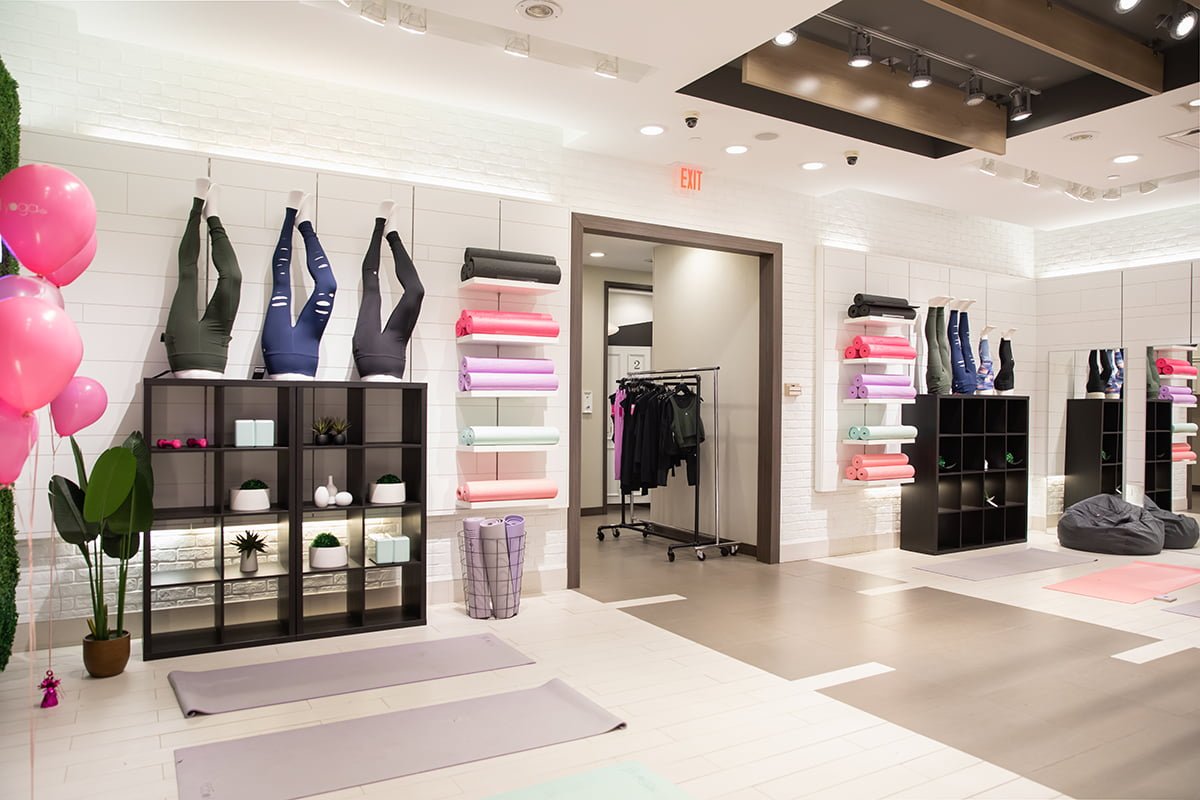
Yoga Studio
Jill Yoga at Hillcrest (Image: Jill Yoga)
The Yoga Studio started before the pandemic and was only once a month, now it has expanded to multiple classes every week.
“Our first pop-up location was at CF Shops at Don Mills three years ago and once a month we would have yoga classes and it was well received. Mothers would come in with their daughters, grandparents, and family would come in to do yoga together. This time around, we thought we would incorporate a studio space right into the store so we could have classes all week and it would be part of the retail experience. The pop-up at Hillcrest Mall is our first experiential pop-up. I say that because the pop-ups we have had previously, did not have the studio space inside,” says Nina Snow, the Creative Director of Jill Yoga.
The yoga studio is in the back of the store and can be expanded depending on the size of the class. Jill Yoga has partnered with three instructors, one is Little Yogis and is Toronto based. This group focuses on children’s yoga, ages three to six, will be sending instructors to the studio, and will have two sets of classes for different ages. One class will be for toddlers and the other class will be focused on children six years of age and above. The instructors will be focusing on yoga activities and will sometimes bring in toys and offer mindfulness activations.
Jill Yoga at Hillcrest (Image: Jill Yoga)
Jill Yoga has also partnered with two individual yoga instructors, and they will be focusing on bringing classes that are for mom and baby class, family class, and kids play which will include different activities for kids and not just yoga.
“The mom and baby class during the week will be interesting for the moms and babies in the area who are at home. Yoga for kids is an amazing thing. The world and their lives are so full of distraction and being able to give them skills such as focusing, mindfulness, and the ability to get off their devices for around 30 minutes are things they can carry with them every day. This is a wonderful practice that kids really enjoy.”
All the classes offered at Jill Yoga are offered free of charge as part of the retail experience at Jill Yoga.
Fashionable Clothing for Women and Kids
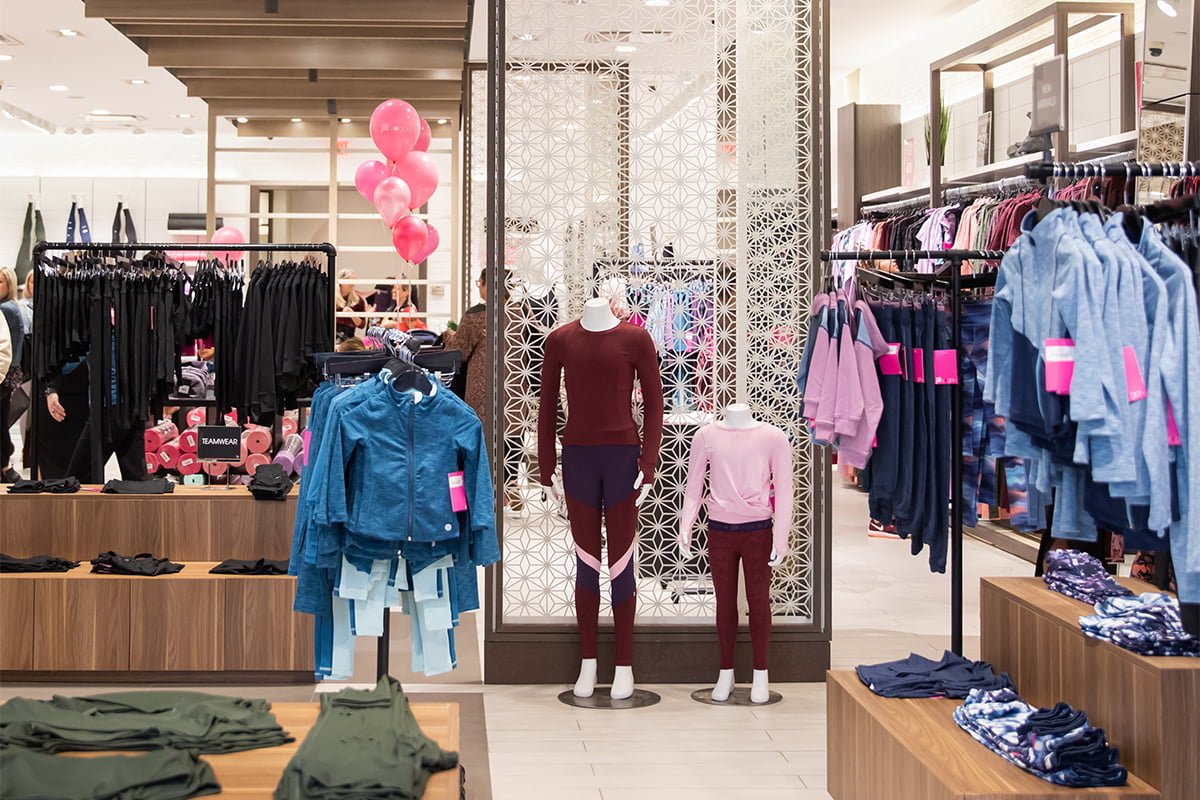
Jill Yoga at Hillcrest (Image: Jill Yoga)
Jill Yoga has a wide variety of products including active wear for women. Clothing sizes go all the way down to six months old. Customers can also find a wide variety of yoga accessories such as yoga mats and bags.
“We do fashion active wear, and it is all ages. It is for women and girls and starts at six months and goes all the way up through women’s sizing. It also gives a unique opportunity for a mom and daughter to match. So, we have a Mommy and Mini line, and it is adorable. We see it in a lot of classes, where people come in and dressed in Mommy and Mini – dressed alike and doing yoga together.”
Jill Yoga’s products, such as the Mommy and Mini line, are also carried at Hudson’s Bay stores across Canada.
What is Next for Jill Yoga?
Jill Yoga at Hillcrest (Image: Jill Yoga)
Snow said the goal will be to open five new stores within the next two years. The difficult task will be to find a retail store that will also include a studio space so all its stores can continue with the new yoga studio concept.
“We do plan on moving forward with it, we just haven’t had a chance to decide where, when, and to put a plan together. But we would like to go forward with the experimental location where we do have a studio in the space. We are hopeful that the next expansion will be opening five stores within the next two years. We will venture out of Ontario, but the first few will be in Ontario, and we will see how it goes.”
Jill Yoga is also looking at expanding its class selection to add more breathing classes for kids, mindfulness, and “we really want to see what we can bring to the area in terms of health and wellness.” Snow said one thing it will be bringing in is dance classes for kids.
“We have the permanent studio space in the store, so we are looking at a wide variety of health, wellness, mindfulness, and interesting classes that will be posted on our site. We are coming out of the pandemic, and everyone has been inside – so, it has been well received. Kids can come out and have fun. We are bringing fun back and it is combined with a great retail experience. We are putting the joy back into yoga.”
No Frills in Sydney, Nova Scotia (Image: Field Agent Canada)
“Following the path of many grocers around the world, Loblaw became the first Canadian grocer to voluntarily freeze food prices. While non-cynical Canadian shoppers will appreciate the grocer’s empathetic gesture, such a move was long overdue.”
For weeks now, many have called for Canadian grocers to voluntarily freeze prices for some main staples at the grocery store as we weather the current food inflation storm. Many Western economies have seen price freezes from grocers, including German giant Lidl and the well-known French multinational Carrefour. The first grocer in the world to do this was more than six months ago. Canada has had no grocer pursuing this strategy; none, that is, until now. As of this week, Loblaw Companies Ltd. became the first Canadian grocer to voluntarily freeze prices for a variety of food products.
In an unprecedented move, the number one grocer has frozen prices for over 1,500 privately labelled products sold across the country until the end of January 2023. For Canadian shoppers, especially the 25% who are having a hard time coping with food inflation, it was long overdue.
For months now, Canadian grocers—all of them—have been continuously criticized by consumers and politicians for price gouging. It even pushed Ottawa’s standing parliamentary committee in agriculture to launch an investigation on the matter just a few weeks ago. The industry desperately needed to do something for its own reputation.
Some of the criticism was expected, and likely deserved. Given what happened with the bread price fixing scheme, few consumers have forgiven the industry, even after all this time. In December 2017, Loblaw and Weston Bakeries admitted to having been part of a bread-price fixing scheme for fourteen years. Indeed, Canadians were able to apply for a 25-dollar gift certificate, but not one single person in the industry was fined or went to jail. Things would have played out differently in the United States. Americans don’t mess around with companies trying to undermine the free market.
In our grocers’ defense, though, financial numbers aren’t necessarily telling us that grocers are abusing their oligopolistic powers, even in the current inflationary environment. Many will want to believe it, but the evidence is just not there. Canadian grocers have done well, but gross margins have remained anywhere between 2% to 4 %. Loblaw’s numbers are slightly higher than usual this year, but it’s nothing like in other economic sectors.
Image: Loblaw
Take banking for instance. Last year, the Royal Bank of Canada alone made more money in one single quarter than what all Canadian grocers combined made during the entire fiscal year. That list includes Loblaw, Sobeys, and Metro. Banks are making a killing while shelter costs are also impacting food affordability. Many Canadians are paying more to have a roof over their heads, mainly due to higher interest rates. Paying more for shelter will compromise food budgets eventually. According to Statistics Canada, 56% of Canadians are currently concerned about whether they can afford housing or rental costs. Also, in a recent survey, more than 7% of Canadians are now using a credit card to pay for groceries without knowing when they will pay their balance back. Interest rates charged by banks add to these outstanding amounts.
While some will appreciate Loblaw’s empathetic gesture, the grocer’s latest campaign will likely bring some cynicism along the way. Some will state that freezing prices for a while is an admission of guilt by Loblaw. Not necessarily. Food inflation is a worldwide phenomenon. The entire global agri-food sector has been severely impacted by higher costs. Even if Canada has the third-lowest food inflation rate amongst G7 countries, Canadians could not have been spared. Some will also claim that other products will increase even more, penalizing those who don’t want to buy products that are part of the campaign. That is certainly a possibility, but freezing prices for more than 1,500 products for more than three months in food retail is quite the statement. Anyone involved in the industry will appreciate that.
The Consumer Price Index (CPI) for September, the next one, will be released this week on October 19. Even if Canadian grocers should have done this a while ago, Loblaw did choose the right week to somewhat tame the eventual barrage of profiteering accusations that always come with the CPI report. The report will likely remind Canadians once again that feeding ourselves has gotten more expensive.
In the grand scheme of things, Loblaw’s move was easy to execute. Negotiating with contract manufacturers which support the grocer’s brands is not that challenging. It just needed a plan. The campaign is powerfully symbolic and will show that grocers in our country do have a heart. Let’s hope other companies follow suit.
Amazon Canada is launching the return of the Amazon Designer Spotlight, which is an exclusive online fashion series celebrating six Canadian designers, hosted by celebrity stylist Brad Goreski.
Vickie Gu
“At Amazon, we are committed to fueling Canada’s fashion industry by giving locally-loved products a nationally accessible platform that helps them thrive,” said Vickie Gu, Head of Amazon Fashion in Canada. “Canadians rally around supporting small; this video series brings a sense of community to shopping from home by helping consumers feel connected to what they are wearing, and who they are supporting through these purchases.”
The series takes Amazon.ca customers alongside Goreski as he unveils each designer’s personal and professional story in two-minute shorts dropping every day on the Amazon Canada Instagram channel (@amazonca).
The first video drops today at 9 a.m. ET / 6 a.m. PT, with the final video premiering on Saturday, October 22. All six designer collections are also available now for customers to shop and discover at amazon.ca/DesignerSpotlight.
“It basically takes customers and viewers alongside Brad as the videos basically (tell) their personal and professional stories. So each of the videos kind of goes through how they got their start. What inspired them to be a designer and then to where they are now launching their brands on Amazon,” said Gouveia.
He said the campaign is an extension of Amazon’s work with Canadian small businesses.
“We’ve offered virtual shelf space to Canada-based sellers, many of which are small businesses, for almost 20 years now. This is an extension of our work with small businesses, more specifically in the fashion category. It’s a way for us to highlight these great talents and designers across Canada by giving them a way to share their stories and also launch their collection. Five out of six of the designers are launching both their collections and brands on Amazon for the first time and one has already been selling on Amazon for a couple of years now,” said Gouveia.
Amazon Canada launched the 2021 Small Business Empowerment Report, which shared that from January to December 2021, Amazon selling partners in Canada sold more than 100 million products. This averaged more than 200 items sold every minute, with most third-party sellers being small- and medium sized businesses.
Amazon Designer Spotlight (Image: Amazon Canada)
Collections in each video are worn by influencers that are unique to each designer’s brand, connecting creatives in communities across the country. Designers also share in the videos how they are choosing to pay it forward to Canada’s fashion community through their Amazon-powered $25,000 give-back-grant.
“We just thought that was important because so many of these designers along the way they’ve needed funding or support to kind of get their brands off the ground as any small business does,” said Gouveia. “So this is just a way for them to kind of pay it forward and I think also for customers to know that what they’re supporting is also going back to a good cause.”
Image: Amazon Designer Spotlight
The six Canadian designers and recipients are:
L’Uomo Strano creates affirming wardrobes for gender-non conforming people and their allies. Designed by Mic. Carter [they/them] in Toronto, the brand is invested in how clothing can foster self-expression and a sense of community. Carter has shared their grant with the fashion department at Toronto Metropolitan University, offering education in communication, design, textile and material practices, and design leadership;
Hilary MacMillan is a fashion-first lifestyle brand, rooted in making a statement with size inclusive clothing and building women up. Designer and brand owner, Hilary MacMillan [she/her], pulls inspiration from her Scottish heritage, love of art, Canadian landscapes and design decades throughout history. Blanche MacDonald Centre is a worldwide recognized fashion, design, and beauty school in Vancouver, and the recipient of MacMillan’s grant;
Entin Gartini is an Indonesian brand based in Montreal that uses one-of-a-kind handmade batik designs created by Entin Gartini [she/her]. Gartini selected Dress for Success Montreal as the recipient of the grant. The non-profit provides professional attire and development tools to women so they can gain economic independence;
Valmora is a contemporary brand born out of Montreal. Matteo Valmora [they/them] is the Founder and Designer and strives to dismantle binary conceptions of menswear by inspiring men to seek non-gender conforming fashion. The recipient of the grant was not released. The grant recipient will be announced in the near future;
Hunter & Trove is a jewelry brand based in Vancouver, founded and designed by Yulee Harris [she/her]. Harris loves to create beautiful pieces that spark joy and create memories. Hitting close to home, Harris has selected the Jewellery Art and Design program at Vancouver Community College that educates students on the design, fabrication, and history of jewelry, as a recipient of the grant;
Mobilize Waskawewin is an Indigenous-owned streetwear brand based in Edmonton. Designer Dusty LeGrande [he/him] aims to bring representation for Indigenous peoples and strives to empower, educate and help others find identity. Mobilize Waskawewin is “street wear with a Cree flair.” The grant will be shared with The Next Gen Scholarship – a resource allowing for authentic sharing of knowledge, business, design, and art practices to break barriers by supporting the next generation of designers.
Belicia Chung
Belicia Chung, Marketing Manager at Amazon Canada, said all the designer stories are “very unique, they’re very touching. We have two gender non-binary brands. We have the first jewelry brand that we’re launching this year. So there’s a couple of first-time categories in designers that we’re launching this year.”
Retail Insider is streamlining its Canadian retail news from around the web to include a handful of top news stories that can be viewed quickly during the day. Here are the top stories from the past three days.
While total Canadian retail sales increased 10 per cent in the first half of the year, apparel only sales, during the same period, increased 42.9 per cent, according to a report by Trendex North America, a marketing research and consulting firm.
The report indicated that men’s apparel sales (+58.6 per cent) increased at a faster rate than women’s apparel (+38.3 per cent).
Also, apparel sales in the first half of 2022 were 5.7 per cent greater than in the pre-Covid period of January-June 2019.
“The two dominant trends in the first half of 2022 were the lack of growth for activewear/loungewear sales, and the significant increase in dress apparel sales. In the first half, men’s dress apparel sales increased 112.5 per cent, while the same category for women increased 49.8 per cent. Both increases were the largest in the respective gender segments,” said the report.
“Ecommerce sales continued to struggle in the first half as consumers lost all inhibitions as to shopping in malls/stores. During the period, total e-commerce sales fell 18.1 per cent.
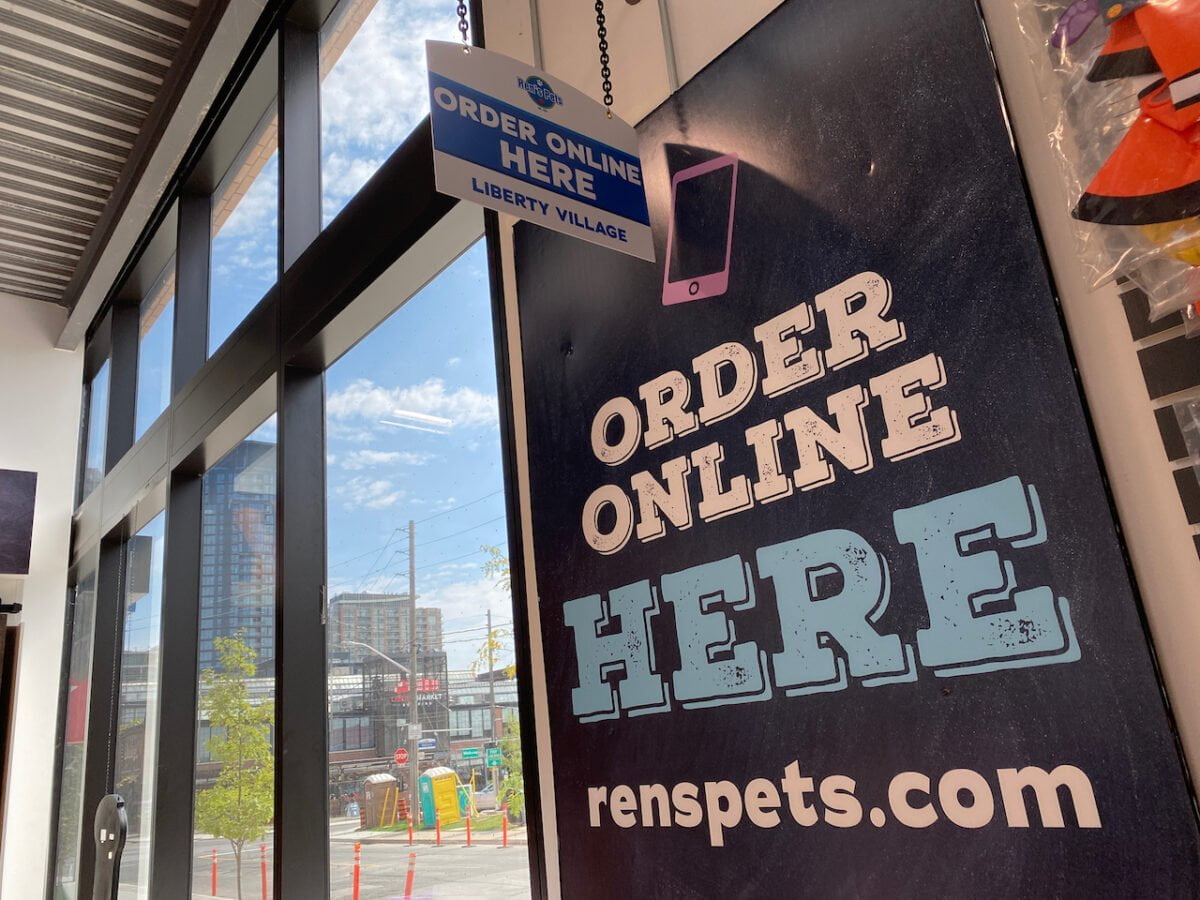
Ren’s Pets Online Ordering at Liberty Village (Photo by Dustin Fuhs)
“During the first half of the year there was concern that the overall increase in the inflation rate would cause consumers to cut back on their discretionary purchases including apparel. The concern, while logical, did not manifest itself year to date. The torrid increase in retail apparel sales in the first half of 2022 will not be repeated in the second half, as apparel retailing almost returned to normal at the beginning of the fourth quarter of 2021. Trendex is forecasting that apparel sales will increase 7.5 per cent in the second half of 2022 and by 19.4 per cent for all of 2022. Trendex forecasts are based on the assumption that apparel prices in the second half of 2022 will not increase by more than two per cent (y/y) and the overall rate of inflation will fall to 4.5 per cent from 5.5 per cent. An increase greater than six per cent in the overall rate of inflation would almost certainly negatively affect spending on apparel. If Trendex’s estimate for all of 2022 is correct, it would mean that apparel sales in 2022 would end up being 6.1 per cent greater than in 2019.”
Randy Harris, president and owner of Trendex North America, described the Canadian apparel market as experiencing “incredible growth.”
Randy Harris
“The first major reason is that in the first half of the year there were no pandemic restrictions on shopping compared to a year earlier. So people came back to the malls with a vengeance, if you will,” he said.
“Secondly, men’s sales were extremely strong in the first half of the year and that is due to the fact that men’s dress apparel, suits and sportcoats, had extraordinary growth because people have returned to the office and therefore they have to buy more dress clothing.
“The same thing happened with women’s dress clothing but to a far lesser extent. What we do see parenthetically is the growth for what I would call leisure apparel has ended in the first half of the year as people return to the work environment. Now in the process, they have substituted buying comfort clothes with dress apparel and that is much more expensive per item. The units might be the same but the dollars spent per unit has gone up drastically.”
Harris said the only disappointing spot in the first half was the decline of e-commerce.
Top Top Markham (Image: Tip Top)
“Some people will say that consumers are simply coming back to the stores instead of buying online. But some people who don’t buy online stopped buying apparel during the pandemic.
“The fact that people are coming back to the stores is helping all age groups and causing all age groups to buy more,” added Harris. “The other thing that people don’t recognize is when people tend to go into stores in Canada to buy apparel, they tend to buy multiple items as opposed to going on and ordering a specific item online. So the incidence of multiple purchasing in-store is greater than online.
“There’s also a lot of promotional selling going on as retailers are trying to adjust their inventories in time for the holiday season. Their inventories are out of whack in a sense over the last two years and now they’re starting to get everything back in order but in order to do that they have to have promotions.”
Harris said the opening up of tourist travel to Canada has increased the luxury apparel market in the country.
“What we have here is an alignment of planets where six or seven things came together to boost apparel sales. Now the bottom line is that the growth in the first half continued, at least through August, and apparel sales were up 37.4 per cent but as we move into the end of the year, the growth rate will slow down dramatically because by the fourth quarter of last year a lot of shopping restrictions had been lifted if not all of them. And that’s why we had a very, very strong Christmas season for apparel last year because in effect there were no restrictions on in-store shopping,” explained Harris.
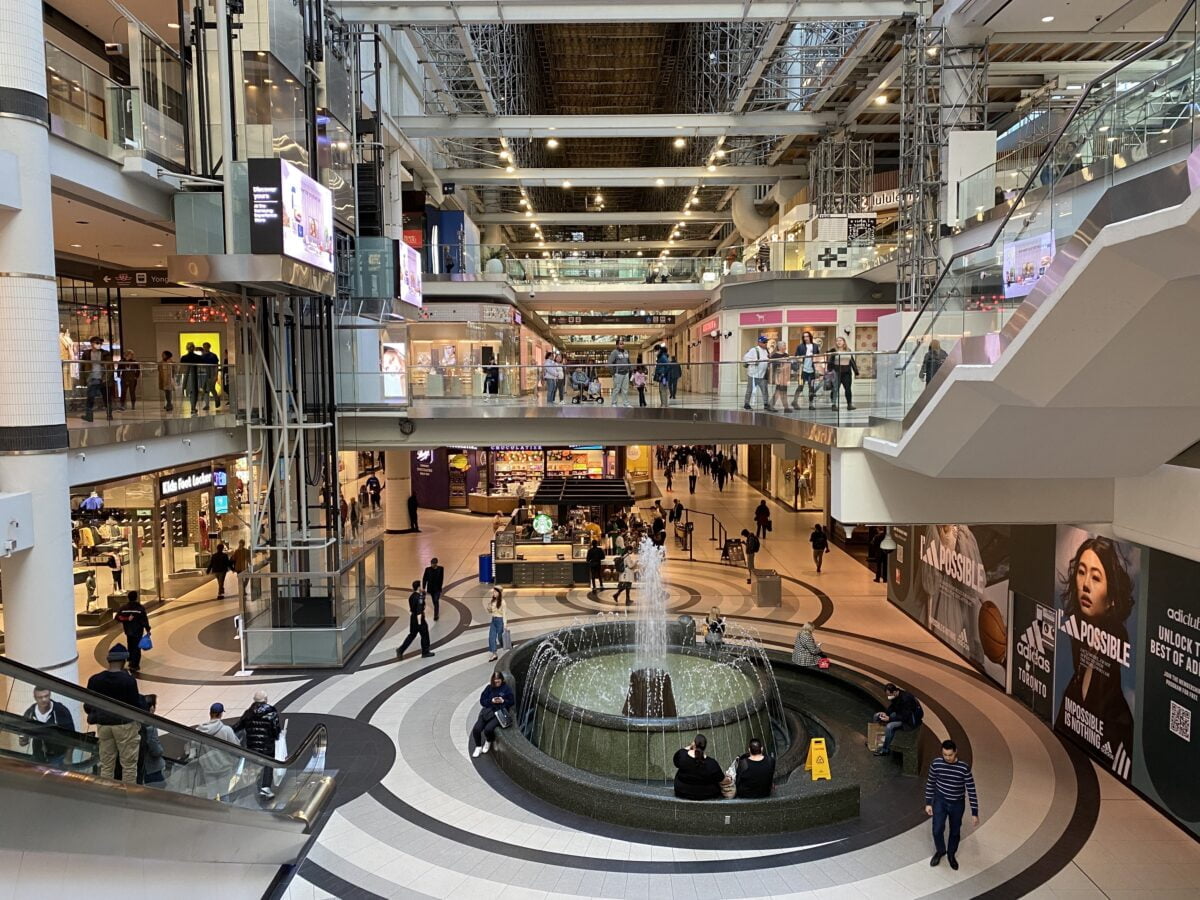
CF Toronto Eaton Centre (Image: Dustin Fuhs)
The Trendex report also looked at what has been recently happening with Hudson’s Bay in Canada, posing the following question: “Is Hudson’s Bay flailing along to simply generate topline sales, or is there a credible long-term strategy underlying its numerous new initiatives since being taken private?”
“Recently Mark Cohen (X-Sears Canada, CEO), indicated that many of HBC initiatives have been designed to address the underperforming space in its stores. This publication is in complete agreement, however the question is whether each initiative will, in fact, increase its stores’ productivity, while not detracting its image. From Trendex’s perspective, many of the initiatives HBC has undertaken are consistent with the objective of increasing its stores’ productivity,” said the report.
“Closing its “mausoleum” stores in Winnipeg and Edmonton were no-brainers, and if truth be told, should have happened at least five years earlier. Given the proximity of HBC’s Bloor St. store to its flagship store, closing the store also seems to be long overdue.”
MEC at Hudson’s Bay Queen Street (Image: Dustin Fuhs)
Potential winners of The Bay’s initiatives include launching a marketplace and adding MEC (Mountain Equipment Corporation) shop in shops.
“Even though there are already a number of e-commerce marketplaces, what sets HBC’s offering apart is that its marketplace customers can use their Bay credit card and acquire Bay loyalty points. This initiative has the potential to significantly increase sales, especially with existing customers and those that are not traditionally HBC customers,” said Trendex.
“HBC’s sporting goods business is underdeveloped as a consequence of both the strength of the segments’ competitors and the profile of the HBC customer. For this partnership to be successful, it needs to be implemented in markets in which MEC does not have a presence and be highly publicized.”
The Trendex report said only time will tell on the retailer’s initiatives with its spin off e-commerce including partnering with children’s reseller Rebelstork.
“As HBC’s infant’s apparel/equipment business is minimal, therefore this initiative becomes a means to increase its sales in the segment. However, after sharing the revenue the direct sales benefits will be minimal unless it leads to additional infants’ sales,” said the report.
And Trendex listed the following as “Just Plain Bad Initiatives” – adding Forever 21 shop in shops and Zellers.
“Previously this publication has made no bones about its view of the decision of HBC to replace its Top Shop/Top Man boutiques with Forever 21, a failed retailer. Why HBC thinks that young women will beat a path to its new fast-fashion shop in shops is a mystery. It should be noted that already three of the Forever 21 shops in HBC have been replaced by MEC shop in shops.
“Easily the most misguided of The Bay’s initiatives is adding Zellers shop-in-shops, at least for now, in a limited number of its stores along with adding Zellers products to its Marketplace. Speaking in favor of the initiative was Tanya Mark associate professor at the university of Guelph, who noted that, “The Bay needs to attract and retain customers to be successful, Zellers will bring in a new customer and increase the value of the shopping basket for those who already shop at HBC”. To which Trendex responds, “au contraire”. While the plan to add a Zellers section to HBC’s Marketplace is logical, having a shop in shop for Zellers branded products runs the risk that HBC’s image will be denigrated, and Zellers purchases could cannibalize HBC’s sales.
“Some pundits have questioned whether HBC’s recent initiatives mirror those of Sears Canada in the period just prior to its demise. From this publication’s perspective the situation of both retailers, is only at best, marginally similar. As others have rightly noted, Sears Canada’s downfall was directly attributable to: Being starved for investment capital by its U.S. parent, a failure to capitalize on the potential for e-commerce and its post Marc Cohen inept leadership. HBC needs to be acknowledged for its willingness to undertake initiatives, but it needs to also recognize that some might result in a short-term gain but a long-term loss.”
Retail leasing in Vancouver continues to be robust with vacancies continuing to trend downwards and the expectations for the second half of 2022 continue to stay strong, as the retail market has been resilient throughout the summer months, says a new report by commercial real estate firm JLL.
Asking retail rents have stabilized over the summer but are expected to slightly rise over the following months. Due to the current tenant demand we are seeing, net rents are expected to feel slight upward pressure while vacancy rates decline even further,” said the report.
“The retail space has become even tighter as availability further drops from the previous quarter and developers postpone construction due to an increase in construction costs,” said JLL.
“Food services and bars have made a tremendous comeback over the summer and sales have been trending upwards . . . Enclosed malls are continuing to thrive with increased consumer confidence and a desire to be in a more social setting. In aggregate, sales per square foot in major malls have surpassed pre-pandemic numbers in Q2 2022. Completion of mall re-developments will further enhance the enclosed mall shopping experience.
“Mixed-use developments with retail components are occurring in the suburbs because of land shortages and the high prices in the city. These developments in the suburbs are being pre-leased at a quick rate, which is contributing to the decrease in vacancy.”
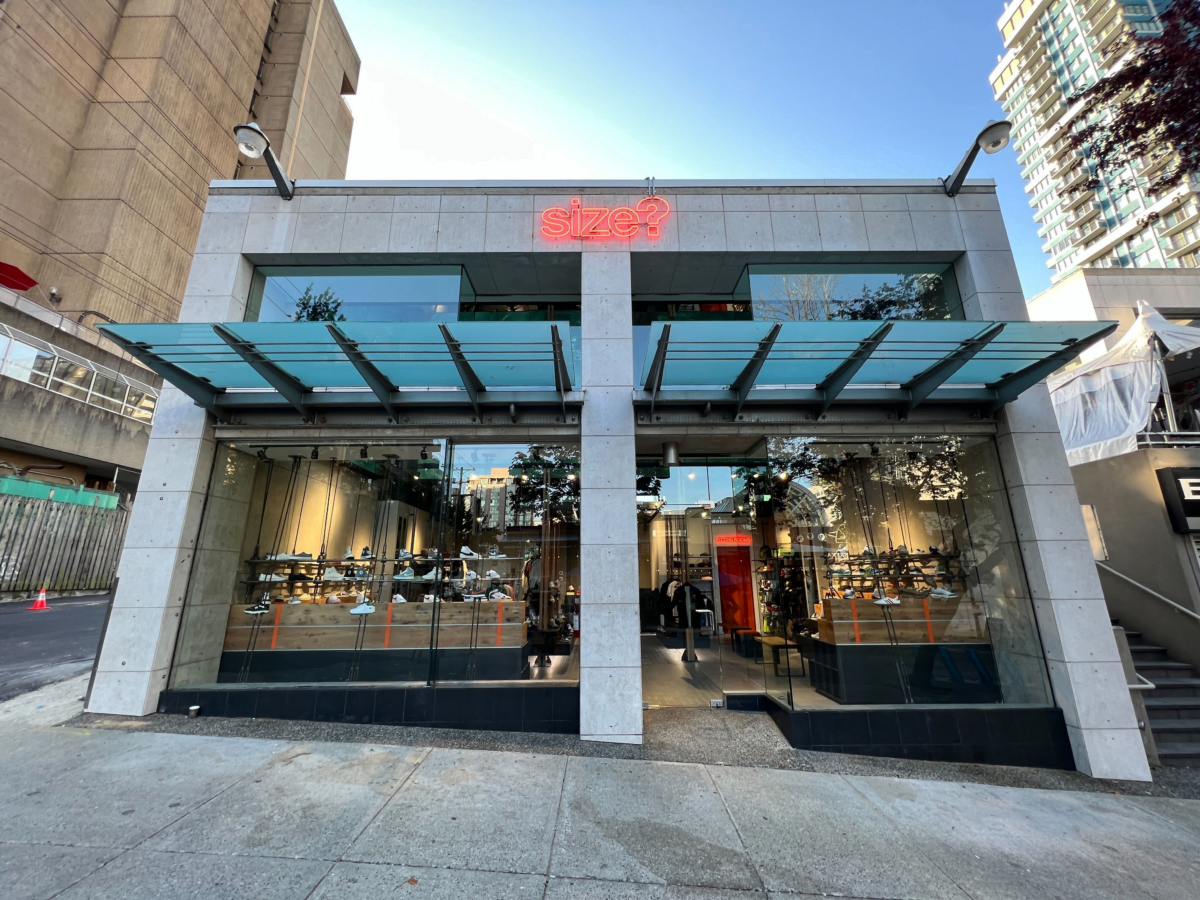
Exterior Storefront of size? Vancouver. Photo: Lee Rivett
Trevor Thomas, Vice-President with JLL, said there has been an uptick in daytime population with many people returning to work in offices. What has also helped the retail market is the relaxation of travel restrictions and the return of cruise ships to the West Coast.
“The demand is outpacing supply which obviously puts upward pressure on rents. But one of the realities that a lot of the retailers that have been around for a while are facing today is these new market rents,” he said.
Trevor Thomas
“There are a lot of retailers waiting on the sidelines waiting to jump in for the right opportunity and so it really doesn’t give these retailers much leverage with the landlords in their renewals.”
Thomas said the market is going to continue to stay strong.
“We’re going to start to see a lot more new to market retailers landing in Vancouver. We’re certainly on the map. It’s on the radar for a lot of brands that aren’t here or are looking to expand. I think we’re going to start to see a lot more of that,” he said.
“I think we’re going to start to see a lot more off market deals with a lot of these pending natural expiries coming up. Retailers are pretty savvy of identifying places where they might be able to replace retailers. We’ve already seen that happening in the past quarter. We did a couple of off market deals on Robson Street.
“The vacancy in the last few years has only gone down. Vancouver kind of skated through this (pandemic). We didn’t have the mass closures and shutdowns. So the retailers on the street did well. There’s still a lot more vacancy in some of the enclosed malls, not necessarily the majors but in the B and the C malls.”
Park Royal (Image: Lee Rivett)
JLL said the trend to move in remains stronger than the trend to move out, as tenants are thoroughly searching for old and new vacant spaces to start their businesses.
“Interest rates are having a negative impact on construction as developers have put a pause on their development plans. As interest rates continue to rise, the costs for developers to take out construction loans also rise. This will put even more pressure on net rental rates in a retail market that is already seeing extremely low vacancies,” said the report.
“Demand for more talented employees is also leading to rising labour costs. These additional costs are being passed down by landlords to tenants, contributing to higher rents in new build retail assets.
“Desire for experiential retail has been increasing, as evidenced by the opening of a flagship store for Vancouver- based brand DUER. More consumers are looking to engage in retail that has some aspect of experience that will leave them with a lasting memory.”
Image: DUER
JLL said the sales per square foot will continue to trend upwards through the end of 2022. Foot traffic should gradually approach its pre-pandemic level by the end of 2022, as shoppers become less hesitant to go to physical stores. As a result of consumers spending more time hanging out and browsing in the malls, sales per visit should drop down in the second half of the year.
“Compared with the pre-pandemic level, the vacancy rate has slightly risen, but remains relatively low. The vacancy rate is expected to decline as leasing activities and openings increase, especially for those shopping centres which are renovating and will attract more tenants,” added JLL.
“Landlords are taking actions to add stronger food operators, such as casual/fine dining restaurants and international brands, inside shopping centres to attract more traffic. Some of the shopping centres, including The Amazing Brentwood, Willowbrook Shopping Centre, and Oakridge Centre are redeveloping new concept food courts/halls by providing more seating, outdoor patios, multiple access points, and updating lighting and décor. The new Courtyard at The Amazing Brentwood will be a benchmark for food court renovations in Canada.
“The mixed-use redevelopment projects for some shopping centres are already in progress. The mixed-use project at The City of Lougheed is arguably the largest redevelopment with a retail component in Canada, with Phase 1 coming in 2023. The redevelopment of Oakridge Centre started in 2019 and is expected to be completed between 2024 and 2027. The construction at CF Richmond centre is in Phase 1. The two-tower mixed-use redevelopment project at Park Royal is in the pre-lease stage.”