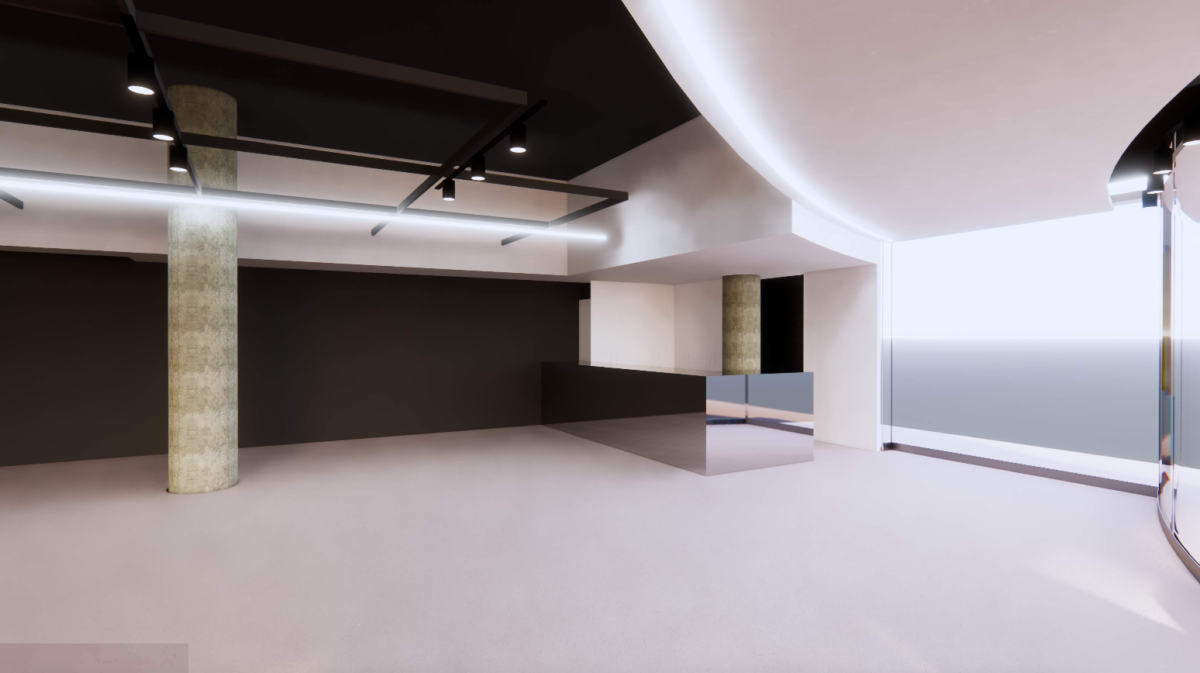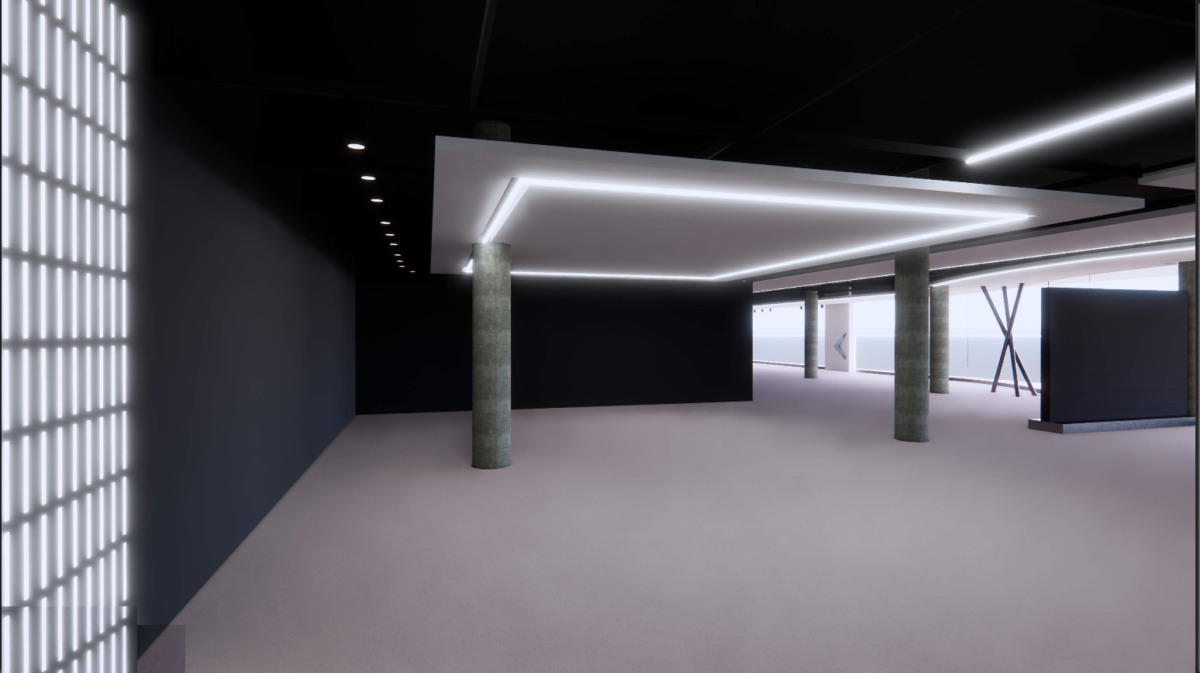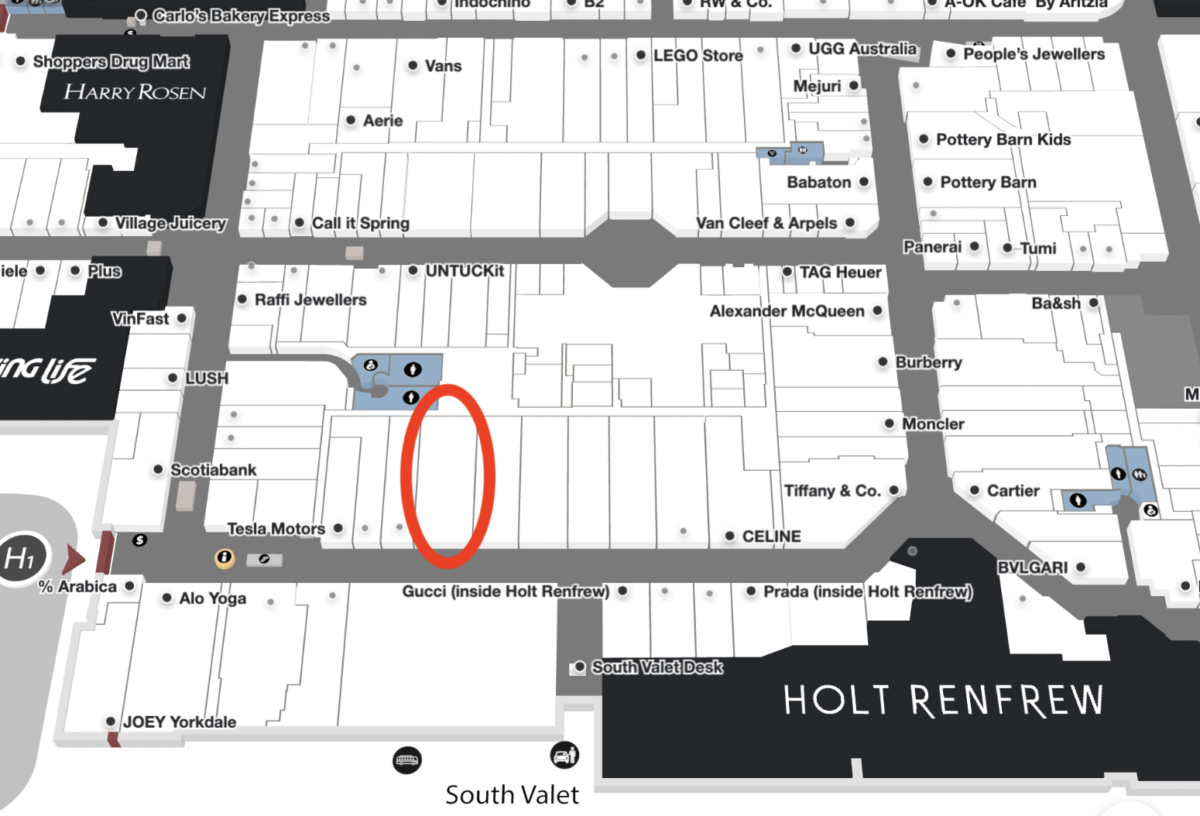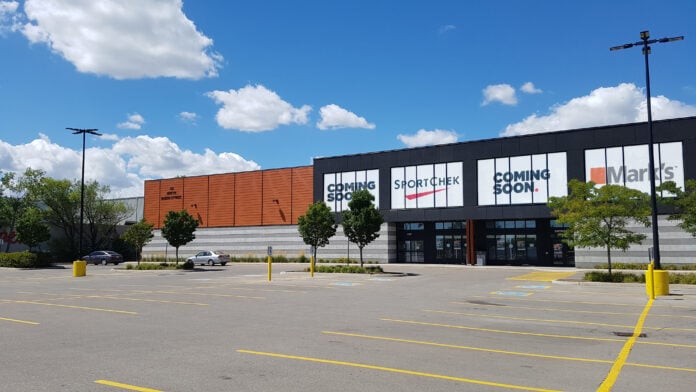
Oregon-based mega brand Nike is building a flagship store at the Montreal Eaton Centre in downtown Montreal. Construction hoarding went up this week on the multi-level store that will boast prominent frontage on Ste-Catherine Street West. The store is expected to open in the spring of 2023.
Nike will replace a large multi-level Gap store that occupied space in the downtown shopping complex for years. Lease plans for the Montreal Eaton Centre show the Nike space spanning about 11,000 square feet at street-level with a second floor measuring a bit over 10,000 square feet. It’s not yet known if a third level spanning nearly 10,000 square feet that the Gap leased will also be occupied by the new Nike flagship.
It’s the second large-format Nike store for the Canadian market following last year’s opening of a 24,000 square foot Nike flagship at Toronto’s Yorkdale Shopping Centre. That store is operated by Tel Aviv-based Fox Group which also recently announced that it will bring Spanish fashion brand Mango to the Canadian market with about 20 stores. In 2017, Fox signed an agreement with Nike Canada to set up a chain of stores in this country over a period of seven years.
Montreal Eaton Centre, image via JLLConstruction hoarding going up on Thursday, July 21, 2022. Photo: Maxime FrechetteFuture Nike at Montreal Eaton Centre (Image: Dustin Fuhs)
The 485,000 square foot Montreal Eaton Centre is home to numerous prominent retailers and prior to the pandemic it boasted the most foot traffic of any mall in Quebec. We recently reported that B2 by Browns Shoes had opened its largest storefront in the centre, joining anchors that include Canada’s largest Uniqlo store, Decathlon, Sephora, Old Navy and Canada’s only Time Out Market food hall. The centre is home to over 150 retailers and is owned by Ivanhoé Cambridge and managed by JLL. In years past a massive Eaton’s department store occupied the eastern portion of the existing shopping centre.
Nike has been opening its own stores while pulling out of many of its wholesale accounts with multi-brand retailers globally. It remains to be seen what retailers in Canada will carry Nike products in the coming years as more Nike stores are built. Sources have told Retail Insider that Nike is expected to open more partner-operated large-format Nike flagship stores in Canada with downtown Toronto and Vancouver said to be targets. Nike also operates a network of smaller standalone stores in Canada as well as several outlets, as well as an e-commerce site.
In years past, Nike operated large Niketown locations in major cities globally, though the concept was scaled back. A Niketown location once occupied nearly 40,000 square feet of space at 110 Bloor Street West in Toronto, which is now part of a Brooks Brothers store in a commercial podium that will soon see a significant redevelopment. Brooks Brothers will soon relocate to 83 Bloor Street West which was formerly occupied by a three-level Hugo Boss flagship store until 2019.
Video Interview: Canadians Continue To Shop Local As Small Businesses Innovate
Don Ludlow, Vice-President of Small Business, Partnerships & Strategy, RBC, discusses how Canadian consumers are continuing to support small business owners.
Ludlow talks about the reasons for the support, how sustainability and social responsibility are helping drive the trend, and how small business owners are looking at innovation, digital solutions and diversification as key aspects of growth.
The Video Interview Series by Retail Insider is available on YouTube.
Connect with Mario Toneguzzi, a veteran of the media industry for more than 40 years and named in 2021 a Top Ten Business Journalist in the world and the only Canadian – to learn how you can tell your story, share your message and amplify it to a wide audience. He is Senior National Business Journalist with Retail Insider and owner of Mario Toneguzzi Communications Inc. and can be reached at mdtoneguzzi@gmail.com.
Also check out the other series offered by Retail Insider, including The Weekly podcast and The Interview Series, which are both available on Apple Podcasts, Stitcher, TuneIn, Google Podcasts, or through our dedicated RSS feed for Simplecast and other podcast players.
Global retail sportswear giant adidas plans to launch its first branded Terrex store in North America in November in the Kitsilano area of Vancouver.
Lesley Hawkins, VP Retail for the company, said globally the first Terrex branded store opened in Munich, Germany in November 2021.
Terrex is adidas’ outdoor brand with an extensive product assortment of footwear, apparel, and accessories.
“Why Vancouver? Because it is absolutely the home of the outdoors. There are more consumers engaged in the outdoors every day in the Vancouver market, as they enjoy an unbeatable array of amenities including numerous outdoor parks, the mountains and the ocean on their doorstep,” said Hawkins.
Terrex Kitsilano Digital Footwear Wall (Rendering: adidas)Terrex Kitsilano Front Facade (Rendering: adidas)
“The location we have chosen on West 4th in Kitsilano is a very busy destination for the young urban outdoor enthusiast.”
The store will be just under 2,300 square feet.
Lesley Hawkins
Hawkins said adidas has a core belief that through sport we have the power to change lives.
“And Terrex is really that invitation for everybody, no matter the body, to embrace a really connected, conscious and adventurous life in nature. Terrex is really an inclusive and inspiring companion to allow you to enjoy and experience the outdoors from start to finish,” she said.
Terrex Kitsilano Left Entrance (Rendering: adidas)
“Within the Terrex brand there are multiple franchises, covering hiking, technical, outerwear, trail running and others. So when I say that it helps from start to finish it’s really for your entire outdoor journey. We truly believe that the outdoors are accessible to all and certainly the last two years we have definitely seen a major increase in people moving outdoors whether they’re running or hiking or walking. And none of it requires you to be a superstar athlete. Terrex allows you, no matter who you are, to engage with the outdoors whether you’re a beginner or an extreme athlete.”
Hawkins said another component of Terrex is the company’s focus on sustainability which ties into the overall brand values as well.
“We are on a mission to end plastic waste. In all areas of our business, adidas is focused on sustainability – from product innovation to manufacturing processes to in-store design. Our Terrex store in Kitsilano will feature resource-saving and recyclable materials in the store design itself.”
Terrex Kitsilano Jacket Wall (Rendering: adidas)
She said the Terrex store itself is a retail destination but it is also a real, true community hub, grounded in the adidas heritage.
“You will have an opportunity to learn about the adidas history and the history of Terrex while in the store, but more than anything, we are looking forward to connecting with the Vancouver outdoor consumer, the community and our product assortment will be tailored to best meet their needs,” added Hawkins.
She said the retailer is expecting to open another four or five Terrex locations in Canada in 2023 with more beyond that.
“Terrex will be expanding globally, although as Canadians are more outdoor focused than other regions, we will be accelerating our outdoor presence in Canada at a faster rate,” she said.
Applications for the Terrex Canadian expansion will be available on the adidas Career Portal.
Retail Insider would like to join Retail Council of Canada in recognizing the winners of this year’s Excellence in Retailing Awards which were held on May 31, 2022. The awards celebrate innovation and the best of the best in the Canadian retail industry.
This is part two of a three-part series where we’ll showcase this year’s winners in the categories of In-Store Experience & Design, Pop-Up Experience and Design, Environmental Leadership, and Supply Chain Innovation.
The following is a breakdown of each of the Excellence in Retail Awards winners in these categories, as well as some background on their outstanding achievements.
Lowe’s team. Photo: Wade Muir Photography
In-Store Experience & Design: Lowe’s Canada
Lowe’s Canada was honoured for its launch of Myredvest, an intuitive platform that provides customer flexibility. Lowe’s says that with its omnichannel mindset it is constantly looking for ways to offer an optimized and seamless customer experience across all channels. The approach led Lowe’s Canada’s IT teams to actively work on a new platform called Myredvest that interacts with many internal systems to simplify cash register usage, making it possible to offer a user-friendly self-checkout service.
What set the project apart in the retail industry is the collaboration that led to designing and managing the new interface in-house, allowing Lowe’s Canada to tailor it to their complex needs. Everything is easy and simple: customers can choose the way they want to be served for the last step of their journey in store, and always benefit from an outstanding experience.
Mobile Klinik team. Photo: Wade Muir Photography
Mobile Klinik: Project Reimagine
Rapidly-growing Mobile Klinik has rebranded and repositioned themselves to evolve their business beyond cell phone repair into the destination for “All things Mobile”. Its ‘Project Reimagine’ has created a new retail experience defined by the four key pillars of the brand, Buy, Sell, Repair, Connect, to provide the complete wireless solution and bring the enhanced brand promise to life for their customers and employees.
Congratulations Mobile Klinik on winning this award for the latest in innovation.
Canadian Tire team. Photo: Wade Muir Photography
Pop-Up Experience and Design: Canadian Tire Corp., Christmas Trail
Canadian Tire recognized the need to keep people safe during the pandemic while also wanting to celebrate the holiday spirit. Building off the success of the 2020 Canadian Tire Christmas Trail, Canadian Tire saw the opportunity to help even more Canadians celebrate the season safely in 2021. The Trail, a one-of-a-kind, interactive drive-along Christmas experience located at Black Creek Pioneer Village in Toronto, officially returned for a second year, providing new and unique Christmas experiences complete with Santa Claus, show-stopping lights, elves, festive music, and treats – all from the safety of guests’ vehicles.
Canadian Tire successfully brought the holiday spirit to many.
Walmart team. Photo: Wade Muir Photography
Environmental Leadership: Walmart for eliminating 680 million plastic bags from our environment
In August 2021, Walmart Canada embarked on a nationwide initiative to remove single-use plastic checkout bags from stores and omni operations. The retailer’s latest contribution to regeneration is projected to prevent more than 680 million plastic bags from entering circulation annually. That’s enough bags to circle the earth approximately 10 times.
Walmart says that it made this change three years ahead of schedule, surpassing its goal of reducing single-use plastic checkout bags by 50% by 2025. Walmart Canada is on a transformative path to become a regenerative company, being one that works to restore, renew, and replenish in addition to preserving our planet, while encouraging others to do the same.
“We’re so proud to receive an RCC Excellence in Retailing Award for Environmental Leadership, recognizing our initiative to eliminate single-use plastic shopping bags at Walmart Canada. Being recognized amongst our peers is an honour – and an opportunity not only to celebrate the work that’s been done by our cross-collaborative Walmart team, but also to inspire our peers as we walk this path to eliminate single-use plastics together.”
Michael Hill team. Photo: Wade Muir Photography
Supply Chain Innovations: Michael Hill Jewelers for its Project Raptor – delivering a quality supply chain transformation
Australia-based jewelry retailer Michael Hill has about 300 stores across three countries including 85 in Canada, 155 in Australia, and 50 in New Zealand, as well as an online presence in all countries. In 2019, its existing supply chain created service and cost challenges in an expanding store and e-commerce operation, particularly in Canada. A key first phase in Michael Hill’s supply chain transformation journey was a requirement to improve distribution capability in Canada.
The transformation initiative was named Project Raptor, after the success of the 2019 NBA Champion Toronto Raptors, in the hope that the project would deliver similar success. Given the adversity facing the project during the COVID-19 pandemic, the collaboration between Michael Hill and its partners Kuehne + Nagel, and the resulting deliverables of cost reduction, service improvement, and technical efficiency, was indeed a championship effort.
The delivery of Michael Hill’s Project Raptor transformed and future-proofed its business. The retailer says that it applied to the Excellence in Retailing Awards for Supply Chain Innovation because it wanted the talented people behind Project Raptor to shine.
Three key aspects of the Michael Hill Raptor project include:
1. The great collaborative effort of the Michael Hill team, not only internally between departments, but with their third party provider, Kuehne + Nagel.
2. Team Michael Hill’s ability and drive to deliver this project remotely despite the many challenges of the COVID-19 pandemic.
3. The amazing benefits delivered commercially for Michael Hill, but more importantly, for the Canadian customers as enhanced service experiences.
There are a lot of exceptional retailers in Canada and to be awarded this prestigious recognition by industry peers is a huge achievement. Congratulations to everyone. Stay tuned for part three of this series next where we profile more winners from this year’s Excellence in Retailing Awards.
Retail Insider is streamlining its Canadian retail news from around the web to include a handful of top news stories that can be viewed quickly during the day. Here are the top stories from the past 24 hours.
Once again, the numbers coming out of Statistics Canada were discouraging. The food inflation rate in the country was 8.8% in June, which is still higher than the general inflation rate. Everyone is affected by higher food prices. Americans learned last week that food inflation at the grocery store was 12.4%, a 41-year high. Despite all of this, consumers can see some light at the end of the long tunnel we’ve all been passing through in recent years.
First, we believe food inflation in Canada may have already peaked. Supply chain challenges are still there, making the movement of goods more expensive, but things are slowly improving. Pandemic protocols around the globe are increasingly becoming predictable, which makes for much easier logistical planning. In February, the Russian invasion of Ukraine pushed commodity prices higher, making input costs an issue for most farmers and food manufacturers. But this seems to have stabilized as well. Markets are much calmer than before, and most important, more predictable. If nature continues to cooperate, Canada’s agricultural sector should see a strong harvest this year, helping to keep commodity prices lower and costs down. Again, more good news.
Since March, food sales at dollar stores have increased by 18%, according to NielsenIQ. Sales at discount stores have also increased by 5% since that period, so consumers are clearly trading down, and grocers know it. More discount store conversions are on the way in Canada. We have seen at least 15 new major discount stores in the country so far this year alone. Depending on the week, consumers can save anywhere between 25% to 40% at a discount store, compared to a regular grocery outlet. Something to consider.
But the Canadian Dairy Commission played party pooper by recommending an unprecedented second increase of 2.5% for September 1, as schools open in the fall. This comes after a record 8.4% hike in February. As a result, the price of butter is up almost 20% since December. In some markets, fluid milk is 25% more expensive than last winter. The 2.5% at the farm will look more like a 6% to 10% at retail, for all consumers. As prices stabilize in most sections of the grocery store, dairy will continue to be the exception for a while.
To add insult to injury, we also learned last week that executives at the Canadian Dairy Commission received bonuses last year, and these are federal employees. The Crown corporation refused to disclose amounts or reasons that bonuses were given. There’s nothing wrong with bonuses, but the lack of transparency is simply unacceptable. Taxpayers and consumers deserve better. Our quota system was designed to make our dairy sector immune to inflationary cycles. Something is not working.
Interest rates are also going up. Last week, the Bank of Canada made an almost unprecedented move, delivering a jolt to consumers everywhere, by raising its benchmark interest rate a full percentage point. This is the biggest one-time increase since August 1998. Since the announcement, mortgage brokers have been busy. For many households, the cost of shelter spiked, making it harder to spend on anything else. But food is a necessity. Before the interest rate hikes, the market was flooded with cash, and some consumers had no qualms about paying $28 for a T-bone steak. This obviously contributed to higher prices in our economy, including at the grocery store, especially for premium products and categories. Well, since fewer people can now afford a $28 T-bone steak, we are expecting some prices to soften or even drop a little. Simple food economics.
With higher rates though, our Canadian dollar will gain strength against the American greenback, making imports cheaper. And we do import many food products. This is likely going to help consumers who purchase centre-of-the-store dry goods, whose prices have skyrocketed recently. But the American Federal Reserve is also planning another rate increase, which could put pressure on our dollar. Interesting times. Higher rates are bad news for mortgage owners, but good news for imports.
Overall, we should not expect prices to drop anytime soon, year to year, but the rate at which food prices are rising is slowing down. Food inflation is critical for our food economy, but a 10% rate is just not sustainable. As predicted in December of last year by Canada’s Food Price Report 2022, we should end the year at about 7%, as forecasted, unless some other geopolitical crisis occurs. This is still high, but it’s not 10%.
Canadian luxury apparel sales saw a rebound in 2021 but not enough to return to pre-pandemic sales levels, according to a new report by Trendex North America, a marketing research and consulting firm.
The report indicated sales reached almost $2.4 billion last year which was a 12 per cent hike over 2020, a year where sales dipped by 21.8 per cent from 2019.
And Trendex is forecasting sales to continue to climb by 15.2 per cent year-over-year in 2022 with solid growth in the coming years, reaching over $3.2 billion in sales by 2026.
The Trendex report said any forecast of luxury apparel sales from 2022-2027 has to be based on the assumption that there will be no pandemic-related shopping restrictions and that, at a minimum by early 2023 foreign tourism will revert to 2019 levels. With these caveats in mind, Trendex is forecasting an average increase of 4.75 per cent in luxury apparel sales during the period 2023-2026.
Nordstrom at CF Toronto Eaton Centre (Image: Dustin Fuhs)
Randy Harris, president and owner of Trendex North America, said the luxury market is in the process of returning to pre-pandemic levels.
“The only thing that’s holding back the growth right now of the luxury apparel market is the fact that many tourists, especially from Asia, are still not coming into the country and they’re a very important segment of the luxury market,” he said.
“Otherwise, the market itself is improving and about the only thing that could throw a wrench into it is the downturn in the economy or a drastic drop in consumer confidence. But I am very optimistic about the growth of the luxury apparel market in Canada. It should grow probably two to three times faster each year going forward than the total apparel market.”
Harris said many things are driving that growth including more young people purchasing more luxury apparel. Also some new flagship stores are acting as a magnet to draw people.
Harry Rosen at CF Toronto Eaton Centre (Image: Dustin Fuhs)
“You’ve got the growth of luxury athleisure apparel which is a whole new category that’s been exploding over the last couple of years but recently moreso,” he said.
“The only thing that I see as a current drag on it is the sale of luxury men’s apparel, suits and sportcoats. There’s no growth in that market right now at all. That’s one of the reasons retailers like Harry Rosen have moved so dramatically to push their casual wear sales because formal dress apparel is not a growth market right at the moment.”
But Harris said he’s very, very optimistic about the luxury side of the apparel market. It was hard hit in 2020 when the market dropped 22 per cent but it came back by 12 per cent last year with 15 per cent growth this year.
“These are good numbers and the market has really turned around,” he said.
Yorkdale Shopping Centre (Image: Craig Patterson)
The Trendex report said the growth in the 2021 Canadian luxury apparel market was due to a number of factors:
Shopping restrictions being lifted by the second half of the year:
Luxury accessories sales outstripping the growth of luxury apparel;
An increase in luxury activewear sales, a relatively new category;
The increase in e-commerce luxury apparel sales; and
An increase in mono luxury apparel flagship stores.
While these factors all contributed to luxury apparel sales growth they were offset by:
A continuing reduced level of foreign tourists. In 2020 the number of foreign (non US) tourists fell 84.4 per cent. Last year the number of foreign tourists was 86.8 per cent less than 2019. While over the same two-year period, tourist visits from China (-94.4 per cent), Hong Kong (-91.5 per cent) and Japan (-95.2 per cent) decreased even more;
Continued poor sales of men’s luxury dress apparel (e.g. Nordstrom Canada); and
Increased sales of pre-owned luxury apparel sales, such as those sold by LXRandCo.
Those who own businesses that focus on these poor performing items in this industry should consider insuring their businesses against losses, sooner rather than later. General business and wholesale insurance will provide huge benefits that can protect against liability in the current climate.
The Room at Hudson’s Bay Queen Street (Image: Dustin Fuhs)
During 2022 – 2027 Trendex forecasts that:
Holt Renfrew will continue to increase its share as a result of its emphasis on concessions;
Harry Rosen share will increase as a result of its luxury casualwear sales and its new private label;
Monobrand luxury apparel stores will increase their share at the expense of multi-brand luxury apparel retailers including Nordstrom and Hudson’s Bay;
New foreign retailers including Lafayette 148 and Alexander Wang will continue to enter the market;
Luxury apparel sales growth will be minimally twice that for the total Canadian apparel market;
Luxury apparel consumers will focus increasingly on sustainability and ethical products; and
Odds at 50/50 that Saks Fifth Avenue will exit Canada sometime during the next five years.
UK-based Optical retail chain Specsavers has a $100-million investment strategy for Canada to open 200 locations across the country.
Half of that investment and locations will be in Ontario where a $50-million investment will create about 1,500 jobs.
The multi-million-dollar investment will cover 100 per cent of location start-up costs for optometrists and opticians who become Specsavers business owners. All optometry clinics and optical stores will be locally owned, creating new jobs and allowing owners to focus on the specific needs of their community.
Bill Moir, General Manager, Specsavers Canada, said the company wants to be market leaders in Canada by opening about 200 stores in the country by 2024.
Image: Specsavers Canada
“Every province we treat as unique because every one is different, every one has got its different regulations and cultures. We’re going to do 50 stores in British Columbia, 50 stores in Alberta and 100 stores in Ontario,” said Moir.
Image: Bill Moir
The company bought BC-based Image Optometry in March 2021 as it entered the Canadian marketplace. It currently has 16 locations – all in BC with the first in Nanaimo in November 2021.
Moir said Alberta stores will start opening in August, with some more stores in BC, followed by Ontario store openings in September.
“Those were the initial markets that we thought our model would work and be very successful with and then will continue to grow them over the course of the next 12 months,” he added.
Specsavers Store, Woodgrove Centre, B.C. (Image: Specsavers Canada)
The company does plan to open beyond those three provinces in the future.
“In order to be market leaders in Canada, we need to make sure that the majority of customers in Canada will have access to the brand,” said Moir. “We’ll start with these three provinces and we’ll then go to additional provinces.”
Moir said the high cost of eyewear is a barrier for many Canadians and Specsavers is keen to remove that barrier across the country. He said Canada is an appealing market for the company because it is not seeing customers’ needs being met in the market.
“We’re seeing the high price of eyewear in the market and that’s one of the reasons Canadians aren’t having regular eye exams. With our model, we come in, we use our scale to lower the cost of eyewear for Canadians, remove the barriers for people getting regular eye exams,” said Moir, adding that saving money is important to people now considering the rising costs of everything.
“We lower the cost of eyewear to encourage people to visit their optometrist more often.”
Belmont, Victoria (Image: Specsavers Canada)
Specsavers was founded in the U.K. nearly 40 years ago by optometrist husband and wife team Doug and Mary Perkins and there are now more than 2,500 Specsavers healthcare businesses across 11 countries caring for 41 million patients and customers.
In announcing its Ontario expansion, Specsavers cited a recent poll which found that one-third of Ontarians haven’t had an eye exam in over three years, and 55 per cent feel as though eyewear is currently not affordable for Canadians. Specsavers’ $50-million investment in Ontario is aimed to enhance eye health outcomes, reduce preventable blindness and redefine accessible eyecare.
“Specsavers’ investment into Ontario aligns with our purpose of changing lives through better sight,” said Moir. “Seventy-five per cent of vision loss and blindness is preventable or treatable with early intervention. With Specsavers’ global scale, we are able to lower the cost of eyewear for Ontarians, which helps remove a significant barrier to getting regular eye exams, especially at a time when Ontarians are being more careful with their money due to rising costs.
“We equip optometrists and opticians working at Specsavers with the latest imaging and clinical technology to provide comprehensive eye exams. This includes OCT (optical coherence tomography), a 3D eye scan, which is provided to all patients as part of Specsavers’ standard eye exam because it’s proven to have a measurable impact on the early detection of sight threatening eye conditions.”
The company said it is focused on following the clinical evidence from Specsavers in Australia, where consistent use of OCT as part of standard care has enabled a significant increase in early detection and management of conditions like glaucoma. This ensures patients are made aware of any risks they have so their condition can be managed preventatively before vision is lost. OCT scans are a critical step in prevention and detection of a number of diseases, not all eye related, it said.
Image: Specsavers Canada
“Conditions such as glaucoma and diabetes can be detected through routine eye exams. When detected, they can be managed to ensure minimal impacts on vision. However, without attending for routine eye exams, Ontarians run the risk of these conditions advancing with little in the way of symptoms, which can ultimately lead to significant vision loss and detrimental impacts on quality of life,” said Naomi Barber, Specsavers’ Director of Optometry. “Regular eye exams can also play a role in identifying other significant health conditions, including high blood pressure and diabetes. Eye exams really are critical to overall health and well-being.”
Specsavers also announced that the brand will be setting out to build the largest network of opticians in Canada through appointing VP of the Opticians Association of Canada and President of the OAC’s British Columbia Chapter, Claudia Rojas, as Head of Opticianry, Specsavers Canada.
Claudia Rojas, Head of Opticianry
“In my new role as Head of Opticianry, I am guided by my commitment to promote eyecare and eye health awareness,” said Claudia Rojas, Head of Opticianry at Specsavers Canada. “I look forward to broadening our network and ensuring opticians feel relevant, important and appreciated, as they are integral to the eyecare industry.”
Specsavers aims to have at least one optician present at all optical stores, at all times, to mentor eyecare consultants and optimize patient care.
“Opticians are integral to the delivery of Specsavers’ purpose, which is to provide accessible, quality eyecare and affordable eyewear,” said Moir. “With Claudia at the helm, we’ll continue to support, train and mentor opticians to provide the best care possible, for example, using our OCT scans as a standard part of pre-test and our range of quality eyewear and advanced lenses, to best serve their patients.”
A unique retail concept has opened in Toronto where people search for clothes, shoes and accessories in numerous bins, then take their shopping choices to the till where they are weighed and priced out at $4.99 per pound.
Shmata Stores has opened its thrift store with more than 4,500 square feet of men’s, women’s and children’s clothes on the Southwest Jane and Finch Plaza in North York.
David Bryckine, one of the owners of the new concept, said the retailer’s name is a Yiddish word meaning used clothes.
“It’s a fun word and we want to make used clothes fun,” he said. “We opened in the spring this year and basically what we are is a pay by the pound retail thrift store. What that means is we have used and new clothing available and we sell it by weight where everything is $4.99 for the pound.
“Jane and Finch was on our radar for potential locations because we really feel like the neighbourhood is up and coming and has a lot of our target demographics which is working class people. What we offer, if not the best deals, one of the best deals, on clothing available in the city and wanted to find people who would get the most value from it. Really what we like about Jane and Finch there’s a real tight-knit community to it. We don’t pretend to be from it. We’re not. But we try to work with community partners to get more involved and there’s an LRT being built on Finch Avenue. There’s condos coming up.
Click for interactive mapShmata Thrift Store (Image: Shmata)
“It feels like a neighbourhood full of change and we found the right location for it.”
Bryckine said his background is in liquidations and close-outs. He’s worked with overstock and inventory. Clothing and fashion has always been a personal interest for him. He and his business partner Oleg Galenco noticed the opportunity, met the right people and lined up to find the connections to buy the clothing for the new concept.
The clothing sold in the store is primarily bought from charities.

“The idea of pay by the pound is not original to us. We’re not the ones who came up with it. It’s quite popular in the US, in Europe, in France I’ve heard quite a bit of good things,” said Bryckine. “We just thought that the product we could get our hands on would do really well sold this way.
“We have everything organized in bins. These are custom made metal bins we had made in Woodbridge. We like to call them treasure chests. Each one is three feet by three feet and each one is categorized and basically what you do is you dig through them. And what you’re doing is you’re sifting through looking for the gem.
Shmata Thrift Store (Image: Shmata)
“We do have expansion in mind. Does that mean a bigger store? Does that mean more locations? We’re not entirely sure yet because we want to perfect the shopping experience we currently offer but expansion is definitely in our minds for the future. Just no immediate plans right now.”
Bryckine said that for every 10 pounds a customer buys, one pound is free. Bins are restocked on a daily basis.
“We’re trying our best to have a positive effect on those around us on three different levels which is the individual, the local and the global. Individually means providing people fantastic deals on clothes they love because everything is getting more and more expensive and we personally believe how you look is very important to how you feel,” he said.
“Locally we’re trying to have a positive impact on the community and give back. Jane and Finch often gets a bad rap. There’s a lot of misconceptions. So we want to show the rest of Toronto and its businesses that this is a friendly and welcoming place with a lot of growth potential.
“Lastly, globally, textile pollution from the clothing industry is one of the biggest contributors to pollution in the world and really we want to play a part in trying to reduce it. Thrifting often has a stigma around it but we want to work hard to ensure that cleanliness and freshness in every aspect of our store. We have very high sorting standards. All the clothes that come in are sorted and a certain percentage make it onto the floor and those that don’t make it onto our sales floor we either repurpose it or ship it overseas. Nothing that enters our store is ever wasted. So everything that comes in here either leaves in a customer’s bag or a delivery to a wholesale customer.
“We still have a long way to go. We’re not perfect. We’re just two guys on a mission to have people looking and feeling great for less.”
Robson and Granville in Vancouver (Image: Colliers)
Vacancy in Vancouver’s retail sector is at a record low and it could get even lower.
According to commercial real estate firm Colliers’ new retail report, Vancouver retail is roaring back, with record low vacancy rates across many different neighborhoods. The Urban Retail Colliers Index Vacancy Rate is 2.5 per cent, while the Suburban Retail Colliers Index Vacancy Rate is 2.3 per cent.
“Historically, Vancouver is a city that has performed at the polar opposite of everywhere else in North America. And in retail so far this year, vacancy in all nodes has remained astonishingly low,” said Madeleine Nicholls, Senior Managing Director for Colliers in Vancouver. “Although we are waiting to see if talk of a recession will impact Vancouver retail, the story for Vancouver retail for 2022 is resiliency. Vancouver is bucking retail trends across the rest of Canada. Despite all the uncertainty, retail here has performed really well.”
She said the low vacancy rate is a result of several factors in the Vancouver market.
Lynn Valley Centre (Image: Colliers)
The first is the fact that lockdowns and public health restrictions in British Columbia were not as extensive and long as in other jurisdictions such as Ontario and Quebec.
“Vancouver had the smallest amount of time when things were locked down and that was really at the beginning of 2020 where everything shut really for just a few months and then started gradually opening – the stores and the restaurants. They started opening again with the reduced capacity and the plexiglass,” she said. “But they opened only a few months after being closed. Nowhere else in the rest of the country did that happen.”
Madeleine Nicholls
Nicholls said Vancouver in 2021 had a growing population, adding that the census metropolitan area grew at twice the pace of the national average with 190,000 people coming to the region in the past five years.
“Vancouver’s not overbuilt to start off with. The vacancy is low and layered on top of that is we looked at 21 new developments coming online over the next several years and when I totalled up all those there’s around 6.6 million square feet of additional retail that’s coming on,” she explained. “And a lot of it is pre-leased. Vancouver retail space is not overbuilt. There’s still a very healthy demand for it indicated by the fact that so many of these future projects are pre-leased.
Image: Colliers Vancouver Retail Report
“This makes way for the new retail to come in. COVID has been an accelerator. Some of the retail was already on the way out. It hadn’t reinvented itself with the times to keep up. So now we’ve got an opportunity for the new wave to come in.”
Nicholls added that pre-pandemic Canadian retail sales were $619 billion (annually) and now that’s at $675 billion.
“Much higher than the previous high and we’re still growing. We’re on our way to $700 billion. So people are still spending money. I think it’s important to say that because there’s this notion that people have stopped spending,” she said.
“The other thing is people are spending money on different things. In 2020, everyone was at home, everyone had the urge to redo their landscaping, redo kitchens, buy computer equipment, outfit home offices, big ticket items, big spending . . . We’re not going to see that big spending now but what we’re seeing they’re spending on, because people are still spending, they’re spending on clothing, they’re spending on experience, they’re spending on restaurants, they’re spending on food. The amount they’re spending on groceries has gone through the roof. Part of its inflation for sure but it’s also the home meal kits that arrive at your door. There’s a huge wave of that . . . But now that we don’t have to cook at home all the time, we want to get out, we want to get out to restaurants.”
Luxury has also been strong as people have a little more money to burn in their jeans, having saved money in the past two years by not travelling for example, and they want to spend it.
The Colliers retail report identifies several factors that are still contributing to a sense of uncertainty in the Vancouver market including 20-year-high inflation, decade-high and rising interest rates, risk of recession, increasing construction costs, labour shortages, and the war in Ukraine.
Image: Colliers Vancouver Retail Report
“Landlords, developers, and occupiers are all watching carefully to see what change the next few months brings,” said the report. “There are a significant number of new, mixed-use developments under construction with the prime retail units being leased up fast, sometimes years in advance. In general, we are seeing demand to lease retail space across with the spectrum of tenants, with the exception of middle of the market fashion retailers, a trend that started before the COVID-19 pandemic and accelerated in the last two years as a result of several factors including e-commerce and significant international competition.
“In the short-to-medium term, based on the current tenant demand we are seeing, we expect slight upward pressure on net rents and a decline further in vacancy rates.
“Longer term, the supply of new retail space may slow, with many developers pausing proposed projects not yet under construction, watching if interest rates are going to continue to climb and if construction costs will increase, moderate or decline. If these projects remain on hold, we anticipate further pressure on net rents and a further reduction in the vacancy rate. In addition, government-imposed rent control policies are affecting planned, new residential rental buildings, many of which contain ground floor retail. Landlords are being pinched between being unable to raise rents enough to cover costs and rapidly rising inflation increasing the costs of borrowing, materials, and labour.”
Citing the Conference Board of Canada, the report said 2021 retail sales in Vancouver were 14 per cent above 2019 levels, recording $45.7 billion in sales ($40.0B in 2019). While 2022 is expected to experience a small decline in the two per cent range, 2023 and beyond are expected to return to growth with total sales values above the 2021 total.
“Compactly designed sites that help serve a variety of community needs are growing in popularity. Alongside site intensification, verticality, and mixed-use sites, most are thinking about how an even greater number of pieces fit together. There are growing calls from municipalities, residents, and businesses for compact, complete communities where residents can live, work and play in an efficient, more environmentally conscious way. As these forward-thinking demands increase, expect to see further proliferation of mixed-use sites,” said Colliers.
“Well established and embraced now, online shopping is not going away. Consumers have become attached to the convenience and product selection of buying online, but in-person shopping has seen a resurgence in recent months as COVID-19 pandemic-related restrictions have been removed. As a result, retail adjacent services are looking to locate closer to the populations they serve. Micro-fulfillment, another use we are watching, is a concept that places small-scale warehouse facilities in densely populated urban locations closer to the consumer to improve delivery times, oftentimes in underutilized spaces of existing properties.”