Advertisement
Advertisement
Home Blog Page 896

213: Brands Opening Stores & Ann Taylor, Mendocino and Swimco Filings/Closures

exc-5f24a032f18626203334613e

This week Craig & Lee talk about brands opening stores including Dyson and Canada Goose, why experiential retail is needed for physical stores to survive, as well as filings and store closures for Ann Taylor, Mendocino and Swimco.  

The Weekly podcast by Retail Insider Canada is available on Apple Podcasts, Stitcher, TuneIn, Google Play, or through our dedicated RSS feed for Overcast and other podcast players.

Article Details

  1. Dyson to Open 3rd Canadian Retail Space in Calgary

  2. All Ann Taylor, LOFT and Justice Stores Closing in Canada  as US Parent Ascena Files
  3. Canadian Fashion Retailer ‘Mendocino’ to Permanently Shut Stores Amid Insolvency
  4. National Swimwear Retailer ‘Swimco’ Files for Creditor Protection: CEO Interview

Subscribe, Rate, and Review our Retail Insider Podcast!

Follow Craig:

Follow Retail Insider:

Listen & Subscribe:

Share your thoughts!

Drop us a line at Craig@Retail-Insider.com. You can also rate us in Apple Podcasts or recommend us in Overcast to help more people discover the show!

Listen on Google Play Music

Share your thoughts!

Drop us a line at Craig@Retail-Insider.com. You can also rate us in Apple Podcasts or recommend us in Overcast to help more people discover the show!

Background Music Credit: Hard Boiled Kevin MacLeod (incompetech.com). Licensed under Creative Commons: By Attribution 3.0 License. http://creativecommons.org/licenses/by/3.0/

Canadian Footwear Brand Maguire Opens First Toronto Store

EXTERIOR VIEW OF NEW MAGUIRE STORE IN TORONTO. PHOTO: NIAMH BARRY PHOTOGRAPHY

At a time when many brands and retailers are downsizing and closing stores as a result of the COVID-19 pandemic, Montreal-based footwear brand Maguire is expanding with a new Toronto store and growing online sales. The brand has benefitted from being nimble, adaptable, and from having a direct-to-consumer distribution model during this challenging period, according to designer and Co-Founder Myriam Maguire.

MAGUIRE SPECIALIZIES IN HIGH-QUALITY SHOES AT A FAIR AND TRANSPARENT PRICE

Maguire specializes in high-quality women’s shoes at fair and transparent prices. Sisters Myriam and Romy Maguire launched the brand in 2017.

After having spent years learning about the footwear business as a designer with major international brands such as Benetton and ALDO, Myriam found that there were many hidden costs in the price of shoes, and the average customer was unaware of the true costs associated with manufacturing shoes.

“Everywhere I went, quality shoes were expensive, and it was hard to find something with good quality but at a fair price,” she says. “We wanted to offer more transparency to our customers.” The brand offers footwear, handbags, and accessories starting at $115, with a focus on quality, durable materials, such as genuine leather and suede. A detailed breakdown of prices is available on Maguire’s website.

CLICK FOR INTERACTIVE GOOGLE MAP OF MAGUIRE STORE IN TORONTO

THE DIGITALLY-NATIVE BRAND NOW HAS TWO PERMANENT STORES

Maguire launched with an online distribution model, in addition to hosting pop-up shops. Last year, the brand opened its first permanent store on Montreal’s St. Laurent Boulevard, and after several years of assessing potential Toronto locations, Maguire opened its second permanent store in late June. The new store is located at 1514 Dundas Street West in Little Portugal. Myriam says the neighbourhood was a nice fit for Maguire, since there are numerous other independent boutiques in the area, and many of the brand’s customers live nearby.

The public health restrictions associated with the pandemic forced Maguire to open the new store later than originally planned, as well as putting bigger growth plans on hold.

“COVID forced us to really rethink the speed of our growth, for at least a few months,” Myriam says. Now, however, she anticipates there will be attractive opportunities to expand. “Every time there’s a crisis like this, a lot of stores close, so that means the rent will go down a bit. We’re going to try to take advantage of the opportunities that emerge.”

In particular, she hopes to open a store in New York City and one in Paris. Rather than operating a large network of stores, Maguire intends to focus primarily on online distribution supported by a handful of stores in major cities, providing an opportunity for customers to try on styles.

Instead of targeting central, high-traffic areas, Maguire prefers to operate stores in neighbourhoods outside of the downtown core where rent is more affordable, which ultimately helps to keep costs down for customers.

Maguire aims to provide an in-store shopping experience that is more customer-friendly than a traditional shoe store. For example, shoes are accessible in all sizes so that customers can try on styles without having to wait for an associate to bring out their size.

“We designed it so that it’s more like self-service,” Myriam says. “Of course someone is there to help, but we want to remove the pressure…we felt that [traditional model] was not really serving the customer well.”

The stores are also organized differently than traditional shoe stores, with a smaller, more curated selection of styles. Rather than having dozens of different options for each style of shoe, Maguire focuses on carrying the core essential styles for each season. Myriam describes Maguire’s style as “classic with a twist.”
“We try to just make the best of the best,” she says. “Our styles are classic with a little something different. There are so many basic styles on the market. We always try to add something special.”
With less merchandise to display, the stores are spacious and inviting. “It doesn’t look like your traditional footwear store,” Myriam says. “It’s a bit more like a museum feel.”

The design of the store is part of an effort by Maguire to create a high-end boutique feel. “We’re keeping the price closer to a fast fashion brand,” Myriam says, “but the experience is closer to high-end brands.”

The new store is approximately 1,000 square feet in size, and features design elements that reflect the essence of the surrounding area. “We tried to design the store according to the architecture of city,” Myriam says. For example, the floors are more rustic and portions of the wall feature exposed brick. “There’s a bit more of a vintage element to it, compared to Montreal.”

Although many customers still prefer to try on footwear before making a purchase, Myriam says Maguire has seen a significant shift towards online sales recently. “Right now online sales are increasing a lot,” she says. “I think people have realized it’s pretty convenient to order something online.”

MAGUIRE HAS ADAPTED ITS BUSINESS MODEL TO ACCOMMODATE CHANGING CONSUMER HABITS DUE TO COVID-19

A key factor that has helped Maguire thrive in the past few months is being lean enough to have the flexibility to adapt its styles to rapidly changing customer demands as the pandemic has continued. Rather than having to design styles and order footwear many months in advance, Maguire is able to adjust its collections on short notice.

“It’s a different lifestyle now,” Myriam says, noting that sales of flats have surged and shoes with heels have declined in popularity as most social events have been cancelled. “We’re really lucky to be able to adapt our designs really quickly to the market.”

Being lean has also helped Maguire adapt to the public health guidelines in place in response to COVID-19, including reducing capacity in the stores to allow for physical distancing, making hand sanitizer available to customers and quarantining shoes for three days after a customer has tried them on.

“We’re a small team, so it was pretty easy to implement [these measures],” Myriam says.

The Montreal company anticipates lower rents and as a result, and plans to selectively open more locations as well as growing its e-commerce presence.

Fuzz Wax Bar Plans Major Cross-Canada Expansion Over 5 Years

EXTERIOR OF FUZZ WAX BAR IN TORONTO

A $7 vintage sweater at a thrift shop brought Florence Gaven-Rossavik and Jessie Frampton together several years ago and today the entrepreneurs have a growing multi-million dollar membership-based, wax bar.

The concept of Fuzz Wax Bar has taken off with more expansion in the works from its roots in Toronto to across the country and possibly internationally.

From that chance meeting, the two quickly became friends and soon discovered that they were both committed to waxing for their hair removal. They were both seeking a wax place to love in the Toronto area, but couldn’t seem to find one.

FUZZ WAX BAR FOCUSES ON AFFORDABILITY, CLEANLINESS, AND EFFICIENCY

They just wanted reasonably-priced services in a clean environment and in a setting that was welcoming and comfortable as well.

“No such place existed at the time. So we did what any enterprising women would do–we built it! We created the experience we wanted to have. And now, Fuzz is a multi-million-dollar company, founded on the principles of body positivity, personal and financial growth, innovation, and community,” say the entrepreneurs.

“We are a membership-based waxing only salon for men and women,” said Frampton.

INTERIOR OF FUZZ WAX BAR FRONT DESK AND PRODUCT SHELVES. PHOTO: FUZZ WAX BAR

The friendship and business partnership between the two began when Frampton asked Gaven-Rossavik her opinion about the vintage sweater she had discovered at Value Village.

“I had never done that before and I haven’t done it since,” said Frampton.

“We had both been waxing for over 10 years. I was going somewhere pretty routinely but I wasn’t happy with the service. And other places in Toronto were typically very expensive or the alternative was sanitation was an issue and it was a little bit shady.”

Gaven-Rossavik mentioned to Frampton a popular concept in Europe that was a waxing only salon. They both realized this was a concept that didn’t exist in their market. And at the time different niche business models were exploding in popularity for things like lash extension bars. They were becoming trendy. But there was no wax bar in Toronto.

FUZZ WAX BAR WAXING TABLE. PHOTO: FUZZ WAX BAR

When researching the concept, they realized the trend was gaining popularity as well in the U.S. and on the West Coast of Canada. After eight months of conversations, the two opened Fuzz Wax Bar in Toronto in February 2012.

“Not only were we selling the concept of a wax bar but we were also selling the concept of a membership. Never in the past had there been memberships tied to beauty. But the minute we opened our doors clients came in. We saw immediate success and we’re very thrilled, we’re lucky and we’re very grateful but we also saw immediate success with our membership,” said Frampton.


View this post on Instagram


SUPER EXCITING NEWS!! Fuzz Plateau is reopening this Friday! 👏 -- We'll be announcing the reopening of Fuzz Ajax, Whitby, and Oakville soon - stay tuned! 😉

A post shared by Fuzz Wax Bar (@fuzzwaxbar) on


View this post on Instagram


RED DEER! We are SO excited to announce we’re opening on FRIDAY, JULY 10! 👏 It’s our first Alberta location, and we are thrilled to open. Pre-book your wax today - link in bio!

A post shared by Fuzz Wax Bar (@fuzzwaxbar) on

“When we developed the model, we developed it from a very client-centred perspective. We created something that was very fast because typically in this city when you get a wax it’s very dragged out and very long. We wanted something that’s affordable. We wanted to be very competitively priced and convenient. Typically people have to schedule their wax around their aesthetician but we wanted a space that people could come in and just come out any time of day without booking an appointment.

“But we also wanted something that was going to motivate our clients to come back. The membership works well because hair grows on a four-week cycle and our membership is taken out every four weeks. They’re pre-paying for their waxing services prior to coming in.”

There was immediate success and the brand started growing corporately right away. There are seven corporate locations currently and three franchise locations with five more expected to open in the next six months.

FUZZ WAX BAR IS EXPANDING ACROSS THE COUNTRY DESPITE COVID-19 DELAYS

Frampton said that the company recently opened a location in Montreal's Griffintown area as well as Red Deer Alberta and in Toronto's Leaside area. A location near the corner of Church Street and Carlton Street in Toronto will be opening soon. “By the end of the year, we’ll be at 13 locations including five franchise-owned and nine locations that are corporately owned.”

Frampton said that Canada could support about 95-100 franchise locations within the next five years.

Prior to COVID-19, Fuzz Wax Bar planned to open its first U.S. location in Chicago as part of an expansion that could see as many as 1000 locations there. That expansion has been halted given the current situation south of the border.

Locations have reopened after shutdowns due to the pandemic. Frampton said that the company already had enhanced sanitization protocols and was well prepared. "Because of COVID, we have tightened up structures and procedures, and everyone now wears masks. Not much has changed although there is now more time between appointments to make sure that we are doing a major clean.”

Fuzz offers waxing in 20 minutes when the industry average is 45. The company said its quick waxing method was created to ensure less pain as only the best wax with high-quality ingredients is used. Wax is never reused.

Lightspeed Launches New Features to Drive Digital Transformation of Retail SMBs

Global commerce company Lightspeed has announced new digital features to help SMBs navigate a new retail landscape permanently altered by COVID-19.

The Montreal-based company is supporting its customers with the continued digital transformation of their businesses with new tools that offer increased mobility when processing transactions, more options for viewing business insights, and will better support SMBs as they continue to adjust to consumer behaviour.

In the coming weeks, Lightspeed will introduce business-empowering features for in-store POS and eCommerce, including Mobile Tap supporting curbside pick-up and contactless payment, Digital Wallet, and Analytics Core.

“Our priority as we look to the future of retail is to enable our customers to adapt quickly to the dramatic and rapid changes in consumer behaviour over the past few months,” said Dax Dasilva, Founder and CEO of Lightspeed. “The SMBs that Lightspeed powers are innovating quickly because they are equipped with tools that help them remain agile, stay connected with their customers, and future-proof their businesses.”

The digital overhaul forced by COVID-19 has become the new normal, with consumer trends showing that eCommerce will remain crucial as SMBs adopt tactics to elevate the digital experience for their customers. Lightspeed’s new solutions enhance the omnichannel shopping experience, enable greater multi-location efficiencies, and offer opportunities for improved productivity for Lightspeed retailers.

Mobile Tap for Curbside Pick-Up and Contactless Payment

Lightspeed merchants in the U.S. using Lightspeed Payments will now be able to process transactions with just a tap, anywhere in-store or curbside, offering greater flexibility in situations of social distancing. The Mobile Tap hardware connects through Bluetooth, essentially turning an iPad into a contactless mobile payments terminal. Payments are processed securely with the integration of end-to-end encryption technology.

Digital Wallet for eCommerce

Optimized for mobile, the introduction of Digital Wallet in North America supports faster eCommerce conversion and supports a plethora of payment methods globally, including Google Pay and Apple Pay. With 21% of U.S. eCommerce shoppers abandoning their cart at checkout due to a lengthy or complicated process, this secure and seamless one-click eCommerce checkout experience is part of the answer to improved conversion online.

Analytics Core for Retail Insights

Through this new module, users will have access to a variety of business dashboards and insights on sales, inventory and employee performance, enabling retailers to make data-driven decisions about the future. Analytics Core will be released globally and is the perfect entry point to Lightspeed’s existing retail analytics suite.

While it was integral for retailers to have an online presence during pandemic shutdowns, it has become clear that their digital presence and strategies will remain crucial. Retailers who utilize these tactics, combined with a deep understanding of their customers will come out ahead.

Lightspeed continues to share industry knowledge through an online resource guide that serves to protect SMBs during the pandemic.

For more information, please visit: www.lightspeedhq.com

On social media: Linkedin, Facebook, Instagram, YouTube, and Twitter

*Partner content. To work with Retail Insider, email: craig@retail-insider.com

Oxford Properties Announces Southcentre Mall Sears Box Redevelopment in Calgary

EXTERIOR OF SOUTHCENTRE MALL ENTRANCE

Calgary’s Southcentre Mall is moving forward with the redevelopment of the massive vacant retail space formerly occupied by Sears and adding at least five new tenants and potentially more to the shopping centre’s mix.

Total redevelopment will be 235,000 square feet and be completed by 2022, but the project will be kickstarted by the first phase which includes close to 100,000 square feet to house new retailers PetSmart, Winners, and Dollarama on the first floor of the shopping centre space. The overall project covers three levels and the upper floors will likely be home in the future to bigger format retailers.

“We are the first shopping centre in Calgary to redevelop retail space of this scale in recent years,” said Jason Bos, General Manager at Southcentre Mall. “We strive to introduce retailers that serve our community’s needs and wants. These three new retailers deliver on this goal and reinforce Southcentre’s reputation as an important, local shopping centre with strong community connections.”

Sears closed its stores in Canada in January 2018. Since then, there had been some specialty leasing activity in the Sears space at Southcentre with a furniture retailer, Showhome Furniture, for about a year while the shopping centre was working through the preliminary phases of the redevelopment process.

MAP OF SOUTHCENTRE MALL

“Once the redevelopment process got to a point where we needed to hand it over to the construction team to start swinging hammers we had to vacate (the space) again so that they could get the space ready. That was done last May, and it’s basically been under construction since then,” said Bos.

The first phase of the redevelopment includes Dollarama, which is set to open this fall and PetSmart and Winners which are scheduled to open in Spring 2021. Future phases will include additional retailers and businesses on the upper two floors.

Bos said in today’s world it is almost impossible for a shopping centre to lease that amount of space to one large anchor.

“That type of format — department store format — doesn’t really exist in terms of new construction, new build, in the industry anymore. It’s prudent to take the course we’re taking in terms of breaking that up into some smaller units,” he said.

“Generally speaking, we found at other Oxford Properties where Target’s have been redeveloped and similar things have been done, it’s a net positive. People in general aren’t shopping at the department store type retail as much as they used to be. While Hudson’s Bay is certainly still a draw and certainly still brings in a significant amount of traffic something like a Sears the traffic had been decreasing for some time. Going in this direction we expect to see significantly higher footfall once things have stabilized and we’ve got the entire project open.”

IMAGE OF SOUTHCENTRE ADVERTISEMENT REVEALING NEW RETAILERS
INTERIOR OF SOUTHCENTRE MALL AND ITS ADVERTISEMENTS REVEALING NEW RETAILERS

At one point over the last few years, there was talk that La Maison Simons could have been a tenant for that empty Sears space.

“We had had conversations with Simons at a certain point in time but nothing had ever been finalized,” said Bos.

Including the Sears box, Southcentre Mall is just over one million square feet and home to over 160 stores, including Aritzia, Sephora, H&M, lululemon, CRAFT Beer Market, and Calgary exclusives like Crate & Barrel, Restoration Hardware, and Western Canada’s first Sporting Life.

“The redevelopment of this real estate was designed to complement and diversify Southcentre’s existing retail mix,” said Bradley Jones, Head of Retail at Oxford Properties, which owns and manages Southcentre. “We aim to connect people to exceptional places; Southcentre is a best-in-class shopping centre that will continue to serve the community’s needs at large.”

Southcentre said that the opening of the first three new retailers is expected to create more than 150 permanent jobs as well as more than 200 jobs during the construction phase.

“I think this is a great thing for the shopping centre,” said Bos. “It will really reinforce our position as a community destination where we can connect people and build exceptional places and experiences for them.”

Coworking and Flexible Work Spaces Expanding in Suburban Malls in Canada

EXTERIOR OF LAUFT COWORKING SPACE. PHOTO: LAUFT

Flexible work and coworking spaces have become an increasingly popular trend in today’s world, with accelerated growth expected due to the COVID-19 pandemic.

FLEXIBLE COWORKING SPACES TO SEE GROWTH DUE TO COVID-19

And companies that have unique and innovative workspaces are taking advantage of that scenario.

“We’re definitely in growth mode and actively looking at locations in other shopping malls to extend our network of flexible workspace,” said Graham Wong, Founder/CEO of LAUFT.

“For individuals and organizations with the freedom to work remote, we provide the tools and services for them to do their best work in the most convenient, consistent, and professional way possible. We locate LAUFT wherever people need to work so our global vision has us setting up in shopping malls, store-in-store (ex. coffee shops, bookstores, etc.), hotels, conference centres, hospitals (when safe), and locations that allow people to work closer to where life happens.

“Pre and Post COVID the demand has been increasing rapidly as remote work has become the norm for many companies. We’re excited to roll out to serve and support remote work everywhere.”

LAUFT opened December 2018 in Upper Canada Mall in Newmarket. Other current GTA locations include: Barrie (Georgian Mall), Vaughan (Vaughan Mills), Toronto (Metro Centre), and Burlington (Burlington Centre). There are also locations in Ottawa and Kingston.

INTERIOR OF LAUFT COWORKING SPACE. PHOTO: LAUFT

The expansion plan includes more locations in Toronto (401/Dufferin + Yonde/Wellesley), Mississauga, Oakville, Oshawa, Scarborough, and other locations around the GTA.

Wong said the platform is mobile and technology driven. People can rent a desk, an office, a meeting room or even a boardroom by the hour.

“It’s very much like Uber. You open the app, you find the closest LAUFT and you can book. You don’t have to call ahead, you don’t have to have a membership or contract,” said Wong, adding that coworking in general in places like Regus, We Work, and Staples is still a very traditional office model for companies.

“We want to solidify the GTA model and then build out across Canada and into the U.S. It’s a global vision to really have LAUFT on almost every street corner so that if you need to work you open that app and find the closest one, you get to work.

“We’ve created the utilitarian aspect of flexible work, put it into a convenient package, a network of touchpoints and we’ve made it totally customizable so that you book by the hour, the day, the week and it’s up to you.

“We’re aggressively looking at shopping malls. We’re looking across the board to really build up the model in southern Ontario right now. Once we’ve proved that model we also are going to be locating LAUFTs in airports, hotels, conference centres and hospitals when they are able to. We’ll roll this out across the country, into the U.S. and eventually go global. We want to take flexible work and put it on every corner. That’s our goal.”

Robert Martellacci, Founder & CEO of MindShare Workspace Inc., Canada’s first mall located coworking innovation space in Erin Mills Town Centre in Mississauga, said the concept is for shared office space for small businesses and startups.

“We are looking to expand our format into other suburban area malls,” he said.

“I had this vision four years ago when we started evolving the concept and that was kind of ahead of my time but now all of a sudden now the expansion opportunities, in combination with COVID and store spaces opening up, it’s a great opportunity to expand.”

The Erin Mills Town Centre space is about 4,000 square feet, a former Urban Planet store. There are nine offices, dedicated desks, and drop in space. It accommodates 40 to 50 businesses.

“I want to make it really super simple and easy to access our space,” said Martellacci. “People really value the amenities of the mall. The food court. The free parking. We’re solving the problem for the malls. I see a shift happening to more services in the future with the recent closures. It presents opportunities.

“We’re looking at other locations. We’re definitely looking at U.S. expansion and we’re looking at expansion into other suburban malls that are a key region like the GTA. We’re interested in Calgary. We’re looking at major metropolitan areas in suburban regions because people are re-evaluating priorities in life. People are looking to stay closer to home. People are starting their own businesses because of COVID. Growth is definitely on the horizon.”

“We’re in discussions with Milton. The Town of Milton is the fastest growing town in Canada and over 3,000 people travel downtown daily on the GO. That’s likely going to be our next location. There’s no coworking space there and there’s a mall that’s being renovated.”

A mall conglomerate in Upper State New York to Boston with 16 locations has also expressed interest in the concept.

Mobile Klinik Professional Smartphone Repair Plans Major Expansion Post-TELUS Acquisition

MOBILE KLINIK LOCATION AT PARK ROYAL, WEST VANCOUVER

Mobile Klinik Professional Smartphone Repair, Canada’s largest and fastest growing while-you-wait smartphone and tablet repair, care, sales, and services retailer, expects its growth to accelerate after it was recently acquired by telecommunications giant TELUS.

MOBILE KLINIK IS THRIVING IN THE WAKE OF TELUS ACQUISITION

The Mobile Klinik chain currently has 83 stores in major shopping malls, select Walmart stores, and other high-traffic retail locations across the country. The chain is located in eight provinces. In September, a location will open in the Halifax Shopping Centre and it’s currently negotiating a deal for Charlottetown in Prince Edward Island.

It will continue to operate as an independent business division of TELUS, after the deal was closed on July 1.

Tim McGuire, CEO of Mobile Klinik, said the intent is to use the greater financial and human resources of TELUS to allow Mobile Klinik to “accelerate our already crazy fast-pace of expansion across Canada”.

“Our goal is to get to 200 plus stores across Canada to ensure we can be in virtually every community. Certainly every community of probably 30,000 or more in population. And to get there as quickly as we can so we can help all of our partners — whether that’s the device makers like Samsung and Apple or the carriers or the insurance companies that provide the extended warranty coverage for those customers,” said McGuire.

“We want to be able to provide them with a nationwide network of consistent, professional service in every market and therefore the faster we grow the faster we can deliver that service everywhere in Canada and the TELUS deal will help us accelerate and get there a year or two earlier.”

MOBILE KLINIK LOCATION INSIDE WALMART IN OAKVILLE, ON

The Mobile Klinik brand, store look, strategy, and management team remain the same.

“The only thing frankly that changes in the strategy is the pace. And where we would have planned to do 30 or 40 stores by next year, we’ll probably do 50 or 60 stores instead. We’ll get to our national coverage plan a year or two earlier than we otherwise would,” said McGuire.

“Our goal is to serve as the utility for the industry. We’re the one player in every mall, the one player in every community, that all carriers, all customers, all partners can rely on and that doesn’t change in any way.”

MOBILE KLINIK WILL CONTINUE ITS PARTNERSHIP WITH WALMART

McGuire said the company will continue to partner with Walmart stores in Canada by opening locations in the mega retailer.

Mobile Klinik has six locations in Walmarts. Two recent ones were added in Milton and Oakville in Ontario. Another one is expected to open in Niagara Falls before the end of the year.

“In communities where there is not an effective enclosed mall or where we need additional store support beyond what traditional malls provide we want to go to the next biggest centre of retail activity and in most markets that’s the one big outdoor mall that has Walmart, Costco, Canadian Tire, and Cineplex,” said McGuire. “We normally would have gone to those locations and rented a store space in the mall, along with other small retailers, but given the traffic advantages and the partnership with Walmart locating inside their stores in those communities is an even more effective way to get to the place where people shop.


View this post on Instagram


Hey Oakville! We’re now open inside your @walmartcanada Supercentre! Fix your phone fast - no appointments necessary, any carrier, any device. We’re here to help!

A post shared by Mobile Klinik (@mobileklinik) on

“I wouldn’t be surprised if we ended up with 30 or 40 Walmart locations over the next few years.”

In addition to Mobile Klinik’s core repair business, the TELUS deal will help it dramatically accelerate its certified pre-owned phone business as well in Canada because it will have access to all of the phones that TELUS customers trade in as they upgrade to new phones and new plans.

“This means a significant expansion in our ability to buy phones, refurbish those phones and re-sell them through our network and continue to make operating a cell phone more affordable for every Canadian by giving them lower cost phone options as well as our repair instead of replace options,” said McGuire.

“Particularly in these challenging economic times when people are relying on their devices more than ever to stay connected since it’s more difficult to connect in person, we believe that through the combination of our professional repair services at great value and the ability to provide lower cost devices to folks that want a certified pre-owned rather than a new device it can really help keep telephone costs affordable for Canadians across the country.”

Sterling Road Landlord Offers Extended Rent Relief to Artist Tenants in Toronto

ONE AKIN ARTIST SHOWCASES HER WORK AT AUTO BLDG. PHOTO: BIANCA ROCO

Toronto developer Castlepoint Numa is providing rent relief for a group of artists in its unique Auto BLDG to help the tenants survive and get through the COVID-19 pandemic.

THE CASTLEPOINT NUMA RENT RELIEF WILL ALLOW AKIN ARTISTS TO CONTINUE TO WORK AMID COVID-19

The rent relief, which takes effect immediately, is increasing and extending support measures for Akin, Canada’s largest artist-run provider of shared studio space, to maintain the artist studio program for three years with rent-controlled relief. This commitment will allow over 20 artists per year to continue to work and flourish at the Auto BLDG, located at 158 Sterling Road.

In addition, Akin will launch a new series of free and pay-what-you-can community programs which will include open studio events, artist talks, family workshops, plus more when gathering restrictions are lifted.

“When the Auto BLDG at 158 Sterling Road opened its doors in 2018, Castlepoint Numa made a commitment to foster and support the creative community and during the COVID-19 crisis we are upping that commitment. Now more than ever, practising artists need support and places to create,” said Harley Valentine, Vice-President of Castlepoint Numa. “Akin is at the heart of the emerging artist community and we support their vision.”

Measures include a 75 percent reduction in monthly rent for the next three years from September 1 on and for rent that has already been paid during the period of March 1 to September 1, a credit has been applied to future months.

EXTERIOR OF AUTO BLDG IN TORONTO. PHOTO: BIANCA ROCO
CLICK FOR INTERACTIVE MAP OF 158 STERLING ROAD, TORONTO.

The 10-storey building is about 100,000 square feet and is a landmark building in Toronto being more than 100 years old. Valentine said the building is one of the first iterations of a concrete slab construction in Ontario. It was originally built by Alcan in 1919 for the manufacturing of aluminum.

“What’s unique about this landmark building is each of the 10 floors is addressed separately. We’ve got a retail tenant which is the Museum of Contemporary Art. They’ve got a cafe amenity on the first floor and bookstore and they occupy the first three floors of the building,” said Valentine. “Then we have our artist studio program which happens on the fourth floor. And on the fifth floor to the 10th floor, we’ve got a mix of high-end office.”

THE AKIN STUDIO PROGRAM WILL CONTINUE TO THRIVE AT THE AUTO BLDG THANKS TO RENT RELIEF PROGRAMS

The Auto BLDG is a heritage designated building in the City of Toronto. This landmark building was used as an aluminum foundry and manufacturing plant until its closure in 2006. Castlepoint Numa led the restoration and adaptive reuse of the Auto BLDG and today continues to be at the heart of the emerging mixed-use neighbourhood. The restored building opened its doors in 2018 and is currently home to a number of organizations in the creative sector, including Junction 59, Zeidler Architects, Fusion FX, Pride Toronto, Akin and Museum of Contemporary Art Toronto.

“We are all thrilled that the Akin Studio Program can continue on in a new iteration at the Auto BLDG at 158 Sterling Road thanks to the support of Castlepoint Numa,” said Oliver Pauk and Michael Vickers of Akin, in a statement. “This special program is a unique opportunity for artists, curators, and writers to have shared studio space in the building and be immersed within a community of peers. The support also allows us to engage the public through special events.”

In the Auto BLDG, 20 artists each have about 200 square feet of fixed studio space for 12 months.

“There’s various practices of painting and sculpture and textile and fashion design,” said Valentine.

“We’re offering a 75 percent reduction in rent for them and the 25 percent that they do pay over the course of COVID, we’ll re-issue that as a credit towards future community programming. Further we’re fixing their rent for the next three years at a below market rate.

“What’s unique about Akin, and it’s really been a focus of our group’s efforts, is these working artists have been hit hardest and in the neighbourhood that we exist in the lower Junction in the west end of Toronto there’s always been a strong history of makers and artist studios. And we want to double down on our participation and continuance of that tradition.

“What’s unique about this building, and we really pride ourselves on it, is the tenant mix and the ecosystem we’ve been able to cultivate. One of the reasons we’ve attracted the likes of Zeidler Architects and some of these other cutting-edge tech companies is that we support that diversity and we don’t want to turn our backs on what’s been able to set us apart in the retail and commercial market. And we’ve been known for it. I think during this downturn the successes property owners have been able to ride I think they’re in jeopardy of potentially losing that by losing some of the fundamental and principal defining qualities of their building. So it’s something we’re very cognizant of.”

Castlepoint Numa has also offered support and modified lease agreements to Toronto Biennial of Art, allowing them to continue to work uninterrupted as they plan for the next Toronto Biennial in 2021.

Valentine said Castlepoint Numa acquired the brownfield site in 2001 and has spent the last 20 years remediating, cleaning the site and rejuvenating the 100,000-square-foot office building top to bottom.

“Basically outfitting it to be a state-of-the-art, modern office building. Sandblasting every inch of concrete and re-delivering it as a landmark to a future master-planned development. And this will be forever sort of the heart of that neighbourhood.”

Concerns Among Retailers as Canada Emergency Commercial Rent Assistance Program Ends this Week

BUSINESS OWNER CALCULATING BUSINESS COSTS

The Canada Emergency Commercial Rent Assistance program is scheduled to come to an end on Friday and groups across Canada are urging the federal government to continue the initiative but to also improve it so it can help more small businesses struggling to survive through the COVID-19 pandemic.

RENT RELIEF REMAINS CRITICAL FOR CANADIAN SMALL BUSINESSES AS CECRA COMES TO AN END

According to the Canadian Federation of Independent Business, a survey indicates one in three small businesses say rent relief remains a critical missing piece for their recovery.

“Three months into the launch of the program, it is now abundantly clear that while CECRA has helped some, it has left many more stranded without relief. How is it fair that the dry cleaner on one side of the street will survive because their landlord is using CECRA and the one on the other side will go under because they can’t access the program? Another problem is the bar to access the program is extraordinarily high even with a willing landlord,” said Laura Jones, Executive Vice-President at CFIB.

“We need provincial finance ministers to help Ottawa fix this, now. Waiting to see if more landlords apply for CECRA by the application deadline would be a big mistake not in keeping with sensible recovery plans. Rent relief needs an overhaul now to ensure a successful economic recovery for the small business community.”

The CFIB said federal government records show that less than 10 percent of the funding committed to CECRA has been spent to help 29,000 small business tenants. An additional 25,000 applications are predicted before the submission deadline at the end of August (program ends in July, but applications are open until the end of August), which still leaves the program underutilized.

CFIB IS ENCOURAGING PROVINCIAL GOVERNMENTS TO WORK WITH THE FEDERAL GOVERNMENT TO AID SMALL BUSINESSES AMID COVID-19

The CFIB is recommending provincial governments work with the federal government to allow tenants to directly apply for and access CECRA funding. CFIB has also recommended the forgivable portion of the Canada Emergency Business Account be expanded as an alternative way to provide rent relief.

In an open letter to Canada’s Finance Ministers, the CFIB said there is an urgent need to fix rent relief for small business owners across Canada.

“On behalf of the businesses that have been left out of a program that can make or break their future, we are urging you to fix this by repurposing the money left in the CECRA budget to get help directly to tenants. One in three businesses say rent relief remains a critical missing piece for their recovery—a failure to address this would represent a serious failure in any economic recovery plan,” said the letter.

“Rent relief needs an overhaul now. Ideally, provincial and federal finance ministers should work together to fix CECRA by establishing an alternative way to get rent relief money directly to tenants who need it. However, if this is not possible to do quickly, CFIB urges provincial governments to immediately pull their portion of CECRA funding and redirect those funds to directly support small business tenants that have not been able to access the program. This pivot to assist local businesses that have been denied access to rent relief is critical to economic recovery.”

David Lefebvre, Restaurants Canada Vice President, Federal and Quebec, said CECRA has been beneficial for some restaurants who were able to access that support over the past few months.

“For those participating in the program, this could make the difference between being viable and being able to remain open and having to close,” he said.

“At this point from the conversations we’ve had with the government it seems right now the only possibility is an extension. There’s no indication in the short term that there will be major changes to the program but they’ve been open to extending it for a few more months like they did with the wage subsidy. But in the wage subsidy you had some positive changes in the program.

“Also at this point being in the middle of the summer, there’s not a lot of movement in terms of the government.”

The main thing Restaurants Canada has been asking from the beginning is for the program to be better for tenants, explained Lefebrve.

“Right now the landlord has a veto right to enter or not to enter into an agreement under the CECRA program. This is definitely a problem. We’d like to have something like if a tenant fulfills some kind of checklist they could force an agreement on the landlords under the program,” he said. “This is something we’d like to see – some way to make it compulsory for landlords to participate in the program.

“We’d also like to see applications to be more streamlined and easier to do for operators.”

RETAIL COUNCIL OF CANADA SAYS CECRA IS TOO COMPLICATED

The Retail Council of Canada said CECRA is too complicated, too restrictive with the threshold for revenue loss for tenants too high at 70 percent, and it is voluntary, requiring landlords to apply on behalf of tenants which it appears was not successful based on the lack of pick up.

“There’s been a challenge with the program from the get-go with respect to landlord participation,” said Karl Littler, Senior Vice President, Public Affairs at the Retail Council of Canada. “The program is a weird one which is if you benefit from it, it’s a godsend right. And if you do not benefit from it, it’s utterly useless to you.”

Another issue with CECRA is that only small business tenants paying less than $50,000 per month in gross rent in a given location are eligible which leaves out many bigger retailers.

Jon Shell, Managing Director & Partner of Social Capital Partners in Toronto, and Co-Founder of Save Small Business, a grassroots coalition of small businesses across Canada, said the CECRA program doesn’t really do very much.

“Not very many people use it. I think for the very few businesses that have it you might as well extend it. It doesn’t cost very much money. So why not?,” said Shell.

“They don’t have any alternatives that they’ve proposed. I think not extending it is nonsense but even extending is not that important. It’s super important for the very few companies that get it but so few companies get it. It’s had almost no impact. We’d like it to be replaced with something useful.

“The government announced $3 billion for rent relief. I’m assuming that the reason they did that is because they thought rent relief was important and the $3 billion was the right amount of money to provide to small business in order to pay the rent. They have spent a fraction of that money. So the question is do they still believe that rent is important and if so what’s the plan with all the money. Our suggestion is creating a simpler mechanism to deliver that money directly to tenants as opposed to going through the landlords.”

Retail E-Commerce Explodes in Canada Amid COVID-19 Pandemic

ONLINE SHOPPERS USING ECOMMERCE PLATFORM WHILE INSIDER BRICK AND MORTAR STORE

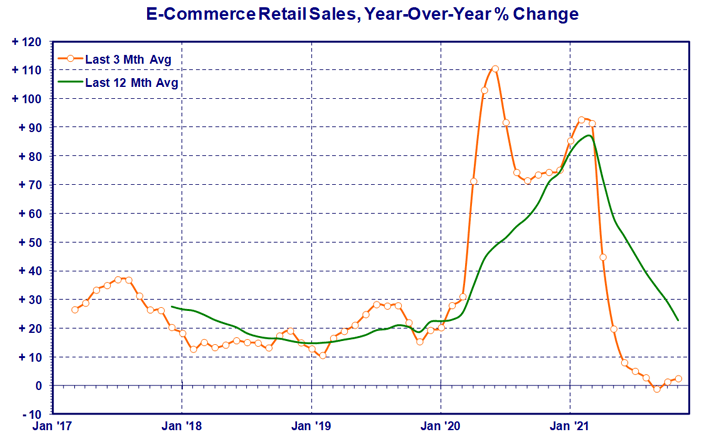
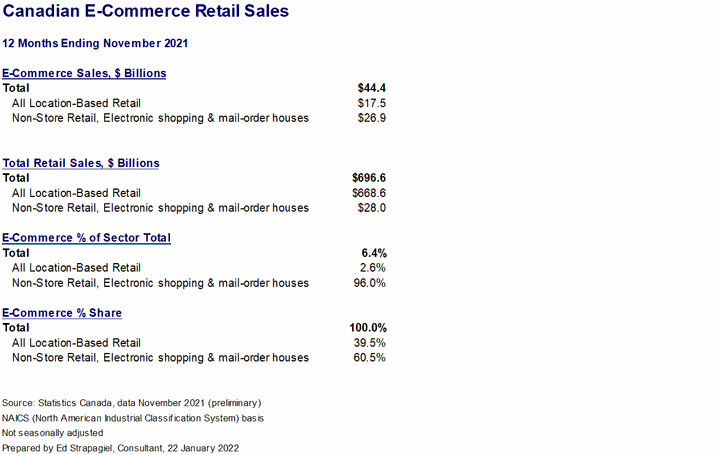
Retail e-commerce sales reached a record $3.9 billion in May in Canada, a 2.3 percent increase over April, and a 99.3 percent increase over February ($2.0 billion), according to Statistics Canada.

Year over year, e-commerce sales more than doubled—with a 110.8 percent increase compared with May 2019.

THE EXPLOSION OF ECOMMERCE HAS THE POTENTIAL TO RESTRUCTURE THE CANADIAN RETAIL INDUSTRY

The federal agency said small businesses are increasingly turning to e-commerce platforms and are using these platforms in innovative ways. The degree to which Canadians continue to choose e-commerce purchasing options or return to traditional purchasing methods has the potential to change the structure of the retail trade industry in Canada. Clearly, the retail landscape will evolve, it said.

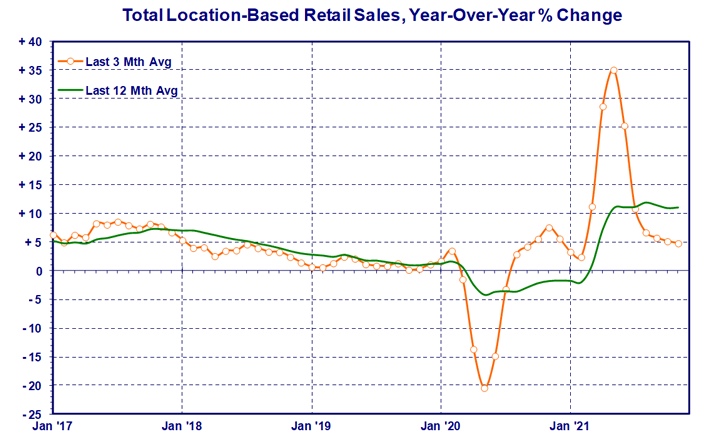
“These record gains in e-commerce occurred as total retail sales experienced record declines. The impact of COVID-19 is best highlighted using April data. Retail sales plummeted to $33.9 billion in April, a 29.1 percent decline from February and a 26.4 percent decline from April 2019. While e-commerce saw a 63.8 percent monthly increase in April, in-store sales dropped 25.3 percent. In May, total retail sales started to recover, reaching $39.3 billion,” said the federal agency.

“Retail e-commerce sales have risen steadily, with the proportion of online sales rising from 2.4 percent in 2016 to 4.0 percent in 2019. The month of April highlights the peak of the COVID-19 impact, with the proportion of retail e-commerce sales jumping from 3.8 percent in April 2019 to a record high of 11.4 percent in April 2020. In May, as the Canadian retail environment allowed for more in-store purchases, the proportion of retail e-commerce sales was 10.0 percent.”

The report said e-commerce sales increased more among non-essential retailers. All 11 retail trade subsectors with e-commerce sales saw an increase in online sales as a result of COVID-19. From February to April 2020, only the food and beverage subsector experienced an increase in in-store sales (+3.3 percent) and a surge in e-commerce (+107.0 percent).

StatsCan said In-store sales declined for general merchandise stores (-15.1 percent), building material and garden equipment and supplies dealers (-15.8 percent), and health and personal care stores (-16.1 percent). These subsectors had relatively moderate declines compared with other brick-and-mortar operations, it said.

“In contrast, other retail trade subsectors — such as furniture and home furnishings stores (-69.6 percent); sporting goods, hobby, book, and music stores (-79.0 percent); and clothing and clothing accessories stores (-84.2 percent) — saw much sharper declines in in-store sales from February to April 2020. As in-store sales decreased for these subsectors, e-commerce sales increased.

“Mandated business closures that prevented retailers from making traditional in-store sales resulted in a greater shift toward e-commerce. Meanwhile, food and beverage stores — essential services that were allowed to remain open — saw a 38 percent increase in grocery sales in the second week of March compared with 2019, and a surge in sales of certain personal care products.”

EXPERT BELIEVES THAT BRICK AND MORTAR WILL STILL APPEAL TO CUSTOMERS AS ‘NEW NORMAL’ SETTLES

Michael Kehoe, broker/owner of Fairfield Commercial Real Estate in Calgary, said the mandated business closures that prevented retailers from making traditional in-store sales over most of the past five months was a black swan event.

“The spike in retail e-commerce sales over this period is no surprise but there is a robust return to customer visits to physical stores that will likely lead to similar customer footfall levels over the medium term that were seen before the COVID-19 pandemic,” said Kehoe, a veteran of the consumer real estate industry with 45 years of experience.

“Small businesses in the retail sector have increased their e-commerce platforms but as things normalize across the country retailers will rely on their bricks and mortar locations that are essential to any omni-channel retailing strategy. Retailers are the heart and soul of the country we have realized during the pandemic. Shopping will normalize over time as Canadians return to their favourite venues.”

COVID-19 HAS ACCELERATED DIGITAL FULFILLMENT IN THE CANADIAN RETAIL INDUSTRY

Gary Newbury, a retail supply chain strategist and serial transformation executive, said the impacts of COVID-19 for Canadian retailing prompted full attention to digital fulfillment, especially for those non-essential retailers who were forced to close, but also for those in essential businesses as they deployed “in store” fulfillment models.

The figures at 10 percent do not show the potential. This potential is split between three key factors, he said:

  1. Canadian’s propensity to order abroad having their items imported (which are not tracked by Stats Canada);
  2. How retailers choose to report their online sales, there are some classification challenges; and
  3. The lost opportunity for many retailers to “shine” during this time with a combination of curbside and home delivery services to help drive brand loyalty during a period of extreme uncertainty for many consumers.

“The significant uptick in volume of online order fulfillment is an important trend. It also is a time for reflection for retailers who were often forced to ‘get their digital side of their business up and running’, to attempt to scale their services from a standing start, or were, frankly, in their element as they had already been operating at volume and welcomed the extra demand, especially if their stores were closed to consumers,” said Newbury.

“Given many consumers are fearful or, at best, reluctant to “get back to normal” with their shopping habits, it begs the question, will the recent rise in online sales continue to grow?

“My thoughts are that there are many factors that relate at category, brand and consumer level. I believe there will be a massive flight to value during this year and early next and uncertainty will prevail for 18-24 months. This seismic demand movement will tend to mean there is no prospect of profit for many retailers looking to operate an online business. Only those making significant investments now will likely be in good shape to buck this trend. Those still looking at eComm as a bolt on to their store distribution network will run into all manner of problems and will conclude the best way forward will be to close the online store.”

He said retailers are starting to rethink their merchandising approaches and are looking to have more clear propositions both in store and online, often by removing proliferating SKU (stock keeping unit) assortments and going back to basics.

At the end of the day, whether the percentage online will grow, stabilize, or reduce will be as a result of consumer perceptions of value, how quickly they want to acquire products and the relative friction they experience between channels (store and online), much of which is in the retailers hands to manage, he added.

“Many people experienced online services for the first time over the last four months, some had a great experience, some not so great. If somewhere in the order of 50 percent of people would prefer to avoid retail stores (lots of friction currently), this is a big prize for retailers to go after, however, they need to approach this opportunity with care, ensure they elicit the help of digital fulfillment experts, be open to look at digital retailing in a different way (skip the extended aisles and pricing mechanisms etc), and ensure they fully comprehend the financials of online if they are going to develop a profitable online business,” said Newbury.

Bruce Winder, author of RETAIL Before, During & After COVID-19 and President of Bruce Winder Retail, said the Statistics Canada report confirms what many people hypothesized: as brick and mortar retail softened in many cases, e-commerce sales soared during the key months of the pandemic (thus far).

“The multi-million-dollar question is what will e-commerce sales look like from now until a potential vaccine is developed and administered and what will e-commerce sales look like post vaccine,” he said.

“One can argue that the growth in e-commerce during wave one of the pandemic allowed consumers to sample the convenience, safety and endless aisle of online shopping - leading to a permanent uptick in this channel. Sadly, we will probably see wave two sometime soon which will reinforce online shopping's benefits.

“An important point however, is to recognize that existing e-commerce infrastructure is lacking as witnessed by countless order delays, missing products and charging errors during wave one. As we have already seen from Walmart and Empire, retailers (and suppliers) have begun to pivot to quickly increase online shopping and delivery capacity to meet anticipated needs.”

STORE COUNTS WILL DIMINISH BUT BRICK AND MORTAR WILL PREVAIL

This will have, as we have already seen, retailers reviewing store counts and closing unproductive locations that have been pushed into the red. There will be fewer stores from many legacy brands as a result, added Winder.

“New digitally native brands will emerge though and have the benefit of building brick and mortar infrastructure based on this evolving environment. They will integrate all channels so that the shopping experience involves less friction than today's incumbents,” he said.

“The tough part for retailers is learning how to make money on e-commerce sales - especially if they don't sell their own brand. Even with the required scale, technology and partner infrastructure, it won't be easy and net profit margins could be considerably less than traditional brick and mortar channels that have been refined for decades. Will suppliers help pay for this gap as per Walmart's announcement to add new discounts to vendors last week?

“Nevertheless, this is a transition that must happen as the customer is demanding it. Those that can make the successful jump to profitable e-commerce will survive, those that cannot will be swept away as online retailers like Amazon, who have been readying for this day for decades, will dominate."