Google searches for “best bank for travel” are up 1,032% in the past year. The data explains why.
A study by Gradient Labs, a company building AI agents for finanсial services, finds that39% of travellers have switched or seriously considered switching banks after a poor support experience abroad.
The issue is widespread: 1,000 of the 1,998 travellers surveyed reported experiencing a card, payment, or banking issue abroad in the past two years.
Nearly a quarter (23%) waited 30 minutes or more to speak to someone at their bank abroad, and 6% nеver got through at аll.
Half of respondents rated their bank as unhelpful, with one in three waiting days for a resolution.
The loyalty damage is lasting. 35% of affected travellers actively warned friends or familyaway from their bank based on how it handled a prоblem abroad.
The inverse is smaller but telling: 12% have recommended a bank specifically because it handled an issue well.
Dimitri Masin
“Our research shows that banking problems abroad are common and costly: 40% of travelers have lost more than $200, and one in four has been forced into dеbt. At the same time, rapid resolution is entirely achievable. Banks that pull it оff are not the ones with fundamentally superior infrastructure,” said Dimitri Masin, CEO of Gradient Labs.
“They provide fаst, human-like incident response, 24/7, in any language, across аll channels and аll time zones. This is exactly the kind of consistency a competent AI agent can provide. And loyalty is truly at stake, as frequent travelers are actively looking for a bank that won’t let them down abroad.”
Masin said two things matter overseas: time and resolution.
“Every minute spent waiting in line abroad has a real cost, such as a missed flight, disrupted plans, or a night you didn’t book. And a stranded customer doesn’t need to wait 30 minutes to find out why their card is blocked; they need it working again, and as quickly as possible,” he said.
Research suggests poor service abroad can drive customers to switch banks. What are the most important actions banks can take to retain those customers?
“Make customer experience a top priority. It’s a product that must compete on speed and problem-solving, in the customer’s language, at any time of day, and be handed over to a specialist with full context when needed. Consistency is crucial: deliver the same fast and high-quality results at 3 AM in a foreign time zone as at 3 PM at home, every time. That’s a design choice banks can make now,” said Masin.
‘The thing is, infrastructure can’t simply be “fixed.” It’s a highly regulated industry, and many of the seemingly problematic aspects are actually essential: fraud monitoring, background checks, and consumer protection obligations exist for a reason. However, customer service can be improved within these parameters, and that’s encouraging. Most problems abroad boil down to legitimate activity being flagged as unusual, and they’re quickly resolved if customers can contact their bank quickly and actually get through to let the bank know it’s them.
Masin said Gradient AI agents can deliver faster, more consistent support.
Atlantic Ambience photo
“Our agents are already doing this in production for names like Wise, Current, Zego and Pockit, so this isn’t theory. In every single deployment across our customer base, customer satisfaction scores are higher than human teams,” he explained.
“At one of the largest AI support deployments in European banking, at a digital bank with around 10 million customers, the agent runs at a 98% quality score, above the bank’s own 95% human benchmark, with 84% CSAT (Customer Satisfaction Score) on complex cases like disputes and blocked payments. Pockit reached 70% end-to-end resolution and 80% CSAT within six months.”
In 2025, international inflows reached record levels and continue to grow, meaning that for a growing share of customers, “banking abroad” is simply banking, added Masin.
“I expect customer service quality to become a real driver of customer acquisition and retention in the next few years, ranking alongside fees and bonuses. People will no longer compare their bank’s service quality to other banks,” he said.
“They will compare it to the service quality of their favourite consumer apps like Uber or Amazon. And supporting cross-border transactions is a near-perfect testing ground for it: high interest rates, responsiveness, strict rules, and clear results.”
A newreport from global technology companyThales reveals how global IT and security professionals at retail organizations across 20 countries view data security in the age of AI. The report illustrates how AI security stacks up against other security operations and data security initiatives:
Key findings from the report:
Spending on AI security is rising: 32% of retail organizations have a dedicated budget for AI security, while 52% fund it through existing security budgets.
The speed of AI development puts security teams on the back foot: 72% of retail organizations cite rapid changes in AI ecosystems as their leading security concern, undermining the ability of traditional tools to keep pace.
AI Attacks are Already Hitting Retailers: 61% of respondents have already experienced deepfake attacks, and 48% have suffered reputational damage from AI-generated misinformation.
Identity is the Primary Target: 51% of retailers rank identity and access management as a top-three security priority as attackers increasingly exploit user credentials.
Human Error vs. Geopolitical Threats: Nation-state attackers and hacktivists were cited as the top security concerns; however, reality shows that 27% of retail organizations reported human error as the leading cause.
“Retailers are trying to secure an environment that’s changing every few weeks, not every few years. The first thing they need to do is get visibility into their data. Our research found that only 37% of retailers say they know where all of their data is stored, and if you don’t know where your sensitive data lives, you can’t protect it from AI or anything else,” he said.
“Over the next year, I’d focus on discovering and classifying your data, strengthening identity controls, and encrypting your most sensitive information. Those fundamentals become even more important in an AI-driven world.”
Todd Moore
Moore said AI has dramatically lowered the cost of deception.
“A fake executive voice, a fraudulent customer support message, or convincing misinformation about a brand can all be created in minutes. Retailers have always worried about protecting transactions, but now they also have to protect trust,” he said.
“The answer is stronger identity verification, better monitoring for abnormal behaviour, and making sure employees know how to recognize AI-enabled social engineering. Ultimately, the organizations that verify identities instead of simply trusting what they see or hear will be much better positioned.
Moore said attackers have realized it’s often easier to log in than to hack in.
“AI makes phishing, credential theft, and impersonation much more convincing, so identities have become the new perimeter. Once someone steals legitimate credentials, they can often bypass traditional security controls,” he explained.
“The mistake many retailers still make is thinking about identity as just an employee login problem. Every customer account, API, machine identity, and now AI agent needs to be authenticated and governed. As AI creates more digital identities, identity security becomes the foundation for everything else.”
The report suggests that nation-state actors and hacktivists dominate security concerns, yet human error remains the leading cause of many incidents. Why is there still such a gap between perceived threats and the realities retailers face?
Anna Shvets photo
“I think it’s human nature. We worry about the sophisticated attacker we see in the headlines, but most breaches still start with everyday operational problems such as a misconfiguration, a stolen credential, or someone clicking the wrong thing. Our research found human error remains the leading cause of breaches, and complexity is a big reason why. Security teams are managing more tools, more cloud environments, more identities, and now AI. The simpler you can make your security operations, the fewer opportunities there are for mistakes,” noted Moore.
“I don’t think organizations necessarily need a completely separate AI security budget, but they do need to avoid treating AI as a bolt-on project. AI touches your identity systems, your cloud infrastructure, your data, and your applications. If you’re simply moving money from one security priority to another, you may create gaps somewhere else. The best investment is strengthening the foundation by knowing where your data is, encrypting it, protecting identities, and simplifying your security architecture. Those investments pay off whether you’re defending against traditional attacks or AI-powered ones.”
By Larry Leung, Founder and Experience-in-Chief, Transformidy
Air Canada’s latest investment in passenger comfort offers a useful case study in how a large service company can use everyday customer touchpoints to introduce Canadian brands, demonstrate business capabilities and support future growth.
Beginning in August, the airline will introduce new comfort products across its cabins on international flights. Economy and Premium Economy passengers will receive six-foot polar-fleece blankets, while Air Canada Signature Class customers will see upgraded duvets and pillows.
Air Canada has also partnered with Sahajan, the Canadian skincare company founded by Lisa Mattam, to include Lip Karma balm and The Hand Remedy cream in its amenity kits. Sahajan combines Ayurvedic traditions with modern clinical science, giving the program a Canadian wellness story that fits the realities of long-distance travel.
Cabin humidity can fall to between 10 and 20 per cent, making dry skin a common concern for passengers. The products therefore serve a practical purpose during the flight while introducing travellers to the Sahajan brand.
Hunter Amenities, a Burlington, Ontario-based hospitality products company, developed, manufactured and sourced the kits. It also manufactures the two Sahajan products for the program at its Burlington facility. Founded in 1981, Hunter works with hospitality, travel and retail partners in more than 120 countries.
Each participant brings a distinct capability to the partnership. Sahajan contributes its wellness expertise, product story and founder-led identity. Hunter provides formulation, manufacturing, sourcing, packaging and the ability to deliver at airline scale. Air Canada gives passengers an environment in which they can experience the products during a relevant moment in their journey.
At the unveiling event at Park Hyatt Toronto, I spoke with members of Air Canada’s product team, Hunter Amenities CEO Dave Lemmon and Sahajan founder and CEO Lisa Mattam. The conversations explored the path from initial concept to final execution, along with the time, coordination and operational discipline required to launch the program across Air Canada’s international network.
What passengers see as a compact assortment of comfort products is the result of a much larger undertaking. Every item requires development, testing, manufacturing, sourcing, packaging and alignment among the participating brands. The products must also be delivered consistently across a complex airline operation.
The value of the partnership extends beyond what passengers find inside the amenity kit.
For Air Canada, the products provide a tangible expression of its customer-experience strategy. Sahajan gains exposure in a setting where its wellness proposition is particularly relevant. Hunter demonstrates its ability to convert a brand collaboration into a program capable of operating across an international airline network.
Exposure, however, does not automatically produce lasting commercial value.
Air Canada Amenity Launch
Passengers may use and enjoy the products without remembering the companies behind them or understanding the expertise required to create the program. The business challenge is to build appropriate connections between the onboard experience and the wider stories of Sahajan and Hunter while preserving the exclusivity of Air Canada’s offering.
For Sahajan, the partnership introduces its products and Canadian wellness positioning to an international audience. That visibility could strengthen recognition of its wider portfolio, deepen its association with travel wellness and create opportunities in related retail, hospitality and service settings.
Hunter’s opportunity is less visible to passengers but equally important. An amenity kit does not reveal the complexity of the operation behind it. The program nevertheless demonstrates Hunter’s ability to coordinate product development, manufacturing, sourcing, packaging, sustainability considerations and brand collaboration at scale.
That record of execution may support future conversations with prospective partners across aviation, hospitality and other experience-focused industries.
The next stage of partnership value does not depend on placing airline-exclusive products on store shelves. The larger opportunity is to identify which capabilities, customer needs and brand stories can support credible future experiences or collaborations.
Air Canada, Sahajan and Hunter Amenities bring together customer reach, wellness expertise, manufacturing knowledge and operational scale. Those complementary strengths could support other relevant offerings or experiences for Canadian consumers.
The partnership also provides a useful lesson for retailers, suppliers and brand leaders. Strong collaborations can fulfil an immediate business need while giving each participant a chance to demonstrate its capabilities, deepen customer relationships and explore new sources of value.
Air Canada’s new amenities may begin with a better night’s rest in the sky. Their longer-term value will depend on how effectively the companies involved build on the experience once passengers return to the ground.
The Canadian retail landscape continues to evolve rapidly, driven by a nuanced interplay of strategic physical expansions, technology-enabled service innovations, and the ever-present undercurrent of global trade uncertainties. This week, a steady stream of announcements underscore how retailers and real estate players alike are seeking growth through experiential environments, strategic partnerships, and diversification, even as external pressures like tariff threats and economic policy shifts introduce caution into investment and operational decisions.
Notably, the period from mid- to late-July coincides with several key industry calendar moments, such as the ramp-up to the Fall Toronto Gift + Home Market, reminding retailers of the criticality of in-person buying and supplier connections ahead of the holiday season. Meanwhile, emerging consumer demand centred on wellness, convenience, and curated brand offerings plays out vividly across sectors from apparel to food service and retail real estate development.
Retailer News
Retailers continue to refine and expand their physical footprints in ways that align with evolving consumer preferences and strategic market positioning. Roots’ new travel retail store at Vancouver International Airport leverages high-traffic travelling audiences with curated Canadian-made products, signalling a targeted focus on experiential and location-aware retail formats. Similarly, UNIQLO’s expansion with a second Winnipeg store emphasises large-format growth to capture urban markets, in line with its national strategy. Meanwhile, international brand Rains opened its second Canadian store at Yorkdale, underlining Canada’s rising importance for contemporary lifestyle brands integrating retail, wholesale, and e-commerce channels.
The grocery and convenience sectors are not standing still either. After Walmart gained exclusive Canadian rights to Esprit’s apparel line, adding recognizable fashion depth to its offerings, Staples strengthened small business shipping services through a new partnership with Canada Post. At the same time, Amazon enhanced its Prime membership benefits in Canada with the rollout of Amazon Family and Add to Delivery features, reflecting ongoing investments to improve convenience and customer experience amid intensifying e-commerce competition.
The wellness sector remains a vibrant growth area. Toronto’s Sweat and Tonic club opening joins Montréal’s Bota Bota spa expansion in underscoring a broadening trend toward multifaceted wellness destinations in mixed-use real estate. Meanwhile, Shoppers Drug Mart’s new obesity care partnership illustrates how pharmacy-led health services are deepening their role in integrated virtual care offerings.
On the real estate front, Bramalea City Centre’s revitalization with Walmart Canada, UNIQLO, and Victoria’s Secret illustrates evolving retail mix strategies and community programming that support sustainable customer engagement. Meanwhile, RONA’s reacquisition of Atlantic Canadian stores reflects operational consolidation strategies enhancing logistical and retail presence in key regional markets.
Retailer Financials / Trends / Reports
Canadian retail continues to display resilience, albeit with inflationary and cost pressures that are eroding margins in some sectors. According to Statistics Canada, May 2026 retail sales rose by 1.0%, fuelled mainly by gains in gasoline stations and fuel vendors, suggesting a cyclical component influenced by price volatility. The latest CPI data showing a 2.8% annual rise highlights moderated inflation but persistent price pressures in grocery and travel segments, which continue to shape retailer pricing and consumer budgets.
The fast food segment posted growth through innovation and expansion; A&W’s Q2 results showcased sales and revenue increases supported by same-store sales and new franchising initiatives, reflecting consumer demand for familiar, value-driven offerings enhanced by promotional pushes. Meanwhile, the gaming and sports sectors continue capitalizing on experiential retail, as discussed in the recent sporting goods and outdoor report, where participation and engagement drive loyalty and differentiated retail environments for landlords and operators alike.
The jewellery market also demonstrates clear bifurcation between luxury experiential formats and accessible premium offerings, per the Retail Insider jewelry report, reinforcing that high-touch physical retail remains vital. Birks Group’s strong fiscal results and planned expansion are emblematic of this trend, despite overall sector challenges. Meanwhile, home furnishings retailers are restructuring around service, value, and accessibility, as the home furnishings report notes, adapting stores to experiential hubs with knowledgeable staff to counter softer demand.
Retailer People News
Leadership developments reflect efforts to guide retail and cooperative entities through complex market conditions. After an extended search, Calgary Co-op appointed Andrew Clarke as CEO, bringing extensive international expertise and a members-first focus that will be pivotal for maintaining competitive operational growth. Such fresh leadership is critical in bridging community values with business momentum in cooperative retail models.
Retailer Op-Eds
The recent announcement of proposed 50% U.S. tariffs on Canadian imports has spurred significant debate around the future of Canada’s food and beverage trade. Sylvain Charlebois, in his op-ed on the tariff risks, highlights the urgent need for Ottawa to intensify direct negotiations with Washington to preserve vital market access. This looming trade volatility threatens not just exporters but the entire retail supply chain, underlining how geopolitical factors can reverberate through commercial real estate and retail investment dynamics.
In a complementary examination of consumer behaviour, Charlebois’s analysis of permanent daylight time adoption outlines subtle but meaningful shifts in dinner habits that may redistribute spending from grocery stores to foodservice establishments. This time policy shift underscores how even non-economic factors can influence retail patterns and competitive landscapes, further complicating food sector strategies in interconnected urban markets.
Editor’s Take
This week’s retail coverage paints a portrait of an industry steering through a complex convergence of opportunity and risk. On one hand, physical retail expands thoughtfully — with wellness clubs, experiential jewellery, and lifestyle apparel brands broadening their footprints into carefully selected urban and regional markets. On the other, looming tariff threats and sustained inflationary pressures compel sharper operational focus and heightened agility.
Retailers capturing growth are those integrating digital innovation with authentic physical experiences, as seen in Amazon’s Prime upgrades and Walmart’s exclusive Esprit partnership. Meanwhile, real estate players must align with tenants who offer broad experiential appeal and stable necessity-based business – a strategy epitomized by Choice Properties REIT’s focus on retail anchors and industrial logistics. The synthesis of these dynamics suggests that success will favour adaptable actors who balance prudent investment with meaningful customer engagement amid an uncertain external environment.
Looking ahead, leadership shifts like Calgary Co-op’s new CEO appointment and strategic funding deals in luxury retail highlight the importance of fresh perspectives and capital in navigating evolving market and consumer complexities. The impact of broad socio-political forces – from trade policy to daylight time changes – underscores a perennial reality for Canadian retailers and investors: anticipating and adapting to external disruptors is as vital as responding to shifting local demand.
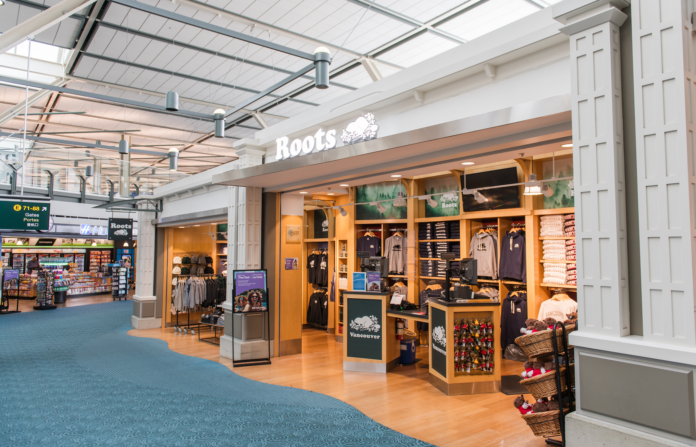
Roots store at Vancouver International Airport. Image: Roots
Roots has expanded its presence in Vancouver with a new store at Vancouver International Airport, adding travel retail to a growing mix of flagship, destination, shopping centre and experimental formats.
The store is located after security near Gate E88 in YVR’s U.S. Departures Terminal and was opened in partnership with Hudson, part of global travel retailer Avolta. Roots and YVR marked the opening on July 23 with an event attended by airport partners, media and invited guests.
The location gives Roots access to Canadian and international travellers at one of the country’s busiest gateways. It also follows a period of investment in the retailer’s physical network, including a significantly larger Robson Street flagship, major renovations at Vaughan Mills and Mont-Tremblant, and the launch of a smaller pilot concept in Toronto.
“Our product assortment is uniquely suited for comfort and travel, making airports a natural extension of our retail strategy,” said Meghan Roach, President and CEO of Roots Corporation. “Opening at YVR allows us to connect with both Canadian and international travellers at a key global gateway, building on our longstanding success of serving consumers in tourism and travel destinations.”
Travel-Focused Assortment at YVR
The YVR store carries a focused selection of Roots apparel, accessories and giftable merchandise. Products include the retailer’s Original Sweats, Vancouver graphic fleece and T-shirts, Made in Canada collections, Cabin socks, Beaver stuffies and keychains.
Select Vancouver graphic fleece and T-shirt styles are exclusive to the airport location, giving travellers access to products tied specifically to the city.
The assortment draws on several categories where Roots has strong brand recognition. Its sweats and casual apparel are suited to travel, while Vancouver graphics and smaller accessories provide options for visitors seeking Canadian-branded gifts.
The airport store also extends a localized merchandising strategy that Roots has used at other destination locations. Its downtown Vancouver flagship carries a dedicated Vancouver Collection, while stores in tourism markets such as Mont-Tremblant adapt their merchandise and presentation to their surroundings.
“We’re thrilled to partner with YVR and Hudson to bring Roots to the airport,” said Melinda MacDonald, Vice President of Wholesale and Business Development at Roots Corporation. “As we continue to expand our travel retail presence, this new location allows us to bring Roots heritage, signature products and spirit of adventure to millions of travellers from all around the world.”
Meghan Roach
Roots Builds Its Travel Retail Presence
Roots already has a presence at Taiwan Taoyuan International Airport and says it is exploring additional travel retail opportunities across Canada.
The partnership with Hudson gives Roots access to Avolta’s experience operating in airport environments, where retailers face different requirements than they would in conventional street or shopping centre locations. These can include security restrictions, extended hours, limited storage and a customer base making purchases within a relatively short period.
For Roots, the YVR format creates an opportunity to reach travellers without replicating the size or full assortment of a traditional store. The product mix centres on recognizable apparel, destination graphics, Canadian-made merchandise and smaller items that are easy to carry during a trip.
Roots has more than 100 corporate stores in Canada, two stores in the United States and more than 100 partner-operated stores in Asia. The company also sells internationally through its e-commerce platform and a branded storefront on Tmall in China.
A Larger Roots Presence in Vancouver
The airport opening comes about a year after Roots relocated and expanded its longstanding Robson Street flagship.
The retailer opened its new store at 929 Robson Street, at the corner of Hornby Street, in 2025. It replaced the former Roots flagship at Robson and Burrard, where the company had operated for more than 30 years. Arc’teryx subsequently expanded into the former Roots space.
The new flagship occupies a large corner location previously divided between Peloton and TWG Tea. Roach said the store is considerably larger than its predecessor and extends almost half a block along Robson and Hornby streets.
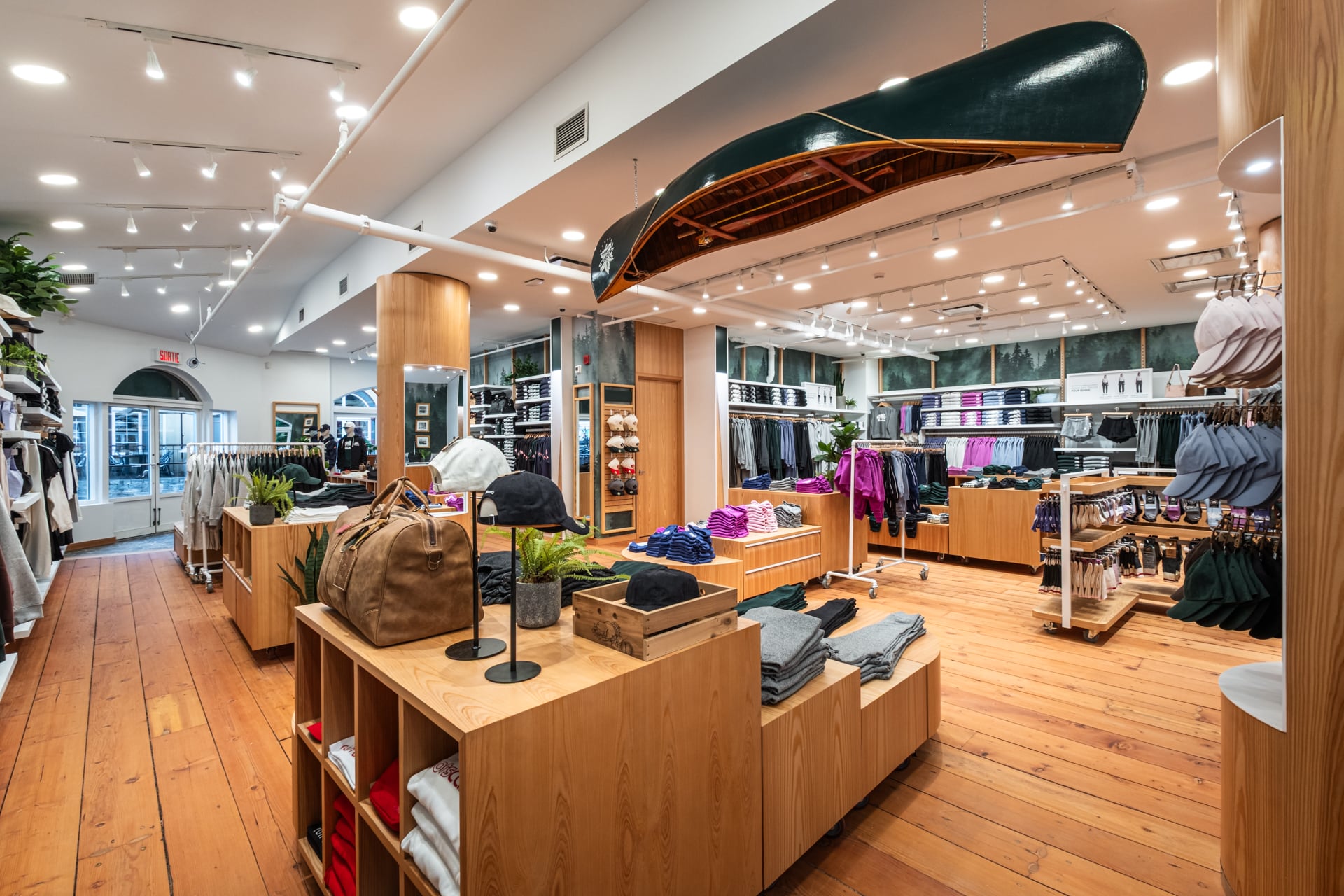
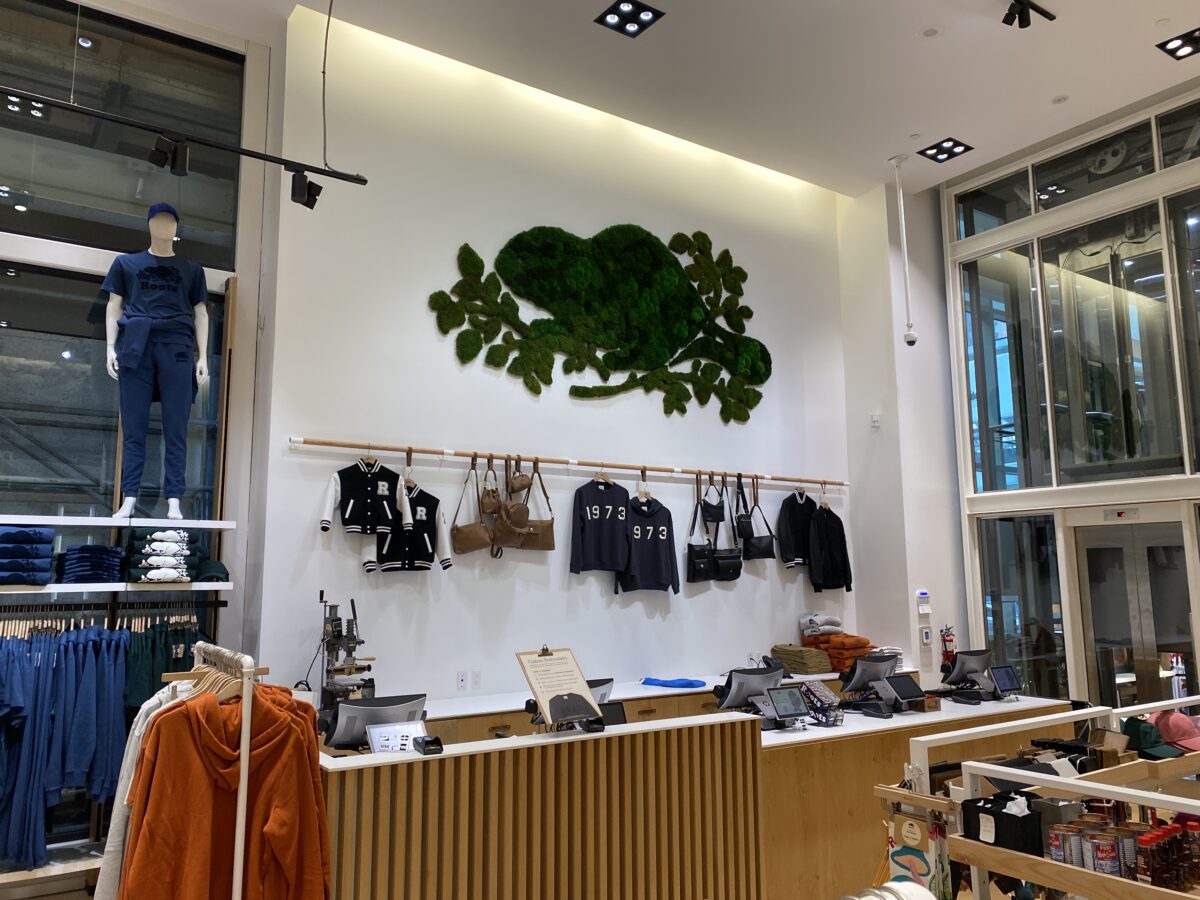
Its design incorporates natural references associated with Vancouver and the Roots brand. Features include a preserved moss wall, a moss sculpture of the company’s beaver logo, light wood finishes and a ceiling installation featuring a commissioned image of Stanley Park.
Digital screens and holographic displays are used throughout the space for campaigns and brand storytelling. Large windows along both streets give the store a prominent presence on one of Canada’s best-known shopping corridors.
The flagship also introduced a dedicated Vancouver Collection, displayed across an entire wall and available exclusively at the location.
“We dedicated an entire wall to Vancouver product because we know this store attracts a mix of locals and visitors,” Roach previously told Retail Insider. “Tourists want something that feels distinct to the city, while Vancouverites appreciate the nod to their community.”
The YVR store brings that destination-specific approach into an environment where many customers will be leaving Vancouver or Canada. Together, the two locations give Roots distinct positions in the market. Robson Street serves downtown residents, regional shoppers and tourists, while the airport store is built around departing travellers.
Roots Tremblant store. Photo: Roots
Renovations at Vaughan Mills and Mont-Tremblant
Roots has also been updating established stores in several markets.
Its Vaughan Mills location completed a major transformation in April 2025, while the Mont-Tremblant store reopened following renovations in July of that year. The projects formed part of a wider effort to modernize key locations while adapting each design to its setting.
Vaughan Mills is one of Roots’ busiest shopping centre stores. Its renovation introduced lighter finishes, simplified merchandising and digital touchpoints suited to a high-traffic mall environment.
“When we were thinking about the concept and how we modernize the experience, we wanted to make sure we considered all the different types of stores we operate,” Roach told Retail Insider at the time.
The Mont-Tremblant renovation retained elements of the existing location, including its wood floors, while introducing brighter colours, digital screens and references to nature. Moss installations and other features connect the space with Roots’ Canadian identity and outdoor heritage.
Mont-Tremblant offers a useful comparison with YVR. Both locations serve customers who encounter Roots during a trip and may be particularly interested in products associated with Canada, comfort and outdoor living.
Roach has said Roots looks at its stores by category, including flagship street locations, destination stores and high-traffic shopping centre units. Each format receives a somewhat different treatment based on its setting and customer base.
Roots at CF Toronto Eaton Centre (Image: Dustin Fuhs)
Updated Store Design Spreads Across the Network
Several elements now appearing in Roots stores were introduced through the company’s updated concept at CF Toronto Eaton Centre.
The design uses brighter interiors, natural materials, clearer product organization and digital storytelling. Roots has since adapted parts of the concept for Robson Street, Vaughan Mills, Mont-Tremblant and other locations.
The company has indicated that it is identifying successful features that can be introduced more widely, including in stores that do not receive a complete renovation. That allows Roots to update parts of its network gradually while reserving larger capital investments for strategically important or high-traffic locations.
Roach previously identified Robson Street, Vaughan Mills and Champlain Mall as locations receiving investment, while also discussing plans to test a smaller retail concept.
That experimentation became more visible with the opening of Roots Outpost in Toronto.
Roots Outpost at 1096 Yonge Street in Toronto. Photo: Craig Patterson
Roots Outpost Tests a Smaller Format
Roots opened the pilot Roots Outpost concept at 1096 Yonge Street in Toronto’s Rosedale commercial district in October 2025.
The location sits near the site of the first Roots store, which opened at 1052 Yonge Street in August 1973. The smaller-format store combines archival pieces, contemporary merchandise, Canadian art, heritage objects and products from local makers.
Its presentation is more curated than that of a conventional Roots location. Apparel and vintage items are displayed in a gallery-like setting, allowing the company to place greater emphasis on product history, materials and craftsmanship.
Roots Outpost also gives the retailer a place to test limited-run merchandise. The store has carried archival apparel, rare vintage pieces and small leather capsules produced using materials from the company’s Toronto factory.
Local pottery, soaps, candles and apothecary products have also appeared in the assortment, supporting the location’s role as a neighbourhood and community-focused concept.
The Outpost differs in size and purpose from the new YVR store, though both illustrate how Roots is developing formats around particular customers and locations. One draws on the company’s history in Rosedale, while the other presents Roots to travellers moving through Vancouver.
Selective Investment in Physical Retail
The recent projects point to a selective approach to Roots’ store network.
The company is directing investment toward prominent flagships, productive shopping centre stores, tourism destinations and smaller concepts that can be used to test new ideas. Store design, merchandise and storytelling are adjusted according to the role each location plays within the network.
Roots operates a mature Canadian store base, making renovations, relocations and format changes an important part of its growth strategy. The expanded Robson Street store increased the retailer’s presence within an established market, while the Vaughan Mills and Mont-Tremblant projects improved two productive existing locations.
YVR adds another channel without requiring the assortment or footprint of a full flagship.
Roots said in 2025 that additional renovations were being prepared, subject to discussions with landlords. Roach also indicated that recognizable design elements from recent projects could eventually be introduced across a wider portion of the chain.
Store Investments Continue During Strategic Review
The physical retail investments are continuing as Roots undergoes a broader strategic review.
In March 2026, the company announced that its board had begun examining alternatives that could include a full or partial sale, strategic partnerships, joint ventures, changes to its capital structure or other transactions. Roots retained J.P. Morgan Securities Canada as its financial advisor and Torys LLP as legal counsel.
The company said there is no assurance that the review will result in a transaction and that operations are continuing normally during the process.
The review followed a period of improved business performance. Roots reported sales of $71.5 million for the third quarter ended November 1, 2025, an increase of 6.8 per cent from the previous year. Direct-to-consumer comparable sales increased 6.3 per cent, while adjusted EBITDA rose 5.3 per cent to $7.5 million.
For the first nine months of fiscal 2025, direct-to-consumer comparable sales increased 11.5 per cent, supported by stronger online traffic and improved conversion in stores.
The recent retail projects show that Roots continues to make operational and real estate investments while the strategic review proceeds.
Additional Canadian Airport Opportunities Under Consideration
Roots has not identified which Canadian airports could follow YVR, although the company has confirmed that it is exploring further travel retail opportunities across the country.
Future locations could build on lessons from YVR, including the performance of destination graphics, Canadian-made merchandise, casual apparel and smaller accessories within an airport setting.
The partnership model could also give Roots a way to enter additional airports through operators that already understand passenger flows, terminal requirements and travel retail merchandising.
The products that define the holiday shopping season are often selected months before consumers make their first purchases.
For retailers, August is one of the most important buying periods of the year, providing an opportunity to discover new merchandise, strengthen supplier relationships, and finalize assortments before the busiest shopping season begins. That is why buyers from across Canada gather each summer for the Fall Toronto Gift + Home Market, taking place August 9 to 12, 2026, at the Toronto Congress Centre – North.
Hosted by the Canadian Gift Association (CanGift) as part of its 50th-anniversary year, the trade-only event brings together hundreds of exhibitors representing the gift, home, lifestyle, fashion, gourmet food, stationery, wellness, toy, jewellery, and seasonal merchandise categories. Whether you’re looking for your next best-selling product or searching for new supplier relationships, the market offers an efficient way to prepare for the months ahead.
Discover Products That Differentiate Your Business
Consumers continue to look for products that feel distinctive and memorable, creating opportunities for retailers that offer merchandise not found everywhere else.
The Fall Toronto Gift + Home Market allows buyers to explore hundreds of product lines in one location, compare brands side by side, and discover emerging companies alongside established suppliers. Instead of scheduling dozens of individual appointments throughout the year, retailers can evaluate a wide range of merchandise over four productive days.
From giftware and home décor to gourmet food, fashion accessories, stationery, wellness products, toys, jewellery, and seasonal collections, the market showcases products designed to help retailers build assortments that reflect changing consumer preferences.
Build Stronger Supplier Relationships
While digital buying tools have become increasingly sophisticated, wholesale retail continues to be built on relationships.
Meeting suppliers in person provides an opportunity to examine product quality, discuss merchandising strategies, ask questions, and establish connections that often lead to long-term business partnerships.
As Dwayne McKillop, President and CEO of the Canadian Gift Association, has said, “Nothing can replace the importance of face-to-face business.”
Those conversations remain one of the defining strengths of wholesale markets, offering retailers insights that extend well beyond the products themselves.
Discover Canadian Brands
One of this year’s highlights is Proudly Canadian, presented in partnership with the Canadian Federation of Independent Business (CFIB).
The feature showcases Canadian-made products and growing businesses, making it easier for buyers to discover merchandise created by domestic manufacturers and entrepreneurs. As interest in supporting Canadian businesses continues to grow, the initiative provides retailers with another way to source products that reflect local craftsmanship, innovation, and quality.
For emerging companies, it also creates valuable exposure to buyers from across Canada, reinforcing CanGift’s long-standing role in supporting business growth and product discovery.
Connect with the Industry
The Fall Toronto Gift + Home Market is about more than buying products.
It is an opportunity to exchange ideas with fellow retailers, learn about evolving consumer preferences, discover merchandising inspiration, and reconnect with industry colleagues from across the country. Whether you’re operating a single independent boutique or managing multiple locations, the market offers valuable opportunities to gain fresh perspectives while preparing for the important holiday selling season.
Celebrate 50 Years of CanGift
This year’s market takes place during a milestone year for the Canadian Gift Association, which is celebrating its 50th anniversary in 2026.
For five decades, CanGift has connected retailers and suppliers through wholesale markets that encourage product discovery, business development, and long-term industry relationships. The Fall Toronto Gift + Home Market continues that tradition as Canada’s flagship wholesale buying event for the gift, home, and lifestyle industries.
Plan Your Visit
Fall Toronto Gift + Home Market
Dates: August 9–12, 2026
Location: Toronto Congress Centre – North 650 Dixon Road, Toronto
Show Hours
Sunday, August 9: 9:00 a.m. – 6:00 p.m. Monday, August 10: 9:00 a.m. – 6:00 p.m. Tuesday, August 11: 9:00 a.m. – 6:00 p.m. Wednesday, August 12: 9:00 a.m. – 1:00 p.m.
The Fall Toronto Gift + Home Market is open exclusively to qualified retail buyers and industry professionals. Qualified buyers receive complimentary admission.
Whether you’re refreshing an established assortment, discovering Canadian-made products, or preparing your business for the holiday shopping season, the Fall Toronto Gift + Home Market offers one of the year’s best opportunities to source new merchandise, strengthen supplier relationships, and gain inspiration from across Canada’s gift, home, and lifestyle industries.
Canadian retailers are spending more on technology than at any point in the past decade. Cloud platforms, point-of-sale systems, digital signage, and security tools now run every corner of the store, not just the back office. But for many multi-location chains, the harder problem isn’t the budget line. It’s the sprawl underneath it: dozens of telecom carriers, ISPs, cloud vendors, and security providers, each with its own contract, renewal date, and support desk, spread across every location a retailer operates. That complexity is starting to look less like an IT headache and more like a genuine business risk.
Why Vendor-Neutral Advisory Is Gaining Ground
Retail IT teams weren’t built to manage a dozen simultaneous vendor relationships. Most retail organizations have a handful of IT staff covering everything from POS troubleshooting to cybersecurity policy, and few have deep telecom procurement expertise. Yet a single mid-size chain might juggle contracts with two or three internet providers, a managed security vendor, a cloud hosting partner, and separate carriers for mobile and voice, each up for renewal on a different schedule.
That mismatch between in-house capability and vendor complexity is why more retailers are turning to independent, vendor-agnostic advisory firms rather than negotiating deals directly with any single provider. CommQuotes is one example of this model: an advisory firm that compares telecom, cloud, and connectivity options across hundreds of providers on a retailer’s behalf instead of pitching a single vendor’s product line. For a retail operator without a dedicated telecom procurement team, that kind of outside comparison can mean the difference between renewing a contract on autopilot and actually finding a better fit for a growing footprint.
This isn’t a new idea in retail. Chains have long used managed service providers for day-to-day network operations. What’s changing now is the point at which retailers bring in outside expertise, earlier, at the procurement stage, rather than only after something breaks.
The Rising Cost of Fragmented Retail Technology
US retailers are projected to push technology budgets to $113 billion in 2026, a 6.6% jump year-over-year, according to Forrester’s “US Tech Forecast 2026 For Retail.” Gartner puts the global figure even higher, forecasting worldwide retail technology spending will hit $388 billion by 2026, with AI-related investment growing nearly 25% annually.
Much of that spend reflects how central cloud infrastructure has become to daily retail operations. Cloud adoption in retail now sits at 96.9%, the highest of any industry, and retail and eCommerce businesses report the highest overall cloud usage at 79%. Inventory systems, customer data, payment processing, and loyalty programs all run through cloud infrastructure that didn’t exist in most retail environments a decade ago.
That growth has a cost most trend reports skip over: integration pain. 61% of retailers report delays deploying new IT tools because of compatibility issues with legacy systems, and folding a cloud-based ERP into legacy POS terminals extends implementation timelines by an average of 7 months. For a chain running 50 or 200 locations, that’s a year or more of mismatched systems while trying to keep stores running normally. Retail Insider has covered similar strain in the connectivity space before, noting how multi-location networking challenges push chains toward outside help just to keep locations online during upgrades.
Cybersecurity Risk Is Now a Boardroom Issue
Vendor sprawl isn’t just an efficiency problem. It’s a security exposure. Between 70% and 80% of retail businesses experienced a cyberattack in 2025, and the average retail data breach now costs $3.54 million, a 17% increase, according to IBM’s Cost of a Data Breach Report 2025. RH-ISAC data shows retail security incidents climbed from 725 to 837 between 2023 and 2024, with confirmed breaches rising from 369 to 419 over the same period.
Every additional vendor in a retailer’s stack is another point of contact, another login, another potential gap between systems that weren’t designed to talk to each other. A retailer running five different ISPs across its store network, each with its own security posture and patch schedule, has a harder job securing that network than one working from a smaller, coordinated vendor set. IBM’s own guidance on holiday-season retail cybersecurity makes a similar point: attackers increasingly target the seams between systems, not just the systems themselves.
This is why loss prevention and security have moved from a store-operations line item to a board-level agenda item at most retail chains. Retail Insider’s own coverage of core retail risk management has tracked this shift in detail, and the underlying driver is the same one showing up in vendor management: fragmented systems create fragmented accountability, and fragmented accountability is where breaches happen.
What This Means for Multi-Location Retailers Heading Into 2026-27
The practical response isn’t complicated, even if it’s not easy to execute. Retailers need to audit existing vendor contracts against actual usage, not just renewal dates, and consolidate providers where the numbers support it. That doesn’t mean chasing a single-vendor setup for its own sake. Redundancy across critical systems, like a backup internet connection at high-volume locations, still matters. But it should be a deliberate choice, not an accident of never reviewing the contract stack.
Retail Insider’s Q2 2026 reporting on commerce infrastructure investments makes a related point: retailers that treat infrastructure decisions as strategic, tied to growth plans and risk tolerance, are outperforming those that treat them as a recurring procurement chore. Cloudflare’s guidance on holiday-season readiness echoes this from the security side, noting that retailers who plan connectivity and security capacity well ahead of peak periods avoid the scramble that leads to costly downtime.
For a 15-location chain, this might mean a single procurement review this year. For a 200-location operator, it likely means an ongoing process, revisiting vendor relationships on a rolling basis rather than only when a contract expires.
Conclusion
Retail technology budgets aren’t shrinking, and neither is the risk that comes with the systems those budgets fund. As Canadian retailers keep adding cloud platforms, connectivity providers, and security tools across their store networks, the ones that manage that complexity well, whether through in-house expertise, tighter vendor consolidation, or independent advisory relationships, will be the ones that avoid the costly downtime and breaches now hitting their less-prepared competitors. The infrastructure conversation in retail has moved past “what to adopt.” It’s now about who’s actually managing what gets adopted.
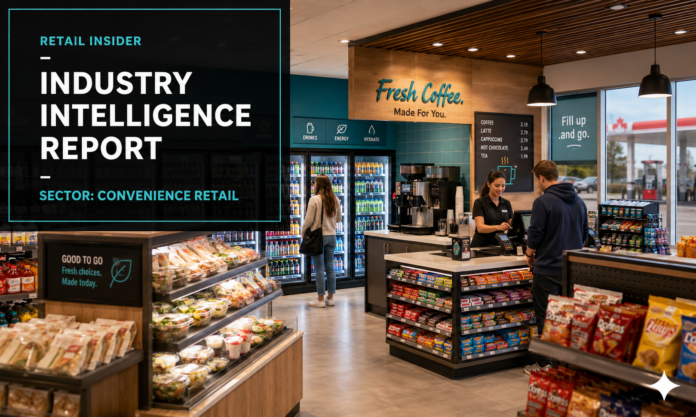
Retail Insider Reports are designed to deliver executive-level insights across major retail sectors and can be accessed through the Retail Insider Report Hub.
Drawing on Retail Insider’s reporting, company disclosures and broader market research, the report examines Canadian convenience retail, including convenience stores, fuel retailers, grab-and-go foodservice, neighbourhood retail, tobacco alternatives, beverages and related convenience formats. It explores the commercial forces reshaping a sector that is increasingly expanding beyond its traditional dependence on fuel and tobacco.
General Themes
Foodservice Drives Growth — Prepared meals, coffee, grab-and-go products and meal bundles are becoming increasingly important contributors to store economics.
Neighbourhood Convenience Evolves — Operators are positioning stores as destinations for everyday meal occasions and grocery top-up shopping rather than only quick fuel-related purchases.
Digital Loyalty Becomes Strategic — Loyalty platforms are evolving into customer engagement systems that integrate payments, personalization and data.
Beverages Gain Importance — Beverage innovation is creating new traffic opportunities while giving brands a platform for product discovery and immediate-consumption occasions.
Store Networks Are Being Optimized — Retailers are investing in larger, modern formats while reassessing older locations that no longer fit changing customer expectations.
Fuel Remains Foundational — Fuel continues to generate traffic, but retailers are increasingly using those visits to drive broader in-store purchases and stronger customer relationships.
Retail Insider Coverage
Retail Insider’s reporting throughout the quarter documented many of the developments shaping the report’s conclusions. Coverage included 7-Eleven’s decision to close hundreds of stores as it shifts toward larger food-focused formats, Circle K’s continued expansion strategy centred on foodservice and loyalty, and Jones Soda’s significant expansion into Circle K locations across Eastern Canada. The publication also examined Scene+’s nationwide rollout across Shell Canada locations and Cascadia Liquor’s enhanced loyalty platform.
Taken together, these stories illustrate how convenience retailers are broadening their value proposition through prepared food, beverage innovation, digital engagement and more modern store formats. Rather than representing isolated company announcements, they reflect wider structural changes occurring across the Canadian convenience sector.
Broader Industry Coverage
The report suggests convenience retail is entering a more competitive phase as operators increasingly overlap with quick-service restaurants, coffee chains, grocery retailers and specialty beverage concepts. Success is becoming less dependent on individual product categories and more closely tied to a retailer’s ability to capture multiple customer visits throughout the day through food, beverages, loyalty and convenience.
Digital capabilities also continue to grow in importance. Loyalty platforms, mobile engagement and customer data are becoming operational tools that support personalization, faster transactions and repeat visits. At the same time, network quality is emerging as a more significant competitive advantage than network size alone as retailers modernize portfolios while reducing exposure to older formats.
Editor’s Take
The report concludes that Canadian convenience retail is no longer defined primarily by fuel and tobacco. Those businesses remain important, but the industry’s next phase will be shaped by operators that successfully combine foodservice, beverages, digital loyalty and modern store formats into a broader daily-use platform. The sector’s strongest performers appear to be building businesses capable of serving multiple customer needs across the day while strengthening long-term customer relationships beyond individual transactions.
Esprit has returned to Canada through an exclusive collection at Walmart, bringing the once-prominent mall brand back to Canadian shoppers more than a decade after its North American store network disappeared.
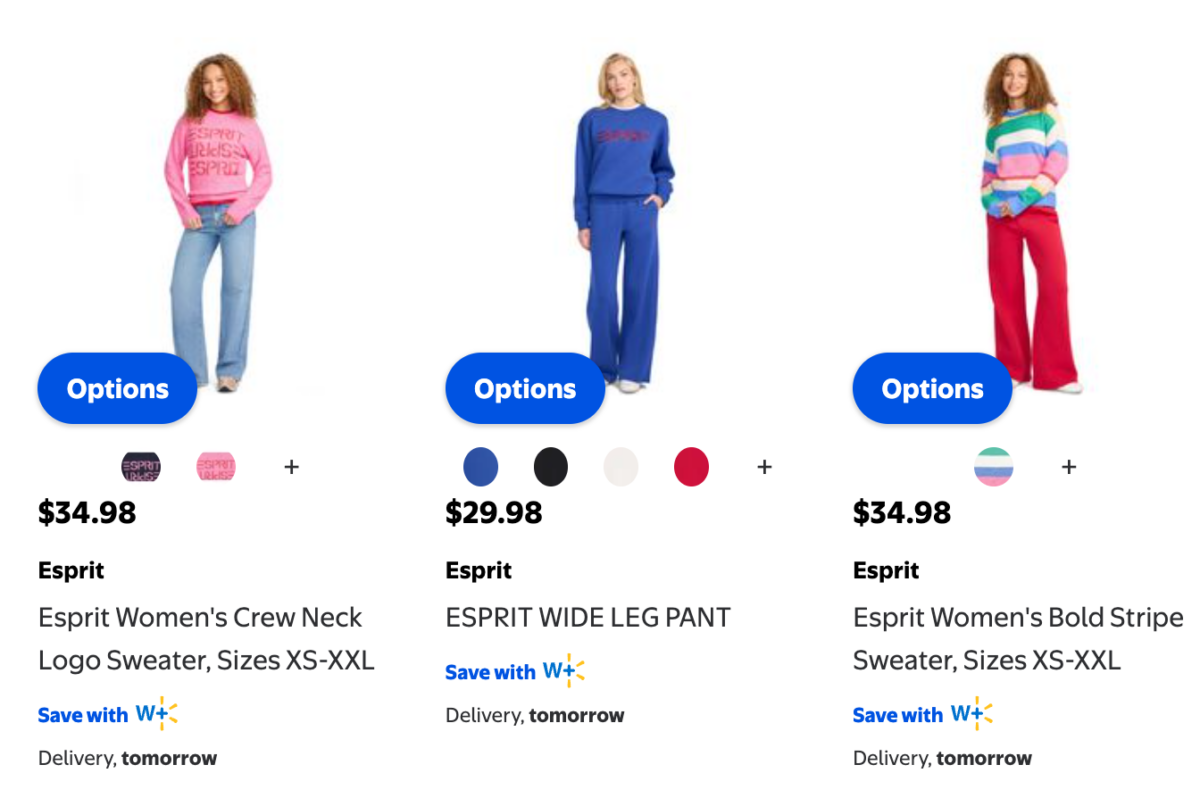
The initial collection is available at select Walmart Canada stores, on Walmart.ca and through the Walmart app. It includes knitwear, denim, layering pieces and everyday basics in sizes XS to XXL.
Walmart is positioning the launch around renewed interest in 1990s fashion, giving the collection the potential to reach Canadians who remember shopping at Esprit stores and younger consumers encountering the brand for the first time.
The collection was developed in collaboration with Centric Brands, a global licensing and brand-management company that is taking on a growing role in Walmart Canada’s apparel business.
Centric also worked with Walmart and KnitWell Group to introduce Lane Bryant to Canada earlier this year. Centric has told Retail Insider that additional brands are expected to follow, although the company has not yet identified them.
The developing relationship suggests that Esprit is part of a broader effort to bring recognizable apparel names into Walmart’s Canadian network.
That strategy is unfolding as Walmart works to capture a larger share of the country’s fashion and beauty market, supported by more than 400 stores, a national ecommerce platform and a customer base already visiting regularly for groceries and household essentials.
The opportunity has become more visible since Hudson’s Bay closed its remaining stores on June 1, 2025, removing one of Canada’s largest multi-brand sellers of apparel, accessories, cosmetics and home products.
Esprit Collection Arrives at Walmart Canada
The Esprit assortment includes casual pieces drawing on the brand’s history in colourful, accessible fashion. Walmart describes the collection as combining nostalgic influences with updated silhouettes for today’s shoppers.
The retailer has not disclosed how many stores are carrying Esprit, how long the exclusive arrangement will run or whether the collection could eventually expand into additional product categories.
The launch gives Esprit a considerably broader Canadian platform than its previous comeback attempts. Through Walmart, the brand can reach shoppers across the country without establishing its own stores, distribution infrastructure or Canadian retail organization.
Walmart gains an exclusive name with decades of recognition. Esprit built its identity around casual apparel, distinctive advertising, colourful stores and a highly recognizable stencil-style logo.
Although the brand began in California, it eventually developed into a global fashion business with a particularly strong presence in Europe and Asia.
For many Canadians, however, Esprit remains closely associated with the country’s shopping centres during the 1980s, 1990s and 2000s.
Image: Walmart Canada website
A Familiar Brand in Canadian Malls
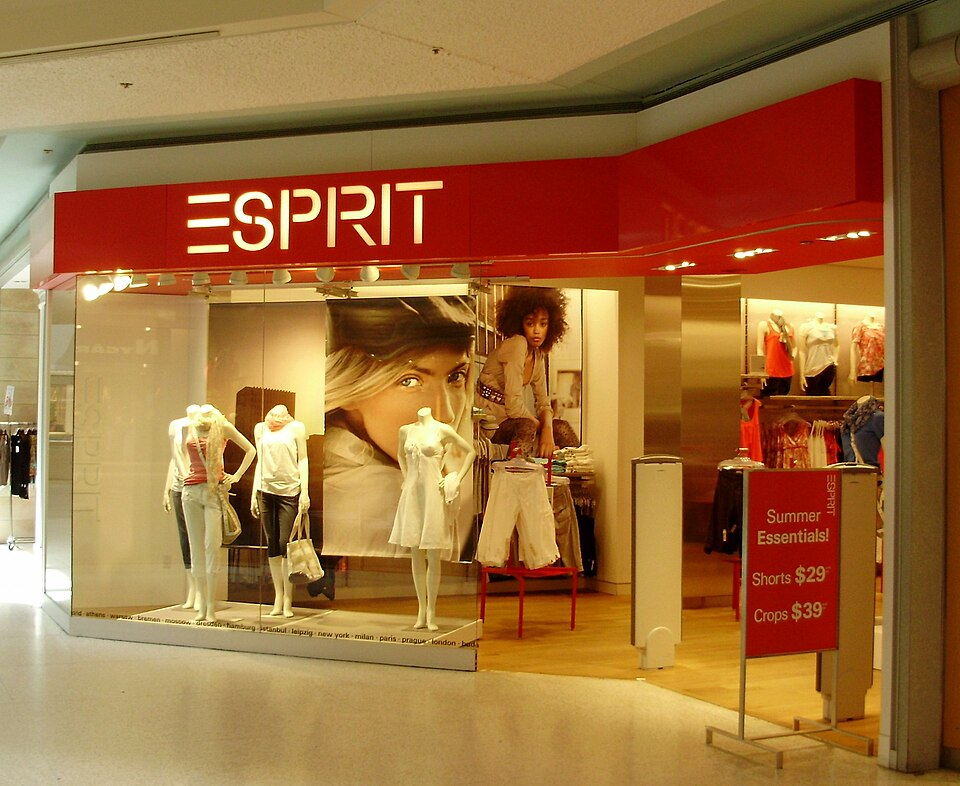
Esprit was once a regular tenant in major Canadian malls, operating stores in large metropolitan markets and regional shopping centres.
Former locations included CF Toronto Eaton Centre, Yorkdale Shopping Centre, CF Sherway Gardens, Bayshore Shopping Centre in Ottawa and Metropolis at Metrotown in Burnaby, along with stores in other communities.
Its Canadian locations carried women’s and men’s apparel, denim, accessories and casual wardrobe staples. The company also operated the younger-oriented edc by Esprit label at various points in its history.
Esprit held a sizeable position in the mid-market fashion sector, alongside other international and Canadian apparel chains that relied heavily on enclosed malls.
Its visual identity helped distinguish the company. Esprit’s stores and advertising drew from modern art, graphic design and architecture, creating a presentation that was unusually distinctive for a broadly accessible clothing brand.
By the late 2000s, Esprit faced growing competition from fast-fashion chains and a wider selection of international retailers. Its North American business struggled to remain profitable while the company directed greater attention to its larger operations overseas.
North American Stores Closed in 2012
Esprit announced in 2012 that it would close all 93 of its company-operated stores across Canada and the United States.
The withdrawal followed mounting losses in the region and an unsuccessful effort to find a sustainable path for the business. Esprit explored the possibility of continuing through a licensing partner but ultimately closed its company-operated North American stores.
For Canadian shoppers, the decision caused the brand to disappear from malls relatively quickly. Esprit merchandise remained available sporadically through wholesale accounts and independent retailers, but the national chain Canadians remembered was gone.
The departure came during a period of substantial change in the middle of Canada’s apparel market. In the years that followed, several familiar fashion chains contracted, entered insolvency or left the country as competition intensified and shopping habits shifted.
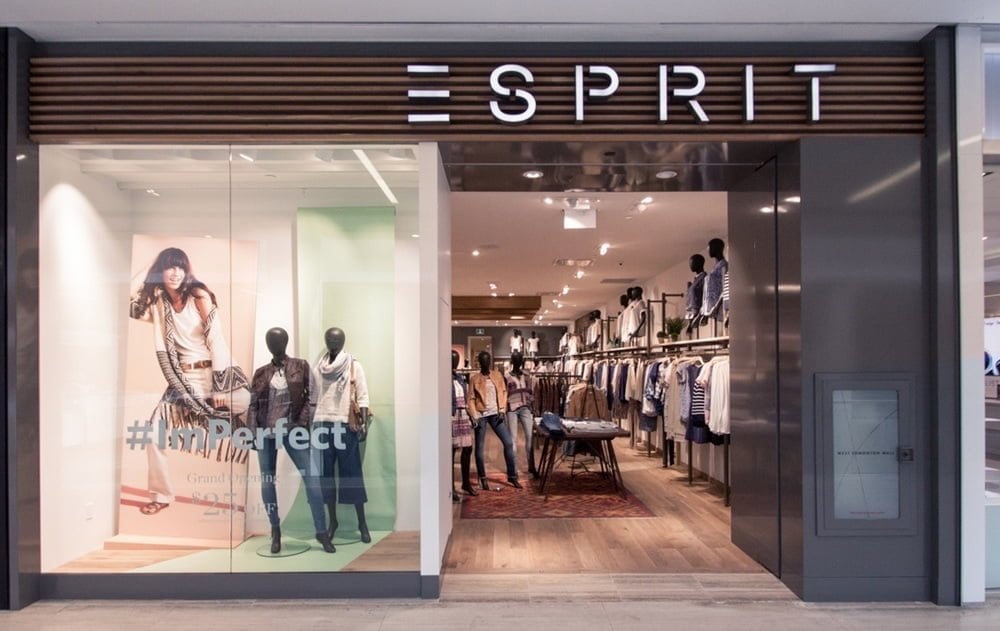
Former Esprit store at West Edmonton Mall
A Brief Canadian Comeback in 2016
Esprit attempted to rebuild a Canadian presence four years after its North American withdrawal.
Montreal-based Freemark Apparel Brands brought the company back to Canada in 2016, beginning with a roughly 2,000-square-foot women’s store at West Edmonton Mall. The opening marked Esprit’s first North American retail location following the 2012 closures.
A second store opened at Metropolis at Metrotown in Burnaby. The approximately 2,500-square-foot location carried both men’s and women’s collections.
The new stores were smaller and more boutique-oriented than many of Esprit’s former mall locations. Freemark discussed a much larger Canadian rollout, with the possibility of eventually operating approximately 30 stores across the country.
A Square One location in Mississauga was also announced as part of the planned expansion, although confirmation that it ultimately opened has been difficult to establish.
The broader rollout did not take hold. Freemark later encountered financial trouble, and the Canadian Esprit stores closed.
Esprit Shifts Toward Licensing
Esprit considered another North American revival during the early 2020s, opening temporary spaces in markets including New York and Los Angeles and discussing plans to re-establish permanent stores.
Retail Insider reported in 2022 that Canada was among the markets being considered as part of that strategy.
The attempted comeback was followed by further financial difficulty. During 2024, Esprit operations in several European markets entered insolvency or bankruptcy proceedings, leading to store closures, job losses and a sharp contraction of the company’s directly operated business.
Esprit Holdings Limited, the Hong Kong-listed company that owns the brand, subsequently moved toward an intellectual-property management and licensing model.
Under that structure, Esprit can work with outside companies to design, source, manufacture, distribute and sell merchandise under its name.
Centric Brands is the partner involved in the Canadian Walmart launch. Esprit Holdings remains the brand owner, while Centric provides the operating expertise required to bring the collection to market.
The arrangement allows Esprit to earn revenue from its name and design heritage without rebuilding the costly store network that once supported the company.
For Walmart, the partnership provides access to an established label that can be developed for the retailer’s price points and customer base.
Centric Builds a Brand Pipeline at Walmart
Esprit follows the January 2026 Canadian launch of Lane Bryant, which arrived through a partnership involving Walmart Canada, Centric Brands and Lane Bryant owner KnitWell Group.
The Lane Bryant collection was introduced online and in 320 Walmart stores, giving the U.S. plus-size fashion brand a substantial Canadian presence without opening standalone locations.
The launch filled a gap in Walmart’s women’s fashion assortment while bringing a recognizable name into its apparel departments.
The Esprit partnership applies a similar model to a different customer group. Esprit carries broad recognition among Generation X and older Millennials, while its 1990s heritage may appeal to younger shoppers interested in fashion from the period.
Centric’s involvement in both launches points to a repeatable strategy. The company brings expertise in licensing, product development, sourcing, merchandising, marketing and distribution. Walmart supplies the physical and digital reach.
Centric has indicated to Retail Insider that other brands are expected to enter Walmart Canada, suggesting the partnership is developing into a broader pipeline of branded apparel. The names and timing of those future launches have not been disclosed.
Former Esprit store at Scarborough Town Centre. Photo: Wikimedia Commons
Walmart Expands Its Fashion and Beauty Ambitions
Walmart has traditionally built much of its apparel business around value, wardrobe basics and private labels such as George.
Recognizable third-party and licensed brands can strengthen that assortment by increasing customer familiarity and giving shoppers a greater reason to browse the apparel department.
Walmart has also been giving greater prominence to established apparel labels, including Levi Strauss products, while adding exclusive brands aimed at particular customer groups.
A similar effort is underway in beauty. The retailer has introduced exclusive and younger-skewing beauty names, expanded inclusive product ranges and strengthened categories that can encourage shoppers to add discretionary purchases to routine store visits.
Apparel and beauty can help Walmart increase the value of each customer trip. Both categories may also shift perceptions among consumers who know the retailer primarily for groceries, household goods and opening-price-point merchandise.
Walmart’s scale gives it a considerable advantage. A brand entering the retailer’s network can quickly gain exposure across much of the country, including communities with limited access to department stores or dedicated fashion chains.
An Opening Following Hudson’s Bay
The disappearance of Hudson’s Bay has left Canada with fewer national retailers capable of selling multiple apparel and beauty brands under one roof.
Hudson’s Bay completed the liquidation of its remaining department stores in June 2025. Its departure removed a large amount of retail space and disrupted established distribution channels for fashion, cosmetics, footwear and home brands.
Walmart’s apparel strategy was likely in development before the Bay completed its liquidation. The department store’s closure nevertheless creates a larger opening for retailers willing to invest in branded discretionary categories.
Former Hudson’s Bay customers will not move to a single replacement. Their spending will be divided among specialty chains, ecommerce platforms, off-price retailers, beauty stores, warehouse clubs and mass merchants.
Walmart is well positioned to capture part of that market, particularly among shoppers seeking recognizable brands at accessible prices.
Esprit provides a useful test of that opportunity. The brand retains enough recognition to attract attention, while its licensing model allows the collection to be developed specifically for Walmart’s distribution network. The retailer can draw on Esprit’s history without assuming the cost of restoring the company’s former mall-based format.