Advertisement
Advertisement

Disposable Income Spent on Food by Canadians Varies by Provincial Tax Rates [Op-Ed]

Date:

Share post:

As Canadians sit down to their dining tables, the financial burden of what lies on their plates extends beyond mere calories. Recent data from Statistics Canada paints a stark picture of household disposable income being consumed by food retail across the provinces, with a noteworthy correlation to the tax rates levied upon their earnings.

The bar chart representing the percentage of disposable income spent on food retail in 2022 and 2023 shows Newfoundland and Labrador (NL) leading the charge, with 11% of household income dedicated to sustenance (up +1.1% from 2022). This is closely followed by Quebec (QC) (Up +0.6% from 2022), Nova Scotia (NS) (UP +0.2% from 2022), and New Brunswick (NB) (Up +0.3% from 2022), all hovering around the 10% mark. In stark contrast, Alberta (AB) expends only 8.1%, the lowest among the provinces.
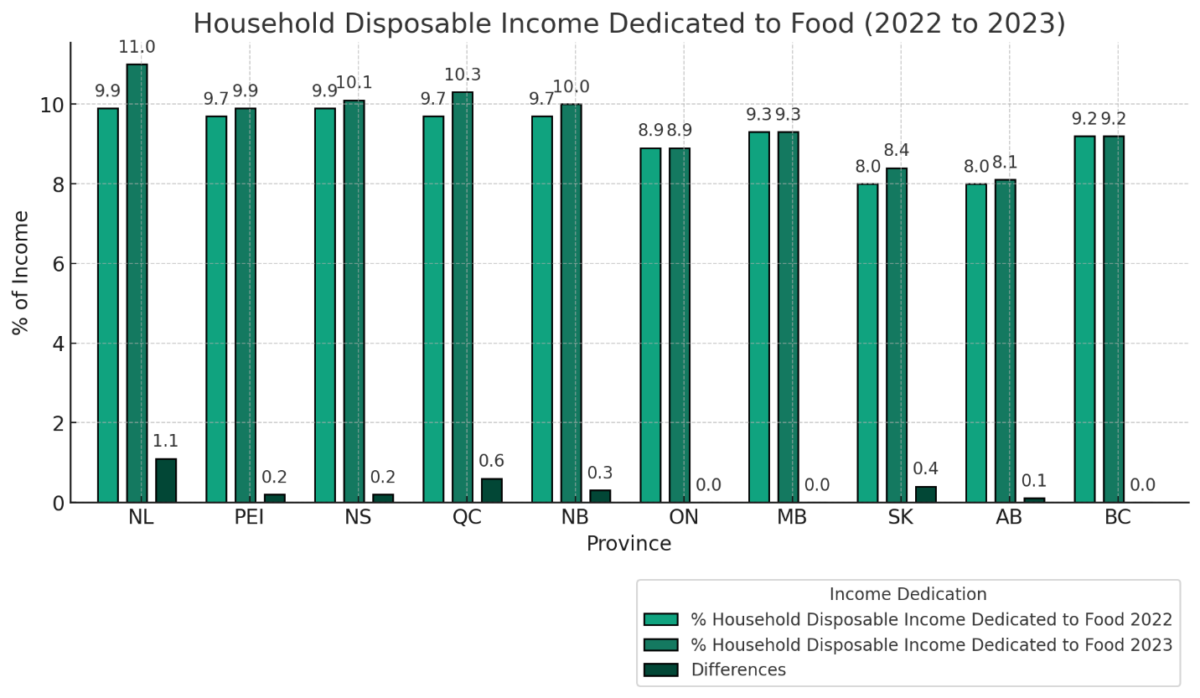
Simultaneously, a table detailing the income tax rates reveals a story in parallel. Quebec, despite its renowned culinary culture, imposes a notable tax burden on its residents, with rates climbing to 19% on income just shy of $100,000. This is the province where citizens dedicate a significant portion of their income to food, second only to NL, which also features higher tax rates compared to the national average.
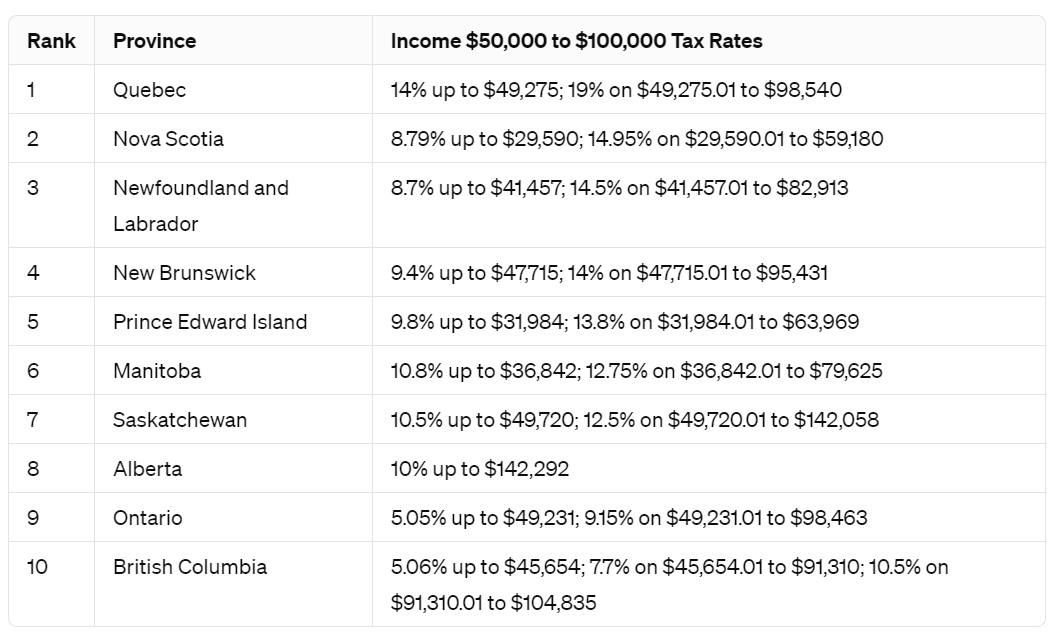
Is it a mere coincidence that provinces with higher tax rates see a greater share of income going towards food? Or is this an indicator of a larger economic narrative where the tax burden intersects with the cost of living, amplifying the impact on disposable income and, consequently, on food affordability?

Consider this: taxes affect disposable income, which in turn influences purchasing power. The interplay is especially evident in the realm of food, a necessity that consumes more of the household budget in regions with higher taxes. The situation begs a question of policy and priorities: Are we taxing our way into tighter kitchen budgets?

Provinces like Alberta, with its lower tax rates, see a lesser percentage of income spent on food. This leaves room for investment in quality, nutrition, and diversity. It might also create a wider economic space for citizens to engage in other sectors, bolster savings, and stimulate local economies beyond the grocery store aisles.

Furthermore, there’s an element that transcends the raw numbers. These figures do not only represent economic data; they reflect the lived realities of Canadian families. The percentage points translate into decisions about whether to buy fresh fruit or canned, organic or non-organic, local or imported. They influence lifestyle choices, dietary health, and, in broader terms, the wellbeing of communities.

Provinces and the Canadian government and policy makers must heed these statistics as more than fodder for fiscal debates. They are a call to action to balance the scales between taxation and affordability. With food prices continuing to escalate worldwide, there’s a pressing need to ensure that tax policies don’t inadvertently tighten the financial belts of Canadians around their dinner tables.

A policy reevaluation seems prudent, one that considers the cost of living, particularly food, in its formulation. It could be a step towards ensuring that families in Quebec, Newfoundland and Labrador, and indeed across all provinces, are not disproportionately burdened by a basic human need.

As we navigate the complex web of economic policies and their social consequences, Canada stands at a crossroads. Will the country adjust its fiscal policies to nurture not just a healthy economy, but also a healthy populace? The data is on the table, and it’s time for a national conversation about the recipe for a balanced, affordable, and nutritious food environment for all Canadians.


LEAVE A REPLY

Please enter your comment!
Please enter your name here

More From Retail Insider

RECENT RETAIL INSIDER VIDEOS

Advertisment

Subscribe to the Newsletter

Subscribe

* indicates required

RECENT articles

L’OCA Quality Market to Close Edmonton-Area Stores

L’OCA Quality Market will close its Sherwood Park and Edmonton stores March 12 after less than two years of operation.

Nearly 1 in 3 Canadians snack at night, far above global average: IKEA

In Canada, the main frustrations when it comes to cooking at home are lack of surface space (31%) and lack of storage (29%).

From The Desk: Navigating Retail Evolution Through Expansion, Tech, and Consumer Shifts

Sephora's Canadian expansion, AI reshaping shopping, and retail bifurcation highlight evolving strategies amid market pressure and consumer shifts in 2026.

Hudson’s Bay Collapse: One Year After the CCAA Filing

A year after Hudson’s Bay filed for CCAA protection, the retail industry reflects on the collapse of a 355-year-old institution.

Enoteca Monza opens at CF Market Mall in Calgary (Video, Photos)

Founded in 2010, Enoteca Monza has grown to 10 locations across Canada and was acquired by Foodtastic in 2018.

Casavogue Celebrates 54 Years with Anniversary Savings

Casavogue marks its 54th anniversary with $500 off every $3,000 spent on sofas, bedroom sets, and dining sets.

VIDEO: Iran conflict’s impact on retailers and consumers

Retailers are focusing on controlling costs and expanding private-label offerings while increasing promotions to help shoppers manage tighter budgets.

MR MIKES SteakhouseCasual Surpasses 50 Locations in Canada

MR MIKES SteakhouseCasual expands to more than 50 restaurants across Canada after opening seven new locations in 2025.

Tim Hortons partners with Canadian Paralympic Team

The partnership furthers Tim Hortons long-standing commitment to supporting sport and Canadian athletes, including investments in getting kids active like the Timbits Hockey and Soccer programs.

Sundays Opens Terminal HQ Showroom in Vancouver

Canadian furniture brand Sundays opens a 15,000-square-foot Terminal HQ showroom in Vancouver, expanding its retail footprint and introducing sister brand Hetta.

Quebec Retailers Face Rising Language Compliance Pressure

Bill 96, OQLF inspections, and rising complaints are reshaping Quebec retail operations, hiring, signage, and digital marketing strategies.

Dixie Outlet Mall in Mississauga Placed into Receivership

Dixie Outlet Mall in Mississauga enters receivership as redevelopment plans and long-term transformation of the site move forward.

BAPE Opens First Canadian Store on Vancouver’s Alberni Street

Japanese streetwear brand BAPE opens its first Canadian store at 1028 Alberni Street in downtown Vancouver, entering the Canadian retail market.

Daily Synopsis: Mar 5, 2026

Gas prices to impact food, George Weston sees revenue climb as Loblaw and Choice Properties gain, Costco Canada comp sales up 10%, Sunterra appeals cheque kitting ruling, Krazy Bins store opening in Edmonton, and other news.

Walmart Canada kicks off sponsorship with Canada Soccer to bring Canadians closer to the game 

One of the country's most accomplished and recognizable players, Canada Soccer Men's National Team forward Jonathan David will support the collaboration as an official Walmart Canada ambassador.

Sungiven Foods Expanding Metro Vancouver Footprint

Sungiven Foods plans up to 15 new Metro Vancouver stores as it refines its small-format, private-label grocery model.

Victoria’s Secret & Co. reports 2025 Q4 and full year results with annual sales of more than $6.5 billion

The company reported net sales of $6.553 billion for fiscal year 2025, an increase of 5% compared to net sales of $6.230 billion for fiscal year 2024.

Governments suffer big decline in alcohol earnings: Statistics Canada

Overall, liquor authorities and other retail outlets sold $25.8 billion worth of alcoholic beverages in the fiscal year ending March 31, 2025, down 1.6% from fiscal year 2023/2024.

Vivo Avanti Expands with Restaurant in King City

Vivo Avanti has opened in King City, introducing an elevated Italian dining concept from the team behind Vivo Pizza + Pasta.

The Reset Team Leads Retail Merchandising in Canada

Canadian firm The Reset Team helps retailers nationwide with scalable merchandising, fixture installation and precise execution for complex rollouts.