According to research by Capterra, demand for customer service looks to be increasing, and brands plan to invest in both employees and software to handle this.
As in most industries, artificial intelligence (AI) may offer some solutions here. The technology has the potential to automate customer interactions and streamline back-end processes, said the report.
And another Capterra report found that in a crowded marketplace, exceptional customer service can help brands stand out from the competition. But delivering on the promise of a great experience can be costly — it requires good people plus investment in customer service tools and processes. What’s more, customer service can be hard to scale. The more customers you have, the more effort it takes to keep them all happy.

Eduardo García Rodríguez, an Analyst at Capterra, said a lot of brands are using different customer service support channels, but most stick to traditional ones – 82 per cent of survey respondents use email and phone calls as the most available channels.

“So what we’ve seen here is that there’s a need to really find a hybrid between email and phone calls, and that tends to be live chat or chat bots. So there’s a kind of need for companies to diversify their customer service channels and use technology for that. Why? Because, I mean, in the end, hybrid live chat rep with representatives, or even chat bots, they address 24/7 interactions. They also provide attachments and they’re scalable as well. So I think there’s a kind of need to try and address those kind of issues.
“Another key point is, when choosing the software you want to use, it is important to cater to customer demands. And something we have seen here is that there is a demand for immediacy and timeliness. We’ve seen this because 89 per cent of customers that use phone or live chat, they speak within 10 minutes with a representative, and the further 65 per cent you have, the statistic they say that issues are resolved in the same time frame. So it’s really important that addressing timeliness is an imperative for companies, and the best way to do that is when they’re seeking their software tools, it’s ones that cater to this kind of timeliness.
“Why? The costs of meeting these demands is quite high. We’ve seen that 95 per cent of respondents track their customer satisfaction. So for them, customer feedback is essential in the same way that it’s essential for marketing, for sales, they seek that quantitative feedback, that measurable, customer satisfaction, and tend to do that with all the software tools. Customer satisfaction software can help them do that because it provides surveys and feedbacks. So the need to address timeliness is imperative as well for these kinds of companies.”
Rodríguez said research indicates 79 per cent of respondents in the Capterra survey say that the introduction of AI capabilities and customer service has impacted customers positively.
“AI is not perfect. It’s not always a solution to every customer service problem. It’s just it’s a solution to some. So respondents, they appreciate the benefits of AI, 64 per cent think it can reduce response time. 60 per cent believe it can save money. However, people are also realistic about the limits of AI and where it makes sense to bring in a human touch. AI cannot perform certain human tasks. We talk about multi language conversations, analyzing data, routine tasks. AI is very proficient in that. But humans are also considered to outperform AI and other tasks such as personalized interactions.”
Here are some of the key findings from the Capterra research:
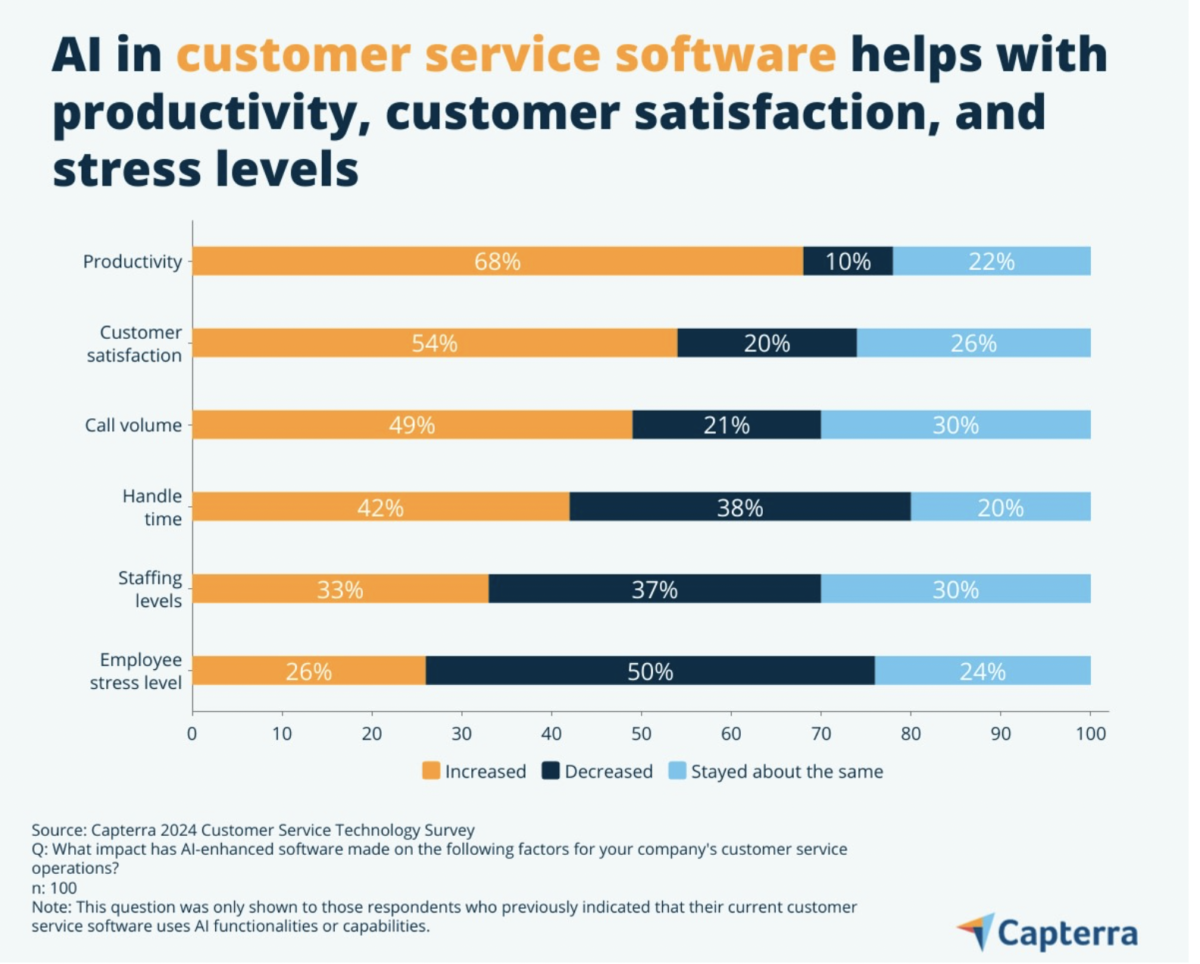
- 68 per cent of those whose company uses AI-powered customer service software have reported an increase in productivity levels;
- Companies that are adopting AI tech for their customer service are putting measures in place to secure customer data in response to security concerns, such as secure data storage (68 per cent), data encryption (59 per cent);
- 60 per cent of companies are offering customers the option to choose between AI and human-assisted interactions;
- 54 per cent of Canadian businesses report increases in customer service satisfaction scores over the past two years, despite the low investment in customer service software solutions. However, half of respondents are already using AI in their customer service operations, which is impacting both customers and employees positively;
- Over 80 per cent of those polled said their company offers phone or email support, while large proportions also provide help via live chat (49 per cent), social media (47 per cent), and SMS (46 per cent). 82 per cent of companies offer live phone support, but only 51 per cent use call centre software. Despite the added efficiency, just 35 per cent of those who don’t already use it have formal plans for an investment;
- Customer satisfaction is a key performance indicator for customer service teams, with 95 per cent tracking it. A crucial determining factor for customer satisfaction is speed, and 89 per cent of respondents report that customers are able to speak to a representative on the phone or via live chat within 10 minutes. In fact, 54 per cent of respondents cite an improvement in customer satisfaction compared to two years ago;
- 42 per cent of senior staff surveyed report that their company has plans to hire more customer service staff in order to keep up with growing demand. Beyond increasing headcount, companies are also looking to AI to offer solutions to problems like speed and cost, as 64 per cent of respondents believe AI can reduce response times, and 60 per cent believe it can save money. In fact, 68 per cent of those whose company uses AI-powered customer service software customer service representatives have reported an increase in productivity levels;
- In certain areas, representatives believe that AI agents can outperform humans, for example in multiple language conversations (58 per cent), analyzing data and generating insights (55 per cent), routine tasks (46 per cent) and avoiding biases (45 per cent);
- 79 per cent of respondents think that AI tools have an overall positive impact on customers. This is corroborated by the fact that 54 per cent of customer service representatives who say that their company uses AI-powered customer service software have reported an increase in customer satisfaction as a result;
- However, no new tech is without its drawbacks, and maintaining customer trust will be a challenge to AI implementation, as cited by 40 per cent of respondents. Other challenges include ensuring accurate information (45 per cent) and maintaining customer privacy or security (31 per cent);
- As the use of AI surrounds itself with concerns about data privacy, companies are putting measures in place to secure customer data, such as secure data storage (68 per cent), data encryption (59 per cent), secure communication channels (52 per cent), and incident response and reporting (49 per cent). Moreover, 83 per cent of representatives who use AI-powered customer service tools say they have received training on handling customer data when using it. For those customers who are wary of AI, 60 per cent of companies are offering customers the option to choose between AI and human-assisted interactions.