Artificial intelligence is becoming embedded in retail decision-making, influencing sourcing, assortment planning, pricing, marketing and how consumers discover products.
Canadian retail strategist Carl Boutet sees enormous potential in the technology, along with a growing risk. As retailers adopt similar tools, draw on similar information and optimize toward similar performance measures, they may increasingly arrive at similar answers.
Boutet describes the potential result as a “sea of sameness,” where retailers become more efficient while losing some of what made their businesses distinctive.
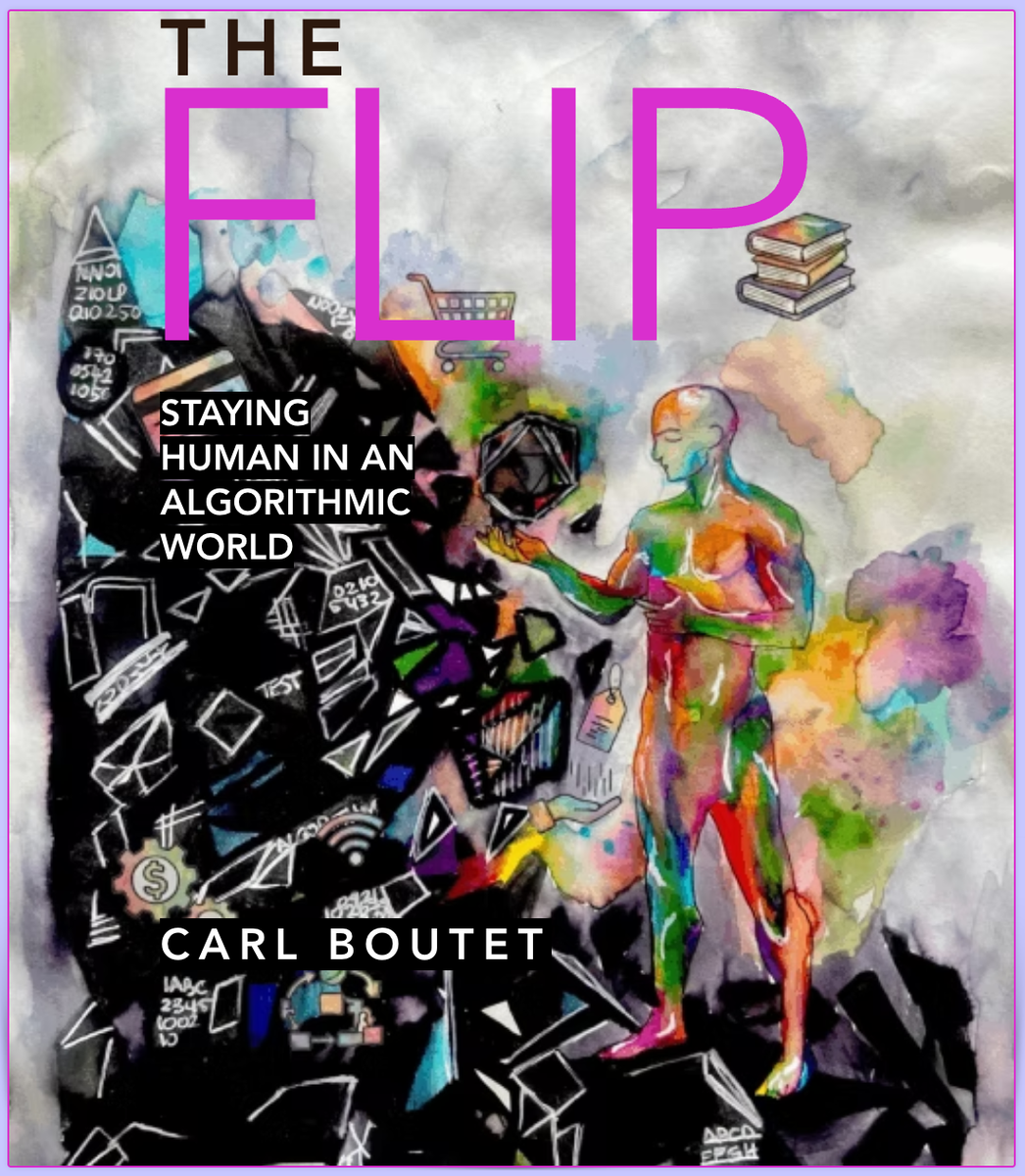
The concern is central to his new book, The Flip: Staying Human in an Algorithmic World, the third instalment in a trilogy that began with The Great Acceleration and continued with Blindspot.
Drawing on more than 30 years in retail and his teaching at McGill University and the Asian Institute of Technology, Boutet examines how businesses can benefit from increasingly capable systems while preserving the judgment that gives those businesses direction.
“The Flip itself is this change that we’ve seen in where value is being created,” Boutet said in an interview with Retail Insider.
Historically, human ingenuity, strategy and judgment sat at the centre of value creation, with technology supporting those decisions. Boutet argues that the relationship is beginning to reverse.
“We go from a place where the human was at the core and technology would amplify what the human could do, and now it’s sort of the other way around,” he said.
In retail, the shift extends well beyond employees using generative AI to produce marketing copy. Algorithms influence where products are sourced, how merchandise moves through supply chains, which products retailers carry, how they are priced and promoted, and where marketing dollars are deployed.
“There are very few decisions that are made in a retail organization that algorithms aren’t directly influencing,” Boutet said.
A ‘Sea of Sameness’ in Retail
Boutet is not arguing that retailers should pull back from AI. Companies face competitive pressure to adopt technologies that improve productivity, sales and profitability, and he expects that adoption to continue.
His concern is what happens when businesses increasingly optimize toward the same outcomes without questioning whether those outcomes support a distinctive customer proposition.
Similar tools and information can contribute to convergence. So can shared performance measures that reward immediate conversion, lower costs or faster inventory turnover without adequately accounting for longer-term brand value.
“I think that’s my biggest fear,” he said. “Everything starts looking and feeling the same.”
Boutet sees early signs in digital marketing, particularly among emerging and mid-market brands whose advertisements can take on similar language, imagery and presentation. He contrasted that with companies including Gucci, Louis Vuitton, Aritzia and Nike, which he cited for their recognizable identities and clearly defined brand playbooks.
Those identities do not make a company immune to competitive pressure or algorithmic convergence. They do, however, provide a reference point against which recommendations can be assessed.
The issue becomes more consequential as AI moves from assisting with individual tasks to influencing decisions historically made by experienced merchants, marketers and executives. Retailers also need to consider what happens to institutional knowledge when systems repeatedly make decisions involving pricing, sourcing and merchandising.
“If you start losing the knowledge in the company that allows you to do the right pricing or the right merchandising, the right sourcing, because you just let the algorithms decide that for you all the time, then who really holds that knowledge?” he said.
‘Delegate, Not Relegate’
Boutet summarizes the distinction with a phrase: “Delegate, not relegate.”
Algorithms can produce strong recommendations, making it natural for companies to give them greater responsibility. Problems emerge when an organization stops maintaining the knowledge and judgment needed to challenge those recommendations.
A system might identify a price likely to maximize a particular outcome or recommend products with the strongest projected sales. Those decisions can make commercial sense individually while gradually pushing a retailer away from its broader positioning.
The responsibility for defining success therefore remains with leadership. A retailer needs to understand what its systems are optimizing for and whether those objectives reflect the business it intends to build.
“They need to use the algorithms, but they need to be conscious of what direction the technology is pointing them in,” he said. “As much as they need to leverage it and use it and make sure that they’re staying competitive, the key message is: delegate, not relegate.”
Taking the ‘Back Flip’
Boutet calls the response the “Back Flip”: restoring human intention, judgment and accountability to the centre of strategy while using technology to expand what people and organizations can accomplish.
That does not require people to resume making every operational decision. It requires them to retain ownership of the business’s purpose, strategic direction and the choices that define its relationship with customers.
“The Back Flip is taking back that agency, taking some risk, maybe not always letting the algorithm make all the choices for us,” he said.
He is explicit that this does not mean rejecting AI.
“I’m not an anti-AI person,” Boutet said, explaining that his concern is with companies going “full throttle” without remaining conscious of where algorithms are pushing the organization.
“It’s great to create fire,” he said. “Just try not to burn the house down.”
For retailers, that leaves room for merchants, marketers and executives to make decisions that may not represent the most efficient outcome predicted by a model. A decision can still strengthen the retailer’s identity, introduce something unexpected or support a longer-term strategy that is difficult to capture through optimization alone.
AI Is Changing Product Discovery
Consumers are also beginning to use AI differently when they shop. Instead of entering several keywords into a search engine and working through the results, shoppers can give an AI assistant a detailed description of what they need.
Boutet used running shoes as an example. A consumer could explain that they are preparing for a 10-kilometre race, expect rainy conditions, are a moderate runner and have a particular budget. That gives the system more context when recommending products.
Boutet expects this type of discovery to become significant, although he is more cautious about predictions that consumers will routinely hand the entire transaction to autonomous shopping agents.
“I’m still more in the camp around agentic that it’s going to have a way bigger impact on how we discover stuff than how we actually purchase,” he said.
Some services already support authorized purchases under specified conditions. Amazon’s U.S. shopping assistant, for example, allows customers to arrange automatic purchases when an item reaches a target price.
The distinction is between what technology can already do and how widely consumers will choose to delegate those decisions. Boutet sees discovery and evaluation as the more immediate strategic changes for retailers.
An AI system can influence which products a consumer considers before that shopper ever reaches a retailer’s website or store.

Getting Recommended by AI
The shift has implications for the information retailers make available about their products.
Consumers can provide AI systems with detailed context about what they want, allowing recommendations to move beyond the conventional keyword searches retailers have spent years learning to optimize for.
Product descriptions, reviews, editorial coverage and discussions in online communities can all contribute information that AI systems use. Structured product data, including accurate specifications, pricing and availability, also helps shopping services represent a retailer’s offering.
Boutet pointed to Reddit as one source that has attracted attention because of its volume of human discussion. He also cautioned that attempts by marketers to influence those conversations could eventually undermine their usefulness.
No single source or content tactic guarantees a recommendation. Different systems draw on different information, and retailers may have limited visibility into why one product is presented over another.
For brands, that creates another layer between the business and the consumer. Clear, credible and current product information becomes increasingly important, alongside the distinctiveness of the offering itself.
Physical Stores Could Become More Important
Asked whether AI makes physical stores more or less important, Boutet did not hesitate.
“More.”
He sees distinctive stores as one way retailers can push back against the “sea of sameness” emerging across digital channels.
“Well-designed stores that stand out and really communicate the brand identity, I think that’s going to be more than ever what differentiates and helps brands connect with consumers,” he said.
A physical store gives a retailer considerable control over how its brand is experienced. Architecture, merchandising, service and human interaction can create something difficult to reproduce through an AI interface.
Boutet’s Retail Relevance Index provides a framework for considering that opportunity. It examines four dimensions of value: price, convenience, customer delight and company purpose. Price and convenience help a retailer earn consideration, while delight and purpose offer further opportunities to build meaningful differentiation.
Stores can contribute across those dimensions, whether by making a purchase easier, providing useful advice or creating an experience customers want to revisit.
Boutet also pointed to digitally native companies such as Warby Parker that subsequently developed substantial physical store networks. He argues that locations can generate awareness and relationships that support digital channels as well.
In his view, that role could become increasingly valuable as more product discovery takes place through AI systems over which retailers have limited control. The strategic contribution of a store can therefore extend beyond the transactions completed inside it.
What Asian Retail Can Teach Canada
Boutet, who teaches and spends considerable time in Asia, said retailers there often operate in a different competitive environment. He cautioned against treating Asia as a single retail market, pointing to significant differences between China, India and Southeast Asia.
In Southeast Asia, he continues to see retailers putting considerable effort into creating energy, community and reasons for consumers to spend time in physical environments. Their competition can extend well beyond another retailer or shopping centre.
“Their competition is the night market, it’s the weekend market, it’s the train market,” Boutet said, also pointing to the informal food vendors and other businesses surrounding stores in many markets.
Some informal operators can have lower overhead, increasing the pressure on formal retailers to offer compelling reasons to visit.
“You really need to stand out,” he said. “You have to do something and really resonate there.”
For Canadian retailers, the lesson is to consider the full range of alternatives competing for a customer’s time and attention, and the role that community and experience can play in earning a visit.
Looking at AI Through Four Forces
In The Flip, Boutet moves beyond using “AI” as a catch-all term by identifying four forces reshaping commerce: Optimization, Automation, Immersion and Contextualization.
Optimization describes the pursuit of efficiency, with systems continually refining the path toward a defined outcome.
Automation transfers tasks and decisions from people to machines, raising questions about where responsibility and control should remain.
Immersion describes environments engineered to capture attention and shape desire, influencing what people want as well as what they buy.
Contextualization adapts experiences and recommendations to the individual and the moment. Personalization belongs within this force, as systems respond to a person’s circumstances, preferences and needs.
The forces reinforce one another. Automation produces data that can support contextualization. More tailored experiences generate behavioural signals that enable further optimization.
The framework helps leaders examine what technology is actually doing, how it changes the customer experience and where it expands or diminishes human agency.
Keeping Humans in the Decision
Asked what retail CEOs should be doing differently today, Boutet returned to the question of control.
Leadership teams should understand which decisions have become automated, what objectives guide those systems and where human judgment remains essential. They also need to preserve the expertise required to recognize when a recommendation conflicts with the company’s direction.
That can become difficult when competitors are using similar technologies to improve productivity and performance. Retailers have strong reasons to adopt AI, and Boutet does not expect that pressure to disappear.
His argument is that adoption should be accompanied by deliberate choices about what the business stands for, how it creates value and which responsibilities its leaders must continue to own.
As algorithms become more deeply involved in retail decisions and product discovery, human judgment remains central to giving customers a reason to choose one company over another.
“Delegate, not relegate,” he said.