RioCan Real Estate Investment Trust says it expects its 2026 earnings to reach the high end of its previous forecast after reporting 5.1 per cent growth in third-quarter Core funds from operations (FFO) per unit and record retail committed occupancy of 98.9 per cent.
The Toronto-based real estate investment trust reported Core FFO per diluted unit of 41 cents for the three months ended Sept. 30, up from 39 cents in the same period last year. Net income per diluted unit was 42 cents, compared with a loss of 41 cents a year earlier.
The results reflect increased rental income, stronger commercial same-property net operating income (NOI) growth and contributions from property acquisitions and unit repurchases. RioCan also reported higher leasing rents and continued demand for its retail properties in major Canadian markets.
“Our third quarter results reflect continued execution of our simple, retail-focused strategy and the strength of our business,” said Jonathan Gitlin, President and CEO of RioCan. “Strong tenant demand, record retail occupancy and limited new supply continue to support healthy leasing economics and earnings growth. Combined with the capabilities of our independent platform, these fundamentals position RioCan well to continue executing our strategy and creating long-term value for unitholders.”


Earnings outlook and financial performance
RioCan now expects its 2026 Core FFO per diluted unit to be toward the high end of its previously established range of $1.60 to $1.62. The trust attributed the outlook to strong commercial same-property NOI growth and lease cancellation fees that are expected to be higher in 2026 than in the previous year.
The trust reaffirmed its forecast for commercial same-property NOI growth of 4.0 to 4.5 per cent, an increase from its original outlook of 3.5 to 4.0 per cent.
However, RioCan lowered its 2026 development spending forecast to between $35 million and $45 million, down from its original range of $45 million to $55 million. The change reflects lower anticipated spending on residential inventory. All other financial outlook metrics remain unchanged.
For the first nine months of 2026, Core FFO totalled $346.9 million, compared with $343.3 million in the same period last year. Core FFO per diluted unit was $1.19, up from $1.16.
Net income for the nine-month period was $367 million, compared with a loss of $58.9 million in 2025. Net income per diluted unit reached $1.26, compared with a loss of 20 cents a year earlier.
RioCan said the improvement in quarterly net income was primarily attributable to fair value gains on investment properties, compared with fair value losses in the previous year, as well as prior-year losses related to equity-accounted investments.
Net book value per unit increased to $24.81 as of Sept. 30, compared with $24.37 at the end of 2025. The trust attributed the increase primarily to investment property fair value gains and retained earnings.
Retail occupancy and leasing activity
Retail committed occupancy reached 98.9 per cent at the end of September, compared with 98.4 per cent a year earlier. Overall committed occupancy for the commercial portfolio was 98.2 per cent, up from 97.8 per cent.
RioCan completed 1.1 million square feet of leasing during the third quarter, including 900,000 square feet of renewals. Its retention ratio was 89.9 per cent.
The blended leasing spread was 17 per cent during the quarter, compared with 20.8 per cent in the same period last year. New leasing spreads were 19.1 per cent, while renewal leasing spreads were 16.4 per cent. Excluding fixed renewals, which represented approximately 46 per cent of the total square footage of renewed leases, the average blended leasing spread was 20.6 per cent.
Average net rent for new leases reached $31.45 per square foot, 32 per cent higher than the $23.81 average net rent per occupied square foot at quarter end.
The trust highlighted two grocery leasing transactions totalling 63,000 square feet. One involved a 35,000-square-foot renewal at a Montreal property that achieved a 64 per cent increase in rent. The other was a new 28,000-square-foot lease at an Ottawa property.
Commercial same-property NOI growth was 4.2 per cent in the third quarter. RioCan said higher rental revenue, net of rental operating costs, was offset by lower residential inventory gains and reduced fee income, resulting in a $200,000 decrease in operating income compared with the same quarter last year.
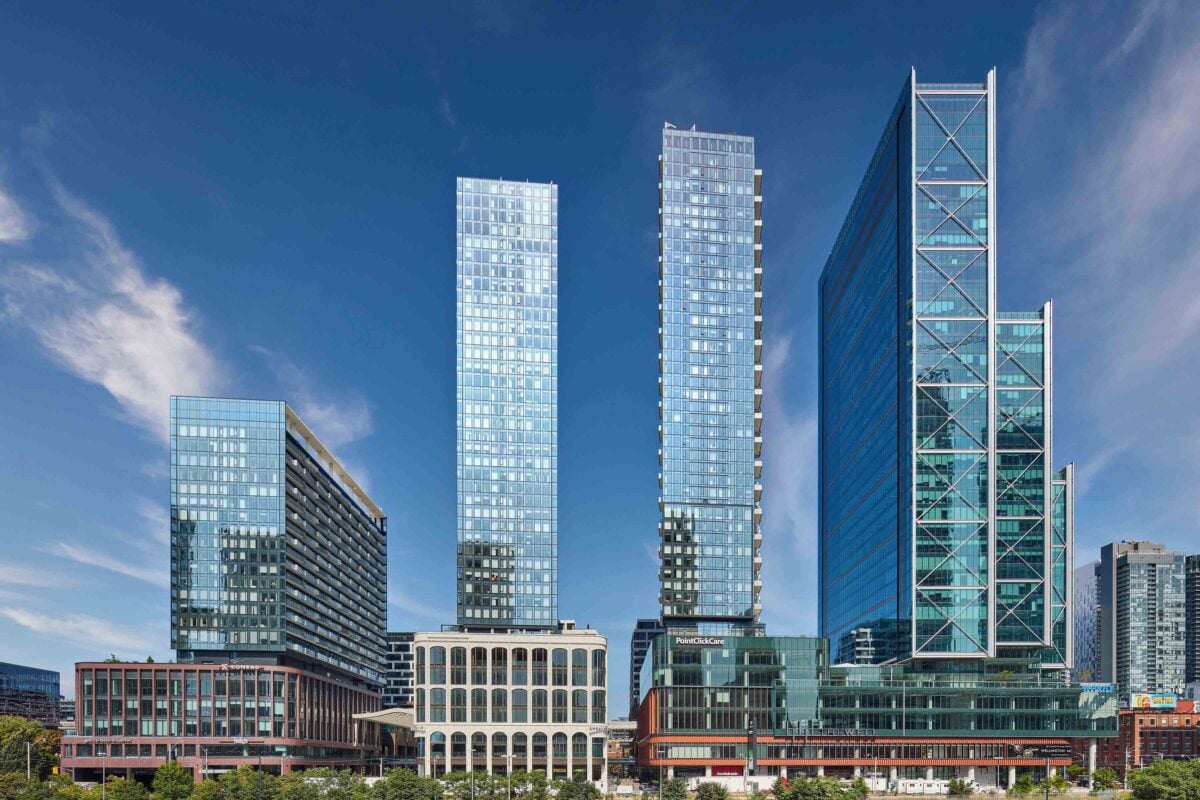
Property transactions and capital strategy
RioCan also continued to adjust its property portfolio through acquisitions and dispositions.
During the quarter, the trust agreed to acquire a partner’s 37.5 per cent interest in East Hills, a Costco-anchored property in Calgary, for $54.8 million. The transaction, which is expected to close in the first quarter of 2027 subject to customary closing conditions, will increase RioCan’s ownership interest in the property to 77.5 per cent.
The trust completed the sale of Pivot during the quarter for gross proceeds of $95.7 million. For the nine months ended Sept. 30, it sold interests in five RioCan Living properties, including Pivot, for aggregate gross proceeds of $376.2 million.
RioCan also has a conditional agreement to sell its interest in another RioCan Living income-producing property for estimated gross proceeds of $110 million. The transaction is expected to close in the fourth quarter of 2026, subject to finalization, due diligence and customary closing conditions.
Including that conditional transaction, RioCan reported $1.27 billion in cumulative capital repatriation from RioCan Living over the 21 months ended Sept. 30, against its $1.3-billion target for 2025 and 2026.
The total includes $782.8 million in gross proceeds from the sale of 12 residential rental properties and $373.4 million from residential inventory sales, including RioCan’s share of equity-accounted joint ventures.
Debt and liquidity
RioCan reported total consolidated debt of $6.9 billion as of Sept. 30, down from $7.15 billion at the end of 2025. Its total assets were $14.6 billion, compared with $14.9 billion at year end.
During the third quarter, the trust entered into a new $400-million, 7.3-year floating-rate, non-revolving unsecured credit facility. The facility was priced more favourably than its revolving unsecured operating line of credit, with proceeds used to partially repay amounts drawn on that operating line.
RioCan said the financing strengthened its liquidity position, extended its debt maturity profile and reduced borrowing costs. Liquidity, including cash and cash equivalents, stood at $1.08 billion on a consolidated basis at the end of September.
The trust reported a 71 per cent ratio of unsecured debt to total contractual debt, supported by an unencumbered asset pool valued at approximately $9.7 billion.
RioCan owns, manages and develops necessity-based retail properties in densely populated communities. As of Sept. 30, its portfolio comprised 163 properties with an aggregate net leasable area of approximately 31 million square feet, based on its ownership interest.
More from Retail Insider: