Toronto-Based liquidator sees spike in inventory deals amid shifting retail landscape

Date:

Share post:

Toronto-based inventory liquidator Alex Hennick says business is booming as companies across North America and Europe face mounting challenges tied to unsold goods, warehousing costs, and shifting consumer behaviour.

“We started in 2009,” said Hennick of A.D. Hennick & Associates. “So we’ve been around for 16 years. We are primarily buying and selling large quantities of excess inventory, canceled orders, and distressed assets. So we’re working with manufacturers, with distributors, with bankruptcy trustees, and a variety of different avenues where we’re purchasing volume of inventory.”

Alex Hennick
Alex Hennick

The liquidator resells that merchandise through a number of channels. “Depending on what we’re buying, we’re selling to discount retailers, we’re selling in auctions, and we’re selling in wholesale. And then occasionally we’ll do store closing sales if we’re doing, say, a bankruptcy of a retailer.”

Hennick says that in recent years, the flow of deals has grown substantially. “There’s so much more inventory on the market right now and there’s so many factors that are affecting it,” he said. “COVID, tariffs—there’s a lot of decisions that companies made in the moment that they look back at a couple years later and the economy has changed significantly.”

He confirmed his company was involved with the Hudson’s Bay Company liquidation. “We were involved a bit with the Bay,” he said. “We work closely with the people who ran the liquidation sale—some of the largest U.S. liquidation firms. And what a lot of these liquidators do in the sale is they’re able to augment or supplement the sale. So the liquidation companies purchase a lot of inventory and they sell them in the store closing sales, because the stores are packed, there’s so much traffic.”

“When the judge gave them approval, we had a lot of inventory in stock that we were able to sell. That was then sold in the store closing sale.”

According to Hennick, many companies in trouble wait too long before making key decisions. “We see a lot of companies doing too much,” he said. “So for example, a clothing company—they might have a lot of different styles, a lot of different colours. Sometimes less is more.”

He added: “Shoe companies—there’s so many different sizes. When you make different styles, you have to have different sizes. So it’s less about how much you’re selling, it’s more about how much you’re buying.”

He noted that poor inventory decisions can cascade into major financial trouble. “You get 50,000 items… if you sell over 48,000 of them, you could be in good shape. But if you sell 30,000, you probably won’t even break even. Then you have warehouse costs and you have overhead, you have so many additional fees that go into it—cash flow and affecting other products.”

Another issue is companies failing to diversify sales channels or evolve. “A lot of companies, if they don’t evolve, sometimes their eggs are in so many baskets. Talking about HBC—obviously for years people thought there might be problems, but a lot of companies are very leveraged because HBC is one of their biggest customers.”

“They’ve now manufactured quite a bit of inventory for HBC which is not going to be bought. So they’re sitting on that and they’ve lost a large customer for years to come. So the impact this will have on manufacturers and brands will be enormous.”

Third-party logistics (3PL) warehousing is another challenge, he added. “The cost to warehouse your inventory is so much these days that we continue to see brands fail because they have these big items that they’re storing in warehouses, and the fees and the cost to store them there—unless it’s turning over quickly—it’s going to outweigh itself,” said Hennick. “The 3PL is the only one making money.”

The liquidator now operates globally. “Some of our biggest customers are in Europe. We’re in Canada, U.S., and Europe. Those are the main markets that we’re selling into.”

Hennick said certain retail segments are especially vulnerable right now. “Besides real estate… obviously the cannabis industry for years grew very quickly. The amount of bankruptcies in cannabis is huge,” he said.

And the struggling housing market has sent ripples through adjacent industries. “Because homes aren’t selling as much and the housing market’s bad, people aren’t doing renovations. So because of that, flooring companies, lighting companies, furniture companies are in really big trouble. They’re sitting on stock and it’s not a price thing.

“Consumers don’t have money. They don’t have money for a big-ticket purchase. And if you’re not doing a renovation, you’re almost never going to be buying flooring and lighting and furniture because it’s kind of situational.”

That economic pressure is fueling a surge in discount retail, Hennick noted. “There’s a tremendous amount of inventory on the market, which allows a lot of these discount retailers and places to get opportunities—great deals. 

“If the retailers are buying right and they’re able to get the right deals on the floor, it’s only going to make a better name for themselves and grow their customer base.”
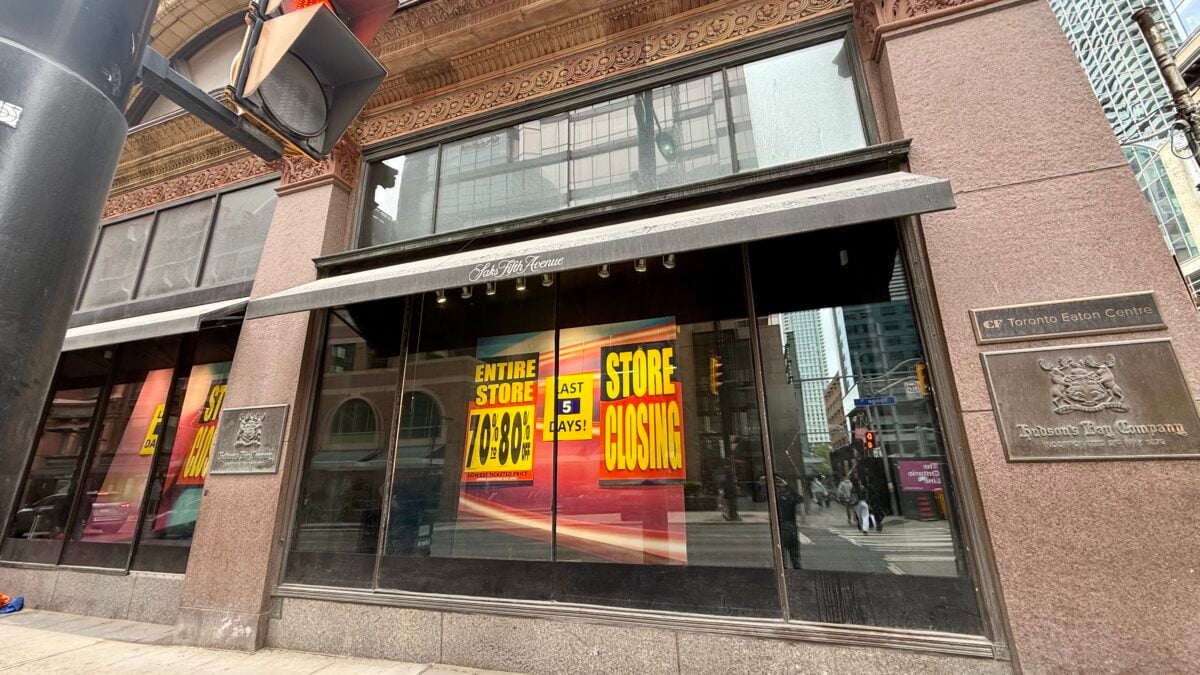
Display window at Saks Fifth Avenue in the Hudson’s Bay building on Queen Street in Toronto, May 28 2025. Photo: Craig Patterson

He cited one notable example from last year: “We bought the assets of the world’s largest barbecue store. That was a store located in Toronto—50,000 square feet.”

“Why was it not located in Texas versus Toronto with our five- or six-month barbecue season? Doesn’t make sense to me.”

“During COVID, they couldn’t keep things in stock. Everyone was at home, everyone needed a new barbecue. All of a sudden in June—barbecue season of 2022—their phones stopped ringing. Because if you buy a barbecue, chances are you don’t need one for another 10 years.”

“They way over-inventoried because they thought, ‘Wow, 2020, our sales went like this. In 2021, 2022, it’s just going to continue.’ But they went and bought that much more inventory.”

“A lot of companies did this—2020 and 2021 were record years. People were at home, interest rates were low, they had disposable income, they couldn’t travel. Then these companies get stuck with huge facilities, massive rent, big overhead, and inventory. And it’s hard. It’s not sustainable.”

Related Retail Insider stories:

Mario Toneguzzi
Mario Toneguzzi
Mario Toneguzzi, based in Calgary, has more than 40 years experience as a daily newspaper writer, columnist, and editor. He worked for 35 years at the Calgary Herald covering sports, crime, politics, health, faith, city and breaking news, and business. He is the Co-Editor-in-Chief with Retail Insider in addition to working as a freelance writer and consultant in communications and media relations/training. Mario was named as a RETHINK Retail Top Retail Expert in 2024.

Subscribe to the Newsletter

Subscribe

* indicates required

LEAVE A REPLY

Please enter your comment!
Please enter your name here

Recent articles

VIDEO: Franchise model helps Ontario bakery owner navigate economic uncertainty

Franchising can offer operational assistance such as human resources and technology support, along with brand recognition that helps create a stronger foundation for new business owners.

Jobs increase in May, unemployment rate edges down: Statistics Canada

Accommodation and food services sees employment growth while wholesale and retail trade experience decrease.

Veronica Beard Opens Third Canadian Store at Vancouver’s Oakridge Park

Veronica Beard has opened its third Canadian store at Vancouver's Oakridge Park, building on strong growth in Toronto, Montreal, and online.

Fairmont Jasper Park Lodge unveils $100M transformation

This marks the latest in a series of investments by owner Oxford Properties in Canada, where the firm has committed more than $2 billion since 2025.

Inside the Brokerage Deals Reshaping Luxury Retail in Canada

Luxury retail expansion at Oakridge Park and Yorkdale is reshaping Canada’s retail landscape as brokerages help global fashion brands secure flagship locations in the country’s top luxury destinations.

Cellzy preparing for aggressive launch in Canada

A new modern retail concept focused on accessories, electronics and repair services, is preparing for an aggressive launch phase, with plans to open five new locations in 2026.

HEAL Wellness expands across Canada and U.S., targets 100 locations by end of 2026

What started as a single Ontario location has now grown to more than 37 locations across the country.

Big City Mayors call for federal action to bolster downtowns, drive economic growth

City leaders say revitalizing downtowns is central to broader national economic goals, with impacts on employment, business activity and community well-being.

Ocgrow Group expands into luxury hospitality with launch of premium hotel division

The company’s first hotel offering is located within Greystone, a 150-acre master-planned community where Ocgrow is the largest developer and landlord.

Retail and Grocery Leaders Honoured at RCCSTORE2026 Awards Programs

Retail Council of Canada recognized retailers, brands and industry leaders at RCCSTORE2026 through its Excellence in Retailing Awards and Canadian Grand Prix New Product Awards.

Creative Production Supports Retail Growth in Canada

Brandomatic Studios helps retailers scale creative production across digital and in-store channels with consistent execution.

Daily Synopsis: Jun 4, 2026

T&T Supermarkets opening at CF Sherway Gardens, MEC owner acquires Saint John Mall, Lululemon reports slower Canadian sales, Walmart launches Walmart+ membership in Canada, and other news.

Lululemon Sees Canadian Sales Decline as North American Growth Slows

Lululemon reported declining sales in Canada and lowered its annual outlook as the retailer works to rebuild momentum in North America amid growing competition.

T&T Supermarket to open at CF Sherway Gardens

T&T Supermarket will open at CF Sherway Gardens in Toronto, taking over the former Pusateri's and Saks Fifth Avenue food hall space.

MEC Owner Tim Gu Acquires McAllister Place Mall in Saint John

MEC owner Tim Gu has acquired McAllister Place in Saint John for $64 million, expanding Smart Investment's growing Canadian shopping centre portfolio. Craig Patterson speaks with Gu in an exclusive interview.

What Best Buy Says About Consumer Spending in Canada Right Now

Best Buy's latest results suggest Canadian consumers remain cautious and value-focused, but continue spending when products offer innovation and clear value.

Walmart+ membership launched in Canada

Canada is the first Walmart market outside of the United States to launch Walmart+.

Jacques Pérusse and Daughter Scale Teaology Across Canada

Beauty industry veteran Jacques Pérusse and daughter Valérie are expanding Teaology across Canada through major pharmacy retailers.

Charcoal Group pushes ahead with expansion as restaurant sector faces uncertainty: CEO Jody Palubiski

Consumers are still spending on dining out, but have become more selective about where they choose to go.

Sustainability-focused retailer HG Vintage weighs growth opportunities across Canada

Moe Khoja launched HG Vintage in 2019 after decades in conventional fashion retail.

Taylor Swift’s Eras Tour offers a preview of World Cup soccer spending

In Toronto, over the 10-day span of Taylor Swift’s six concerts, Moneris transaction data showed that spending downtown rose 45% week-over-week.

25% of ecommerce side hustlers in Canada earn $1,000+ Monthly: Omnisend

Selling items online is now the most common side hustle overall, chosen by 48% of side hustlers

Daily Synopsis: Jun 3, 2026

Zellers opening 2 Ontario stores, man sues Birks over lost watch, fire closes Mission Canadian Tire, Sunrises Records opening in Brandon, Loblaw City Market prepares to open in Vancouver's South Granville, and other news.

Leyad acquires Intercity Shopping Centre in Thunder Bay

Intercity Shopping Centre serves as the city's primary retail hub and draws shoppers from across Northwestern Ontario.

Zellers announces plans for expansion into Ontario and Zeddy’s comeback

Zellers is expanding into Ontario with two new stores in Toronto and Windsor, building on strong momentum from its Edmonton comeback.