President Trump’s latest threat to increase tariffs on select Canadian imports by 35% represents unprecedented uncertainty to Canadian business, according to various retail experts.
“The worst thing for business is uncertainty. Businesses cannot plan under these circumstances due to the variability in economic forces at play. The knock on effects include lower capital spending, lower hiring, a cautious consumer who spends less at retail and potential GDP erosion and layoffs for our country,” retail analyst Bruce Winder.

“The longer this type of political and economic climate persists, the greater harm to the Canadian economy and thus our quality of life as a country.
“The Canadian government has the difficult job of balancing getting a deal done and not giving away to much to impair our country in the future. I think it is wise for Canada to continue to explore alternative trading partners to help diversify our economy but that takes time.
“One can argue that President Trump will face significant pressure from US business owners and consumers if and when these significant planned tariffs import inflation into America. In essence we are playing a game of chicken with our biggest trading partner and must watch from the sidelines as to who blinks first.”
Sylvain Charlebois, Senior Director, Agri-Food Analytics Lab, Dalhousie University, said Trump’s threat of 35% tariffs on Canadian goods, if implemented, would be a massive blow—not just to Canadian exporters, but also to retailers and ultimately consumers on both sides of the border.
“Canadian retailers would face higher costs on imported U.S. goods they rely on, while Canadian-made products could become less competitive in the U.S. market,” he said.

“We’d likely see price hikes on everything from produce to packaged foods, especially for goods with tight cross-border supply chains. Retailers would try to absorb some of the impact, but much of it would trickle down to consumers, further fuelling food inflation.
“That said, procurement pivots we’ve seen in recent months—such as diversifying supplier networks and increasing domestic sourcing—could help blunt the impact of any new tariffs. While the threat is serious, the Canadian retail sector is more agile now than it was a few years ago.
“This kind of tariff escalation risks reigniting a full-blown trade war, and Canadian businesses—still recovering from the last round—are watching closely and bracing for volatility.”
George Minakakis, Founder and CEO of the Inception Retail Group, said we should expect more of this over the term of this President.
“Trump’s threat of 35% tariffs on all Canadian goods is not just economic posturing; it’s a political weapon. What this tells me is that the Canadian government is pushing back, and Trump doesn’t like it,” he said.
“Retailers on both sides of the border would face immediate consequences: higher costs, supply chain uncertainty, and inflationary pressures that get passed directly to consumers. Consumers will retrench, and basically, the economy will come to a standstill. This kind of volatility can’t be absorbed by any industry; retailing is already grappling with slim margins and shifting consumer behaviors. When this President said he would use economic force to take over Canada earlier this year, he was telling us how vulnerable we are.

“We must move faster toward less reliance on the US. While I know that this is immediately impossible and we will have to acquiesce to some crazy tariffs, Canadians and businesses must stand up to this kind of economic bullying. When this type of trade threat began, I warned clients and associates to begin thinking about economic survival tactics. Canada must rethink its relationships globally, as our very economic and sovereign existence depends on it. Retailers need to think about how they can leverage technology to source products, communicate with consumers, and work through their competitive landscape. We also need to move from reactionary management to responsive and proactive management of businesses. I would anticipate that larger retailers are looking at how they can leverage their AI capabilities to do what I just outlined.
“Trump has mastered the art of provocation and disruption to shape political narratives and outcomes. In the end, the consumer and the retail industry (all industries) become collateral damage in a geopolitical game where predictability and partnership are replaced by chaos and calculated confrontation. And while this threat could blow over, there will be others.”
Michael Kehoe, Broker of Record, Fairfield Commercial Real Estate, said retailing is ‘Darwinian’ struggle in the best of times and for the most part in Canada these are not the best of times.
“We are in challenging times and the uncertainty created by the threat of an additional 35% American tariffs on Canadian goods that could be implemented on August 1, 2025 will compound retailer struggles, he said.

“When we think of ‘survival of the fittest’ a term made famous by British naturalist Charles Darwin in 1869, (it) suggested; “That organisms best adjusted to their environment are the most successful in surviving and reproducing.
“Well, this is applicable to Canadian retailers right now and the stores that can innovate and are financially the ‘fittest’ and able adapt to the current market conditions will survive and expand. It’s the uncertainty that hurts everyone and the ongoing American tariff threats, are a weaponization of chaos against Canada. Chaos is the operative word right now across the retail spectrum in Canada.”
Retail supply chain expert Gary Newbury said U.S. political theatrics have turned into another round of serious economic threats. President Trump announced via a letter posted to Prime-minister Carney, via Truth Social, he would impose a 35% tariff on Canadian goods outside CUSMA protections on 1st August — citing fentanyl trafficking, Canada’s digital tax, and Ottawa’s continued defence of supply management as justification. This is the face of his 30 days period to come to the table to negotiate a deal which falls due soon.
The implications? Chilling, said Newbury.
“If even part of this threat materializes, Canadian exporters in key sectors from agri-food to automotive will face an impossible squeeze. Many simply won’t survive. That means tens of thousands of job losses in manufacturing towns, transport corridors, and rural communities. And retail? It’s next in line,” he said.
Retail doesn’t operate in a vacuum. It thrives on consumer confidence. And here’s the hard truth, according to Newbury:
- 70% of Canadians are already living paycheque to paycheque
- Household debt for around 85% of the population is among the highest in the developed world
- Disposable income is fragile — and regional economies are uneven

When job losses mount, spending dries up. Here’s how the fallout could break down by retail tier, says Newbury:
- Luxury: Foreign spend might hold, but domestic demand will crater outside core global cities (Toronto, Montreal and Vancouver). Expect inventory holdbacks, staffing cuts, and margin defense through exclusivity.
- Mid-market: This is where pain gets real. The bulk of Canadian household spending happens here — and it will hollow out. Discretionary retail (furniture, fashion, seasonal) will feel it first. Following Prime Day promotions, the consumer will be in drought mode.
- Everyday Low Price: Inflation-weary Canadians are already here. But if costs rise further, even Walmart, Dollarama and Costco shoppers may cut back, and retailers will face margin pressure from both ends.
- Discount: The only segment likely to grow — for now. But watch out: if supply chain tariffs affect grey market flows or private-label imports, even value chains could falter.
“Finally, any Canadian retaliatory tariffs or non-tariff barriers (such as quotas or other measures, especially with government “only buy Canadian” spending) — especially on U.S. food, tech, or apparel — risk triggering a price war that bleeds retailers and burns consumers,” he said.
“The timing couldn’t be worse. With supply management now legally shielded by Ottawa, negotiating leverage is limited. Canada may face a no-win choice: concede or endure.
“Retailers must prepare now — for price instability, volume volatility, and a very shaken consumer.”
In a LinkedIn post, high profile Canadian entrepreneur Arlene Dickinson said: “I really wish I was surprised. But when you’ve had to deal with bullies for much of your career, you stop expecting them to act in good faith and start to understand that real strength lies in moving past them and not letting their chaos or threats stand in your way.

“This new 35% tariff threat is not rooted in fairness or fact. And it’s not a surprise because its bullying and autocratic behaviour. A familiar pattern from Trump, where his quest for power replaces principle, threats replace diplomacy, and his real drivers are greed, control, and a need to dominate.
“But it won’t work on us.”
Dickinson said she sits on the Canada–U.S. Trade Council and she believes strongly in constructive negotiation between sovereign nations and in acting in Canada’s best interests while reflecting our values.
“That requires clarity, mutual respect, and not coercion or submission. Not us bowing down or being on bended knee,” she said.
“We’re busy building an economy rooted in fairness, resilience, and global reach. Of course we want to keep building it with the United States, but we’ll build it regardless. Thats what he fails to understand. Canada isn’t his to manipulate. We’re fiercely independent and extremely resilient and we’ll chart our own course.
“We’ve seen this playbook before. We will not be moved by threats.
“We’re acting with decency and with resolve just as we should. Let’s all stay focused on building a strong and independent Canada, open to the world, confident in our values, and unwavering in putting our country and our democracy first.”
Unifor, Canada’s largest union in the private sector, representing 320,000 workers in every major area of the economy. is condemning U.S. President Donald Trump’s latest threat to impose a 35% tariff on non-CUSMA compliant Canadian goods as a reckless act of economic extortion designed to strong-arm Canada into an unfair trade deal.
“There’s only one answer to this extortion from the U.S. president: push back—hard,” said Unifor National President Lana Payne. “Canada must use every bit of leverage we have. Workers are counting on our government to defend their jobs and industries. Concessions won’t stop a bully, but collective strength will.”
The move, announced in a letter Trump posted on social media, marks the latest escalation in the ongoing trade war with the U.S., said the organization.
Trump’s ultimatum, set to take effect August 1, demands Canadian companies relocate production to the U.S. or face punishing tariffs. The threat comes as Prime Minister Mark Carney and Trump are engaged in negotiations to reach a trade deal by a newly announced August 1 deadline. The 35% tariff threat is just the latest in a series of baseless and punitive actions. Trump has already imposed tariffs on Canadian autos, steel and aluminum, and is also promising a 50% tariff on copper, it said.
“Trump’s playbook is clear, implement and threaten sky-high tariffs to condition us into accepting a lower baseline tariff as the new normal. We must never fall for it,” said Payne. “That’s not negotiation—that’s coercion. We will not settle for a future where Canadian jobs are held hostage to the U.S.”
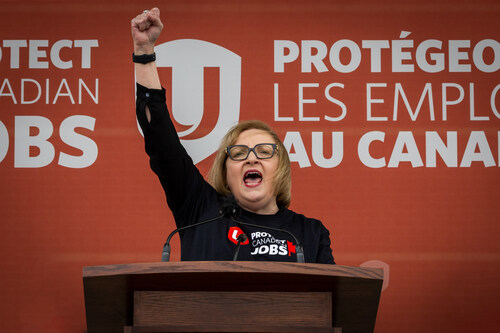
With Canadian jobs and industries under attack, Canada must continue its pursuit of an agreement with the U.S. that is preconditioned on zero tariffs. Any U.S. proposal intended to solidify unjust tariffs must be roundly rejected, said Unifor.
The Canadian government must also consider a range of strategic responses to defend its national interest. Unifor is urging the federal government to invoke powers under the Foreign Extraterritorial Measures Act to penalize firms that relocate production outside of Canada, in response to the President’s tariff policies, up to and including an import prohibition on those firms, it said.
In the event a deal cannot be reached by August 1, Unifor is also urging the federal government to immediately undertake a national reserve strategy, with stockpiles of key inputs such as aluminum and critical minerals, among others, essential to Canadian sovereignty.
For more information visit Unifor’s Protect Canadian Jobs campaign website here.
Related Retail Insider stories: