Toronto-based inventory liquidator Alex Hennick says business is booming as companies across North America and Europe face mounting challenges tied to unsold goods, warehousing costs, and shifting consumer behaviour.
“We started in 2009,” said Hennick of A.D. Hennick & Associates. “So we’ve been around for 16 years. We are primarily buying and selling large quantities of excess inventory, canceled orders, and distressed assets. So we’re working with manufacturers, with distributors, with bankruptcy trustees, and a variety of different avenues where we’re purchasing volume of inventory.”

The liquidator resells that merchandise through a number of channels. “Depending on what we’re buying, we’re selling to discount retailers, we’re selling in auctions, and we’re selling in wholesale. And then occasionally we’ll do store closing sales if we’re doing, say, a bankruptcy of a retailer.”
Hennick says that in recent years, the flow of deals has grown substantially. “There’s so much more inventory on the market right now and there’s so many factors that are affecting it,” he said. “COVID, tariffs—there’s a lot of decisions that companies made in the moment that they look back at a couple years later and the economy has changed significantly.”
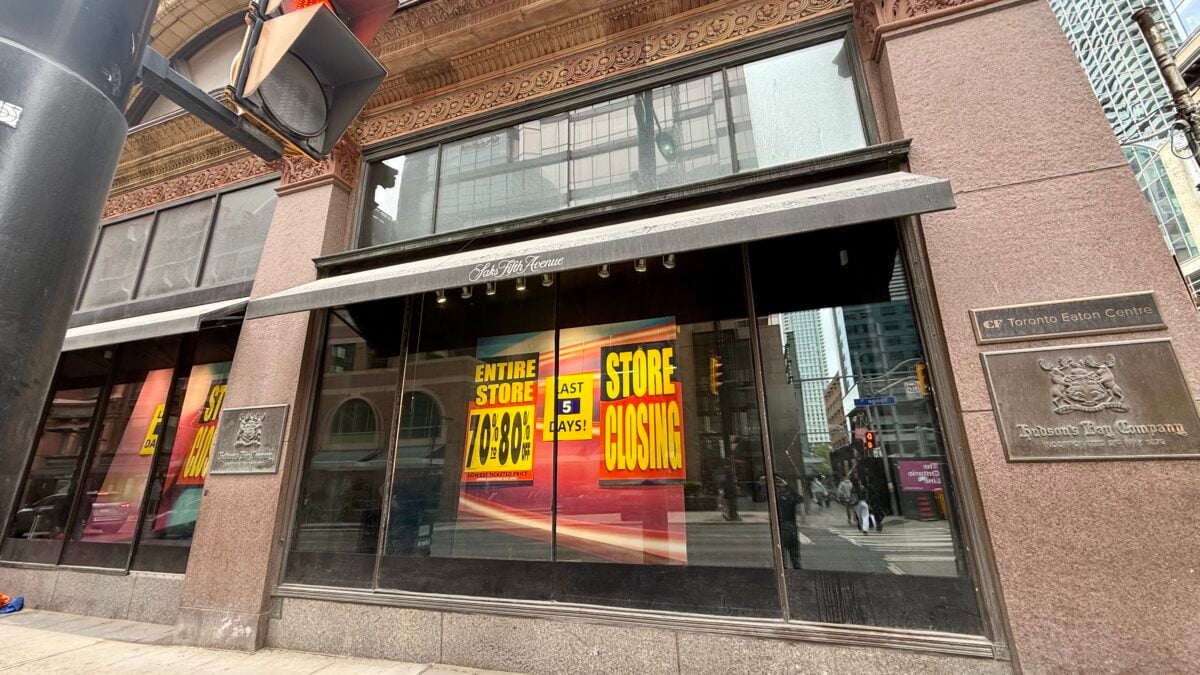
He confirmed his company was involved with the Hudson’s Bay Company liquidation. “We were involved a bit with the Bay,” he said. “We work closely with the people who ran the liquidation sale—some of the largest U.S. liquidation firms. And what a lot of these liquidators do in the sale is they’re able to augment or supplement the sale. So the liquidation companies purchase a lot of inventory and they sell them in the store closing sales, because the stores are packed, there’s so much traffic.”
“When the judge gave them approval, we had a lot of inventory in stock that we were able to sell. That was then sold in the store closing sale.”
According to Hennick, many companies in trouble wait too long before making key decisions. “We see a lot of companies doing too much,” he said. “So for example, a clothing company—they might have a lot of different styles, a lot of different colours. Sometimes less is more.”
He added: “Shoe companies—there’s so many different sizes. When you make different styles, you have to have different sizes. So it’s less about how much you’re selling, it’s more about how much you’re buying.”
He noted that poor inventory decisions can cascade into major financial trouble. “You get 50,000 items… if you sell over 48,000 of them, you could be in good shape. But if you sell 30,000, you probably won’t even break even. Then you have warehouse costs and you have overhead, you have so many additional fees that go into it—cash flow and affecting other products.”
Another issue is companies failing to diversify sales channels or evolve. “A lot of companies, if they don’t evolve, sometimes their eggs are in so many baskets. Talking about HBC—obviously for years people thought there might be problems, but a lot of companies are very leveraged because HBC is one of their biggest customers.”
“They’ve now manufactured quite a bit of inventory for HBC which is not going to be bought. So they’re sitting on that and they’ve lost a large customer for years to come. So the impact this will have on manufacturers and brands will be enormous.”
Third-party logistics (3PL) warehousing is another challenge, he added. “The cost to warehouse your inventory is so much these days that we continue to see brands fail because they have these big items that they’re storing in warehouses, and the fees and the cost to store them there—unless it’s turning over quickly—it’s going to outweigh itself,” said Hennick. “The 3PL is the only one making money.”
The liquidator now operates globally. “Some of our biggest customers are in Europe. We’re in Canada, U.S., and Europe. Those are the main markets that we’re selling into.”
Hennick said certain retail segments are especially vulnerable right now. “Besides real estate… obviously the cannabis industry for years grew very quickly. The amount of bankruptcies in cannabis is huge,” he said.
And the struggling housing market has sent ripples through adjacent industries. “Because homes aren’t selling as much and the housing market’s bad, people aren’t doing renovations. So because of that, flooring companies, lighting companies, furniture companies are in really big trouble. They’re sitting on stock and it’s not a price thing.
“Consumers don’t have money. They don’t have money for a big-ticket purchase. And if you’re not doing a renovation, you’re almost never going to be buying flooring and lighting and furniture because it’s kind of situational.”
That economic pressure is fueling a surge in discount retail, Hennick noted. “There’s a tremendous amount of inventory on the market, which allows a lot of these discount retailers and places to get opportunities—great deals.
“If the retailers are buying right and they’re able to get the right deals on the floor, it’s only going to make a better name for themselves and grow their customer base.”
He cited one notable example from last year: “We bought the assets of the world’s largest barbecue store. That was a store located in Toronto—50,000 square feet.”
“Why was it not located in Texas versus Toronto with our five- or six-month barbecue season? Doesn’t make sense to me.”
“During COVID, they couldn’t keep things in stock. Everyone was at home, everyone needed a new barbecue. All of a sudden in June—barbecue season of 2022—their phones stopped ringing. Because if you buy a barbecue, chances are you don’t need one for another 10 years.”
“They way over-inventoried because they thought, ‘Wow, 2020, our sales went like this. In 2021, 2022, it’s just going to continue.’ But they went and bought that much more inventory.”
“A lot of companies did this—2020 and 2021 were record years. People were at home, interest rates were low, they had disposable income, they couldn’t travel. Then these companies get stuck with huge facilities, massive rent, big overhead, and inventory. And it’s hard. It’s not sustainable.”
Related Retail Insider stories: