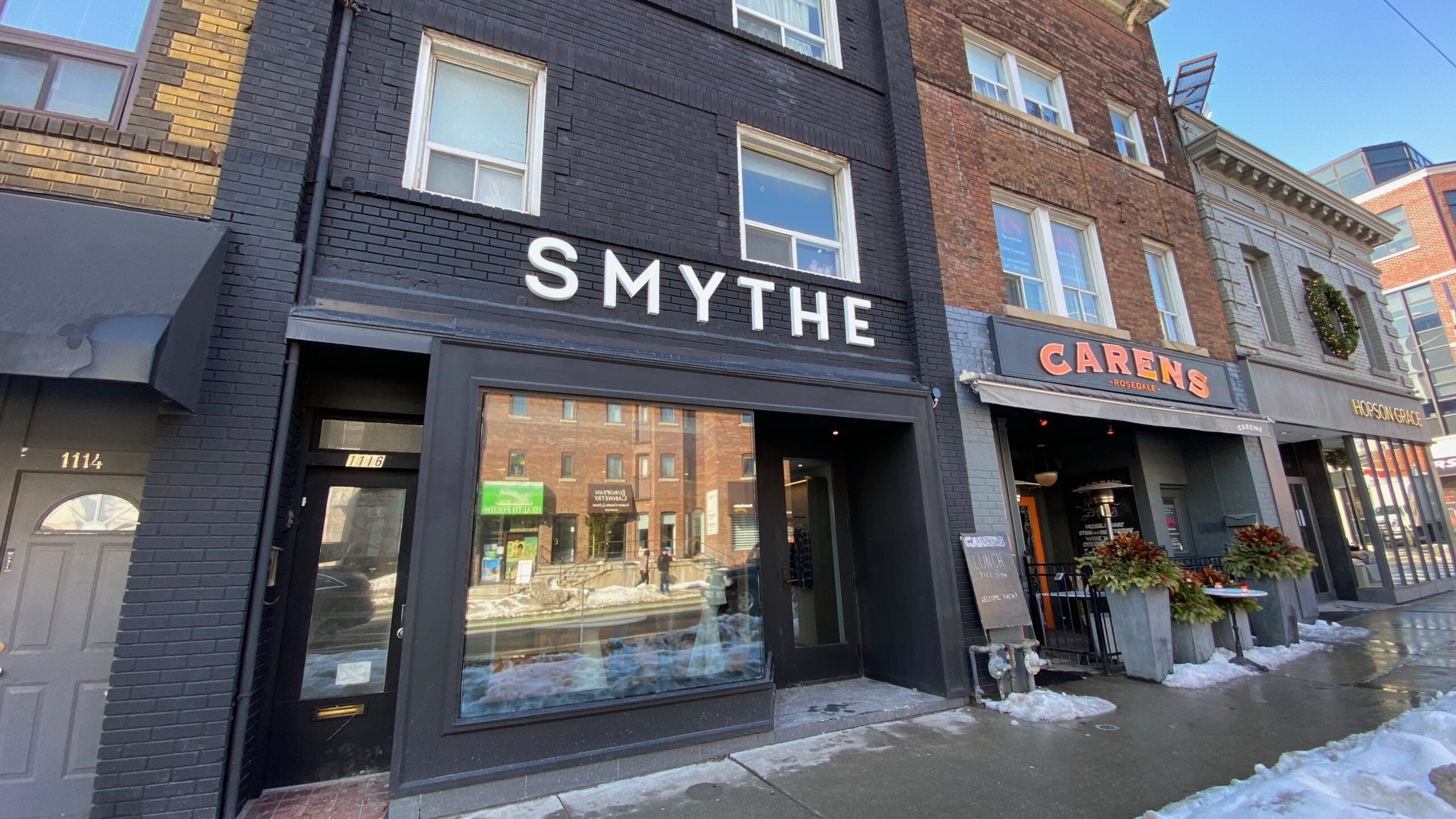
Toronto-based apparel brand mini mioche has returned to brick-and-mortar retail with the opening of a new flagship store in the city’s Leslieville neighbourhood, marking another stage in the company’s transformation under owner and CEO Jacquelyn Corbett.
Located at 1184 Queen Street East, the new store, called The Shop, brings the Canadian apparel brand back into physical retail following the closure of its previous Toronto locations. The opening comes as mini mioche expands its wholesale distribution, introduces new product categories and develops international markets, while maintaining its longstanding commitment to domestic manufacturing.
In an interview with Retail Insider, Corbett said the Canada–U.S. trade war prompted her to reassess the company’s distribution strategy, ultimately leading to the decision to reopen physical retail alongside its growing online and wholesale operations.
“When the trade war hit last February, I was like, ‘We need to rethink the strategy here. What are we doing?'” Corbett said. “We were really focused online.”
Trade Uncertainty Prompts Retail Reassessment
Founded in Toronto in 2008 by Alyssa Kerbel, mini mioche developed a following for minimalist children’s apparel made with certified organic cotton. The brand previously operated stores on Queen Street West and in Toronto’s Distillery District, with those locations closing in 2022 and 2020, respectively.
Corbett subsequently acquired the business and began broadening its operations, developing wholesale relationships, expanding its product assortment and reaching customers outside Canada. By 2025, the company had been investing in both Canadian and American markets, including efforts to build its U.S. wholesale business.
Trade uncertainty prompted Corbett to reconsider the risks of relying heavily on direct-to-consumer sales. She spent much of the second half of 2025 evaluating whether the time was right to reopen a physical store before committing to the idea in January 2026.
“I started getting really caught on the fact that we have one distribution channel, really, and that’s D2C,” she explained. “I love retail, I always have, and I started to think, ‘Is it time for us to open retail again?'”
Corbett considered Leslieville and Roncesvalles, two Toronto neighbourhoods with established family populations that align with the brand’s customer base. A Leslieville resident herself, she discovered the Queen Street East property while walking her dogs. The premises were undergoing renovations, providing an opportunity to design the space around the company’s evolving retail requirements. Mini mioche secured the location in May and completed the buildout over the summer.
The company’s American business has also experienced fluctuations as tariffs and trade policies have changed. Corbett said U.S. sales declined and recovered several times, including another downturn following tariff changes in August, although the business has since stabilized.
A New Model for Physical Retail
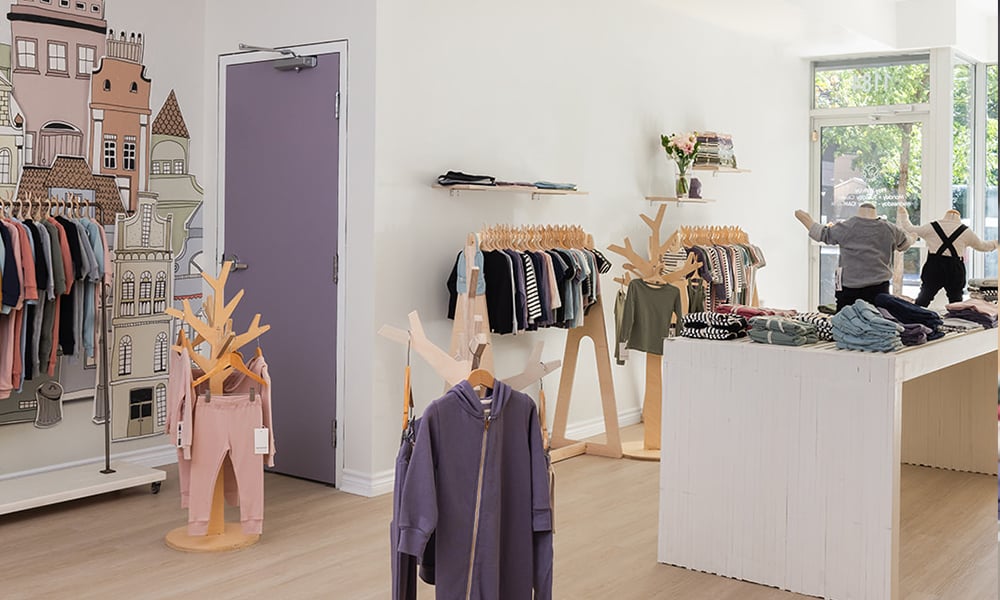
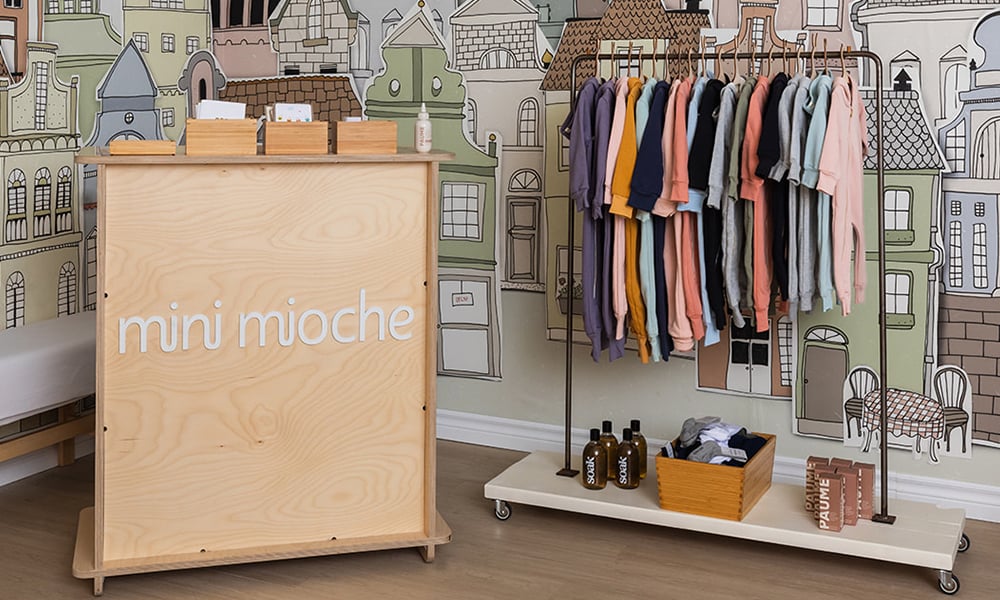
The Leslieville flagship has been designed to serve several purposes beyond conventional retail sales. Its front section functions as a showroom displaying the brand’s collections, colours and seasonal styles, while the rear accommodates shopping, children’s activities and community programming.
Corbett said the company has arranged visits from Canadian authors for children’s readings, along with musicians who will participate in afternoon events. The intention is to establish the store as a neighbourhood destination for families rather than simply a place to purchase clothing.
“The original stores were amazing and beautiful, really good vibe, nice place to visit for families,” she said. “A thing we’re doing differently this time is running it as a shop, but as well as a community space.”
The location also supports the company’s e-commerce operations, with online orders fulfilled from the store. Corbett pointed to larger retailers such as Aritzia, which use physical locations alongside other fulfillment infrastructure to manage inventory and serve online customers.
For mini mioche, the approach allows its retail space and inventory to support multiple sales channels while creating a consistent experience for customers shopping online or in person.
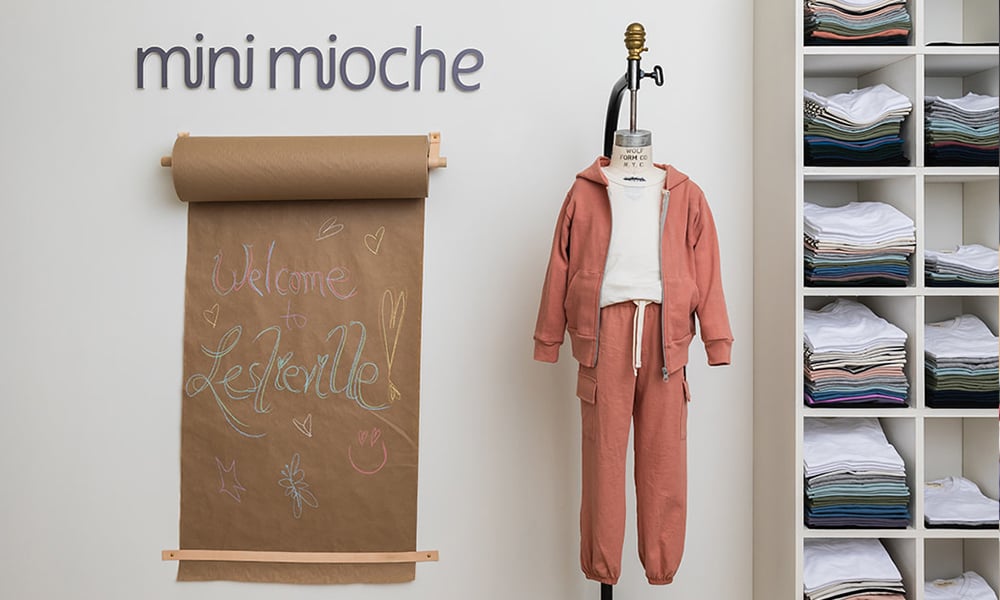
The physical environment also reflects the company’s emphasis on playfulness. Children can use an interactive magnetic display to create outfits from different clothing pieces, while an art area toward the back of the store provides space for drawing and other creative activities.
Wholesale and International Expansion
The flagship opening is one part of a broader effort to diversify mini mioche’s business. Under Corbett’s leadership, the company has developed wholesale relationships, expanded into adult apparel and school uniforms, and opened international shipping markets, creating additional opportunities for growth beyond its original direct-to-consumer model.
Corbett said mini mioche now supplies nearly 100 boutiques, compared with having virtually no wholesale accounts several years earlier. The brand also launched with Canadian baby and children’s retailer West Coast Kids during the summer, providing additional exposure through an established national retail business.
“We built out the wholesale business a lot,” Corbett said. “We’ve got boutiques across the country now. I think we’re in nearly a hundred boutiques at this point.”
International markets have become another component of the strategy. Mini mioche now ships to customers in the United Kingdom, Australia and across Europe, broadening its reach beyond Canada and the United States.
The company has also expanded beyond its original focus on baby and children’s apparel. An adult collection began with T-shirts in 2025, followed by a holiday capsule after early customer response exceeded expectations. The assortment has since grown to include additional everyday essentials based on popular designs from the children’s collection.
Corbett emphasized that the adult offering is intended to stand independently rather than function primarily as coordinated clothing for parents and children.
“Basically, we took our best sellers in kids and turned them into really beautiful upsized versions,” she said. “These are not mommy and me. They’re beautiful adult pieces, just as beautiful as our kids’ pieces.”
School uniforms and spirit wear represent another part of the business. Introduced approximately two and a half years ago, the programs provide an organic cotton alternative to the polyester-cotton blends commonly used for school apparel. Corbett said initial interest came from American customers, prompting the company to develop the offering further.
Together, these initiatives have broadened mini mioche’s customer base and distribution network, creating a business with multiple product categories and sales channels.
Canadian Manufacturing Remains Central
Despite the company’s changing distribution strategy, Corbett said mini mioche has no intention of abandoning Canadian manufacturing, even as trade tensions complicate cross-border business.
According to the company’s published manufacturing information, approximately 95 per cent of its assortment is made in Canada. Core clothing production includes fabric milling, dyeing, cutting and sewing domestically, although raw organic cotton is sourced internationally, including from India and Korea. Certain specialty products are manufactured overseas.
Corbett said maintaining Canadian production was a principal reason she acquired the company.
“When I bought the business, I bought it because of the Canadian manufacturing,” she said. “The local manufacturing is something I feel really strongly about. Sustainability is something I feel really strongly about.”
She explained that the trade war prompted suggestions that mini mioche should consider moving manufacturing overseas to simplify its operations. Corbett rejected that approach, arguing that supporting Canadian employment and retaining domestic production were fundamental to the company’s identity.
“We mill our fabrics here as well,” she said. “That’s a really unique thing in Canadian manufacturing because there’s not a lot of fabric mills left in Canada for the types of things that we produce.”
Mini mioche says its core apparel collections are produced using GOTS-certified organic cotton, reflecting the company’s emphasis on environmental standards and ethical production practices. Corbett also welcomed the increased interest in buying Canadian products, describing the movement as an opportunity for domestically manufactured brands to connect with consumers paying closer attention to where their purchases are made.
Community Partnerships Support Brand Identity
Mini mioche’s community engagement extends beyond its new retail space. The company has developed partnerships with Canadian organizations, including True North Aid and Rethink Breast Cancer, incorporating charitable initiatives into its product development and marketing.
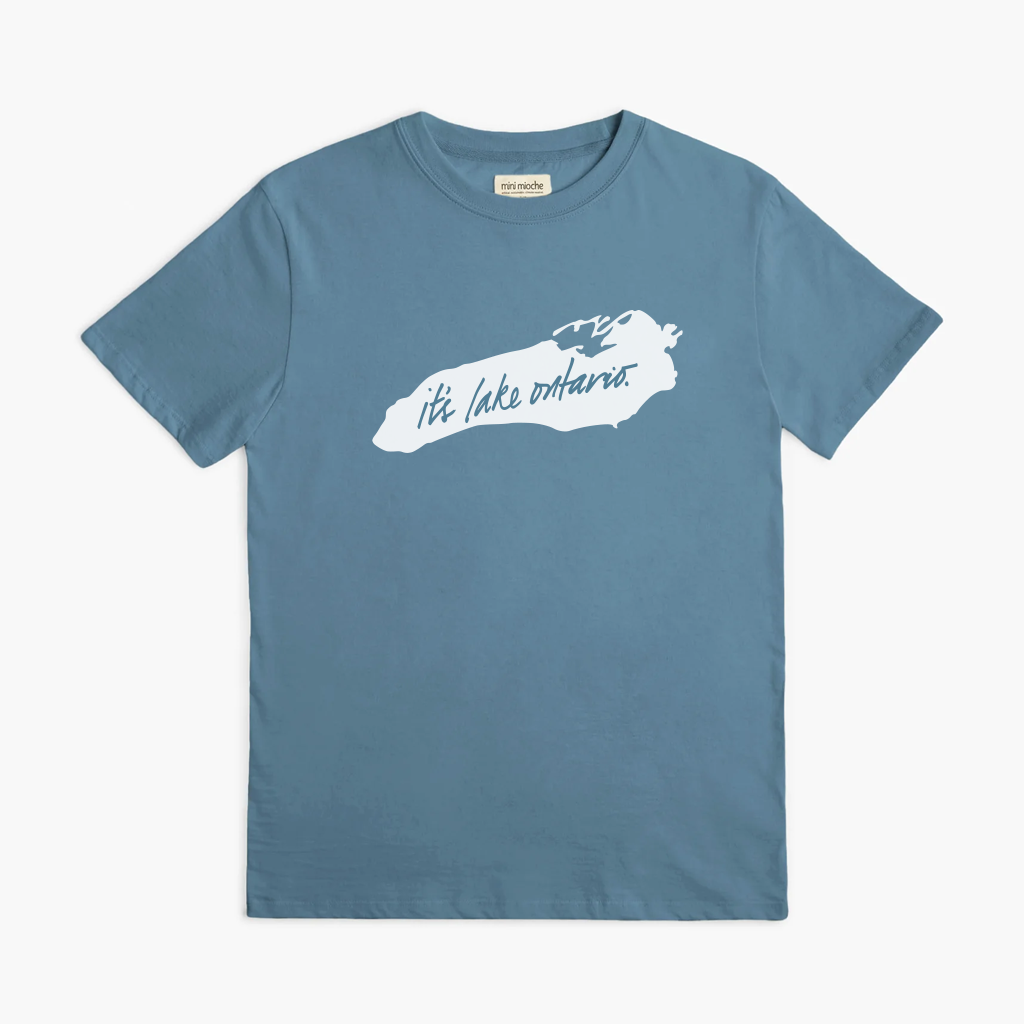
Corbett said mini mioche donated approximately $40,000 worth of clothing to children in northern and remote Indigenous communities affected by wildfires during the summer. The company also created an “It’s Lake Ontario” T-shirt collection, directing net proceeds to True North Aid. The initiative generated an unexpectedly strong response, with Corbett saying the adult version sold out within 24 hours of its initial release, prompting the company to produce additional inventory.
Mini mioche also partnered with Rethink Breast Cancer on a hoodie and jogger collection, with net proceeds supporting the organization’s work with young women affected by breast cancer. These initiatives form part of the company’s broader positioning around people, planet and play, which Corbett said guides its approach to manufacturing, product development and community involvement.
Additional Retail Locations Under Consideration
With the Leslieville flagship now operating, Corbett is considering whether mini mioche could support additional physical stores as the company looks toward 2027.
She said the early customer response has exceeded her expectations, particularly from existing customers reconnecting with the brand and new shoppers discovering it for the first time.
“I’ve been pretty blown away by the response in the community and our existing customers and new customers also discovering the brand,” Corbett said.
She has been working regularly in the store, observing customer behaviour and learning how the new format performs. Those experiences will help inform the company’s next decisions about physical retail.
Although no additional locations have been confirmed, Corbett said further expansion is something she intends to explore.
“I think there’s a lot of potential in this brand,” she said, pointing to what she sees as a shortage of Canadian-owned alternatives in the children’s apparel market.
For now, Corbett is focused on the Leslieville location, where the initial reception has encouraged her to consider how physical retail could contribute to mini mioche’s next stage of growth.