By Sylvain Charlebois
Oceana is known for its splashy reports on fish and seafood fraud. Their cumulative assessment across several Canadian cities showed that 44% of the fish samples assessed were falsely identified. After Halifax, Toronto, Victoria, Ottawa, and Vancouver, Montreal is the latest market Oceana has looked at, and results are not great.
According to the report released last week, 61% of samples picked up in Montreal’s restaurant and retail stores were mislabelled. More than one in three samples did not even have the right species identified. Apart from Victoria, where only 15 samples were analyzed, Montreal is the city where the largest percentage of mislabelled packages was recorded.
Food fraud is obviously a real problem, but by reading the report, we realize that the methodology used is not very clear. Ironically, Oceana itself lacked transparency when describing its sample design. We don’t know how establishments were chosen, or even if they were verified by a third-party organization that certifies ocean traceability practices, such as Ocean Wise. It exists, but Oceana makes no mention of it in their report. It’s a bit odd that no one has questioned Oceana’s methods or sampling strategy.
Based on what we know, in other Canadian cities, anyone could ask Oceana to send a sampling kit. Anyone is able to go to any restaurant or retail outlet for a sample and send it back to Oceana. Samples are then processed by a professional laboratory. In other words, Oceana has gone fishing – fishing for samples without using a scientific approach. It may have happened in Montreal as well.
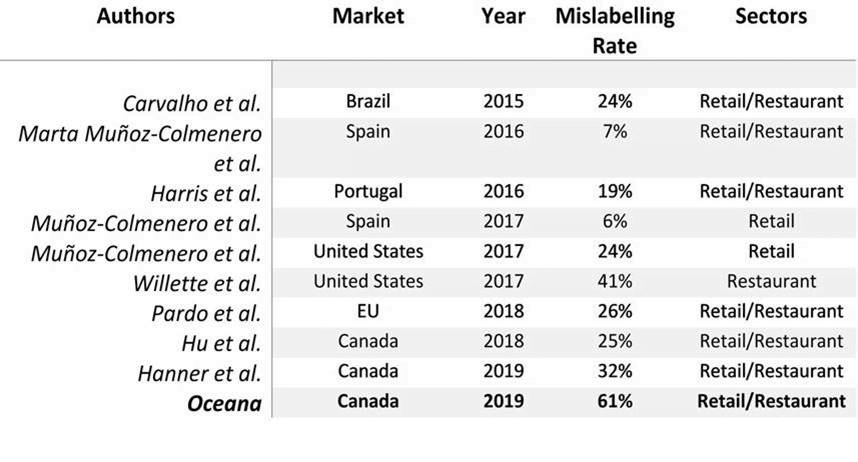
To add to these questionable practices, it seems that suspect species were targeted by participants and the samples collected were purposefully not representative of seafood consumption habits. Oceana simply presented results that supported a narrative of rampant fraudulence. Food fraud is an issue we need to address, but the 61% is perhaps a little inflated. More than 100 scientific studies on mislabelling of seafood products have been conducted in dozens of countries to date. Tens of thousands of samples have been tested on hundreds of species. Los Angeles had the highest rate of mislabelling at 41%, but the report only looked at a handful of sushi restaurants. We are far from the 61% coming out of Montreal and other Canadian cities. The United Nations recently stated that anywhere between 20% to 25% of all fish and seafood sold in the Western world is mislabelled. Our country has a great number of wonderful, accountable restaurants and responsible grocers. We shouldn’t unfairly judge all establishments the same way.
MAJOR SEAFOOD FRAUD STUDIES SINCE 2015
Nevertheless, Oceana’s work reminds us that seafood-related food fraud is a widespread problem with dramatic consequences for public health and species conservation. More attention is being given to fish and seafood labelling in recent years; the Canadian Food Inspection Agency in Ottawa and some provinces like Quebec and Ontario have been working on this issue for a while now. However, fish and seafood fraud remain highly misunderstood and complex issues.
Oceana recommends that we implement a boat-to-plate traceability program to protect consumers. In an ideal world, it could work. But things do get muddy between the Canadian Food Inspection Agency and Fisheries and Oceans Canada, which does not even consider fish and seafood as food per se. What is required is random mandatory testing by businesses and the federal agency combined. Certification programs should also receive some support to reduce the risk of fraud. Most importantly though, no clear definition of food fraud is provided, and no laws or regulations directly address food fraud in Canada. This needs to be rectified as soon as possible so regulations can better align with our aspirations for eliminating food fraud across the board. In doing so, getting provinces and cities involved will only get easier.
The most powerful weapon against food fraud will remain public pressure. For that, Ireland is an interesting case. The mislabelling rate there for fish and seafood went from 34% many years ago to 0%, just because everyone was talking about it. Public pressure-imposed discipline across the entire supply chain resulted in outright eliminating fish and seafood fraud. This could happen in Canada as well.
Even if its methodology is questionable at best, Oceana should be credited for its work on seafood fraud and making sure we keep this issue on our radars.
Oceana Canada Response: Ottawa must act now on improving seafood traceability.
By Sayara Thurston
Oceana Canada agrees with Mr. Charlebois that seafood fraud is a real problem. In fact, no amount of seafood fraud or mislabelling is acceptable.
Oceana Canada’s most recent DNA testing found that 34.4 per cent of seafood samples were swapped species — for example, tilapia labelled as snapper — and a further 26.6 per cent were mislabelled because the name on the product didn’t correspond to accepted market names for seafood sold in Canada. The testing was conducted exclusively by Oceana Canada staff, and detailed results, the methodology (also used by CFIA) and information about the lab testing process are all available at oceana.ca.
For consumers and responsible seafood businesses to make more informed decisions, information must follow fish from the point of capture to the point of sale, including the scientific name and catch documentation. Oceana Canada’s recommendations are based on the EU’s tested and proven model. The EU’s boat-to-plate traceability regulations have resulted in significantly reduced mislabelling rates and are ensuring a safe, legal and transparent seafood supply chain.
Study after study shows that seafood fraud is a serious and persistent problem that must be addressed. As Mr. Charlebois says, public pressure is real, and showing signs of progress: three of Canada’s federal political parties have now recognized that seafood traceability can combat seafood fraud by including it in their election platforms. The government must now take action.
Dr. Sylvain Charlebois is Dean of the Faculty of Management at Dalhousie University in Halifax. Also at Dalhousie, he is Professor in food distribution and policy in the Faculty of Agriculture. His current research interest lies in the broad area of food distribution, security and safety, and has published four books and many peer-reviewed journal articles in several publications. His research has been featured in a number of newspapers, including The Economist, the New York Times, the Boston Globe, the Wall Street Journal, Foreign Affairs, the Globe & Mail, the National Post and the Toronto Star. Follow him on twitter @scharleb.