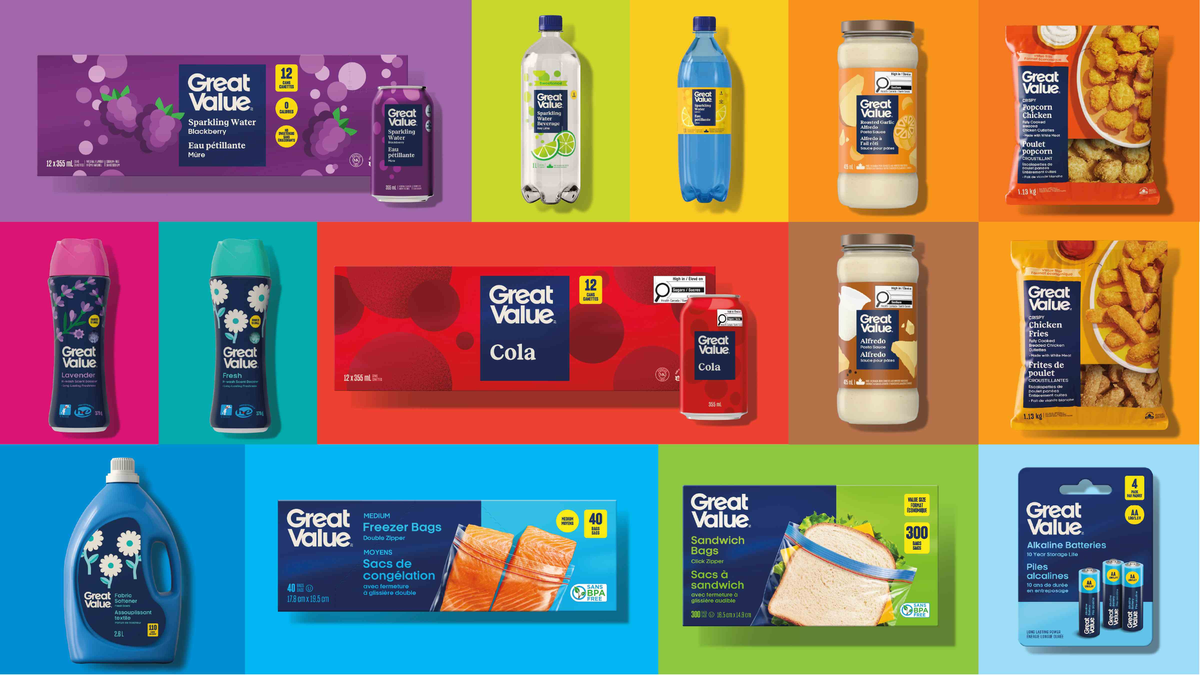
Walmart Canada is giving Great Value a new look, with redesigned packaging appearing in stores this fall and nearly 150 products expected to transition in 2027. The rollout will continue over approximately two years, covering one of the retailer’s largest and most recognized private-label brands.
Great Value has grown considerably since its Canadian introduction in 2002. It now spans nearly 20 departments and more than 100 product categories, including food, beverages, personal care and household essentials.
In an October 27 announcement, Flora Thay, Vice President, Walmart Brands at Walmart Canada, described the changes as part of the company’s continuing work on product quality, assortment and presentation. The new packaging uses bolder colours, clearer typography and consistent visual elements intended to make Great Value products easier to recognize.
The timing is worth examining. Canadian grocers have spent years building private-label businesses that compete with national brands on price and, increasingly, product quality. Walmart is refreshing Great Value while its competitors are making similar investments and consumers are showing greater willingness to buy products carrying a retailer’s name.
The new labels will not, by themselves, make Great Value more competitive. Walmart still has to deliver the products, prices and availability that persuade customers to buy them again.
Great Value’s Place in Walmart’s Business
Great Value is part of a much larger proprietary-brand portfolio at Walmart Canada. The company reports more than 100,000 products across nearly 300 categories and 50 Walmart Brands, including Your Fresh Market, Equate, Mainstays and George. Walmart’s private-label business extends beyond groceries into apparel, home merchandise, health products and other categories.
The Canadian redesign follows a similar Great Value initiative announced in the United States in April. Walmart describes Great Value as its largest private brand in the American market, but it has not published an equivalent ranking for Canada.
The packaging changes serve a straightforward merchandising purpose. Customers looking for Great Value pasta, cleaning supplies or paper products should be able to identify the brand quickly, even when the products sit in different departments.
Retailers have an advantage in building that recognition because they control the shelves and digital storefronts where their products are sold. They can give proprietary merchandise consistent presentation and prominent placement without negotiating those decisions with an outside brand owner.
Canadians Are Buying More Store Brands
Consumer research helps explain why grocery retailers are putting more effort into their proprietary products. In its June 2025 Canadian report, Finding Harmony on the Shelf, NielsenIQ found that 42% of Canadians surveyed said they were buying more private-label products than ever before. Another 72% considered private label good value for money, while 68% viewed it as a viable alternative to national brands.
These are measures of consumer attitudes and reported purchasing behaviour, not private-label market share. They nevertheless point to an important development: store brands no longer have to compete exclusively as cheaper substitutes.
Shoppers are prepared to consider private-label products when the quality, ingredients and price meet their expectations. That gives retailers room to develop more ambitious assortments, although national brands retain considerable strength.
NielsenIQ’s research also found that leading national brands were regaining momentum and outperforming private-label growth in some categories. The market is not moving uniformly toward store brands, and consumers often buy both.
Sales data illustrates the opportunities available in individual categories. An Agriculture and Agri-Food Canada report using Euromonitor International figures puts Canadian private-label frozen ready-meal sales at $957.7 million in 2025, representing 24.1% of category sales by value.
That compares with $484.2 million in 2020, an increase of approximately 98% over five years. The figures are measured in retail dollars, so price increases account for some of the growth; they do not establish a comparable increase in the number of meals sold.
Frozen meals are one example, not a proxy for the entire grocery business. Private-label penetration differs substantially between categories, and the strength of national competitors remains an important consideration.
Sobeys, Loblaw and Metro Are Competing for the Same Customer
Walmart’s announcement follows another major Canadian private-label refresh earlier this year. Sobeys updated its Compliments brand, emphasizing product quality, reliability and a broader definition of value. In a March 30 interview with Grocery Business, Stacie Sopinka, Vice President of Sobeys Own Brands, discussed how shoppers increasingly weigh quality and dietary needs alongside price.
Sopinka identified meal solutions, snacks, pantry staples and lifestyle products among the faster-growing parts of Sobeys’ private-label business. She also pointed to Compliments Balance, Organic and Gluten-Free as examples of products developed for particular consumer preferences.
Compliments and Great Value serve broad shopping needs, making the two redesigns useful comparisons. There is no evidence that either retailer developed its initiative in response to the other.
Loblaw has taken a different approach by maintaining distinct identities for No Name and President’s Choice. No Name is closely associated with value, while President’s Choice has developed an extensive assortment of differentiated products, including items that compete on features and quality rather than price alone.
Metro operates Selection and Irresistibles, while Empire also offers Panache alongside Compliments. These portfolios allow grocers to serve different price points and product preferences without relying entirely on national manufacturers.
The economics are attractive when a retailer develops a product customers seek out specifically. An exclusive item can help retain business that might otherwise go to a competing banner, particularly when shoppers divide their grocery spending among several stores.
But private label still has to earn repeat purchases. Customers who are disappointed by a product have plenty of alternatives, including national brands and competing retailers’ own merchandise.
Walmart’s $6.5-Billion Canadian Expansion
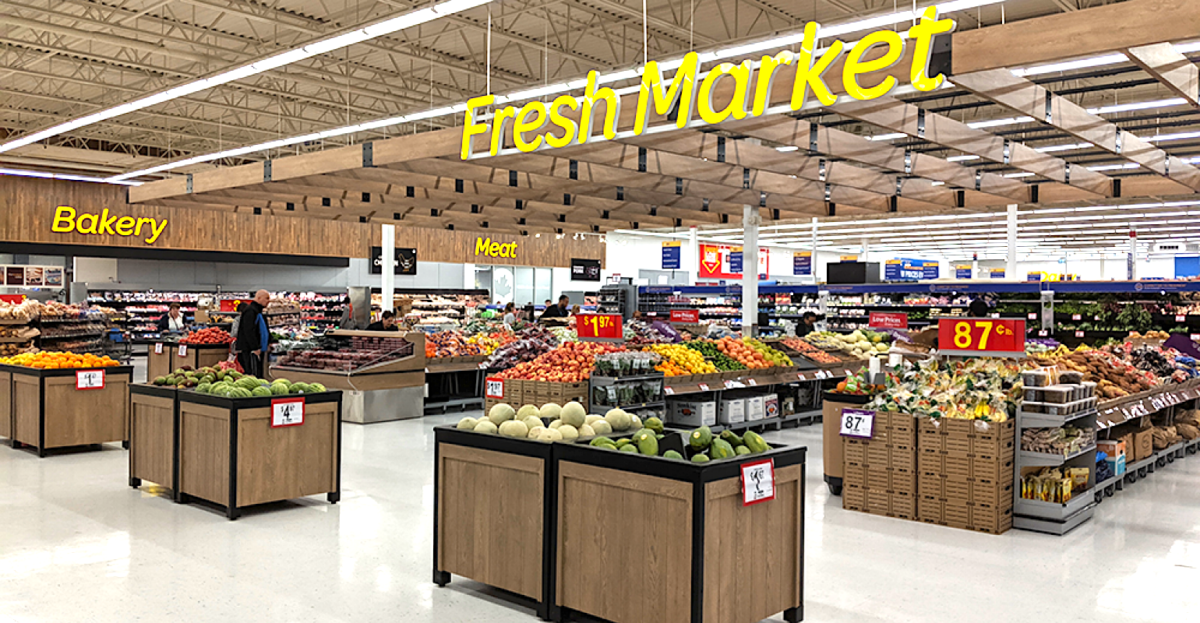
The Great Value refresh comes as Walmart Canada continues a major investment in stores and distribution. In January 2025, Walmart announced a $6.5-billion, five-year program that includes dozens of new stores and improvements to its supply-chain network. Grocery expansion is an important part of that plan, with additional Supercentres and conversions of existing stores.
Walmart’s new Fort McMurray Supercentre, which opened October 22, provides a recent example. At approximately 140,000 square feet, it is nearly 50% larger than the location it replaced and brings a full fresh-grocery assortment to the store for the first time.
The project adds grocery capacity in Fort McMurray, although it is a replacement store rather than an additional Walmart location. Elsewhere, the retailer is pursuing new developments and converting existing stores to expand its food offering.
A larger grocery business gives Walmart more opportunities to sell Great Value products, while distribution investments can help support availability across its network. Neither outcome depends specifically on redesigned packaging.
Private Label’s Complicated Economics
Retailers have several reasons to develop their own brands. They can set product specifications, commission merchandise for particular price points and decide how those products are presented and promoted.
Private label can also offer favourable gross margins, particularly where manufacturing arrangements and marketing costs are advantageous. But the financial outcome depends on the product and its supply chain, not simply on who owns the label.
Retailers still pay for manufacturing, packaging, quality control, transportation and inventory. Products that sell poorly can create costs that offset any apparent margin advantage, while competitive pricing may limit how much profit a retailer can retain.
The consequences for manufacturers are equally mixed. A retailer that gives more space to its own products may reduce opportunities for competing national brands. At the same time, many manufacturers produce private-label merchandise for retailers, providing additional business for factories that may also supply their own brands.
Walmart Canada’s relationship with Quebec-based Cascades illustrates how those arrangements work.
In an April 30 announcement, Walmart identified Cascades as the manufacturer of Great Value Eco paper towels, napkins and bathroom tissue, all made from 100% recycled fibres. Cascades also supplies its own branded paper products to Walmart in Quebec.
The companies have worked together for decades, and their relationship extends beyond finished products. Cascades also collects cardboard from Walmart stores for recycling into new packaging materials.
For Cascades, manufacturing retailer-owned products and selling its own branded merchandise are compatible activities. Walmart has not disclosed the economics of the Great Value contracts, so there is no basis for concluding which arrangement is more profitable.
This is why private-label growth cannot be treated simply as retailers taking business away from manufacturers. Some suppliers face stronger competition on the shelf while others, sometimes the same companies, gain production business through retailer contracts.
Grocers also need national brands. Established manufacturers contribute advertising, product development and consumer demand that retailers would have to replace if they relied too heavily on their own merchandise.
What Walmart Has to Prove
Great Value’s new packaging should make the brand easier to identify across Walmart’s Canadian assortment. The harder task is persuading customers to choose the products consistently when national brands and competing private labels are available.
Walmart has not released Canadian sales-growth expectations or market-share projections tied to the redesign. Its announcement establishes what is changing on the shelf, not what the change will earn.
The wider competition is already well established. Sobeys, Loblaw and Metro have spent years developing proprietary products at different price points, while national manufacturers continue investing in brands with substantial consumer recognition.
For Walmart, the test is whether Great Value can hold its place in customers’ regular shopping baskets as those choices multiply. Better packaging may help shoppers find the products, but price and performance will determine whether they buy them again.