The coronavirus has placed more than half of the world’s population under some kind of restricted movement order. Around the globe, schools are closed, workplaces are shut, public spaces like parks, churches, and shopping malls are shuttered. There’s nowhere to go but online — for news, socializing, but especially for shopping.
Between March and May, online sales skyrocketed in Canada, as some sectors such as household appliances even experienced 625% year on year growth. Furthermore, these new consumer behaviours focusing around e-commerce are likely to stay after the pandemic.
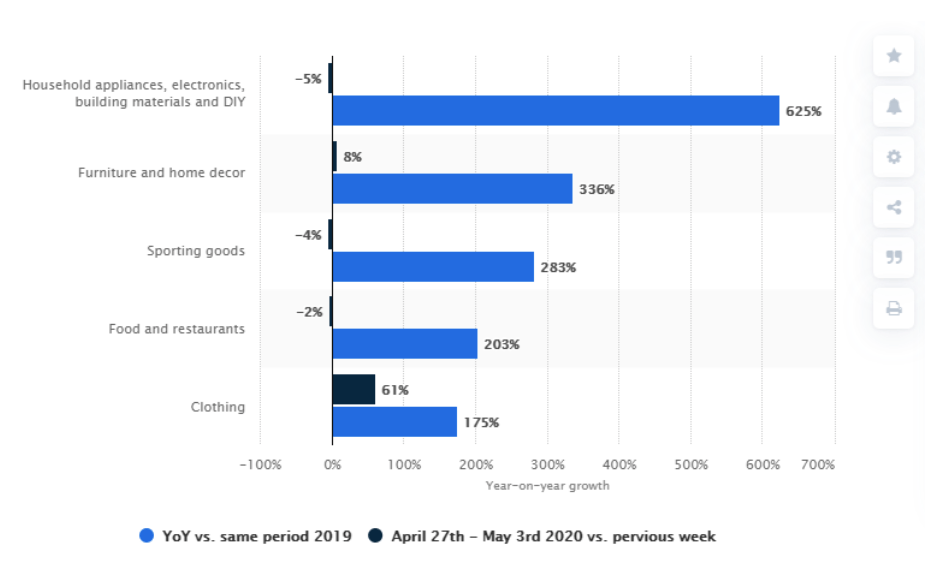
However, while online shopping is a lifeline for consumers stuck at home, one billion people with disabilities are cut off from the internet as well as bricks-and-mortar stores.
For users with disabilities, the internet is a necessary evil
It’s a double blow because internet users with disabilities rely on internet shopping more than the fully able. People with disabilities are more likely to have underlying comorbidities, such as diabetes or heart conditions, or compromised immune systems that put them in the high-risk category. They’ve mostly been self-isolating for longer and more stringently than the rest of the population, increasing their dependence on online services.
Users with disabilities are more likely to need specific medication and diet items regularly, but these are becoming harder to find as the corona crisis bites deeper, forcing consumers to scour smaller online stores which are more likely to be non-accessible. Writing in Vogue about having disabilities and dealing with Covid-19, Je Banach mentions that “Supplements that we normally take daily to stay as well as possible have been disappearing online.”
Anyone over age 65 is considered high risk for Covid-19, but the over-65s are also significantly more likely to have a disability. Older people are not digital natives, making them more likely to find e-commerce sites hard to navigate at the best of times. Many have never made an online purchase before corona forced them to do so, but now they have to work it out alone, because it’s too risky for someone to show them what to do.
E-commerce websites are frequent accessibility offenders
Even in non-corona times, e-commerce sites are one of the biggest targets of accessibility lawsuits. They are frequently small businesses that are run on a shoestring, without the funds or personnel to make their websites accessible. Many still don’t know about their legal requirements under accessibility laws.
The corona pandemic has created more non-accessible online stores, as retail businesses hurried to add online sales capability, throwing up hastily-created websites that are hard to navigate even when fully able.
We’re talking about issues like:
● Failing to support screen readers that blind users need to navigate online;
● Not making a site keyboard navigable for users who can’t point and click on a mouse, preventing anyone with motor disabilities, arthritis, muscle weakness, limb injuries or amputations from moving easily through the site;
● Confusing layouts that leave users with cognitive decline bewildered and lost;
● Hard-to-read displays with low contrast ratios, poor color choices, tiny text, etc. that make it difficult for users with low vision or weak eyes to read instructions, descriptions, guidance in form fields, and more;
● Presenting vital information such as price and product description in an image without descriptive alt tags, so screen readers can’t pick it up;
● Using flashing gifs and animations that can trigger dangerous seizures in users with photosensitive epilepsy;
● Hiding crucial details about delivery and returns in fine print that is almost impossible to find on the site, and/or in jargon that is unclear to many visitors.
How can E-commerce site owners respond?
Some of these are easy to solve without any special training or tools, like choosing larger fonts and higher contrast ratios, plotting an intuitive layout, and rewriting sales details in easy-to-understand language. But others require expert input, such as including ARIA attributes for screen readers and supporting full keyboard navigability. Even apparently simple steps, like adding descriptive alt tags to every image, can be overwhelming if you’re selling thousands of products, each with multiple images.
Solving these challenges fully means paying thousands of dollars for manual accessibility solutions which can take months to complete the process, and then paying again every 6 months to a year, because software updates and new product additions render your website non-accessible. It’s unaffordable and impossible for small businesses.
Alternatively, you can use accessiBe, the only fully-automated web accessibility solution. It’s easy to use; all you have to do is paste a single line of JS code into the source code of your site. Because it uses AI to do the heavy lifting, accessiBe can make any site fully accessible within 48 hours for pricing tiers that are far lower than manual accessibility solutions.
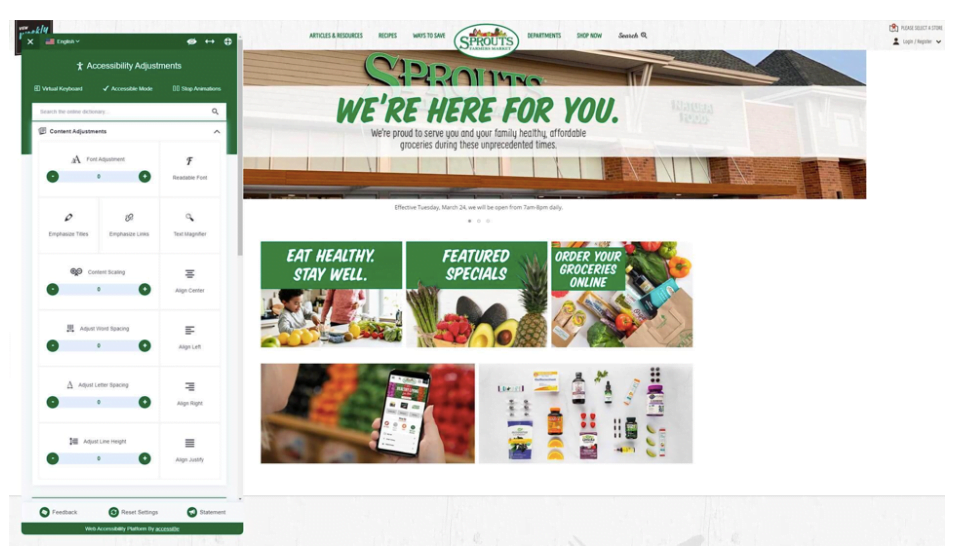
The algorithm rechecks your site every 24 hours to ensure that you remain compliant, and that your site is navigable by keyboard and optimized for screen-readers. This enables screen reader users, keyboard-only users, and everybody else to successfully access every corner of your site, including forms, pop-ups, and image-based content.
Non-accessible e-commerce sites are shooting themselves in the foot
Failing to incorporate web accessibility hurts E-commerce businesses themselves. It costs serious income, as users with disabilities won’t hang around on sites that are difficult to navigate. They’ll simply move on to one that is fully accessible.
Just as importantly, small businesses are losing valuable goodwill. Many people are making an effort to support local small businesses online, but the user who is effectively kicked off a site because of their disabilities isn’t going to try to support your business, and may warn others away from it. Nate Smith, Group Manager of Product Marketing for Adobe Analytics, says “Right now, retailers need to ensure smooth, frictionless, and fast experiences on their E-commerce websites. Meeting your customers’ needs and expectations at a time like this could either make or break your brand.”
On top of all that, SMBs with non-accessible sites run the risk of being sued. ADA title III lawsuits against small businesses have leaped since 2018. At a time of stress, fear, and anxiety, more users with disabilities would sue the E-commerce site that cuts them off from vital services. And during Corona, small businesses can’t afford an average $20,000 for an out-of-court settlement.
Corona raises the stakes for accessible e-commerce sites
It’s ironic that just when we are obeying shelter-in-place restrictions to protect the most vulnerable population, non-accessible e-commerce sites are letting them down. Unable to leave home and at high risk of dying from Covid-19, people with disabilities are now cut off from their only lifeline by non-accessible e-commerce sites that add insult to the injury already caused by coronavirus. e-commerce stores need to step up their accessibility practices to protect their own income, brand reputation, and risk of being sued, but also to meet their responsibility to support all humans with all abilities.