A conversation with a retail construction manager several years ago helped Patrick Rodmell identify a problem that’s common in retail store rollout. The manager was responsible for making daily decisions to control construction costs but had little certainty about how those decisions would affect customer perceptions of the finished stores.
“You know, I make decisions every day to manage costs at the stores we’re building. I just hope our CEO is ok with my changes and likes the end product,” the manager told Rodmell.
For Rodmell, Partner and President of Toronto-based retail design and customer experience consultancy Rodmell & Company, the comment exposed a disconnect between the people designing retail environments and those responsible for delivering them as cost effectively as possible. For example, construction teams regularly make decisions about materials, fixtures and finishes under financial pressure, without necessarily having a clear framework for determining which elements are most important to the customer experience.
Rodmell & Company is addressing that challenge through Customer Experience Value Engineering (CX-VE), a methodology designed to help retailers identify opportunities to reduce store development costs while preserving the design and operational features that support their brands.
The approach is particularly relevant for retailers undertaking multi-store expansion programs, renovations or network-wide modernization projects. Decisions about individual components can have substantial financial implications when the same specifications are repeated across dozens or hundreds of locations.

The Challenge of Controlling Retail Construction Costs
Developing a retail store involves hundreds of decisions about construction methods, materials, furnishings, lighting, millwork, fixtures and finishes. Each affects the project’s capital requirements, while some also influence maintenance costs, operational efficiency and how customers experience the finished space.
Those decisions are frequently made by departments with different responsibilities. Design teams focus on appearance and functionality, construction managers work to meet budgets and schedules, and procurement teams evaluate suppliers and purchasing costs. The resulting specifications may reflect a series of individual decisions without a consistent assessment of their combined financial and customer experience implications.
For a retailer opening one location, the difference between two suitable fixtures or furniture specifications may appear relatively modest. Across a national store network, those differences can become material, particularly when the same components are used repeatedly in new stores and renovations.
Canadian retailers also face varying development conditions across markets, including differences in labour availability, construction costs and material sourcing. These considerations can complicate efforts to maintain consistent store standards while controlling capital expenditures.
Evaluating Costs Through the Customer Experience Lens
Conventional value engineering often focuses on finding less expensive ways to complete a construction project. Rodmell’s methodology adds an explicit customer experience assessment, recognizing that a cheaper alternative can sometimes create additional costs or operational problems.
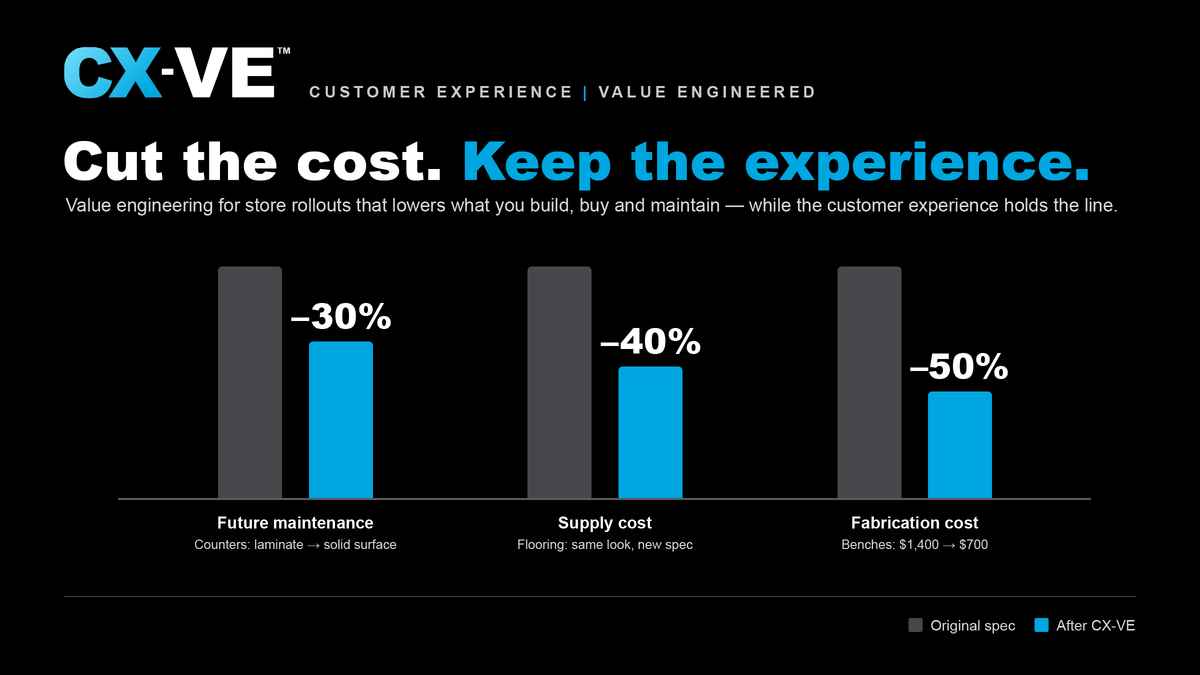
A lower-cost flooring material, for example, might reduce initial construction spending but require more frequent replacement in a high-traffic environment. An expensive decorative feature may contribute relatively little to how customers perceive or use a store, making it a potential candidate for reconsideration.
The objective is to understand which design investments contribute to the shopping experience and which specifications can be modified without undermining the retailer’s brand or operational requirements.
Rodmell & Company has 15 years of experience in retail store design, while Rodmell himself has worked in the field for roughly three decades. The CX-VE methodology draws on that background to examine the relationship between construction spending, store design decisions and customer experience.
The process is organized into four stages: Assessment, Investigation, Prioritization and Standardization.
During Assessment, existing store specifications, costs and customer experience objectives are reviewed to identify potential savings opportunities. Investigation examines alternative materials, fixtures, construction approaches and processes, including their financial and operational implications.
Prioritization evaluates opportunities according to factors such as potential savings, customer experience impact, implementation complexity and risk. Standardization focuses on incorporating approved changes into store prototypes, procurement requirements and future rollout specifications.
The outcome is a document Rodmell & Company calls its Retail Savings Blueprint™, which organizes potential savings opportunities into an implementation roadmap. It identifies estimated cost differences, customer experience considerations, implementation requirements and responsibilities, helping retailers determine which recommendations warrant further action.
The blueprint can include relatively straightforward opportunities described as Quick Wins, along with Fast-track Pilots that require testing or additional evaluation before broader adoption.
The Financial Impact of Repeatable Savings
When it comes to identifying a savings target, Rodmell’s experience is that two approaches emerge; either the retailer’s CFO states a per store rollout cost target, or the business goes through the CX-VE process first, then determine savings based on approved savings initiatives. That said, most savings opportunities fall within 5% to 15% in targeted, tangible line-item costs.
The potential financial benefit becomes more substantial when approved savings can be applied consistently across multiple locations.
Rodmell offers the example of a custom bench specified at approximately $1,400, compared with an alternative costing $700. The lower-cost option met the retailer’s requirements for appearance, durability and functionality, representing a saving of $700 per unit.
For retailers purchasing the same furnishings or fixtures across an extensive store network, per-unit savings can accumulate. The same principle applies to repeatable construction details, materials and other components included in a company’s store development program.
However, a lower purchase price does not necessarily produce a better long-term financial outcome. Installation requirements, maintenance costs, product lifespan and the effect on customer experience must also be considered before an alternative is approved.
The methodology therefore focuses on identifying savings that can withstand a broader evaluation of cost and performance. The goal is to establish specifications that offer appropriate value over time, rather than selecting products solely on their initial purchase price.
Building Savings Into Future Store Rollouts
For retailers operating multiple locations, standardizing approved changes is as important as identifying the initial savings opportunity. A cost reduction implemented in one store may deliver limited network-wide benefits unless it becomes part of the specifications used for subsequent projects. Rodmell & Company’s approach connects the identification of potential savings with the decisions required to implement them. That can involve collaboration among design, construction, procurement and operations teams, particularly when a proposed alternative affects several areas of the business.
Some changes may be relatively straightforward to approve, while others require pilot installations, additional testing or modifications to existing store prototypes. The Retail Savings Blueprint helps retailers manage those decisions and determine which recommendations should be adopted.
Once approved, changes can be incorporated into procurement standards and construction documentation used for future projects. For retailers planning expansion or renovation programs, reviewing specifications before a new prototype is finalized or a major rollout begins creates an opportunity to apply improvements across multiple locations.
The approach also gives senior executives a more structured basis for evaluating proposed cost reductions. Decisions can account for financial, operational and customer experience implications together, with clearer documentation of the trade-offs involved.
As retailers assess capital requirements for upcoming store projects, the CX-VE process helps development teams direct spending toward features that contribute most to the customer experience. Establishing those priorities before construction commitments are repeated across a network may also help companies manage future development budgets with greater consistency.