

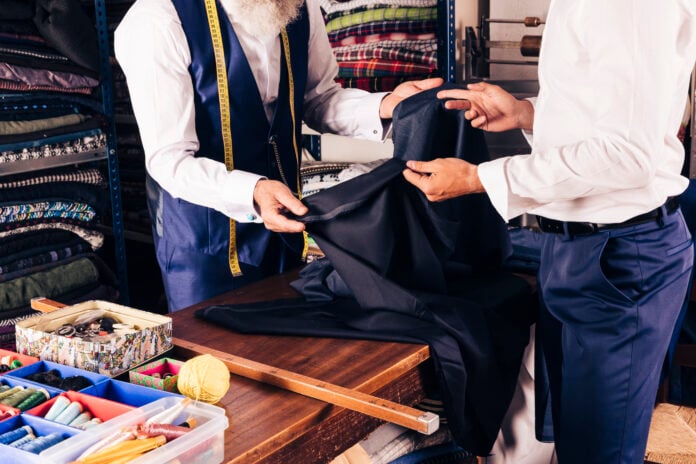
Walk past 182 Davenport Road on a weekday afternoon and there is very little to see. No window mannequins, no sale signage, no racks. The lights are on and someone is inside, but the door is locked. That is not a struggling retailer — it is the operating model.
A small but growing group of menswear operators in Toronto has abandoned the walk-in format entirely. They carry no sellable inventory, occupy a fraction of the square footage of a conventional apparel store, and see clients only by appointment. In a market where retail availability has hit record lows and prime rents keep climbing, the economics of that approach deserve a closer look.
The rent math that makes zero-inventory viable
Toronto’s premium corridors have become expensive and, in places, contradictory. JLL’s Toronto Urban Retail Report put average asking rents on Bloor Street between Yonge and Avenue at $246.27 per square foot in Q4 2025 — the highest of any corridor in the country — while availability in the same strip sat near 20.9 per cent. As Retail Insider reported when those numbers were released, the pool of tenants able to absorb that cost has narrowed considerably.
Appointment-only formats sidestep the problem in two ways. First, they do not need a flagship address. A showroom drawing clients through referral and search rather than footfall can sit a block or two off the primary corridor — Davenport, Hazelton, Cumberland — at a materially lower rate. Second, they need very little space. JLL has flagged that the bulk of current Toronto leasing activity is concentrated in units under 2,000 square feet, a segment where competition is now most intense. A tailoring showroom typically needs a fitting area, a consultation lounge and a wall of fabric books. That is 800 to 1,500 square feet, not 4,000.
The third variable is the one conventional apparel retailers cannot escape: working capital tied up in stock. A made-to-measure operator holds swatch books, not sellable goods. Nothing is marked down at the end of a season because nothing is bought ahead of demand. Every garment is cut against a paid order.
A case study: French tailoring on Davenport
Blandin & Delloye, founded in Paris in 2013, has been operating on Davenport Road since December 2025. Toronto is its 34th location worldwide and its third in Canada, following Montreal and Ottawa. The showroom sits between The Annex and Yorkville, adjacent to the luxury cluster without paying for a Bloor Street frontage.
Its process is deliberately slow. A first appointment runs 90 minutes to two hours: measurement, posture and morphology analysis, template fittings, then fabric and construction choices. Cloth comes from Dormeuil, Vitale Barberis Canonico, Holland & Sherry, Drago and Loro Piana. Delivery runs roughly six to eight weeks, followed by a fitting and, where needed, free alterations. Clients booking custom suits in Toronto through the house are typically working to a wedding date or a professional wardrobe refresh rather than an impulse.
The Canadian assortment differs from the European one in a specific way: heavier English wools and made-to-measure overcoats carry far more weight, for the obvious reason that a garment sold in Toronto has to function at minus twenty as well as in a boardroom.
Where it sits in the competitive set
The appointment model is not replacing traditional premium menswear in Toronto so much as growing alongside it. Modern Ambition’s pairs merchandise with technical tailoring and a hospitality bar. Ross Mayer’s Cumberland Street boutique has signalled plans to add bespoke services. Derek Rose on Hazelton Avenue operates a conventional store but built its Canadian entry around a narrow, high-margin category rather than breadth.
What links them is a move away from assortment as the primary differentiator. Retail Insider’s Q1 2026 apparel and fashion analysis identified the same divergence at national scale: brands combining disciplined real estate decisions with experience-led formats are separating from operators still carrying legacy footprints.
The constraints nobody advertises
The model has real ceilings. Revenue is capped by advisor hours, not by store hours — a showroom running two-hour appointments can serve perhaps four clients a day, and adding capacity means hiring and training people to a standard that takes months to reach. Growth is therefore linear, not exponential, and highly dependent on staff retention.
Acquisition is the second constraint. With no window traffic, demand has to come from referral, search visibility and events. That makes the first 18 months in any new market slow by design, and it explains why houses in this category expand city by city rather than in clusters.
Finally, the format is fragile to service failure. In conventional retail, a bad interaction costs one transaction. Here, where a client has committed weeks and a four-figure order, it costs the referral chain that comes with them.
What it means for landlords
For owners of secondary premium space — the streets one remove from Bloor and Yorkville Avenue — appointment-based tenants are an increasingly attractive proposition. They take small units, sign long leases, invest heavily in fit-out because the space is the product, and are largely insulated from the discretionary spending cycles that hit assortment retailers first. According to the apparel spending has remained uneven through 2026, a pattern that tends to punish breadth and reward specialisation.
None of this makes the format a mass-market answer. But in a city where the best space is scarce, the best corridors are priced beyond most tenants, and consumers are increasingly buying fewer, better things, a locked door with an appointment book behind it is looking less like an anomaly and more like a strategy.

