With President Donald Trump’s recent victory, headlines have been filled with warnings about the “end of democracy,” leading many Canadians to focus on what the next four years might hold. It’s true that the U.S. has just elected its first convicted felon as president, raising questions about the future. But for those of us concerned with Canada’s agri-food sector, food security, supply management, and the well-being of our farmers, the reality may be less about doom and more about data.
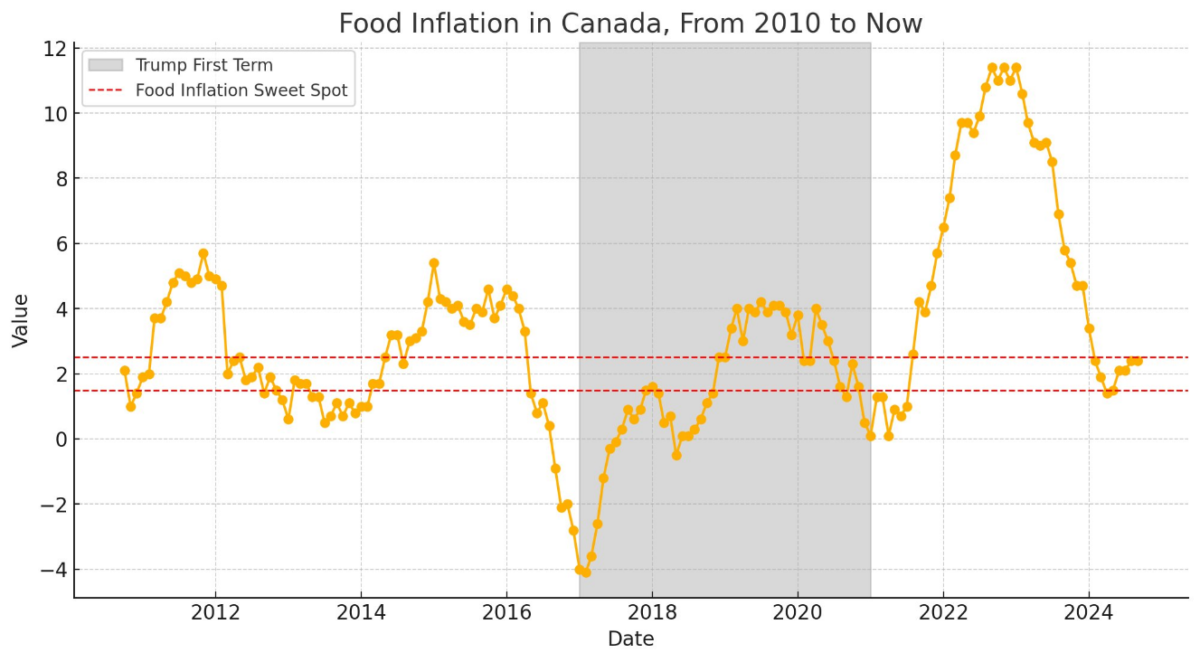
First, let’s examine food inflation during President Trump’s first term. Back in 2016, when President Trump was initially elected, the political climate was similarly intense, with talk of tariffs, renegotiated trade deals, and U.S.-centric policies. When President Trump took office, food inflation in the U.S. was at -4%—a level that may sound advantageous, but negative inflation in food prices often discourages corporate investment and stalls innovation. Though food inflation eventually hit 4% during his first term, it mostly stayed within a manageable range, averaging between 1.5% and 2.5%. Despite fears, no tariffs affecting Canada’s food supply chain were ever imposed.
USMCA and Its Impact on Canada’s Agri-Food Exports
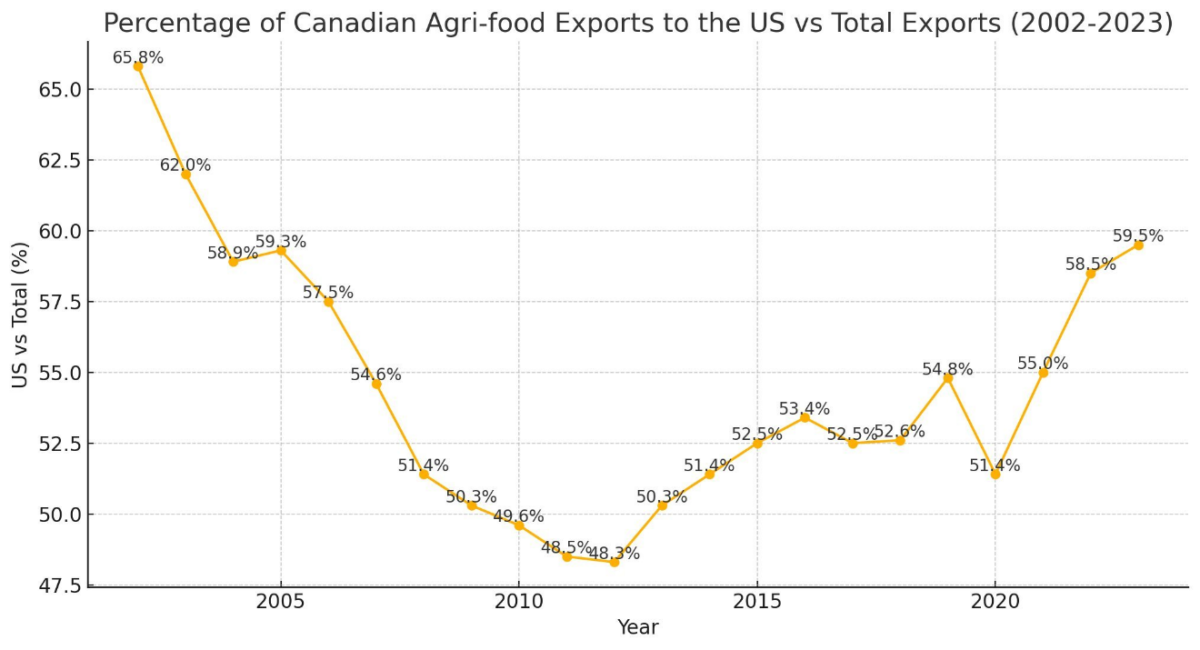
Then came the United States-Mexico-Canada Agreement (USMCA), President Trump’s flagship trade deal, which reshaped North American commerce. Ratified in 2020, President Trump’s last year in office, the agreement has led to a surge in Canada’s agri-food exports to the United States, climbing nearly 57% since 2020 to reach almost $60 billion last year.
Under the Obama administration, around 48% of our agri-food exports went to the U.S., but today, nearly 60% flow south. This dependency on the U.S. is both a blessing and a curse—while our agri-food sector benefits from access to the vast American market, it also leaves Canada’s economy more vulnerable to U.S. policy shifts. President Trump, with his America-first approach, is acutely aware of this dynamic.
Supply Management Concessions and Potential Future Changes
President Trump’s policies brought Canada closer commercially to the United States, especially in the agri-food sector. Additionally, President Trump successfully pressured Canada to concede on supply management, allowing more U.S. market access for products like dairy. Recently, Canada’s Senate criticized Bill C-282, which would have safeguarded supply-managed sectors, including eggs, poultry, and dairy, during future trade deals. If left intact, C-282 could have turned supply management into an even bigger target for President Trump.
But make no mistake—under his second term, further market access will likely be granted to American producers, and Canadian taxpayers will end up subsidizing these sectors even more. While supply management boards may frame these payouts as “compensation” for hypothetical losses, the reality is that they’re subsidies prompted by quota recalibrations, plain and simple.
Competitiveness Challenges Facing Canada’s Agri-Food Sector
Yet the real challenge lies in our ability to keep Canada’s agri-food sector competitive. President Trump’s 2.0 agenda promises to reduce energy costs, cut red tape, lower taxes, and inject additional financial support through a colossal Farm Bill nearing $2 trillion. Since 2019, Canada’s wholesale food prices have risen almost 40% faster than those in the U.S., putting Canadian producers at a distinct disadvantage. If Ottawa doesn’t take immediate steps to address competitiveness, Canadian grocers may increasingly turn to cheaper American imports to keep prices in check.
In the end, while President Trump’s return may prompt changes, Canadians should focus on Ottawa’s actions—or inactions—in supporting our agri-food sector. President Trump’s policies may bring more American products to our grocery stores if we don’t shore up our competitive standing. Rather than fearing a distant White House, Canadians might be better off scrutinizing Parliament Hill.
The bottom line? President Trump’s re-election doesn’t signal the end of the world, and any uncertainty can be balanced by looking at the data. The real worry is not Washington but our own government’s commitment to ensuring the health of Canada’s agri-food sector.