

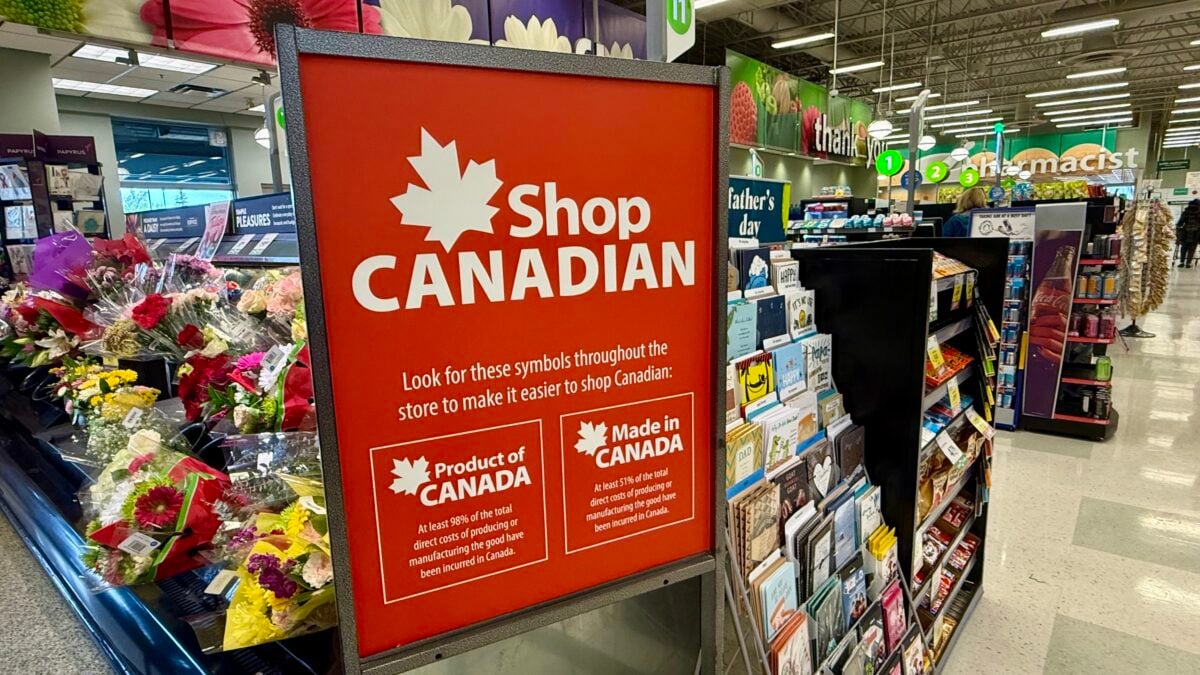
As of March 27, 2026, Empire Company Limited is quietly retreating from one of the most visible merchandising strategies of the past year. The company has begun removing its “Buy Canadian” grocery signage across banners including Sobeys, Safeway, IGA, FreshCo, Foodland, and Thrifty Foods, marking a notable shift in how major grocers are responding to evolving consumer behaviour and regulatory pressure.
The move comes after a period when patriotic merchandising dominated grocery aisles across the country. While Empire maintains that its commitment to sourcing Canadian products has not changed, the company is stepping back from actively promoting those items through in-store shelf markers and signage.
The rise of Buy Canadian grocery signage can be traced back to geopolitical tensions in 2025, following the re-election of Donald Trump. His administration’s renewed “America First” policies triggered tariffs and trade threats that strained Canada-U.S. relations.
Canadian consumers responded with a surge in economic nationalism. Grocery shoppers actively avoided U.S. imports, and retailers moved quickly to highlight domestic products. Major chains including Sobeys, Loblaw Companies Limited, and Metro Inc. filled shelves with maple leaf icons and “Product of Canada” labels.
At the height of the movement, Canadian-made product sales reportedly rose by as much as 10 percent as shoppers aligned purchasing decisions with national sentiment.
Inflation Pressures Shift Consumer Priorities
By early 2026, however, the momentum behind the movement had begun to fade. Grocery inflation reached approximately 5.4 percent in February, significantly outpacing general inflation of 1.8 percent.
This shift has had a measurable impact on purchasing behaviour. While many consumers continue to express support for domestic products, price sensitivity has intensified. Shoppers are increasingly prioritizing affordability over origin, particularly in essential grocery categories.
Empire’s leadership has acknowledged this change. The company’s Chief Customer Officer, Luc L’Archevêque, stated that Canadian consumers are now sufficiently informed to identify product origin through packaging, reducing the need for additional in-store cues.
CFIA Enforcement Drives Risk Mitigation
Another key factor behind the removal of Buy Canadian grocery signage is heightened regulatory scrutiny. The Canadian Food Inspection Agency has intensified enforcement around origin claims under the Safe Food for Canadians Act.
In March 2026, the agency issued fines to several grocery retailers for inaccurate or misleading origin labelling. Notably, a Loblaw-owned store received a $10,000 penalty after inspectors found maple leaf symbols displayed next to imported products.
The CFIA has also confirmed that it is investigating Sobeys’ national operations regarding how origin claims are managed across its banners. In this context, Empire’s decision can be viewed as a proactive effort to reduce legal exposure and reputational risk.
Maintaining accurate signage presents operational challenges in a high-volume retail environment. With thousands of products rotating frequently, ensuring that shelf labels reflect real-time sourcing is complex. A product that is Canadian one week may be imported the next, creating potential compliance issues.
Operational Complexity and “Maplewashing” Concerns
Industry observers have pointed to the risk of “maplewashing,” where products are presented as Canadian through signage that may not fully reflect their origin. Even unintentional errors can result in regulatory penalties.
Retail analysts suggest that Empire’s move reflects a broader derisking strategy. Removing signage eliminates the possibility of mismatches between labels and product origin, particularly in fresh categories where sourcing changes frequently.
At the same time, new front-of-package nutrition labelling requirements introduced in January 2026 have added further visual complexity to grocery shelves. With health warnings, tariff indicators, and digital codes competing for attention, retailers are increasingly considering how to simplify the in-store experience.
Empire’s decision to rely on packaging rather than additional signage may also be an effort to reduce visual clutter and present a cleaner store environment.
Industry Divergence Among Major Grocers
Empire’s approach contrasts with that of its key competitors. Both Loblaw and Metro have indicated that they plan to maintain their Buy Canadian grocery signage strategies, at least for now.
Loblaw, in particular, continues to emphasize domestic sourcing through merchandising and digital tools designed to help customers identify Canadian alternatives. Metro has taken a more measured stance, maintaining current signage while monitoring market conditions.
This divergence highlights an emerging strategic split within Canada’s grocery sector. While some retailers continue to lean into patriotic branding, others are recalibrating in response to regulatory and economic realities.
Implications for Canadian Producers
The removal of Buy Canadian grocery signage could have broader implications for domestic suppliers, particularly smaller producers who benefited from the visibility these programs provided.
Without prominent shelf markers, Canadian products must compete more directly on price and brand recognition. For independent farmers and food manufacturers already navigating regulatory pressures and rising costs, the loss of in-store promotion may present additional challenges.
Industry groups, including the Canadian Federation of Independent Business, have warned that agri-businesses are facing increasing operational strain. The absence of promotional signage removes a key tool that helped differentiate local products in a competitive marketplace.








that didn’t take long
“Elbows Up, Canada!” Sorry Mr Trump I’ll bend over now