Home Blog Page 1042

Alexander McQueen to Open 1st Standalone Canadian Storefront

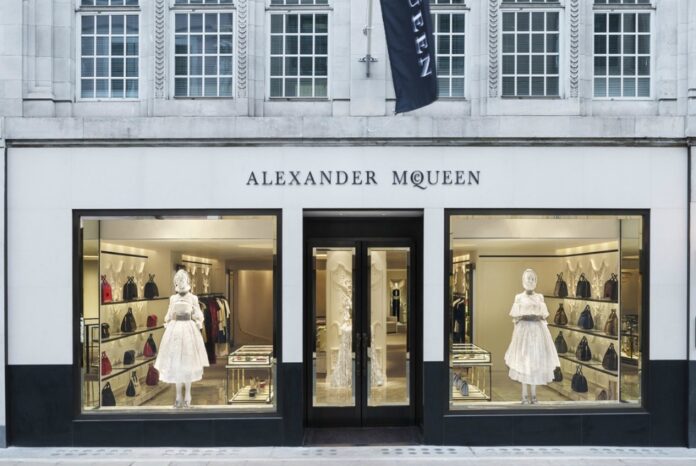
Alexander McQueen storefront on Bond Street in London. Photo: Alexander McQueen

Kering-owned, UK-based luxury brand Alexander McQueen will open its first standalone storefront in Canada later this year at Toronto’s Yorkdale Shopping Centre. The move signals confidence in brick-and-mortar luxury retail in Canada and puts Yorkdale over the top as the epicentre for a global brand clustering in the country.

The Yorkdale Alexander McQueen store will replace a J. Crew store in the mall that had a 4,125-square-foot main floor as well as a 1,250-square-foot lower level. The facade will span an impressive 43 feet according to lease plans. The Alexander McQueen brand features ready-to-wear clothing for women and men as well as a range of bags, accessories, jewellery, and footwear. The company states that its designs feature a “juxtaposition between the feminine and the masculine, fragility and strength, romance and rebellion, man and machine”. Accessories with skulls are a trademark of the McQueen brand.

McQueen will be located between Yorkdale’s Montblanc and Burberry boutiques in the mall’s original luxury wing. Retailers across from the new McQueen include David Yurman and Richemont jewellery brand boutiques that include Piaget, Panerai, Vacheron Constantine, IWC, and Van Cleef & Arpels.
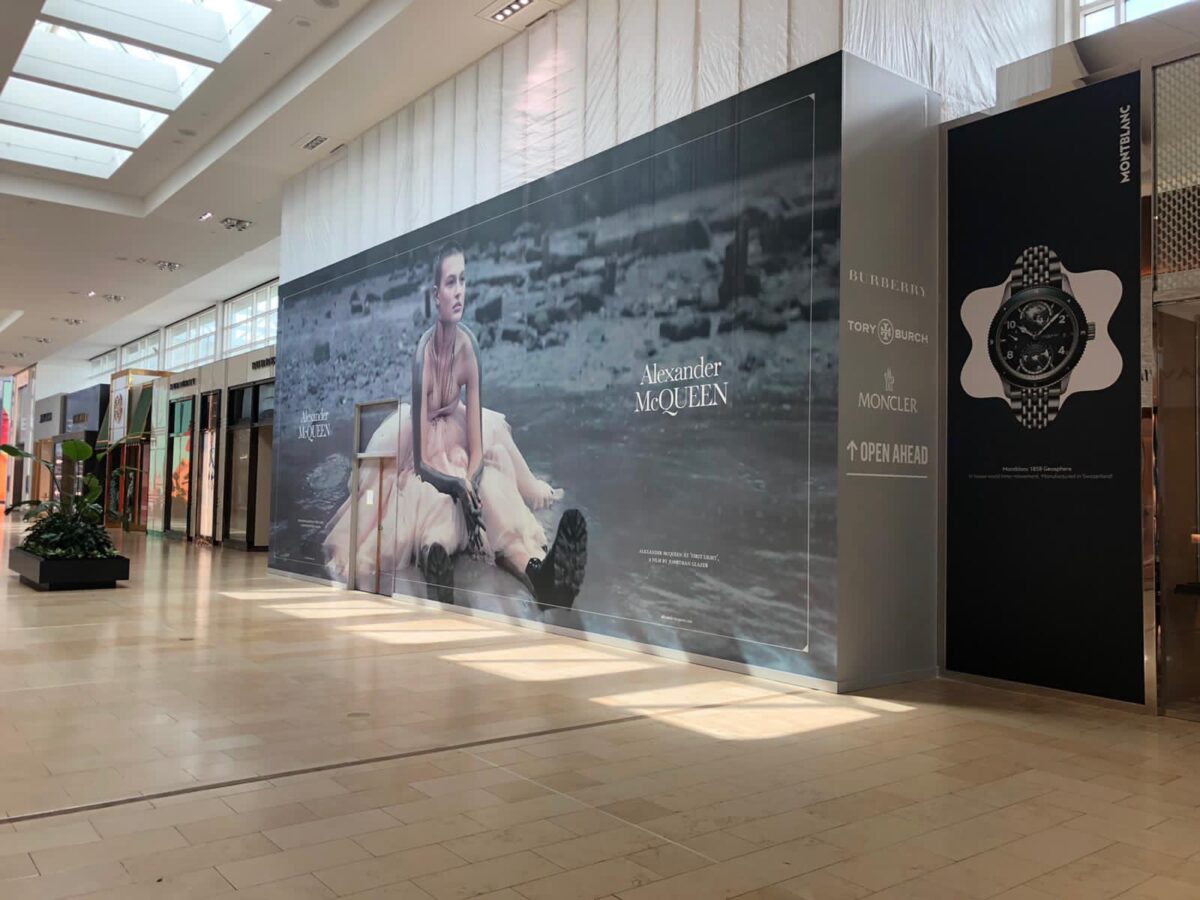
The facade of Yorkdale’s new Alexander McQueen store is yet to be unveiled. Photo: JM

Luxury brand conglomerate Kering, based in Paris, has four other brand stores at Yorkdale including Bottega Veneta, Balenciaga, Saint Laurent, and Gucci. Saint Laurent opened its Yorkdale location in November of 2016 near the new McQueen storefront. Bottega Veneta opened an impressive Yorkdale storefront in November of 2018 and Balenciaga opened a large flagship in late 2019. Gucci, which operates a 5,000-square-foot concession space technically at Holt Renfrew, unveiled its new location in August of 2019. Italian menswear brand Brioni is the only fashion brand under the Kering umbrella that will lack a standalone storefront at Yorkdale when McQueen opens this year. Kering also owns several jewellery brands including Boucheron which has a presence in a boutique space inside of Holt Renfrew at Yorkdale.

In Canada, Alexander McQueen fashions are also carried at several upscale multi-brand stores. Holt Renfrew carries McQueen pieces for women in all of its stores in Canada with a particular focus on the Vancouver location, as well as some menswear. Nordstrom’s Vancouver flagship store features a women’s McQueen shop-in-store. In Toronto, Saks Fifth Avenue’s downtown flagship features a McQueen women’s boutique on its third level as well as an area on the main floor for handbags. When the CF Sherway Gardens Saks Fifth Avenue store opened in February of 2016, it included a McQueen accessory boutique on its main level as well as a women’s ready-to-wear boutique upstairs. Montreal-based retailer SSENSE also carries an assortment of Alexander McQueen on its website.

The standalone McQueen storefront could also impact sales at Holt Renfrew and Saks Fifth Avenue in Toronto as some consumers may be drawn to the full collection within the new flagship store. The brand is said to have seen strong sales in the Vancouver market which is indicative that a second direct-to-consumer storefront for McQueen could also open if a proper space could be found. It’s unclear if McQueen will pull out of some multi-brand retailers as it grows its direct-to-consumer channel in Canada, and it’s a trend being seen with other brands expanding into the market.

The Alexander McQueen brand operates standalone stores globally in major markets as well as concessions in upscale department stores. According to the McQueen website, most of the brand’s stores are in Asia while others are concentrated in Europe.

In the United States, Alexander McQueen operates 11 standalone storefronts in major fashion destinations, including on urban street fronts and in luxury shopping centres. In New York City, McQueen has stores at 747 Madison Avenue on the Upper East Side and at 71 Green Street in Soho. In Miami, McQueen has stores at the Miami Design District as well as at the luxurious Bal Harbour Shops. Two McQueen boutiques are located in Las Vegas at the Bellagio and Wynn retail complexes. In Beverly Hills California, McQueen operates a flagship store at 457 N. Rodeo Drive, and the brand has a location at the upscale South Coast Plaza in Orange County. A standalone McQueen store operates at 58 Geary Street in San Francisco, and in Honolulu McQueen has a store at the popular and busy Ala Moana Shopping Centre. The historic outdoor luxury shopping centre Highland Park Village in Dallas is home to the only standalone McQueen storefront in Texas.
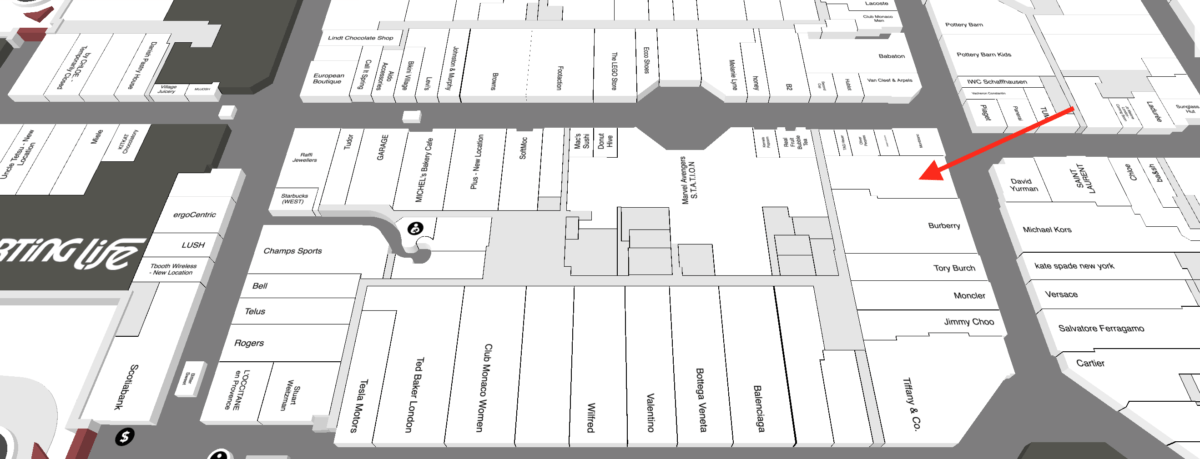
Interactive map of Yorkdale Shopping Centre with red arrow indicating the location of new Alexander McQueen store.

It’s not yet known if Alexander McQueen will open any other standalone stores in Canada. Toronto’s Bloor-Yorkville is the city’s other luxury brand clustering and McQueen could look to open a location either on Yorkville Avenue or on the luxury run of Bloor Street West. In Vancouver, Alexander McQueen may look to open a store in downtown Vancouver, most likely on or near the 1000 block of Alberni Street or within the overhauled Oakridge Shopping Centre which will be completed in 2024.

The addition of Alexander McQueen to Toronto’s Yorkdale Shopping Centre is indicative of the mall’s prominence as a luxury epicentre for Canada. Many of the world’s top luxury brands have opened stores at Yorkdale and more are said to be interested. Yorkdale has managed to overtake Toronto’s Bloor-Yorkville and Vancouver’s Luxury Zone as the top destination for mono-brand luxury stores in Canada as the mall finds its place among North America’s top shopping centres in terms of luxury brand offerings.

The Alexander McQueen brand was founded by fashion designer, Lee Alexander McQueen, in 1992. He became chief designer for luxury brand, Givenchy in 1996 and left the position in 2001. He received the British Designer of the Year award in 1996, 1997, 2001, and 2003, as well as CFDA’s International Designer of the Year award in 2003. French luxury conglomerate Kering acquired the Alexander McQueen brand in 2001.

Lee Alexander McQueen tragically died of suicide on February 11, 2010 at the age of 40 shortly after the death of his mother. Early on in his career, he partnered with fashion icon Isabella Blow while he gained the reputation of being an ‘enfant terrible’ in British fashion with designs such as the ‘bumster’ trouser. Blow, a good friend and noted magazine editor, took her own life in May of 2007.

Sarah Burton is currently the Creative Director for the Alexander McQueen brand. She was appointed Head of Design for womenswear at Alexander McQueen in 2000 and in May 2010, she became Creative Director of the entire brand having worked alongside Lee Alexander McQueen for more than 14 years. Burton was recipient of the Designer of the Year award at the British Fashion Awards in November 2011 and was  named one of Time Magazine’s 100 most influential people in April 2012 and was awarded an Order of the British Empire (OBE) for her services to the British fashion industry in June 2012.
Five Industry Trends Helping Shape the New Retail Environment in Canada

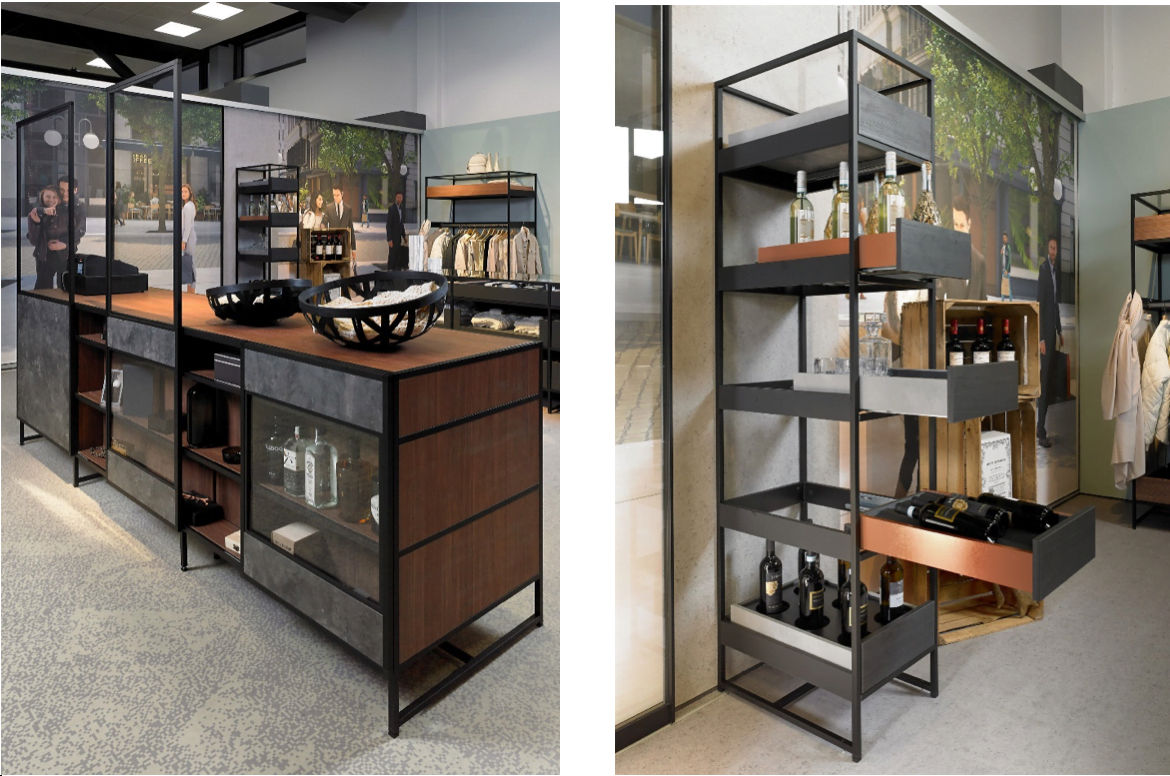
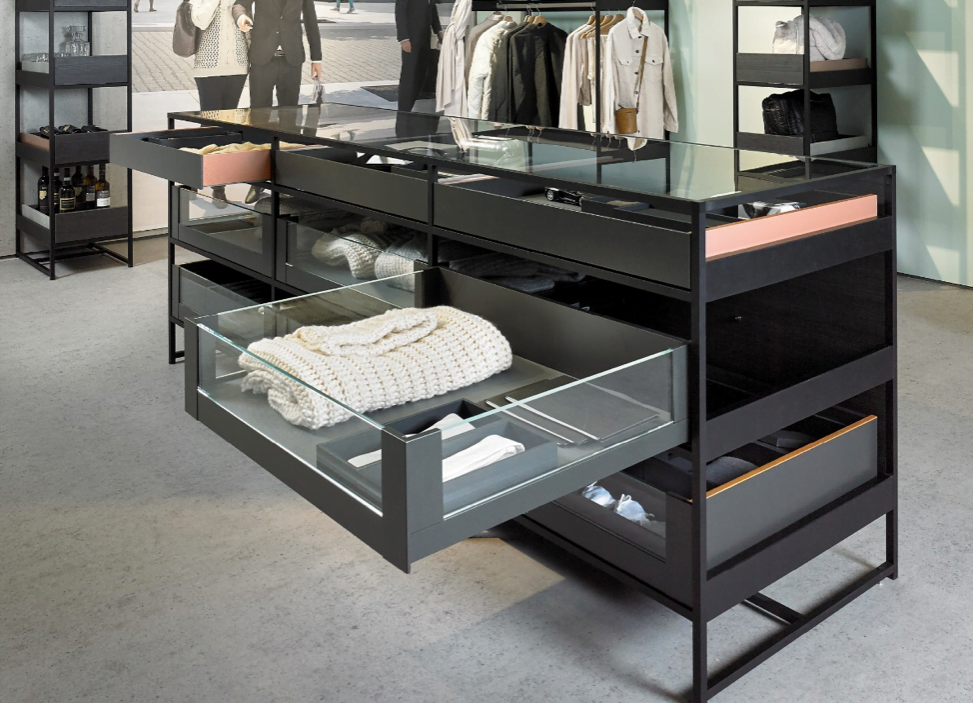
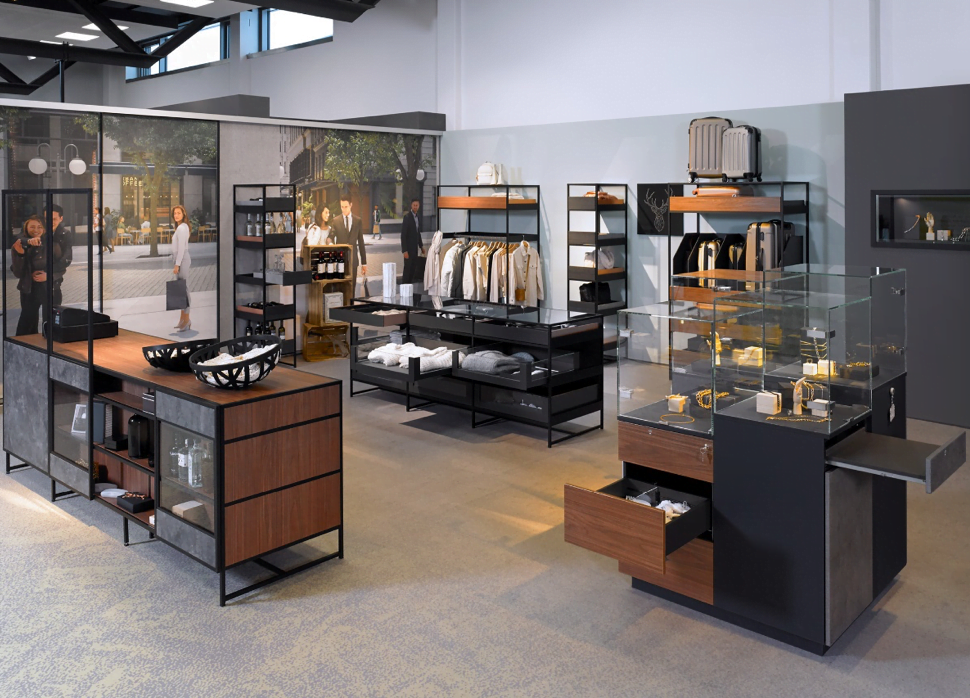
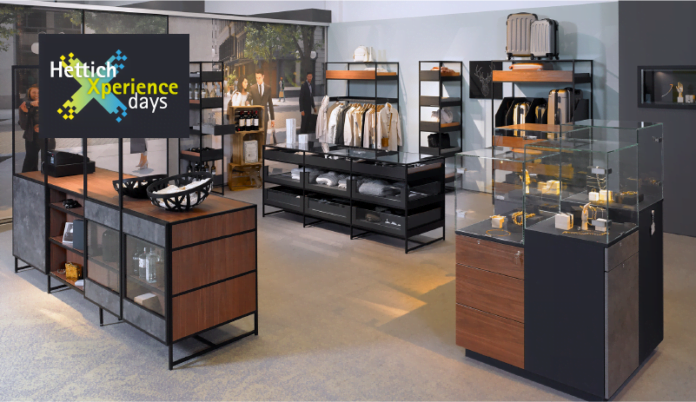
Examples of Hettich Canada's innovative furniture fittings aimed at providing increased ease for retailers when organizing and finding products. Photo: Hettich Canada

By Sarah Duquette

Across all industries, the pandemic accelerated the adoption of digital trends already gaining momentum before the lockdowns, and the retail industry was certainly not spared. Retailers scrambled to shift operations online and provide digital services such as click-and-collect and curbside pick-up. More than one year later, vaccination roll outs are priming consumers to return to stores, malls, and shopping centres. Retailers are confident that shoppers will return to brick-and-mortar, however the new retail environment will look and feel different, requiring a combination of new safety and hygienic protocols, merchandising and operational strategies, and a progression of the retail experience, as well as a greater trend towards convergence of physical and digital to offer increased flexibility and convenience to customers.

Here are five industry trends helping shape the new retail environment.

Providing Avenues for Escapism and Reinvention

After being confined to their homes during the pandemic lockdowns and stay-at-home orders, consumers will experience a heightened need for escapism and self-reinvention – they will crave normal social activities like dining out and casually shopping with friends. A year of WFH, pyjama attire, and COVID haircuts combined with the growing trend of health and wellness also has many people eager to explore new opportunities for self-transformation. Linda Price, a Marketing Professor at the University of Oregon defines this need for self-evolution as the “fresh start mindset”. Retailers that offer creative and inspiring products and services directed at allowing consumers to reinvent themselves will come out on top (think makeover items, self-help, wellness, etc.). 

Retailers can tap into this trend by using a combination of online and in-store storytelling experiences to generate buzz and drive engagement. Within the physical store, retailers should strive to create flex-spaces to accommodate unique in-store events to drive foot traffic. These could include exclusive product drops, pop-ins, or performances hosted through collaborations with local artists, for example.

To further amplify this trend, brands should rethink their visual merchandising experience, especially from the exterior. Social distancing and store capacity protocols will likely remain for some time after the pandemic. In warmer months, this means longer queues of shoppers waiting outside to enter stores, which presents an opportunity for retailers to utilize window displays to showcase the customer journey as they explore various areas of the store or to highlight specific products, promotions, or events.

Ani Nersessian

Unlike stores, window displays are never closed. They are visible and present to passersby at all hours, and therefore, act as brand representatives. Whether they are used for actual displays or left open to show a view of the interior, they need to be sufficient in communicating a message without further help of sales staff. “While the usual intent is to direct traffic into the store, lockdown periods increased the need to inspire customers to shop the brand, and during these periods, that means shopping online. Going forward, window displays, much like the rest of marketing, will likely express an omnichannel experience, meaning e-commerce and in-person shopping is not competing; they are treated as a whole, and the messaging should also reflect this,” says Ani Nersessian, a Visual Merchandising Specialist and Founder of VM ID.

Online Stores in Offline Spaces

Several direct-to-consumer brands – especially in thriving categories like apparel and athleisure – which started online have recently launched and expanded their physical presence. Despite a record number of closures of brick-and-mortar stores throughout 2020 and a decline in foot traffic, brands like Bonobos, Glossier, Casper, and Warby Parker have found that now is the opportune time to take advantage of low rent rates and have announced new store openings this year. Real estate experts have predicted that digitally-native brands will open 850 brick-and-mortar stores within the next 5 years (Tinuiti, 2020). Many retailers are realizing that consumers still prefer physical stores where they benefit from in-person interaction and can touch and feel the products.

Linda Farha

Other brands like Gap Inc. and Lululemon, which were forced to pivot to e-commerce during the pandemic, seem to be ready to shift back into the brick-and-mortar game in an effort to re-engage customers that prefer in-store shopping. “It’s all about maintaining relevancy in the digital economy. Despite many brands seeing a boost in their e-commerce business during the pandemic, retailers are taking advantage of desirable real estate availability and more favourable lease deals to open new shops, expand or relocate existing stores, and launch pop-ups,” says Linda Farha, Founder and Chief connector at pop-up go.

How can retailers leverage this trend? Creating an offline experience is an excellent way for digital brands to leverage the omnichannel technology and convenience of their e-commerce strategy in a physical setting. “Brands should focus on what makes sense for them – be strategic about where your customers are going to be most eager to spend their time,” says Farha.

AR-Powered Shopping Experiences

Augmented reality, artificial intelligence, and machine learning are here to stay. An essential part of many retailers’ e-commerce business, these technologies are helping to further the convergence of digital and physical. According to a Nielsen global survey conducted in 2019, consumers listed AR and VR as the top technologies they’re seeking to assist them in their daily lives, with 51% saying they would be willing to use AR tech to assess products.

These technologies allow brands to create more immersive and visually exciting shopping experiences. Among those who have introduced AR experiences to showcase their products to consumers are IKEA, Home Depot, Target, and Shopify. AR and VR are especially useful for helping customers select the best size and fit of clothing and shoes – something most shoppers find challenging when purchasing online and is a primary reason for returns. 

Retailers can partner with tech companies like 3DLook and TrueFit to offer their customers 3D body scanning services to help improve clothing size selection and hopefully reduce returns. This trend is likely to become increasingly utilized as a way to help consumers reduce the risk of “try until you buy”.

Transforming Store Operations

Physical distancing protocols and a new preference for self-service are altering traditional store operations in order to meet evolving customer experience expectations. For retailers, providing safe in-store experiences will help alleviate consumer worry about returning to pre-pandemic out-of-home shopping activities. Besides cleaning and sanitizing procedures, retailers can implement no-contact payment methods and alter the physical layout of the store, optimizing the footprint to increase distance and enable self-service with frictionless furniture solutions.

Hettich Canada, one of the world’s largest manufacturers of furniture fittings, has responded to this trend with modern furniture solutions that gives users added value in terms of design, functionality, and practical convenience. Products like the TopLine XL sliding door system and the AvanTech YOU drawer platform are creatively combined with other furniture systems to create new functions that make it easier for the retail customer to see and access products. When modifying or reconfiguring their store layout, retailers should focus on utilizing multi-functional merchandising furniture, low shelving, and accessible racks to limit high-touch surfaces and give consumers more control over their environment, rather than the shopping experience being determined by the staff.

Examples of Hettich Canada’s innovative furniture fittings aimed at providing increased ease for retailers when organizing and finding products.

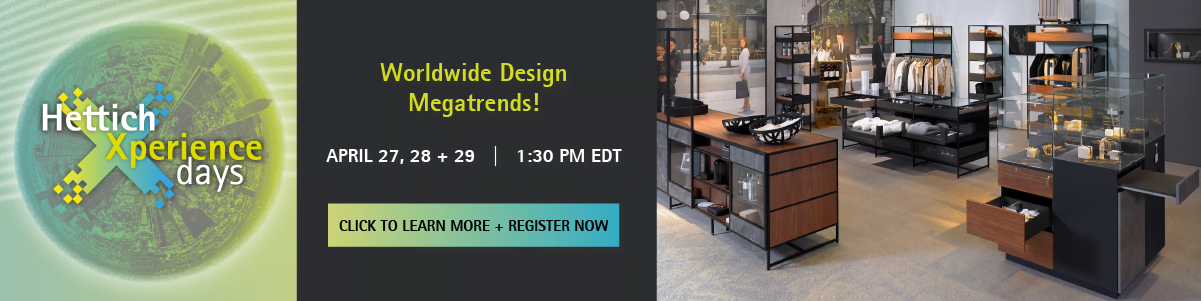
Hettich Canada is offering insights into the future of physical retail environments during its hybrid webinar series, Hettich XperienceDays, taking place April 29 at 1:30 PM EDT. The webinars are free to attend, however, registration is required. Learn more at hettichxperiencedays.com.

The new retail environment is also seeing the trend of everything on wheels – fixtures are designed to be easily moved, taken down, and reconfigured, making moving merchandise and products around much faster. Additionally, retailers will benefit from modular store fixtures that take up less space while enabling the customer to see and access everything more easily and removing walls and bulky furniture to improve sightlines and physical distancing. 

Treating stores and pop-up spaces as showrooms has been critical leading up to the pandemic. Ani Nersessian believes that the need to do so has only increased, especially given that social distancing requires clear walkways. “Editing down to a well-curated presentation has been imperative,” she says. “Since many retailers have been forced into this type of presentation, and customers are conditioned to expect this more than before, customers will likely be even more sensitive to higher standards of presentation. Websites will be treated as e-catalogues, diminishing the need and tendency to use the sales floor as a stockroom rather than as a presentation space” continues Nersessian. 

Redefining the Role of Physical Stores

Having a thoughtful digital strategy has been critical to staying afloat this past year, particularly for many small retailers. While digital transformation will continue to play a major role in many brands’ business plans, the physical store is far from dead. The pandemic has provided an opportunity for retailers to rethink and reassess the purpose of their physical footprint and how to take their customer experience to the next level. In an article published in the Harvard Business Review, leading authority on positioning great brands, Denise Lee Yohn, explains: “As a result of COVID-19, all retailers will have to make their in-store experiences even more extraordinary for those who can visit in person. They have to give people a reason to visit that is so compelling, it justifies their exposure to health risks and overcomes the inertia of the behaviours they adopted during the shutdown” (The Pandemic is Rewriting the Rules of Retail, July 6, 2020). Brands that offer exclusive, one-of-a-kind experiences, superior in-person customer service, and a personalized approach will fair better than those that do not.

Sarah Duquette is an experienced content writer, communications professional, and marketing strategist who partners with brands and businesses to help grow their visibility and engagement through effective communication of their brand value. As the Content and Growth Manager at Zenergy Communications, a PR and Marcom agency based in Toronto, Sarah knows what truly drives brand growth, and it starts with how well you connect with your audience, human-to-human. Driven by a passion for storytelling and an innate curiosity for what influences consumer buying behaviour, she takes pride in helping her clients create, communicate, and capture more value. Sarah holds a BA in Creative Industries with a specialization in business management and minors in media business and professional communications from Ryerson University.

Additionally, physical stores will be used to extend the innovation and digital services a brand offers online, integrating the two worlds to create completely new and immersive shopping experiences.

Beyond supporting a brand’s ecommerce business, retailers are using their brick-and-mortar stores to reinforce brand positioning by placing a greater emphasis on educating consumers rather than simply selling product. This approach has been a staple of pop-ups which, in the past, have primarily served as testing grounds for emerging brands as they dip their toes into the physical retail world. Post-pandemic, Linda Farha believes the pop-up concept will serve as “an important way for brands to reconnect with existing consumers and new prospects in a more controlled environment before making a bigger commitment”. 

Stores will make their comeback, but in a different format, feel, and function. With a progressive approach to integrating both the digital and physical retail environments, modernizing their physical retail infrastructure to be more flexible and immersive, and offering unique storytelling experiences that allow shoppers to reinvent themselves, retailers will be empowered to keep pace in the multichannel world by leveraging the benefits of both ecommerce and bricks-and-mortar to drive success. 

City of Coquitlam Seeks Café Operator for Unique Burke Mountain Retail Space

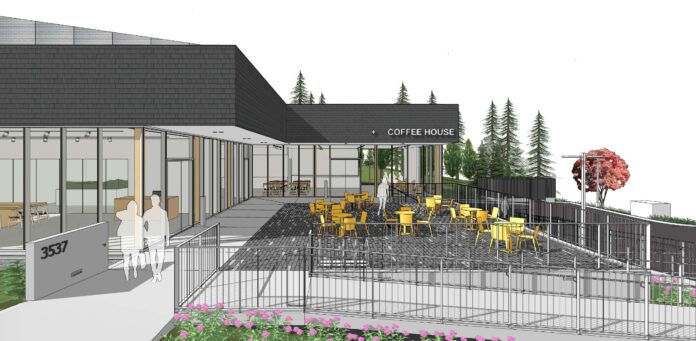
Rendering of the exterior of the future Cafe space. Rendering: The City of Coquitlam

The City of Coquitlam is offering a unique opportunity to lease a newly-built café space in a high traffic location at the Burke Mountain Village Discovery Centre. The location is considered to be exceptional and the café space itself will feature a captive market in an area that will be a draw from the local community and beyond.

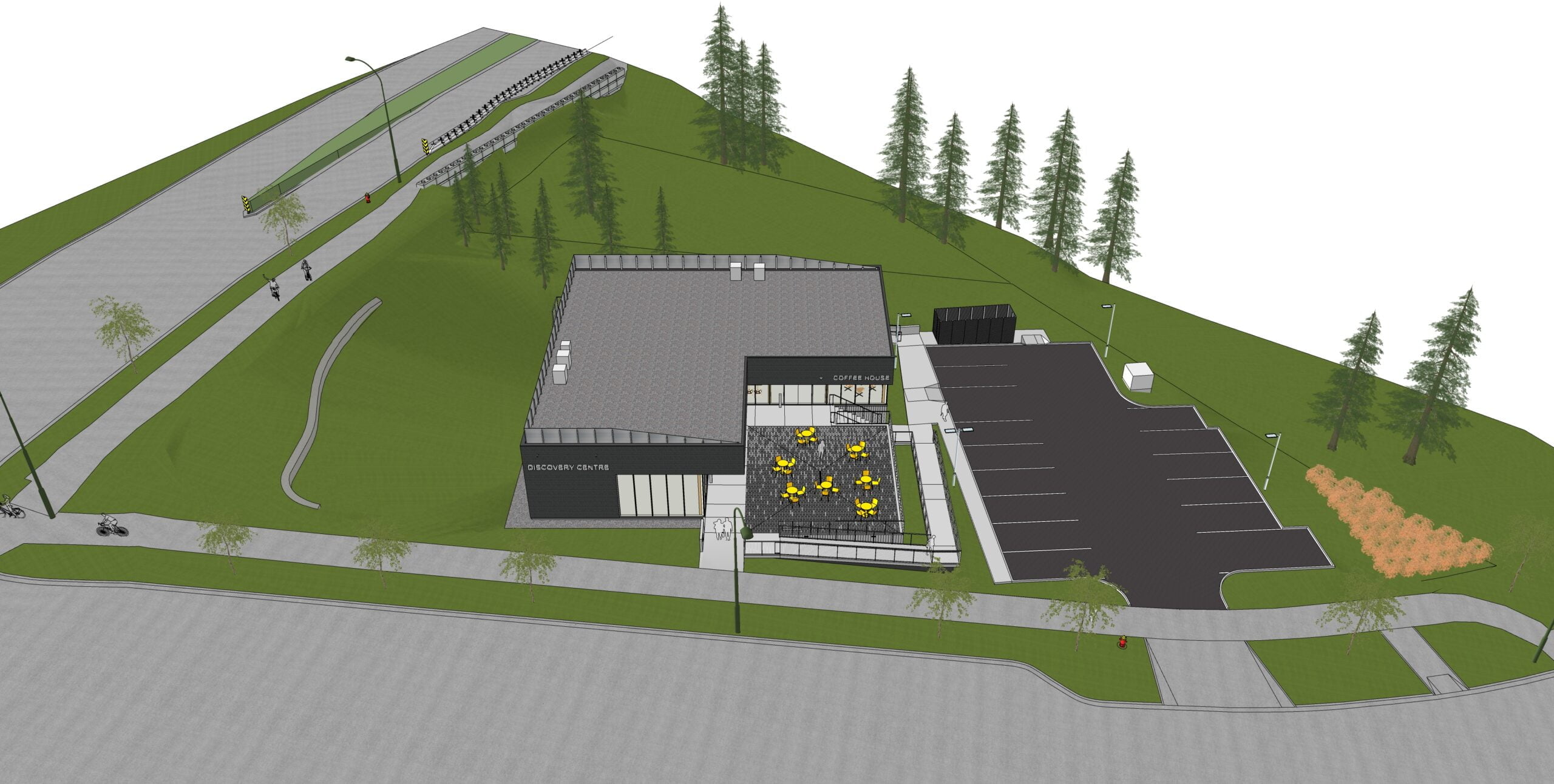
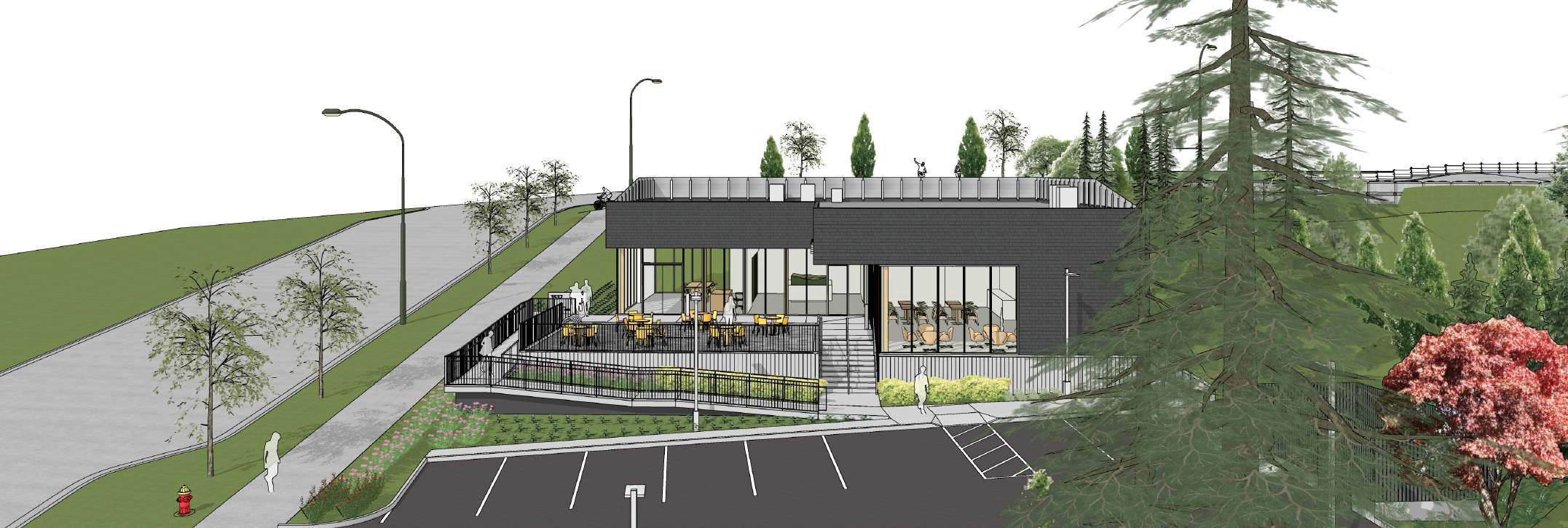
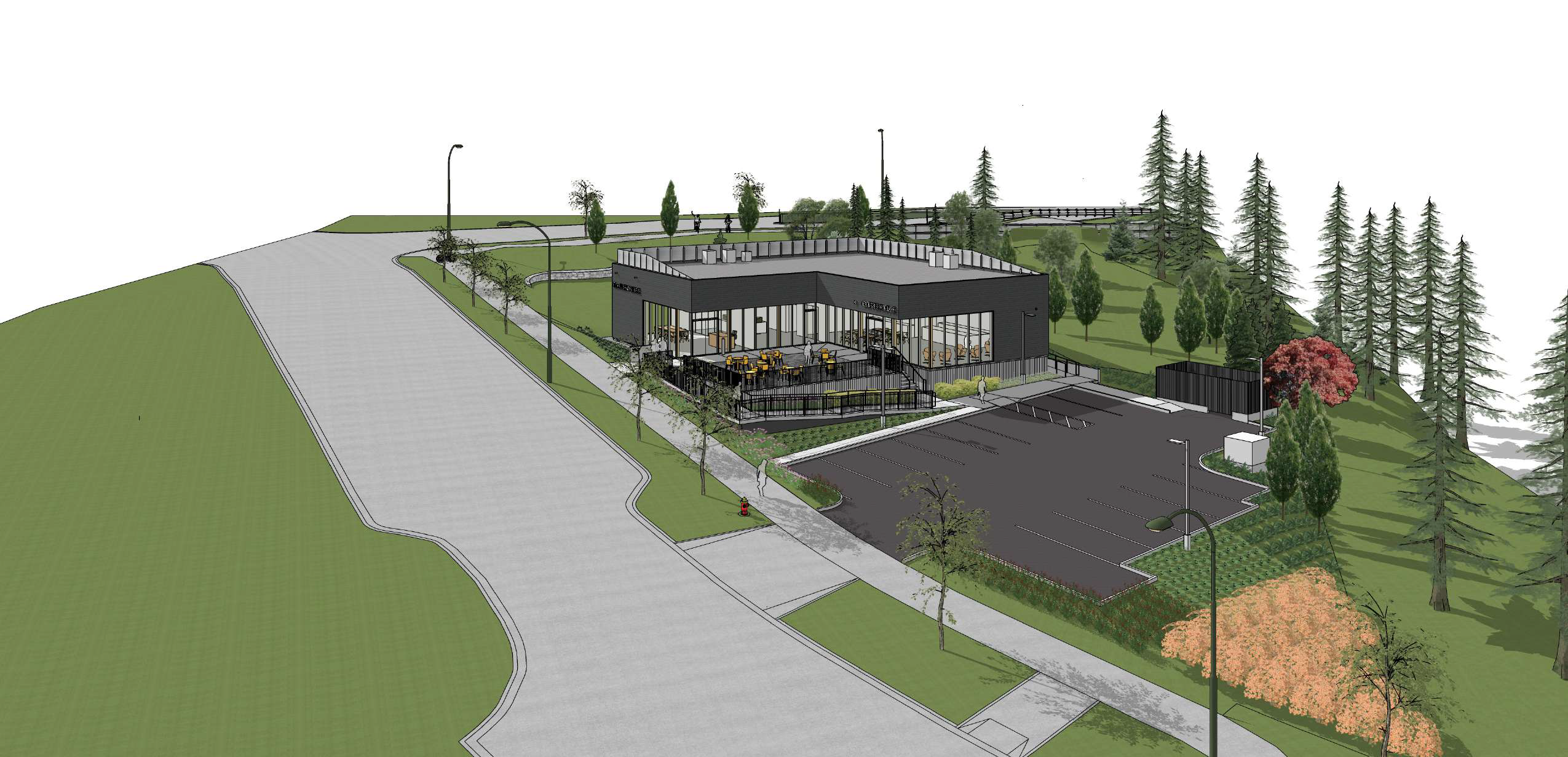
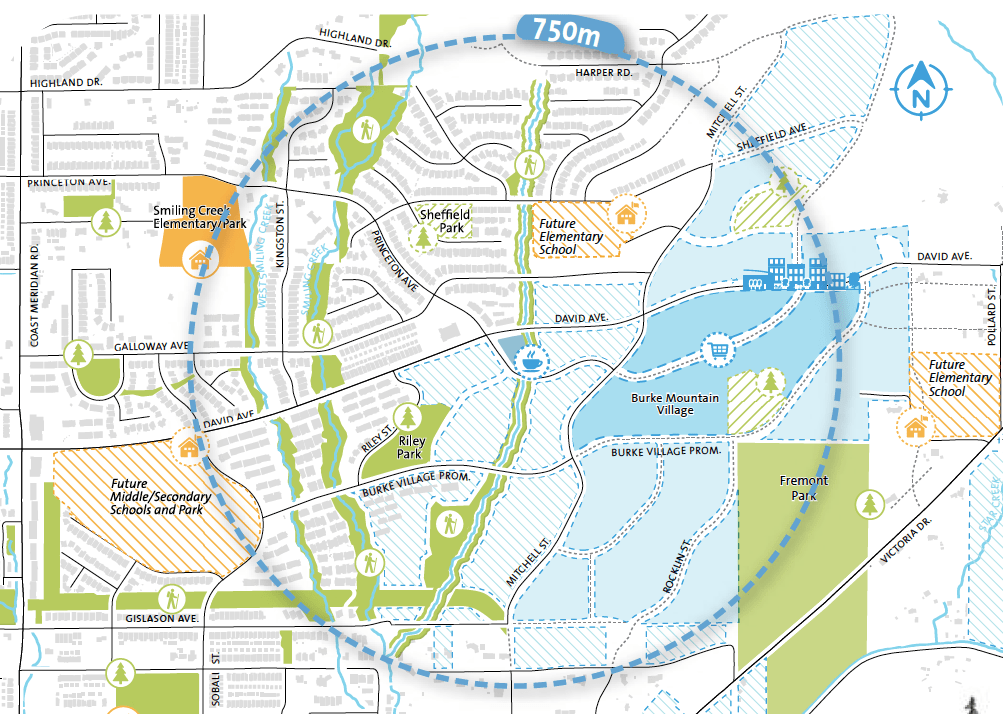
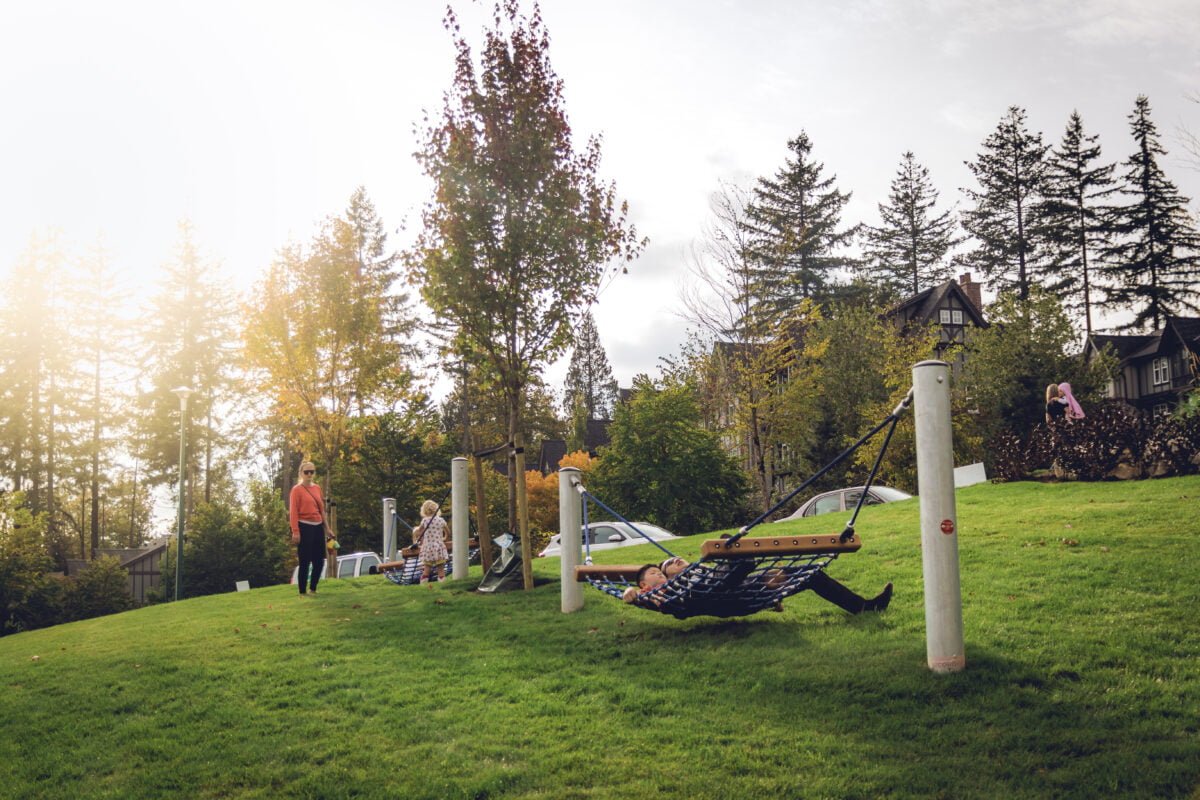
The café space and Discovery Centre are currently under construction and is expected to be completed this fall. The location at the corner of Princeton Avenue and David Avenue has strong exposure and signage opportunities and is adjacent to several large townhouse development projects as well as being surrounded by multi-use pathways and trails connecting the location with nearby parks and neighbourhoods. The Discovery Centre building itself will be designed in a West Coast Modern style with design elements including wood, glass, and metal in a one-level structure that will offer views over the Fraser Valley and the Pitt River.

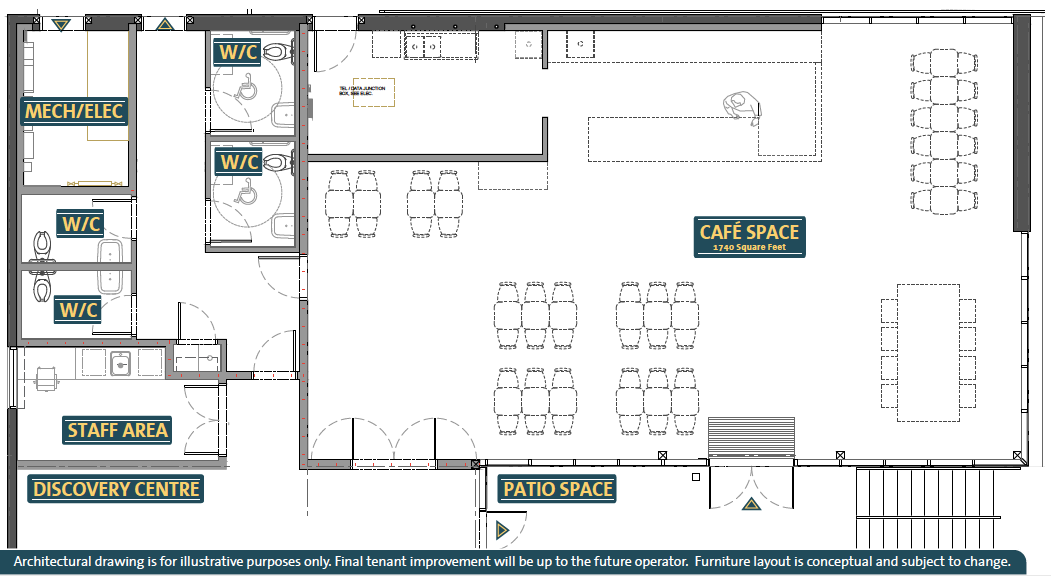
The L-shaped Discovery Centre building will include the available café space spanning 1,744 square feet and a common area with shared washrooms, measuring about 420 square feet. The building will be connected to a shared outdoor patio courtyard with a view of the Fraser Valley and lower Burke Mountain spanning about 1,690 square feet that will accommodate up to 13 tables and 52 seats. A total of 13 shared parking spaces will be included.

The café component, which is an integral feature of this public gathering space, is zoned for restaurant use and will allow for the sale of liquor for a food-primary licence. Concept plans show an opportunity for 60 indoor dining seats and a large front counter as well as a back-of-house space with an exit to a rear ramp and a garbage/recycling facility.

The café space is available for lease through a public request for proposals (RFP) process. The City of Coquitlam will review proposals from proponents interested in leasing. [Download the Documents Here]

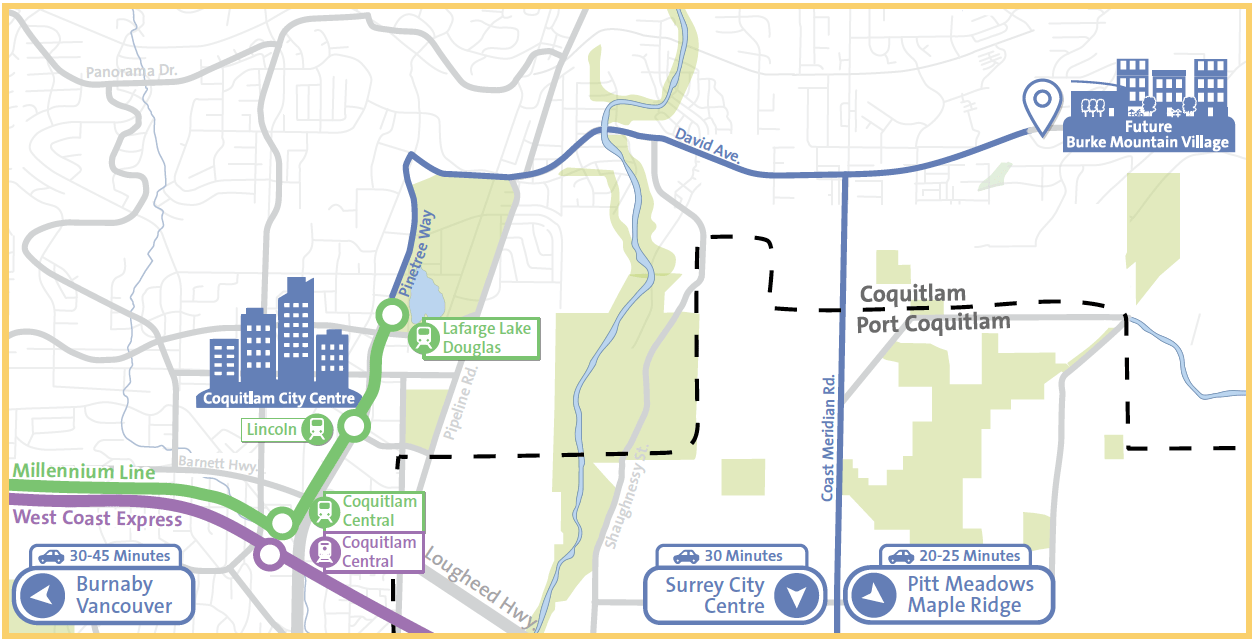
Burke Mountain is one of the fastest-growing neighbourhoods in Metro Vancouver and will include a vibrant master-planned community and mixed-use village. Burke Mountain currently has an estimated population of about 15,000 residents with the population expected to reach about 50,000 when fully built out. The café operator will have direct access to new and existing family-oriented neighbourhoods, and the added bonus to serve the construction workers that are on the mountain throughout the morning and afternoon

The nearby 39-acre future Burke Mountain Village will feature about 120,000 square feet of commercial space including a new grocery store, a new community centre, a public plaza, a greenway, and about 2,000 units. The master-planned community will be designed to honour and protect the beauty that surrounds it according to the City of Coquitlam, with the natural landscape dictating the layout of the pedestrian-oriented neighbourhoods while influencing the architecture of the homes. The City of Coquitlam, as the primary landowner and master land developer, is investing in making Burke Mountain one of the most desirable communities in Metro Vancouver.

A new major recreation complex and recreation centre and 3.6-acre park are part of the mix, as well as two active and two planned elementary schools and one planned middle/secondary school within three kilometres of Burke Mountain Village. Multi-use paths will bring people from the area to Burke Mountain to the village centre. The connecting parks and trails that will converge at Burke Mountain Village will allow residents and visitors to access and enjoy the village amenities by bike or foot without the need for a vehicle. This complete community will provide opportunities for commercial success including the new café at Burke Mountain Discovery Centre.

The City of Coquitlam is welcoming experienced parties interested in operating a café at the Burke Mountain Discover Centre to fill out RFP documents or contact landsales@coquitlam.ca.

Canadian Retail News From Around The Web For April 21, 2021

Canadian Retail News From Around The Web

Advertisement

Top Stories: National

Advertisement

Central/Eastern Canada News

Western Canada News

Sleep Country Canada Sees Explosive Growth in Ecomm Channel Amid its ‘Most Successful Year in Business’ [Feature]

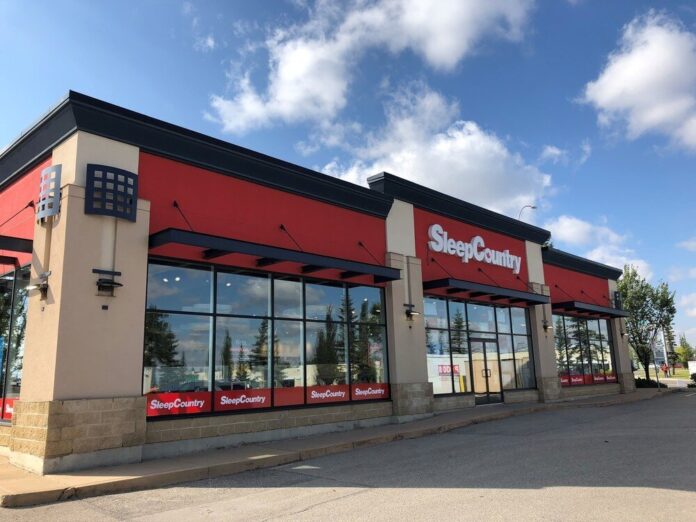
Sleep Country Canada store in Calgary. Photo: Sleep Country Canada

The retail industry has changed significantly over the course of the past year or so. Driven in large part by an obvious and persistent forcing function, consumer behaviour continues to shift, yielding an approach to the shopping journey that is more channel agnostic than ever before. It’s resulted in a swift and dramatic reshaping of the retail environment, one that’s requiring retailers to rethink their offerings and strategies in order to effectively respond to these changes. Efforts to do so have thus far triggered the acceleration of a range of digital initiatives across the country and, in many cases, alterations to operations that are being informed by thorough reassessments of the landscapes on which they operate. Though much of this action has been reactive on the part of retailers, there are some within the industry whose constant innovation and creativity have bred an agility that has enabled success during these difficult times, positioning themselves for further growth.

Dream Growth

One of these innovators is Sleep Country Canada – the country’s leading specialty sleep retailer – which recently announced impressive fourth quarter 2020 results that helped to cap the most successful year in its more than quarter century of business. Reporting a year-over-year increase in fourth quarter net income of 89.4 percent (+$12.6 million vs LY) and a 33.4 percent increase in revenue for the same quarter from $186.5 million in 2019 to $248.9 million in 2020, the company continues its expansion amid an omnichannel transformation and the development of strategic partnerships that began before the onset of the pandemic. According to Stewart Schaefer, Chief Business Development Officer for Sleep Country and President of Dormez-vous, the timing of the retailer’s initiatives has been fortuitously beneficial. But he adds that their outcomes have nonetheless been borne of the company’s penchant to consistently adapt and evolve in order to meet the demands of the consumer.

Stewart Schaefer

“Prior to the impacts of the pandemic hitting the industry, there were a lot of things that we had already set in motion,” he explains. “A little more than a few years ago when everyone started to really take notice of the ‘bed-in-a-box’ concept and the entire industry was concerned that e-commerce was going to be the end of brick-and-mortar retail, we were proactive enough to begin conversations about providing our own ‘bed-in-a-box’ solution and building out our digital capabilities and omnichannel environment. We never experienced any decrease in activity at our physical stores. We’ve been lucky enough over the years to continue to see that compounded growth. However, we also recognized that consumer preferences were evolving and that the ways they like to engage with their favourite brands were changing and expanding. We knew that we had to create a Sleep Country experience that allowed Canadians to shop with us in whichever way they want.”

Building an Experience

To help create the desired experience for its customers, Schaefer’s Sleep Country team initiated dialogue with one of its online competitors, Endy, back in 2017. Identifying the savvy and success of Endy’s online business, as well as the potential mutual benefits that could be realized through a partnership between the two leading mattress providers, a deal to acquire Endy was closed in December 2018, adding Canada’s largest online mattress brand and one of the country’s fastest ever-ever growing retail brands to Sleep Country’s portfolio. And, less than a year later, in November 2019, the company officially launched the fully transactional SleepCountry.ca website (dormezvous.com in the province of Quebec), marking a true foray into the digital space. The expansion of offering and service was cause for excitement internally at the company, representing a massive leap forward toward its digital and operational goals. But soon after, as Schaefer points out, impacts of the pandemic took hold.

“Following the formation of our partnership with Endy and the launch of our website, our numbers for the final quarter of 2019 were very good,” he says. “For the months of January and February 2020, our sales were incredible, both brick-and-mortar and online. We quickly saw the critical importance of the relationship between the physical store and the website. We had become channel agnostic in our approach and didn’t mind where the transaction was happening, as long as we were providing a seamless experience for the customer. And then, when COVID hit, sentiment in the country and around the world quickly changed. Everything just stopped for about ten days. It was concerning. I was starting to wonder if all of the hard work that our team had put in would be in vain. But then, our e-commerce activity started to accelerate as customers began visiting and engaging with us online in numbers.”

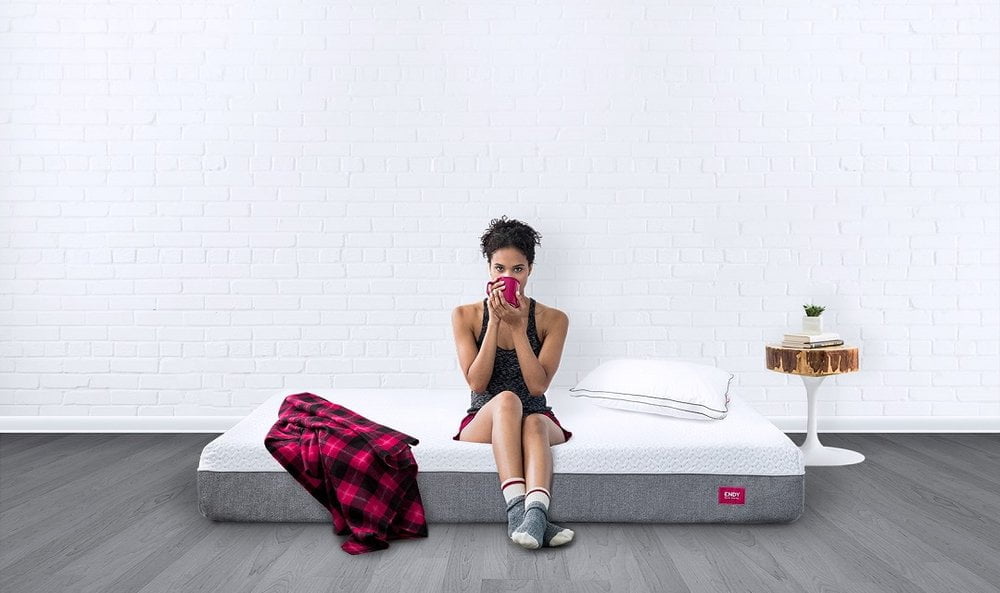
Photo: Endy

E-commerce Acceleration and Marketing Shift

He explains that it was a relief at first to see the company’s online performance start to make up for a shortfall in in-store sales that were impacted significantly by initial lockdowns. However, what Schaefer and his team experienced soon after was an explosion in e-commerce growth. Driven by the country’s new reality amid government-imposed social restrictions and safety protocols, consumers across the country cocooned themselves and their families at home, making purchases that suited their immediate needs. As a result, sales within the accessory segment of Sleep Country Canada’s offering, which it launched a little more than five years ago, increased exponentially. Items like folding cots, sheets, pillows, comforters, and weighted blankets flew off the digital shelves.

These types of purchases not only highlighted the immediate needs of the Canadian consumer, but underscored the significant challenges that people across the country were facing to keep themselves and their families safe and secure. In response to the severity of the situation, just before the first wave of lockdowns took effect, Sleep Country Canada shifted its advertising toward a softer approach. The company stopped advertising mattresses, momentarily retiring its 26-year-old corporate mantra “Why buy a mattress anywhere else?” and replacing it with the message “Sleep well. Stay well”. It was part of an entire new campaign that was launched by the specialty sleep retailer, and one that Schaefer believes has been, at least in part, instrumental in reenforcing the strong connection between the Sleep Country Canada brand and its loyal consumers across the country.

“It didn’t make sense for us to be advertising the sale of mattresses during such a difficult time,” he admits. “When we introduced ‘Sleep well. Stay well.’, it was meant as a message to the Canadian community – a small way by which we could lend our support and to let our customers know that we’re with them. We aren’t clever enough to have created this campaign to drive our business. The intention behind it was completely sincere, providing suggestions like ‘Call someone you love tonight’. But influencers on social media picked up on it and our campaign went viral, seeming to take on a life of its own, helping to solidify Sleep Country’s reputation as a good corporate citizen.”

In addition, Sleep Country Canada also donated $1.5 million in sleep products to non-profit organizations across the country, benefitting frontline healthcare workers as well as vulnerable communities impacted by COVID-19. And when brick-and-mortar stores reopened, it invested millions more in the creation of a safe in-store environment for its 282 stores across the country. It wasn’t long until the company began to experience a return of its mattress sales, both in-store and online. Defying the challenges that have been faced by the industry, Sleep Country Canada’s performance steadily escalated throughout 2020. Supported by its newly created digital experience and omnichannel ecosystem, the company’s most recent successes are reflected in its remarkable fourth quarter numbers, which include a growth in mattresses and accessories revenues of 34.6 percent and 29.3 percent respectively and a third consecutive quarter of triple-digit e-commerce revenue growth, representing 20.1 percent of the company’s total revenue.

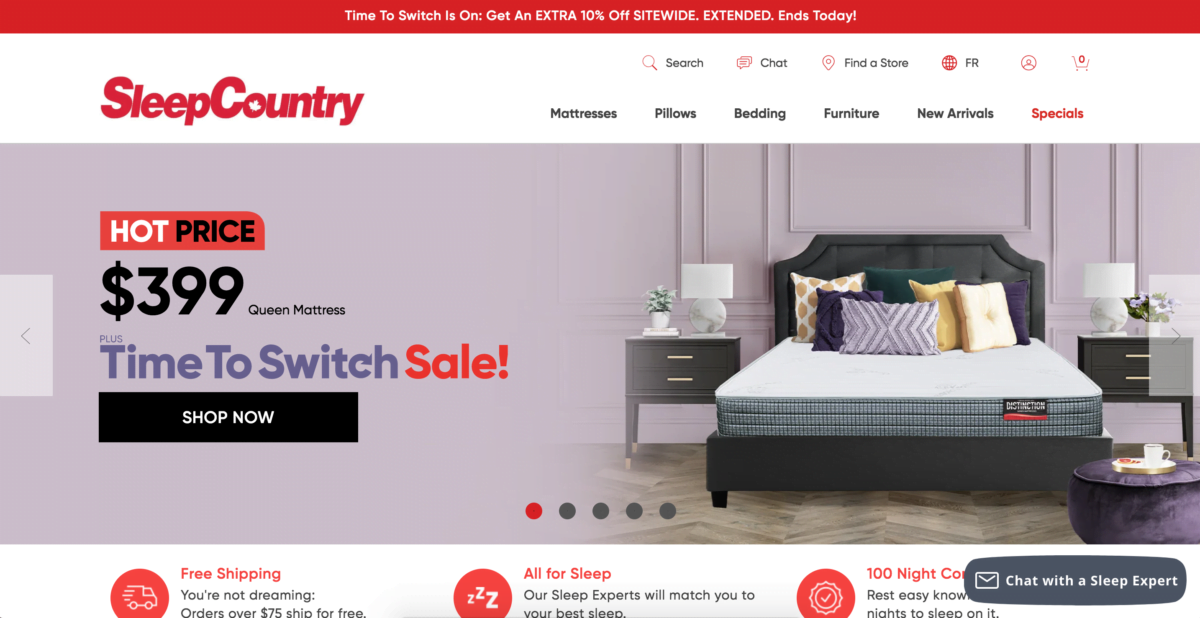
Screenshot of Sleep Country Canada’s website.

Enhanced Digital Service

Another example of Sleep Country’s good corporate citizenship, which also represented an adept adjustment made by the company, is the fact that it did not furlough any of its employees during these difficult times. Instead, it realigned its in-store workforce, forming its ‘Dreamline’ which provides direct access, either by phone, email or chat, with Sleep Country sales associates who are available to offer expert sleep advice and help to inform customer purchasing decisions. Started as a response to the pandemic, Schaefer says that the ‘Dreamline’ has quickly become a mainstay component of the company’s consumer engagement strategy. It’s reflective of the creative culture that’s always provided the underpinning for Sleep Country Canada’s success. And, according to Schaefer, it’s also a testament to the organization’s people who were willing to accept and dedicate toward a new way of doing things.

“The creation of an omnichannel experience for customers is no longer a choice of whether or not to build it,” he says confidently. “It’s representative of the evolution of retail and of an offering that has become imperative to provide for the consumer. It has everything to do with the ease, convenience and satisfaction of the shopping experience that you’ve created for them. Our associates have been incredible throughout this journey, supporting the initiative, ensuring that the same exceptional Sleep Country Canada experience is consistent across all of our channels. They’ve always been key to our success, providing the magic behind our customer engagement. But they’ve been unbelievably positive in accepting their evolved responsibilities and helping to drive this transformation.”

The Power of Digital

In addition to complementing in-store sales, the digitization of the business has also informed Sleep Country Canada’s marketing, enabling it to supplement its traditional media with online and social content. For a company that’s always prided itself on its unique storytelling through creative marketing and advertisements, digital channels are providing the perfect mode of communication to start conversations with its customers, while strengthening and expanding awareness of the Sleep Country Canada brand. As is evidenced through the hugely successful partnership with Endy, the development of an omnichannel ecosystem has also allowed the company to continue thinking strategically. Prior to its acquisition of Endy, in support of its digital growth and to further enhance its online offering, the company also teamed up with Simba – Europe’s leading mattress-in-a-box purveyor – in May 2018. And, in March 2019, it entered into a partnership with Walmart, becoming the exclusive provider of Mattresses on the Walmart.ca marketplace. Most recently, in October 2020, Sleep Country became the exclusive Canadian retailer of Purple – the leading mattress-in-a-box creator in the U.S.

The digitization of Sleep Country’s business can’t be described as anything short of a revolution, a critical step that’s allowing the iconic Canadian specialty sleep retailer to venture into a new frontier, adding to the already impressive legacy that its built. It’s changed the very landscape that the company operates on, bringing competitors together and opening a multitude of possibilities for the brand that would not have otherwise been possible. And, combined with its perennially strong brick-and-mortar performance at locations across the country, those possibilities and opportunities to continue growing the brand, according to Schaefer, are presenting Sleep Country Canada with a very exciting future.

“Things are so fluid within the company at the moment and happening so quickly that it’s difficult to look any further than 18 months down the road in terms of what we need to do transactionally to execute on our current plans and growth. We’re focused on continuing to develop our marketplace relationships and exploring strategic partnerships to find that next, best, relevant brand. We’ll continue building out a best-in-class, seamless omnichannel experience and developing that digital relationship with our customers. And we’re also going to build on our real estate portfolio. There’s still room for us to grow in terms of physical locations. And, given our current circumstances, I believe that there are tremendous opportunities for brick-and-mortar retailers ahead. Going forward, it’s going to be about continuing to build on the layers we’ve already laid. And, with respect to the power of digitization – the online environment changes the barriers to entry into other parts of the world. As we continue to work with and develop these relevant brands for Canadians, there is some potential for us to possibly extend Sleep Country beyond Canada, providing us with a glimpse of where we might be able to take the brand.”

Why Canadian Retailers Must Own the Customer Experience in the Last Mile: George Minakakis

Entrepreneur cultivating her brand presence online.

By George Minakakis

Every day a new generation of ideas emerge meant to provide consumers with more shopping options under the guise of convenience and a better customer experience. We now have a plethora of choices and more being developed on where and how to shop. Some are meant to draw consumers away from the physical retail world. Others are just offshoots of a brand or shopping concept trying to redefine or preserve themselves in a consumer world demanding more free time.

Over the last few years, we have noticed the line between brick and mortar stores and e-commerce blurring. We have also heard about traditional retailing becoming a hybrid model integrated with all their digital strategies and social channels. Of course, what else could it have become?

When e-commerce grew up into a more serious player, the beliefs were that it eliminated the middleman and filled the consumer’s needs for greater convenience. Service was not a big concern for e-commerce — the bar in physical retail was low to begin with. They were right then, but not so much today. Instead, it brought in a new middleman — courier services are one of them — but they can’t deliver the brand message.

Traditional retailing was also about convenience in the not-too-distant past. That’s why developers built malls, and thousands of stores were added globally to reach a time-starved public. We all know how that has been playing out. Unable to grow their revenue further, many retailers resorted to lowering costs. We all knew that you couldn’t succeed in retail by cutting service.

While writing my new book, I looked at online marketplaces and how innovative and effective they are as a growth vehicle. Many are novel innovations; however, 90-95% of all innovations fail. For marketplaces to be successful you need:

  • an attractive business model that works.
  • an adequate number of potential buyers and sellers.
  • to have the right target market identified.
  • resources (financial and intellectual) to recover from setbacks and demands of growth.
  • to build trust in the process from beginning to end, for customer satisfaction.

The growth of online marketplaces appears to make up for lost share to other behemoths and/or perhaps, keep your piece of the pie. Saks Fifth Avenue and Hudson’s Bay are on their way to launch and grow marketplaces. Walmart and Best Buy are legacy-branded retailers that have created marketplaces as well. Etsy, eBay, and even Craigslist, for example, are more peer-to-peer marketplaces.

Everyone wants a piece of that consumer pie, whether it’s new or resale.

I haven’t forgotten about Amazon. In 2020 they picked up 50 million new Prime members. Once a member is on their site, they order within three minutes. Financial analysts who follow the retail sector, say; “If you want to know where the consumer is going to be and how they will shop post-pandemic, keep close tabs on Amazon.” I agree with them.  It doesn’t stop here; Amazon has ordered 100,000 electric vehicles. Why? Because they understand the importance of owning the customer experience from beginning to end. I can’t emphasize enough how important it is that a brand is appropriately represented at the customer’s door. Amazon is not alone. Walmart has also invested in CRUISE autonomous vehicles. With the plan to own that last mile and their brand ever-present.

Retailers must own that last mile.

A small grocery upstart called ‘Fridge No More’ offers 15 minutes local delivery on E-bikes.

The staff is employed by the company they pick, package and deliver products. It may be unique, but it is a game-changer for anyone in high-density markets looking to serve their customers and control the entire experience.  The idea here, of course, that you don’t need to be locked in by the status quo.

To be clear, owning the last mile doesn’t necessarily mean you need to own the logistics. You need to understand and respond to how your product is delivered and presented to customers — making the assumptions that a customer’s past experience with your physical space will be enough and that they will understand that it’s just the process of shipping. Is a mistake! No different than cutting productive labour hours from stores.

George Minakakis
George Minakakis is the CEO of Inception Retail Group and the author of a soon-to-be-released new book, “The New Bricks and Mortar – Future-Proofing Retail”.

Marketplaces are the other middleman. Some of them are retailers who will be acting as online malls. This competitive landscape will see new entrants, and as malls, plan to add their marketplaces. All of this will only add more confusion for consumers. Whom are they buying from? How does that brand protect its relationship with its customers? They can’t! Marketplaces control the relationship with the consumer, not the retailer or seller. For marketplaces to be an ideal venue for branded retailers, they need to behave like an open-source marketplace where brands are visible. After all the digital transformations and developing a presence on social channels, losing your brands’ online visibility is high.

Controlling your brand presence in the last mile is retail’s next big challenge, or retailer’s risk having their futures controlled for them.

Gap-Owned Brand ‘Athleta’ to Enter Canada with Stores

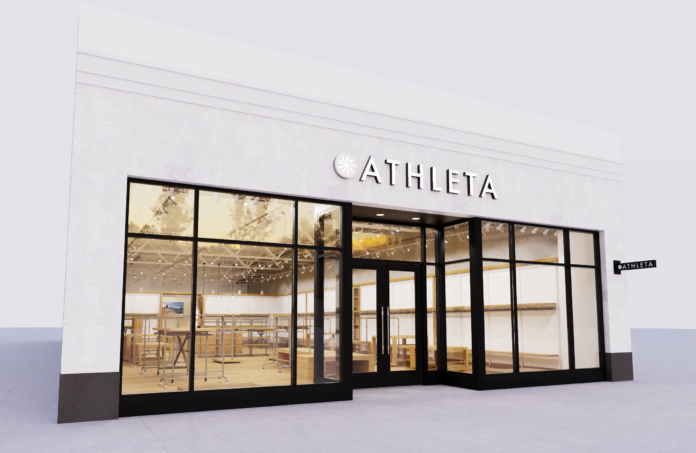
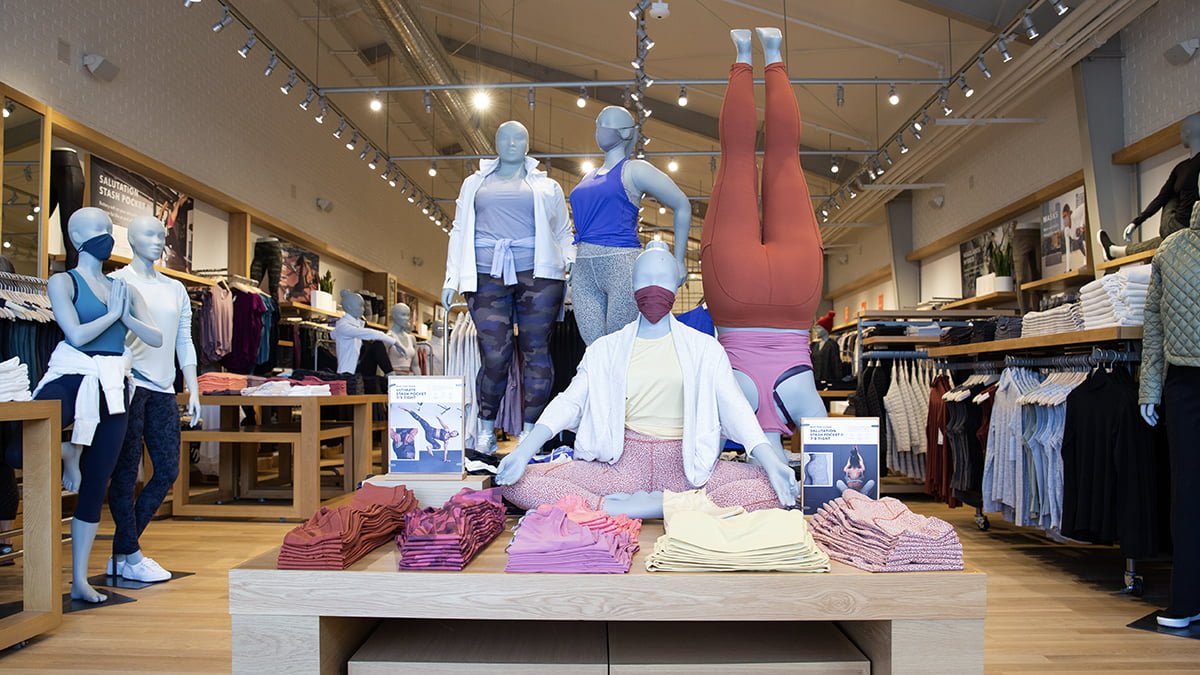
Rendering of Athleta store. Rendering: Gap Inc.

San Francisco-based Gap Inc. announced Tuesday morning that its women’s and girls’ brand Athleta will enter the Canadian market later this year, making the performance lifestyle brand’s first expansion outside the United States. The first two Athleta retail stores will open in Toronto and Vancouver with more to come, and the company will also launch a Canadian e-commerce website this summer to gain traction in the Canadian market prior to the brick-and-mortar expansion.

Athleta’s first two physical stores will open at the Yorkdale Shopping Centre in Toronto and the Park Royal Shopping Centre in West Vancouver. Both stores will open sometime this fall. Yorkdale is considered to be Canada’s leading shopping centre in terms of sales per square foot as well as in terms of a clustering of luxury stores and first-to-market retailers. The beautiful sprawling Park Royal centre features a mix of indoor and outdoor retail as was recently featured in a tour in Retail Insider.

“International expansion is a key component of our growth strategy to reach two billion dollars in net sales by 2023, and we are very proud to introduce Athleta to customers in Canada,” said Mary Beth Laughton, President and CEO, Athleta. “As a purpose-driven brand, we are excited to expand our community of empowered and confident women and girls to Canada and bring them a differentiated and inclusive offering in the performance lifestyle category.”

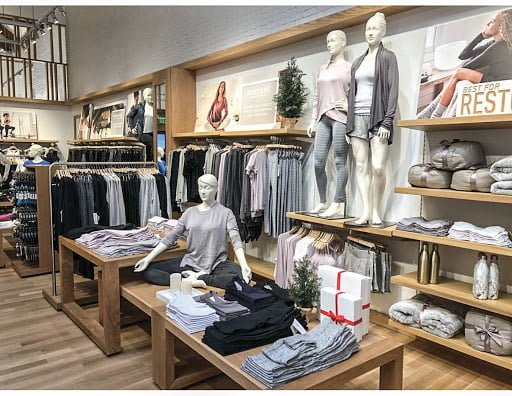
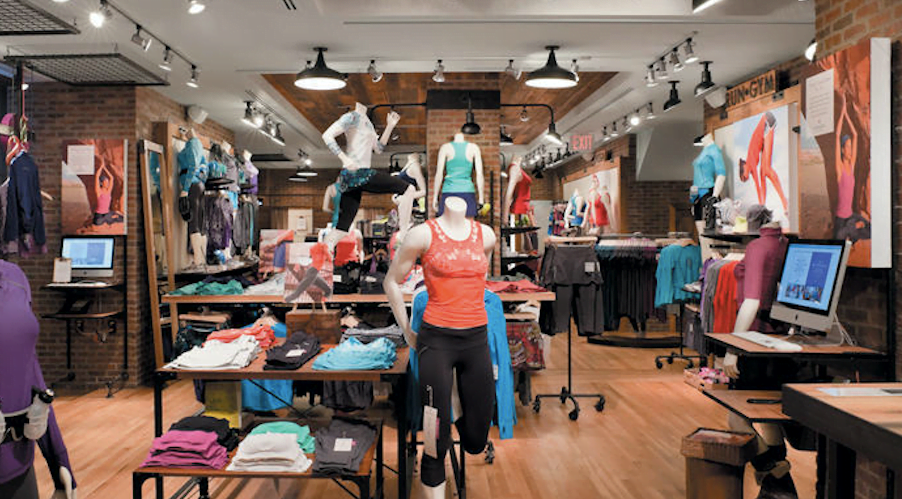
Interior of Athleta store. Photo: Gap Inc.

Athleta says that it plans to open between 20 and 30 stores in North America annually. The brand already has over 200 stores across the United States which it says are profitable. Gap Inc. says that its Athleta stores remain a  “top customer acquisition and brand awareness vehicles and are a key component of the growth and future of the brand.”  New wholesale partnerships and international expansion through franchise and company-operated stores are among Gap Inc.’s strategic steps towards growing the Athleta brand to USD $2 billion in net sales by 2023. Last year Athleta surpassed USD $1 billion in net sales with 16% annual sales growth.

Athleta’s Canadian e-commerce site will see product fulfilled by the Gap Inc. distribution centre in Brampton, near Toronto, which will eliminate international taxes and lengthy shipping times for Canada-based consumers. Athleta noted in a press release that e-commerce in Canada is growing fast and that the pandemic further accelerated the channel’s growth. In 2020, about 60% of Athleta’s US business was generated from e-commerce according to the company.

Prior to making the decision to enter the Canadian market, Athleta says that it conducted extensive research to understand the behaviours of the Canadian consumer. The company’s findings indicated that this is demand for a purpose-driven performance lifestyle brand in this country with Athleta’s differentiated brand focus on “wellness, sustainability and inclusivity” coupled with versatile product that the company says will resonate in all regions. The company said that its product offering in Canada will be “differentiated” with extended sizing in approximately 500 styles in stores and online.

Photo: Gap Inc.

Athleta was founded in San Francisco in 1998 and Athleta Girl was launched in 2016. The company says that its mission “comes to life through inclusive and sustainable product design, connecting with customers through unique experiences in stores, online and within local store communities.” It’s a message somewhat similar to competitor Lululemon.

The expansion comes at a time when Gap Inc. is struggling. Over the past several years the Gap has closed stores across Canada, including the former Gap flagship location at the northeast corner of Bloor and Bay Streets in Toronto. Gap-owned Banana Republic has also closed some Canadian stores while Old Navy appears to be seeing more success. Gap-owned Intermix closed its only Canadian storefront on Bloor Street in Toronto several months ago. Some landlords told Retail Insider that some Gap-owned stores were not paying rent for some months during the pandemic.

Gap Inc., is the largest specialty apparel company in the US selling clothing, accessories, and personal care products for men, women, and children under the Old Navy, Gap, Banana Republic, Athleta,and Intermix brands.  Its fiscal year 2020 net sales were USD $13.8 billion.

Canadian Retail News From Around The Web For April 20, 2021

Canadian Retail News From Around The Web

Advertisement

Top Stories: National

Advertisement

Central/Eastern Canada News

Western Canada News

Pandemic Hits Wholesalers in Canada as Retailers Struggle

Wholesale retailers have been hit hard by the pandemic.

Retailers across the country have felt the tough economic blow that has resulted because of the ongoing COVID-19 pandemic and its associated lockdowns and mandatory public health measures.

But the impact on the industry hasn’t been relegated to just the stores. It’s had a domino effect with the pandemic causing turmoil and hardship as well for a variety of other industries associated to retail, such as wholesalers.

Lisa Wiseberg, owner of LWS Fashions based in Toronto, is a multi-line sales representative who sells men’s and women’s clothing to retail stores.

“People have to realize that it’s just not the retailers that get hurt in these times,” said Wiseberg, who has been in the industry for about 20 years, “because if the retailer isn’t open or the retailer isn’t selling then the wholesaler is getting just as affected because we’re not getting the repeat business or they’re not bringing the goods in. They have to hold goods back because there’s no business.

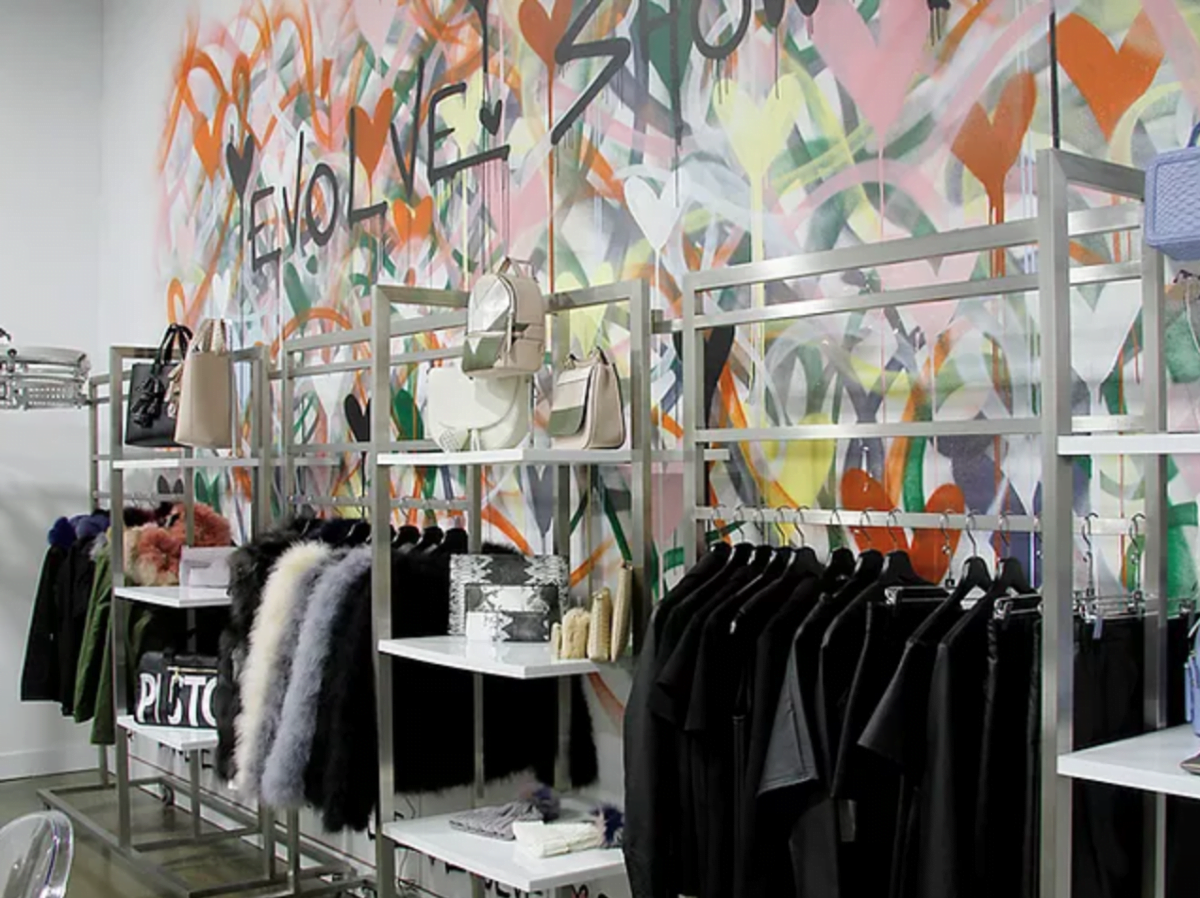
Interior of Evolve Showrooms. Photo: Evolve Showrooms

“If a retailer is suffering, of any kind, even a restaurant, whoever supplies them the goods is also suffering. It’s not just a story about retailers closing up their stores which obviously is horrible. But that means with that store closing or not opening or not selling their product the way they were last season, that means it is affecting everybody who supplies them, which is me. So my revenue has dropped hugely.”

Wiseberg said the whole industry is suffering, not just retail.

“Vendors aren’t getting paid. So we’re having to stretch our credit lines to retailers because they have no money. So it’s a huge domino effect. I think the clothing industry should know about this effect to be honest because it’s affecting all of us and we have to work together,” she said.

“How do we work together? How does the vendor last? If the vendor doesn’t get paid, if I ship out $5,000 to a retailer and then that retailer can’t open or the consumer isn’t buying, how does that retailer pay the vendor and then how much money can the vendor hold in paper until we get paid or we go down? So it really is a huge problem right now in the world of clothing and anything they are deeming non-essential.”

Ivanna Gecelter

The pandemic is affecting every single area of business associated with retail — landlords included.

Ivanna Gecelter, owner of Evolve Showrooms, said that although she has not been affected to the extent that retailers have because of the pandemic “the retailers are my clients so it’s almost like a domino effect.”

“When they’re affected, we’re affected. They have to cancel their orders or they have to put their orders on hold which obviously would affect us and our suppliers. It’s almost like a domino effect when this happens but it’s definitely not as much as they’re having unfortunately with having to be closed and open, closed and going through what they’re going through,” she said.

Evolve is a Toronto-based, full-service sales agency, bringing premium international men’s and women’s clothing and accessories to retailers across Canada.

As a wholesaler, Gecelter acts as the middle man between the retailer and the brand. Her business has 15 brands that she sells to retailers. Most of the brands get booked six months in advance for the next season. She’s been in the industry for about 15 years but has had her own showroom for about three and a half years. The showroom is a large space with samples of each brand.

“Things that were booked six months ago for this upcoming spring season have now had to be put on hold because the retailers are closed and they can’t take it so we’ve had to put those orders on hold or cancel them and so there’s a lot of uncertainty for them to buy or put more money into buying new product because of what’s happened,” she said.

“We haven’t been able to see our buyers in person. We’ve had to do virtual appointments with them. That’s all been a whole other ball game for them to see the brands they’re going to bring into their stores and really understand the feel, and the fit and the quality of what they’re buying. It’s been different.

“My business rides on the retailers. If they don’t survive through this, then I won’t survive through this. It really is a domino effect. A lot of them have been doing an incredible job pivoting through this and going online, working really hard on social media and things like that. And that thankfully saved me as well. But they have to be open at some point for us to continue growing our businesses.”

JLL Report Shows How Retailers and Foodservice Businesses in Canada Have Pivoted with Delivery and Curbside Pick-Up

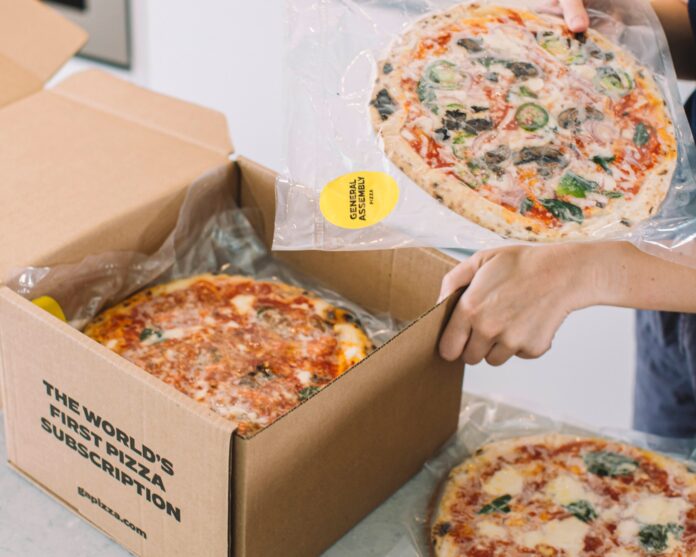
General Assembly subscription user unboxing delivery of frozen pizzas. Photo: General Assembly Pizza

The COVID-19 pandemic, and its associated lockdowns and public health measures, has forced traditional retailers and those in the food industry to think like e-tailers.

In its latest report, Resilient Retail: How Canadian retailers are pivoting and showing signs of resilience, commercial real estate firm JLL said technology has stepped in to bridge gaps as customers change their habits in search of convenience and safer interactions.

“With only a handful of exceptions, Canada’s top 50 retailers now offer delivery services and around 40 percent offer curbside pickup, in-store pickup of online purchases, or both,” said the report.

As society moves forward from the pandemic, the JLL report indicates these will be key trends for the retail industry:

  • Food services will continue to champion off-premises solutions that bring both safety and convenience to customers;
  • Both landlords and retailers are expanding their online platforms, making the customer experience more integrated;
  • Retailers will increasingly leverage video chats to translate in-store events and experiences to a virtual environment;
  • Retailers will adapt their offerings to address the increased need for comfort and health; and
  • Retailers will tighten cost structures and think strategically to absorb new expenses.

Graham Smith, Senior Vice President, Agency Retail Group with JLL, said the sector on a whole is in a period of upheaval and transition.

“I think we’re seeing that the retailers that are really putting a strong focus on not only pivoting their business but looking to kind of reinvent or reimagine their business are the ones that are going to be successful once we come out on the other side of this,” he said.

Graham Smith

“As it specifically relates to foodservice, I think from a bricks and mortar perspective we’ve seen a lot of physical requirements downsize and everyone’s trying to right size now that require smaller spaces that can accommodate both pick up and delivery without having a large rent overhead as a lot of retailers are just uncertain about occupancy levels will reach pre-COVID days.

“Retailers are looking at tightening a lot of their cost structures and are strategically thinking about how to absorb new expenses and how that works in the greater scheme of locations and also potentially delivering e-commerce as well.

“One thing that we noticed during the pandemic is that there were certain operators that were hungry, innovative, driven, that had the ability to pivot their business, and those are the ones that are going to make it through and be a success at the other side of this pandemic.”

Smith said many of the changes that have taken place over the past year or so due to the pandemic will remain for the long term in the foodservice industry.

“Everyone is seeing the merits right now about delivery service and how much pick up there’s been with not only e-commerce but obviously with all the different delivery apps and grab-and-go. I think that’s a trend that’s going to be here to stay,” said Smith. “I don’t think the restaurant experience of going in to dine with friends is ever going to be completely replaced and I think that’s an important attribute to have of any food and beverage operator. But the new trends that we are seeing are absolutely here to stay. The convenience. The quality. And more importantly just the ability to get it to an end-users’ hands quickly and easily is absolutely paramount. That’s what the population was starving for not only during COVID but in the future as well.”

Ali Khan Lalani

Ali Khan Lalani, Founder and CEO of General Assembly Pizza in Toronto, who was featured in the JLL report, said that the early stages of the pandemic were very scary with having to lay off 90 percent of staff and walking into a restaurant that was empty. And dealing with the reality that the company likely had only enough cash to last about three months.

“It forced us to come up with new ideas quickly. We launched a pizza kit in March of last year which was crazy how quick we were able to do that because everything we needed was in front of us the whole time. The light bulb didn’t go off until that day,” said Lalani. “We launched the pizza kit to some success that week and almost 48 hours later we saw the opportunity in the freezer aisle in the grocery store as frozen pizza was in very high demand if not sold out at most grocery stores that did have it and had limits on how much you could buy.”

A year ago in April the company sold its first frozen pizza out of its own restaurant.

“We sold a lot of them in the first few days and we developed a strategy to start approaching local grocers, small to medium size grocers, who I knew were having a hard time keeping frozen pizza on their shelves,” said Lalani.

“Our business started scaling relatively quickly in the grocery space and then we made a decision to take it to the next level and develop an e-commerce recurring revenue subscription model. I had never built an e-commerce business before. I thought I was going to do it in a few weeks. That did not happen. It took six months. I grossly underestimated the infrastructure, costs, and resources required to do that. But once we figured out how to do it in September of last year we launched our e-commerce model and a lot of restaurants, including General Assembly, are now what we call omni channel brands. So they have their traditional restaurants. Some of them have grocery products and retail products. They’ve been able to successfully reach their customers in different ways.”

Lalani said tough economic times, like the one we’ve been experiencing due to the COVID pandemic, forces innovation out of necessity for businesses.

“That necessity is the desire to stay relevant and not lose the hard work and the years or days or decades it took to get to that moment of where you are,” he said. “Most people can’t do it alone. Most people need a supportive team behind them to realize those goals and to help turn those opportunities into reality.

“In the beginning it’s survival. We need to do this to survive. And then if just a little bit of that work you actually are in a position to make your business better for the future – on the retail side a lot of businesses have figured out ways to bring in revenue from different places. So that when things get back to normal over the coming year or two most businesses that have made it through this might actually be in a much more robust, stronger position, because they’re not relying on just one revenue source.”