Advertisement
Home Blog Page 1042

Atrium Toronto Launches Pop-Up Retail Initiative

ATRIUM BUILDING RENDERING OF FUTURE ADDITION. PHOTO: CITY OF TORONTO

Atrium, the massive mixed-use complex in downtown Toronto, is launching a pop-up retail initiative in an effort to create a more compelling tenant mix while at the same time creating a buzz from a diverse range of activations. It’s a trend that more landlords are embracing as consumers seek out new shopping experiences.

As part of the pop-up initiative, Atrium is making available several spaces in its retail podium for temporary activations. One of the goals is to provide a boost to adjacent retailers while at the same time creating publicity for the pop-up brands.

A handful of pop-up tenants have already been secured — over the weekend there was a one-day pop-up art gallery open by invitation only, featuring Montréal artist Alice Marques’ works, for example. This week, on Wednesday, February 13 and Thursday, February 14, a unique experience called “VRalentine’s Day” will be held in a retail space on Atrium’s Concourse Level — guests can choose from a selection of games in which they can compete against friends, as well as enter a contest with a chance to win a grand prize from The Kitchen Table located in Atrium.

Asset Management and consulting firm MPA Inc.  is responsible for Atrium’s retail component. MPA’s president, Mike Parker, explained why pop-up retail is being included in the mix. “This pop-up program will help us continue to grow our brand awareness and attract a diverse audience as we work through a significant upgrade and remerchandising at Atrium,” he said.

A dedicated pop-up space is located on both the Ground Level of Atrium as well as on the Concourse Level. Atrium partnered with Toronto-based temporary retail activation company, pop-up go, which has worked with brands and landlords both in Canada and the United States. “Bringing pop-up shops and unique and memorable activations to Atrium has been a desired goal of mine for some time,” said Linda Farha, Founder and Chief Connector of pop-up go. “Atrium has been a long-time client of our sister company, Zenergy Communications. This type of initiative has proven to boost sales, drive exposure and create brand buzz,” she continued. 

PHOTO: ATRIUM TORONTO
MUJI ATRIUM. PHOTO: MUJI

Atrium occupies an entire city block on the north side of Dundas Street bounded by Yonge Street to the east and Bay Street to the west and Edward Street to the north. Its retail podium spans more than 150,000 square feet over three levels and houses a diverse range of retail tenants. Muji recently unveiled its largest flagship store outside of Asia at Atrium with a frontage onto busy Dundas Street West. There’s a Jordan brand store at 306 Yonge Street with Yonge Street and concourse access in Atrium, and other centre tenants include the OLG Prize Centre and Canada Post, as well as food and beverage options such as Red Lobster, Pickle Barrel, Spring Rolls and ‘Concourse Eats,’ the centre’s food court located on the Concourse Level. Above the retail podium is a substantial office component featuring three towers with more than 900,000 square feet of prime workspace.

The nearby Yonge-Dundas Square area is one of the busiest urban areas in North America, which some consider to be Canada’s answer to New York City’s Times Square. Included is the busiest pedestrian intersection in Canada — that foot traffic due in part to the presence of the CF Toronto Eaton Centre on the south side of Dundas Street (across from Atrium), which is the busiest shopping centre in North America with nearly 54-million annual visitors, according to Retail Council of Canada. Ryerson University’s campus draws thousands to the area daily, as do several major hospitals in the area, as well as Toronto City Hall and other nearby draws.

CF TORONTO EATON CENTRE ACROSS YONGE-DUNDAS SQUARE. PHOTO: BRANDED CITIES
PHOTO: RYERSON UNIVERSITY

Retailers and landlords continue to utilize pop-up retail in order to create brand awareness as well as to create buzz. Last year one retail expert, David Ian Gray, predicted that 2018 would be ‘the year of the pop-up’ in Canada, and 2019 appears that it will be another banner year. Experiential retail is becoming a priority for some brands that are seeking to engage with consumers.

Various major shopping centre landlords are adding pop-up retail as part of their real estate strategy. We previously reported on CONCEPT at Toronto’s Yorkdale Shopping Centre, which is a permanent dedicated 3,600 square foot space for temporary retail activations. Oxford Properties, landlord for Yorkdale, has launched other pop-up initiatives in its malls. Cadillac Fairview has been experimenting with temporary retail activations with considerable success, ranging from springtime ‘flower markets’ to temporary locations for brands such as Amazon. Ivanhoé Cambridge, too, is launching pop-up retail in its centres – the landlord partnered with US-based storefront for some of its malls, and is also using Ms. Farha’s pop-up go to facilitate temporary activations at the landlord’s three ‘Mills’ properties in Canada – that includes Vaughan Mills north of Toronto, CrossIron Mills outside of Calgary, and Tsawwassen Mills which is south of Vancouver.

We recently published expansive articles discussing how retailers and others are creating experiences to engage with consumers, and how pop-up retail continues to gain traction as it becomes a mainstream phenomenon.

Thoughts and Observations from the Floor of the ICSC Whistler Conference

exc-5c5e4272c83025b45f54f67f

I recently attended the annual ICSC Whistler Conference at the Fairmont Chateau Whistler Resort, in Whistler, BC. The event ran from Sunday, January 27th to Tuesday, January 29th. As always, this conference attracts retailers and retail development professionals from across Canada, and presents a fascinating snapshot of industry trends and developments.

Strategic and deliberate

While I haven’t seen official numbers yet, my overall impression was that conference attendance seemed healthy, but certainly not record-setting. I suspect one of the reasons why attendance may have lagged slightly behind some of the busiest years in the past is that there seemed to be fewer large groups from Eastern Canada attending this signature Western Canadian conference. There were plenty of executives and high-end decision-makers, but few larger entourages in town from the East. That dovetails with something else I’ve picked up on: relative to past years, attendees at Whistler seemed keenly focused on being productive and getting business done. The conference wasn’t quite as much of a social event as it has been at times in the past.

This business-first approach seems fitting, at a time when there has been a great deal of turbulence in the industry. The tone at the conference was generally somewhat thoughtful and cautious. Deal-making seemed to continue on an ongoing industry trend of proceeding more slowly and with more deliberation than in the past. Whether it’s real estate transactions, or the behavior and decision-making of landlords, developers and retailers, it feels like potential opportunities are being scrutinized more carefully. There is more discretion in the way capital dollars are spent, and deals are taking noticeably longer to put together.

Industry trends

One thing that’s clear across many different retail sectors is that there’s a great deal of thought going into what delivery models will look like in the future, and how to balance online offerings and brick-and-mortar assets. In many cases that means smaller store sizes and more thoughtfully positioned locations.

Other notable trends include:

Financial Institutions: One category that has been materially impacted by the move to e-commerce is the banking segment. This has always been a very profitable category for landlords/developers as this category traditionally paid the highest rates and offered the best covenant. What we are now seeing is the banks realize that bricks and mortar is an integral part of customer acquisition and service. Although in a much smaller format and often without drive thru, this category is becoming increasingly active again.

Densification on the rise: We continue to see several institutional real estate owners in Canada working to curate their holdings and dispose of non-core assets (typically in secondary markets). Consequently, repurchasing of existing assets continues—especially enclosed malls or big box power centers. Their focus seems to be solely on major urban markets – densification opportunities and transit oriented development. 

Opportunities in tight markets: We are starting to see some cracks in retail markets where there’s been little or no vacancies/opportunities in the past. Calgary is a great example. A conservative planning and approval process has avoided overdevelopment and kept vacancy rates in quality retail trade areas in the low single digits. Today, however, we are seeing some opportunities via closures and down-sizing, which is allowing some retailers to capitalize on new opportunities.

Rezoning reversals: As multifamily slows, more and more smaller multifamily sites are getting rezoned for commercial development—especially in some of the prairie markets. This is the exact opposite trend of several years ago, when a booming multifamily space was prompting zoning changes to accommodate more multifamily opportunities.

Categories and capital

It was clear from the conference that the fitness segment remains among the most active retail categories right now. Big names like Planet Fitness and L.A. Fitness, as well as some trendier concepts like Orange Theory, are all aggressively pursuing new expansion opportunities.

The proliferation of Asian grocery stores, including brands like Seafood City Supermarket and H-Mart Korean grocer, is also a noteworthy development. Especially because the success of this sub-segment stands in contrast to traditional large-format grocery, which has slowed noticeably. Grocers are being fairly cautious with their capital right now: taking their time to think about the future of grocery delivery and getting a better feel for what the right footprint might be in different markets.

The fast food segment remains sluggish, although we are seeing some American QSR groups looking at Canada (Chick-fil-A will open its first international location in Toronto in 2019). The overall U.S.-to-Canada retail pipeline is not as strong as it once was, however. The devaluation of Canadian currency and food/labor costs have had an adverse impact that’s contributed to that slowdown. Big Canadian markets like Toronto and Vancouver continue to get the lion’s share of the attention from U.S. retailers.

The expansion of U.S. concepts into Canada is also a prominent trend worth mentioning from the conference floor. Particularly, big box discount retailers like Nordstrom Rack and Saks Off Fifth continue to seek real estate and expansion opportunities in the Great White North. Don’t be surprised if you see more of these concepts popping up this year.

Question marks

There are two interesting issues to watch going forward. A lot of talk at the conference consisted of rising property tax assessments for commercial real estate, and the potential challenges that presents for the development market. Combine that with rising construction costs, and it’s easy to see why some developers are feeling the heat.

The other issue is the significant amount of property acquired by retail cannabis groups including the real estate that is sitting unused because of supply or licensing issues. It will be fascinating to see what happens in that market going forward, and what (if any) kind of ripple effect that could have in select Canadian markets. Canada is setting the stage for the retail sales of cannabis and the world is watching.  

Louis Vuitton to Open Large Standalone Store at West Edmonton Mall

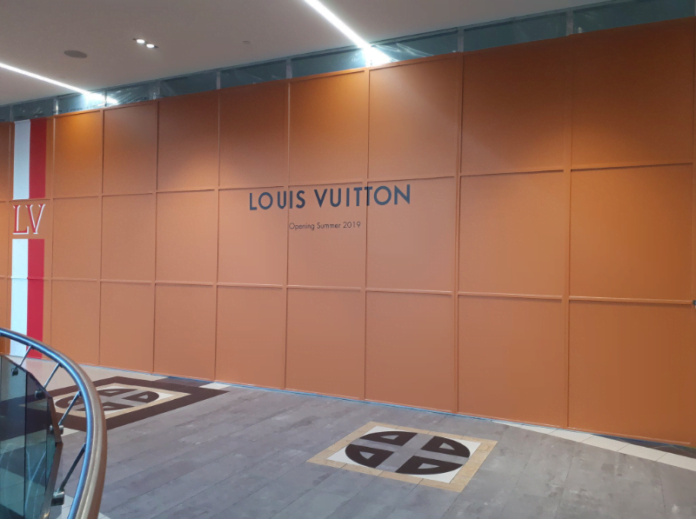
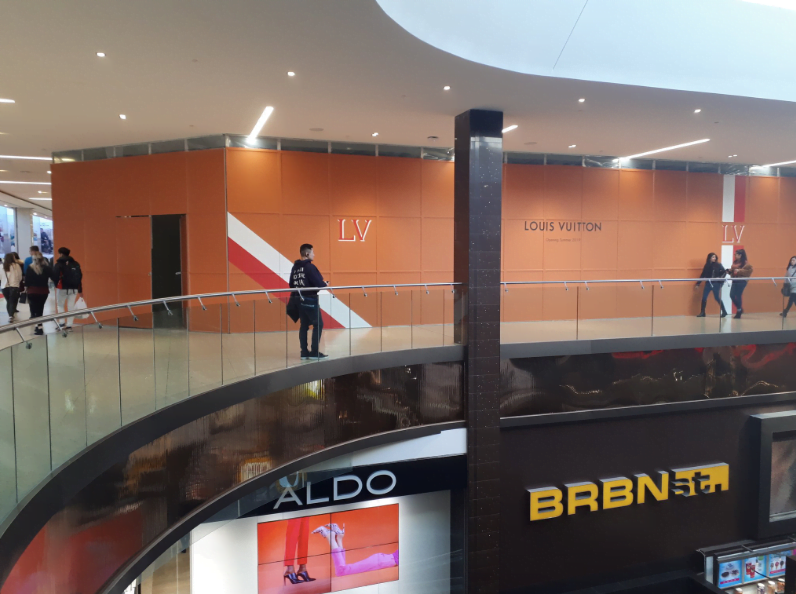
CONSTRUCTION SIGNAGE ON THE FORMER BANANA REPUBLIC SPACE AT WEST EDMONTON MALL. PHOTO: CHRISTOPHER LUI

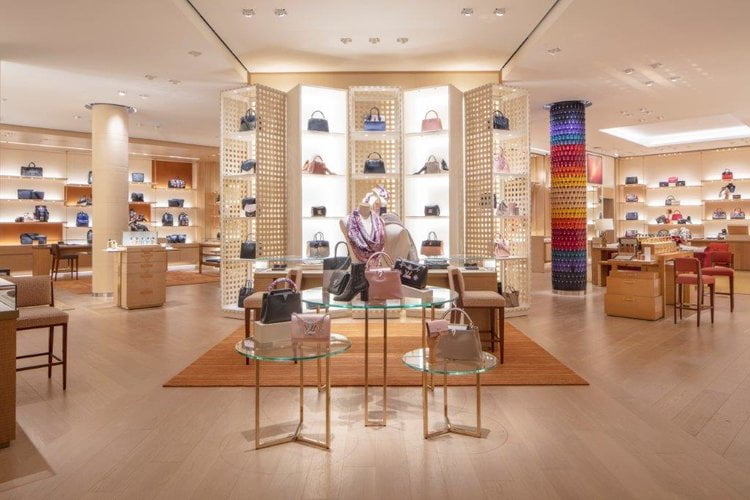
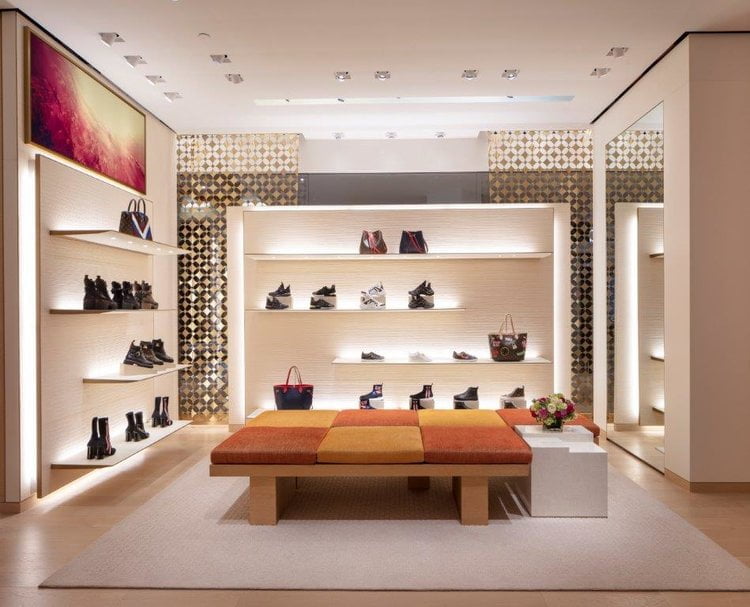
Iconic French luxury brand Louis Vuitton will open a large standalone store on the second level of West Edmonton Mall this summer, which will result in the closure of Vuitton’s downtown Edmonton boutique that has operated there for years. The move signals a shift in luxury retailing in Edmonton as brands exit the downtown core with a focus on the massive suburban shopping centre, which could eventually see a ‘Yorkdale-like’ luxury component on the mall’s second level near Tiffany & Co. and other upscale storefronts. 

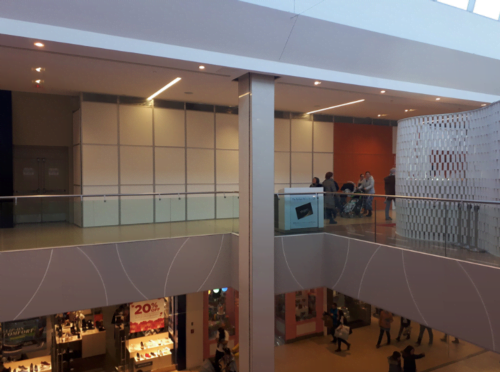
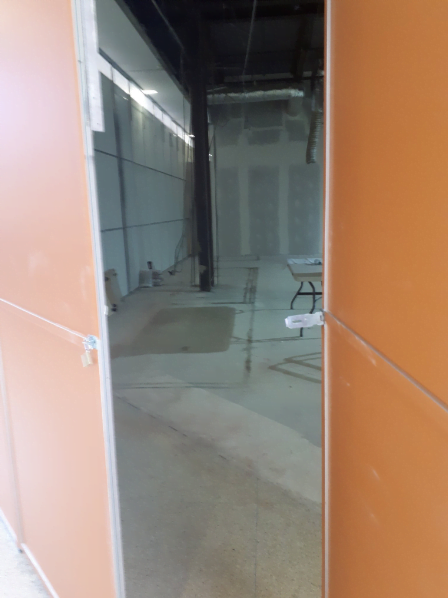
Construction hoarding went up over the mall’s former Banana Republic space a couple of weeks ago and late last week, Louis Vuitton signage was revealed. Landlord Triple Five Corporation had been in talks with Louis Vuitton for several years and proposed several locations in the mall prior to deciding on the chosen space. 

Banana Republic’s former West Edmonton Mall space spans 6,270 square feet according to lease plans, though Louis Vuitton is expected to occupy less than 5,000 square feet. The area surrounding the store has been adding upscale retailers over the past few years. Across from the new Vuitton, Tiffany & Co. opened a 3,300 square foot storefront in October of 2013, and other upscale stores followed including Kate Spade, Coach, Stuart Weitzman, Marc Cain and Michael Kors, which also unveiled Canada’s first dedicated men’s store in the mall in October of 2017. 

LOUIS VUITTON FRAGRANCE POP-UP (FAR LEFT OF PHOTO) WITH CONSTRUCTION SIGNAGE FOR NEW BOUTIQUE (TO THE RIGHT). PHOTO: CHRISTOPHER LUI

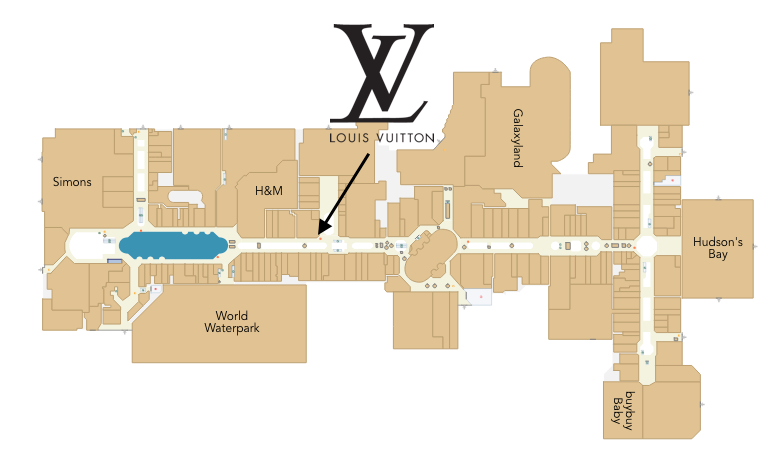
Luxury multi-brand jeweller Gemoro Goldsmith secured a space across from the new Louis Vuitton to open, among other things, a Rolex boutique as on the floor plan above. Other luxury brands are expected to follow Louis Vuitton in some of the retail spaces stretching west from Vuitton towards the mall’s H&M store. High-end brands would also be sought across the way along the Tiffany & Co. side — Tiffany itself was recently looking to expand according to sources in order to gain a more prominent facade. 

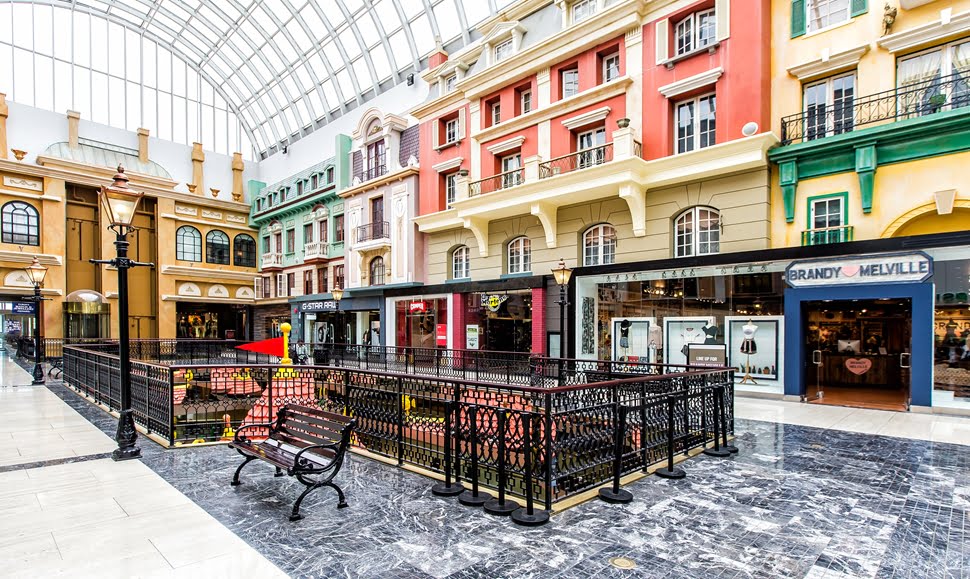
Several years ago West Edmonton Mall was considering repositioning the nearby ‘Europa Boulevard’ into a luxury avenue — Europa Boulevard is known to many for its mock-European facades in a glass-enclosed corridor that is anchored by a 126,000 square foot La Maison Simons store, which opened in October of 2012. Proposed retailers would have included some found at Toronto’s Yorkdale Shopping Centre, which boasts more luxury retailers than any mall in Canada. 

UP UNTIL RECENTLY, WEST EDMONTON MALL WAS TOYING WITH THE IDEA OF CREATING A LUXURY WING IN THE MALL’S ‘EUROPA BOULEVARD’ COMPONENT, AND LOUIS VUITTON WOULD HAVE OCCUPIED A CORNER SPACE ONCE HOUSING RETAILER ‘SCOTCH & SODA’. PHOTO: WEM INN

West Edmonton Mall is still looking to create a ‘Yorkdale-like’ luxury area though now, it would be on the mall’s highly-productive ‘main run’. According to Retail Council of Canada’s most recent Shopping Centre Study, that part of the mall boasts annual sales per square foot of $1,182 — slightly above Edmonton’s Southgate Centre which is Canada’s fifth most productive mall. Sources confirm that several of the possible luxury brands to open in the mall currently operate leased concessions at downtown Edmonton’s Holt Renfrew store or are otherwise prominent dedicated wholesale areas.

Louis Vuitton has had a presence in downtown Edmonton’s Holt Renfrew store at Manulife Place for years — it began with a small accessory counter in the early 1990’s and eventually expanded into a concession that was made possible with a minor store expansion on the main floor several years ago. Sources say that Louis Vuitton constitues about half of all retail sales at Holts in downtown Edmonton, and that its loss would be catastrophic for the store, not to mention for high-end retailers in the downtown core generally. Staff at Louis Vuitton in Edmonton said that the West Edmonton mall store will open in July, and the downtown Edmonton Holt Renfrew concession will close in December of this year. The future of Holts in Edmonton is even more uncertain now. 

PHOTO: CHRISTOPHER LUI

Downtown Edmonton’s Holt Renfrew also houses shops and concessions for brands such as Gucci, Burberry and David Yurman — all three brands are expanding their operations in Canada by opening new stores. Brands such as Canada Goose are also said to be looking to open retail spaces in the city, specifically at West Edmonton Mall. 

Several high-end retailers have recently vacated downtown Edmonton. German luxury brand Escada closed its Manulife Place store in the spring of 2018, and Birks also left soon after. Upscale multi-brand retailers continue to operate at Manulife Place including Blu’s Womenswear and upscale men’s retailer Henry Singer, the latter which is rumoured to have secured a retail space in a new downtown commercial development. 

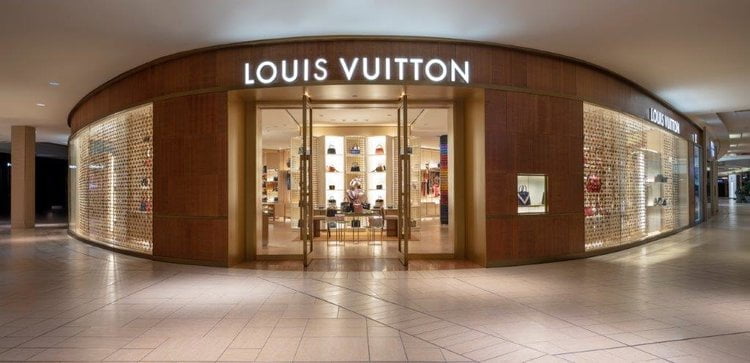
Louis Vuitton is expanding its presence significantly in Canada, including opening standalone replacement units in selected locations. In October of 2018, Louis Vuitton opened a 4,450 square foot store at CF Chinook Centre in Calgary, which replaced a smaller downtown Calgary Holt Renfrew concession that closed as a result. CF Chinook Centre is also adding new luxury retailers to create something of a ‘Yorkdale-like’ luxury wing near the mall’s Saks Fifth Avenue store, which opened a year ago this month.

Calgary’s Louis Vuitton carries an expanded assortment of leather goods and accessories as well as jewelry and footwear. It doesn’t carry ready-to-wear collections for men or women however — currently the only two Louis Vuitton stores in Canada to carry ready-to-wear include ‘Maisons’ in downtown Toronto and Vancouver. Next year another Canadian unit may carry ready-to-wear, as sources say Louis Vuitton is finalizing details to open a large store at Yorkdale Shopping Centre in Toronto. 

RECENTLY OPENED CF CHINOOK CENTRE STOREFRONT. PHOTO: COURTESY OF LOUIS VUITTON / PAUL WARCHOL

Louis Vuitton operates stores across Canada. The luxury brand opened its first Canadian store at 110 Bloor Street West in Toronto in 1983 in partnership with luxury retailer Ira Berg, spanning about 2,000 square feet. A second location opened as a concession at Holt Renfrew in downtown Vancouver in 1987 and in 1989, another concession opened inside of the Ogilvy department store in downtown Montreal. Louis Vuitton’s second standalone store in Canada opened in 1996 at the Fairmont Hotel Vancouver and in late 2010, it was expanded to 10,000 square feet, making it the first ‘Maison’ in Canada and Vuitton’s 12th globally at the time (to mark the occasion, the company spent $1.5-million on a party that included a trip on a 70-year old steam engine train). 

In Toronto the spring of 2012, Louis Vuitton vacated a 6,000 square foot flagship store at 111 Bloor Street West for an 18,000 square foot ‘Maison’ flagship location at 150 Bloor Street West where it continues to operate to this day. Louis Vuitton also operates concessions at Holt Renfrew stores in Vancouver (which was vastly expanded in  2016), Edmonton, and at two Holt Renfrew stores in Toronto (50 Bloor Street West and Yorkdale Shopping Centre). In Toronto, as well, Louis Vuitton operates a 1,200 square foot concession inside of Saks Fifth Avenue at CF Toronto Eaton Centre (it opened in February of 2016, facing the southwest corner of Queen Street West and Yonge Street) as well as a 3,200 square foot concession at Ogilvy in Montreal. 

Vuitton once also operated a 3,000 square foot store at Banff’s Cascade Plaza shopping centre which closed in the spring of 2011. 

CF CHINOOK CENTRE LOCATION INTERIOR. PHOTO: COURTESY OF LOUIS VUITTON / PAUL WARCHOL

Louis Vuitton is picking up the pace with its expansion in Canada. Last fall, it opened a men’s shop-in-store at Holt Renfrew in Vancouver, which remains one of only a handful in the world to date. That Vancouver concession marked the beginning of a significant expansion for the brand in Canada that will continue into 2020. 

Late last year, Louis Vuitton unveiled a substantially expanded concession at Holt Renfrew at 50 Bloor Street West in Toronto, spanning 2,650 square feet. Vuitton will also grow its presence at the new ‘Holt Renfrew Ogilvy’ which is under construction in Montreal

Louis Vuitton is a division of luxury conglomerate Louis Vuitton Moet Hennessy (‘LVMH Group’), which includes several leading luxury brands under its corporate umbrella. Louis Vuitton was founded by a man of the same name in 1854, and now boasts a network of nearly 500 stores globally. The company saw revenue somewhere between $9.28-billion and $11.6-billion (US dollars estimates) in 2017, placing it as either the top or second luxury brand in the world in terms of annual sales — Chanel saw sales of nearly $10-billion US dollars last year, according to the company. Italian luxury brand Gucci, which is seeing explosive growth, is expected to surpass both of them by the end of this year after seeing about $7.1-billion US dollars in revenue in 2017. 

We’ll continue to follow this story as Louis Vuitton and other luxury brands open stores at West Edmonton Mall. We’ll also follow what’s happening in downtown Edmonton, especially the future of Holt Renfrew and other retailers in the core.

Why More Canadian Mall Landlords Should Utilize Apple Maps for Customer Navigation

exc-5c60d8dcec212d3859d68234

By Larry Leung

Introduction

The shopping centre directory map has been in existence since the first enclosed climate-controlled mall was built in Edina, Minnesota in 1956. The Southdale Center had an alphabetical listing of store names by category (e.g. apparel) followed by their location in an imprecise map.  Navigating through the directory to find a store was an easier task when malls were smaller in size, however. The challenge became more enormous for time deficient customers trying to locate a store in the 3.8-million square foot West Edmonton Mall, for example.

Apple noted the navigation obstacles as an opportunity to innovate by introducing indoor mapping capacities in 2017’s iOS 11’s update for select iPhone, iPad and iPod Touch users.

Since its introduction in September 2017, many Canadian malls have jumped on board with indoor mapping. Here we explore the features Apple Maps bring to malls currently, reasons why mall operators should get on board and new ideas that can improve engagement, productivity and customer satisfaction.

Apple Maps

Coverage

While indoor mapping was added in September of 2017, it was not until August of 2018 that the first batch of 18 Canadian malls were added to Apple Maps’ coverage list. These malls, with the exception of Square One in Mississauga, are managed by Cadillac Fairview (CF). Those malls include:  

British Columbia (1)

  • CF Richmond Centre in Richmond

Alberta (2)

  • CF Chinook Centre in Calgary

  • CF Market Mall in Calgary

Manitoba (1)

  • CF Polo Park in Winnipeg

Ontario (9)

  • CF Rideau Centre in Ottawa (refer to the screenshot below for a floor map shown inside Apple Maps)

  • CF Markville in Markham

  • CF Shops at Don Mills in Toronto

  • CF Fairview Mall in Toronto

  • CF Sherway Gardens in Toronto

  • Square One in Mississauga

  • CF Lime Ridge in Hamilton

  • CF Fairview Park in Kitchener

  • CF Masonville Place in London

Québec (4)

  • CF Galeries D’Anjou in Montréal

  • CF Carrefour Laval in Laval

  • CF Promenades St-Bruno in Saint-Bruno

  • CF Fairview Pointe Claire in Pointe-Claire

New Brunswick (1)

  • CF Champlain Place in Dieppe  

While some of Canada’s largest malls have signed on to be featured on Apple Maps (West Edmonton Mall and CF Toronto Eaton Centre are recent additions), 11 of the top 20 biggest still have not participated. Those include:

British Columbia (3)

  • Metropolis at Metrotown, Vancouver

  • Park Royal, West Vancouver

  • Guildford Town Centre, Surrey

Alberta (1)

  • CrossIron Mills in Calgary

Ontario (5)

  • Bramalea City Centre in Brampton

  • Scarborough Town Centre in Toronto

  • Vaughn Mills in Vaughn

  • Oshawa Centre in Oshawa

  • Yorkdale Shopping Centre in Toronto

Québec (3)

  • Galeries de la Capitale in Québec City

  • Laurier Québec in Québec City (refer to the print screen below for a floor map shown without indoor mapping incorporated)

  • Carrefour de l’Eestrie in Sherbrooke

A side-by-side comparison of the two maps clearly shows that the one with indoor mapping completed has significantly more details of the retail elements.

Mall Indoor Maps – Five Key Features

Apple Maps allows customers to conveniently locate points within the mall at any time and avoid the need to check a physical directory or ask a guest ambassador where to go. The following is a list of five key features that make the customer experience at a mall more seamless:

  1. One stop shop for information – Most customers are unaware that the mall they are visiting may have a mobile application. With an expanded coverage and a common interface, Apple Maps makes it easy for users to shop in malls around the world without having to download another application with only generic maps.

  2. Browse shops by category (see below for an example of the categories listed) – Apple Maps improves searches by letting customers digitally locate shops by category similar to how a physical directory would function but doing it at their own leisure.

  3. Exact location – Using the iPhone’s GPS, customers can pinpoint their exact location so that they can guide themselves to another spot inside the mall. This would work even in malls with multiple levels by toggling between floors.

  4. Siri integration – Customers can activate the phone’s virtual assistant search by asking “Hey Siri, where is the closest coffee shop?”

  5. Imbedded third party application support (refer to the following example below for Starbucks) – Retailers with an application in the App Store can imbed it into Apple Maps so that customers can access them in one click. 

    Benefits For Mall Operators Gaining Access To The Apple Maps Ecosystem

Some may question why mall operators should invest in getting indoor mapping completed when the physical directory continues to achieve its goal on managing customers’ wayfinding needs. We have three key reasons why they should take notice:

1. Big user base

According to research firm DeviceAtlas, Apple’s iOS is the dominant mobile platform with nearly 60% market share in Canada for 2018. With Canadians owning over 25 million mobile devices currently, Apple’s share is approximately 15 million. That is a big user base that mall operators should not ignore.

2. Planning ahead

Just like going to a supermarket with a grocery list in hand, many customers and tourists plan ahead before they visit a mall. Centres with comprehensive indoor mapping have rich layers of information that would assist customers search and plan their retail experience earlier instead of wasting time locating a store at a physical directory. In addition, third party application integration allows for multitasking and new services (e.g. purchase ahead and pickup at the store). 

3. Digital Transformation

Mall operators and retailers are exploring ways to engage customers and improve satisfaction and sales. In combination with beacon technology, indoor mapping can assist in analyzing traffic patterns over a period of time and resolving space utilization challenges. Additionally, indoor mapping can open new ideas such as incorporating augmented reality into storefronts and gamification of the shopping experience (refer to Retailer Insider’s article on how Cadillac Fairview digitally disrupts retail with the Ravel by CF initiative).

Future Ideas

Apple Maps is playing catch up with its chief competitor Google Maps as the de facto mapping application for users. While Apple as a company has come a long way by introducing indoor mapping, implementing the following wish list items can further improve the customer experience at the mall:

  1. Extend real time end-to-end navigation inside the mall and bigger stores – Apple Maps currently provides navigation information to customers but not inside the mall unlike Google Maps does. This addition can provide customers with more accurate way finding information.

  2. Update its Maps API to include more information – Mall operators and customers alike can benefit with new fields that would highlight special events through banners (e.g. a Christmas tree lighting), sales promotions or art installations updated dramatically by the mall operator or specific store. This would improve the way Apple Maps interacts and engages with potential customers and introduces new concepts such as gamification of the shopping experience.

  3. Deeper integration with Apple and third-party applications – For customers, new shortcuts and features can allow them, for example, to make a quick reservation inside Apple Maps and show it in Calendar dramatically. For mall operators and retailers, new reporting features can provide them with increased levels of customer experience data.

    As digital transformation in the retail industry moves in a rapid pace, tools such as Apple Maps can change customer behaviours and allow mall operators to find new ways to engage and interact with higher success.

Larry Leung is a research and strategy director based in Toronto. He focuses on technology, experience creation, marketing and loyalty in the aviation and retail industries. Larry contributes blog posts for aviation consulting company Experience The Skies (www.experiencetheskies.com) and writes for Urban Toronto. Follow him on Twitter at @larrykleung. You can also email him at: lleung@experiencetheskies.com

‘The Well’ to Transform Downtown Toronto Neighbourhood

The Well Concept Art

It’s being billed as a first of its kind in Canada.

The Well in downtown Toronto is a 3.1 million-square-foot mixed-use development spread over 7.8 acres which the developers, RioCan Real Estate Investment Trust and Allied Properties Real Estate Investment Trust, say is a “bold reflection of Toronto’s energy and diversity, and an extension of the urban vibrancy of King West.”

“A place where a vibrant community thrives at the centre of it all. Through this sense of experiential energy, the spirit of Toronto comes alive,” says a marketing brochure for the massive project which will include three highrise condo towers, three apartment rental towers, one office building and retail space of about 420,000 square feet.

“To us it really is the link between the condo developments that have taken place at City Place and King Street West. It is an extension of that which links the downtown south of the Gardiner (Expressway) with the balance of King Street West,” said Jeff Ross, Senior Vice president, Leasing and Tenant Construction for RioCan.

“That whole area has obviously been going through some massive changes with the condo developments that are around it, but King Street West has never had a “centre of the community”. It’s an organic neighbourhood that extends up from what is downtown west. The Well, in our mind will be the centre, tying all of that area together.

“Because of the size and magnitude of the project, we’re going to provide a place to live, work, play, shop, eat while ensuring it’s sewn into the fabric of the existing neighbourhood. This is in no way a mall. It truly is an extension of the downtown west area.”

Bordering Front Street, Spadina Avenue and Wellington Street, The Well is at the epicentre of some of Toronto’s most vibrant areas. It is located within a short walking distance to Queen Street West, King West West, the Entertainment District, the Financial District, and the Waterfront District.

“It’s the biggest hole in the city of Toronto right now,” said Ross. “We’re starting to come up on the office podium and we will look to deliver this ultimately fall of 2021. That’s the date we’re shooting for.”

The Well also includes:

  • 1.1 million square feet of office space to house about 8,000 workers;

  • A 35,000-square-foot glass canopy atop open-air walkways enabling year-round shopping;

  • 60,000 square feet of storage space on loading dock level with 20 loading bays;

  • Thermal energy storage facility through Enwave partnership;

  • 3,000 residents in 1,700 condo and apartment units;

  • 20-foot ceilings on retail levels;

  • 40 to 60 feet wide pedestrian street style corridors and walkways;

  • 16 freight elevators to service back of house;

  • Underground parking;

  • Brick and beam inspired architecture; and

  • A curated retail mix of premium, flagship and new concept stores “for those who seek the extraordinary.”

“On the retail side, we’ve got the ability to create a place to meet, a place to be. It allows the opportunity for retailers who were otherwise having trouble fitting into what is an existing portfolio and brick and beam buildings in downtown west, to live in a curated environment where they can have a retail layout that’s more conducive to what people are looking for and gives us the opportunity to provide larger space,” said Ross.

ENWAVE NETWORK EXPANSION TO THE WELL. PHOTO: THE WELL.

“The problem is finding larger (in excess of 15,000 and 18,000 square feet) retail space anywhere in a downtown urban environment. You just don’t have those large formats available with easy access. So we have the ability to do larger format retail that is tough to find anywhere in the downtown area.”

Arlin Markowitz, senior vice president of urban retail at commercial real estate firm CBRE which is the exclusive listing agent and advisor for the retail at The Well, said the more than 400,000 square feet of retail will be a combination of food, service, entertainment and fashion – a mix of local and international retailers.

“It’s a real mix of all different types of urban retail,” he said. “It’s a purpose-built high street environment. The glass canopy protects you from the elements but you’re definitely still outside. It’s kind of a hybrid retail format that’s never existed before and I think people are going to love it.

“From a location point of view The Well is the epicentre of Toronto’s most vibrant areas . . . It’s so close to so many great things. I think locationally it’s a home run. . . It’s really a reflection of the urban vibrancy of King Street West. The architecture is something that is so important as well. The UK firm, BDP, is the mastermind behind it along with Toronto-based Adamson Associates Architects, and they are really creating something that mirrors the brick and beam and industrial look and feel of King Street West.”

“It’s going to be a one of a kind experience. It is the farthest thing from cookie cutter or a typical retail centre that we’ve ever seen in the country. What’s being built here is really phenomenal.”

The developers say residential and office developments within two kilometres of The Well include over 25,000 residential units and over 8.7 million square feet of new office/mixed-use projects to be completed in the next five years.

Ross said the anchor to The Well will be a 90,000-square-foot market hall that will be built in the lower ground floor.

“That’s going to be unique not only to Toronto but it is going to be unique to Canada. We think that is the way the new Millennials, the new demographic, wants to shop where you’ve got a market offering your daily needs that’s tied into also quick service restaurants and it’s also tied into meal replacement,” he said. “We are going to have a conventional grocery store there and this will provide that unique shopping environment for the people who live in the area.”

Five Mistakes Canadian Retail Tenants Make When Negotiating Their Lease Renewal

By Jeff Grandfield and Dale Willerton of The Lease Coach

As The Lease Coach since 1993 and co-authors of Negotiating Commercial Leases & Renewals FOR DUMMIES, we have found that retail tenants often leave a lot on the table when negotiating a commercial lease renewal. One of the biggest mistakes is assuming that everything will go smoothly. Rarely do things ever go as planned and you always have to account for Murphy’s Law. Renewing your commercial lease takes just as much time, effort, negotiating expertise and careful consideration as your initial lease – if not more! The following are just five of the most common oversights we have witnessed of retail tenants … please don’t make the same mistakes!

Allowing the Landlord to Retain Your Deposit

If your lease agreement required you to make a deposit for the initial lease term, then it is not acceptable for that deposit to continue indefinitely. Ask yourself, are you a security risk? Likely not! Have your rental payments been made on time? The Lease Coach frequently successfully negotiates for a reduced or returned deposit at this time.

Not Allowing Sufficient Time

Lease renewal negotiation should begin twelve to fifteen months before the term expires. This will give you sufficient time to look at other sites and do your homework. Remember, you are the landlord’s customer and it is the landlord’s job to re-earn your tenancy. By “shopping around”, evaluating other sites, and collecting written Offers to Lease from other landlords, you are – effectively – creating competition for your tenancy and will be more prepared to move – if need be. If you can’t get a decent renewal rate, would you rather find out you need to move with twelve weeks or twelve months left on your lease term? Time will be your ally or your enemy, depending on how you use it.

Undervaluing Your Bargaining Strength

Several factors will determine your bargaining strength with respect to negotiating a lease renewal. These include the overall vacancy rate of the building and recent tenant turnover. Your size in relation to the entire property is relevant. It’s not whether you occupy 1,000 or 5,000 square feet, but more so what percentage of the building you represent that counts – the bigger your percentage of the building you occupy the bigger the impact your vacating would have on the landlord. Your business history is also important. If you have remained a long-term tenant in the commercial property, your landlord will value your tenancy. 

Missing Out on Lease Renewal Allowances

Retail tenants often don’t consider getting a tenant allowance on their lease renewal term. Approximately 75 % of our clients get a tenant allowance on their renewals. Remember, if the landlord is giving allowances to new tenants coming in, then why shouldn’t you get an allowance too? After all, your tenancy is proven, plus there is much less risk for the landlord putting cash into your renewal than taking a chance on a new tenant. We also often get the retail tenant free rent while the renovations are being done.

Not Keeping Success Quiet

One of the main reasons a retail tenant will be forced into a rental rate increase for a renewal term is the landlord’s belief that the retail tenant can afford to pay it. The more successful your business is, the quieter you must be about that success. It’s important to stifle your staff, as they are the ones who frequently tip off the property manager that you don’t want to move. While a commercial landlord won’t accept any blame for poor performance, he/she will take credit (and rental increases) when times are good for the tenant.

Retail tenants are often at a disadvantage when negotiating (or renegotiating) with a commercial landlord. Retail tenants specialize in a specific product or service offered and customer service while landlords (and leasing agents) negotiate lease deals every day for a living. If ever in doubt, hire a professional to advocate for you, represent your best interests and to get you the best lease deal possible. Remember, in commercial leasing, retail tenants don’t get what they deserve … they get what they negotiate!

For a copy of our free CD, Leasing Do’s & Don’ts for Commercial Tenants, please e-mail your request to JeffGrandfield@TheLeaseCoach.com.

Jeff Grandfield

Jeff Grandfield is a senior consultant with The Lease Coach. Grandfield completed his honor’s degree in business administration with a designation in Marketing from Wilfrid Laurier University. It was the challenge of the real estate industry and satisfaction of working with business owners of all types and sizes that drove Grandfield to join The Lease Coach in 2005.

Dale Willerton

Dale Willerton owned a number of businesses requiring him to be a commercial tenant before getting into commercial real estate. His interest in commercial real estate led him to work for landlords as a shopping centre manager where he leased space to tenants.  In 1993, Willerton realized it wasn’t landlords who needed his help, it was tenants. Therefore, Willerton switched sides and became The Lease Coach.

Cadillac Fairview Launches Groundbreaking and Disruptive Shopping Centre Experience Initiative

exc-5c5b4d02e5e5f0051af09ffd

Cadillac Fairview is innovating with a new business entity called ‘Ravel by CF’ that will disrupt the shopping centre landscape in Canada. Operating as something of an ‘in-house tech company’, Ravel utilizes digital platforms with connected technologies and artificial intelligence to improve the overall consumer experience in the landlord’s centres, while at the same time removing ‘friction points’ that are common in busy shopping malls nationwide. Cadillac Fairview will continue to perfect Ravel as it looks to the future of shopping centres globally, and competing landlords will no doubt be taking notice.

The Ravel by CF initiative comes at a challenging time for shopping centre landlords in Canada, as retailers close stores and international brands continue to enter the already crowded market. The word ‘Ravel’ is a derivative of the word ‘unravel’ — some are saying that the industry is ‘unraveling’ and Cadillac Fairview is looking to ‘bring it back together’ with Ravel’s goal to create positive consumer experiences not currently available at other shopping centre properties.

Cadillac Fairview is an anchor investor in the new $150-million fund from Framework Venture Partners, which is a Canada-focused technology venture capital firm. About $50-million is from the Business Development Bank of Canada and another $50-million is from Cadillac Fairview, RBC and British Columbia’s BC Tech Fund.

Cadillac Fairview Executive Vice President Jose Ribau is leading the Ravel business entity which is described as being “a highly integrated operating model that both disrupts and gives support to the industry from within”. Ravel’s data-driven model is agile with the capability to capitalize on market trends, while at the same time being able to respond quickly to evolving needs of consumers, retailers and office clients.

“Ravel by CF will create an engagement platform to enhance the businesses of brands and retailers while providing a more seamless, enjoyable experience for our consumers. Our integrated model gives us a strategic advantage in the market, allowing us to be more nimble and anticipate the needs of our consumers, our retailers and the office employees in our properties,” he said.

Cadillac Fairview’s aim is to ultimately improve the retail sales conversion for its retailers. Mr. Ribau explained how the landlord has a role in helping physical stores be profitable, and Ravel is able to do that by educating consumers about retailers and products available, while at the same time removing friction points that might otherwise lead to negative consumer experiences. As a result, Cadillac Fairview malls may become preferable to those of competitors.

At a time when many consumers are choosing to shop online for convenience, Ravel seeks to bridge the gap between physical and online retail — studies show that physical retail is able to drive sales to online brands, with digital-only brands such as Frank And Oak, Indochino and Warby Parker opening physical stores with considerable success.

Ravel’s enhanced in-mall experiences include tailored services and offerings, product and retailer suggestions, better way finding in shopping centres, improvements to access such as parking and transportation, food delivery, easier payments, and anything else that might otherwise be a ‘friction point’ that could use improvement. Apps will be part of the initiative, be it third-party or those developed by Ravel as learning progresses.

One way Ravel will look to enhance the shopping experience at Cadillac Fairview malls is through product and store suggestions. For example, a shopper may be looking to buy a pair of black shoes, and suggestions of different retailers can be provided. Prior to speaking with a sales associate in any specific store, some will utilize information provided to them on their mobile device to help focus their search. Ravel also helps narrow down choices that might otherwise be overwhelming. 

Montreal-based footwear retailer Aldo is an early partner in the Ravel initiative, according to David Bensadoun, CEO of Aldo. “Our transformation to a true omni-channel retailer includes physical stores as incredible assets that drive brand equity, customer experience and data collection. We are excited to be an early partner to help shape the shopping experience of the future together with Ravel by CF,” he said.

Cadillac Fairview is already a very strong landlord in Canada. Of the top 10 most productive shopping centres in Canada as ranked by annual sales per square foot, five centres are managed by Cadillac Fairview. That’s according to Retail Council of Canada’s 2018 Canadian Shopping Centre Study which lists and analyses the country’s top 30 centres (13 of which are Cadillac Fairview properties).

Other landlords with top properties in Canada include Oxford Properties (with Yorkdale being the most productive mall in Canada), Ivanhoé Cambridge, QuadReal, and a handful of other smaller management companies. It remains to be seen what innovations these landlords might bring to the table following Cadillac Fairview’s tech-focused initiative. Oxford Properties continues to innovate with technology as well as by adding more food and beverage offerings to its malls — that includes food halls as well as full-service restaurants. Ivanhoé Cambridge and QuadReal are also upgrading their properties by brining in food halls and food markets while also continuing to upgrade and redevelop some properties . We’ll be watching Canada’s shopping centre landlords as they react to Ravel by CF — competition is fierce and over the past five years Canada’s malls have seen billions in investments, more than at any time in our history.

Canadian Company Disrupts Industry By Creating ‘World’s Toughest Pantyhose’

Sheertex Advertisement

Sheertex, the brand formerly known as Sheerly Genius, has created what it calls the world’s toughest sheer pantyhose and is poised to grow its business from its base in Muskoka, Ontario.

The company says the unbreakable pantyhose is powered by Sheertex knit, made with ballistic grade fibres often found in bullet-proof vests for sheers that last 10 times longer than typical sheer pantyhose.

“Sheertex is an apparel technology company. We have created the world’s toughest pair of pantyhose using the world’s strongest polymer,” says Natalie Catania, Sheertex’s Category Manager.

Sheertex was founded in 2017 and its factory is in Muskoka, about two hours north of Toronto. The facility is about 2,000 square feet with 11 people working for the company.

The company’s founder Katherine Homuth was a software entrepreneur who always wanted to be an entrepreneur as a teenager. ShopLocket was her first company which was an ecommerce platform.

Homuth thought we could send a man to the moon and have access to self-driving cars but why didn’t women have a pair of pantyhose they could buy that gets them through the day.

“She actually went to research the world’s strongest fibres looking . . . and she finally found a fibre that would work but it was about a thousand times too thick. There was nothing that was thin enough to be used in pantyhose,” said Catania.

After a year of research and development, the Sheertex team developed a proprietary manufacturing process built to withstand the strength of the material without compromising the wearability of the end product.

And the company was named one of TIME Magazine’s Best Inventions of 2018.

The company buys its fibre and gets it made in the U.S. It is shipped in a yarn to Muskoka where it is made into pantyhose.

“Right now we’re doing directly to customer (sales). We’re finding that’s working really well for us. It’s really, really popular to be purchasing online these days,” said Catania. “It’s really through our Shopify site online through ecomm and through Kickstarter. We do Kickstarter campaigns as well.

“We’re really, really excited to announce our Kickstarter campaign at the end of February for a new colour of pantyhose. Our customers have been asking for that for quite awhile.”

Has Sheertex thought of getting the product into retail store locations in the future?

“It’s a possibility in the future,” said Catania. “Right now our pantyhose are about $99 sold online because our fibre is super, super expensive. So there’s up to $50 worth of fibre in every pair of pantyhose compared to the pennies in the regular department store brand.

“As we grow and can get our costs down, we definitely would think about that in the future but for right now we’re going to be just selling (direct to customer) at the moment.”

The company produces and ships in batches. It is currently into its third batch.

“The reason being that our fibre has to be purchased in batches so that’s how we run it. In each batch, there’s around 500 to 1,000 pieces,” she said.

“We’re going to be coming out with new product. People should head over to Sheertex.com to pre-order their sheers and keep up with news and updates because we’re always coming out with new things. In the future, we’ll be definitely coming out with new things.”

Catania said Sheertex’s brand feels and wears like a regular department store brand but the Sheertex proprietary fibre is stain, odor and moisture resistant. It’s also cool to the touch.

“The sheers last 10x longer than a typical designer pair. Before Sheertex, women had two options when it came to pantyhose: thick tights that may last but are made for the temperatures you’d find in the North Pole or a disposable pair of sheers that typically lasts one to two wears,” says the company.

“You don’t have to trade function for fashion anymore. The proprietary fibre is stain, odor and moisture resistant; it’s cool to the touch while still allowing for complete comfort and support. Sheertex pantyhose are crafted with reinforced seams, an invisible waistband and a control top. They flatter and hug the curves of all body types. Plus, the Sheertex knit is self-healing, meaning that in most cases when the knit gets pulled out of place it can be manipulated back into place without any fear of rips or runs.”

Sheertex ships to the United States, Canada, Mexico, Oceania and Europe.

Former David’s Tea Head Launches Upscale Spice Brand with 1st Standalone Retail Unit

Image: Kanel Spices

A new company specializing in gourmet spice blends, called Kanel Spices, has opened its first retail location in Montreal as well as an online store, and has big plans for growth across a variety of different distribution channels.

Kanel offers a range of spice blends and sea salts that aim to provide an easy way for customers to make flavourful meals. Examples include Summer Black Truffle Salt, Smoked Chorizo Rub, Organic Sunday Roast, Organic Louisiana Fried Chicken, and the most popular blend, Sweet & Smoky Salmon.

Kanel’s founder, Kim Wiseman, came up with the concept after having her two kids and finding that she had little time to prepare meals.

“I couldn’t help but notice the lack of taste, freshness and the abundance of fillers in the average spice blend,” says Wiseman, who was previously head of store operations with David’s Tea. “I just saw an opportunity that would make my life and the lives of many others easier and more delicious.”

Kanel opened its first physical location, a kiosk, at CF Carrefour Laval in November 2018. The kiosk model is ideal for Kanel, Wiseman says, since it provides an open-concept space where customers can interact with the products.

“We were inspired by the experience found in food markets from around the world, so we designed the kiosk to allow customers to freely touch, taste and smell our blends,” she says. “The space is totally open concept so we mingle with our customers without barriers, and all of our transactions are cashless and completed on iPads.”

The design of the kiosk mimics the design of Kanel’s product packaging: clean and uncluttered, and primarily black and white. Wiseman says that although there can be a stigma around retail kiosks, she views it as a model with lots of potential for Kanel.

“We really are trying to ‘premiumize’ the whole kiosk experience,” she says. “At this time, we aren’t looking at in-line stores. We really like the way the kiosk model is so open. So, we’re going to keep working in that direction for now.”

Kanel is exploring potential new locations in Quebec and Eastern Ontario in 2019, with a focus on high traffic malls. The kiosks require between 100-150 square feet. In addition, Wiseman says she is interested in exploring other types of locations, such as spaces within food halls that are emerging across the country. The company is also considering distribution partnerships with specialty grocery stores.

“We see opportunity across Canada, and maybe beyond!” she says. “As we grow, we would like to continue to build a fully omnichannel experience for our customers, elevating their shopping experience.”

Wiseman plans to leverage the e-commerce channel to engage customers on a different level, by providing product recommendations and recipe suggestions based on each customer’s individual purchase history. In addition, she intends to enable users to share feedback, recipes and reviews with other shoppers through the online platform. “Nothing beats user-generated content in the food arena,” she says.

Kanel targets a broad demographic with its products, according to Wiseman.

“We like to think about our market in terms of lifestyle: our customer is someone who loves great flavor and quality ingredients,” she says. “We have created a product that is for everyone from kitchen novices to chefs and beyond.”

Kanel uses all natural ingredients, and follows a rigorous process for developing new blends. “We expertly balance different notes and taste profiles, and use the freshest herbs and spices to bring the boldest flavours possible,” says Wiseman. She says her team tests many different variations before deciding on the best ones.

“We tried over 500 blends to launch this collection of 17,” she says.

The company is currently preparing to launch three new blends, and plans to continuously add to and refine its collection of products.

“There’s a lot of seasonality to it,” Wiseman says, noting that the selection of products will likely shift throughout the year, featuring more barbeque options in the summer and flavours like pumpkin spice and apple pie in the fall months. She says there’s also potential for Kanel to expand from spices into products such as drinks and flavoured oils.

The company strives to be as green as possible in its operations, including using packaging that is compostable and recyclable. “We’re very environmentally focused,” Wiseman says.

‘Roll Up The Rim To Win’ Needs an Environmental Reboot

PHOTO: TROY MEDIA MARKETPLACE

The entire “Roll up the Rim” campaign rests on the physicality of the cup itself. Almost 300 million cups are produced for the campaign, which usually ends in mid-April. Some winners have been required to send in the entire cup to claim their prize, instead of just ripping off the tab. But to redeem any prize, a cup is required, which is something tangible.

But packaging is on everyone’s mind these days. Hardly a day goes by without a story on plastics, garbage, or unsustainable practices in food retailing. In 1986, when Tim Horton’s Roll up the Rim campaign started, cities were still a few years away from launching recycling programs. Today, not only are food retailers and restaurant outlets under watch, Tim Horton’s has been targeted specifically as one the largest generators of garbage that ends up on Canadian seashores, alongside McDonald’s, PepsiCo, Coca Cola, and Nestle.

What is different now is how society values the concept of the circular economy. A company, any company, will remain responsible for the product it sells, from the initial transaction between the consumer and retailer to when all materials have eventually been repurposed, in one way or another. No waste, no pollution — only positive and desirable results, from a sustainable perspective. But even the slightest disregard for the environment will break the cycle of sustainability. Everyone cares about the environment, it seems, until life gets in the way. Time constraints, carelessness, laziness — many things can prevent proper disposal of products once they get into consumers’ hands. But gradually, companies are being held partially responsible for the garbage left in a parking lot, a stadium, on a beach or in a school yard. Times are changing. But the Roll Up The Rim To Win campaign is not.

A group of Calgary-based students, Mya Chau, Eve Helman and Ben Duthie, have amassed over 100,000 signatures to encourage Tim Horton’s to bring the entire campaign online. Another Albertan tried the same thing in 2016. Digitizing the promotion is being proposed by these groups so that customers can then bring in their own reusable cups to Tim’s, in order to reduce waste. A noble objective indeed. For Tim Horton’s though, such a shift would fundamentally change the nature of what the campaign is all about. There would no longer be conversations among friends or co-workers, with their cups of Tim’s coffee, waiting to see if anyone has won a car, cash, or simply another coffee. The campaign strategy worked and got many Canadians hooked. And sales at Tim Horton’s during the mid-winter months magically soared and customers kept coming back.

But it’s 2019, and the argument that increased profit justifies the means carries less weight than it did in 1986. It’s not just about increasing sales or getting customers on board. A promotional campaign is now, perhaps more than ever, about making people feel better. Buying countless paper cups with plastic lids isn’t acceptable anymore, especially for younger customers, specifically Generation Z and Millennials. That would be anyone under the age of 39, which accounts for more than 40% of the population. Demographic pressures are real. Not only does this age group value the environment, their economic clout is increasing. What’s more, they mostly see the internet, or apps, as a viable, easy alternative to any physical aspects of a marketing campaign. They believe that if the technology exists, why not use it? Some less tech-savvy customers may feel disenfranchised by a shift to an online campaign, but Tim Horton’s could risk losing more customers by sticking to past practices. Starbucks and other chains are making changes, so expectations are shifting rapidly.

Simply put, Canada’s love affair with Roll Up The Rim To Win needs to be modernized. It was nice while it lasted, but Canadians are expecting restaurant chains to embrace the circular economy, and that includes Tim Horton’s.